Pictures that belong to no paper
Seventeen renders from the closing sessions of the programme
Read these as a workbench
This site is a record of a workbench, not a record of finished results. Rigorous standards were applied to the arXiv paper alone. Nothing printed anywhere in this project rests on any picture below, and several of them record a correction rather than a result.
These seventeen pictures were made in the last weeks of the programme, in the register the first three papers built: the partial sums of a Dirichlet series drawn as a walk in the plane, and the shapes that walk makes near a zero. Almost all of them were made because the author looked at the moving object and said what he saw, and the picture is the answer to that sentence.
None of them is a figure of any paper. They were never promoted, never captioned into a paper's visual companion, and no claim printed anywhere in this project rests on one of them. Several of them record a correction rather than a result — a measurement made from the wrong point, a structure aliased away by drawing every two-hundredth term, an answer given to a different question than the one asked. Those are kept here in the state they were made, because that is what this site is for.
The captions say what each picture shows. Where a picture carries a ceiling — a statement of what it cannot be evidence for — the ceiling is printed with it rather than left off.
Three further renders exist and are not shown: earlier versions of the skeleton pair and of the tether panels, superseded by the ones below and identical in intent. Nothing else was left out.
Undoing the analytic continuation
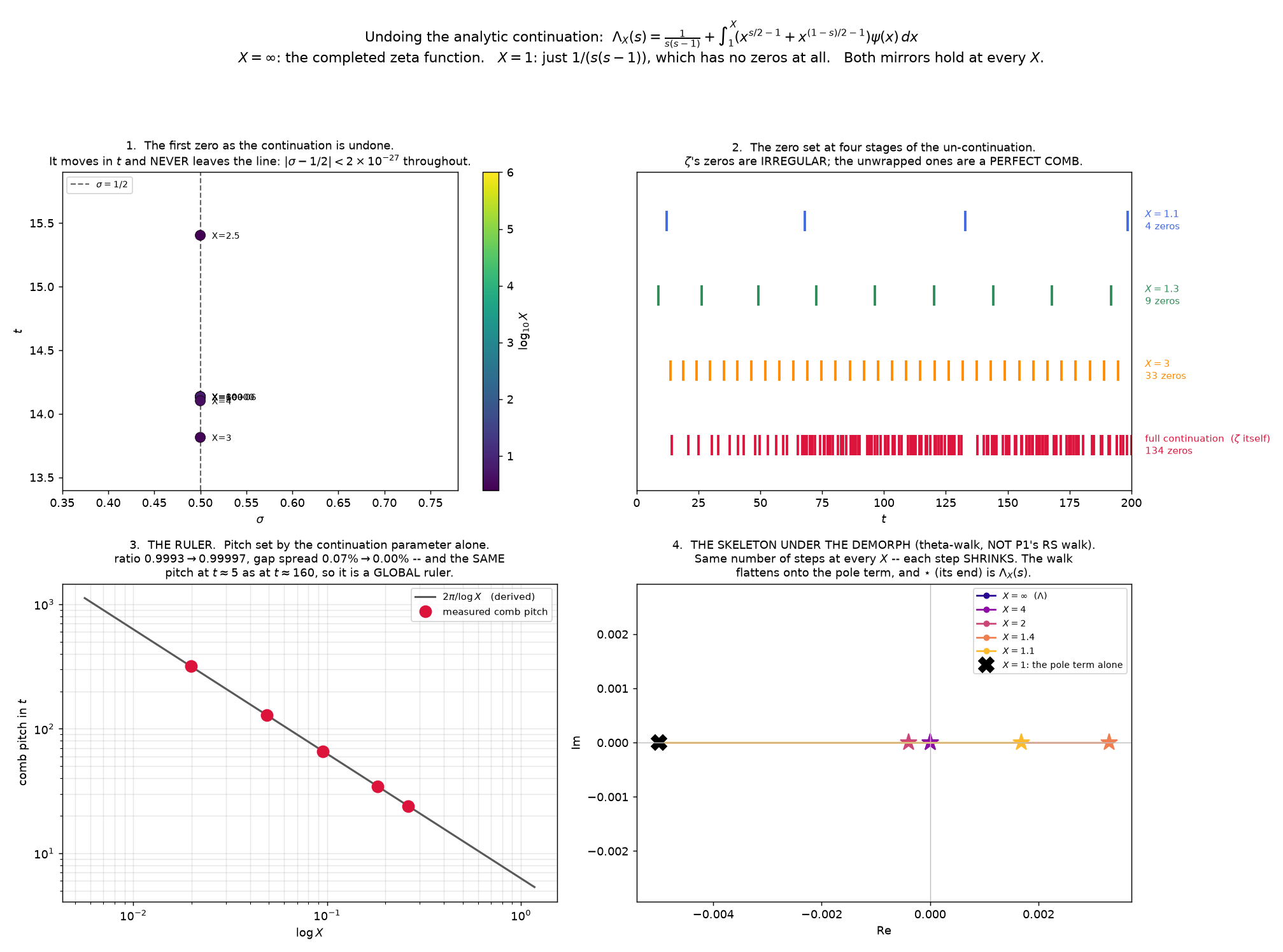
Four panels. The first zero watched as the continuation is undone — it never leaves the line. The zero set at four stages, the irregular zeros of ζ against a uniform comb. The ruler law, with the comb's pitch at 2π/log X. And the walk itself, drawn, which is what the question behind the picture was actually about.
The spikes on the counterexample's arm
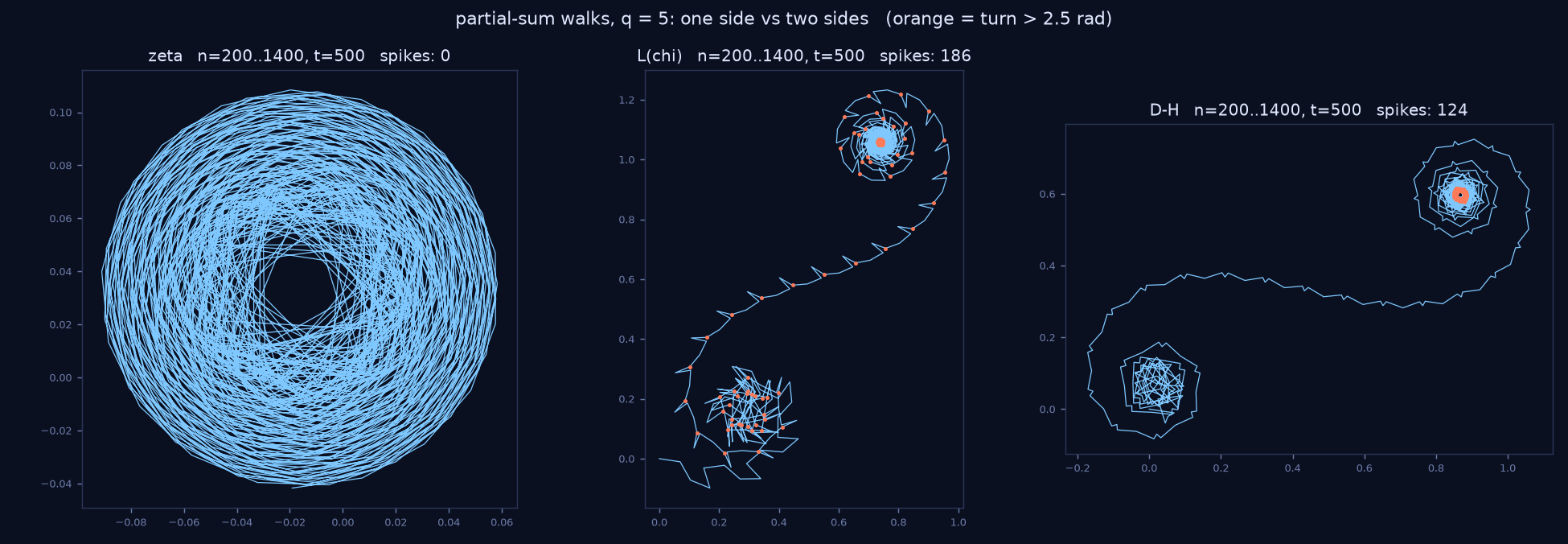
The claim tested here was the author's, made from a screenshot of the walk: that the spikes along the arm are artefacts of overlaid mirrored rectangles — an eight-spike star. The picture asks two things of it, and the second is the one that could have refuted him: are the spikes real and periodic, and does a control object show them too. Conductor 5.
The skeleton, normalised
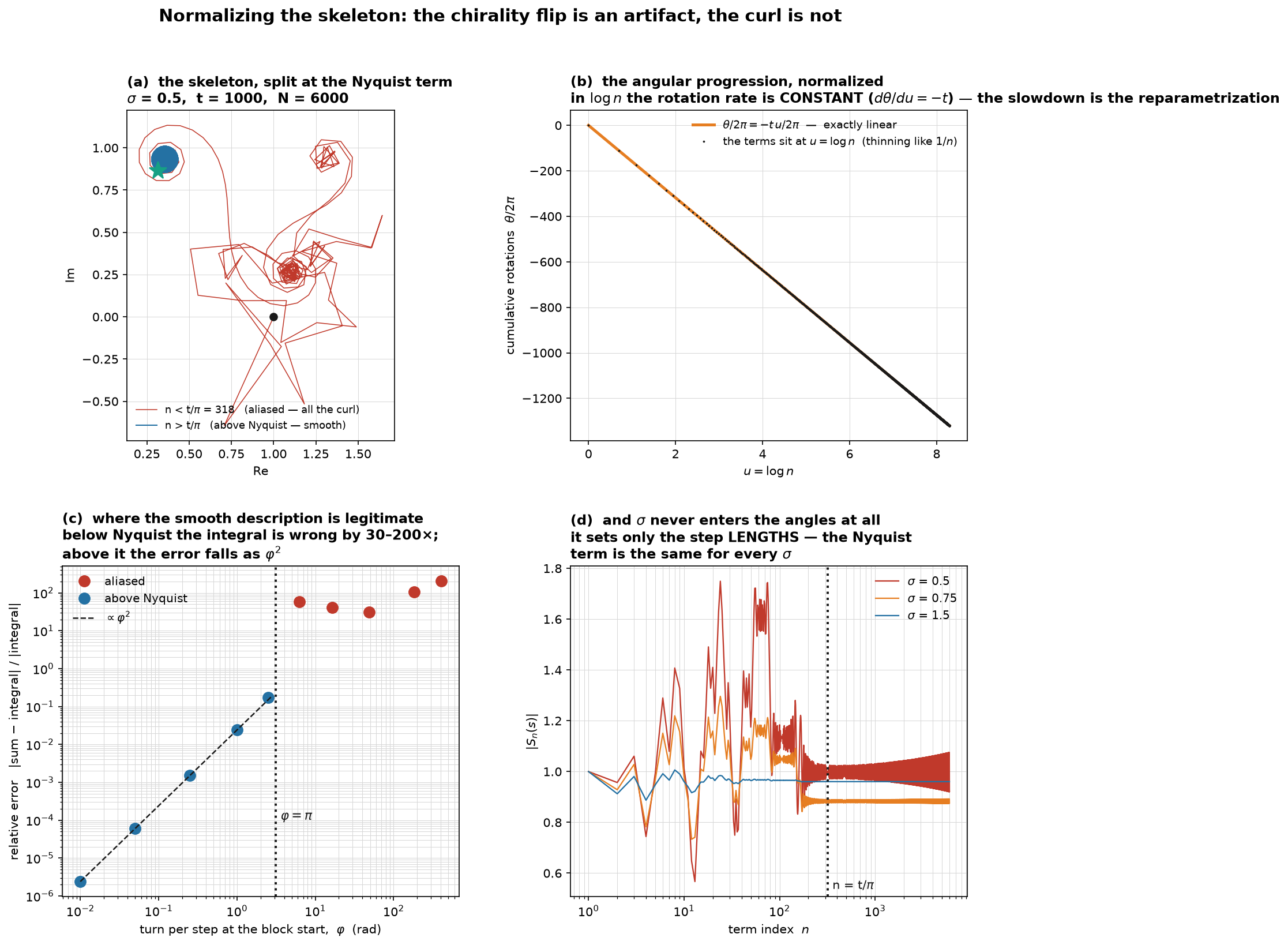
Every step rescaled to unit length with its direction untouched, for four objects at one height in one window: ζ, a complex character of order 4, a real character as the control, and the counterexample. The decay in the step lengths is what makes the walk a spiral, so removing it leaves the skeleton.
The walk is split at the term where the turn per step passes π. Below it lies all of the curl; above it a smooth spiral. The finding printed on the picture is that the chirality flip is an artefact of the rescaling and the curl is not. Two further panels: measured in log n the rotation rate is exactly constant, so the apparent slowdown is a reparametrisation and nothing else; and σ never enters the angles at all — it sets only the step lengths, so the term where the split happens is the same for every σ.
This is the picture that prompted this page.
The turn only ever shrinks
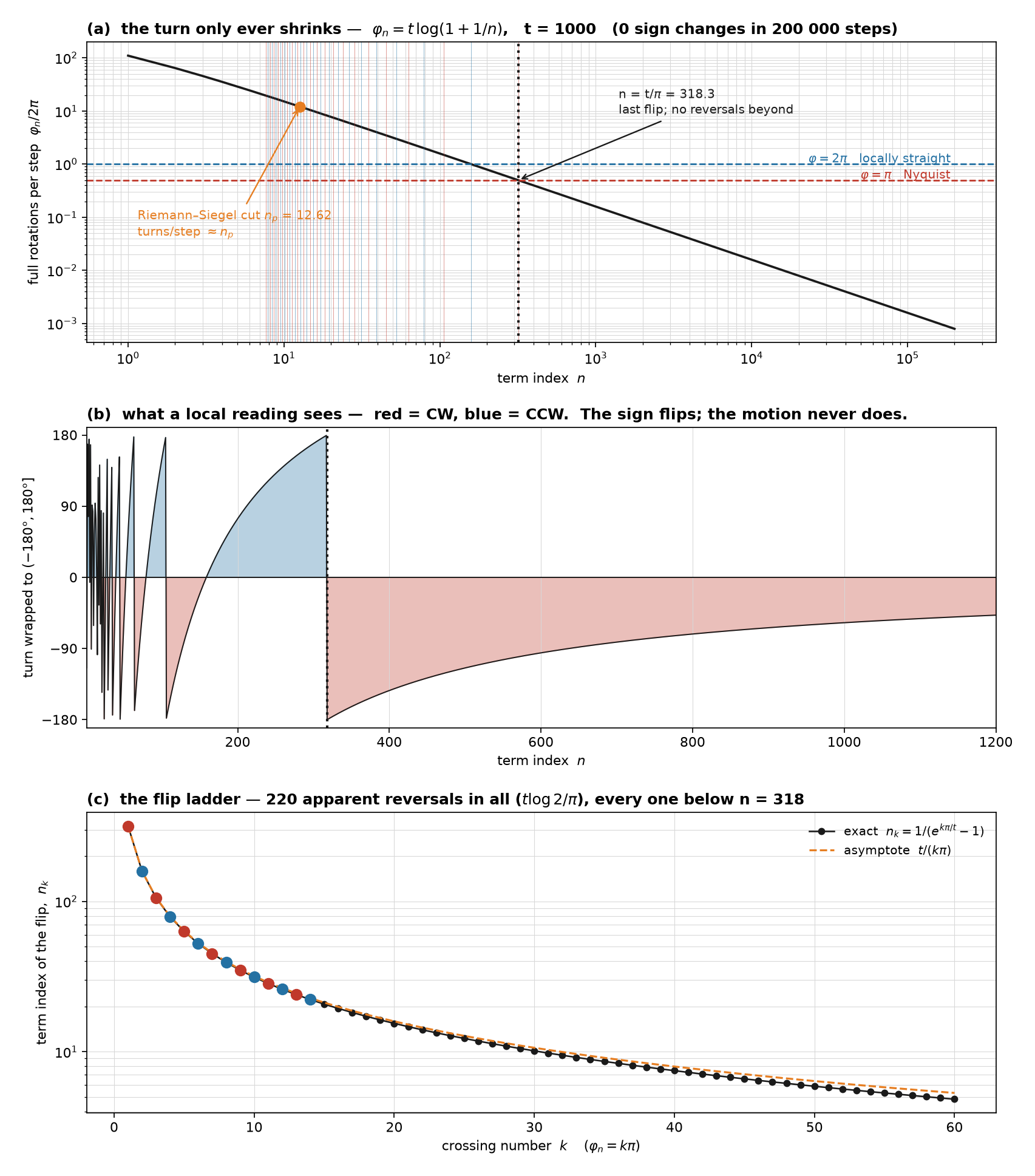
The same objects, asking what a local reading of the walk actually sees. The turn per step falls monotonically and never reverses. What a local reading sees instead is the sign flipping — 220 apparent reversals in all, every one of them below term 318, and beyond that nothing flips again. The sign flips; the motion never does.
The capture events
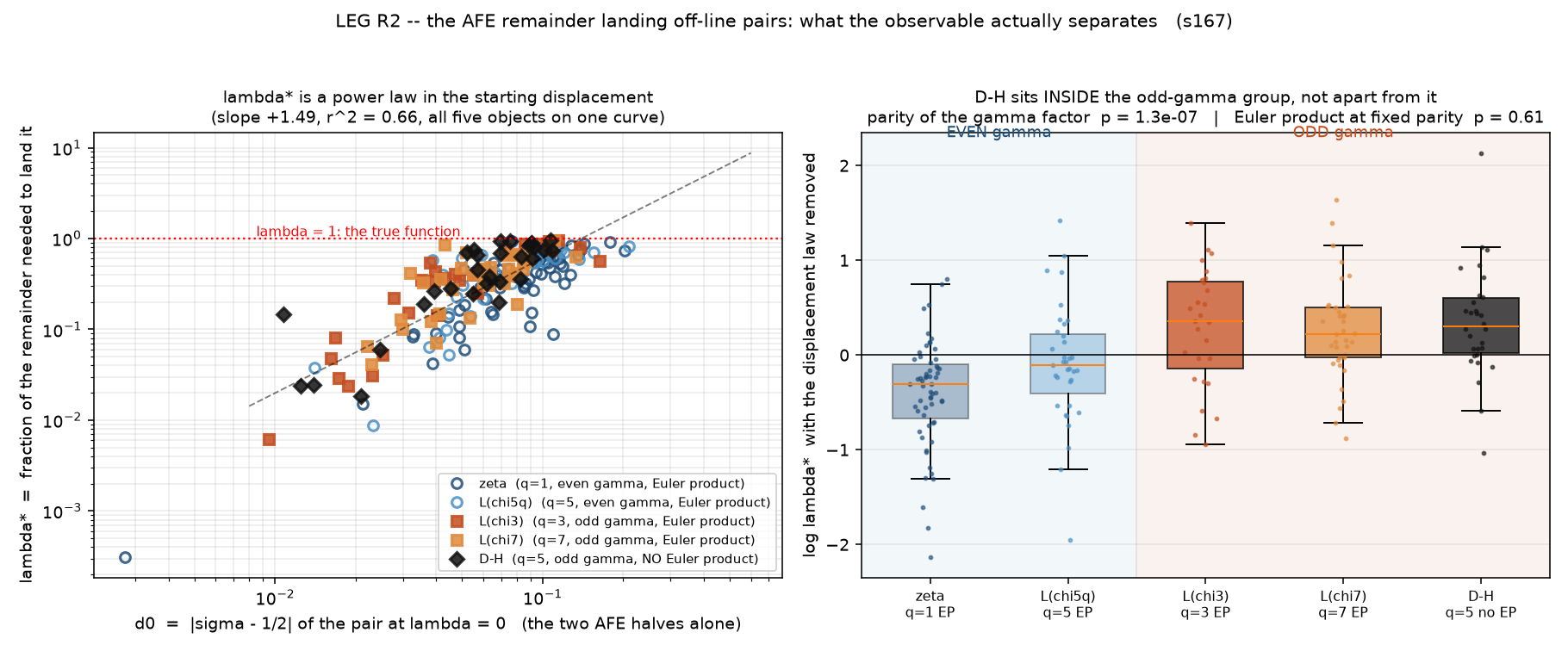
A pair of zeros that merges and leaves the critical line as a parameter is varied, tracked across heights and truncations with the counterexample as the control. The quantity plotted is how much of the remainder is still unspent at the moment an off-line pair lands on the line.
This is the deformation picture, and it is a different object from the static near-collision statistic of the ninth paper — that paper's negative result is explicit that it does not touch this.
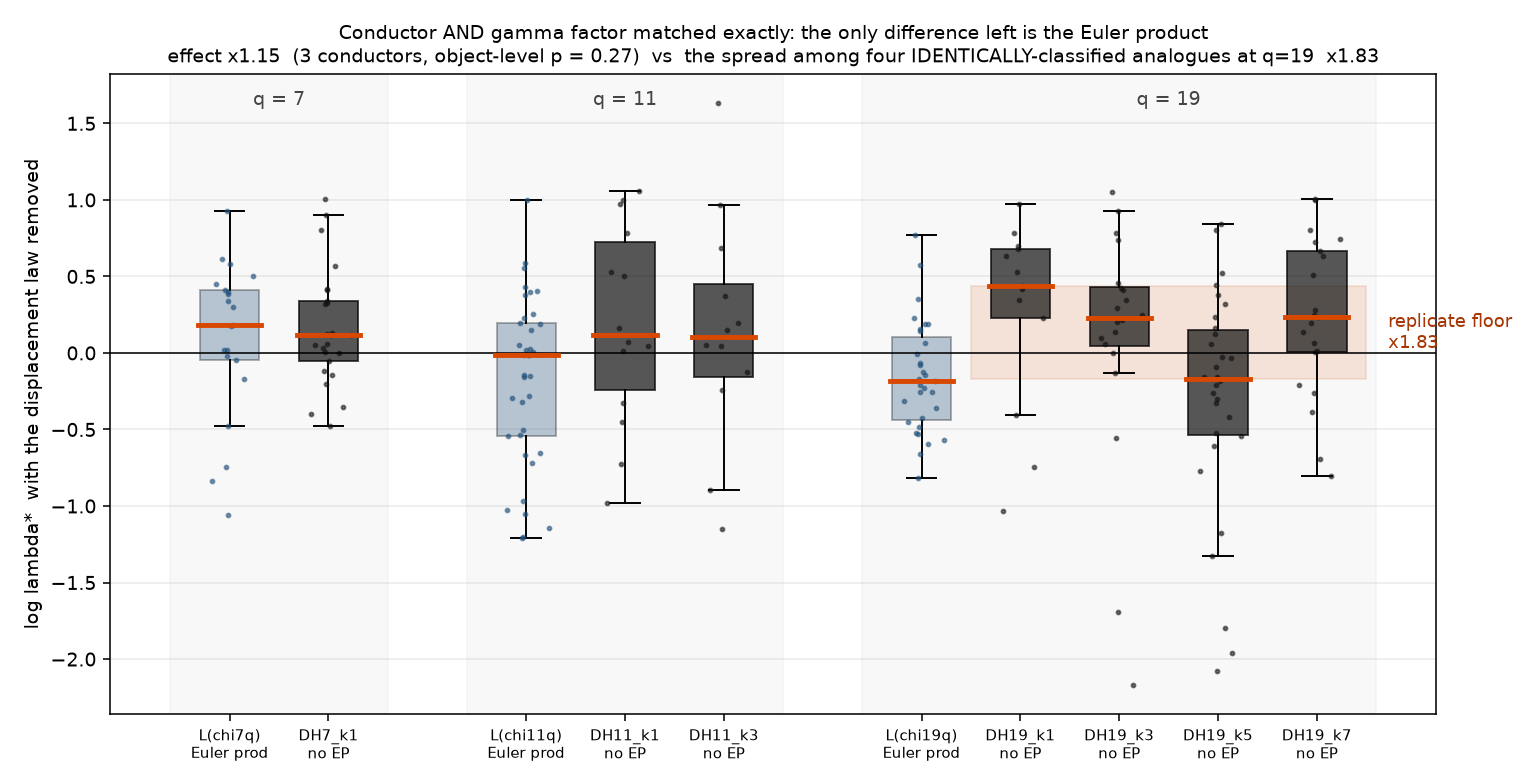
The falsifier, with the conductor matched exactly
The previous control held the gamma factor's parity fixed and let the conductor float, comparing the conductor-5 counterexample against Euler products at conductors 3 and 7. That brackets the conductor without matching it — and the conductor itself turned out to carry a signal among the Euler products, so it was live noise inside the very comparison it was meant to clean. This is the same test with the conductor matched exactly and the objects paired.
The tether
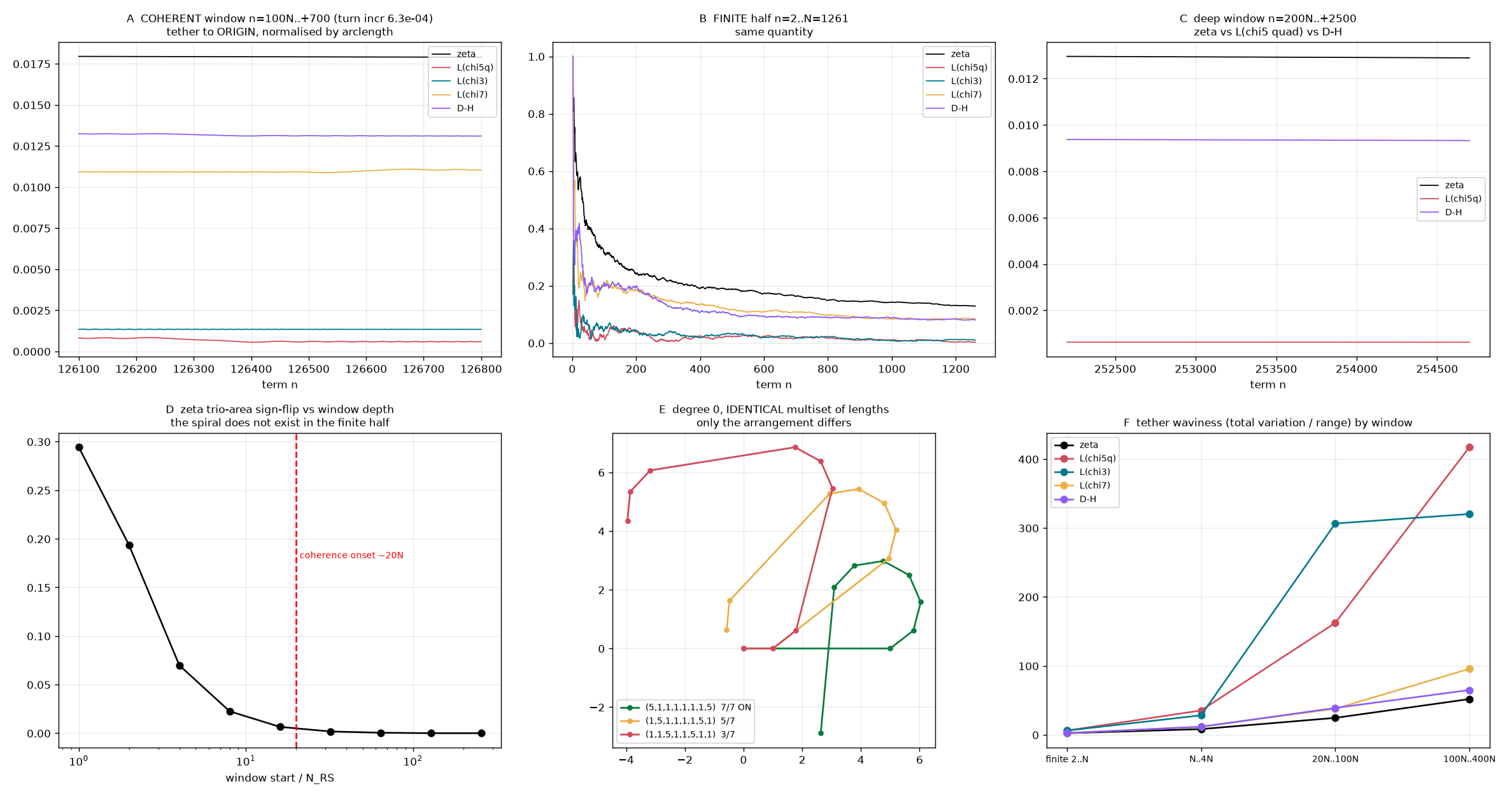
Six panels on the vector from the origin to the partial sum. The tether normalised by arc length, in a coherent deep window, in the finite half, and deeper again. The depth at which the spiral begins to exist at all — about twenty times the Riemann–Siegel cut, before which it simply is not there. A degree-0 object drawn three ways from an identical multiset of step lengths, where only the arrangement differs. And the waviness of each tether, window by window.
The tether term-length function
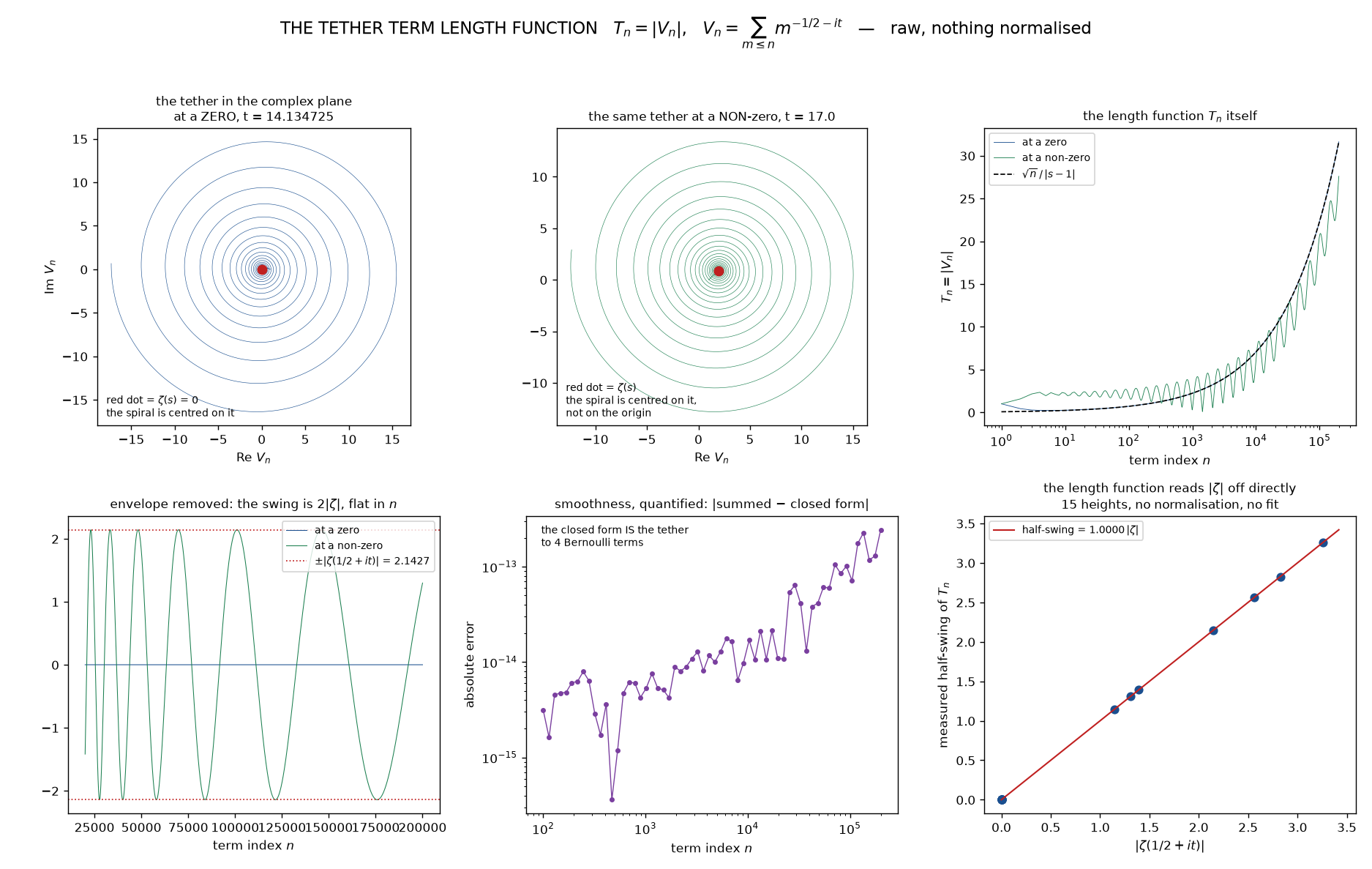
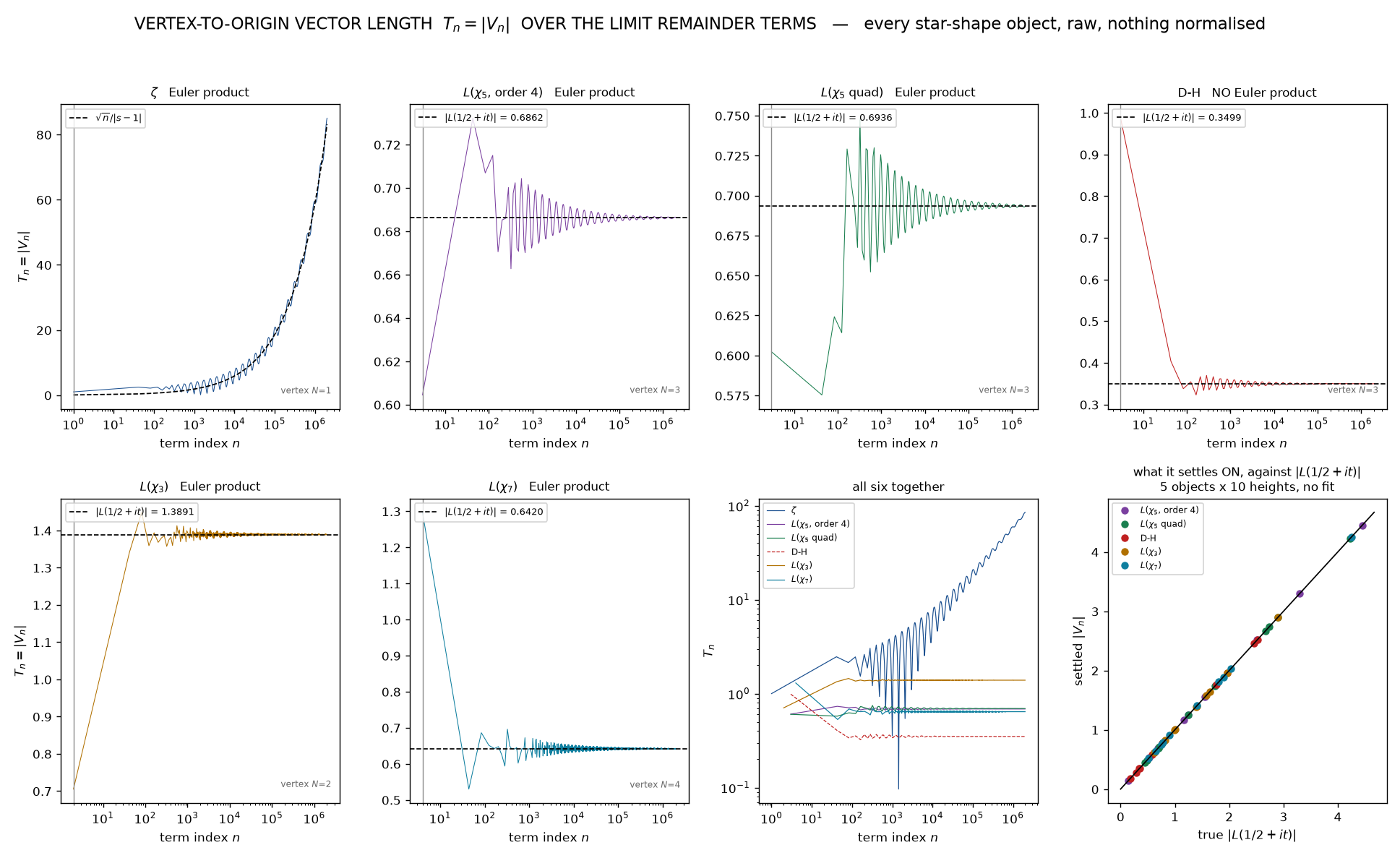
Built from one sentence of the author's: that the tethers of the terms taking part in locating the limit axis are perfectly smooth in the complex plane, without needing to be normalised at all. The picture builds exactly that function — the distance from the origin to the partial sum, as a function of the term index, raw, with nothing divided by anything — and builds nothing else. No object comparison, no coefficient statistic, no summary number.
Vertex-to-origin length, over the limit remainder
The same length for every object this line has a star shape for. The length settles, and what it settles on is the modulus of the L-function at that height: 50 readings across several heights, worst absolute error 4.8e−09.
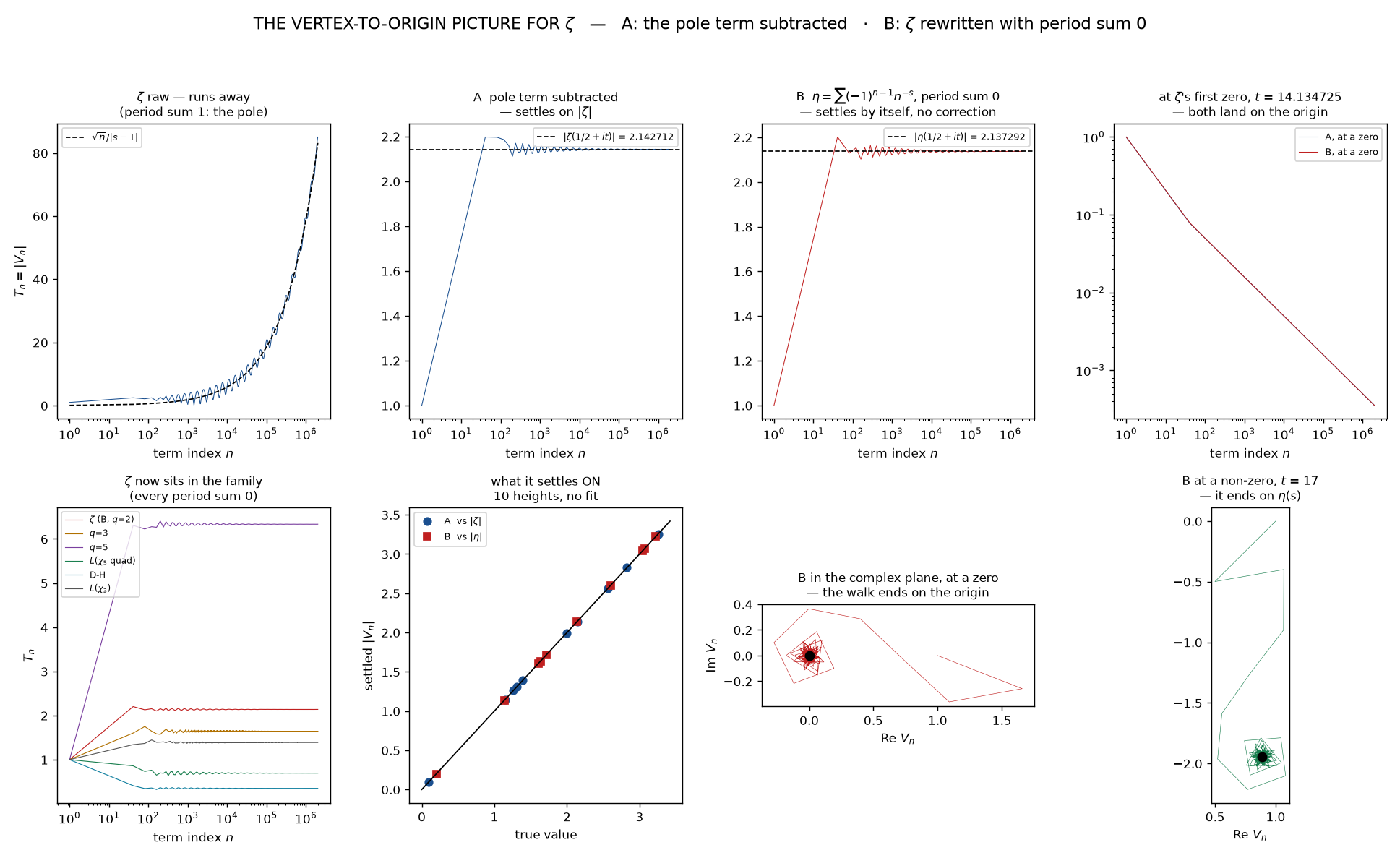
The same picture for ζ
ζ is the one object whose length runs away instead of settling, and the picture names the reason: it is the only one of them whose coefficients do not sum to zero over a period. That surplus is its pole.
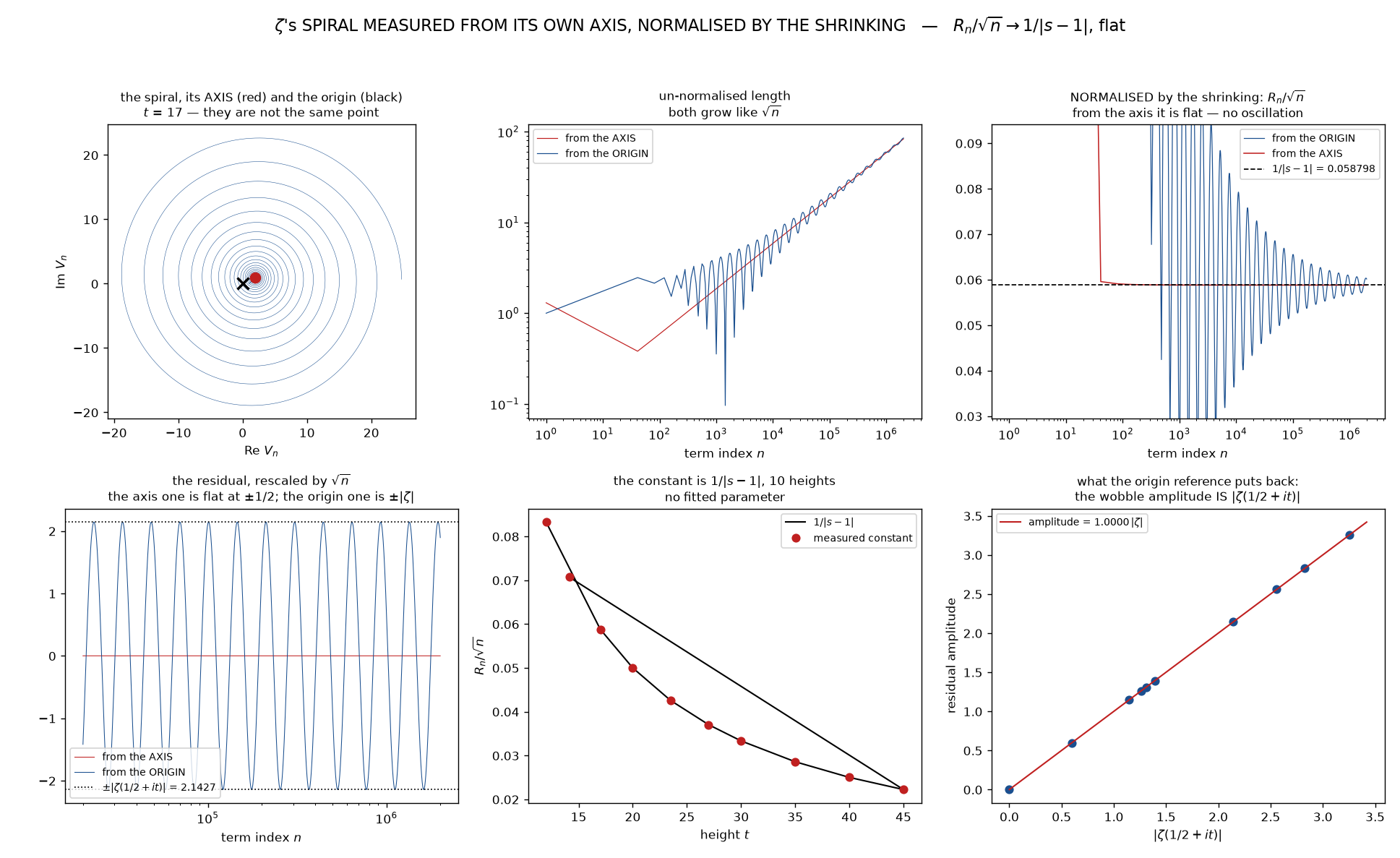
ζ's spiral measured from its own axis
Measured from the axis rather than from the origin, and normalised by the logarithmic shrinking. It is a correction: the figures before it had measured from the wrong point, and the near-constant length the author expected only appears once the measurement is taken where he was taking it.
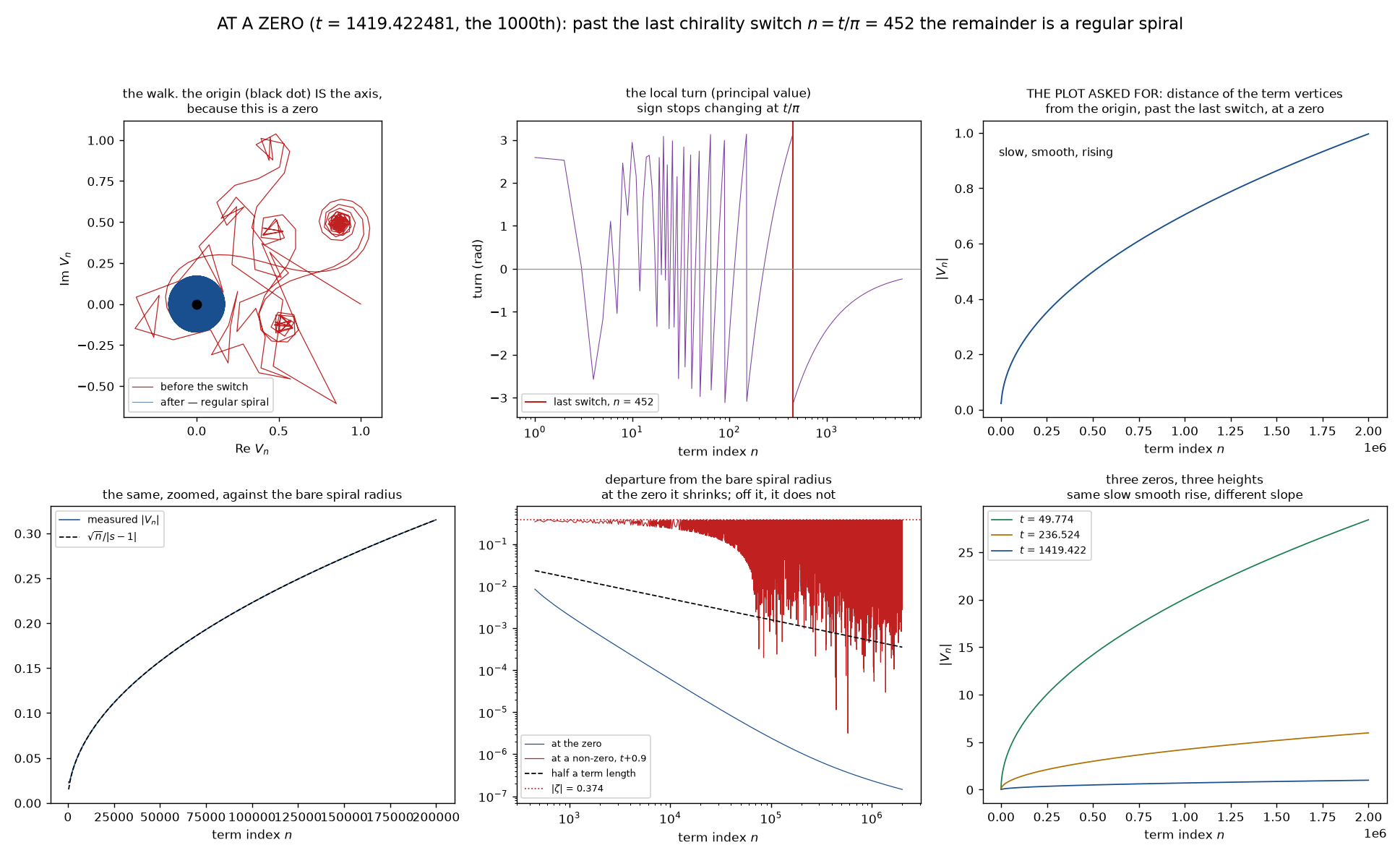
At a zero
Past the last chirality switch the remainder is a regular spiral, and the distance of the term vertices from the origin is the slow, smooth, rising curve. The panels also separate the two cases that matter: measured against the bare spiral radius the departure shrinks at a zero and does not shrink off one.
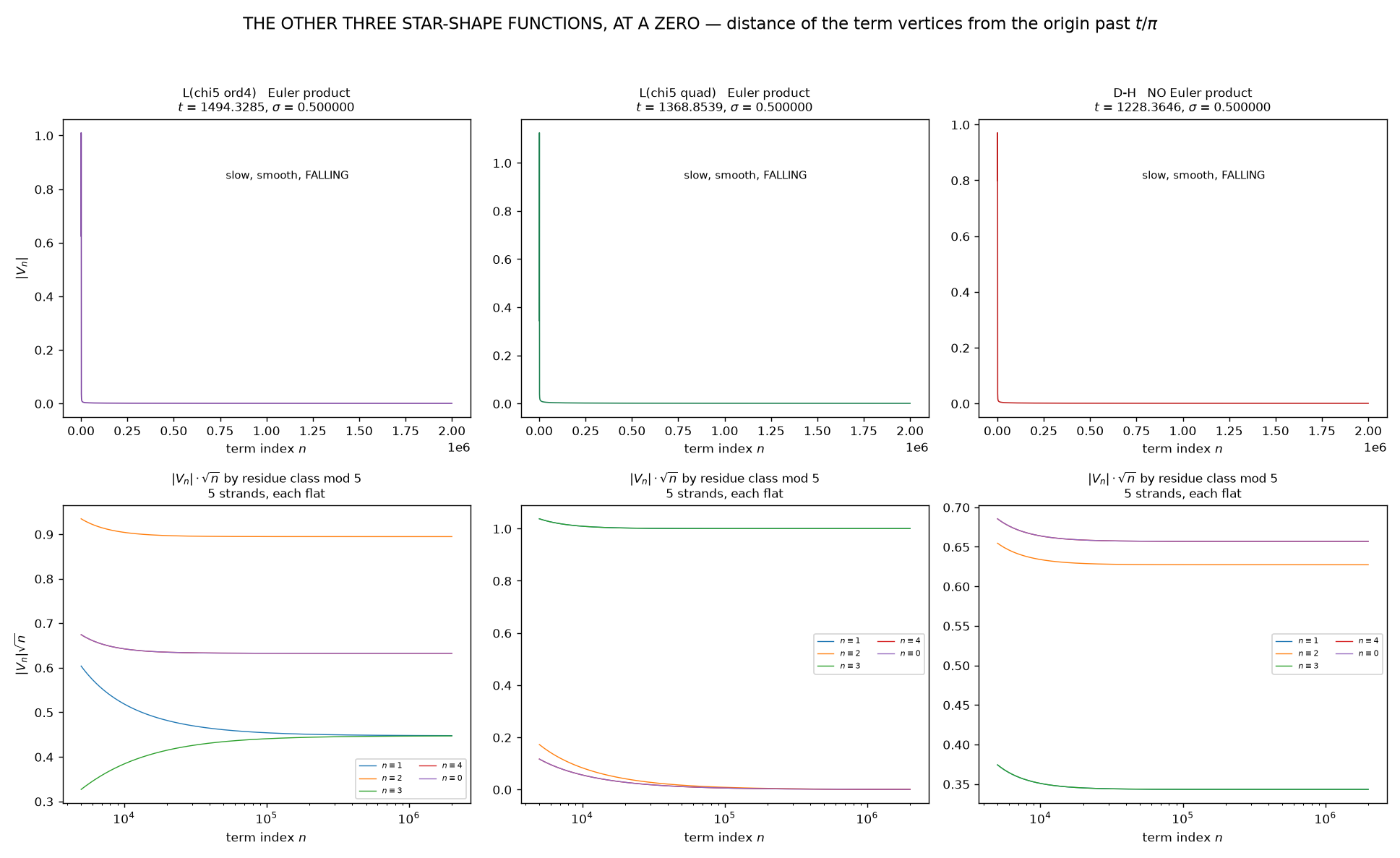
The other three star-shape functions, at a zero
The same measurement in the same order for the three objects beside ζ — a complex character of order 4, a real character, and the counterexample, the last of which has two distinct segment lengths rather than one. The falling law holds off the critical line as well as on it, with exponent 1−σ in place of ½.
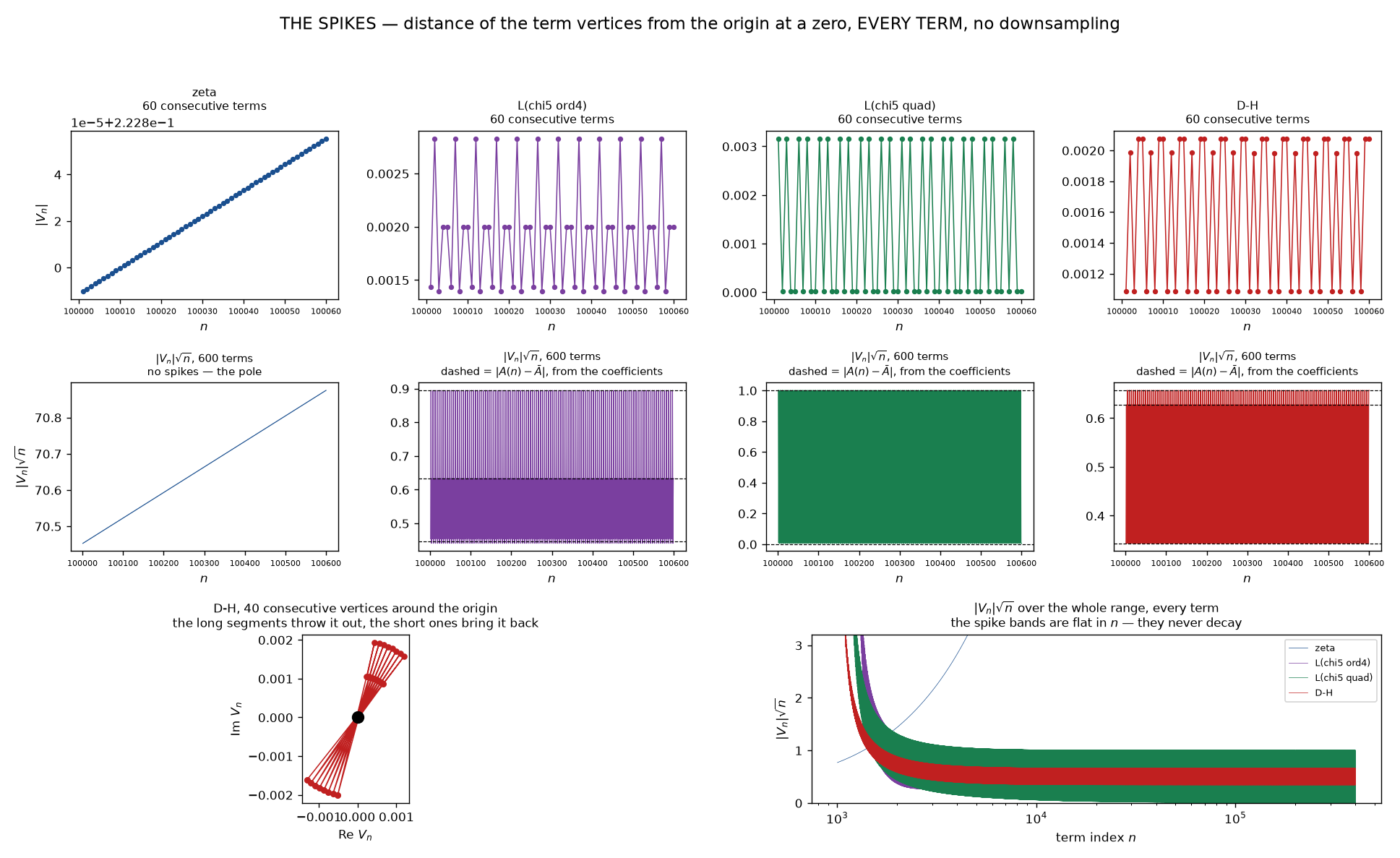
The spikes, every term, no downsampling
A correction to the picture above it. That one plotted every two-hundredth term, and the structure being asked about has period 5 — it had been aliased away, and the author caught it. Here every term is drawn.
The picture also carries a correction against its own earlier reading, printed on it rather than quietly fixed: one of the objects has three distinct strand heights, not four. The two classes that read as different are equal, and they converge more slowly than the others — a convergence drift had been read as a distinction.
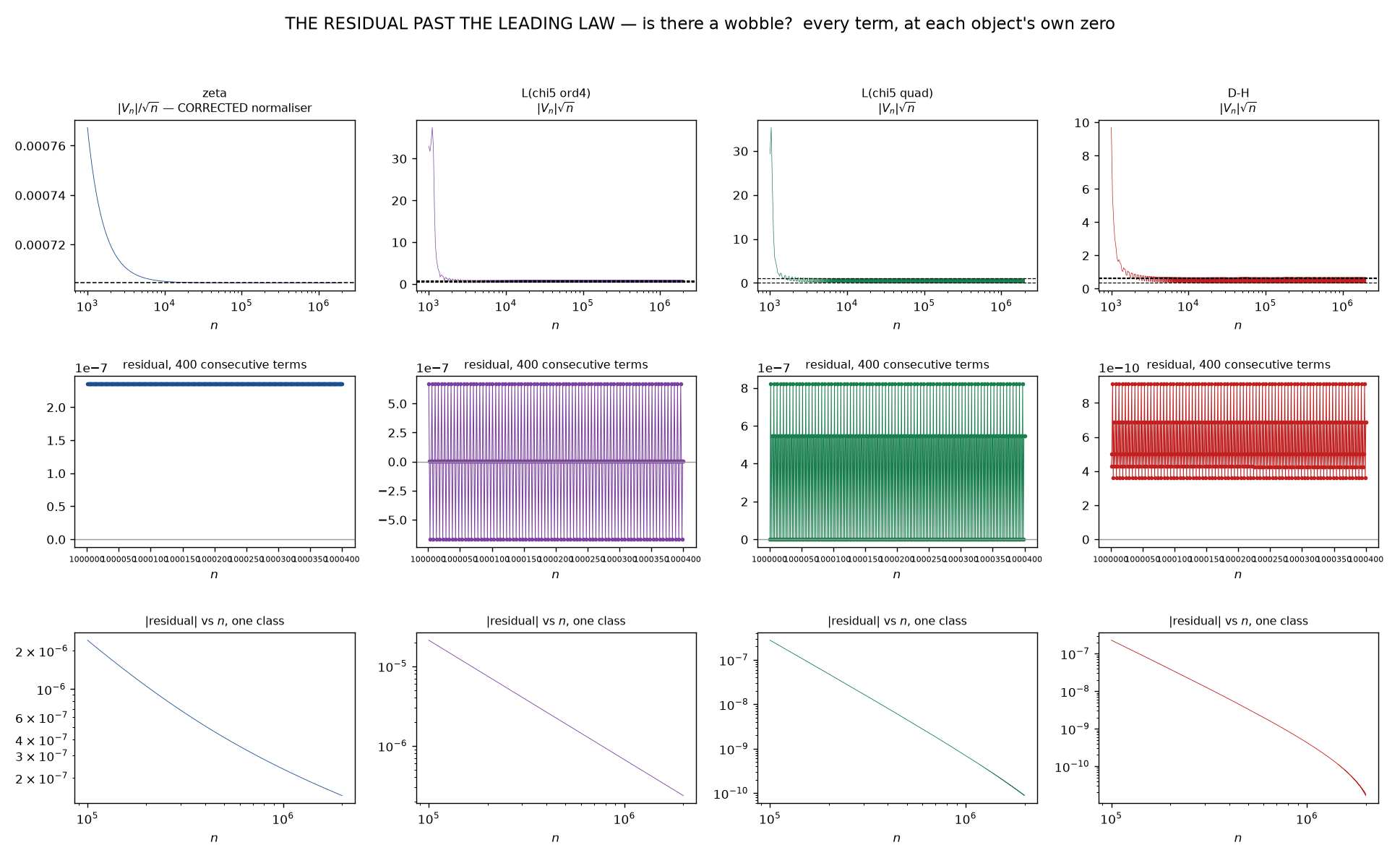
Is there a wobble?
Past the leading law, is there anything left moving, and if so does it oscillate or does it drift smoothly? Asked of all four objects, at their own zeros, at every term.
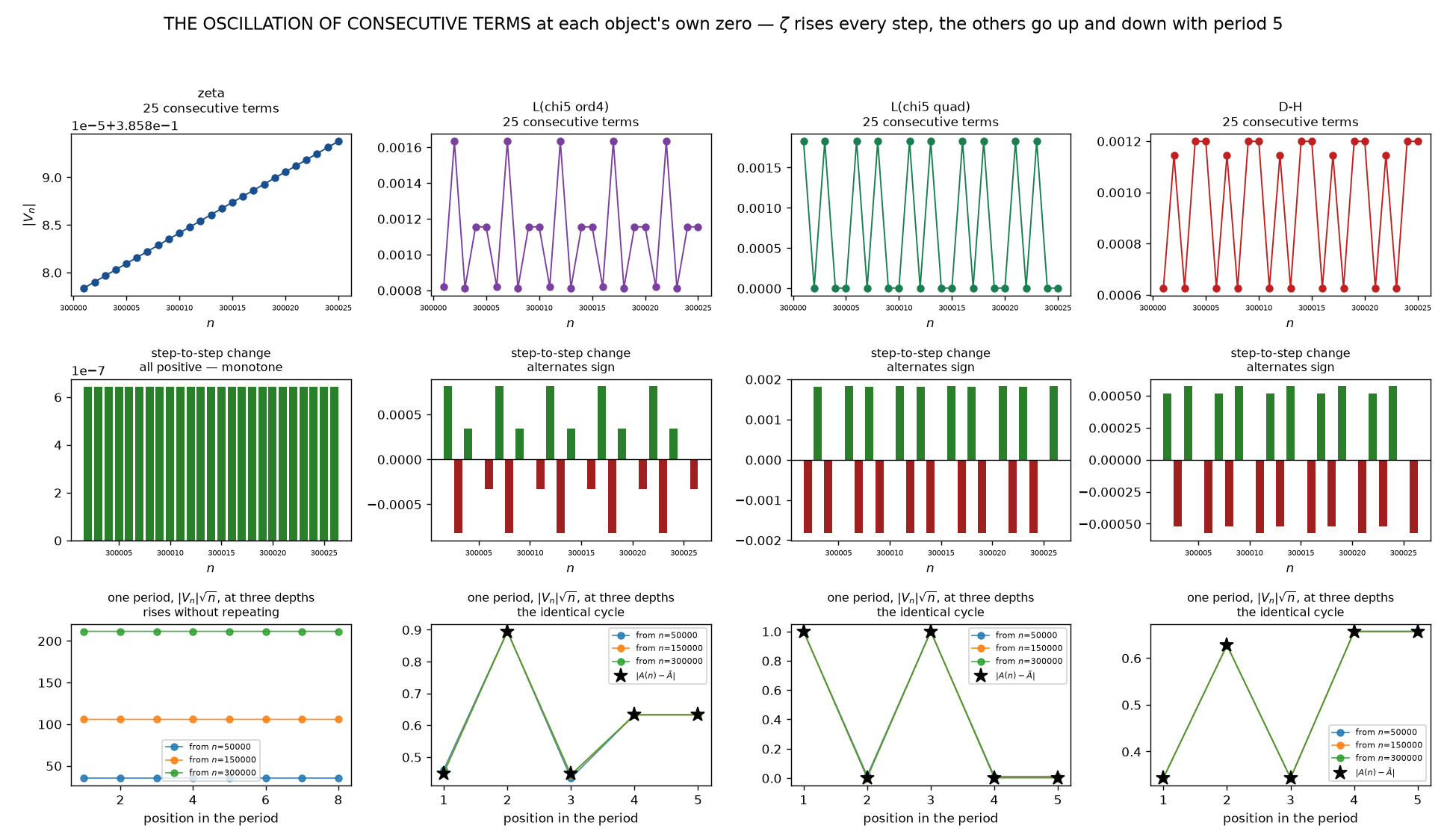
The oscillation itself
The question the picture above answered was not the question that had been asked. The author's own words were that at ζ the consecutive terms lie on a straight line and at every other object they go up and down — and the previous answer had removed the period-q law first and then reported that no oscillation was left, which is a different statement entirely. The law removed was the oscillation.
So this picture draws it. The oscillation is the running partial sums of the coefficient list, and nothing more.
Its ceiling, printed with it. This is a property of the coefficient list, so it cannot on its own separate ζ from the rest at degree 1 without reducing to the hypothesis itself. What it does separate is ζ from every object whose coefficients sum to zero over a period — and that is the pole again, not the Euler product. The counterexample sits with the characters here, on the same side as the objects that keep every zero on the line.
The circle
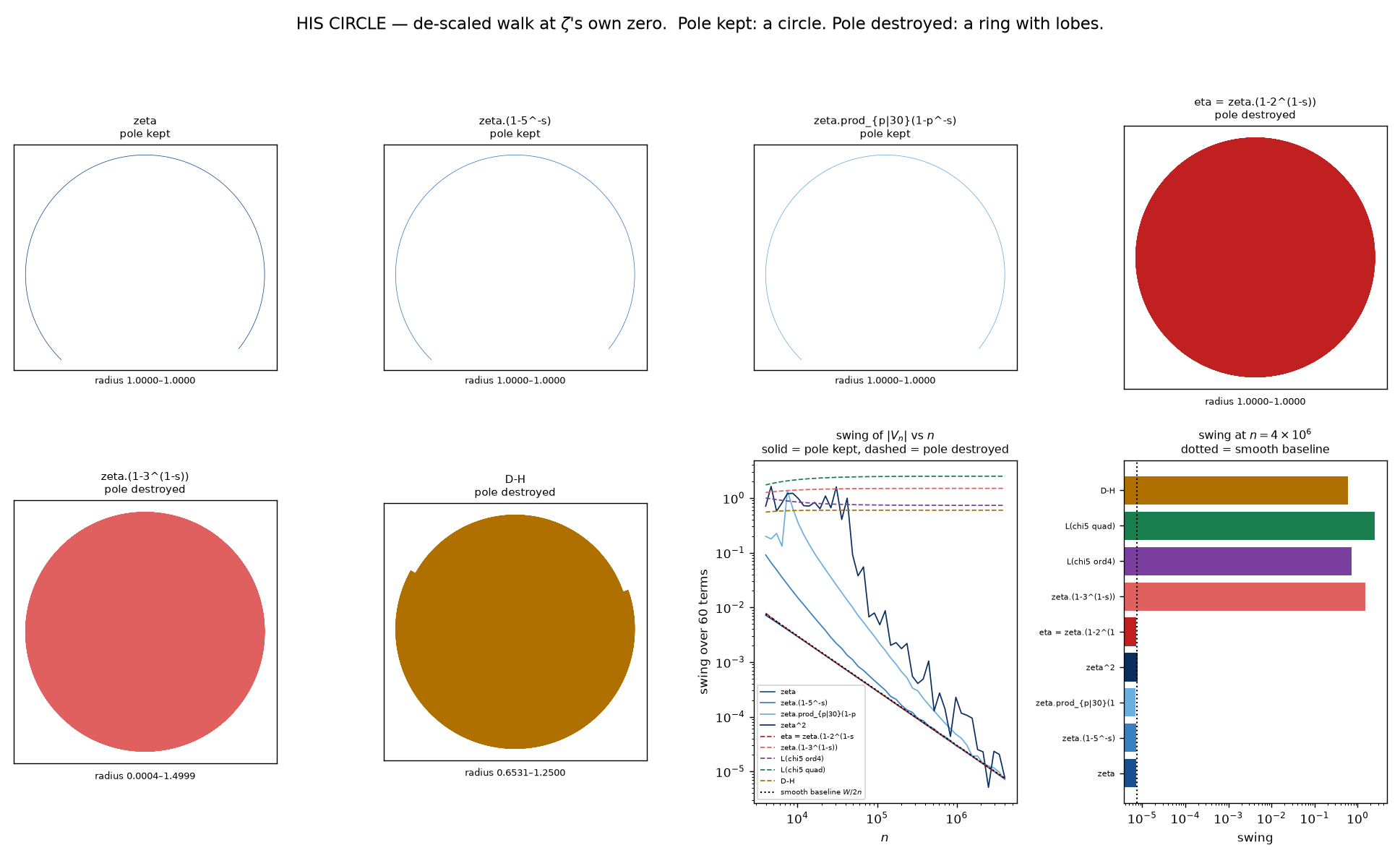
The author's conjecture, in his own words: that ζ is the natural expression of the smoothness of the primes and everything else is a deviation from it, as though ζ were π drawing a perfect circle and the other objects were drawing ellipses.
The picture runs the test that conjecture actually asks for, which is not ζ against unrelated L-functions — it is ζ against objects that share its zeros exactly and differ elsewhere. The result is on the face of it: with the pole kept, the de-scaled walk at ζ's own zero is a circle. With the pole destroyed, it is a ring with lobes.
Its ceiling, printed with it. Having a pole is a property of the coefficient list, and at degree 1 with a functional equation the only objects that have one are ζ and its shifts — so "smooth if and only if ζ" reduces to the hypothesis before it is measured. What the picture is worth is as a description: it says exactly which deformation destroys the smoothness, and it says that moving the zeros does not.