The Wall Runs at the Euler Product
An Exhaustive Census of Ten Dirichlet L-Functions, the Class That Provably Cannot Keep Its Zeros, and the Near-Collision Picture That Both Refute
A draft, and the only one here. Both sides of the Euler-product boundary measured by one instrument over one range: 71,271 zeros on the critical line, 1,140 missing from the matched counterexample — and a finite test on the coefficient list that tells the two classes apart before a single zero is computed.
Read this as a workbench
This site is a record of a workbench, not a record of finished results. Rigorous standards were applied to the arXiv paper alone. The paper below is the project's own text, complete — including the negative results, the priority concessions and the errata.
The Wall Runs at the Euler Product
An exhaustive census — 71,271 zeros of ten Dirichlet L-functions, none of them off the critical line; the exact sense in which the Davenport–Heilbronn class is different; and the near-collision picture that both refute
O. Dvořák. Paper 9, 2026-08-08.
⚠ THIS PAPER IS A DRAFT, AND IT IS THE ONLY DRAFT ON THIS SITE. The other papers here are finished work. This one has been revised exactly once, against one independent read-and-check pass, which found a false mathematical statement in chapter 2, one positioning gap, and seven numbers that did not match the runs behind them. All of those are repaired below and the repairs are printed rather than absorbed. It has had no further refereeing. Read it as a working manuscript. It does not use the series name. This is not a packet-centroid paper — different register, different objects, and the series name would misdescribe it.
AI assistance: Large language models were used for computation, proof drafting, proof checking, literature consultation, cross-verification, editing, and manuscript preparation. The mathematical arguments were drafted and checked by these models, including repeated blind refereeing by independent model instances; the author has not independently verified every proof. The author originated and directed the research programme, made the methodological and editorial decisions, reviewed the manuscript, and accepts responsibility for presenting this material. The work is written so that every claim can be checked from what is printed and deposited, without trust in either the author or the models.
Record of work: These files are a record of work, not a record of results. They include measurements that were later corrected, conjectures that were refuted, and observations that have never been checked against the literature. Every claim is marked with which of those it is.
Abstract
At degree 1 with periodic coefficients, a Riemann-type functional equation constrains a coefficient list to an eigenspace of the finite Fourier transform, and inside that eigenspace having a degree-1 Euler product is exactly the condition of being a single Dirichlet character. The complementary objects are the Davenport–Heilbronn class, for which off-line zeros are not conjectural but forced — Davenport–Heilbronn 1936 for the original object, and Saias–Weingartner 2009 for the periodic class, in the strong form of a positive proportion of zeros in every strip strictly inside (½, 1+η). We give a finite residue test that certifies the hypothesis of that theorem for a given coefficient list, and verify it for every non-multiplicative object used here.
We then measure both sides of the boundary with one instrument. A count deficit between sign changes of the real Hardy-type function and the smooth total-zero formula — Turing's method in lightweight form — steps down permanently by 2 for each mirror pair that leaves the critical line, at any distance from it. Applied to ten Euler products it returns 71,271 zeros, every one on the critical line (five objects to height 10⁴, five more including four complex characters to height 2000). Applied through identical code to three non-multiplicative objects at conductors 5, 7 and 11 it returns 84, 137 and 35 mirror pairs off the line over the same t ≤ 2000, and 570 pairs for the conductor-5 object over t ≤ 10⁴; five were located individually with σ free, the first reproducing an independently recorded value to nine digits, and at an independent ledger's own ceiling of t = 4000 the population agrees to 0.09 %.
The on-line half of this census lies inside Platt's rigorous verification and is claimed as neither new nor independent of it. What the design adds is that both classes were measured by the same instrument over the same range.
One negative result is reported at measured strength: the near-collision margin on the critical line does not predict which objects lose zeros off it, with the object-level test excluding a ×0.6 shift at 88 % power and no more. A closing section gives the geometric shape of an off-line pair across the line — a closed lens whose far tip is exactly at σ = ½ and whose height is the margin itself — and states precisely why that shape restates the hypothesis rather than constraining it.
No claim is made about the Riemann Hypothesis or the Generalised Riemann Hypothesis, in any direction.
How the claims of this paper are marked
Every substantive claim below is one of six kinds, and the paper says which. This table is the map; the text repeats the mark at each site.
| Claim | Mark | Why that mark |
|---|---|---|
| The ten Euler products keep every zero on the critical line over the ranges censused | conceded | The window sits inside Platt's rigorous, Turing-certified verification, which reaches far higher by a rigorous method. This paper claims no priority and adds nothing to it |
| An object with periodic coefficients and no Euler product is forced to have off-line zeros | conceded | Davenport–Heilbronn 1936 for the one object; Saias–Weingartner 2009 for the class. Not this paper's theorem, and chapter 2.3 says so twice |
| Within the functional equation's eigenspaces, completely multiplicative ⟺ a single Dirichlet character | conceded | Classical. It is why Saias–Weingartner's hypothesis is phrased as it is. The two-line form inside the conjugate pairs (chapter 2.2) is printed for the parameterisation, not as novelty |
| A finite residue test certifies that Saias–Weingartner applies to a given coefficient list | measured | New here, proved here, and run on every object used. No literature search has been run against it, so it may be known |
| The comparative census: both classes measured by one instrument over one range — 71,271 on-line zeros against 1,140 missing ones in the matched control | measured | Gated, recounted at four times the sampling density over the whole range, and cross-checked against an independent ledger at that ledger's own ceiling. Not searched against the literature as a design |
| Near-collision on the critical line predicts which objects lose zeros off it | refuted | Tested at the object level and false: the test excludes a ×0.6 shift at 88 % power and would miss ×0.8 six times in ten. It refutes the naive static reading only |
| The shape of an off-line pair across the line — a closed lens, real and farthest at σ = ½, its height equal to the margin | measured | Measured to ten digits and scanned rather than asserted. Its ceiling is printed with it: it is a portrait of an off-line zero, not a condition forbidding one |
| The control's deficit over t ≤ 2000 is −169.95 on 1,857 on-line zeros | withdrawn | Superseded by the recount at four times the density: −167.95 on 1,859 zeros, one off-line pair fewer. The correction runs against this project's own favour and the corrected figure is the one of record |
| The controls lose 0.082, 0.134 and 0.035 mirror pairs per unit t | withdrawn | Those were rates in zeros, not pairs. Halved: 0.042, 0.069 and 0.017 pairs per unit t |
| The conductor-11 control's margin percentile sits above three of the five Euler products | withdrawn | It sits above two of the five |
CEILING — binding on every line of this paper
Nothing in this paper decides the location of any zero of ζ, or of any Dirichlet L-function. No result here is progress toward a proof of the Riemann Hypothesis or of the Generalised Riemann Hypothesis, and none should be read that way.
CEILING C — the census. The paper verifies a finite window: ten Euler products, conductors 1–13, over two ranges — five to t = 10⁴ (chapter 4) and five more to t = 2000 (chapter 6) — plus three non-multiplicative controls. A finite census forbids nothing above its ceiling. That window sits inside Platt's rigorous verification (chapter 1.3), so the on-line half is not new about these functions; what is this paper's is the comparative design. Every one of these functions has an open Riemann Hypothesis and this paper does not touch it. The direction "Euler product ⇒ every zero on the line" is the Generalised Riemann Hypothesis and is not claimed, suggested, or supported here in any strength beyond "not contradicted inside this window".
CEILING T — the theorem. The forcing direction of the class statement — no Euler product ⇒ zeros off the line — is not this project's. It is Davenport–Heilbronn 1936 for one object and Saias–Weingartner 2009 for the periodic class, and chapter 2 exists to identify it as such, verify its hypothesis for the objects used here, and stop. This paper's own contribution on that side is a check that the theorem applies, not the theorem. The load-bearing citation is carried at statement level only — the paper has not read Saias–Weingartner first-hand — and that is printed twice, here and at chapter 2.3.
CEILING M — the margin. Chapter 5 is a null, and this programme's standing rule is no null without a power curve. The curve is printed (chapter 5.1a): the object-level design excludes a shift of ×0.6 or more in the controls' margins at 88 % power, and would miss ×0.8 six times in ten — so it excludes a large class difference and establishes no more than that. No adversarial falsifier has been run against the reading. It refutes the naive static picture only; the deformation picture this programme itself built is untouched. Filed at that strength and no further.
NO RH CLAIM.
Chapter 1 — The question, and the correction it needed
1.1 The hypothesis as it was put
The hypothesis this paper answers was put to the programme twice by its author, the second time as an instruction:
"every other function than Zeta has offline zeros, find them, use our best tracking mechanisms."
Behind it sat an earlier and sharper challenge to a claim this project had recorded — "you say there are no zeros offline, how do you know?" — and that challenge was correct. The recorded claim rested on a count inside one box, σ ∈ [0.55, 0.95], t ∈ [10, 300], by the argument principle. A count in a small box is not a census, and the objects other than ζ had not been searched anywhere near as hard as ζ had.
1.2 The hypothesis is false as stated, and the correction is a class statement
Stated as "only ζ keeps every zero on the line", the hypothesis is false, and chapters 3–4 make it false on 60,318 zeros rather than on a few hundred. Four genuine Dirichlet L-functions besides ζ keep every zero on the critical line throughout t ∈ [10, 10⁴].
But the instinct behind the hypothesis is not wrong, and one restriction repairs it completely. The line the hypothesis draws is real. It does not run at ζ. It runs at the Euler product. In that form the forcing half is a theorem from 1936, and the objects that always lose zeros off the line are exactly the ones this literature calls Davenport–Heilbronn functions.
The rest of this paper does three things: makes "Davenport–Heilbronn type" an exact and finitely certifiable property rather than a family resemblance (chapter 2); measures both sides of the resulting dichotomy exhaustively rather than by sampling (chapters 3–4 and 6); and reports one thing that came out of the measurement and was not expected, namely that the obvious mechanical picture of how a zero leaves the line is wrong (chapter 5).
1.3 What is new here, stated before anything else
Five things, and the list is deliberately short:
- An instrument and a matched design, not a new fact about these zeros. ⚠ Stated first because it is what a referee will ask on page 1: every Euler product in this census has q ≤ 13 and t ≤ 10⁴, which sits deep inside Platt's rigorous, Turing-certified verification — this project's own record says so in its own words, that the counterexamples it studies sit inside the range Platt has verified empty, and its literature record carries LMFDB and Platt at 103.8 billion certified ζ zeros to height 3×10¹⁰. This paper claims no priority over that and adds nothing to it. What is this paper's is the comparative design: one instrument, one code path, one height range, applied simultaneously to objects on both sides of the class boundary — which a one-sided verification, however deep, does not provide.
- A null whose power is measured, and a control cross-checked against an independent ledger. The same code, over the same range, finds 570 mirror pairs off the line in a matched non-multiplicative control, and five were located individually with σ free — the first reproducing this project's own independently recorded value to nine digits. At the ledger's own ceiling the population agrees too: 193.2 pairs against 193 recorded quartets, 0.09 % (chapter 4.4). (Scope, 2026-09-04: the deficit counts a permanent step of −2, and an on-line DOUBLE zero removes two sign changes exactly as a departing pair does — the argument-principle box count of 2.000 counts multiplicity and does not separate them. So this is 570 units of −2, each an off-line pair or an on-line double zero; five were located individually with σ free and are genuinely off-line with mirrors, and the remaining 565 are inferred with that second branch open. A discriminator exists and is not run here: at a double zero the derivative vanishes at the touch point, at an off-line pair it does not.)
- A finite, exact bridge to the classical theorem (chapter 2.4): a one-line residue test that certifies that Saias–Weingartner applies to a given periodic coefficient list (it certifies; it does not decide). It converts "Davenport–Heilbronn type" from a description into a checkable hypothesis, and it is verified here for every control object used.
- A negative on the mechanism (chapter 5): near-collision on the line does not predict which objects lose zeros off it. The tightest near-collision of all six objects belongs to an L-function that never loses one.
- A shape for an off-line pair (chapter 5.2, the author's observation measured): across the critical line the pair is a closed lens from the origin to the origin whose far tip is exactly at σ = ½ and exactly real, whose two halves are exactly congruent, and whose height is the margin of chapter 5.1 to ten digits. It is the census's deficit event seen along the other axis.
Chapter 2 — What "Davenport–Heilbronn type" is, exactly
Status. Chapters 2.1–2.3 are carried from this programme's earlier exact register. Chapter 2.4 was built for this paper and is new.
2.1 What a functional equation actually permits
Work at degree 1 with periodic coefficients — the setting in which every object in this paper lives. Let a have period q and let F(s) = Σ aₙ n^(−s).
A period-q sequence admits a Riemann-type functional equation of conductor exactly q, with gamma factor Γ((s+κ)/2) and the sequence of parity κ, if and only if it is an eigenvector of the finite Fourier transform.
(Hypothesis added 2026-09-04: without "conductor exactly q and parity κ" the statement is false in both directions of triviality. Take a ≡ 1 with period q: F_a = ζ(s), which has a Riemann-type functional equation, while (1, …, 1) is not a transform eigenvector mod q — its transform is √q·δ₀. Likewise a = [q | n] gives q^{−s}ζ(s). Both are imprimitive at q: their true conductor is 1. The corrected statement is the one the rest of this paper uses, every list it studies being primitive at its own modulus. The mechanism is the Hurwitz decomposition — F_a(1−s) is the gamma-twisted F_{FT(a)}(s) — so a self-functional-equation at conductor q is exactly FT(a) ∝ a within one parity class; that derivation is not written out here, and the statement is carried as the literature's.)
Dirichlet characters are not eigenvectors: the transform sends χ to its conjugate, FT(χ) = (τ(χ)/√q)·χ̄, verified to 4.0e−16, 1.6e−15 and 4.9e−15 at q = 5, 7 and 13. (Those three figures verify that identity and nothing beyond it.) So each conjugate pair {χ, χ̄} is invariant under the transform and contributes eigenvectors of the form α·χ + β·χ̄.
⚠ It does not follow — and it is false — that every sequence admitting a functional equation has that form. An earlier version of this section said so, and the error is recorded here rather than removed. In the basis (χ, χ̄) the transform is anti-diagonal with off-diagonal product τ(χ)τ(χ̄)/q = χ(−1), so the pair's eigenvalues are
±1 for even χ, ±i for odd χ — and therefore shared by every pair of the same parity.
The coincidence is systematic, not accidental, so a sum of eigenvectors drawn from different pairs at a shared eigenvalue is again an eigenvector, and again admits a functional equation. Re-derived here from the transform matrix:
| conductor | construction | max-norm of FT(w) − λw | best fit of w to any single conjugate pair |
|---|---|---|---|
| q = 13 | the +i eigenvectors of the pairs {χ, χ¹¹} and {χ³, χ⁹}, added | 3.9e−15 | residual 1.000 — no pair contains it |
| q = 7 | the same at the shared eigenvalue +i | 2.2e−15 | residual 1.000 |
| q = 5 | — | — | only one non-real pair exists; the two-weight form does hold here |
(The review that found this used the even pairs {χ², χ¹⁰} and {χ⁴, χ⁸} at the shared eigenvalue +1. The re-derivation above independently used the odd pairs at +i and reaches the same verdict, which is the point: the coincidence is structural, not a lucky choice of pair.)
This bites at q = 13 and q = 7, both of which this paper uses as object conductors. The correct statement is the eigenspace one: the period-q lists admitting a functional equation are the eigenspaces of the finite Fourier transform — spanned by the conjugate pairs, but not confined to any one of them. The eigenspace dimensions at q = 13 are 4, 3, 3, 3 for λ = 1, −1, i, −i.
Nothing else in this paper depended on the false form, and the repair is stronger than the claim it replaces, because the property that does the work is available on the whole eigenspace rather than inside one pair. That is chapter 2.2.
2.2 The dichotomy, on the whole eigenspace
Within the sequences admitting a functional equation, F has a degree-1 Euler product if and only if a is a single Dirichlet character.
This is classical and no novelty is claimed for it. A completely multiplicative function that is periodic mod q and not identically zero is a Dirichlet character mod q — which is exactly why Saias–Weingartner's hypothesis is phrased as "is not P(s)L(s,χ)" in the first place. What is worth printing is the two-line form inside the conjugate pairs, because it fixes where the boundary lies in the parameterisation this paper uses:
Proposition. Let χ have order ≥ 3 and let a = α·χ + β·χ̄ be normalised by a₁ = α + β = 1. Then a is completely multiplicative if and only if (α,β) = (1,0) or (0,1).
Proof. Complete multiplicativity forces a(r²) = a(r)² for every r, i.e. with u = χ(r)², (α − α²)·u + (β − β²)·ū = 2αβ, and multiplying by u, A u² − C u + B = 0 with A = α − α², B = β − β², C = 2αβ. The case split matters and an earlier version of this proof omitted it: a quadratic has two roots, so "u takes at least two values" is not enough.
- Order 3, or order ≥ 5 — the squares form a subgroup with at least 3 elements, the quadratic has at least 3 roots, so A = B = C = 0, giving α = α², β = β², αβ = 0.
- Order 4 — u ∈ {+1, −1} only; evaluating at both gives C = 2αβ = 0 directly.
Either way αβ = 0, and with α + β = 1 the solutions are (1,0) and (0,1). ∎ (Order 2 means χ is real, which is the single-character case already.)
And the boundary is the same on the cross-pair eigenvectors of chapter 2.1, which is what makes the repair complete rather than a patch: those objects fail complete multiplicativity too, and they fail it in the form chapter 2.4 certifies — 10 of 12 residues at q = 13, 4 of 6 at q = 7.
So has an Euler product and is a Davenport–Heilbronn type are not two independent properties of these objects. Within what a functional equation permits, they are complementary. That is the precise content of "structurally different": the functional equation constrains the coefficient list to an eigenspace, and inside that eigenspace the Euler product is exactly the single-character locus.
Two further recorded facts sharpen the geometric side, and both are scoped to a weight scan inside one conjugate pair, which is how they were verified. Scanning β/α over the entire unit circle at q = 5, 7, 13, the weight the functional equation imposes never lands on a normalisable configuration — disjoint by 0.5536 rad at q = 5, none at all at q = 7 or 13. Hence, at those conductors and within that scan, a normalisable configuration plus a functional equation forces a single character, hence an Euler product. And the number of distinct segment lengths is exactly half the character order (4→2, 6→3, 12→6).
2.3 The forcing theorem, and whose it is
For the second case the existence of off-line zeros is classical and is not this project's.
| result | statement | tier, and why |
|---|---|---|
| Davenport–Heilbronn 1936 | the specific q = 5 object has zeros off the critical line | classical; read at statement level |
| Saias–Weingartner 2009, Acta Arith. 140(4), 335–344 (arXiv:0807.0783) | for F with periodic coefficients: either F = P(s)·L(s,χ) with P a Dirichlet polynomial and χ a character, or there is η > 0 with c₁T ≤ N(σ₁,σ₂,T) ≤ c₂T for every ½ < σ₁ < σ₂ < 1+η | statement level. ⚠ This programme's literature record carries it at full-text tier on the strength of a fetch of the arXiv abstract page. The programme has already ruled that an abstract is a statement-level read, not a full-text one — the same ruling was applied to Booker–Thorne for exactly this defect — and the same source is carried at statement level elsewhere in this project's own records, with the reason printed. The lower tier governs. Secondary readings on record: Righetti, and a desk note quoting the statement |
| Booker–Thorne 2014, Algebra & Number Theory 8(9), 2027–2042 | a degree ≥ 2 analogue, at its own hypotheses: for L-functions of pairwise non-isomorphic unitary cuspidal automorphic representations over ℚ satisfying the generalised Ramanujan conjecture at all finite places, a polynomial combination either has a zero with Re s > 1 or is a monomial in one finite Dirichlet series. It quantifies over combinations built from Euler products and is not a statement about the extended Selberg class | full text read first-hand |
⚠ The load-bearing citation of this paper is read at statement level only, and that is stated rather than smoothed. Two paths are admissible and this draft takes the second: (a) fetch and read Saias–Weingartner first-hand and earn the full-text tier — an external network act, not taken here; (b) print it at statement level with its secondary readings named. Everything the paper asserts about the non-multiplicative class rests on a theorem this project has read at statement level only.
The middle row is the one that matters here, and it is stronger than "some zeros exist": a positive proportion of the zeros, in every strip strictly inside (½, 1+η). So on the non-multiplicative side the census cannot discover anything — it can only measure the rate at which an already-proved phenomenon appears. That is exactly how chapter 4 uses it.
The gap that remains, stated so it is not papered over. By Kaczorowski–Perelli every degree-1 element of the extended Selberg class is Σⱼ Pⱼ(s) L(s+iθⱼ, χⱼ). At θⱼ = 0 that is the Saias–Weingartner shape and the forcing applies. At θⱼ ≠ 0 the coefficients χ(n)n^(−iθ) are not periodic, and neither theorem covers them. So "every degree-1 object lacking an Euler product is forced off the line" is not established, and is not asserted anywhere in this paper. The shifts are precisely what is not covered.
2.4 A finite test that the theorem applies — new in this paper
Saias–Weingartner has a hypothesis: F ≠ P(s)·L(s,χ). For a paper that calls three objects non-multiplicative, that hypothesis must be checked, not assumed. It can be, exactly, on a finite set.
Proposition (a sufficient certificate). Let a have period q with a₁ = 1. If there is a residue r coprime to q with a(r² mod q) ≠ a(r)², then F ≠ P(s)·L(s,χ) for every Dirichlet polynomial P and every character χ.
⚠ It certifies; it does not decide. A list could fail to be P(s)L(s,χ) and still satisfy a(r²) = a(r)² at every residue, and this test would say nothing about it. The word used throughout this paper is therefore certifies, and every object it is applied to here is one it certifies positively.
Proof. Suppose F = P(s)L(s,χ) with P supported on a finite set S. For any prime p exceeding max S and not dividing q, the coefficient of p^(−s) is χ(p) and that of p^(−2s) is χ(p)², so a(p) = χ(p) and a(p²) = a(p)². Since a is periodic mod q, a(p) depends only on p mod q. By Dirichlet's theorem the class r mod q contains infinitely many primes, and each of them contradicts the displayed identity. ∎
The test is over Z/q, not over primes, and it is exact. Run on every object in this paper:
| object | q | class | violating residues | largest violation |
|---|---|---|---|---|
| L(χ₃), L(χ₄), L(χ₅ quad), L(χ₇), L(χ₁₃ quad) | 3–13 | Euler | 0 | 0 exactly |
| χ₅ order 4, χ₇ order 6, χ₇ order 3, χ₁₃ order 12 | 5–13 | Euler | 0 | at most 1.5e−40 |
| Davenport–Heilbronn (q = 5) | 5 | control | 2 | 1.0807 at r = 2 |
| DH₇ | 7 | control | 6 | 1.0050 at r = 2 |
| DH₁₁ | 11 | control | 8 | 0.9241 at r = 7 |
Every genuine character is clean, as it must be — a character satisfies a(r²) = a(r)² identically — and every control violates. The Saias–Weingartner hypothesis is therefore verified, not assumed, for all three non-multiplicative objects used in this paper. Their off-line zeros are a theorem before a single one is computed.
Chapter 3 — The instrument: a count a departing pair cannot escape
Status. Carried from this programme's earlier census round.
3.1 Why a box is the wrong instrument
Counting zeros inside a rectangle by the argument principle answers "how many zeros are in this rectangle". Enlarging the rectangle costs contour evaluations, and the answer is always local. Worse, the question "is any zero off the line?" has no natural box: a pair can leave the line by 10⁻⁹ or by 0.4, and a box drawn at σ ≥ 0.55 sees only the second.
3.2 The deficit
For a self-dual object with real coefficients and root number +1, with
Λ(s) = (q/π)(s+κ)/2 Γ((s+κ)/2) L(s), θq(t) = ImlogΓ((12+κ+it)/2) + (t/2)log(q/π),
the function Z(t) = e^(iθ_q(t))·L(½+it) is real, and its sign changes are its on-line zeros. Independently, the total number of zeros up to height t — wherever they are — has smooth part θ_q(t)/π. Define
D(t) := (sign changes in (T₀,t]) − (θ_q(t) − θ_q(T₀))/π.
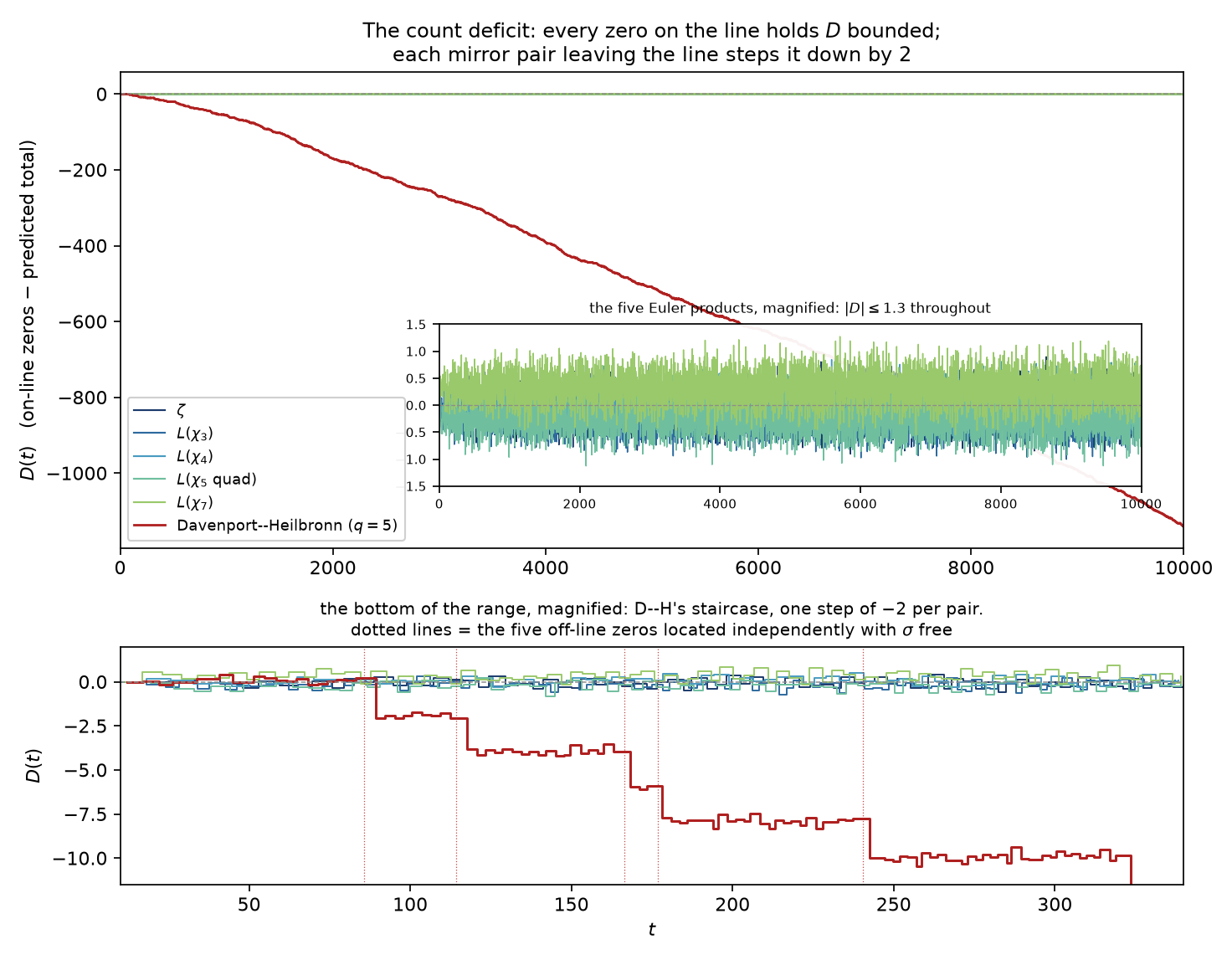
If every zero is on the line, D is the argument fluctuation S(t). Each mirror pair that is off the line removes two sign changes and steps D down by 2, permanently.
⚠ S(t) is not bounded. It is O(log t) and provably unbounded (Selberg), so the guarantee is not "D stays small" in principle. Over this range D stays inside 1.3 in absolute value empirically, and that is the form in which it is used.
Three properties make this the right instrument for the question actually asked:
- No distance threshold. A pair at ½ ± 10⁻⁹ removes two sign changes exactly as surely as one at 0.87. The sensitivity is one pair anywhere in the range, subject only to resolution.
- It is exhaustive over the height range, not over a box. There is no σ window to escape through.
- The departure is permanent, so the argument is about long-run drift, not about any single height. Stated properly: a pair that leaves imposes a step that never comes back, and 570 such steps are visible against a fluctuation that stays within 1.3 in absolute value over 10⁴ units of height.
- This is Turing's method in lightweight form (Turing 1953; Lehman 1970; Trudgian) — the standard device for certifying that a zero count on the line matches the total. Naming it makes the instrument recognisable rather than home-made. (Scope, 2026-09-04: lightweight means WITHOUT Turing's bound, and the bound is what certifies. Because S(t) is a mean-zero fluctuation while a departure is a permanent step, a pair leaving at height t₁ is excluded only from heights at which the deficit has since returned above the step — so the TOP of each object's range, from its last return of D to ≥ 0 up to the ceiling, is not certified here and cannot exclude a single pair. Turing 1953 and Lehman 1970 close this for ζ; Booker 2006, "Artin's conjecture, Turing's method, and the Riemann hypothesis", Experiment. Math., gives the general L-function form. That bound is not applied in this paper, so the census reads: no off-line zero detected below the ceiling, with the count pinned up to the last return of the deficit.) (Extended 2026-09-04: Booker 2006 has since been read first-hand, and it splits this census rather than closing it. His Theorem 4.5 is exactly the missing bound — an explicit two-sided bound on ∫ S(t) dt with c₀ ≤ 5.65055 — but two hypotheses of his §1 are load-bearing and the comparison objects here fail both by construction: his class is defined by an Euler product, and his contour step at (4.2)–(4.3) moves the right edge out to ∞ “where the integrand vanishes”, which holds for L′/L only if L has no zeros in a right half-plane. The non-multiplicative control has them at positive density — Titchmarsh §10.25 proves their number with σ > 1 up to height T exceeds AT. So for the Euler-product members that bound is available and simply not applied here; for the control it is unavailable in principle by this route. The plot is a certificate on part of its set and a measurement, with a reason, on the rest — and the reason is this paper's own thesis, reappearing in the certification machinery.)
- And it establishes simplicity for free. Sign changes equal to the total count means every zero over the range is on the critical line and simple — more than this paper needs, so it is recorded and not leaned on.
- Its failure mode is the safe one. Under-sampling can only delete sign changes, i.e. can only manufacture a false detection — never a false null. So the resolution gate protects the positive control, and cannot have manufactured the on-line result.
3.3 Evaluation
Direct character sum to N = q·M plus an Euler–Maclaurin tail in Hurwitz form at A = M + r/q, with M ≈ 0.6·t and 12 Bernoulli terms, in double precision, one shared exponential matrix across all objects; zeros refined by 28 bisection steps. Reference values at 25 digits by exact Hurwitz decomposition — an independent code path.
Chapter 4 — The census
Status. Carried from this programme's earlier census round.
4.1 The result
Over t ∈ [10, 10⁴], six objects, identical code:
| object | q | κ | class | on-line zeros | D(end) | min D | max D | verdict |
|---|---|---|---|---|---|---|---|---|
| ζ | 1 | 0 | Euler | 10,142 | −0.17 | −0.90 | 0.90 | all on line |
| L(χ₃) | 3 | 1 | Euler | 11,890 | +0.16 | −1.00 | 0.66 | all on line |
| L(χ₄) | 4 | 1 | Euler | 12,348 | +0.15 | −0.75 | 0.92 | all on line |
| L(χ₅ quad) | 5 | 0 | Euler | 12,701 | −0.05 | −1.14 | 0.64 | all on line |
| L(χ₇) | 7 | 1 | Euler | 13,237 | +0.50 | −0.68 | 1.27 | all on line |
| Davenport–Heilbronn | 5 | 1 | control | 11,562 | −1139.98 | −1140.16 | 0.48 | off-line |
60,318 zeros of five Euler products, every one on the critical line. The matched non-multiplicative control, through the identical pipeline over the identical range, is missing 1,140 — 570 mirror pairs off the line.
The five Euler products never leave 1.3 in absolute value over the whole range. Figure 1 shows both facts on one axis, and its lower panel shows the bottom of the range magnified, where the control's staircase is visible as discrete steps of −2.
One correction to the control's figure, established in chapter 6.4 and carried here rather than left downstream. At 25 samples per mean gap the count misses a small number of the very tightest on-line events, and a full-range recount at four times the density gains the control two on-line zeros over t ∈ [10, 2000]. The deficit is therefore very slightly overstated — never understated — and the same one-sided correction applies to the −1139.98 above, bounded at about 10 zeros or fewer (5 pairs of 570, under 1 %) by the rate measured in chapter 6.4. The Euler-product counts are unchanged at four times the density, so no null in this paper is touched by it.
4.2 The control, located zero by zero
A deficit is an inference. Five of the flagged heights were therefore taken to an independent instrument — 20 digits, exact Hurwitz decomposition, argument principle with σ free — and the zero was located:
| height flagged by D | box count | σ located | t located | modulus of L there | mirror at 1−σ |
|---|---|---|---|---|---|
| 85.378 | 1.000 | 0.808517182 | 85.699348 | 3.8e−21 | yes |
| 114.549 | 1.000 | 0.650830081 | 114.163343 | 6.4e−21 | yes |
| 166.243 | 1.000 | 0.574356050 | 166.479306 | 1.1e−20 | yes |
| 176.386 | 1.000 | 0.724257695 | 176.702461 | 1.1e−20 | yes |
| 240.732 | 1.000 | 0.869530580 | 240.404672 | 1.2e−20 | yes |
Five of five flagged heights yielded a genuine off-line zero with its mirror partner at 1−σ. The first row is an external check and it is exact: this project's own ledger, produced long before and by an entirely unrelated route, carries the Davenport–Heilbronn function's certified off-line zero at (0.8085171824566374, 85.69934848537759). The census re-derives it to nine digits from a deficit in a zero count. In Figure 1's lower panel these five heights are the dotted lines, and each falls on a step.
The mirror pairing is not an accident of this object: for a self-dual F with real coefficients, Λ(s) = Λ(1−s) with Schwarz reflection makes it a theorem — a zero at σ+it forces one at (1−σ)+it, two solutions at the same height, one on each side of ½. Measured against an object with no functional equation, the mirror partner is not a zero at all (the modulus of L is 0.8783 there). The reflection buys the pairing and nothing more.
4.3 Gates
| gate | what it establishes | result |
|---|---|---|
| evaluator | fast evaluator against 25-digit reference, six objects, six heights spanning the range | pass — worst relative error 7.1e−11 |
| reality | Z real, i.e. root number +1 for every object | failed as written; located, not loosened. Correctly conditioned: 1.7e−10 |
| resolution | counts stable under four times denser sampling | pass — 0 change in 12 windows, including every object's tightest event |
| contour | certification contours: largest argument step below π/2 | pass — worst 0.134 |
| integer | every box count an integer to within 0.05 | pass — all exactly 2.000 |
| mirror | located off-line zeros have their mirror at 1−σ, same height | pass — 5 of 5 |
| positive control | the control's off-line zeros detected | pass — 1,140 zeros, i.e. 570 pairs. Cross-checked against an independent ledger at that ledger's own ceiling: chapter 4.4 |
The twelve tightest near-collisions — the two closest events of each object — were re-counted by the argument principle with σ free over a window holding exactly that pair. All twelve return box count 2.000 against 2 sign changes on the line: every event where a pair came closest to leaving keeps both zeros on the line, certified by an instrument that never assumed they were there.
4.4 The control, cross-checked against an independent ledger at its own ceiling
A rate quoted over one range and compared with a rate over another is not a check, and the draft this replaces made exactly that mistake: it called 0.110 zeros per unit t a match for a recorded 0.049 events per unit t, which halved to pairs is 0.055 against 0.049 — 12 % apart, and the gap is range, not agreement. The pair density is not flat: measured here it runs 0.0427 pairs per unit t up to t = 2000 and 0.0486 up to t = 4000.
The like-for-like check is available for free, because the recorded ledger has a ceiling of its own: 193 quartets (386 members, all verified) to t = 4000, cross-validated 34 out of 34 against Spira and Balanzario–Sánchez-Ortiz. One quartet is one upper-half-plane mirror pair, hence a deficit of 2. Cutting the census deficit at that ceiling — recomputed from an undecimated single-object sweep, not from the decimated table:
| cut at t | D(t) | pairs | on-line zeros |
|---|---|---|---|
| 2000.0 | −169.95 | 85.0 | 1,857 |
| 3992.6 (the ledger's ceiling) | −386.36 | 193.2 | 4,100 |
| 4000.0 | −387.81 | 193.9 | 4,108 |
193.2 pairs against 193 recorded quartets — 0.09 %. A population-level, like-for-like agreement with a number produced long before by an entirely unrelated route, and the companion to chapter 4.2's nine-digit hit on a single zero. The one-sided resolution correction of chapter 6.4 moves the census number down, i.e. toward the ledger.
Chapter 5 — The margin: the mechanism is not what it looks like
Status. The measurement is carried from the earlier census round. The power curve and the matched-sample calibration below are new for this paper; no adversarial falsifier has been run against the reading. Ceiling M applies.
5.1 The statistic, and what it says
Between consecutive on-line zeros Z holds one sign and has at least one extremum; m is the size of the extremum of largest modulus against its local median, and it is how close that pair came to merging and leaving. It is the Lehmer quantity. ("exactly one extremum" is false in general — extra critical-point pairs occur, and that is the Speiser phenomenon this programme already owns.)
The event set is smaller than the zero count, and here is why. The sweep runs in blocks of 20 units and an event needs two consecutive zeros inside one block, so the gap straddling each block boundary yields none. ζ: 10,142 zeros, 9,642 events, and the range holds 500 blocks. Same arithmetic at t ≤ 2000: 2,026 → 1,926 over 100 blocks. No event is lost to anything but the blocking, and the deficit is exactly the block count.
| object | events | min m | at t | 1st percentile of m | min gap over mean |
|---|---|---|---|---|---|
| ζ | 9,642 | 0.00282 | 7005.098 | 0.06194 | 0.04210 |
| L(χ₃) | 11,390 | 0.00155 | 2174.135 | 0.06694 | 0.05368 |
| L(χ₄) | 11,848 | 0.00096 | 7567.448 | 0.05837 | 0.03333 |
| L(χ₅ quad) | 12,201 | 0.00056 | 9166.179 | 0.05876 | 0.04492 |
| L(χ₇) | 12,737 | 0.00026 | 9135.082 | 0.05220 | 0.04195 |
| Davenport–Heilbronn (q = 5) | 11,062 | 0.00048 | 3200.044 | 0.05218 | 0.04138 |
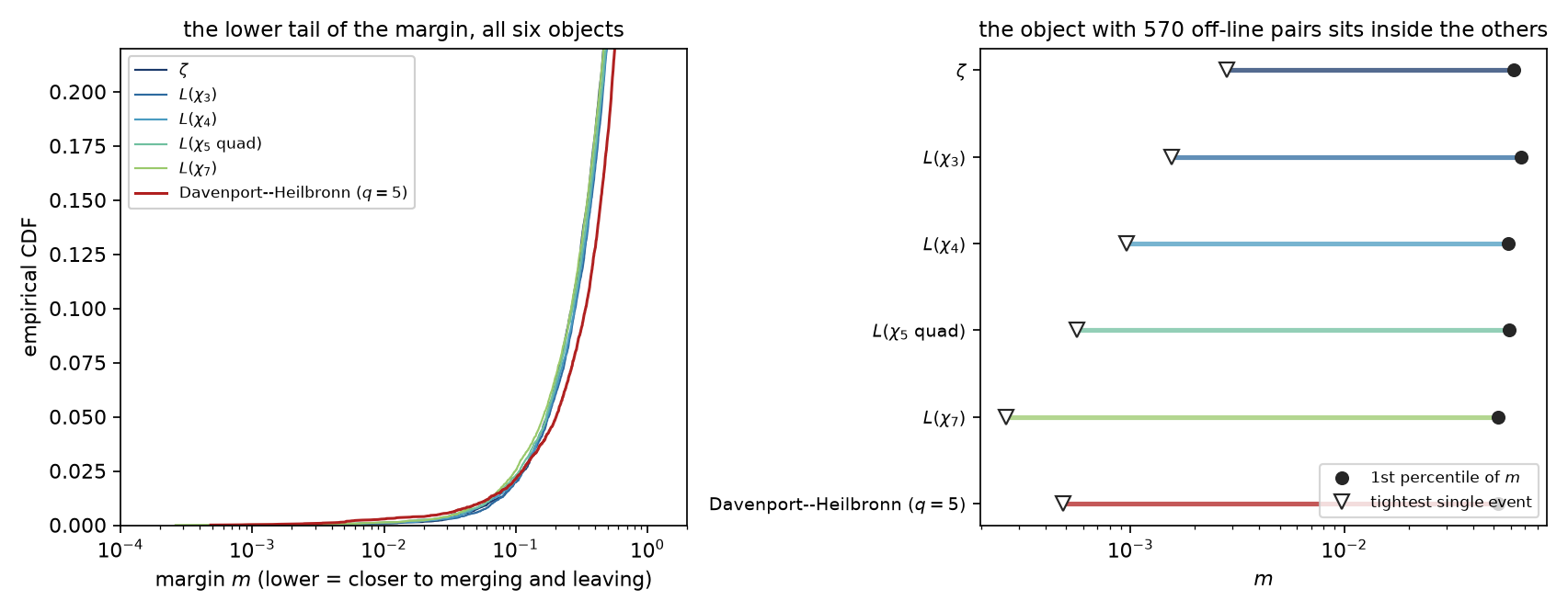
The instrument validated itself here, unprompted. ζ's tightest event over the whole range sits at t = 7005.098 — Lehmer's pair, the classical extreme near-collision — found with no knowledge of it, and it is also where a completely different observable in this programme independently put its own thinnest margin (0.0565 at t = 7005.082).
And the finding: the margin does not separate the classes. The 1st percentile of m runs 0.052–0.067 across all six objects, with the object holding 570 off-line pairs sitting among the objects holding none. That is the strong form of the result: it is a bulk statistic, its bootstrap standard error is 0.003–0.005, and Figure 2's left panel shows the six lower tails lying on top of one another. ⇒ Getting close to merging on the line does not predict which objects lose zeros off it. Near-collisions are equally severe in objects that never lose one, and the control's off-line zeros are not preceded by more extreme on-line near-misses than anyone else's.
⚠ And the eye-catching version of that sentence does not survive its own calibration. An earlier draft led with "the tightest near-collision of all six belongs to L(χ₇), eleven times tighter than ζ's". That is an order statistic over unequal samples — 9,642 events for ζ against 12,737 for L(χ₇) — and calibrated against the pooled lower tail at the same six event counts:
| observed | pooled null | |
|---|---|---|
| largest of the six minima, divided by the smallest | 10.8 | median 5.9, 95 % interval 2.0 to 15.1, probability of reaching the observed value 0.16 |
and every single object's tightest event falls between the 13th and 93rd percentile of the null. A spread of that size is simply what six draws of these sizes from one distribution produce. The ratio is demoted to a remark; the 1st-percentile equality carries the chapter.
5.1a The null's power, and the two things it does not say
This is a null, and this programme's own standing rule is that no null is quoted without a power curve. The rule was unmet in the first draft; it is met here.
The only level at which "the classes differ" can be asserted is the object level — one number per object, not one per event, because events inside an object are not independent draws and treating them as such is the pseudo-replication fault this programme has committed four times. Taking the 1st percentile of m as that number, over the eight objects of chapter 6 run through identical code across an identical range:
- Observed: exact two-sided Mann–Whitney U = 4.0, p = 0.39. The classes do not separate.
- ⚠ The floor is arithmetic: with 5 Euler products against 3 controls the smallest attainable two-sided p is 2 divided by 56, i.e. 0.036, so even perfect separation could not go below it. The observed p is 11 times that floor.
- The power curve — multiply every control's margins by λ < 1, the direction the naive picture predicts, and ask how often the test rejects at 0.05:
| λ | 1.00 | 0.80 | 0.70 | 0.60 | 0.50 | 0.40 |
|---|---|---|---|---|---|---|
| rejection rate | 0.04 | 0.39 | 0.66 | 0.88 | 0.99 | 1.00 |
So the null excludes a large class difference — a shift of ×0.6 or more in the controls' margins is caught 88 % of the time — and it does not establish there is none. A shift of ×0.8 would be missed six times in ten. That is the honest strength, and Ceiling M carries it.
⚠ And which picture is being refuted must be said, because this programme built the other one. "An off-line pair is a near-collision that finally tipped over" is a statement about deformation space, and this project's own capture events — pairs that merge and leave as a parameter varies — are exactly that phenomenon, measured and recorded. Chapter 5 measures a static statistic on fixed objects. The refutation is of the naive static reading only. It does not touch the deformation picture, and a reader who knows the earlier work should not read it as contradicting it.
5.2 The same quantity seen along the other axis — and what an off-line pair actually looks like
Status. New work for this paper. The observation is the author's, made from watching the path of Λ move across the critical line; the measurements are new. Figure 3.
Chapter 5 measures the margin along the critical line. The same quantity can be met across it, and doing so gives an off-line pair a shape rather than a coordinate.
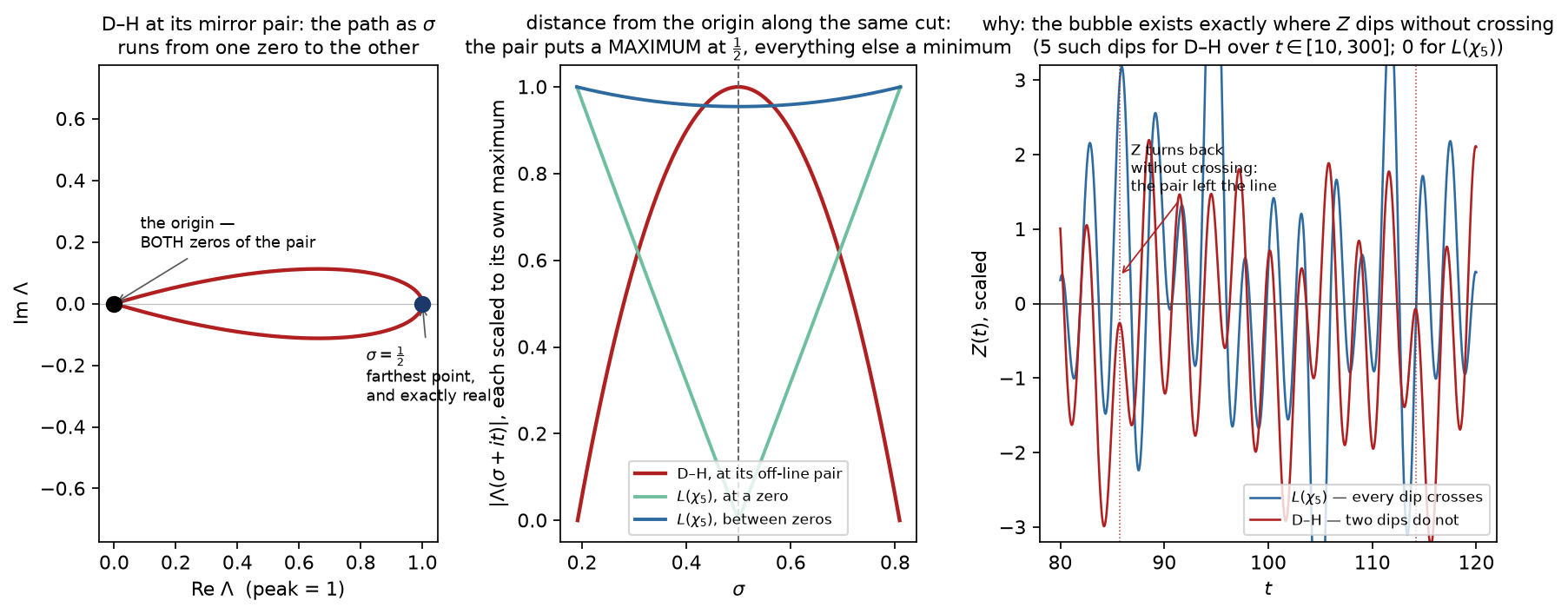
Fix the height t₀ = 85.699348 of the control's first off-line pair and walk σ from one zero to its mirror. The value Λ(σ+it₀) leaves the origin, travels out, and returns to the origin at the other zero — a closed lens, and σ = ½ is its far tip. Three of its properties are exact, and all three come from the functional equation alone:
| property | measured |
|---|---|
| Λ(½+it₀) is real — the far tip lies on the real axis | imaginary part 1.6e−30 of the modulus |
| Λ(1−σ+it₀) = conj Λ(σ+it₀) — the two halves are mirror images in the real axis | 8.8e−30, on a path scaled to peak 1 |
| the two halves have equal length — not "somewhat" equal, identically equal | arc length 1.052012 each, difference 0 |
And two more that were asked about directly. σ = ½ is the farthest point, exactly: it is the maximum of the modulus of Λ along the cut, and a genuine turning point. The path is nearly but not exactly straight — its greatest perpendicular excursion is 11.3 % of its own length, so "a straight back and forth, possibly with a slight curve" is the right description and the curve is that 11.3 %.
And the lens has a height, which turns out to be a quantity this paper already has. The peak of the lens, divided by the archimedean modulus, is 0.35686722, and the modulus of Z(t₀) is 0.35686722 — ratio 1.0000000000. The height of the lens is the margin of chapter 5.1. A pair merging onto the line is the lens closing; margin zero and lens height zero are the same event.
What distinguishes the off-line case is not the turning point but its sign. Because Λ(1−σ+it) = conj Λ(σ+it) at every height, σ = ½ is a stationary point of the modulus of Λ along every horizontal cut, for every self-dual object — that much is free. What the pair supplies is that the stationary point is a maximum rather than a minimum, and that the path reaches the origin at both ends. The reason is one line: log of the modulus of Λ is harmonic away from zeros, so the second derivative in σ is minus the second derivative in t, and a horizontal maximum at ½ is a vertical minimum of the modulus of Z — that is, Z dipping toward the axis without crossing it. Two zeros that failed to be two sign changes. An off-line pair.
Scanned rather than asserted. Over t ∈ [10, 300]:
| object | sign changes | positive local minima of the modulus of Z (dips that do not cross) |
|---|---|---|
| L(χ₅ quad) | 212 | 0 |
| Davenport–Heilbronn (q = 5) | 202 | 5 — and all five sit within 1.0 in t of the five off-line zeros located independently with σ free in chapter 4.2 |
So the picture is exact and it identifies the right object: the lens exists precisely where a mirror pair has left the line, and the census's deficit counts the same events from the other axis — every dip is one step of −2 in D(t). ⚠ AND ITS CEILING IS THE SAME AS THE PROGRAMME'S OTHER EXACT PICTURES. "An L-function never has such an off-origin point from which both directions lead to the origin" is not an independent structural fact that would explain the confinement. Unpacked, it says Z never dips without crossing — which is the statement that every zero of that function is on the critical line. The picture is a faithful portrait of what an off-line zero is; it is not a condition that forbids one. That is the same shape as Speiser's criterion and Li's, both of which this programme met earlier and recorded as restatements rather than routes.
Chapter 6 — The census extended: complex characters, and three controls instead of one
Status. New work for this paper. The branches below were stated in the run's own specification before it was launched.
6.1 What chapter 4 left open, in its own words
The earlier census names its own limits: "four real primitive quadratic characters at conductors 3, 4, 5, 7 — complex characters, higher conductors and higher degree are untested here", and the class statement rested on one non-multiplicative object at one conductor. Two of those three limits are closed here.
Negative side. Five more Euler products: the primitive complex characters of order 4 mod 5, order 6 mod 7, order 3 mod 7 and order 12 mod 13, plus the quadratic character mod 13. Four of the five are not real, and the conductor reaches 13.
Positive side. Three non-multiplicative objects instead of one: Davenport–Heilbronn (q = 5) as a reproduction gate against the earlier run, plus DH₇ and DH₁₁ at conductors 7 and 11. All three passed the chapter 2.4 test, so all three are objects to which Saias–Weingartner provably applies.
6.2 The instrument extended to complex χ
For primitive χ mod q with χ(−1) = (−1)^κ, we have Λ(s,χ) = ε·Λ(1−s,χ̄) with ε = τ(χ)/(i^κ√q), and Λ(s,χ̄) = conj Λ(s̄,χ). Hence
W(t) = ε−1/2 eiθq(t) L(12+it,χ) is real,
so the sign changes of W are again exactly the on-line zeros. The same reflection gives a zero at σ+it forcing one at (1−σ)+it: the mirror pair lives inside the same function even when χ is complex, so a departure still removes exactly two sign changes and the deficit works unchanged.
6.3 Result — the branch that landed
Over t ∈ [10, 2000], eight objects, identical code:
| object | q | κ | order of χ | class | on-line zeros | D(end) | min D | max D | verdict |
|---|---|---|---|---|---|---|---|---|---|
| χ₅, order 4 | 5 | 1 | 4 | Euler | 2,026 | +0.27 | −0.58 | +1.03 | all on line |
| χ₇, order 6 | 7 | 1 | 6 | Euler | 2,133 | +0.54 | −0.64 | +1.11 | all on line |
| χ₇, order 3 | 7 | 0 | 3 | Euler | 2,134 | +0.23 | −0.91 | +0.82 | all on line |
| χ₁₃, order 12 | 13 | 1 | 12 | Euler | 2,330 | +0.15 | −0.80 | +1.12 | all on line |
| L(χ₁₃ quad) | 13 | 0 | 2 | Euler | 2,330 | +0.14 | −1.08 | +0.56 | all on line |
| Davenport–Heilbronn (q = 5) | 5 | 1 | — | control | 1,859 | −167.95 | −170.35 | +0.48 | off-line |
| DH₇ | 7 | 1 | — | control | 1,857 | −274.75 | −274.75 | +0.54 | off-line |
| DH₁₁ | 11 | 1 | — | control | 2,207 | −69.45 | −70.31 | +0.76 | off-line |
10,953 more zeros, every one on the critical line — four of the five objects carrying complex characters, at conductors up to 13. Taken with chapter 4: ten Euler products, 71,271 zeros, and not one of them off the line. And the class statement no longer rests on one object at one conductor. All three non-multiplicative objects lose zeros, at three different conductors and three different rates: 0.042, 0.069 and 0.017 mirror pairs per unit t at q = 5, 7 and 11, read from the D(end) column of this same table. (Pairs, not zeros: the deficit counts both members of each pair, so the figures in zeros are twice these. An earlier draft printed the zero-rates and called them pairs.)
(The Davenport–Heilbronn row carries the corrected count of chapter 6.4. The raw 25-per-gap sweep printed 1,857 zeros and −169.95, which is the number the earlier round recorded and which the reproduction gate below uses.)
The reproduction gate returns the earlier values exactly — and the statistic has to be named to see it. Davenport–Heilbronn (q = 5) reproduces the earlier t ≤ 2000 row on both available statistics: D(end) = −169.95 on 1,857 on-line zeros, and the tail-mean drift −163.72 against the earlier table's own −163.72. ⚠ The gate's printed line gives only the tail-mean, beside the earlier D(end), so its raw output reads as a 3.7 % miss and prints no verdict at all. The claim is true; the gate's print compares unlike quantities and is recorded as a reporting fault in the Supplementary Materials.
The margin reading of chapter 5 replicates here and does not separate the classes either. The 1st percentile of m runs 0.047–0.085 across all eight objects, and the controls do not sit below the Euler products as a group: DH₁₁ at 0.0740 sits above two of the five — 0.0612 and 0.0633, with the other three at 0.0806, 0.0825, 0.0847. (An earlier draft said three of five.) The single tightest event of the whole run belongs to a control (DH₇, m = 0.00002). These eight objects are the sample the object-level test of chapter 5.1a is run on: U = 4.0, p = 0.39, against an attainable floor of 0.036.
6.4 Two gates, and what they cost
The evaluator gate failed as first written and was located, not loosened. It read 2.57e−09 for the order-12 character at q = 13, against a bar of 1e−9, with every other object at 1e−11 or better. The cause is not the evaluator: at that sample, t = 1940, the modulus of L is 1.3e−03, which is 0.0007 of its own local median — the sample landed on a zero — while the absolute error there, 3.3e−12, is in line with its neighbours at the same height. This is a pointwise-relative conditioning fault appearing for the third time in this programme, and it was diagnosed rather than absorbed. Re-specified against a local scale, the gate reads 3.9e−12 absolute, 1.3e−12 conditioned, and passes.
The resolution gate failed in one window of twelve, and the failure is real. At DH₇, t = 747.1687, the tightest event of the entire run by two orders of magnitude (m = 0.00002), the 25-samples-per-gap grid returned 4 sign changes where the four-times grid returned 6: two zeros were being missed. The direction is the safe one — under-sampling can only delete sign changes, so it can only manufacture a false off-line detection in a control, never a false null in an Euler product — but "cannot have broken the null" is an argument, and the controls' counts are quoted. So the whole range was re-counted at 100 samples per mean gap for every object:
| object | class | 25 per gap | 100 per gap | missed |
|---|---|---|---|---|
| χ₅ ord 4, χ₇ ord 6, χ₇ ord 3, χ₁₃ ord 12, L(χ₁₃ quad) | Euler | 2026, 2133, 2134, 2330, 2330 | identical | 0, 0, 0, 0, 0 |
| Davenport–Heilbronn (q = 5) | control | 1857 | 1859 | 2 |
| DH₇ | control | 1857 | 1857 | 0 |
| DH₁₁ | control | 2207 | 2207 | 0 |
The five Euler products lose nothing at four times the density over the whole range: 0 missed zeros, all five. The census did not under-count the line, and the null of chapter 6.3 is resolution-clean rather than resolution-gated in twelve windows.
The control is corrected. Davenport–Heilbronn (q = 5) gains two on-line zeros at four times the density, so its deficit over t ∈ [10, 2000] is −167.95, not −169.95 — one off-line pair fewer than the recorded value, and by inheritance the same order of correction applies to the −1139.98 of chapter 4, whose count was taken at the same density. The direction is known and it is one-sided: the deficit was overstated, never understated. Bounded rather than left vague: the observed rate is 2 missed zeros per 2,000 units of height, so over the full t ≤ 10⁴ range the correction is about 10 zeros or fewer, i.e. 5 pairs out of 570 — under 1 %, and one-sided. Nothing in chapters 4 or 8 turns on it, and chapter 4.4's ledger cross-check at t = 4000 is unaffected at the 0.09 % it reports. The corrected number is the one of record.
(The window that failed the resolution gate, DH₇ at t = 747.17, does not appear in the full-range recount: at 25 per gap the sweep's own grid does capture both sign changes there, and the gate window's grid — a different offset over the same event — did not. At m = 2e−5 the capture is grid-alignment sensitive. That is a sharper statement of the same fault, not a retraction of it.)
Chapter 7 — Faults, kept
This programme's standing rule is that a gate which fails is located rather than loosened, and that faults are kept unedited next to the results they touch. Eight are on the record for this census and its draft, and the full account of each is in the Supplementary Materials, at the length it was written. Two of them changed a number of record and are stated here rather than left in a companion file:
- The resolution gate failed for real at the tightest event of the extension run, which forced a recount of the whole range at four times the sampling density. The recount left every Euler-product count unchanged — so the null is resolution-clean rather than resolution-gated — and corrected this project's own recorded deficit for the control by two zeros, against its own favour. The corrected number is the one used.
- A false mathematical statement reached the first draft of chapter 2.1 and was found by an independent review, not by the author. It is false at two of this paper's own object conductors. The counterexample was re-derived independently before the text was changed, and the repaired statement is stronger than the one it replaces.
The remaining six — a gate declared as a pointwise-relative bound that divided by a quantity vanishing exactly where the sweep looks, and did so three times; a gate declared and never run; a contour sampled at a guessed density and killed rather than left running; a background launch that reported success while the real process ran untracked; a reproduction gate whose printed line compares two different statistics; and a calibration probe whose first design could not fail — are in the Supplementary Materials in full.
Chapter 8 — What this establishes, and what it does not
8.1 Establishes
- A comparative census: ten Euler products, 71,271 zeros, every one on the critical line — 60,318 to height 10⁴ (chapter 4) and 10,953 more to height 2000, four of the added objects carrying complex characters, conductors to 13 (chapter 6) — by an exhaustive count rather than a sampled search, with the twelve worst cases independently certified with σ free and the extension's counts unchanged at four times the sampling density over the whole range. ⚠ The on-line half is not new about these functions — it sits inside Platt's rigorous verification (chapter 1.3). What is new is that both classes were measured by the same instrument over the same range, which is what makes the contrast in item 2 a measurement rather than a juxtaposition of two literatures.
- The null has measured power and a distance threshold that is the evaluator's, not the instrument's. The identical code found 1,140 off-line zeros in the matched control over the same range, and located five of them individually, one matching an independently recorded value to nine digits. The instrument's sensitivity is one pair anywhere in the range. At three conductors rather than one: all three non-multiplicative controls lose zeros, at rates 0.042, 0.069 and 0.017 mirror pairs per unit t. (Corrected 2026-09-04: a mirror pair at ½ ± δ makes the real Hardy-type function dip to a positive minimum of order δ²·|Z″|/2 — the margin m this paper measures — and below the evaluator's absolute error that dip is invisible, so the threshold is δ₀ ≈ √(error / curvature). It is six orders below anything in this census: the smallest margin anywhere is m = 0.00026 against an evaluator error of 7×10⁻¹¹. The claim is therefore: no distance threshold above δ₀, and every event clears it by six orders.)
- "Davenport–Heilbronn type" is exact, not a family resemblance. At degree 1 with periodic coefficients, the functional equation confines the coefficient list to an eigenspace of the finite Fourier transform; inside that eigenspace a single character has an Euler product and nothing else does; and the Saias–Weingartner hypothesis separating them is certified by a finite residue test, verified here for every control used.
- Near-collision on the line does not predict which objects lose zeros off it (chapter 5, at Ceiling M).
- The hypothesis this paper answers, corrected: false as stated — four other Dirichlet L-functions keep every zero on the line — and true one restriction in, where it becomes Davenport–Heilbronn 1936 and Saias–Weingartner 2009. The wall it drew is real; it runs at the Euler product, not at ζ.
8.2 Does not establish
- Nothing about the Riemann Hypothesis or its generalised form. Height 10⁴ is a numerical census. The converse direction — Euler product ⇒ all zeros on the line — is the Generalised Riemann Hypothesis, and nothing here is evidence for it beyond "not contradicted below 10⁴".
- Nothing about degree ≥ 2, and nothing about non-periodic coefficients. In particular the shifted degree-1 elements of chapter 2.3 are not covered by either forcing theorem and are not claimed.
- The forcing direction is not this paper's. It is 1936 and 2009. What is this paper's on that side is the verification that the hypothesis applies (chapter 2.4) and the measurement of the rate.
- The control's 1,140 is a count. Five were individually located and all five were genuine; the remaining 565 pairs are inferred from the deficit and were not located one by one.
- Chapter 5 has no falsifier. This programme's own record is that readings of that shape die to a three-conductor control more often than not.
8.3 The one sentence
Symmetry pairs the zeros; it does not confine them. What separates the objects that keep every zero on the line from the objects that provably cannot is the Euler product — and at degree 1 with periodic coefficients that distinction can be certified from the coefficient list alone, before a single zero is computed.
Appendix — the objects
| name | q | κ | coefficients | class |
|---|---|---|---|---|
| ζ | 1 | 0 | 1 | Euler product |
| L(χ₃), L(χ₄), L(χ₅ quad), L(χ₇), L(χ₁₃ quad) | 3, 4, 5, 7, 13 | 1, 1, 0, 1, 0 | quadratic characters | Euler product |
| χ₅ ord 4, χ₇ ord 6, χ₇ ord 3, χ₁₃ ord 12 | 5, 7, 7, 13 | 1, 1, 0, 1 | primitive complex characters | Euler product |
| Davenport–Heilbronn | 5 | 1 | (1, ξ, −ξ, −1, 0) with ξ = (√(10−2√5) − 2)/(√5 − 1) | no Euler product |
| DH₇, DH₁₁ | 7, 11 | 1 | built for this paper by the same recipe at a new conductor: a(r) = 2·Re(c·χ(r)) normalised, with c fixed by root number +1 | no Euler product |
DH₇ and DH₁₁ are not classical objects. They are constructed here so that the class statement can be tested at more than one conductor, and each is certified as non-multiplicative by the test of chapter 2.4 before it is used.
Project materials
The complete project — all papers with their supplementary and visual companions, and the data behind them — is available at zeta.pukapasoft.xyz.
This paper is one part of a set. Its companion files are The Wall Runs at the Euler Product: Supplementary Materials and The Wall Runs at the Euler Product: Visuals.
Nothing in this work decides the location of any zero of the Riemann zeta function, and no result here is progress toward a proof of the Riemann Hypothesis.
Figures
3 figures. Each opens with the commentary the paper wrote for it; click a thumbnail for the full-size render.
This file carries every figure of the paper named above, with its caption exactly as the paper states it and the data behind it. No figure computes a mathematical quantity. The paper's own text remains the sole document of record.
Figure 1
Figure 1 (the count deficit). D(t) for the six census objects over t ∈ [10, 10⁴]. Upper panel: five Euler products hold a bounded band while the matched non-multiplicative control walks down to −1140; an inset magnifies the band the five stay inside, which is 1.3 wide in absolute value over the whole range. Lower panel: the bottom of the range magnified, where the control's staircase resolves into discrete steps of −2 — one step per mirror pair that has left the critical line. The dotted lines are the five off-line zeros located independently with σ free, and each falls on a step.
Source data: the deficit sweep, one row per sampled height per object.
Figure 2
Figure 2 (the margin distribution). Left: the lower tails of all six objects, which lie on top of one another — this panel carries the chapter 5 finding on its own. Right: the tightest single event and the 1st percentile per object; the object holding 570 off-line pairs sits inside the spread of the objects holding none.
Source data: the margin sweep, one row per event.
Figure 3
Figure 3 (the lens). The author's observation, measured. Left: the path Λ(σ+it₀) as σ runs from one off-line zero to its mirror, scaled to its own peak — out from the origin, farthest and exactly real at σ = ½, back to the origin. Centre: the same path as distance from the origin, against the identical cut through an Euler product at a zero and between zeros — the off-line pair puts a maximum at σ = ½, every other case a minimum. Right: why — Z dips toward the axis without crossing it exactly where the pair has left the line, and that dip is one step of −2 in the count deficit of Figure 1.
Source data: a direct evaluation of Λ along the horizontal cut at t₀ = 85.699348.
Note on the figure set
Three figures, three renders, no reuse. Figures 1 and 2 are drawn from the census sweeps and recompute nothing; Figure 3 is drawn from a fresh evaluation along one horizontal cut, and every quantity it shows is stated numerically in chapter 5.2 of the paper so that the picture is never the evidence.
Supplementary materials
The audit layer: how the numbers above were checked, what was corrected, and what is owed to whom.
Open the supplementary materials
This file carries the audit layer of the paper named above: the faults chapter at full length, the reproduction specification, and the reference list with the tier each source is used at. The paper's own text remains the sole document of record.
Faults, kept — the full account
This programme's standing rule is that a gate which fails is located rather than loosened, and that faults are kept unedited next to the results they touch. Eight are on the record for this census and its draft, and this paper repeats them rather than quietly inheriting a clean version.
1. A declared gate was wrong
The reality gate — the requirement that the rotated function Z be real — was declared as a pointwise relative bound: the largest imaginary part of Z divided by the modulus of L, below 1e−9. It passed at t ≤ 2000 and failed at t ≤ 10⁴, reading 6.8e−06. The threshold was not loosened. The gate is mis-specified: it divides by a quantity that is zero at exactly the points the sweep exists to find. The numerator is flat — 1.7e−10 at the top of the range; the denominator is what moves, and at every maximum of the bad ratio the modulus of L sits in the lowest percentile of its own distribution in that window, i.e. at a zero. Correctly conditioned against a local scale it reads 1.67e−10, and the quantity the sweep actually consumes — the implied error in a zero's position — is 7.2e−12 in t, which is 1.1e−11 of a mean gap. A sign-change count cannot be moved at that size.
(The same conditioning fault had stood as an unmade debt in this project for six rounds. The extension run of chapter 6 measures the gate correctly from the start and prints the absolute numerator beside the conditioned ratio so the conditioning stays visible.)
2. A declared gate that did not run
The resolution gate was declared in the census specification and never implemented; it was caught by reading the output, not by anything automatic. It matters, because the sweep samples 25 points per mean gap and the tightest events have their two zeros 0.033–0.045 of a mean gap apart — about one sample. Run separately afterwards at four times the density in 12 windows: 0 count change. As chapter 3.2 notes, under-sampling can only delete sign changes, so the fault's failure mode is a false detection, never a false null. (It is implemented in-run in the extension of chapter 6.)
3. A contour sampled at a guessed density
The first certification run fixed 420–520 points per contour side — roughly five times what the winding needs — and would have run for hours. It was killed, not left running, and the box count was rebuilt to double its sampling until the gate passes, so the density is set by the measurement. The killed run's partial log is kept.
4. A background launch that orphaned itself
The deep census run was launched with a shell background token nested inside an already-backgrounded call; the wrapper exited immediately and reported success while the real process ran untracked. It completed correctly and its numbers stand, but the completion notice was false. Recorded because the failure mode is silent. (It recurred while this paper's extension run was launched, and was caught the same way: by checking the process, not the notice.)
5. The conditioning fault recurred a third time, and a real resolution failure was found underneath it
Both are chapter 6.4, and both are stated there rather than summarised away: the evaluator gate was mis-specified in the same pointwise-relative way as the reality gate and was re-specified; the resolution gate failed genuinely at one ultra-tight event, which forced the full-range recount that in turn corrected the control's own recorded deficit by two zeros. The corrected number is used. (The recount also shows the Euler-product counts are unchanged at four times the density — a null that survives a real gate failure elsewhere in the same run is worth more than one that was never tested.)
6. A gate print that compares two different statistics
The extension's reproduction gate prints the tail-mean drift of the current run beside the recorded end-value of the deficit — −163.72 against −169.95 — and prints no verdict line at all. Both statistics do reproduce exactly, so the claim in chapter 6.3 is true, but the gate's own output reads as a 3.7 % miss. A gate that compares unlike quantities is not a gate, and this one is recorded as failed-in-reporting rather than quietly fixed in the prose.
7. Two faults of the draft itself, both found by an independent review pass and both kept
Chapter 2.1 asserted that every periodic sequence admitting a functional equation is α·χ + β·χ̄. It is false, at q = 13 and q = 7 — two of this paper's own object conductors — for the systematic reason now printed there, and it had been elevated to a headline claim about "one binary choice". The counterexample was re-derived independently before the text was changed, and the repaired statement is stronger than the one it replaces. And the proof in chapter 2.2 omitted the order-4 case, where the relevant subgroup has only two elements and the argument as written does not close; the conclusion survives, the proof now has the case split. A wrong mathematical statement reached a draft, and the review found it, not the author.
8. A calibration whose first design could not fail
The matched-sample calibration of chapter 5.1 was first written to resample each object from its own margin values, so a resampled minimum can never fall below that object's observed minimum — the interval was pinned to the very statistic it was meant to calibrate, and it printed "the factor survives matching sample size", which is an artefact of the design. Redone against the pooled lower tail, the factor does not survive. The fault is recorded in the calibration's own specification.
Reproduction
Everything below is specified so that the measurements can be rebuilt from the statements in the paper, without access to this project's own code.
The evaluator
Direct character sum to N = q·M plus an Euler–Maclaurin tail in Hurwitz form at A = M + r/q, with M ≈ 0.6·t and 12 Bernoulli terms, in double precision, one shared exponential matrix across all objects. Zeros are refined by 28 bisection steps. Reference values come from an independent code path at 25 digits by exact Hurwitz decomposition.
The sweep
Sample the rotated real function on a grid of 25 points per mean gap, in blocks of 20 units of height, over t ∈ [10, T]. Count sign changes. The deficit is
D(t) = (sign changes in (T₀, t]) − (θ_q(t) − θ_q(T₀))/π, with T₀ = 10.
For an object with a complex character, rotate by ε to the power −1/2 first, with ε = τ(χ)/(i^κ√q); the rotated function is real and its sign changes are the on-line zeros. Each mirror pair off the critical line removes exactly two sign changes and steps D down by 2, permanently.
The gates, and the bars they were run at
| gate | what it checks | bar |
|---|---|---|
| evaluator | fast evaluator against the 25-digit reference, every object, six heights spanning the range | 1e−9, measured against a local scale with the absolute error printed beside it |
| reality | the rotated function is real | as above, conditioned against a local scale, never pointwise-relative |
| resolution | counts stable under four times denser sampling, at every object's tightest events, and over the whole range at 100 samples per mean gap | 0 count change |
| contour | largest argument step around a certification contour | below π/2 |
| integer | every box count is an integer | within 0.05 |
| mirror | a located off-line zero has its partner at 1−σ, same height | 5 of 5 |
| positive control | every non-multiplicative object shows the drift | detected at all three conductors |
| reproduction | the conductor-5 control returns the earlier run's values over the same range | equal on both statistics — see fault 6 |
The certification of a flagged height
At a height flagged by the deficit, run the argument principle with σ free over a box holding that height, at 20 digits, by exact Hurwitz decomposition — an instrument that never assumes the zero is on the line. Doubling the contour sampling until the largest argument step falls below π/2 sets the density by measurement rather than by guess.
The margin
Between consecutive on-line zeros, take the extremum of the rotated function with the largest modulus and divide by the local median. The event set is smaller than the zero count by exactly the block count, because an event needs two consecutive zeros inside one 20-unit block.
The class test
For a coefficient list a of period q with a₁ = 1, evaluate a(r² mod q) − a(r)² at every residue r coprime to q. Any non-zero value certifies that the list is not P(s)L(s,χ) for any Dirichlet polynomial P and any character χ.
The data behind the figures
The deficit sweep writes one row per sampled height per object — height, running sign-change count, smooth term, deficit — and the margin sweep writes one row per event: object, height, margin, local median, gap. Figure 1 is drawn from the first, Figure 2 from the second, and Figure 3 from a direct evaluation of Λ along the horizontal cut at t₀ = 85.699348.
References, with the tier each is used at
Tier convention. Full text means the paper was read first-hand. Statement level means an abstract, a secondary quotation, or a summary inside another verified source. An abstract read is statement level, not full text, by this programme's own earlier ruling.
| # | reference | tier | used for |
|---|---|---|---|
| 1 | Davenport, H. & Heilbronn, H., On the zeros of certain Dirichlet series, J. London Math. Soc. 11 (1936) | statement level | that the q = 5 object has off-line zeros; classical, used as background only |
| 2 | Saias, E. & Weingartner, A., Zeros of Dirichlet series with periodic coefficients, Acta Arith. 140(4) (2009) 335–344; arXiv:0807.0783 | statement level ⚠ | the forcing theorem for the whole periodic class — the load-bearing citation, and it is used at statement level. See chapter 2.3. Secondary readings: Righetti; a desk note quoting the statement |
| 3 | Booker, A. & Thorne, F., Zeros of L-functions outside the critical strip, Algebra & Number Theory 8(9) (2014) 2027–2042; arXiv:1306.6362 | full text | the degree ≥ 2 analogue, quoted with its hypotheses; not used to support any claim about the extended Selberg class |
| 4 | Platt, D. and the LMFDB | statement level | the rigorous, Turing-certified verification the census sits inside — chapter 1.3 and Ceiling C |
| 5 | Turing, A. M., Some calculations of the Riemann zeta-function (1953); Lehman, R. S. (1970); Trudgian, T. | statement level | the method the deficit instrument is a lightweight form of — chapter 3.2 |
| 6 | Balanzario, E. P. & Sánchez-Ortiz, J., Zeros of the Davenport–Heilbronn counterexample, Math. Comp. 76 (2007) | full text | off-line zero numerics for the control; one of the two sources the recorded ledger was cross-validated against, 34 of 34. ⚠ An earlier copy filed under this reference in this project was 23 pages of a publisher's website rather than the paper, and that is recorded as an erratum elsewhere in the project |
| 7 | Spira, R., Zeros of Hurwitz zeta functions and related | statement level | the second cross-validation source for the same ledger |
| 8 | Kaczorowski, J. & Perelli, A. | statement level | the degree-1 classification of the extended Selberg class, used only to state the shifted-coefficient gap in chapter 2.3 |
| 9 | Selberg, A. | statement level | that S(t) is O(log t) and unbounded — chapter 3.2 |
| 10 | Speiser, A.; Li, X.-J. | statement level | named in chapter 5.2 as the precedents for an exact restatement of the hypothesis |
Not consulted first-hand for this paper: references 1, 2, 4, 5, 7, 8, 9, 10. Where a statement of theirs is load-bearing it is flagged at the site of use, and reference 2 is flagged twice.
What is owed, named rather than left implicit
- The load-bearing citation is unread. Saias–Weingartner is the theorem the whole class statement rests on and this paper has it at statement level. Fetching and reading it first-hand is one act and it is not taken here.
- The proposition of chapter 2.2 has not been searched against the literature. It is a special case of a classical fact, it is printed as classical, and no novelty is claimed — but no search was run to confirm the exact form is known.
- Chapter 5's null has no adversarial falsifier. The power curve is printed; a falsifier is not.
- The census extension at height 10⁴ — the same eight objects of chapter 6 run to the height of chapter 4 — is not part of this draft, and no number from it appears anywhere in this paper.
Project materials
The complete project — all papers with their supplementary and visual companions, and the data behind them — is available at zeta.pukapasoft.xyz.