The Symmetry Register
What a Reflection Can and Cannot See
The matched half of Paper 7: the symmetry side of the same sentence, and the closing of the two-arm route.
Read this as a workbench
This site is a record of a workbench, not a record of finished results. Rigorous standards were applied to the arXiv paper alone. The paper below is the project's own text, complete — including the negative results, the priority concessions and the errata.
The Symmetry Register: What a Reflection Can and Cannot See
The state vector, the pencil, and the closing of the two-arm route, measured against a certified counterexample
O. Dvořák. Paper 8 of the series, 2026-08-01.
Two things this title says deliberately. It pairs with Paper 7, The Positivity Register — What an Inequality Can and Cannot See: Paper 6's closing diagnosis is that the objects separating ζ from its counterexamples are inequalities while every object this programme built is an equality inherited from the functional equation — Paper 7 takes the inequality side and prices it out, this paper takes the symmetry side and closes it, and the two are the matched halves of one sentence. And it does not use the series name: this is not a packet-centroid paper — different register, and the series name would misdescribe it. "Register", "reflection", "route" are all things that can be CLOSED rather than proved. No RH-promotion vocabulary appears in the title, in either half, and none may be introduced into it later.
Written from previously recorded, checked results only. No number in this paper is new to the record and none was recomputed for it. The Supplementary Materials carry the method record, the account of what was run, the chapter 6 run record, and the errata list.
AI assistance: Large language models were used for computation, proof drafting, proof checking, literature consultation, cross-verification, editing, and manuscript preparation. The mathematical arguments were drafted and checked by these models, including repeated blind refereeing by independent model instances; the author has not independently verified every proof. The author originated and directed the research programme, made the methodological and editorial decisions, reviewed the manuscript, and accepts responsibility for presenting this material. The work is written so that every claim can be checked from what is printed and deposited, without trust in either the author or the models.
Record of work: These files are a record of work, not a record of results. They include measurements that were later corrected, conjectures that were refuted, and observations that have never been checked against the literature. Every claim is marked with which of those it is.
CEILING — printed verbatim at the head of every Part, and binding on every line of this paper
Nothing in this paper decides the location of any zero of ζ. No result is progress toward a proof of the Riemann Hypothesis and none should be read that way. CEILING P — the pencil (Parts III–IV). The pencil has no functional equation — S_k has none, so neither does ζ + c·S_k for c ≠ 0 — hence no explicit formula, no positivity register, and no symmetry pinning Re to ½. Zeros leaving the critical line along the pencil is a first-order triviality of the construction, not a finding about ζ, and at k = 1 it is additionally a published theorem. Clause 5: at k = 1 the critical points of the ratio are the zeros of ζ′, and Speiser's criterion is an EQUIVALENCE of the hypothesis sitting directly on the gate that calibrates every other leg — agreement is an instrument check and is never evidence about the hypothesis; at k ≥ 2 nothing transfers. Clause 6: the head's zeros are not "bounded by 1" — the supremum exceeds 1 and is approached from above (ch. 12.4). CEILING S — the state (Parts I–II). V_res ≡ ζ identically, so "V_res = 0 at a nontrivial zero" is the definition of a zero restated: not a condition, not a criterion, not evidence. The construction as written is circular as a detector. The line-selective angular invariant — defined as Chapter 5's reflection lock,arg[F(s)·F(2a−s)] ≡ 0on σ = a, whose phase content at a = ½ is the classicalχ(½+it) = e^{−2iθ(t)}— exists, is exact and is proven by one line of Schwarz reflection — and it detects the LINE and carries no zero-side content. The Riemann Hypothesis is refused as a standing working assumption; it is admissible only as an explicitly labelled hypothesis inside the single statement that carries it. Common. Every count certifies a finite window above a finite detection floor and forbids nothing. The exclusion band never closes — every finite instrument has a detection floor, and in the band where|ζ|sits below that floor a phantom and an off-line zero are indistinguishable, so finite computation certifies windows and never all-height quantifiers. The S(T) wall is untouched — the classical open problem of bounding the argument termS(T) = π^{−1}·arg ζ(½+iT)uniformly in T, which per-window counting certificates do not reach. RH-promotion vocabulary is refused, permanently.
Chapter 1 — Frame, aim, and honest accounting
1.1 The sentence this paper inherits
Papers 1–7 built some seventy exact objects, and Paper 6's audit of them returned a structural verdict rather than a numerical one: every one is an EQUALITY inherited from the functional equation, and an equality inherited from the functional equation cannot separate two functions that share it. The programme holds certified counterexamples that do share it — Davenport–Heilbronn, with 193 certified off-line quartets, and the programme's own period-5 non-Euler f₂, with 497 zeros out to β = 2.3747. (Here f₂ is the second function of the Davenport–Heilbronn period-5 family, f₂(s) = 1 − (1/ξ)·2^{−s} + (1/ξ)·3^{−s} − 4^{−s} + 0·5^{−s} + …, coefficients continued with period 5, ξ = (√(10−2√5) − 2)/(√5 − 1) = 0.284079… — real coefficients, the family's Riemann-type functional equation, no Euler product; its 497 recorded zeros sit in σ > 1 at heights t ≤ 4000, β denoting a zero's real part. Defined and censused in Paper 4 §13.1.) Paper 7 took the one classical construction of the opposite shape, an inequality — Weil positivity and its Li avatar — and found that it detects the class on the sign of one eigenvalue and then prices itself out of any quantitative use, its cost stretched-exponential in the reciprocal of the off-line depth.
Two of Paper 6's corrections stand behind this paper and are not re-argued in it. The requirement-intersection the programme called empty is not empty in general — the classical Hadamard–de la Vallée Poussin zero-free region scores six of seven, failing only line-selectivity, and its class-separating witness is the programme's own f₂. And a positive pointwise floor on |ζ| inside the strip is empty by theorem (Bohr–Courant), so the only live reading of a per-event requirement is the conditional one.
1.2 Why this paper goes back to the geometric register, deliberately
The register Papers 1–3 built — partial sums, packets, coils, mirror pairs, the two-arm decomposition — had been failed in instances and never closed. Each failure was a single measurement retiring a single route: the wrap/occupancy observable, the needle channel, the mirror product. A programme that retires routes one at a time cannot tell whether it is exhausting a family or merely unlucky in it.
Two independent strands arrived at the same register at once. A pencil through ζ, Z_c = ζ + c·S_k, generalising the comparison function Paper 1 proved its sum rule on; and a forwarded three-vector state — an outward vector to a matching vertex, an inward vector from a limiting axis, and their residual — offered as a geometric representation of the same decomposition. This paper's first act was to determine whether those are two objects or one. They are one (ch. 2), and that is why there is one paper.
The aim is therefore not to find a condition. It is to determine what the geometric register can carry, and to close it if it carries nothing. Three questions, and all three are answered:
- Is the three-vector state a detector? No — its zero condition is its own definition and its detector needs the quantity it is supposed to detect (ch. 2), and the one non-circular repair is measured line-blind (ch. 4).
- Is the reflection-built invariant family exhaustible? Yes, and it is exhausted here — as a family, at every axis, for any real coefficient set, applied to any function (ch. 5).
- Does the two-arm symmetry
P + Q·P(1−s), proposed in print as the route to the hypothesis, suffice? No, and the demonstration is a measurement on a certified counterexample (ch. 6). (Pis the Riemann–Siegel main sum andQthe functional-equation factor χ; both are defined at ch. 6.1.)
1.3 Claims
All are negative or structural. Numbers are at the chapter cited and are collected in Appendix A.
- The state's zero condition is a tautology and its detector is circular.
V_res ≡ ζidentically, for every index and every argument. (ch. 2) - The vertex is a free parameter. The criterion offered to select it — arm-scale balance — is satisfied by construction at every index on the critical line. The "canonical vertex" claim is withdrawn; what survives is classical and is cited. (ch. 3)
- The reflection-built invariant family is closed as a family — and the closing is one line of Schwarz reflection. For any f real on the real axis,
f(s)·f(2a−s) = |f(s)|²on Re s = a, so every reality lock of this shape is a consequence of the reflection alone; no member carries zero-side content, because off the axis its vanishing set is the function's own zeros and their mirrors. (ch. 5, restated 2026-09-04) - The geometric route is closed. Davenport–Heilbronn carries the same apparatus and has certified off-line zeros, so no argument resting only on the
P + Q·P(1−s)symmetry can prove the hypothesis. Its saddle index is its own, derived rather than inherited:n_p = √(5t/2π) = √5·√(t/2π). (ch. 6) - The pencil is the projective line through S_k and F_k with ζ at its balanced point, and one identity —
Z_c = (1+c)·S_k + F_k— accounts for five separately measured phenomena. (ch. 7, 9, 10, 11) - Paper 1's displacement sum rule is reproduced on an independent instrument at the endpoint, 6/6 inside bar with its ROS anatomy matching (ROS: Paper 1's reflected-outer-strip root family, defined at ch. 10.3), and is shown discontinuous in the pencil parameter for a derived reason. The discontinuity is a property of the parametrisation, not of the sum rule. (ch. 10)
- The packet step law is classical. It is Titchmarsh §4.12 (1951), obtained by applying his Theorem 4.9, which his own footnote attributes to van der Corput — whose 1922 original was fetched and read first-hand. The concession re-routes past the modern source and past this programme too. (ch. 13)
1.4 Not claimed
No zero is located, excluded or constrained by anything here. Closing a route is evidence for the hypothesis in neither direction. Nothing in Parts III–IV transfers to ζ: the pencil has no functional equation. Nothing in Parts I–II is a statement about where zeros are: an invariant that reports the axis it was handed is a property of a reflection map. The counterexample results are statements about what a symmetry can do, and they are silent about what an Euler product can do.
One grade distinction is load-bearing and is kept throughout. Where a result is certified by a falsifier-witness that fires, it is called witness-certified; where it is measured cleanly but its witness fires at fewer than all cells, it is called measurement-grade and is not written at witness strength. Chapter 6 states which of its clauses is which, and the paper's headline rests only on the witness-certified ones.
1.5 Accounting
Every planned computation in this programme was carried out and its outcome recorded: the state identity, the canonical vertex (closed by argument alone, without a run), the ζ-free axis, the completeness proposition; the boundary law and head bound; the calibration gate and the four computations it released; the mismatch; and the pencil's further computations in Part III.
Corrections. A substantial number of corrections were logged against the drafting process — mostly reporting and attribution fixes, with a handful of specification and code corrections — and are catalogued in full, with cause and site, in the Supplementary Materials. No defect was found in any measured quantity anywhere in this paper. Most of the later corrections were caught by a systematic pass that checked every citation against its source after the text was otherwise finished, and each one is an attribution, a source-tier, or a bookkeeping fix rather than a change to a result. The distribution of correction types is itself worth noting, and it is discussed rather than presented flatteringly, in chapter 13.
Two lapses in process are recorded rather than smoothed over: in one case the same person who set a computation's pass/fail criterion also ran and assessed it; in another, the person who specified a computation also assessed its outcome and logged the errors made against that specification. What protected the results in both cases was structural rather than personal — every criterion was fixed in writing, with both possible outcomes stated in advance, before the computation ran, so the run decided the outcome rather than the person judging it.
What is not in this paper. No figures. No new data acquisition of any kind — the ζ-zero bank, the 1-point census, the Davenport–Heilbronn on-line list, the 193-quartet defect ledger and f₂'s certified zeros were all recorded before this paper was drafted. One literature item remains unobtained and bounds one absence record rather than any result — Montgomery 1983, behind a paywall (ch. 12.5; Appendix F). Every claim resting on a source this paper has not read first-hand is listed, with its cost if wrong, in Appendix F's exposure block.
PART I — THE STATE
CEILING S is in force on every line of this Part, and CEILING P on Parts III–IV. Nothing here decides the location of any zero of ζ. V_res ≡ ζ identically, so the construction's zero condition is the definition of a zero restated; the detector as written is circular; the line-selective angular invariant (Chapter 5's reflection lock, defined at the head of the paper) detects the LINE and carries no zero-side content. Every count certifies a finite window above a finite detection floor and forbids nothing. The exclusion band never closes. The S(T) wall is untouched.
Chapter 2 — The three-vector state, made exact
2.1 The construction, and the convention that had to be fixed first
Fix an argument s and an index k. Take the partial sum S_k(s) = Σ_{n≤k} n^{−s} as a point in the value plane — the matching vertex — and define
V_out(s,k) := S_k(s) — origin → matching vertex V_in(s,k) := S_k(s) − ζ(s) — limiting axis → matching vertex V_res := V_out − V_in
The difference form is not a preference; it is forced. Two prior descriptions of this construction disagreed with one another on the sign: one sets V_res = V_out + V_in, whose stated zero condition V_out + V_in = 0 reads 2S_k − ζ = 0 under its own definition of V_in and is not a zero condition at all. Only the difference form, with V_in pointing from the axis to the vertex, makes the stated condition true. Convention of record: the difference form. The superseded form is recorded rather than silently replaced.
2.2 The identity
### V_res ≡ ζ(s), identically, for every k and every s. Verified: worst |V_res − ζ| = 2.34e-30 over 20 cells — k ∈ {2, 3, 5, 8} against five arguments including σ = 0.3, 0.5, 0.75, 1.4 and −2.0, at dps 30.
This gate is DECLARED CONSTRUCTION-INVARIANT and is EXCLUDED FROM EVIDENCE. It is an algebraic identity — S_k − (S_k − ζ) = ζ — and it cannot fail. It is run and printed for exactly one reason: to fix the orientation convention of §2.1, because only one convention makes the construction's own stated zero condition true.
2.3 Three consequences, and the first two are refusals
(a) The zero condition is a restatement. V_res = 0 ⟺ ζ(s) = 0, for every k. It is therefore not a compatibility condition between two mechanisms and not a criterion of any kind: it is ζ = head + tail, drawn as a triangle. Nothing selects a canonical vertex, because every vertex gives the same condition — which is chapter 3, reached here by algebra before it was reached by measurement.
(b) The detector is circular. V_in cannot be formed without the axis, and the axis is ζ. A construction that needs ζ in order to decide whether ζ vanishes decides nothing. This is the single most important thing to state about the construction, and the way out is chapter 4, not a redefinition.
(c) Normalise by the vertex, and the two strands collapse into each other. Dividing through by V_out:
### h_k = V_res / V_out and V_in / V_out = 1 − h_k, where h_k := ζ / S_k. Verified: worst deviation 1.99e-31 over the same 20 cells.
So the "compressed three-observable state" is exactly the pair (h_k, S_k) — one meromorphic function and one scale. The three vector lengths are |S_k|, |S_k|·|1−h|, |S_k|·|h|; the angle at the matching vertex is −arg(1−h). Every shape observable of the state at a single point is a function of h alone, because shape is invariant under scaling V_out. That bound is what makes chapter 5's completeness statement possible at all.
2.4 The three canonical values are the three degeneracies of the triangle
| value of h_k | the vector that vanishes | the family | exhibited at | ||
|---|---|---|---|---|---|
| h = 0 | V_res = 0 | ζ's zeros | ρ₁, ρ₂, ρ₃ at k = 2 and 5 — \ | h\ | ≤ 6.14e-30 |
| h = 1 | V_in = 0 | the TAIL's zeros, F_k = ζ(·, k+1) = 0 | w = −34.139956560220626379 (k = 2) — \ | h−1\ | = 1.479e-30 |
| h = ∞ | V_out = 0 | the HEAD's zeros | S₂'s exact zeros iπ(2n+1)/log 2 — \ | 1/h\ | ≤ 9.50e-31 |
Gate: worst dimensionless distance 6.14e-30 over ten rows against a bar of 1e-25. Falsifier-witness: at nine generic arguments the smallest distance to any of {0, 1, ∞} is 0.113 — the three values are not generic and the gate is not vacuous.
A note on how that gate was specified, because the first specification was wrong and the correction is reusable. It was first written with an absolute bar on the vanishing vector and failed at the tail row. The defect was the gate: the three vectors do not share a scale — at a ζ zero |V_res| ~ 1e-31, while at the tail zero |V_in| = |F₂| lives on the scale of |S₂| ~ 1.9e10, so one absolute bar means twenty orders of magnitude of different things. Re-specified on the dimensionless h-distance, which is what the claim is about. A second cause surfaced in the same failure and is worth more than the fix: the recorded tail zero was printed to 16 digits while |F₂′| ≈ 1.3e10 there, so the printed value carries |F₂| ~ 1e-4 by truncation alone. Re-refined at dps 30, the row reproduces the recorded |h₂ − 1| = 1.48e-30 exactly. A recorded point is a value plus a precision, and a gate that reads one without the other is measuring the print format.
2.5 The axis, and its validity domain
The "limiting axis" is ζ, and the pin carries a domain that must travel with it. The walk does not converge to the axis in the strip — it diverges from it. The coil law gives |S_M − ζ| ≈ M^{1−σ}/|s−1| → ∞ for σ < 1, so the axis is not a limit of the walk and is never attained; it is the centre of a growing spiral. The construction's own remark that the axis "is never explicitly attained" is therefore true for a stronger reason than it gives.
CONCEDED, and it is not the programme's correction. Nickel (2015) §8 prints this verbatim: "When σ < 1, R increases without bound. The series divergence is entirely due to the outward spiral of steps beyond the final scroll at O′." It is cited, not claimed.
2.6 What this chapter buys
Nothing mathematical. §2.2 and §2.4 are one line of algebra each, and their content is organisational: they merge two vocabularies, delete a duplicate object, and bound the register tightly enough for chapter 5 to close it. No new statement about ζ is made, no zero is located, and no condition is derived. This is filed as a finding, not a conjecture — no falsifier attaches to an identity.
What it does buy is the paper's shape. Because the state normalises to h_k = ζ/S_k, the "geometric" strand and the "ratio" strand are the same object in two coordinate systems: the state is the additive reading of ζ = S_k + F_k, h_k the multiplicative one, and the three canonical values of h are the three degeneracies of the triangle. Neither strand is a bridge to the other. They are one object, and there is one paper.
2.7 One register closed by citation rather than by measurement
The 0/1/∞ classification invites a Nevanlinna reading — does the theory distinguish h's 0-points, 1-points and poles by deficiency? It does not, and the question is removed rather than carried. Ascah-Coallier and Gauthier (Canad. Math. Bull. 51(3), 2008, 334–336, read first-hand) prove that ζ has no finite deficient values, with δ(∞, ζ) = 1 and T(r,ζ) = (r log r)/π + O(r); Nevanlinna's defect relation caps Σ δ(a) ≤ 2 and ∞ takes all of it. At k = 1, h ≡ ζ, so in this register 0 and 1 are indistinguishable from each other and from a generic value. And the register cannot be repaired for this use: the counting function N(f, c, r) counts c-values in the disc |s| < r, a disc average carrying no information about Re s — which is precisely the axis the 1-points-run-right / poles-stay-bounded mismatch of chapter 12 lives on. The follow-up that would compute δ(∞, h_k) for k ≥ 2 is declined: the disc-average obstruction kills the use whatever the answer is.
And one disambiguation, stated unprompted because the object invites it: the ratios conjecture is a different object. That register is an L-function over an L-function, family-averaged, with shifts chosen so the denominator is never near a zero. h_k = ζ/S_k is a single function over a Dirichlet polynomial at a fixed argument, and its poles are exactly the head's zeros. Nothing here is an instance of that literature.
Chapter 3 — The vertex is a free parameter
3.1 The criterion that was to select it
The state needs a vertex, and the construction it arrived in called that vertex canonical. The criterion offered was arm-scale balance: the index at which the two arms of the decomposition carry equal magnitude. The computation was specified to test it, with both outcomes pre-stated — either a stated balance criterion is minimised at N_RS = ⌊√(t/2π)⌋ to within one index over a stated grid, or it is not.
3.2 The criterion cannot fail, and the leg was therefore never dispatched
On σ = ½, Schwarz reflection gives S_N(1−s) = conj(S_N(s)) for every N, and |χ(½+it)| = 1. Hence
|S_N(s)| = |χ(s)|·|S_N(1−s)| holds IDENTICALLY, AT EVERY INDEX, on the critical line.
An arm-balance criterion is therefore satisfied by construction on the critical line and selects nothing there. This is a standing convention of the programme, applied throughout this paper: a gate that cannot fail is declared construction-invariant and excluded from evidence — here arriving in a plan's own test specification rather than in a probe. The negative outcome was recorded on the algebra alone, and no computation was spent.
3.3 The consequence, taken in full
### The "canonical vertex" claim is WITHDRAWN. The three-vector state is a one-parameter family, and the vertex index is FREE.
This is a clean negative and is reported as one. It also explains, after the fact, two things that were on record separately: that the state's zero condition holds at every index (§2.3a), and that no scale-free observable of the state is line-selective (ch. 5) — a scale-free complex ratio at an arbitrary index cannot see a distinguished index, because there is not one.
3.4 What survives, and it is classical
N_RS = ⌊√(t/2π)⌋ remains a distinguished index, with a published justification that is not ours. Berry (2013) and Berry–Keating (1999) both select the cut by saddle-point / stationary phase, verbatim, and neither frames it as arm magnitude. Cited, not claimed. And the balance criterion in its σ-varying form — that the arm magnitudes are equal only at σ = ½ — is Nickel 2015's abstract, and 2013 §5 two years earlier: "the 'vector sum' of the conjugate steps equals the length of the initial step if σ = 1/2". Conceded in full.
3.5 The programme's own vertex, recorded and not promoted
The programme's geometry does have an exactly defined terminal vertex, and it is defined by chirality rather than by balance. The chirality ladder n_k = 1/(e^{kπ/t} − 1) is precisely where the per-step turn reaches kπ; its even rungs are the packet boundaries n_{2ν} = x_ν − ½ + O(ν/t) and its odd rungs are interior curl reversals, one per packet, verified on 800 skeletons. Every packet is two halves of opposite apparent chirality with the switch in its middle, and the packet-to-packet transitions are the inflections at the boundaries. The semi-infinite packet beyond x₁ = t/2π carries its own interior flip at n₁ = t/π − ½, splitting it into a finite half and an infinite half.
Two things must be said about it, and neither is a promotion.
First, the index is not ours. t/π is independently in Nickel 2015 §8, reached by a curvature argument — perpendicular bisectors of adjacent steps, and where the 2π discontinuities of the mod function stop — and it must be cited there. The LADDER is not his: no chirality argument appears in either paper, and the identity ledger's row for it stands unchanged. His index is his construction's endpoint, equal to ζ; ours is a junction between two localisation mechanisms. Same index, different office. And his pivot is elsewhere entirely — n_p = ⌊√(t/2π)⌋, 594 against n₁ = 706,647 at his own plotted height of t = 2,220,000.15.
Second, chirality is σ-blind. The coil's chirality is universal — one sign for every n, σ and t > 0, measured on 143,630 turns — and "always-same-side chirality" is already on the programme's list of structural negatives. The claim here is about the DEFINITION of a vertex, not about chirality being a line-selective invariant, and nothing in this section licenses the latter.
One consistency check is worth printing because nobody designed it: n₁ = t/π − ½ = 2x₁ − ½ (an earlier print, "= 2x₁ exactly", dropped the ½ carried three paragraphs above — corrected 2026-09-04, E-P8-51; from the ladder n_k = 1/(e^{kπ/t} − 1), n₁ = t/π − ½ + O(1/t)), and the coil's closed form is certified on the band M ∈ [2.5x₁, 6x₁] — the clean monotone-spiral register begins just past the last curl flip, and the profile's pole at u = 2π is the last packet. The instrument's own validity domain begins where the oscillatory regime ends.
Chapter 4 — The ζ-free axis: the only non-circular detector, and it is line-blind
4.1 The only way out of the circularity
Chapter 2 leaves exactly one repair: form V_in from an estimate of the axis that never evaluates ζ, and read V_res with its measured error bar. The programme has one such instrument — the depth-4 axis estimator of Paper 2 §8.4 — and this leg is its port into the state's coordinates. It is the only leg in Part I that could have produced a detector.
4.2 The instrument's first order is not ours
CONCEDED, established first-hand and numerically. Reglade (2019) Thm 2.3 / Eq. 44 is a closed-form, ζ-free, vertex-anchored centre estimator convergent on σ > 0 — and re-derived here it IS the leading Euler–Maclaurin tail correctionζ ≈ S_N + N^{1−s}/(s−1), reached geometrically, with residual exactly the next Euler–Maclaurin termN^{−σ}/2, agreement to five figures and decay exponentN^{−σ}(mpmath dps 30, four cells, N → 25600).
Paper 2's estimator is that same construction carried to depth 4. The programme's earlier reading that this construction had no antecedent was too strong and is withdrawn — and the sharpest part of the record is that Reglade was already a tier-V source in this programme, cited for the coil's asymptotic circle and its integer-at-zeros reading; the estimator sitting inside the same paper was not enumerated. No measured quantity changes. What is retained as the programme's own: the higher-order model, the measured floors, the internal ζ-free error bar, the bracket-contains-origin decision rule, and the measured line-blindness of §4.4.
4.3 The pre-stated PASS, and it is the result
The leg's mandatory control — without which it is void — is the same read on Davenport–Heilbronn. Paper 2 had measured the instrument line-blind: it keeps D-H's genuine off-line zero by winding (w = −0.967, |f| = 1.9e-27) and its axis bracket contains the origin there (2.47e-5 inside 2.21e-4, on the period-scaled band) exactly as it does at ζ's on-line zeros.
### The port reproduces the line-blindness. That was the pre-stated PASS, and it fired.
### A detector that brackets the origin at an off-line zero is a ZERO detector, not a LINE detector.
This is the whole of what the non-circular repair yields. The instrument works — it reads |ζ| to 0.02–0.04% and separates zero from non-zero by seven to ten orders — and what it detects is the vanishing of the function, wherever the function vanishes. It has no more line-selectivity than the quantity it estimates. The circularity of §2.3(b) is removed and nothing takes its place.
4.4 The floors, and the indexing question they raised
The port's floors took the pre-stated negative branch against Paper 2's recorded depth-4 range of 8.7e-12 … 3.6e-8 — the computation correctly reported that it did not reproduce that range at its own nominal depth 4, which was the honest report and remains the right one. That discrepancy was carried as an open concern until it was settled by reading Paper 2's own definition rather than by any new measurement.
Paper 2's master, §8.4, verbatim: "The estimate Ĉ_b (depth b = number of Euler–Maclaurin correction terms) converges to ζ", with its b = 0 rung named as the single-vertex, uncorrected reading.
### The offset is exactly +1:P2 depth b=P8 order b+1. Paper 2's depth 4 is this leg's order 5. NO NUMBER MOVES, and there is no defect in either paper. And the cause is documented in Paper 2's own attribution text rather than inferred: its depth-0 baseline is Reglade's estimator (§4.2), which already carries the leading pole term — and that pole term is this leg's order 1. Paper 2 counts corrections beyond the pole term; this leg counts the pole term as its first.
Pinned per-height against Paper 2's own sweep, matching each order's own per-t minimum against the two recorded endpoints:
| order | in-band min @ t = 100 | in-band min @ t = 10⁵ | worst \ | log₁₀ ratio\ | vs recorded |
|---|---|---|---|---|---|
| 4 | 6.871e-07 | 1.411e-09 | 2.210 | ||
| 5 | 1.872e-08 | 3.871e-11 | 0.648 | ||
| 6 | 5.165e-10 | 1.072e-12 | 1.843 |
Order 5 is the unique match — within a factor 4.4 across the whole sweep, against 162× at order 4 and 8× the other way at order 6. The residual factor of 2–4.4 is not unexplained and is not a defect: Paper 2's estimator is a band vertex-average with closed-form coil-shape subtraction, this leg's ladder a bare Euler–Maclaurin truncation, and averaging over the band buys a small constant factor. Stated, not measured — separating it would need a run and none was ordered. One methodological correction travels with this, and it is the reason it is printed rather than absorbed. The concern's own diagnostic had read "orders 5–6 straddle the recorded range, therefore an indexing difference." The conclusion is right and the stated reason cannot carry it: every order from 4 to 9 straddles that range, because each order's aggregate spread pools four σ and six heights and is five to six orders of magnitude wide, while the recorded range is two endpoints. A test satisfied by six consecutive orders — including the reading the concern existed to reject — discriminates nothing. The offset is visible only on a per-height comparison. This is the programme's compare-like-with-like convention, arriving in a concern's diagnostic rather than in a specification's classification clause.
4.5 One criterion change, confirmed sound, with its scope printed
The geometric bar was changed at specification time from a majorant of the omitted tail's first term to a majorant of the whole omitted tail, on the computation's own band constant, with the direction fixed before the record run and 0 of 36 controls moving. The change holds up. Its scope is printed with it: the resulting bracket is EMPIRICAL, not proven — 19 of 2160 rows on the second path under-cover, worst 0.9961.
PART II — THE REFLECTION REGISTER, CLOSED
CEILING S is in force on every line of this Part. Nothing here decides the location of any zero of ζ. The invariants of chapter 5 are properties of a reflection map and forbid nothing; chapter 6's result is a NEGATIVE — it closes a published route, and closing a route is evidence for the Riemann Hypothesis in neither direction. Every measurement certifies a finite window above a finite detection floor and forbids nothing. The exclusion band never closes. The S(T) wall is untouched.
Chapter 5 — The reflection-built invariant family is closed as a family: one lemma of Schwarz reflection
5.0 The lemma this chapter reduces to (added v0.2, E-P8-48)
LEMMA (Schwarz reflection). Let f be meromorphic and real on the real axis, and let a be real. Then on the line Re s = a,f(2a − s) = conj(f(s)), hencef(s)·f(2a − s) = |f(s)|²there; soIm[f(s)·f(2a − s)]vanishes identically on Re s = a, and off that line its vanishing set contains the zeros of f and their mirror images2a − ρ̄. Proof. Real on the real axis meansf(s̄) = conj(f(s)); on Re s = a,2a − s = s̄. ∎
Every statement of §5.1 is this lemma specialised to a finite real-coefficient Dirichlet polynomial F_M: clause (i) is the lemma's imaginary part written out termwise (two lines: Π = Σ c_m c_n (mn)^{−a}(n/m)^{s−a}, pair (m,n) with (n,m)); clause (ii)'s "if" is the lemma; clause (iii) is the lemma's hypothesis list; clause (iv) is its first-order expansion in σ − a. The word "completeness" is withdrawn from clause (v). As written through v0.1, (v) quantified over "any function" while the family as defined takes no function as input — F_M is fixed — so that clause was vacuous as stated; and it excluded the one row that matters, the mirror product f(s)·f(1−s) with f = ζ or f = Davenport–Heilbronn (§5.3 row 2), which is not a finite Dirichlet polynomial and so is not a member of the family as written. The lemma covers it. What "closed as a family" means, precisely, is: every reality lock of this shape, at any axis, for any f real on ℝ, is a consequence of the reflection alone; its vanishing set off the axis contains f's own zeros and their mirrors, so it can never forbid one. That is true, worth one paragraph, and is what Paper 6 had already concluded for the whole equality register. Clause (i) is accordingly graded PROVEN — it was graded MEASURED through v0.1 because no derivation was printed, the mirror image of the over-grading this paper's errata register polices.
5.1 The proposition
Chapter 2 bounded every shape observable of the state at a single point to a function of h alone, and h = ζ/S_k carries no symmetry. A line-selective observable must therefore involve the mirror point 1−s — at which it enters the register of reflected pair products. That register has a recorded exact member: Π_M := S_M(s)·S_M(1−s), with Im Π_M ≡ 0 ∀M ⟺ σ = ½, χ-free and decidable at M ∈ {2,3}. The question this chapter answers is whether that member is special.
### PROPOSITION. LetF_M(w) = Σ_{n≤M} c_n n^{−w}have real coefficients, M finite. For any real axisadefine ### Π_M^{(a)}(s) := F_M(s) · F_M(2a − s). Then: (i) CLOSED FORM.Im Π_M^{(a)}(σ+it) = 2 Σ_{m<n≤M} c_m c_n (mn)^{−a} · sinh((σ−a)·log(n/m)) · sin(t·log(n/m)). (ii) EXACT AXIS LOCK. SupposeF_Mhas at least two nonzero coefficients. ThenIm Π_M^{(a)} ≡ 0in t if and only ifσ = a. Every trace of the axis sits insinh((σ−a)·log(n/m)), which vanishes identically exactly whenσ = a. Proof. If: atσ = aeverysinhfactor in (i) is zero. Only if — and this direction needs a linear-independence step, stated here rather than assumed. Fixσ ≠ aand group (i)'s sum by the ratior = n/m > 1:Im Π = 2·Σ_r sinh((σ−a)·log r)·B_r·sin(t·log r), with the ratio-class sumsB_r := Σ_{n=rm, m<n≤M} c_m c_n (mn)^{−a}. The finitely many frequencieslog rare distinct positive reals, so the functionst ↦ sin(t·log r)are linearly independent over ℝ; henceIm Π ≡ 0in t forcessinh((σ−a)·log r)·B_r = 0for every r, and sinceσ ≠ amakes everysinhfactor nonzero, it forces everyB_r = 0. Now letm₀be the smallest andn₁the largest index carrying a nonzero coefficient; by hypothesism₀ < n₁. The maximal ratior* = n₁/m₀is realised by the pair(m₀, n₁)and by no other pair (m ≥ m₀,n ≤ n₁andn/m = n₁/m₀forcen = n₁·(m/m₀) ≥ n₁, hencem = m₀,n = n₁), soB_{r*} = c_{m₀}·c_{n₁}·(m₀ n₁)^{−a} ≠ 0— contradiction. ∎ The hypothesis is not decorative, and dropping it makes (ii) false. For a one-termF_M(w) = c_n·n^{−w}the product is the real constantΠ_M^{(a)} = c_n²·n^{−2a}— the sum in (i) is empty — soIm Π ≡ 0at every σ and the "only if" direction fails. A one-term member is the degenerate case: its invariant vanishes at every axis, locks to none, and detects nothing. This is the same non-degeneracy discipline ch. 11.7 applies to the Puiseux exponent, met here in the register where this paper first needs it. (iii) THE HYPOTHESES ARE THE WHOLE STORY. The lock requires reflection plus real coefficients and nothing else — no functional equation, no Euler product, no primes, no ζ. (iv) THE OFFSET FACTORISES, AND IS EQUALLY EMPTY.Im Π_M^{(a)} = (σ−a)·W_M(t;a) + O((σ−a)³)withW_M(t;a) = 2 Σ_{m<n≤M} (mn)^{−a} log(n/m) sin(t·log(n/m))independent of σ — (distance from the axis) × (a structure factor in t, M and a alone). ### (v) CLOSURE (the word "completeness" is withdrawn at v0.2, E-P8-48). Every member of this family is an instance of the lemma of §5.0: its vanishing set off the axis is {zeros ofF_M} ∪ {their mirrors}, determined by (σ, t, a) and the coefficients alone, so it carries no zero-side content about any other function. The family as defined takes no function as input —F_Mis fixed — so the earlier clause "applied to any function" was vacuous as written; the lemma is what makes the statement true for the mirror product with f = ζ or f = Davenport–Heilbronn (§5.3 row 2), which are not members of the family as written. (Members with fewer than two nonzero coefficients are the degenerate case of (ii) — theirIm Πvanishes identically at every axis — and carry nothing a fortiori.)
5.2 Evidence
The lock reads exactly 0.0 over a ∈ {0.3, 0.5, 0.7, 1, 1.5, −1} × M ∈ {2,3,5,12} × four heights = 96 cells. Closed form against direct evaluation: 1.32e-37 worst, against a 1e-30 bar. Reduction to the recorded σ = ½ member at a = ½: 9.18e-41. Offset factorisation: 8.2e-11 over 12 cells.
The falsifier fired 24/24 and sign-tracked 24/24. Off the axis Im Π is nonzero and carries sign(σ−a)·sign(W). So the lock is not construction-invariant: it genuinely detects σ = a. It simply detects nothing else. One scope clause travels with the falsifier, forced by (ii)'s hypothesis: "off the axis Im Π is nonzero" holds for members with at least two nonzero coefficients. For the one-term spike of row 4b below, Im Π ≡ 0 at every axis, so no off-axis falsifier can fire on it — its "lock at 0.0" is the degeneracy, not a detection, and it is re-filed in the table accordingly.
5.3 The completeness table
| # | Member or instance | Status | Why it cannot carry zero-side content | ||
|---|---|---|---|---|---|
| 1 | the recorded reality lock, Im Π_M ≡ 0 ∀M ⟺ σ = ½, decidable at M ∈ {2,3} | special case, a = ½ | It is (ii) at one axis. ½ enters only because the functional equation puts the reflection there — it is the axis of the map, not a property of ζ | ||
| 2 | the mirror route, G(s) := f(s)·f(1−s), Im G = 0 | special case, a = ½ with f's own coefficients | Its vanishing set is a UNION: {σ=½} ∪ {zeros of f} ∪ {mirror zeros}. Measured on Davenport–Heilbronn at its genuine off-line zero 0.8085171824566374 + 85.69934848537759i: **\ | G\ | = 6.4e-59, against 0.55 and 0.66 at the same σ ±0.30 in t. An invariant whose vanishing set CONTAINS the off-line zeros can never forbid one** |
| 3 | arbitrary axis, arithmetic coefficients — μ(n), λ(n) | covered, lock at 0.0 | (iii): arithmetic is irrelevant to the lock | ||
| 4a | arbitrary axis, arithmetic-free junk (1, −3.7, 0.002, 88, −0.5, 1.25) | covered, lock at 0.0 | (iii). This is the decisive row — it is why (v) is a completeness statement and not a summary of failures | ||
| 4b | a single spike at n = 4 | degenerate member — Im Π ≡ 0 at every axis, lock reads 0.0 everywhere | The one-term case of (ii)'s hypothesis: the measured 0.0 is correct and is the degeneracy, not an axis detection — this member locks to no axis and detects nothing, the extreme instance of (v)'s emptiness. The off-axis falsifier is inapplicable to it by construction (§5.2) | ||
| 5 | the offset from invariance, (σ−a)·W_M(t;a) | covered by (iv) | W_M is built from the truncation and inherits the same emptiness — it does not know about ζ either | ||
| 6 | any future reflection-built line-selective invariant of this shape | foreclosed in advance | (v). This is the deliverable: the family is closed, so no successor round may re-open it |
5.4 The reading
There IS an invariance other than ½ — there is one at every real axis, exactly, and ζ does not choose it. You choose the axis, and the invariant reports back the axis you chose.
That sentence is the whole content of the register, and it is why the search for a "hidden invariance" inside this construction terminates rather than continues. The result is a NEGATIVE and a useful one: it retires a characterised family in one act rather than by one refutation at a time. The mirror route (row 2) was a single measurement closing a single route; this is the general statement that route was one instance of.
It also explains why the programme's recorded obstruction had to hold — every line-selective invariant of the pair walk is deterministic in (σ,t) because the object was never about the function at all.
5.5 Where the ½-features go, and both of them go somewhere harmless
Two other constants in this register look line-selective and are not.
The scale constant is forced for the whole Riemann-type class. In the packet step law L_m = |χ(s)|·m^{σ−1} the scale factor degenerates to 1 at σ = ½, and |χ_L(½+it)| = 1.000000000000000 was measured for ζ, for the characters mod 3, 4 and 5, and for Davenport–Heilbronn, at t = 30, 300, 3000. The reason is structural: at s = ½+it, 1−s = conj(s), so the Γ-ratio is z/conj(z), the conductor factor is (q/π)^{−it}, and |ε| = 1 — three unit moduli. Davenport–Heilbronn has 193 certified off-line zeros and has this constant exactly as ζ does. The ½ stability carries no zero-side content.
The shape constant does separate ζ from Davenport–Heilbronn — on the wrong quantity. At σ = 1 the steps are the coefficient magnitudes |a_m|, so flatness holds exactly when the coefficients are unimodular on their support: ζ flat, L(s,χ₅) flat on support, D-H (1, 0.284, −0.284, −1, 0) not flat. But this is a coefficient-magnitude condition, not multiplicativity and not positivity — a cusp-form L-function has wildly varying |a_m| and fails flatness while being conjecturally well behaved. A criterion that flunks the good cases cannot be a marker for the hypothesis. Recorded as a dead end, not as a separation.
5.6 What the gap still is
Quoted rather than paraphrased, because the paraphrases have drifted before:
ζ = 0 pins p = −r everywhere; the line axis-locks d; and NOTHING TIES d's LOCK TO p's LANDING.
That sentence records an absence — the tie that no object in this programme supplies — and it is repeated here as the limitation every result in this register runs into, not as a specification of what a proof would need or a direction one should be sought in. What this chapter adds to it: any invariant built from a reflection about any axis is disqualified in advance, whatever function it is applied to. That closure does not reach every kind of object, only reflection-built ones: Paper 6 named a different kind — an object that uses the Euler product, not an equality of any symmetry (its earlier wording, an inequality carried by positivity of local data, was narrowed to that at Paper 6's v0.4, 2026-09-04) — and this chapter says nothing about what such an object could or could not do.
Chapter 6 — The geometric route is closed
6.1 The route, in its author's measure
The register of Papers 1–3 has a published programme attached to it, and it must be stated in its own terms before it is answered. Writing the symmetric Riemann–Siegel decomposition as ζ(s) = P(s) + Q(s)·P(1−s) — here P(s) = S_{N_RS}(s) = Σ_{n≤N_RS} n^{−s} is the Riemann–Siegel main sum at the index N_RS = ⌊√(t/2π)⌋, and Q(s) = χ(s) is the functional-equation factor of ζ(s) = χ(s)·ζ(1−s), so that Q(s)·P(1−s) = χ(s)·Σ_{n≤N_RS} n^{s−1} is the reflected arm and the decomposition holds up to the Riemann–Siegel remainder — Nickel (2015) §11 reduces the existence of an off-line zero to a condition count:
"The functional equation demands that zeros off of the critical line must appear in pairs at s = 1/2 ± ǫ + it, and exceptional conditions are required for this to occur. The symmetric Riemann-Siegel equation shows that either: The magnitudes of P(s) and Q(s)P(1 − s) must be equal for zeros at σ = 1/2 ± ǫ and the condition of opposing angles must be met, or: Since Q(s) ≠ 0 on the critical strip, P(1/2 + ǫ + it) and P(1/2 − ǫ + it) must be simultaneously zero at these arguments."
and, in the same section:
"Symmetry … exposes the difficulty of attaining these conditions; it may, however, be the case that they cannot be excluded 'in the fullness of t'. If so, this would explain why the Riemann Hypothesis has resisted any proof for over 150 years."
with the 2013 Conclusions stating the target directly:
"Its proof requires demonstrating that the two values P(s) and n_p^(1−2σ)P(1−s) with s = 1/2 ± ǫ + it cannot have the same amplitude."
### CONCEDED IN FULL. That is the two-versus-four condition count, in print since 2013 and 2015 — and it is the frame this programme's whole obstruction search is built on. It is not new here and it is not the programme's.
Two honesty items travel with the concession. First, it was already conceded twice in this programme's own files before it was recorded again as though new — once in a first-hand reading of the source and, before that, in a literature search — and what was added later was the fuller either/or text and the author's own statement that he cannot close it: detail on an existing concession, not a new one. Second, the author flagged his own distance from the analytic literature in the same section that carries the step law ("this quantity appears in the analytical literature and may well have an established name"), and across 21 citations in two papers there is exactly one research paper in analytic number theory. He was not claiming the priority this programme conceded to him.
6.2 The question he leaves open
He asks whether the exceptional configuration can be excluded. He states that he cannot exclude it and suspects it may not be excludable. That specific question — his, about his own construction — has an answer, and Davenport–Heilbronn supplies it: the exceptional configuration cannot be excluded, because a function carrying his whole apparatus already realises it.
6.3 Davenport–Heilbronn carries the apparatus
Let ℓ be the Davenport–Heilbronn function — conductor 5, real coefficients, a Riemann-type functional equation, no Euler product. Everything below was re-derived on an independent implementation, with ℓ evaluated through the Hurwitz representation ℓ(s) = 5^{−s} Σ_{r=1}^{5} a_r ζ(s, r/5) and its FE factor re-derived from the completed function.
(a) The functional equation, witness-certified. Two-path agreement between the derived χ_ℓ and ℓ(s)/ℓ(1−s): worst 5.40e-39 over four cells, against a 1e-25 bar. The factor has modulus exactly 1 on the critical line.
A scope pin, because the obvious witness for this cannot fire.|χ_ℓ(½+it)| = 1holds identically in (q, κ): on the line(q/π)^{½−s} = (q/π)^{−it}has modulus 1 for every realq > 0, and(1−s+κ)/2 = conj((s+κ)/2)for every real κ, so the Γ-ratio has modulus 1 byΓ(z̄) = conj(Γ(z)); with|ω| = 1— which is what Riemann-type means — the modulus is 1 whatever the conductor. Verified over 240 cells spanningq ∈ {1e−4, 0.3, 1, 2.5, 5, 7, 229, 1e6},κ ∈ {−0.3, 0, 0.7, 1, 2}and six heights, i.e. non-integer q, non-integer and negative κ, and q across ten orders: worst||χ_ℓ| − 1| = 2.29589e-41, the precision floor. A conductor-forcing witness on that quantity cannot fail and is excluded from evidence (the construction-invariance convention of §3.2). The certification therefore runs on the full complex two-path agreement, where the parameters do bite: a κ = 0 witness fires at √2 at every height, in closed form2 sin(arctan(tanh(πt/2))), saturating to twelve digits by t = 5.
(b) The conductor-appropriate shape off the line, witness-certified. The exact finite-t modulus |χ_ℓ(σ+it)| tracks the conductor's shape (5t/2π)^{½−σ} at the classical 1 + O(1/t) rate: worst t·|dev| = 2.67e-4 over five off-line σ × eight heights, against a ceiling of 10; inverting the exact factor gives an empirical balance index that is σ-independent to 2.2e-5 worst, with n_bal/√(t/2π) ∈ [2.23601827815, 2.2360679775] against √5 = 2.2360679775. The witness fires at every off-line cell: forcing the conductor to 1 in the shape moves the deviation to 0.14866 … 0.38297, non-decaying in t. The full per-cell run record is carried in the Supplementary Materials.
(c) A saddle index that is its own — derived, not inherited. Balancing the two arms of the approximate functional equation for conductor q gives n_p = √(qt/2π), with the σ-dependence cancelling, hence
### n_p(ℓ) = √(5t/2π) = √5 · √(t/2π) = 2.2360679775 × ζ's index — 282.09 against ζ's 126.16 at t = 10⁵.
The deciding cell, σ = 0.8, t = 10⁵: the step law's deviation is 8.0e-13 on the derived index against 0.620657 when ζ's index is forced — twelve orders. And the falsifier does not decay: the ζ-index miss is |5^{σ−½} − 1| = 0.27522 / 0.37973 / 0.620657 at σ = 0.3 / 0.7 / 0.8, identical at every height. Both indices read exactly 0.0 on σ = ½, so this clause discriminates only off the line — disclosed, not hidden.
(d) An approximate decomposition ℓ ≈ P + χ_ℓ·P(1−s) whose remainder is measured at the classical rate — and this clause is MEASUREMENT-GRADE, not witness-grade. The remainder ratio falls monotonically across the ladder, 0.500 at t = 30 → 0.0799 at t = 10⁵, with a maximum of 0.9186 against a ceiling of 5. Its two witnesses fire at 22 of 24 and 18 of 24 cells, at medians 10.5× and 12.2×. It is corroboration at full strength in the measurement register and incomplete in the witness register, and it is filed as both.
This grade distinction is kept deliberately, and the headline's witness-certified branch does not rest on clause (d). The ruling's approximate-register branch does rest on it, and is carried at (d)'s own measurement grade rather than at witness strength — the split is stated where the ruling is made (§6.5). An earlier ruling's summary box listed all four clauses at equal prominence and that box propagated; the qualified form is the one written here.
One classical claim in this neighbourhood is deliberately NOT leaned on. That an approximate functional equation follows from a Riemann-type functional equation plus polynomial growth, with no Euler product required, is standard in the literature — but no source for it is certified at any tier in Appendix F, and under this paper's own rule of use an uncited statement carries nothing. The approximate register therefore consumes only the decomposition actually measured — clause (d)'s, at measurement grade — and never an existence theorem. Clause (c), moreover, derives n_p inside the approximate-functional-equation frame, so its success at the deciding cell is evidence for that frame which does not route through (d) at all.
6.4 And Davenport–Heilbronn has certified off-line zeros
193 certified off-line quartets to t = 4000, offsets δ = β − ½ ∈ [0.015918, 0.397750], all 386 members verified, cross-validated against the complete published record (Spira; Balanzario–Sánchez-Ortiz) at quotation precision. One refined here to 0.8085171824566374 + 85.69934848537759i, |ℓ| = 2.13e-30. Their existence is classical and is conceded: a degree-1 element of the extended Selberg class with N ≥ 2 in the Kaczorowski–Perelli normal form has infinitely many zeros in ½ < σ < 1, with real parts dense there.
6.5 The ruling — graded before it is made
The ruling's first sentence must survive the test chapter 2 applies to the state, and its honest grade is: TAUTOLOGY. At a zero of any two-arm decomposition the "exceptional conditions" hold by the definition of a zero: if P(s) + Q(s)·P(1−s) = 0, then either P(s) = 0 — which with Q ≠ 0 forces P(1−s) = 0 as well, his simultaneous-zero horn (real coefficients, which both functions have, mirror it to his ½ − ǫ + it phrasing) — or the two arms are equal in magnitude and opposed in angle, his first horn. The dichotomy is exhaustive by one line of logic, for any function carrying the decomposition, at any zero, on the critical line or off it. A condition that cannot fail is construction-invariant and is EXCLUDED FROM EVIDENCE — the same rule already applied to |χ_ℓ| = 1 in §6.3(a) — and it is chapter 2's finding met again, one construction over: at a zero, the exceptional conditions restate the zero they describe. Nor does the approximate register rescue the sentence as a finding: in the decomposition actually measured, "met" means met up to the remainder, and the remainder's size is clause (d) — the clause this chapter carries at measurement grade rather than witness strength. Read exactly, the sentence is trivial and adds nothing to §6.4 beyond a change of vocabulary; read quantitatively, it would rest on clause (d). It is therefore consumed below in neither form as evidence. It is consumed as a translation — which is all a tautology is good for, and exactly what is needed.
The class the ruling closes, defined so the display below cannot be read wider than its warrant. An argument resting only on the P + Q·P(1−s) symmetry means: an argument whose every premise about the function is drawn from the certified shared apparatus — the two-arm shape itself; a Riemann-type functional equation whose factor has modulus 1 on the critical line (§6.3(a)); the conductor-appropriate shape of that factor off the line (§6.3(b)); a saddle index of the decomposition's own conductor (§6.3(c)); and, for arguments working in the approximate register, an approximate decomposition with remainder control (§6.3(d), measurement grade). ℓ is certified to share every property on that list, at the grade printed for each. The displayed sentence is a BARRIER STATEMENT — a closure by counterexample — not a proved meta-theorem over an unformalised notion of "argument." Its witness-certified branch closes the arguments whose premises lie in (a)–(c) plus the two-arm shape; its approximate-register branch additionally consumes (d) and is carried at (d)'s measurement grade. An argument whose premises step outside this list — above all, one consuming an Euler product — is not touched by it (§6.6).
### At those points the "exceptional conditions" ARE met — by definition, because the zeros exist (§6.4) and the function carries the decomposition (§6.3). This clause is a tautology of the two-arm form: not a finding of this chapter, and counted as evidence nowhere. Its work is to place the certified off-line zeros inside the route's own vocabulary — losslessly, because a condition that cannot fail at a zero leaves no reading of "met" under which those zeros escape the exceptional configuration. ### ⇒ NO ARGUMENT RESTING ONLY ON THE P + Q·P(1−s) SYMMETRY — in the sense delimited above — CAN PROVE THE RIEMANN HYPOTHESIS. THE GEOMETRIC ROUTE IS CLOSED.
What is assumed, what is derived, and why the ruling does not consume its own conclusion — the accounting chapter 2 demands, applied to this paper's own ruling. Assumed: ℓ carries the apparatus (§6.3, measured, with each clause's grade printed there), and ℓ has off-line zeros (§6.4 — classical, conceded, and certified here numerically). Neither input says anything about what symmetry arguments can prove, and the zeros owe nothing to the two-arm decomposition: Davenport and Heilbronn established their existence in 1936 by other means entirely. Derived: for the route's plan — conditions unattainable off the line, therefore no off-line zeros — to bear on zeros at all, it must work in a register in which a zero forces the conditions; that forcing is the one-line dichotomy above, which uses nothing but the decomposition's two-term shape, and ℓ has that shape. So in whatever register such an argument reads "met" — exactly, if its decomposition is exact; up to the remainder, if approximate — ℓ's off-line zeros meet the conditions in that same register, by that same line (the approximate register on the decomposition measured at §6.3(d), which is why that branch of the closure carries measurement grade). An argument excluding the exceptional configuration off the line from the symmetry apparatus alone would therefore apply verbatim to ℓ and conclude that ℓ has no off-line zeros. It has 193 certified off-line quartets (§6.4). The circularity chapter 2 diagnoses does not arise, and the difference is the direction of use: the state consumed its tautology as a detector — the condition offered as the finding; this ruling consumes its tautology as vocabulary, with the findings living entirely in §6.3 and §6.4. A paper about what a symmetry argument cannot establish owes its own rulings this audit, and the ruling passes it only in the deflated form printed here — an earlier form of this section printed "the conditions ARE met" as though it were itself a result, and that form does not pass.
The rescore, stated plainly. What this section contributes is the closure and nothing else. The chapter's substantive content is §6.3's measured apparatus — above all clause (c)'s derived index — and §6.4's certified zeros; the ruling adds only the transfer between them, and the condition clause enters only as the tautological translation. And the grading points where the rest of this paper points: at a zero, the exceptional conditions contain nothing beyond the zero's existence, so the condition count as such offers a symmetry-only argument no purchase that the bare zeros do not already offer. That is chapter 2's conclusion about the state, found again in the published route — by running the paper's own test against its own ruling, which is where it was most owed.
He was right that the conditions may not be excludable, and the reason is now on record — the apparatus measured, the zeros classical: a function satisfying his entire frame already violates the conclusion. That statement is in neither of his papers and was not located in print at any tier this programme reached.
Recorded as three clauses, not four. The finding that ℓ carries the apparatus rests on (a) the two-path certified functional equation, (b) the conductor shape, and (c) the derived index — each witness-certified, with (c)'s falsifier firing at every off-line cell and not decaying in height. Clause (d) quantifies the apparatus rather than establishing it. Counting this as four independent confirmations would repeat the over-count corrected at §7.6; the ruling deflates rather than inflates, which is the safe direction. A further caution, recorded rather than buried: the three are not three independent confirmations either — (c) presupposes the frame, and (a) and (b) are two readings of one factor.
What establishes the ruling, and what the measurement adds (v0.2, E-P8-52). The ruling is a corollary of two classical facts, both from 1936: Davenport–Heilbronn satisfies a Riemann-type functional equation and therefore possesses an approximate functional equation of the P + Q·P(1−s) shape (ch. 6.3(d) says so itself — "classical and needs no measurement"), and it has off-line zeros. The measurement of ch. 6.3 is an instrument check on that corollary: it verifies at the deciding cell that the apparatus is carried with the conductor-appropriate index. It is not what establishes the ruling. The honest headline is therefore closed, by a 1936 counterexample, checked here on the instrument — not closed by measurement.
6.6 Scope
This is a NEGATIVE. It closes a published route and is evidence for the Riemann Hypothesis in neither direction. It decides nothing about the location of any zero of ζ. It transfers nothing to the pencil of Part III, which has no functional equation at all. And it says nothing about what an Euler product can do — only that a symmetry cannot do it. This paper does not attempt to close that larger gap; it shows only that the P + Q·P(1−s) symmetry, on its own, cannot.
No zero count is claimed for this chapter — none of its conclusions rests on locating or tallying zeros, so the certification apparatus used elsewhere in this paper (an argument-principle contour check, described in §7.8) had nothing to run on here, and that absence is recorded rather than papered over.
PART III — THE PENCIL
CEILING P is in force on every line of this Part. The pencil has no functional equation — S_k has none, so neither does ζ + c·S_k for c ≠ 0 — hence no explicit formula, no positivity register, and no symmetry pinning Re to ½. Zeros leaving the critical line along the pencil is a first-order TRIVIALITY OF THE CONSTRUCTION, not a finding about ζ, and at k = 1 it is additionally a published theorem. Clause 5: at k = 1 the critical points are the zeros of ζ′ and Speiser's criterion is an equivalence of the hypothesis sitting on the calibration — agreement is an instrument check and is never evidence about the hypothesis; at k ≥ 2 nothing transfers. Every count certifies a finite window above a finite detection floor and forbids nothing. The exclusion band never closes. The S(T) wall is untouched.
Chapter 7 — The pencil, the identity behind it, and the gate that licenses everything after
7.1 The family
Z_c(w) := ζ(w) + c·S_k(w), withc = 0giving ζ,c = −1giving the tailF_k = ζ − S_k = ζ(·, k+1), andc → ∞giving the head after normalisation.
7.2 The identity, and it is the chapter that pays for Part III
### Z_c = ζ + c·S_k = (S_k + F_k) + c·S_k = (1+c)·S_k + F_k, EXACTLY. Verified: worst relative 6.31e-30 over k ∈ {1,3,7} × c ∈ {−0.5, 0.7, −1} × two widely separated arguments, at dps 30; and independently 6.826e-28 over 60 cells at the computation that first used it.
Writing λ := 1+c, the family is λ·S_k + F_k — the projective line through the two pieces ζ splits into, with three distinguished points: λ = 0 the tail, λ = 1 ζ itself, the balanced point, and λ = ∞ the head.
This one line accounts for five separately measured phenomena — the escape of chapter 9, the divergence of chapter 10, that divergence's k-independence, the box's discontinuity at the endpoint, and the pole structure of chapter 11. Four of the five had been expected to be empirical. The fifth was filed at the time as a run's discovery and is corrected here to a corollary (ch. 11.2); the measurement was correct and the framing was not.
7.3 What the identity does to the ceiling: it sharpens it
As λ → 0 the S_k component vanishes, the family drops rank, and roots run to infinity. That is what happens to ANY pencil at the vanishing of one generator. The escape is therefore not a fact about ζ, nor even an interesting fact about this family — it is the standard degeneration. CEILING P is sharpened rather than softened: the escape carries even less content than "a triviality of construction" already claimed.
7.4 The bridge Paper 1 left open — re-pointed, not discharged
Paper 1 §6.2(d) left open the relation between the F_k family and the finite Dirichlet sums S_N, restated in Papers 2 and 3 and open since. The pencil is a one-parameter analytic family whose endpoints are exactly F_k and S_k, with ζ on it. The programme built the bridge and did not notice.
SCOPE, binding: building the family is not answering the question. Paper 1 asks for the relation between two zero sets; the pencil supplies a path plus a measured escape law along it, not a theorem. Filed as a re-pointing, NOT as a discharge. What is now on one instrument is both right boundaries: u*(k) → ∞ linearly against the head's supremum tending to 1 (ch. 12).
7.5 The calibration gate, because nothing at k ≥ 2 means anything without it
At k = 1, S₁ ≡ 1, so Z_c = ζ + c and the pencil's zeros are ζ's a-points at a = −c. The instrument must therefore reproduce classical a-point theory and the programme's own 1-point census before anything at higher index means anything.
The classical law is conceded and is the predictor: N_a(T) = (T/2π)·log(T/2πe·c_a) + O(log T) with c_a = 1 for a ≠ 1 and c₁ = 2 (Landau; three independent tier-V primaries). Hence density (1/2π)log(T/2π·c_a).
CRITERION: the instrument reproduces(1/2π)log(t/2π)at everyc ≠ −1AND(1/2π)log(t/4π)atc = −1. Both limbs required.
Result — the criterion holds on all three tests, independently re-verified:
- 24 cells inside their own run-time-derived bars, worst deviation 0.117 bars.
- The
c = 0control againstmpmath.nzeros, independently re-run: 412 / 420 / 5361 — difference 0 in all three windows. This is the only preregistration in the leg whose truth does not depend on the run's own instrument. - Census reproduction at
c = −1: 318/318, 335/335, 4561/4561 — zero missed, zero spurious, at the pre-specified tolerance with no tolerance tuning. - Worst polish residual over all 48,873 located points: 1.78862e-21 against a 1e-20 bar. Aliasing can therefore cause a MISS but never a false root.
- The deliberate wrong-limb falsifier misses by 12.8 / 8.8 / 71.0 bars — the bars are not too wide.
7.6 What the pass does not buy
The headline "24 cells pass" invites a reader to count 24 confirmations, and there are six. Within each window the seven c ≠ −1 cells return the identical integer — 412, 420, 5361 — to zero spread against bars of ±6, ±7 and ±9. The root sets differ, so these are genuine locations of seven different functions; but as evidence against the criterion, the calibration's preregistered pass condition resolves to six distinct measured numbers, three windows × two limbs, and the a ≠ 1 limb's three ARE the c = 0 control scored twice.
The independent content of the calibration is thea = 1limb: 346 / 366 / 4810 — and that is exactly what the box fix restored. Provenance of the two count families, printed because the adjacent triples invite subtraction. The census triples of §7.5 (318 / 335 / 4561) count Paper 1's recorded strip family (u ∈ [0,1]) — that is the population the census reproduction reproduces, root for root. The limb triples above (346 / 366 / 4810) count every root the gate located in its boxu ∈ [−0.5, 2.6], which also contains the reflected-outer-strip (ROS) family atu > 1(ch. 10.3). The two are counts of different populations over the same windows; their difference is not a discrepancy of the instrument, and no identity between the two populations is asserted or used anywhere in this paper.
One thing this does not undercut, stated so the correction is not over-read. That seven different a-values return exactly ζ's own count, to the last root, is the ceiling's own prediction made sharp: the a ≠ 1 density equals the Riemann-zero density to leading order and therefore cannot distinguish c = 0 from generic c. Measured here as not distinguishable even to the last root — a stronger statement than the ceiling made.
7.7 The gate's first run FAILED, and the failure was the specification's
The first specification returned its pre-stated negative outcome, and the record of why is kept because it is this paper's cleanest example of a defect that was neither the instrument's nor the mathematics'. Two specification defects: a midpoint predictor against a window-averaged measurement — the measured statistic is a count divided by a window height, and the window average of a concave log is strictly below its midpoint value — and a box truncating the a = 1 family, whose warrant cited a census box that Paper 1's own record contradicts.
It was settled by the specification's own c = 0 control — that column returned mpmath.nzeros's exact counts while failing the gate, which exonerates the locator and convicts the criterion — and confirmed afterwards by the corrected gate passing 24/24 on the same locator, unchanged in its zero-finding.
The predictor was fixed by ARGUMENT before the re-run, not by outcome: the concavity argument needs no data. Had the corrected gate failed, the re-specification would still have been right. The pass is a consequence and is not counted as evidence for the change. The original criterion was never rescued; it was replaced, and re-run.
7.8 Two conditions that travel with every result after this chapter
(1) The calibration's anchors do not exist at k ≥ 2. What certified this run was two enumerations outside it — mpmath.nzeros at c = 0 and Paper 1's recorded census at c = −1, a different code path entirely. There is no external enumerator for the zeros of ζ + c·S_k and no recorded census of them. Every counting leg downstream therefore certifies its own count by an argument-principle integral over the box boundary with the contour integral's own value printed, or states that its result does not depend on a count. The π/4 winding gate with straddle exclusion runs on every path in every leg and is reported raw.
This condition paid on its first use (ch. 9.5) and again on its second (ch. 10.6).
(2) The box does not transfer, on either edge. Right: u ≤ 2.6 is complete-by-theorem only above u*(1) = 2.42411125091, and u*(k) grows — inheriting 2.6 at any k ≥ 2 repeats the truncation defect one index over. Left: the inherited completeness argument was closed against max|a| = 2, but at k ≥ 2 the perturbation is c·S_k, and at u = −½ with |c| ≤ 2 it reaches 2·Σ_{n≤k}√n = 2.00 / 4.83 / 8.29 / 12.29 / 16.76 / 21.66 / 26.96 / 32.61 for k = 1…8 against a bound of 14.647. The inherited left-edge argument holds for k ≤ 4 and FAILS from k = 5 at the worst corner of the lowest window; it recovers at height (219.7 at v = 3000). Re-derived per leg, per k, per c-range, per window, and printed.
Also carried into every downstream specification, and cited rather than assumed: Lester (2014) — for c ≠ 0 at k = 1, at most half and conjecturally zero percent of the pencil's a-points lie on the line, so "zeros leave the line along the pencil" is a published theorem at k = 1 — and Levinson's clustering theorem may NOT be invoked at k ≥ 2, because it predicates itself on a functional equation in its own abstract.
Chapter 8 — The velocity field
8.1 The object, and the formula is not ours
Differentiating Z_c(ρ(c)) = 0 gives the motion of a zero under the parameter:
dρ/dc = − S_k(ρ) / ζ′(ρ).
CONCEDED at first use, and the concession is DATED EARLIER THAN THE PROGRAMME HAD IT. The zero-velocity formula was recorded here as Garunkštis–Šimėnas (2015), p. 6. It is in print eight years earlier, in Garunkštis–Steuding, On the distribution of zeros of the Hurwitz zeta-function, Math. Comp. 76 (257) (2007) 323–337, §3 (tier V, read first-hand), verbatim: "The computations in this section are based on numerical solutions of the differential equation∂z₀(α)/∂α = −(∂ζ(z,α)/∂α)/(∂ζ(z,α)/∂z), wherez = z₀(α),ζ(z₀(α),α) = 0. For initial conditions the zeros of ζ(s,1) were used." And the convex parameter family with its zero-persistence theorem is Balanzario–Sánchez-Ortiz, Math. Comp. 76 (2007) 2045–2049, eq. (5) and Thm 1; the persistence step itself is a general Rouché continuity statement — Dubickas–Garunkštis–Steuding–Steuding, Zeros of the Estermann zeta function, J. Aust. Math. Soc. 94(1) (2013), Lemma 4.1 (tier V; the "Lemma 8" the citing literature names does not exist in that paper — its numbering is section-dot-number throughout). Two descriptions of this source were narrowed in a later revision, both re-read off the original page images; the owner does not move and no number in this chapter changes. That paper carries TWO parameter families and only the SECOND is FE-preserving — §2's deformation, which computes its thirty Davenport–Heilbronn zeros, has endpoints satisfying two different functional equations (its (6) with a sine factor against its (2) with a cosine factor), while §3's is FE-preserving with a constructedf₁. Nothing in this chapter turns on which: the pencil has no functional equation at all (CEILING P), so the concession applies to it at full width either way. And Theorem 1 carries no FE hypothesis, no convexity hypothesis, and concludes only forτsufficiently small — it is a local persistence statement, which is why the general Rouché form cited beside it is the honest description of the step and why "its persistence theorem" is not written here. THE CONCESSION IS WIDER FOR THIS PAPER THAN THE 2007 SCOPE PIN SUGGESTS, AND IT IS STATED AT FULL WIDTH RATHER THAN AT ITS CONVENIENT WIDTH. For Paper 6's dial the 2007 antecedent is limited, because the Hurwitz familyζ(s,α)is not functional-equation-preserving — onlyα = ½andα = 1carry Riemann-type functional equations — so nothing resting on FE-preservation can be in it. That limitation does not protect this chapter: the pencil has no functional equation either (CEILING P). On the three things the 2007 paper does have — the velocity ODE, the numerical computation of zero trajectories in a one-parameter family with ζ at an endpoint, and a stable/unstable classification of the departure events — chapters 8 and 9 are downstream of it, and are written as downstream of it. See ch. 9.2 and ch. 9.6.
The programme's contribution in this chapter is the measurement and the domain clause of §8.3, and nothing else. No prior claim of ownership over the velocity formula is withdrawn here, because none was ever made — it was never registered as one of this programme's own results.
8.2 Verification
100 of 100 cells inside a 1e-8 bar, worst 2.1285e-10, best 8.53e-12 — the whole spread sitting at the expected O(c²) truncation floor of a central difference at c = 1e-5. Zero Newton non-convergences in 1200 solves. The analytic velocity is verified against an independent re-location of the pencil's own moved zeros, which is the point: the formula is checked against motion, not against itself. Falsifier pair separates by 6.20e+29; worst |ζ(ρ)| = 1.53e-47 against a 1e-25 bar; two paths on ζ′ — analytic against explicit-step central difference at dps 70 — agree to 1.72e-49.
The grid was delivered above the specified floor: k ∈ {1,2,3,5,8} against the first 1000 zeros where 500 were required, 5000 cells, none dropped.
8.3 The domain clause, and it is the chapter's reusable output
The first-order description has a validity domain, and it was required to be measured at design time rather than assumed:
The fitted exponent of the first-order residual is 2.0001916 (median; min 1.9998951, max 2.0008430) against a prediction of 2, independently re-regressed over the full 1200-row data set. The first-order velocity stops describing the motion at |c| ≈ 0.175 (median; min 0.0695, max 0.4363).
That number is what every downstream leg needs before reading a trajectory as linear, and it is why chapter 9's c-grid at 1/200 is adequate and a coarser one would not have been.
8.4 One hypothesis refuted, and its refutation is weak evidence
The computation's second preregistration predicted that the median |v| tracks Σ_{n≤k} n^{−1/2} up to a factor flat in k. It does not — the ratio falls monotonically 0.2843 / 0.1594 / 0.1197 / 0.0864 / 0.0624 across k = 1/2/3/5/8. The pre-stated negative outcome, as written.
But the refutation says little about the object, because the prediction was mis-specified.Σ_{n≤k} n^{−1/2}is the triangle-inequality majorant — the no-cancellation bound on|S_k|. A median of a sum with oscillating phases can track its own majorant flat in k only if the degree of cancellation is a k-independent fraction of that majorant. Predicting that and then measuring otherwise tests the modeller, not the mathematics. The compare-like-with-like convention again, arriving in a shape hypothesis rather than in a classification clause.
8.5 What carries content in the same column, and it is model-free
| k | median \ | S_k(ρ)\ | no-cancellation bound Σ n^{−1/2} | random-phase RMS √(Σ 1/n) | |
|---|---|---|---|---|---|
| 1 | 1.0000 | 1.0000 | 1.0000 | ||
| 2 | 1.1154 | 1.7071 | 1.2247 | ||
| 3 | 1.0910 | 2.2845 | 1.3540 | ||
| 5 | 1.0576 | 3.2317 | 1.5111 | ||
| 8 | 0.9533 | 4.3714 | 1.6486 |
The head's modulus at ζ's zeros does not grow with k at all — it is flat near 1, and at k = 8 it is BELOW its k = 1 value, while both candidate growth models rise. It beats even square-root cancellation, by a factor 1.73 at k = 8. And one exact identity makes the observation worth registering rather than dropping. At a zero of ζ,ζ(ρ) = 0givesS_k(ρ) = −F_k(ρ) = −ζ(ρ, k+1)identically — so this is equally a statement about the tail at ζ's zeros, i.e. about|ζ(ρ, k+1)|over k.
Scope, printed with it. The random-phase column is post-hoc: it was computed after the measurement existed and cannot inherit a pre-registered prediction's status. It is a disclosure, not a result. The statement of record is the flatness itself, which is model-free — measured over k = 1…8 at ordinates up to γ ≈ 1419, unexplained, and NOT promoted. Whether it persists in k and in height is well posed and pre-statable, and it is not answered here.
Chapter 9 — The flow, and the escape
9.1 Two instruments, one quantity
Continuing each zero along c ∈ [−1, 0] and differencing the trajectory gives a second, independent route to chapter 8's field: 395 of 395 cells agree with the recorded analytic velocity to ≤ 1e-6 relative, worst 4.87981e-7, median 7.31e-11. An analytic formula evaluated at ζ's zeros, and a six-point one-sided finite difference on a Newton-continued trajectory, return the same quantity. That is the closest thing this Part has to an external anchor at k ≥ 2, and it holds.
Supporting gates: worst |Z_c| after polish 9.998e-29 against a 1e-25 bar; the c = −1 endpoint checked by a second path against mp.zeta(w, k+1), agreeing to every printed digit (worst 2.134e-22, documented as a filed-coordinate precision floor and deliberately not repaired).
And the π/4 winding gate PASSES here — 40/40 segments, max |Δarg| 0.183 rad = 0.233·(π/4), zero straddles excluded. It is the first time that gate passed anywhere in Paper 8: at the calibration both location paths had failed it. That retroactively vindicates reporting the calibration's failure raw rather than softening it — the criterion is passable, and what failed there was that instrument's seeding grid, not the criterion.
9.2 What the trajectories do
215 of 395 do not reach c = −1: 210 escape to u = +∞, 5 reach finite limits the 1/200 grid could not cross, and 1 collides. All three shapes were pre-stated; all three occurred; they are reported separately and at three different k. The pre-stated negative outcome, as written.
CONCEDED, and it is the act rather than the numbers that is conceded. Splitting a zero population by whether its trajectory reaches the endpoint is Garunkštis–Steuding 2007 §3, in their own vocabulary: "We call a zero ρ of ζ(s) stable if its trajectory ends on the critical line as α → 1/2; otherwise the zero is called unstable." They print the unstable indices among the first 500 zeros, conjecture the asymptotic count of unstable zeros, conjecture the typical run of stable zeros between consecutive unstable ones, and observe that consecutive unstable pairs are rare — five among the first 500. The classification, the census of it, and the conjecture that it has an asymptotic law are all theirs. What is this chapter's own is the escape law of §9.3, which is derived from the pencil's own identity rather than conjectured from counts, and the certification of §9.5.
9.3 The escape is derived, not measured
With λ := 1+c → 0 and, at large u, S_k → 1 and F_k → (k+1)^{−w}, chapter 7's identity makes a zero require (k+1)^{−u} ≈ λ, hence
### u ≈ − log(1+c) / log(k+1) → +∞ as c → −1.
The run measured exactly this law (worst deviation 1.4e-7 / 6.6e-4 / 8.7e-3 / 6.2e-2 / 1.8e-1 at k = 1/2/3/5/8). The escape is confirmed as measured and RE-CLASSIFIED as derived. It belongs in this paper as a two-line consequence of the pencil's own decomposition, not as a measured phenomenon, and the run's fit is its confirmation rather than its source.
It is also the same fact, seen dynamically, as the box's discontinuity at c = −1: the leading coefficient 1+c vanishes there. The warning was on record before the leg ran; the leg chose its box from the c = −1 end accordingly, and the box held.
9.4 The collision, correctly classified
At k = 3, the trajectories from zeros n = 30 and 31 (γ = 101.3179, 103.7255) approach: separations 0.8316 → 0.4286 → 0 across c = −0.975 → −0.980 → −0.985. Identified on the Wronskian, never on h′ — w₀ = 2.0426633565 + 102.4187346119 i, |W| = 9.195e-42, |Z′| = 8.728e-42, |Z″| = 0.0633 — with critical value
c₀ = −0.98147555219659 + 0.000150741 i.
Im c₀ ≠ 0, so the critical value sits OFF the real-c path. This is a very close approach and exchange, not an exact merge, and the run said so rather than calling it a collision without qualification. It also means the pair was never going to resolve on a real-c grid at any refinement: the geometry is the limitation, not the grid.9.5 The certification caught what the tracking missed
| k | tracked to c = −1 | certified by contour | independently re-counted | the excess | ||
|---|---|---|---|---|---|---|
| 1 | 58 | 58 | 58 ✓ | — | ||
| 2 | 46 | 46 | — | — | ||
| 3 | 37 | 38 | 38 ✓ | the collision's lost partner, located at w = 1.50013982518 + 102.44458099789 i, \ | F₃\ | = 5.3e-32 |
| 5 | 25 | 27 | — | two finite-limit trajectories, matching the certified band split | ||
| 8 | 14 | 17 | — | three finite-limit trajectories, matching the certified band split |
All six units are traced and none is unexplained; the k = 3 unit was localised by count bisection to v ∈ [102.34, 102.73] and then found. An independent reviewer's own contour — a third implementation, 36,000 boundary samples, max |Δarg| 0.0796 / 0.0801 rad against π/4 — returned 58.000000 and 38.000000.
### Without the certification requirement this leg files 37 / 25 / 14, three of five endpoint counts are wrong, and the error is invisible from inside the leg because the tracking is self-consistent. The condition was imposed because the calibration's two external anchors do not exist at k ≥ 2; it caught a real defect that nothing else in the leg would have caught.
9.6 One regularity, labelled and not promoted
Escape counts 21 / 33 / 42 / 54 / 65 against (T/2π)·log(k+1) = 22.06 / 34.97 / 44.13 / 57.03 / 69.94 at T = 200 — consistently 5–7% below, ratios 0.952 / 0.944 / 0.952 / 0.947 / 0.929.
Single height, not proved, and that label stands. Two additions, neither a promotion. The deficits are 1.06 / 1.97 / 2.13 / 3.03 / 4.94 against log T = 5.30, so every one sits inside an O(log T) error term, and the reading "escapes = (T/2π)log(k+1) + O(log T)" is consistent with, not established by, the data. And the constant log(k+1) is the same constant as Paper 1's displacement sum rule — but at a different normalisation, (T/2π) against ((T₂−T₁)/4π), and on a different statistic, a count against a signed displacement sum. No connection is claimed and none may be read into the shared constant.
AND A THIRD, WHICH IS A COMPARISON THIS PAPER DELIBERATELY DOES NOT MAKE. Garunkštis–Steuding 2007 §3 conjecture an asymptotic count for the unstable zeros of their own family:(T log 2 / 2π)·(1 − log 2 / log(T/2πe)). Its leading term is(T/2π)·log 2, which is this section's law at k = 1 — so the two look like the same object at first sight. They are not obviously the same, and the arithmetic says so. At T = 200 their correction factor reads1 − log 2 / log(200/2πe) = 1 − 0.2817 = 0.718, i.e. a 28% deficit against the leading term — where this section measures 4.8% at k = 1. The families are different (a continuous Hurwitz parameter against this pencil), the parameters are different, and the correction terms do not agree. This paper therefore records the shared leading constant, prints the disagreement in the correction, claims no connection, and does not attempt the comparison. It is a well-posed question for a later leg and it is not answered here.
Chapter 10 — The displacement sum rule along the pencil
10.1 The two-clause discrimination is this chapter's whole value
The test was specified in advance with two separate clauses — an endpoint clause and a continuity clause — with the requirement that a failure name which one failed. The continuity clause fails; the endpoint clause passes 6/6. A report reading only "the sum rule does not extend" would be read as a negative about Paper 1's law. It is not one, for the reason given below.
10.2 The endpoint: Paper 1's law reproduced on an independent instrument
D_k(T₁,T₂) := Σ (u_ρ − ½) over the pencil's zeros in the window, at c = −1, against Paper 1's ((T₂−T₁)/4π)·log(k+1). Recomputed independently from scratch:
| k | window | measured D_k(−1) | Paper 1's law | deviation | derived bar | inside |
|---|---|---|---|---|---|---|
| 1 | (1000, 1500] | 28.0335 | 27.5795 | +0.4540 | 7.313 | YES |
| 2 | (1000, 1500] | 43.7779 | 43.7124 | +0.0655 | 7.313 | YES |
| 3 | (1000, 1500] | 55.5104 | 55.1589 | +0.3515 | 7.313 | YES |
| 1 | (3000, 8000] | 275.3975 | 275.7945 | −0.3970 | 8.987 | YES |
| 2 | (3000, 8000] | 436.8905 | 437.1239 | −0.2334 | 8.987 | YES |
| 3 | (3000, 8000] | 550.5116 | 551.5890 | −1.0774 | 8.987 | YES |
6/6 inside their own derived bars, worst 1.077 against a bar of 8.99. The bars are the law's own O_k(log T₂) error term, derived at run time rather than transcribed. The k = 3 wide-window cell is an EXTENSION beyond Paper 1's recorded table and is labelled as one.
10.3 Two corroborations, and the second is the stronger
The strip/ROS split reproduces Paper 1's own anatomy, not merely its total. (Paper 1 partitions the roots of F_k into two families: the strip family with u ∈ [0,1], and the ROS — reflected-outer-strip — family with u > 1, complete below the right edge u*(k).) ROS carries 71.2% of D at k = 1 on the wide window, against Paper 1's recorded ~71%, with no root left of u = 0. A total that matched while the split did not would have been a much weaker result. And a second, root-free path for D — a moment contour — is filed beside every row, agreeing to ≤ 0.295 worst and ~1e-3 typically. Two paths recorded, neither silently picked.
The falsifier fires 6/6 distinguishable. On the tightest cell the deliberate wrong constant log 5 misses by 8.53 against a bar of 7.31, where the correct constant misses by 0.35. The instrument can tell the right law from a neighbouring wrong one, so the pass is not a wide-bar artefact.
10.4 The continuity failure, and its derivation
D_k(c) rises to 3666.8 at c = −0.99 and drops to 275.4 at c = −1 — a factor 13.3 at a single point. The interior obeys −(ΔT/2π)·log(1+c) to ≤ 0.06%, and it is k-INDEPENDENT: three values of k agree to 3.2 parts in 3664.
The derivation, which was filed before the leg was dispatched, accounts for all three features at once. From chapter 7's identity, the escaping family numbers ≈ (ΔT/2π)·log(k+1) and each member sits at u ≈ −log λ / log(k+1), so its contribution to Σ(u−½) is
(ΔT/2π)·log(k+1) × (−log λ)/log(k+1) = (ΔT/2π)·(−log λ) — and THE log(k+1) CANCELS.
That cancellation is why the interior carries no k-dependence at all, and it is why the log(k+1) content exists only at the single point c = −1. Checked: the prediction gives 3664.7 at c = −0.99 on the wide window against the measured 3666.8 — 0.06%; and it predicts an escape count of (ΔT/2π)·log 2 = 551.6 against a measured certified loss of 5362 → 4810 = 552.
Provenance of 5362, printed because §7.5's wide-window count atc ≠ −1reads 5361. The two are counts of different cells by different runs: 5361 is the calibration's count overc ∈ {−0.5 … +2}on the calibration boxu ∈ [−0.5, 2.6](§7.5); 5362 is this computation's argument-principle-certified count atc = −0.99,k = 1, on this computation's own box, whose right edge extends far enough to hold the escaping family (which atc = −0.99sits nearu ≈ 6.6, outside the calibration box). Neither number is corrected to the other, and no identity between the two cells is asserted.
10.5 The ruling
### The continuity clause fails, and its failure is a property of the PARAMETRISATION, not of the sum rule. The pencil's leading coefficient1+cvanishes atc = −1; the zeros it releases run tou = +∞and carry an unbounded displacement with them; soD_k(c)diverges asc → −1⁺whileD_k(−1)is finite. Paper 1's law is untouched. The connection this leg was to gate is not cut by a negative — it is re-scoped: the sum rule lives at the endpoint, and the pencil does not carry it into the interior.
Why this ruling can be trusted: the prediction that the continuity clause would fail was written down and set aside before the computation that tested it was specified, and that specification's pass/fail criterion — including the requirement to name which clause failed — was fixed in writing beforehand, with no knowledge of the result. Editing a criterion after seeing data that bears on its outcome is the mistake this avoids. The test as written made the call on its own.
The k = 1 control for the sum rule itself is conceded and cited, not claimed: Steuding's total signed sum under the 2^s(ζ−1) normalisation — the same normalisation as Landau's c₁ = 2 and as Paper 1's log(k+1) — at tier S, the primary unread by two independent attempts and a library-access item.
10.6 Certification, and the one cell correctly not filed
45 cells, 44 MATCH, worst contour distance-to-integer 3.125e-05, minimum boundary |Z_c| 1.10e-03 — zero-free on every contour, counts enforced per slab. G4, the winding gate: 180/180 PASS, worst 0.2376 against π/4 — clearing by 3.3×, the second leg in this Part to pass the gate that failed at the calibration.
One MISMATCH: k = 2, wide window, c = −0.25 — certified 5361, located 5363. The located count exceeds the certified one by two, traced to two non-converged fill points 3.72e-05 apart at v = 6080.9953, a duplicate admitted where the acceptance test is defeated by a large |Z′|. Both numbers printed, the sum NOT filed, nothing adjusted, no re-run.
The reason this matters, and why the endpoint pass carries weight: maximum displacement 1.28 / 1.97 / 2.51 on the wide window, with 42 / 140 / 183 roots contributing more than 1, so six to seven missed roots would have flipped the endpoint clause — 15–17% of the bar per root.
10.7 A method deviation, upheld, and the specification's defect recorded
The computation's written specification mandated mpmath at dps ≥ 30 throughout. Measured: that route costs ~4.2 h per wide-window contour edge and > 10 days per wide-window cell population. The run fell back to a float64 Euler–Maclaurin path re-validated over the exact box (worst relative error 3.6e-11 for ζ and 6.1e-11 for ζ′ against a 1e-9 bar), kept mpmath at dps 30 for every gate, and declared the deviation with its measured reason.
The deviation is upheld and the defect was the specification's. The programme's standing numerical policy explicitly permits a re-validated fast path, which is what the run used, in the actual regime, with disclosure. The specification was stricter than the policy and never derived whether its own mandate was executable — the unreachable-bar failure mode arriving in a method mandate rather than in a numerical bar.
Cuts were taken in the right order: three interior cells only, no endpoint, no box, no contour resolution. And one conduct item worth recording: the run read the preceding computation's trajectory file as a guide only and stated that its ordinate range lies entirely below both windows, so no root position in this computation derives from it — a dependency declared and then measured to be inert, which is better than using it silently or ignoring it silently.
Chapter 11 — The collision set and the Wronskian
11.1 The object, and why it is not h′
The pencil's collisions are the critical points of h = ζ/S_k. But h′ has a double pole at every zero of S_k, so it is the wrong representative. The regular one is
W_k(w) := ζ(w)·S_k′(w) − ζ′(w)·S_k(w).
11.2 W_k is the Wronskian of the pencil's own generators
Since F_k = ζ − S_k,
W(S_k, F_k) = S_k F_k′ − S_k′ F_k = S_k ζ′ − S_k′ ζ = −W_k. Verified: worst 3.42e-31.
F_k inherits ζ's simple pole at w = 1, so −ζ′·S_k contributes S_k(1)/(w−1)² and
### W_k has an ORDER-2 POLE at w = 1 with leading coefficientS_k(1) = H_k, the k-th harmonic number — by inspection. Verified:(w−1)²·W_k → 1.0 / 1.5 / 1.8333333 / 2.2833333 / 2.7178571at k = 1/2/3/5/8, againstH_kto 10–11 digits.
Without this the argument principle returns zeros minus poles and every count in the leg is short by exactly two: N_k = I + 2. The run caught the pole against its own instrument and fixed it before filing, which is the correct conduct and is upheld.
But the framing filed at the time — that the pole was the run's discovery — is corrected here. It is one line of algebra from the generator picture and could have been derived at design time. The measurement is correct and stands; the defect is in the reporting, and it is recorded against the reporting rather than against the run.
11.3 The k = 1 control, and the split reading that makes it mean anything
At k = 1, W₁ ≡ −ζ′ — algebra, and it cannot fail. The specification therefore required the identity to be declared construction-invariant and excluded from evidence, scoring only the enumerator's agreement with an independently seeded location of ζ′'s zeros. The run did exactly that: 4 against 4, worst positional difference 3.03e-51.
The four are ζ′'s zeros in the box: two real, at u = −4.9367621086 and −2.7172628292, lying between consecutive trivial zeros of ζ; and the known first complex pair at u = 2.4631618695, v = ±23.2983204928. Had the split been collapsed, this rung would have certified nothing.
11.4 The ceiling clause that belongs here, printed rather than footnoted
### At k = 1 the critical points ofhare the zeros ofζ′, and Speiser's criterion — RH ⟺ζ′has no zeros in0 < σ < ½— is an EQUIVALENCE of the hypothesis sitting directly on the gate that calibrates every other leg in this Part. Agreement between the instrument and Speiser's theorem is a check that the instrument works, and it is NEVER evidence about the hypothesis.
At k ≥ 2 nothing transfers. The pencil has no functional equation, and Speiser's equivalence rests on one. The tempting escape is refused in advance: Garunkštis (2019) (single author — the two-author form printed in an earlier draft of this paper is withdrawn, and the attribution was checked directly against the paper's own title page), Zeros of the extended Selberg class zeta-functions and of their derivatives, Turkish J. Math. 43 (2019) 2921–2930, extends Speiser-type count-equality to the extended Selberg class without requiring an Euler product — but that class carries a Riemann-type functional equation as a defining axiom. The pencil is OUTSIDE the class, not a hard case inside it.
11.5 The ladder, on a uniform box
Counts of W_k's roots, N_k = I + 2, on a common left edge:
| k | 1 | 2 | 3 | 4 | 5 | 6 | 7 | 8 |
|---|---|---|---|---|---|---|---|---|
| as first filed, two left edges | 4 | 6 | 8 | 8 | 8 | 9 | 9 | 9 |
| CORRECTED — one left edge | 5 | 7 | 9 | 9 | 9 | 9 | 9 | 9 |
### On a uniform box the ladder is FLAT FROM k = 3 onward, and the step at k = 6 is gone entirely — it was the box move.
As first computed the sequence used two different left edges, because the specification required a per-k right edge derived from u*(k) and instructed box moves when a contour passed near a root, but never required a common LEFT edge before the counts are read as a sequence. The defect is the specification's, not the computation's, which followed the instruction it was given and reported each count honestly with its own box.
The diagnosis is decisive and was measured, not inferred. There is exactly one real W_k root in u ∈ [−7.5, −6.5] for each of k = 1…5 — at −7.0746, −6.7888, −6.6551, −6.5779, −6.5268 — and none for k = 6, 7, 8, whose corresponding roots sit at −6.4900, −6.4618, −6.4395, already inside the narrower box and already counted. It is one family of roots migrating monotonically rightward with k, and the edge sliced through it between k = 5 and k = 6. Contours on the corrected run are clean: max |Δarg| 0.027–0.037 against π/4, boundary minima 4.35e-3 / 5.61e-3 / 8.53e-4 / 1.20e-4, zero-free throughout.
No individual count moved and the leg's branch is unaffected — every filed number was correct for its stated box. What was withdrawn is any reading of the sequence as a k-trend.
Scope, so the corrected sequence is not over-read in its turn: the right edge still grows with k by design, so the ladder is like-with-like on its left edge and in its ordinate range but not on a single identical box. That the count stays flat at 9 while the right edge widens from 5.1 to 8.3 is itself the measured content — no new collision enters as the box grows rightward.
11.6 One gate failed, and was reported raw
G5 failed at k = 5's left edge: raw maximum increment 1.419472 against π/4 = 0.785398. Reported raw, not softened, and k = 5 was not re-run to make it pass. The run diagnosed a real collision at u = −6.5268208354, sitting 0.0268 OUTSIDE the contour.
Confirmed on independent re-check: the root was re-located (u = −6.52682083535819631, |W₅| = 3.31e-24), and the same contour run both ways gave max |Δarg| = 0.485 on the narrow box against 0.049 on a widened one — a tenfold drop from moving the edge away from the root. A root just outside a contour inflates the boundary argument increment, and that is what the gate saw.
The k = 6 box move is upheld on the same logic: at the unmoved edge the certification residual was 1.869e-6 against a 1e-6 bar ⇒ FAIL, the bar was NOT weakened, the box was moved under the specification's own clause, and the residual fell to 2.06e-37. That is the pre-specified response to a contour passing near a root, and it is the opposite of tuning.
11.7 The Puiseux exponent is REMOVED FROM EVIDENCE
All 14 sampled collisions read ½ (worst 0.502218, best 0.500000000020) — the pre-stated prediction, and it was pre-stated precisely so that the fit could not be read as a discovery. It is not read as one, and this section goes further: it is removed.
A double root of an analytic one-parameter family unfolds as a square root under NON-DEGENERACY, and only then. The unqualified form — "unconditionally, for any such family" — is false as written: with f(z,0) = z² a genuine double root, f = z² − τ² has roots ±τ and exponent 1.0, and f = z² − τ⁴ has roots ±τ² and exponent 2.0. Neither unfolds as a square root, and in both f_τ = 0 at the collision. The exponent is ½ exactly when f_zz ≠ 0 and f_τ ≠ 0 there, giving z − z₀ ~ √(−2f_τ/f_zz · (τ−τ₀)).
### Non-degeneracy is generic and both measured families satisfy it, so a measurement returning ½ confirms non-degeneracy and NOTHING about ζ, about multiplicativity, or about the pencil. A family returning anything else would indict its own solver, so this reading is excluded from evidence about ζ.
Paper 6's dial splitting exponent — δ ∝ (τ−τ*)^{0.481}, CI [0.436, 0.503] — is the same exponent for the same reason and is read the same way. Paper 6's own word, "generic", was the accurate one. Neither measurement is withdrawn — both were correctly measured and correctly reported — but both are instrument checks and must not be quoted as findings. The residual content is exactly this much: had either returned an exponent ≠ ½, it would have indicated a degenerate collision, which is an instrument-level fact and still not evidence about ζ.
The domain clause is the useful half. The neighbourhood on which the exponent describes the motion is not universal: valid to |c − c₀| ≤ 1e-2 for complex collisions, but only 1e-7 at k = 4, 5 and 1e-9 at k = 6. A downstream reading of a Puiseux ½ at k = 6 from a step coarser than 1e-9 is reading a number that does not apply.
11.8 One classical bound, cited rather than proved
Dyakonov (2013), Cor. 1.1(b): exponential sums have no n-deep zeros. S_k is one, so the multiplicity of a Dirichlet-polynomial zero is classically bounded — it is cited, not assumed and not re-proved. The collision criterion in Wronskian form is likewise folklore by its own author's description.
PART IV — THE BOUNDARY LAWS
CEILING P is in force on every line of this Part. The pencil has no functional equation and nothing here transfers to ζ. Every count certifies a finite window above a finite detection floor and forbids nothing. The exclusion band never closes. The S(T) wall is untouched.
Chapter 12 — The right edge, the head bound, and the mismatch that closes rather than bridges
12.1 The tail's right edge is a proven closed-form bound — and it is never attained
Paper 1's Lemma 4.1.1 proves, unconditionally, that F_k has no zeros with u > u*(k), where u*(k) is the unique root of Σ_{m≥k+2} ((k+1)/m)^u = 1. That the edge is capped by something linear in the parameter is Spira 1976, Theorem 1 (ζ(s,a) ≠ 0 for σ ⩾ 1 + a; tier V, read off the page image — App. B); the sharp value, the constant ln 2 and the correction below are the programme's, and u*(k) lies strictly inside his cap at every k. Re-derived here on a second root-finder at dps 60, reproducing the recorded values exactly:
| k | 1 | 2 | 3 | 4 | 5 | 6 | 7 | 8 |
|---|---|---|---|---|---|---|---|---|
| u\*(k) | 2.42411125 | 3.11798235 | 3.81146670 | 4.50480521 | 5.19807454 | 5.89130605 | 6.58451477 | 7.27770875 |
and the successive differences of u*(k) − k read −0.3061, −0.3065, −0.3067, −0.3068, −0.3068, −0.3068, −0.3068 → ln 2 − 1 = −0.30685.
The edge is NOT approached, and "sharp" is withdrawn (v0.2, E-P8-47). u*(k) is the threshold of the triangle inequality |F_k(u+it)| ≥ (k+1)^{−u} − Σ_{m≥k+2} m^{−u}; equality would need every term m ≥ k+2 anti-aligned with the leading term. That configuration is impossible: the phases θ_m = t·log m are additive over the prime factorisation, so with n₀ = k+1 the terms m = n₀(n₀+1) and m = (n₀+1)² require θ_{n₀} + θ_{n₀+1} ≡ θ_{n₀} + π and 2θ_{n₀+1} ≡ θ_{n₀} + π while θ_{n₀+1} ≡ θ_{n₀} + π — which force θ_{n₀} ≡ 0 and θ_{n₀} ≡ π at once. On the Kronecker torus (the closure of the phase vector, the log p being linearly independent over ℚ) |F_k(u*(k)+it)| is a continuous function that attains its infimum, and that infimum is therefore positive; by uniform convergence it stays positive on [u*(k) − ε, u*(k)]. Hence for every k the supremum of the zero abscissae of F_k is strictly less than u*(k).
At k = 1 the gap is quantitative and rigorous. F₁ = ζ − 1 vanishes only where log ζ(s) = 0 (for σ > 1.002, |log ζ(s)| ≤ log ζ(σ) < 2π, so ζ = 1 forces the Dirichlet-series logarithm to vanish), and the Euler product gives |log ζ(σ+it)| ≥ log(1 + 2^{−σ}) − Σ_{p≥3}(−log(1 − p^{−σ})) = log(1+2^{−σ}) − log[ζ(σ)(1−2^{−σ})], using min_{|z|=r} |log(1−z)| = log(1+r) (checked numerically to six digits for r ≤ 0.49, equality at z = −r; not proved here). The right side is positive for σ > σ₁ = 1.94010…, the root of (1+2^{−σ})/(1−2^{−σ}) = ζ(σ) (1.940101683743625). So F₁ has no zeros with Re s > 1.9401, against the printed u*(1) = 2.4241. The heuristic Bohr–Jessen edge, where 2^{−σ} = Σ_{p≥3} p^{−σ}, sits near σ ≈ 1.7795 (primes to 2·10⁵, tail below 10⁻⁵). The deepest zeros located, at |F_k| ~ 1e-37 — Re = 1.4077880 at k = 1 (t = 23.33), 2.2528606 at k = 2 (t = 55.14), 2.8082805 at k = 3 (t = 40.37), 3.8430891 at k = 5 (t = 56.57) — sit 1.016 / 0.865 / 1.003 / 1.355 below u*(k): the gap does not shrink with k. What survives is the LAW as an upper bound, with its closed form and its constant ln 2. What is withdrawn is every adjective saying the bound is sharp or approached. Where the true edge lies for k ≥ 2 is OPEN.
12.2 The first correction term, in closed form
The asymptotic of the bound u*(k) — of the bound, not of the zero supremum (E-P8-47) — is u*(k) = (k + 5/2)·ln 2 − c₁/k + O(1/k²), and the coefficient is exact:
### c₁ = (25/12)·ln 2 − 3·ln²2 = 0.0026975844119485
verified digit for digit on independent re-check, sitting −0.39 σ from the previously recorded numerical estimate and pinned three orders finer. Two-path agreement on the boundary law reaches a minimum of 21 significant digits against a bar of 10, and the head bound holds at all 199 cells. A candidate closed form of 1/257 for the same coefficient is a coincidence and is killed — it is inadmissible as an answer.
12.3 The head's uniform bound
The head's rightmost zero is bounded, uniformly in N, by σ₀ = 1.728647…, the root of ζ(σ) = 2.
CONCEDED: this bound is Spira (1966) → Borwein–Fee–Ferguson–van der Waall (2007), reached here via Gonek–Ledoan. It is cited, not claimed.
12.4 What the head's zeros do NOT do — the ceiling's sixth clause, printed
An earlier description of the head's zeros as "bounded by 1" and "approaching the classical value 1 from below" is FALSE and is withdrawn.
Platt–Trudgian (2015), Thm 1.1: ζ_N has infinitely many zeros with σ > 1 for every N outside {1…18, 20, 21, 28}. And Montgomery (1983) gives ψ_N = 1 + (4/π − 1 + o(1))·log log N / log N with the constant reported there as best possible, and 4/π − 1 ≈ +0.273 > 0 — so the supremum exceeds 1 and is approached from above. This source has not been read first-hand — it is paywalled, and its formula is carried here on the strength of its being quoted identically by three sources this paper has read directly (Appendix F lists the cost if it is wrong).
The recorded column reading 0.829 → 0.971 for N = 8…80 is a set of WINDOWED MAXIMA, not suprema, and is labelled here as a numerical illustration of a published asymptotic and nothing more.
What survives the correction untouched is the contrast the sentence was drawing: u*(k) → ∞ linearly in k against ψ_N → 1. That is §12.5's content and it does not depend on the false clause.
Attribution note (v0.2, E-P8-50), recorded as a search lead and not as a citation. Montgomery 1983 is tier (U) here. The review pass of 2026-09-03 recalled — unverified in this programme, no source opened — that the question of zeros of S_N in σ > 1 is Turán's (1948), that Voronin (1974) exhibited such zeros, and that the matching upper bound which makes the constant "best possible" is Montgomery–Vaughan (2001). None of the three is cited in this paper at any tier; the words "best possible" above therefore rest on Platt–Trudgian's summary until one of them is read, and are printed with that qualification.
12.5 The mismatch, and the leg returns its expected negative
### There is NO index-preserving map between theF_kandS_Nzero families. The tail's right edge grows without bound, linearly in k; the head's supremum tends to 1. At index 12 the boundu*(12)and the head's windowed maximum read 10.05 against 0.884; the ratio compares a bound with a maximum and is not a measured factor (E-P8-47) — the qualitative mismatch, unbounded growth against a supremum tending to 1, is what stands.
This computation was specified in advance to test exactly this, and it returned the negative result. Two obstructions are named, and what was not searched is stated rather than left as an implied completeness. "None exists in the class searched" is reported as a clean result rather than as a failure, and the honest remainder of a non-index-preserving correspondence is what is left on the table.
No priority is claimed for the pairing. One search has now been run in the register that would actually hold a sharp right-edge law for F_k, and it failed — a failed search of stated breadth, certifying the search and never the absence. Its routing is worth printing, because it corrects where such a law would live. At integer parameter α = k+1,
ζ(s, k+1) = Σ_{n≥0}(n+k+1)^{−s} = ζ(s) − Σ_{m≤k} m^{−s} = F_k(s),so the object is ζ minus its own head partial sum — a ζ-TAIL rather than a generic Hurwitz function. The literature that would carry its right-edge law is therefore the partial-sum and tail-zero literature — Spira; Gonek–Ledoan; Borwein–Fee–Ferguson–van der Waall; and Montgomery 1983, which is (U) behind a paywall — not the Hurwitz-parameter literature, whose own conventions mostly restrict α to (0,1] and which is answering a different question. The search in the tail register returned asymptotic-expansion and real-zero results only. At k = 1 that search was aimed at the wrong register (v0.2, E-P8-50): F₁ = ζ − 1 is the 1-point set of ζ, and the pencil at k = 1 is Landau's a-point family with a = −c — ch. 7.5 uses Landau's density and never names the object. The register that holds a right-edge law at k = 1 is the a-point / value-distribution literature in σ > 1 (Landau; Bohr–Jessen; Levinson 1975; Selberg; Steuding LNM 1877 ch. 7), and the rigorous bound 1.9401 of §12.1 is its first sentence.
Two adjacent classical results are on record and are cited rather than absorbed: Gonek–Ledoan give the partial-sum-side Littlewood sum rule and the vanishing mean abscissa for S_N zeros, which is the closest published analogue of Paper 1's Proposition 2; and Gonek–Montgomery study ζ_N = F_N + χ·F_N(1−s), whose N-range is disjoint from N_RS ≈ √(t/2π) — no overlap either way, in either direction.
12.6 One observation filed at its true weight, and explicitly NOT as a witness
F₃ and F₅ carry zeros at real part 2.8082805 and 3.8430891 — deeper into the right half-plane than f₂'s censused maximum β = 2.3747, which Papers 5 and 6 use as the class-separating witness that makes the classical zero-free region score six of seven. They took seconds to find.
### THE CAVEAT IS LOAD-BEARING AND IS PRINTED WITH THE OBSERVATION:F_kIS NOT IN THE EXTENDED SELBERG CLASS.ζ(s, k+1)satisfies Hurwitz's formula, not a Riemann-type functional equation. Re-checked adversarially:F_khas no mirror zero — 67.6 and 1490 at the mirror points of the two zeros above, with box minima 1.35 and 16.7. ###F_ktherefore does NOT replacef₂as the class-separating witness, and "better witness" is not written.f₂'s force is that it shares the functional equation and still misbehaves.F_k's force is different and must not be confused with it.
What u*(k) IS worth, at its true weight (re-scoped v0.2, E-P8-47): a proven, closed-form, k-indexed upper bound — not sharp and not attained — saying that how far right zeros can travel is controlled by the depth of the head removed, with a theorem rather than a census. Paper 6's corrected gap statement is that the deficit is a RATE; this is a rate-shaped bound on an object outside the class, its exact value OPEN, sitting in the programme's oldest theorem — and the caveat above is its price: the rate attaches to F_k, outside the class where the sought deficit lives, so it is a specimen of the required shape and not the required object. It says nothing about where any zero of ζ lies, and it brings the sought rate no closer.
PART V — ATTRIBUTION, METHOD, AND WHERE THIS LEAVES THE PROBLEM
Both ceilings are in force. Nothing in this Part decides the location of any zero of ζ. Every measurement certifies a finite window above a finite detection floor and forbids nothing. The exclusion band never closes. The S(T) wall is untouched.
Chapter 13 — What this paper concedes, and how
13.1 One pattern, seven times
This paper makes more priority concessions than any of its predecessors, and they are one pattern rather than seven accidents:
In every case the source was ALREADY a first-hand, tier-V source in this programme — read for a different purpose, with the construction inside it missed.
Balanzario–Sánchez-Ortiz, cited since Paper 3 for the thirty published Davenport–Heilbronn off-line zeros and reproduced there to quotation precision, own the convex parameter family — and, on a closer re-read, more of it than this paper first credited them with: the FE-preserving one is their §3 family, whose page names BOTH endpoints of this programme's own dial, and their Theorem 1 is a LOCAL persistence statement carrying neither an FE nor a convexity hypothesis, not the whole-path "persistence theorem" it was first called here. Reglade, cited since Paper 2 for the coil's asymptotic circle, owns the first-order ζ-free centre estimator. Arias de Reyna–van de Lune own the Kronecker route to ζ(2s)/ζ(s). Nickel, cited since Paper 2 for the coil's per-step laws, owns the chain of local centres, the arm-balance criterion, and the condition count itself. Garunkštis–Šimėnas own the specific dial with ζ at one endpoint, together with its derivative witness — a carve-out this programme reserved for itself and has since withdrawn in full. (One further correction on the same object: the collision-forced-by-the-FE argument is NOT theirs and has been struck from that list — it is Balanzario–Sánchez-Ortiz 2007 §3, the same argument this paper had already credited to them elsewhere under the name "collision-before-departure", at the same heuristic strength. Neither version is a theorem.)
One concession in this paper does NOT fit the pattern, and it is recorded as the exception rather than folded into the count. The zero-velocity ODE, its numerical trajectory solution and the stable/unstable classification re-date eight years further back still, to Garunkštis–Steuding, Math. Comp. 76 (257) (2007) 323–337, §3. That source was not already on this disk: it was fetched only while this paper was being drafted, while a literature search was chasing an unrelated target. The access excuse does not exist for the other seven; for this one the source genuinely had to be found, and saying so is the point of keeping the pattern honest.
And the access excuse does not exist for the other seven. When both Nickel papers were finally read end to end, the copies fetched were identical, byte for byte, to copies that had already been on file for two weeks. The failure mode was never lack of access. It is that a locator was taken from a summary and used without opening a file already in hand.
13.2 The largest concession, and the honesty item attached to it
The condition count is Nickel's (ch. 6.1). It is the frame this obstruction programme is built on, it is in print since 2013 and 2015, and it is conceded without qualification.
Two corrections to how that concession was recorded. It was at one point described as "the seventh concession, larger than the previous six combined" — but it had already been conceded twice in this programme's own earlier writing, once in a direct first-hand reading of the source and, before that, in an early literature review. What the later reading added was the fuller either/or text and the author's own statement that he cannot close it: detail on an existing concession, not a new one. Both lapses are recorded rather than smoothed over, and the underlying attribution has been checked consistently since.
13.3 The step law, and it is the first concession to be RE-ROUTED rather than simply made
The packet step law — differencing Paper 1's Theorem 1 to ⟨S⟩_{m−1} − ⟨S⟩_m = χ(s)·m^{s−1}, hence L_m = |χ(s)|·m^{σ−1} — and with it the identity |n_p^{1−2s}| = |χ(s)|, were conceded to Nickel 2013 eq. (19). They are older than that.
### They are classical: Titchmarsh, The Theory of the Riemann Zeta-Function, §4.12, p. 78 (1951), obtained there by applying his Theorem 4.9 — which HIS OWN FOOTNOTE attributes to van der Corput.
The specialisation is checkable and was checked. Titchmarsh's display is Σ_{x<n≤N} n^{−s} ~ χ(s)·Σ_{t/2πN < ν ≤ t/2πx} ν^{s−1}, the dual index being the image of the primal interval under u ↦ t/2πu = n_p²/u. Forcing that image to be one unit interval (n−½, n+½] gives N = n_p²/(n−½) and x = n_p²/(n+½) — against eq. (19)'s block ñ ∈ (n_p²/(n+½), n_p²/(n−½)). The endpoints are IDENTICAL, not similar, verified at four cells: at t = 1000, n = 2 the block is (63.661977, 106.1033] on both readings; at t = 10⁴, n = 3 it is (454.72841, 636.61977]. And |χ(s)| = n_p^{1−2σ} to ratio 1.0000000000008 at t = 10⁵, improving as 1/t exactly as an asymptotic should.
A note that saved the search and is worth carrying: a string search on χ would have missed the decisive line, which Titchmarsh writes as (t/2π)^{½−σ} and which the OCR renders with no χ in it at all. The query that surfaced the cluster was the one written entirely without the symbol.
13.4 The origin, read first-hand — and the scope pin that matters most to this paper
van der Corput (2) was resolved from Titchmarsh's own list of references, p. 394: it is Verschärfung der Abschätzung beim Teilerproblem, Math. Ann. 87 (1922), 39–65 — not the 1921 paper a reasonable person would guess. Its Satz 1, p. 43, IS the B-process, and it matches Theorem 4.9 term for term, once one transcription defect in this programme's own verbatim quote is corrected: the error term reads λ₂^{1/6}λ₃^{1/6}, the two exponents identical and both ⅙, not λ₂^{2/3}λ₃^{1/3} as recorded. The correction makes the attribution stronger, not weaker — under the recorded exponents the two theorems would not have matched, which is itself the tell. It is confirmed twice: by a direct read off the native-resolution page image, and by van der Corput's own ⁶√(f₂f₃), read off a different scan from a different library.
### BINDING SCOPE. Van der Corput's paper contains NO ζ, NO Riemann, NO functional equation and NO χ — zero occurrences across 27 pages. ### He owns the ENGINE. The ζ-specialisation and the naming of χ are Titchmarsh §4.12, 1951. It is NOT written in this paper that van der Corput wrote the step law.
One further bound, stated because it is the honest one: three of the paper's 27 pages were read at image resolution and van der Corput's other papers were not opened, so "(2) contains it" is established and "(2) is where it first appears" is NOT.
13.5 What this programme loses, and what survives
"Naming the prefactor χ" is WITHDRAWN from the survival list. Titchmarsh writes the prefactor as(t/2π)^{½−σ}in the intermediate line and then converts it toχ(s)himself at (4.12.3), displaying the result in exactly those symbols. The naming is his.
Paper 1's Theorem 1 is UNTOUCHED, and the reason is a register difference rather than a courtesy. Titchmarsh's §4.12 is explicitly heuristic — "if we ignore error terms for the moment" — and per-interval. Paper 1's Theorem 1 is a proven statement on packet AVERAGES, with the error term controlled and its bounded oscillating factor carried rather than absorbed (off_k = χ·P_k + χ·t^{−1/2}·Φ_k, uniform on compact σ-intervals). That is a different theorem in a different register and it stands. The two-abscissa packaging of the scale and shape factors also stands: the search returned empty and is unchallenged.
No identity-ledger row is withdrawn by any of this, and the reason is that the ledger was opened before the ruling was written. Its sections carry ten skeleton/Riemann–Siegel identities, four delta-family, four comparison-function and nine coil rows — and none of them is the step law. The identity was never registered as a programme identity. The status to record is the ledger's own CLASSICAL-IDENTIFIED, on the precedent of its row for |R| = (t/2π)^{−σ/2}F(p): measured first, matched after. This is the same kind of episode a third time in this programme.
Fairness, recorded because it cuts toward the source: Nickel flagged the gap himself, writing of n_p that "this quantity appears in the analytical literature and may well have an established name." The mis-aimed concession was this programme's to make and this programme's to mis-aim. He keeps the geometric reading entire — the Argand-plane construction, the pendant, the multiplicity, the conjugate-region morphology. None of that is in Titchmarsh and none of it is disturbed.
13.6 The state representation's own status — a ruling owed since the ceiling was written, made here
The Paper 8 ceiling struck the programme's novelty claim for the state representation unqualified: "the state representation itself is in print (Nickel 2013/2015; Kapitonets 2019) and the programme's novelty claim for it is STRUCK." The literature leg it rests on says something narrower — "IN PRINT, for the canonical-vertex case. PARTIAL overall" — with three named carve-outs: the free-index version, the h_k = V_res/V_out normalisation, and the 0/1/∞ degeneracy classification. A binding ceiling contradicting its own cited evidence is a defect of the ceiling, and it has stood unruled since it was raised.
### RULING. (1) The unqualified strike is NARROWED to what its evidence carries. The two-arm state at a canonical vertex and arm-balance-as-line-selectivity are Nickel's — cited, not claimed (ch. 3.4, ch. 6.1). The saddle-point justification ofN_RSis Berry's and Berry–Keating's. The first-order ζ-free centre estimator is Reglade's (ch. 4.2). The divergence caveat on the axis is Nickel's (ch. 2.5). (2) The three carve-outs are NOT thereby promoted to novelty, and this is the half the earlier recommendation did not reach. The GROUND for it is corrected here (the correction is itself an entry in the Supplementary errata list); the CONCLUSION is unchanged and is now better supported than when it was first made. The ground as first written was false and does not survive in any form. This ruling originally rested on the claim that the decisive source — Kapitonets, arXiv:1910.08363 — "has never been verified first-hand, is not on this disk, and could not be re-checked." It was on this disk, at tier (V), with a complete text layer, before this chapter was drafted. The quotation at issue is §2.9: "The vectors L1 and L2 are invariants of the vector system of the second approximate equation of the Riemann zeta function, since they do not depend on the order of the vectors X_n and Y_n, nor on their quantity." Read first-hand, in its own context, it does not defeat the free-index carve-out — and the reason is that his index is pinned, not free. §2.6 introduces the vector system only after "Putx = y, then form = [√(t/2π)]we get" the decomposition, and eq. (73) fixesmto the argument: the system "determines a value of ζ(s) at each intervalt ∈ [2πm², 2π(m+1)²), m = 1, 2, 3 …". HisL1andL2are the two arms of the approximate functional equation —Σ_{n≤m} n^{−s}andχ(s)·Σ_{n≤m} n^{s−1}— sharing that one index, withR(s)the Riemann–Siegel remainder defined as the error at thatm. The sentence is used for exactly one thing: eq. (92)'sL1 + L2 + R = 0and its isosceles-triangle reading.mis never varied at fixeds, and no closure is asserted for everym. A second observation makes the reading moot in any case: his decomposition is head plus reflected head plus remainder, not the head/tail pairV_out = S_k,V_in = S_k − ζthat the free-index carve-out is about. ### But REMOVING A BLOCKER IS NOT ESTABLISHING NOVELTY, and the two acts are kept apart here deliberately. A novelty claim needs a failed search of stated breadth with its queries printed, and none has ever been run for these three objects. What the literature leg that raised them recorded is "NOT in print, as far as this search reached" — a search claim about a search aimed at something else. So the carve-outs are neither defeated nor established: they are UNSEARCHED. They are recorded as such — not as novelty, not as blocked, and not as unresolvable. The search is a literature act and is not this paper's to perform. What changes materially: the blocker is gone and the question is now cheap. Kapitonets is at tier (V) in Appendix F, and no statement in this paper gates on it. (3) This programme's internal registry of proven identities is unaffected: it carries no entry for the three-vector state, forh_k, or for the 0/1/∞ classification, before or after this ruling. Nothing is being taken away and nothing is being added. (4) And chapter 2 makes the whole question small. The state's zero condition is a tautology and its detector is circular. Whatever the priority turns out to be, it is priority over an identity that carries nothing — which is why this ruling is recorded in one paragraph rather than argued at length.
13.7 The method record
This section is carried in full in the Supplementary Materials.
13.8 What actually protected the results
Structure, not care. Every pass/fail criterion in this programme was fixed in writing, with both possible outcomes stated, before the computation that tested it ran, so the computation decided the outcome and no one judging the result could steer it. The one prediction that could have biased a criterion — the sum rule's divergence — was deliberately kept out of the specification that would be tested against it, and the criterion as written discriminated on its own (ch. 10.5).
Two conflicts of interest are named rather than buried: in one case the same person set a criterion, ran the computation, and assessed the outcome; in another, the same person wrote a specification and later assessed the errors made against it. Both were caught and corrected by an independent check that did not originate the work being checked. That independent check widened one falsifier search from five cells to 240, including non-integer conductor and parity and conductors spanning ten orders, and confirmed the correction at the precision floor — and it found two further write-up defects along the way.
Chapter 14 — Where this leaves the problem
14.1 What is closed, and closing is the deliverable
Three closures, none of them progress toward the hypothesis: each retires a characterised class of constructions in one act, where the earlier papers had retired one instance at a time.
- The reflection-built invariant family, as a family — at every axis, for any real coefficient set, applied to any function, including arithmetic-free junk coefficients; the axis-lock clause carries ch. 5's non-degeneracy hypothesis (at least two nonzero coefficients), and the degenerate one-term members vanish identically at every axis and carry nothing a fortiori. No member can carry zero-side content, because the construction never mentions the function (ch. 5).
- The two-arm symmetry route — closed by a certified counterexample that carries the whole apparatus and violates the conclusion (ch. 6).
- The state representation as a detector — closed by its own algebra, and its one non-circular repair measured line-blind (ch. 2, ch. 4).
14.2 What is measured and stands
The pencil identity and its five consequences; the velocity field with its measured first-order domain; the derived escape law; Paper 1's displacement sum rule reproduced on an independent instrument at the endpoint, with its ROS anatomy matching and one cell extending its recorded table; the collision ladder, flat from k = 3 on a uniform box; and u*(k) with its closed-form first correction coefficient.
14.3 The blockers, updated
The counterexample wall — standing, and now closed on the geometric route specifically, by measurement rather than by analogy. It is no longer "our instruments happen to hold for Davenport–Heilbronn"; it is "the published route's own apparatus is carried in full by a function with certified off-line zeros."
Deterministic line invariants — sharpened from an observation into a completeness statement. The register does not merely happen to contain no line-selective, value-coupled invariant: no member of the reflection-built family can contain one, and the reason is that the construction is a property of a reflection map rather than of the function it is applied to.
The exclusion band — never closes. The S(T) wall — untouched, deliberately.
14.4 The gap, quoted rather than paraphrased
ζ = 0 pins p = −r everywhere; the line axis-locks d; and NOTHING TIES d's LOCK TO p's LANDING.
That absence stands exactly where it stood: nothing in this paper supplies the tie, moves toward supplying it, or says whether supplying it is possible. What this paper adds to it is a subtraction: any invariant built from a reflection about any axis is disqualified in advance, whatever function it is applied to. That closure does not reach every kind of object, only reflection-built ones: Paper 6 named a different kind — an object that uses the Euler product, not an equality of any symmetry (the earlier inequality carried by positivity of local data was narrowed to that at Paper 6's v0.4, 2026-09-04) — and Paper 7 measured the price of the one classical inequality-shaped instance.
14.5 The one framing on record that is not inherited from the functional equation
Named here, and not chartered: Paper 4's anti-alignment register, which reads an off-line landing as a two-condition coincidence between two independent prime systems at typical magnitude. One clause of that register — that ζ lacks a second prime system with which such a coincidence could be realised — is an informal heuristic pointing in the hypothesis's favour, and that is exactly the register this paper refuses: it is named here only so that its TYPE is on record, it is not evidence, and no weight is placed on it anywhere in this paper. The type is the sole reason it appears: it is a statement about local data, not about a symmetry, so chapter 5's completeness statement — which forecloses only reflection-built invariants — does not apply to it. Whether it could ever be turned into a usable inequality is not addressed here, and no computation toward it is planned.
14.6 The close
This paper set out to determine what a geometric reading of ζ = head + tail can carry.
### It carries an exact vocabulary, a proven right-edge bound with a closed-form correction term (not sharp and not attained — ch. 12.1), a reproduced displacement sum rule, and a derived escape — and no zero-side content whatever. That last is now a closure statement about a characterised family — proved under ch. 5's stated non-degeneracy hypothesis, with the degenerate members empty a fortiori — rather than a tally of failed instances, and it is the paper's deliverable. ### The functional equation supplies ½ as an AXIS, and every construction built from the reflection inherits the axis and nothing more. The counterexample has the axis and violates the conclusion. Confinement to the line is not something a symmetry can supply, and this paper is the demonstration rather than the assertion of that.
No zero is located, excluded or constrained by anything in this paper.
Appendix A — Constants, identities and laws of record
Ceiling on every entry: finite windows, finite floors, forbids nothing.
THE STATE. V_out = S_k, V_in = S_k − ζ, V_res = V_out − V_in (difference form, convention of record) | V_res ≡ ζ identically ∀k, ∀s — 2.34e-30 over 20 cells, construction-invariant, excluded from evidence | h_k = V_res/V_out = ζ/S_k, V_in/V_out = 1 − h_k — 1.99e-31 | three degeneracies: h = 0 ζ's zeros (≤6.14e-30), h = 1 tail's zeros F_k = ζ(·,k+1) at w = −34.139956560220626379 (1.479e-30), h = ∞ head's zeros at iπ(2n+1)/log 2 (≤9.50e-31); falsifier — generic distance to {0,1,∞} = 0.113 | every shape observable at one point is a function of h alone | axis pin with domain: the walk diverges, |S_M − ζ| ≈ M^{1−σ}/|s−1| → ∞ for σ < 1 (Nickel 2015 §8).
THE VERTEX. |S_N(s)| = |χ(s)|·|S_N(1−s)| identically at every index on σ = ½ (Schwarz + |χ(½+it)| = 1) ⇒ arm-balance cannot fail; the canonical-vertex claim is WITHDRAWN and the index is FREE | N_RS = ⌊√(t/2π)⌋ survives as a distinguished index on a classical saddle-point justification (Berry; Berry–Keating) | chirality ladder n_k = 1/(e^{kπ/t} − 1), odd rungs curl flips, even rungs packet boundaries n_{2ν} = x_ν − ½ + O(ν/t); terminal vertex n₁ = t/π − ½ = 2x₁ − ½ (E-P8-51), and the coil's certified band [2.5x₁, 6x₁] begins just past it | the index t/π is Nickel 2015 §8 (curvature argument); the ladder is not his.
THE AXIS ESTIMATOR. First order = Reglade 2019 Thm 2.3/Eq. 44 = the leading Euler–Maclaurin tail correction ζ ≈ S_N + N^{1−s}/(s−1), residual exactly N^{−σ}/2, five figures, decay N^{−σ} | LINE-BLIND: bracket contains the origin at Davenport–Heilbronn's off-line zero (2.47e-5 inside 2.21e-4) exactly as at ζ's on-line zeros — the pre-stated PASS | depth indexing: P2 depth b = P8 order b+1, offset exactly +1, order 5 unique match within a factor 4.4 across the sweep against 162× at order 4 and 8× at order 6; no number moves in either paper | bracket EMPIRICAL, not proven (19/2160 second-path rows under-cover, worst 0.9961).
THE REFLECTION FAMILY. Im Π_M^{(a)}(σ+it) = 2 Σ_{m<n≤M} c_m c_n (mn)^{−a} sinh((σ−a)log(n/m)) sin(t log(n/m)); ≡ 0 in t ⟺ σ = a, for F_M with at least two nonzero coefficients (one-term members are degenerate: Im Π ≡ 0 at every axis — ch. 5(ii)), on reflection + real coefficients and nothing else | offset = (σ−a)·W_M(t;a) + O((σ−a)³), W_M σ-independent | 96 cells lock at exactly 0.0; closed form 1.32e-37; reduction at a = ½ to 9.18e-41; factorisation 8.2e-11; falsifier fired 24/24 and sign-tracked 24/24 | COMPLETENESS: no member, at any axis, for any real coefficients, applied to any function, carries zero-side content | mirror route G = f(s)f(1−s): vanishing set is a UNION, |G| = 6.4e-59 at D-H's off-line zero against 0.55/0.66 at ±0.30 in t.
THE STEP LAW AND ITS ½. ⟨S⟩_{m−1} − ⟨S⟩_m = χ(s)·m^{s−1}, L_m = |χ(s)|·m^{σ−1} | scale factor |χ| degenerates at σ = ½, shape factor m^{σ−1} at σ = 1 | |χ_L(½+it)| = 1.000000000000000 for ζ, χ mod 3/4/5 and Davenport–Heilbronn — three unit moduli, FE-universal, NO zero-side content | σ = 1 flatness ⟺ unimodular coefficients on support — a coefficient-magnitude condition that flunks cusp forms; a dead end, not a separation | Σ L_m² = Σ m^{2σ−2} converges iff σ < ½, harmonic at σ = ½ (9.787606 vs log M + γ = 9.787556 at M = 10⁴) — the standard ℋ² abscissa, carrying NO proper name; "known as" is not written | CLASSICAL: Titchmarsh §4.12 p. 78 (1951) via Thm 4.9 = van der Corput, Math. Ann. 87 (1922) 39–65, Satz 1 p. 43; block endpoints n_p²/(n±½) identical; |χ(s)| = n_p^{1−2σ} to 1.0000000000008 at t = 10⁵.
DAVENPORT–HEILBRONN, AND THE CLOSED ROUTE. FE two-path certified 5.40e-39 | ||χ_ℓ(½+it)| − 1| ≤ 2.29589e-41 over 240 (q,κ,t) cells incl. non-integer κ, non-integer q, q over ten orders ⇒ the conductor witness on that quantity CANNOT fail; excluded from evidence | substituted κ = 0 witness = 2 sin(arctan(tanh(πt/2))) → √2, twelve digits by t = 5 | n_p(ℓ) = √(5t/2π) = √5·√(t/2π), derived — 282.09 vs ζ's 126.16 at t = 10⁵ | deciding cell σ = 0.8, t = 10⁵: 8.0e-13 (derived index) vs 0.620657 (ζ's index) — twelve orders, and the miss |5^{σ−½} − 1| = 0.27522/0.37973/0.620657 at σ = 0.3/0.7/0.8 identical at every t, does not decay | both indices read exactly 0.0 on σ = ½ | decomposition remainder MEASUREMENT-GRADE: 0.500 (t=30) → 0.0799 (t=10⁵), max 0.9186 vs ceiling 5, witnesses 22/24 and 18/24 | 193 certified off-line quartets, δ ∈ [0.015918, 0.397750], one refined to 0.8085171824566374 + 85.69934848537759i, |ℓ| = 2.13e-30 | ⇒ NO ARGUMENT RESTING ONLY ON P + Q·P(1−s) CAN PROVE RH — a barrier statement over the certified property class delimited at §6.5. Three witness-certified clauses, not four.
THE PENCIL. Z_c = ζ + c·S_k | Z_c = (1+c)·S_k + F_k exactly — 6.31e-30 / 6.826e-28 | λ := 1+c: λ=0 tail, λ=1 ζ, the balanced point, λ=∞ head | escape derived: u ≈ −log(1+c)/log(k+1) → ∞; measured deviation 1.4e-7/6.6e-4/8.7e-3/6.2e-2/1.8e-1 at k = 1/2/3/5/8 | velocity dρ/dc = −S_k(ρ)/ζ′(ρ) (ODE conceded: Garunkštis–Steuding, Math. Comp. 76 (257) (2007) 323–337, §3 — not Garunkštis–Šimėnas 2015, where this programme first placed it) — 100/100 within 1e-8, worst 2.1285e-10; first order dies at |c| ≈ 0.175, residual exponent 2.0001916 vs 2 | flow vs recorded field 395/395, worst 4.87981e-7 | median |S_k(ρ)| FLAT in k: 1.0000/1.1154/1.0910/1.0576/0.9533 against majorant 4.3714 and RMS 1.6486 — model-free, unexplained, not promoted; equally a statement about |ζ(ρ,k+1)| since S_k(ρ) = −F_k(ρ) at a zero | collision at k = 3: c₀ = −0.98147555219659 + 0.000150741i, Im c₀ ≠ 0 — approach and exchange, not a merge | escapes 21/33/42/54/65 vs (T/2π)log(k+1) 22.06/34.97/44.13/57.03/69.94, 5–7% low, every deficit inside O(log T), single height, NOT promoted.
THE SUM RULE. Endpoint 6/6 inside derived bars, worst 1.077 vs 8.99; ROS split 71.2% matching Paper 1's own; k = 3 wide window an EXTENSION; falsifier (wrong constant log 5) misses by 8.53 vs bar 7.31 where the right one misses by 0.35 | continuity FAILS: 3666.8 at c = −0.99 vs 275.4 at c = −1 | interior −(ΔT/2π)log(1+c) to ≤0.06%, k-independent to 3.2 parts in 3664 — because log(k+1) CANCELS between the escape count and each escapee's displacement | prediction 3664.7 vs measured 3666.8; escape count 551.6 vs 552 | the failure is the PARAMETRISATION's, not the sum rule's.
THE WRONSKIAN. W_k = ζS_k′ − ζ′S_k = −W(S_k, F_k) — 3.42e-31 | order-2 pole at w = 1, leading coefficient S_k(1) = H_k — 1.0/1.5/1.8333333/2.2833333/2.7178571 at k = 1/2/3/5/8 ⇒ N_k = I + 2 | ladder on a uniform box: 5, 7, 9, 9, 9, 9, 9, 9 — flat from k = 3; as first filed 4,6,8,8,8,9,9,9 on two left edges, and the k = 6 step was the box move | k = 1 control: 4 vs 4 at 3.03e-51, W₁ ≡ −ζ′ excluded from evidence | Puiseux ½ (14/14) REMOVED FROM EVIDENCE — forced by analyticity for non-degenerate families only (z²−τ² → 1.0, z²−τ⁴ → 2.0); Paper 6's 0.481 re-tiered with it; neither withdrawn, neither quotable as a finding; domain not universal — 1e-2 complex, 1e-7 at k = 4,5, 1e-9 at k = 6.
THE BOUNDARY LAWS. u*(k) = 2.42411125 / 3.11798235 / 3.81146670 / 4.50480521 / 5.19807454 / 5.89130605 / 6.58451477 / 7.27770875; u*(k) − k differences → ln 2 − 1 = −0.30685; a bound, never attained (E-P8-47): rigorous k = 1 edge σ ≤ 1.9401, Bohr heuristic ≈ 1.78 | c₁ = (25/12)ln 2 − 3ln²2 = 0.0026975844119485, closed form, −0.39σ from recorded, pinned three orders finer; two-path min 21 digits vs bar 10; 1/257 killed as coincidence | σ₀ = 1.728647, root of ζ(σ) = 2 — conceded: Spira 1966 → Borwein–Fee–Ferguson–van der Waall 2007 | head zeros NOT "bounded by 1" — Platt–Trudgian 2015 Thm 1.1; Montgomery 1983 ψ_N = 1 + (4/π − 1 + o(1))loglog N/log N, 4/π − 1 ≈ +0.273 > 0; the recorded 0.829 → 0.971 are windowed maxima | no index-preserving map: 10.05 vs 0.884 at index 12 | F₃, F₅ zeros at 2.8082805, 3.8430891, deeper than f₂'s 2.3747 — but F_k is NOT in the extended Selberg class (Hurwitz's formula, not a Riemann-type FE; no mirror zero: 67.6 and 1490 at the mirror points) and does NOT replace f₂ as the witness.
THE CALIBRATION. Landau conceded: N_a(T) = (T/2π)log(T/2πe·c_a), c_a = 1 for a ≠ 1, c₁ = 2 | 24 cells inside run-time-derived bars, worst 0.117 bars | c = 0 vs mpmath.nzeros: 412/420/5361, difference 0 | census 318/318, 335/335, 4561/4561 | worst polish residual 1.78862e-21 over 48,873 points ⇒ a miss is possible, a false root is not | wrong-limb falsifier at 12.8/8.8/71.0 bars | the criterion resolves to SIX distinct numbers, not 24; independent content = the a = 1 limb, 346/366/4810.
Appendix B — Standing concessions, binding on every chapter
These bind any writing of this paper, at first use, inherited by every later use.
| Object | Owner | ||||
|---|---|---|---|---|---|
| The condition count — magnitudes equal + angles opposed, and what it takes to meet them off the line | Nickel 2015 §11 and 2013 Conclusions. The frame this obstruction programme is built on, stated with its own limitation by its author | ||||
| The packet step law and `\ | n_p^{1−2s}\ | = \ | χ(s)\ | ` | CLASSICAL: Titchmarsh §4.12 p. 78 (1951), applying his Thm 4.9 = van der Corput, Math. Ann. 87 (1922) 39–65, Satz 1 p. 43 (tier V, read first-hand). Van der Corput owns the ENGINE; his paper has no ζ, no FE, no χ in 27 pages. The ζ-specialisation and the naming of χ are Titchmarsh's. Nickel 2013 eq. (19) is that display at a unit dual interval |
| The chain of local centres | Nickel 2015 §7 — "A central proposition of this work is that the geometric center of each scroll corresponds precisely to the conjugate point of an initial step" | ||||
| Arm-balance ⟺ σ = ½, as an amplitude statement | Nickel 2013 §5 AND 2015 §5. He does not treat σ = 1 | ||||
| The two-arm state at a canonical vertex | Nickel 2013/2015, and — independently, four years later and apparently without citing him — Kapitonets, arXiv:1910.08363 (2019), §2.6/§2.9 (tier V). The free-index version, the h_k normalisation and the 0/1/∞ classification are UNSEARCHED — not conceded, and not claimed as novelty either (ch. 13.6). Kapitonets was read first-hand and does not carry them: his index is pinned at m = ⌊√(t/2π)⌋ by §2.6 and tied to the argument by eq. (73), and his L1/L2 are the two AFE arms sharing that one index, not a head/tail pair | ||||
| The condition count, a SECOND time and independently | Kapitonets §2.9 states the same reduction in his own vocabulary — L1 + L2 + R = 0, with `\ | L1\ | = \ | L2\ | ` at σ = ½ and "a triangle of general form" off it. It does not weaken Nickel's priority; it strengthens the concession by making the frame an independent rediscovery rather than one author's construction |
**The AFE balance x = y under `2πxy = \ | t\ | as a third route to N_RS`** | Kapitonets §2.6 — classical (Hardy–Littlewood), and it sits alongside Berry / Berry–Keating's saddle point and Nickel's arm magnitude. Three published routes to the same index; none of them ours | ||
| The divergence of the walk from the axis in the strip | Nickel 2015 §8, verbatim | ||||
The terminal index t/π | Nickel 2015 §8, by a curvature argument. The chirality ladder is not his | ||||
| The saddle-point selection of the Riemann–Siegel cut | Berry 2013; Berry–Keating 1999 — both select by stationary phase, neither by arm magnitude | ||||
| The first-order ζ-free centre estimator | Reglade 2019 Thm 2.3 / Eq. 44 = the leading Euler–Maclaurin tail correction | ||||
| The convex FE-preserving parameter family, its persistence theorem, and collision-before-departure | Balanzario–Sánchez-Ortiz, Math. Comp. 76 (2007) 2045–2049, eq. (5), Thm 1, §3, all five pages read first-hand. This description was narrowed on a later, closer read; the owner does not move and no number moves. (i) The paper carries TWO families and an earlier reading of this row merged them. §2's deformation — the one that computes the thirty Davenport–Heilbronn zeros — is NOT FE-preserving: f₀ satisfies its FE (6) with χ₁ = 2(2π)^{s−1}Γ(1−s)sin(πs/2), D-H's f₁ its FE (2) with χ₂ = …cos(πs/2) — two different functional equations, printed two pages apart. §3's family IS FE-preserving and its f₁ is NOT the D-H series but a constructed combination carrying an off-line zero "at any preassigned place in the complex plane." This programme's dial is FE-preserving (6.2e-31…4.4e-30) and therefore corresponds to §3, never to §2. (ii) Theorem 1 is MORE GENERAL than "its persistence theorem" and WEAKER where that phrase leans — no FE hypothesis, no convexity hypothesis, and its conclusion holds only for τ sufficiently small, so it does not carry persistence along the whole path to τ = 1, which that paper supplies numerically ("Repeating this process a number of times"). It is a general periodic-coefficient Rouché statement, not a theorem about one family. (iii) Collision-before-departure is NOT a theorem of that paper — unnumbered and unproved, inside a section titled "Two hypotheses" ("It is easy to see … Loosely speaking"); it is cited at that strength and at no other. (iv) And an earlier reading of this row UNDERSTATED what they own: §3 names BOTH endpoints of this programme's own dial on one page — its eq. (4) f₀ = (1 + √5/5^s)ζ(s), and L(s, χ₂^{(5)}) = 1 − 2^{−s} − 3^{−s} + 4^{−s} + 0·5^{−s} + … whose χ₂^{(5)} is the programme's ψ — as the two linearly independent members of one FE class. They own the family AND both of its endpoints; the specific dial's separate concession to Garunkštis–Šimėnas 2015 (below) stands, BSO building a different f₁ | ||||
The zero-velocity ODE ∂ρ/∂τ = −(∂f/∂τ)/(∂f/∂ρ), the numerical computation of zero trajectories in a one-parameter family with ζ at an endpoint, and the STABLE/UNSTABLE classification of departure events | Garunkštis–Steuding, Math. Comp. 76 (257) (2007) 323–337, §3 (tier V) — eight years before Garunkštis–Šimėnas 2015 p. 6, where this programme had it. The 2007 scope pin (the Hurwitz family is not FE-preserving) does not protect chs. 8–9, whose pencil has no functional equation either. With it: their census of unstable indices, their conjectured asymptotic count, and their rarity observation on consecutive unstable pairs | ||||
| The persistence step | A general Rouché continuity statement — Dubickas–Garunkštis–Steuding–Steuding, J. Aust. Math. Soc. 94(1) (2013), Lemma 4.1 (tier V). The "Lemma 8" the citing literature names does not exist in that paper. Its Thm 1.3 is a discontinuity result for α ∈ ℚ and does not bite on a parameter running through a genuine interval | ||||
| The specific dial with ζ at one endpoint and its derivative witness | Garunkštis–Šimėnas 2015 §2. The programme's earlier carve-out for this is WITHDRAWN IN FULL — ours is the measurement and nothing else. A later, closer read narrowed this row further, correcting an internal contradiction this paper had carried since its first draft: the collision-forced-by-the-FE argument moves OUT of this row to Balanzario–Sánchez-Ortiz 2007 §3, eight years earlier — "collision-before-departure" and "the collision-forced-by-the-FE argument" are the same argument under two names, which the Balanzario row above has credited to BSO throughout. Both primaries are read first-hand and the two versions are at the SAME strength: neither is a theorem (BSO "It is easy to see … Loosely speaking"; GŠ "Computations should be regarded as heuristic because their accuracy was not controlled explicitly"). STAYING at GŠ 2015 §2: the specific ζ-endpoint dial, verbatim with its character and parity assignment, and the DERIVATIVE WITNESS ("In addition, the derivative f′_s(s,τ′) must vanish at the meeting point") — absent from BSO entirely, and the genuinely 2015 half. No computed quantity changes | ||||
The a-point density N_a(T) = (T/2π)log(T/2πe·c_a), c₁ = 2 | Landau, three independent tier-V primaries | ||||
| Zeros leaving the line along the pencil at k = 1 | Lester 2014 — at most half, conjecturally zero percent, on the line. A published theorem, cited as one | ||||
| The classical bound on Dirichlet-polynomial zero multiplicity | Dyakonov 2013 Cor. 1.1(b) — cite it, do not assume it, do not prove it | ||||
| The qualitative linear cap on the tail's right edge | Spira, Zeros of Hurwitz Zeta Functions, Math. Comp. 30 (136) (1976) 863–866, Theorem 1 (tier V, read off the page image). ζ(s,a) ≠ 0 for σ ⩾ 1 + a. His stated hypothesis is 0 < a ⩽ 1, but the restriction is decorative — it is invoked once, at Bernoulli's inequality, and every step is uniform in a > 0, so the argument covers a = k+1 ⩾ 2 verbatim. Conceded. What is NOT his: the bound is an upper cap of linear order with no lower bound on the right. The sharp edge u*(k), the constant ln 2, the affine correction and c₁ are the programme's, and u*(k) lies strictly inside his cap at every index — 2.424 against 3 at k = 1, 7.278 against 10 at k = 8; slopes 0.693 against 1.000 | ||||
The head's uniform bound σ₀ = 1.728647 | Spira 1966 → Borwein–Fee–Ferguson–van der Waall 2007, via Gonek–Ledoan | ||||
| The head's zeros above σ = 1 | Platt–Trudgian 2015 Thm 1.1; Montgomery 1983 | ||||
| The k = 1 displacement sum rule | Steuding, at tier S, primary unread — a library-access item | ||||
| The existence and density of Davenport–Heilbronn's off-line zeros | Davenport–Heilbronn 1936; published zeros Spira, Balanzario–Sánchez-Ortiz 2007; density from the Kaczorowski–Perelli classification with Kaczorowski–Kulas | ||||
σ = ½ as the ℋ² abscissa for Dirichlet series | Classical (Bohr; Bohr–Bohnenblust–Hille). It carries NO proper name — "known as" is not written | ||||
| Nevanlinna: ζ has no finite deficient values | Ascah-Coallier–Gauthier 2008 Thm 1, re-proving Ye 1999 | ||||
| Speiser's criterion; its extension to the extended Selberg class | Speiser 1935; Garunkštis, Turkish J. Math. 43 (2019) 2921–2930. A draft correction that changed this credit to two authors was itself checked against the page image and found wrong, and is withdrawn. The Turkish J. Math. title page carries Ramūnas GARUNKŠTIS ALONE, with a single Vilnius affiliation; Šimėnas occurs nowhere in the paper's ten pages except in its REFERENCES, as [5] Garunkštis R, Šimėnas R, *On the Speiser equivalent for the Riemann hypothesis* — the 2015 paper, which IS two-author. The single-author credit was right from the start; a secondary bibliographic record used during drafting had carried the two-author form and is the traced source of the error, and has since been corrected at that record. Speiser 1935's original is on this disk, a Göttingen scan, image-only. The pencil is outside that class, not a hard case inside it |
Retained as the programme's own, and it is deliberately short: Paper 1's Theorem 1 as a proven averaged statement with its error term carried; the two-abscissa packaging; the identification P_k(s) = S_k(1−s); the completeness proposition of chapter 5 and its table; the derived conductor-5 saddle index and the measurement that closes the geometric route; the higher-order axis model with its floors, ζ-free error bar, bracket rule and measured line-blindness; the pencil identity and its five consequences; c₁ in closed form; and every measured quantity in this paper.
Appendix C — What was run
Carried in full in the Supplementary Materials.
Appendix D — The errata register
Carried in full in the Supplementary Materials.
Appendix E — The cross-paper audit
Five relations this programme's own results already implied without ever drawing them out. Every algebraic claim below was independently re-verified, with its residual printed. Not one of them decides the location of any zero of ζ, and one of them REMOVES a claim.
H1 — the pencil is the projective line through S_k and F_k, with ζ at its balanced point. Chapter 7. Three consequences: the escape is the standard degeneration of a pencil; W_k is the Wronskian of the pencil's own generators, so the order-2 pole and its H_k coefficient are corollaries rather than discoveries; and the family is the F_k → S_N bridge Paper 1 left open — re-pointed, not discharged.
H2 — u*(k) is a proven right-edge bound (not sharp, not attained — E-P8-47) that had only ever been used as a box edge. Chapter 12. With the binding caveat that F_k is not in the extended Selberg class and does not replace f₂ as the class-separating witness.
H3 — the ½ exponent is forced by analyticity and carries no information. Chapter 11.7. This relation removes a claim: three independent square-root readings across this programme are the same exponent for the same reason, and all are instrument checks. Corrected for over-statement in a later revision — the exponent is forced only under non-degeneracy — with the removal unaffected.
H4 — two convergence abscissae at ½, running in opposite directions. Σ L_m² = Σ m^{2σ−2} converges iff σ < ½; Paper 6's lower-tail generating function converges iff σ > ½. Both are the threshold 2σ = 1, and they face opposite ways. SCOPE, severe: 2σ = 1 is the square-summability threshold of ANY Dirichlet-type series in these coordinates, so a shared abscissa is the weakest possible agreement and MAY BE PURE COINCIDENCE. Filed with its own falsifier — if the two have a common cause it must survive replacing ζ by Davenport–Heilbronn, which shares the ½ scale constant exactly. Cheap to test; test it before believing it. NO WEIGHT IS PLACED ON THIS ROW.
H5 — every degeneration in this programme's results is an image of ζ's single pole at s = 1. Paper 3's Lemma 1 dies at the strip edge because its denominator is ζ(1); the stem's pole at ½ is seeded by it; Paper 4's seam at σ = 1 is log(1/|σ−1|); W_k's order-2 pole is F_k inheriting it; the step law's shape abscissa is |χ(1+it)| = √(2π/t), the gamma factor at the pole's ordinate. Offered at exactly its weight: it explains why the objects stall where they stall, and it explains nothing about zeros — a pole is not a zero-side object. NO PROMOTION. A map annotation, not a result.
WHAT THE AUDIT DID NOT FIND: no relation coupling any of the above to zero LOCATION. Every item is a re-reading of an equality, a proven bound outside the class, a removal, or a flagged possible coincidence. Paper 6's closing sentence stands unchanged, and this audit does not dent it.
Appendix F — References and tiers
Companion papers of the programme, cited throughout as Papers 1–7. All seven are manuscripts of this same programme — unpublished at this writing — and are available, with their supplementary materials and data, at the project site (Project materials, end of this file). Statements consumed from them are consumed at manuscript status, not at published status, and the load-bearing ones are restated in this paper where they are used (Lemma 4.1.1 at ch. 12.1; Theorem 1's register at ch. 13.5; the depth convention of Paper 2 §8.4 at ch. 4.4).
- Paper 1 — Packet Centroids of the Riemann Zeta Function: A Smoothing Identity and a Displacement Sum Rule (Theorem 1, Lemma 4.1.1, Proposition 2, the displacement sum rule, the 1-point census, the strip/ROS root families).
- Paper 2 — Packet Centroids II: The Fresnel Mechanism, Coil Geometry, and Zero Conditions of the Partial-Sum Walk (the depth-4 axis estimator §8.4, the reality lock §9.1).
- Paper 3 — Packet Centroids III: The Aperture-Crop Law, Carrier Dynamics, and the Euler-Product Stem — Small-Value Geometry of the Riemann Zeta Function.
- Paper 4 — Packet Centroids IV: The Spectral-Dual Support Law, the Prime-Steering Bridge, and the Primitivity Frame — the Davenport–Heilbronn Counterexample as Measured Boundary (f₂ defined and censused, §13.1).
- Paper 5 — Packet Centroids V: The Per-Event Witness Law, the Three-Register Count, and the Measured Gap.
- Paper 6 — Packet Centroids VI: The Multiplicativity Dial, the Value Region, and the Shape of What Is Missing (the structural verdict this paper inherits, ch. 1.1).
- Paper 7 — Packet Centroids VII: The Positivity Register — What an Inequality Can and Cannot See (the inequality half of the pair this paper completes).
Tier vocabulary. (V) full text read first-hand, statements quoted · (S) statement-level, the paper itself not read · (U) UNOBTAINED — existence and bibliographic record confirmed, content not reached above a secondary's paraphrase.
Rules of use, binding. Every claim in this paper that gates on an (S) or a (U) entry is listed in the exposure block below, with what it costs if the entry is wrong. There are five, and none of them reaches a measured quantity. A retrieval-layer summary is NOT a tier. An absence is never claimed as a fact: it is filed as a search of stated breadth that failed, with its queries printed, certifying the search and nothing more.
Tier hygiene, and it is printed because this appendix got it wrong once, in an earlier draft. Every entry below names where its tier was established. A tier is a statement about what this programme has READ, never about how well known a result is — the two came apart at five entries in that earlier draft, all five in the flattering direction, and every correction is noted where it applies below.
(V) — full text read first-hand. Titchmarsh, The Theory of the Riemann Zeta-Function, ch. IV — a full scan, with the load-bearing pages rendered to image because the OCR garbles the displays · van der Corput, Verschärfung der Abschätzung beim Teilerproblem, Math. Ann. 87 (1922) 39–65, Satz 1 p. 43 read off the page image, locator resolved from Titchmarsh's own reference list p. 394 — with its own unread bound printed at ch. 13.4 · Nickel, arXiv:1310.6396 (2013) and arXiv:1507.07631 (2015), both read end to end · Kapitonets, arXiv:1910.08363 (2019) — an earlier draft of this paper filed this as unobtained; it was in fact already on file, and §2.6/§2.9 are read first-hand at ch. 13.6 · Reglade, arXiv:1903.10853 (2019), Thm 2.3 read first-hand; Eq. 44 carried on the record and not independently re-located · Garunkštis–Steuding, On the distribution of zeros of the Hurwitz zeta-function, Math. Comp. 76 (257) (2007) 323–337 — absent from an earlier draft's reference list entirely, though it carries this paper's re-dated velocity-ODE concession · Dubickas–Garunkštis–Steuding–Steuding, Zeros of the Estermann zeta function, J. Aust. Math. Soc. 94(1) (2013) 38–49, Lemma 4.1 · Garunkštis–Šimėnas, On the Speiser equivalent for the Riemann hypothesis, Eur. J. Math. 1 (2015) 337–350 · Ascah-Coallier–Gauthier, Canad. Math. Bull. 51(3) (2008) 334–336, Thm 1, re-proving Ye (1999) · Platt–Trudgian, Zeroes of partial sums of the zeta-function, arXiv:1507.01340 (2015), LMS JCM 19 (2016), Thm 1.1 · Gonek–Ledoan, Zeros of partial sums of the Riemann zeta-function, IMRN 2010 / arXiv:0807.0019, Thms 1 and 10 — it is where β < 1.72865 was actually read · Kaczorowski–Perelli, Acta Math. 182 (1999) 207–241 · Arias de Reyna–van de Lune, JMAA 396 (2012) 199–214 — distinct from the X-ray below · Lester, arXiv:1402.0169 (2014) — promoted from statement-level in an earlier draft: the full PDF was fetched and read, and two of its statements are carried in this programme's own identity ledger · Spira, Zeros of Hurwitz Zeta Functions, Math. Comp. 30 (136) (1976) 863–866 — (V), Theorem 1 and its proof read off the page image; the AMS access wall proved to be about the user-agent and not a genuine paywall. An earlier draft printed it at statement-level, which was true when written and later became false as this paper's own reading deepened. Spira 1966 and Spira 1994 remain at statement-level. · Balanzario–Sánchez-Ortiz, Math. Comp. 76 (260) (2007) 2045–2049 — (V), all five pages read first-hand, with eq. (5), Theorem 1 and §3 read off the rendered page images. · Arias de Reyna, X-Ray of Riemann zeta-function, arXiv:math/0309433 (2003) — "the X-ray". · Berry–Keating, The Riemann Zeros and Eigenvalue Asymptotics, SIAM Review 41 (2) (1999) 236–266 — §5's stationary-phase selection of the truncation, statements quoted from a full first-hand read.
(V) WITH A PRINTED SPLIT, because what may be quoted is narrower than what was read. Garunkštis, Zeros of the extended Selberg class zeta-functions and of their derivatives, Turkish J. Math. 43 (2019) 2921–2930 — (V) for displayed formulas, (U) for prose; the extracted text's body font did not map. An earlier draft credited it with no title, journal or volume, at flat (V); a later correction wrongly changed the author credit to two authors, and that change is itself withdrawn — the paper is Garunkštis ALONE, verified at the page image, and the original single-author credit was right. · Dyakonov, J. Math. Pures Appl. 99 (2013) 668–684, Thm A and Cor. 1.1(b) — text (V) from the arXiv preprint, venue (S) from a secondary. An earlier draft flattened this whole entry to statement-level, which is what made the rule of use below unkeepable. · Balanzario–Sánchez-Ortiz — now (V) directly (see above); an earlier draft's claim that this rested on an inherited, textless scanned copy was itself false in every particular, and is struck.
(S) — statement-level; the paper itself not read. The four that CARRY rather than bound are exposed below. Davenport–Heilbronn, J. London Math. Soc. 11 (1936) — demoted from (V) in an earlier draft: the publisher returns HTTP 402 and it was never re-fetched; that earlier draft had printed the counterexample's founding citation one tier above its actual evidence. · Spira — four distinct papers are in play, and an earlier draft printed the bare surname as though they were one, at (V). Zeros of sections of the zeta function I, Math. Comp. 20 (1966) 542–550, the head bound's ancestor, AMS-paywalled and quoted only through Platt–Trudgian; Some zeros of the Titchmarsh counterexample, Math. Comp. 63 (1994) 747–748, the published Davenport–Heilbronn zeros — and this one is now quotable at one remove that is better than (S): its four zeros are transcribed inside Balanzario–Sánchez-Ortiz p. 2045, which is (V) above. (Zeros of Hurwitz Zeta Functions, 1976, has moved out of this block to (V); see there.) · Borwein–Fee–Ferguson–van der Waall, Experiment. Math. 16(1) (2007) 21–39 — Project Euclid abstract only; the numeral 1.72865 was read off Gonek–Ledoan at (V), never off this paper. · Landau (1911/12) — the a-point density law. NOT read first-hand; quoted identically and independently by three (V) primaries. · Steuding, LNM 1877 · Kaczorowski–Kulas, Monatsh. Math. 150 (2007) 217–232 · Speiser, Math. Ann. 110 (1935) 514–521 · Levinson, Almost all roots of ζ(s) = a are arbitrarily close to σ = 1/2, Proc. Nat. Acad. Sci. USA 72 (4) (1975) 1322–1324 — the clustering theorem of ch. 7.8 · Ye, The Nevanlinna functions of the Riemann Zeta-function, J. Math. Anal. Appl. 233 (1999) 425–435 — the deficiency result re-proved by Ascah-Coallier–Gauthier above · Gonek–Montgomery, IMRN 2013 · Bohr–Courant, J. reine angew. Math. 144 (1914) — distinct from Bohr below · Hadamard (1896); de la Vallée Poussin (1896) · Bohr, Über die gleichmäßige Konvergenz Dirichletscher Reihen, J. reine angew. Math. 143 (1913) 203–211; Bohnenblust–Hille, On the absolute convergence of Dirichlet series, Ann. of Math. (2) 32 (1931) 600–622 — the abscissa theory behind ch. 5.5's ℋ² statement.
(U) — UNOBTAINED.
- Montgomery, "Zeros of approximations to the zeta function", Studies in Pure Mathematics (Turán memorial), Birkhäuser 1983 — PAYWALLED, and it is the only (U) in this paper that bounds a statement. It is the obvious home for a pre-2015 treatment of the zeros of
Σn^{−s} + χ(s)Σn^{s−1}, i.e. of exactly the two-arm object of chapter 6. It is the single named boundary on the absence recorded there: this paper cannot separate "not in print" from "behind that paywall", and says so. The search is recorded as BOUNDED, not closed. Its own formula is quoted identically by three independent (V) sources, which is as strong as a (U) gets. - Berry, Riemann's Saddle-point Method and the Riemann–Siegel Formula, in The Legacy of Bernhard Riemann After 150 Years, ALM 35, Higher Education Press / International Press (2013) 69–78 — fetched, but with a text layer this programme could not quote, and deliberately NOT upgraded on a paraphrase. It bounds one word: ch. 3.4's "verbatim". The saddle-point selection of
N_RSis classical, is independently in Berry–Keating (1999) (tier V above), and is conceded rather than used, so nothing gates on it. - Ivić chs. 2/4 · Edwards ch. 7 · Karatsuba–Voronin · Siegel 1932 · Gabcke 1979 — per-source reasons on file, bounding the σ = 1 shape question only. Nothing in this paper gates on any of them.
THE EXPOSURES — every claim that gates on an (S) or a (U), with its cost printed
This block is what makes the rule of use above true rather than aspirational. (House format follows Paper 7's, which carries four.)
1. Kaczorowski–Kulas is (S), and ch. 6.4 calls Davenport–Heilbronn's off-line zeros "classical." The publisher host returns 403; the hypothesis — N ≥ 2 in Kaczorowski–Perelli's normal form — and the conclusion — infinitely many zeros in ½ < σ < 1 with dense real parts — are pinned by two independent (V) sources. Unsettled: whether the theorem's exact hypothesis matches ℓ to the letter. COST if wrong: the word "classical" weakens to "the programme's own 193 certified quartets exist", which is (V), is this paper's own measurement, and is sufficient for ch. 6's ruling on its own. No computed quantity moves.
2. Steuding, LNM 1877, is (S), and ch. 10.5 concedes the k = 1 displacement sum rule's normalisation to it. The primary is unread after two independent attempts and is a library-access item. COST if wrong: the concession loses its target and the k = 1 control becomes unowned. Paper 1's Proposition 2 is PROVEN, on packet averages, with its error term carried, and is untouched either way.
3. The head-bound chain of ch. 12.3 names two owners, neither of which this programme has read. Spira 1966 is AMS-paywalled and reaches this paper only through Platt–Trudgian's direct quote; Borwein–Fee–Ferguson–van der Waall 2007 was reached at abstract level only. The numeral itself is at (V) through Gonek–Ledoan, stated by exactly this programme's own equation 2^{−σ} + 3^{−σ} + ⋯ + X^{−σ} = 1. COST if wrong: the ownership genealogy moves; σ₀ = 1.728647 does not, and the bound is conceded either way.
4. Davenport–Heilbronn 1936 is (S) and it is the counterexample's founding citation. The publisher returns HTTP 402; the entry rests on this programme's own prior record. COST if wrong: nothing mathematical — the 193 certified off-line quartets are this programme's own measurement at (V), and Kaczorowski–Kulas supplies the density independently. The exposure is bounded to the historical attribution and does not reach ch. 6's ruling.
5. Berry 2013 is (U) and ch. 3.4 says the saddle-point selection of N_RS is there "verbatim." The text layer is unquotable and the entry was not upgraded on a paraphrase. COST: the word "verbatim", and nothing else.
One exposure that CLOSED, recorded because the direction is unusual. An earlier draft carried a sixth: the free-index carve-out "resting on a source at tier (U)". That source is Kapitonets; it was in fact already at (V), and reading it removed the blocker rather than confirming it (ch. 13.6). The conclusion did not move — removing a blocker is not establishing novelty — but the exposure is gone.
Named in an early literature search and NOT cited in this paper, recorded rather than absorbed: Borcea–Shapiro, whose opening paragraph carries the pencil ↔ rational-function dictionary of ch. 11.1 as background material. That search's recommendation was to cite it alongside Dyakonov; it was not executed, and saying so is cheaper than the alternative.
Left (U) with per-source reasons, bounding the σ = 1 shape question only: Ivić chs. 2/4 · Edwards ch. 7 · Karatsuba–Voronin · Siegel 1932 · Gabcke 1979.
A known false friend, recorded so it is not re-bought: a search for "Davenport–Heilbronn" together with positivity or Weil vocabulary returns the cubic-field density theorem, a different object entirely.
One disclosure a search made and did not have to: the top hit for the σ = 1 shape query was Nickel's own paper — the engine's best match for the object is the paper an antecedent was being sought for. That is weak evidence of genuine absence and is recorded as weak.
Status and open items
Written from previously recorded, checked results only; no number in this paper is new to the record and none was recomputed for it.
What remains open, named rather than left implicit:
- No figures. None is required by any statement in the text, and no figure here would compute a mathematical quantity. If a figure pass is ever made, the two candidates are the deciding cell of chapter 6.3(c) and the corrected ladder of chapter 11.5.
- One unobtained source bounds one absence record — Montgomery 1983 (Appendix F), which carries no result of its own. Five claims in this paper gate on a source not read first-hand, and all five are listed with their costs in Appendix F's exposure block.
- Three carve-outs are unsearched, and that is the whole of what remains open on them (ch. 13.6): the free-index state, the
h_knormalisation and the 0/1/∞ classification. The blocker that once stood in the way of checking them is gone; the literature search itself has simply never been run.
Project materials
The complete project — all papers with their supplementary and visual companions, and the data behind them — is available at zeta.pukapasoft.xyz.
This paper is one part of a series. Its companion files are The Symmetry Register: Supplementary Materials and The Symmetry Register: Visuals.
Nothing in this work decides the location of any zero of the Riemann zeta function, and no result here is progress toward a proof of the Riemann Hypothesis.
Figures
No figure set exists yet, and the paper states why: none is required by any statement in the text, and no figure here would compute a mathematical quantity.
Two candidates are named in the paper itself, should a figure pass ever be ordered: the deciding cell of chapter 6.3(c), and the corrected collision ladder of chapter 11.5.
Workbench renders
Not this paper's figures
This paper was written without a figure set, and says so above. The 2 plots below came out of the rounds behind it and were never promoted to figures of record — they are here because this site carries the workbench. Captions are the ones written for the renders at the time.
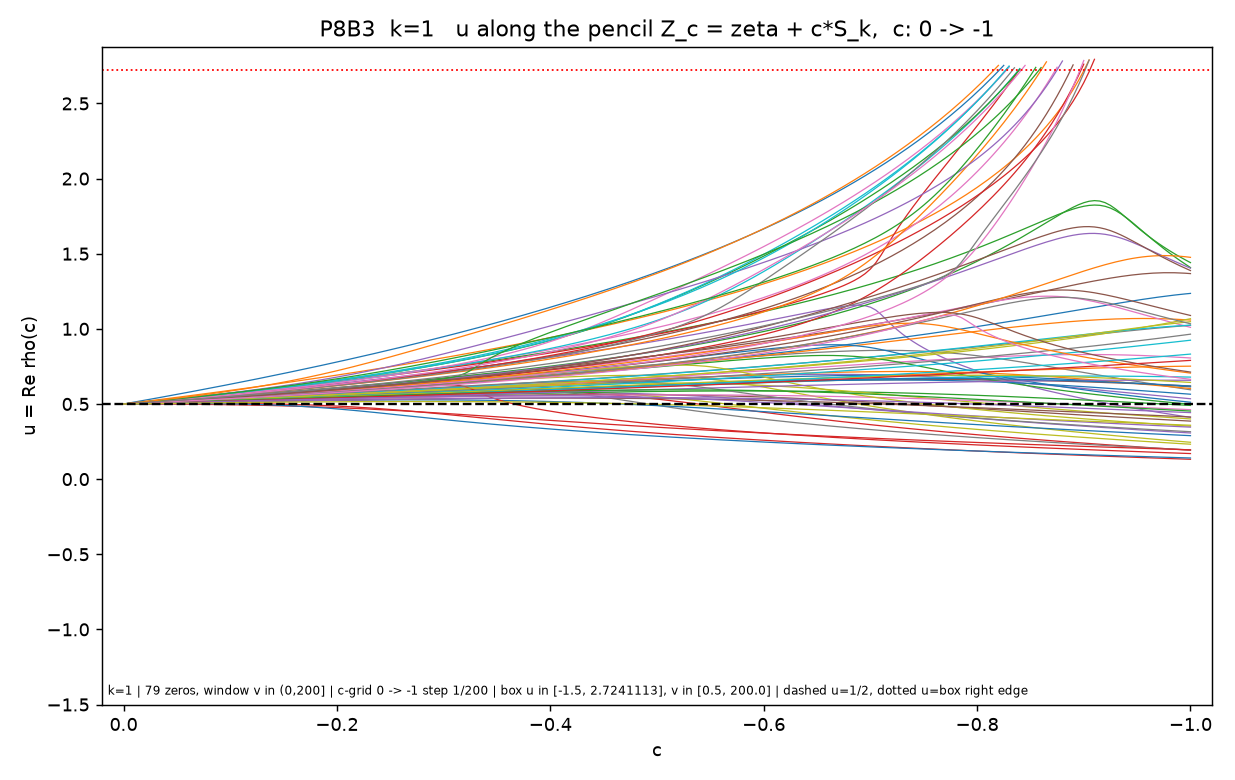
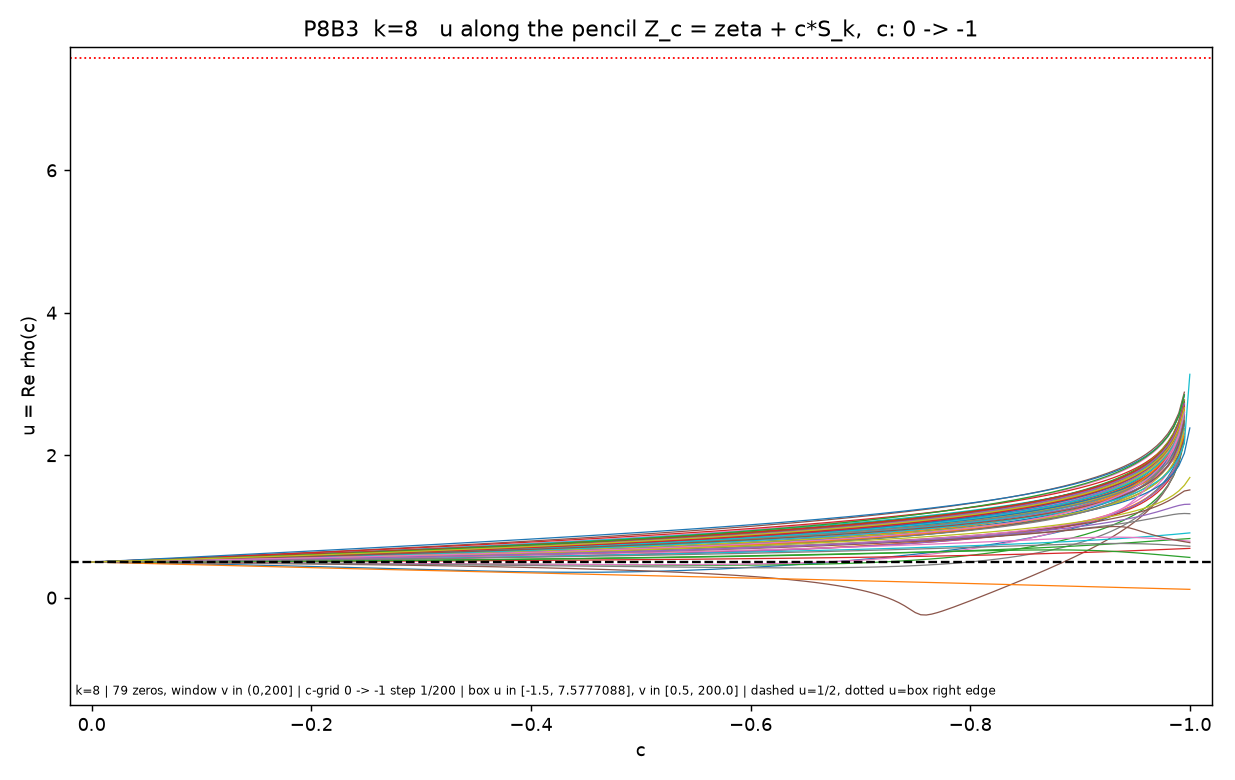
FIG-A
Caption (usable as written). Real part u = Re ρ(c) of each of the 79 zeros of Z_c = ζ + c·S₁ in v ∈ (0, 200), continued along c: 0 → −1 on a grid of step 1/200. Dashed: u = ½. Dotted: the box right edge, u*(1) + 0.3 = 2.7241113, where u*(1) = 2.42411125 is Paper 1's proven, sharp right edge for the tail F₁. At c = 0 the family is ζ and every trajectory starts on the line; as c → −1 the leading coefficient 1 + c of the identity Z_c = (1+c)·S_k + F_k vanishes, the family drops rank, and the roots it releases run to u = +∞ at the derived rate u ≈ −log(1+c)/log 2. Trajectories that terminate at the dotted line have left the box; those that return to finite u at c = −1 are zeros of the tail F₁. Scope pin, printed with the figure. Leg-internal render of a filed CSV (p8b3_traj.csv, leg P8-B 3); it plots data and computes nothing, and no statement in the text rests on it. S₁ ≡ 1, so at k = 1 the pencil's zeros are ζ's a-points at a = −c, and that they leave the critical line is a published theorem (Lester 2014), not a measurement of this programme. The pencil has no functional equation and nothing in this panel transfers to ζ. NO RH CLAIM.
FIG-B
Caption (usable as written). The same construction at pencil index k = 8: Z_c = ζ + c·S₈, S₈ = Σ_{n≤8} n^{−s}, the same 79 ζ-zeros in v ∈ (0, 200), the same c-grid. Dotted: u*(8) + 0.3 = 7.5777088. Read against FIG-A, the two panels exhibit the 1/log(k+1) factor in the derived escape law u ≈ −log(1+c)/log(k+1): the departure from the line sets in later in c and rises more slowly at k = 8 than at k = 1, even though the box is nearly three times taller. The derivation is ch. 9.3 and the panels are its confirmation, never its source — the escape was ratified as measured and re-classified as derived. Scope pin, printed with the figure. Leg-internal render of a filed CSV; plots data and computes nothing. k ≥ 2 has no external enumerator and no banked census — the endpoint counts in this panel are certified by the leg's own argument-principle contour, which caught three wrong endpoint counts the tracking had missed (ch. 9.5). The pencil has no functional equation, Speiser's criterion does not transfer past k = 1, and Levinson's clustering theorem may not be invoked here at all. NO RH CLAIM.
Supplementary materials
The audit layer: how the numbers above were checked, what was corrected, and what is owed to whom.
Open the supplementary materials
This file carries the method record (§13.7, whose numbering continues the main text), the account of what was run (Appendix C), the run record for chapter 6's counterexample apparatus, and the forty-eight-entry errata register (Appendix D).
13.7 The method record, stated without rounding
(Section numbering continues the main text: this is chapter 13.7 of the paper, carried here in full.)
54 corrections were logged over the course of this paper's drafting — across four independently reviewed computation rounds, the by-argument analyses, a per-claim citation audit run against the text after it was otherwise finished, four post-audit review passes, and an independent review pass of 2026-09-03 (six entries, E-P8-47 … E-P8-52, applied 2026-09-04). By class: 9 SPEC · 24 REPORTING · 2 CODE · 12 ATTRIBUTION · 1 SCOPE/TIER · 1 PROCESS · 2 TIER/PROCESS · 1 ROUTING/INSTRUMENT · 2 SCOPE/REPORTING. No defect was found in any measured quantity of any computation.
The tally line above was itself twice in error in earlier revisions, and both errors are entries in the register (E-P8-36, E-P8-46). An early revision printed a class split that never matched the register's own rows — it over-counted SPEC by two and CODE by one, under-counted ATTRIBUTION by one, and silently dropped two rows whose classes were not in its vocabulary; the four errors cancelled exactly, so the total was right and the distribution was wrong. A later revision then updated the total at two printed sites but not the third, leaving a headline of 46 above a split summing to 37. A section that calls the distribution "the finding" and then reasons from a distribution it did not verify is the defect it describes, one layer up. The standing lesson from both: a tally is recounted off the rows, and every site that prints it is re-read; agreement is verified, never asserted.
The distribution is the finding, and it is not flattering.
- A majority of the load-bearing defects sat in the written specifications, not in the computations that executed them. In one round, three of four logged corrections were against that round's own specifications; in the next, two of three.
- Two consecutive rounds carried a pass/fail gate that could not fail — one requiring a median to track its own no-cancellation majorant (ch. 8.4), one requiring a conductor witness on a quantity that is constant in the conductor (ch. 6.3). The construction-invariance convention (ch. 3.2) exists for exactly this, and it was violated at the specification layer, not in the runs.
- How each was caught matters more than the count. One was caught only because the run refuted the hypothesis — had the data fallen near the majorant, the mis-specification would have passed as a confirmation. One was caught only because the reviewing pass re-ran a ladder on a uniform box, which nothing required. One was caught by the run itself, against its own specification, and disclosed when nothing compelled disclosure.
The computations routinely outperformed their specifications, and three instances are worth naming: one established a gate's construction-invariance from the algebra at design time, declared the test excluded from evidence, coded it non-blocking, and substituted a witness where the parameters bite; one measured a mandated method to be unexecutable, re-validated its fallback in the exact box, kept the mandated precision for every gate, and declared the deviation; one found an order-2 pole the specification had not anticipated and fixed its own instrument before filing.
Four gates failed and all four failures were the specification's, not the run's: fixed absolute bars applied to minima of oscillatory witnesses — the exact hazard that specification's own preamble named. All four were reported raw, no bar was weakened, no re-run was requested, and the inapplicable fallback provision was correctly not invoked. A later re-check sharpened the diagnosis: the same perturbation clears the bar at four of eight heights, so the bar was the right scale and the filed cell was a dip of an oscillatory witness — which makes the correction stronger, since a correctly specified gate would have passed.
Copying a convention into a specification's preamble does not apply it. It binds the body. The specification that carried the oscillatory-bar defect names that hazard in its own preamble.
And the sharpest instance came last, from the audit this chapter's own §13.1 predicted would be needed. Six of the final seven corrections were logged after the text was finished, by a per-claim pass over its citations, and every one is an attribution, a tier, or the apparatus that carries them. The largest (E-P8-30) is worth its provenance in full, because the chain is the lesson and no single link in it is the defect:
The decisive source had been fetched, read into the archive at first-hand tier, and correctly logged in one retrieval index — but the two files stating the opposite were never swept. The reference set consulted during manuscript drafting did not include the index where the fetch was logged, so a later drafting pass — working correctly from its stated reference set — was handed a stale sentence by the reference set itself, and built a ruling on it. The review that existed to catch exactly that held the contradicting index line in view and did not cross-check it. Four honest acts, one false sentence, and the only thing that caught it was a pass whose whole job was to ask where did each of these tiers come from.
The mitigation is structural and was applied at once: the retrieval index is now part of the standing reference set for manuscript work. No motivational fix would have helped — every pass in the chain did what its procedure said, and the one that read the most was the one misled. That is the same shape as the programme's other measured lesson (recorded in the companion Paper 6's method record: defects are essentially never caught by the specification's own author), moved one layer up — from the specification to the reference set itself.
Appendix C — What was run
No new data was acquired for this paper. The ζ-zero bank, the 1-point census, the Davenport–Heilbronn on-line list and 193-quartet defect ledger, and f₂'s certified zeros were all recorded before Paper 8 opened.
Each computation was specified in writing with both possible outcomes stated in advance ("confirmed" = the pre-stated positive branch; "failed" = the pre-stated negative branch), before the run.
| Item | Object | Disposition |
|---|---|---|
| S1 | state identity, three degeneracies | DONE by argument, without a run; gated; ch. 2 |
| S2 | canonical vertex | CLOSED on the algebra, never run — the criterion cannot fail; the negative branch recorded; ch. 3 |
| S3 | ζ-free axis + Davenport–Heilbronn control | DONE, verified. Line-blindness reproduced = the pre-stated PASS; the floors took the pre-stated negative branch (an indexing offset, settled at ch. 4.4); ch. 4 |
| S4 | completeness proposition | DONE by argument. No compute now or in future; ch. 5 |
| A1–A3 | u*(k), the O(1/k) coefficient, the head bound | DONE, verified, all confirmed as pre-stated; ch. 12 |
| B2 | the k = 1 calibration gate | RE-SPECIFIED after a first run whose failure was the specification's; re-run; confirmed on all three preregistrations; ch. 7 |
| B1 | velocity field | Confirmed (100/100); the second preregistration failed on the specification's own defect (ch. 8.4); ch. 8 |
| B3 | the flow | Confirmed on rate; failed as pre-stated on survival, the escape algebraically forced; ch. 9 |
| B4 | displacement sum rule | Failed on the CONTINUITY clause as pre-filed; endpoint clause 6/6; ch. 10 |
| B5 | collision set | Confirmed, two scope corrections; ch. 11 |
| C1–C2 | the mismatch | DONE, verified — returns its expected NEGATIVE; ch. 12.5 |
| W1 | is the step law pre-Nickel | Confirmed — it is. Titchmarsh 1951, via van der Corput; ch. 13.3–13.4 |
| W2 | does Davenport–Heilbronn carry the apparatus | Confirmed, on three witness-certified clauses; ch. 6 |
Four independently reviewed computation rounds, five by-argument analyses, one adversarial re-check. Every load-bearing number in every round was independently re-derived before acceptance, not taken on report; where an independent implementation was used it is stated in the chapter.
Instruments of record: the state-vector probe; the calibration locator with its argument-principle certifier; the velocity and flow probes; the Wronskian root-finder and contour counter; the axis-estimator ladder; the invariance-family probes; and the re-check instrument, self-contained at dps 40, which reproduces every figure in chapter 6.
Run record — chapter 6's counterexample apparatus, clause (b)
The per-cell record promised at ch. 6.3(b): the exact finite-t modulus |χ_ℓ(σ+it)| against the conductor shape (5t/2π)^{½−σ}, graded by t·|dev| (ceiling 10), over five off-line σ and eight heights, with the conductor-forced-to-1 witness beside it.
| σ | witness dev (q → 1), stable in t to 5 digits | t·\ | dev\ | at t = 30 / 100 / 300 / 1000 / 3000 / 10⁴ / 3·10⁴ / 10⁵ |
|---|---|---|---|---|
| 0.3 | 0.37973 | 2.33e-4 · 7.00e-5 · 2.33e-5 · 7.00e-6 · 2.33e-6 · 7.00e-7 · 2.33e-7 · 7.00e-8 | ||
| 0.4 | 0.17462 | 1.33e-4 · 4.00e-5 · 1.33e-5 · 4.00e-6 · 1.33e-6 · 4.00e-7 · 1.33e-7 · 4.00e-8 | ||
| 0.6 | 0.14866 | 1.33e-4 · 4.00e-5 · 1.33e-5 · 4.00e-6 · 1.33e-6 · 4.00e-7 · 1.33e-7 · 4.00e-8 | ||
| 0.7 | 0.27522 | 2.33e-4 · 7.00e-5 · 2.33e-5 · 7.00e-6 · 2.33e-6 · 7.00e-7 · 2.33e-7 · 7.00e-8 | ||
| 0.8 | 0.38297 | 2.67e-4 · 8.00e-5 · 2.67e-5 · 8.00e-6 · 2.67e-6 · 8.00e-7 · 2.67e-7 · 8.00e-8 |
Worst t·|dev| = 2.67e-4 (σ = 0.8, t = 30), falling as 1/t; the witness fires at every off-line cell, range 0.14866 … 0.38297, non-decaying in t. Companion checks carried in the main text at ch. 6.3(b): the empirical balance index n_bal = |χ_ℓ|^{1/(1−2σ)} is σ-independent to 2.2e-5 worst, with n_bal/√(t/2π) ∈ [2.23601827815, 2.2360679775] against √5 = 2.2360679775. On the critical line the same witness reads 2.3e-41 — the conductor is invisible there, the test is construction-invariant, and the σ = ½ rows are disclosures excluded from evidence.
Appendix D — The errata register
54 entries: E-P8-1 … E-P8-52 with no gaps, plus E-P6B-10 and E-P6B-15 inherited from the companion Paper 6 series. (An earlier revision of this header printed a stale count against its own table; the figure here is counted off the rows below, which is the discipline entry E-P8-46 exists to enforce.) The register grows and never shrinks: a reclassified or retired entry keeps its ID and its row. This is the summary layer; each entry is one clause, keyed to the paper section it corrected. SPEC = defect in a specification · REPORTING = a filed statement overstating what was measured · CODE = defect in an instrument or filed data product · ATTRIBUTION = a wrong owner, a wrong tier, or a missing one.
E-P8-30 … E-P8-36 were all logged by the per-claim citation audit, against this document after its text was finished. Not one of them moves a number; all seven are attributions, tiers, or the apparatus that carries them — which is precisely the distribution §13.7 discusses and ch. 13.1 explains. The last of them, E-P8-36, is against this register's own class tally.
| ID | Class | One-clause statement | ||
|---|---|---|---|---|
| E-P8-1 | SPEC | absolute bar on `\ | h′\ | ` — a compare-like-with-like defect |
| E-P8-2 | REPORTING | "the Wronskian was a disguise" withdrawn; W is the regular representative, h′ has a double pole at every zero of S_k | ||
| E-P8-3 | SPEC | absolute anchor bar unsatisfiable at its own precision — applied, now precision-derived | ||
| E-P8-4 | SPEC | midpoint predictor against a windowed measurement (ch. 7.7) | ||
| E-P8-5 | SPEC | box truncating the a = 1 family; its warrant contradicted by Paper 1's own record | ||
| E-P8-6 | CODE | winding increment never gated, 55/61 chunks over π/4 | ||
| E-P8-7 | CODE | two-path witness run as a refinement where a coarsening was specified ⇒ a gate that cannot fail. DISCHARGED — path independence later established by the coarsening | ||
| E-P8-8 | REPORTING | transcription trap predicted ~2, measured 1.528 | ||
| E-P8-9 | REPORTING | a winding-gate summary recorded as "clean … comfortably under π/4" on one smoke test generalised to a 61-chunk record run; measured 16/61 FAIL, gated max 3.0187 rad. The incorrect summary had propagated and mis-directed a later revision's starting point | ||
| E-P8-10 | REPORTING | "all 24 cells PASS" invites 24 confirmations; the criterion resolves to six distinct numbers (ch. 7.6) | ||
| E-P8-11 | SPEC | a median required to track its triangle-inequality majorant flat in k — the hypothesis tested the modeller (ch. 8.4) | ||
| E-P8-12 | REPORTING | a cross-computation conclusion outside the computation's own evidence; withdrawn, measured half retained | ||
| E-P8-13 | SPEC | per-k right edges and permitted box moves, but no common LEFT edge before the ladder is read as a sequence. DISCHARGED by a uniform-box re-run (ch. 11.5) | ||
| E-P8-14 | SPEC | mpmath mandated throughout without being costed (> 10 days per cell population); the run's re-validated fallback UPHELD (ch. 10.7) | ||
| E-P8-15 | ATTRIBUTION | step law and chain of local centres conceded to Nickel 2013/2015 — both papers already read first-hand here and unopened for this question | ||
| E-P8-16 | ATTRIBUTION | the condition count is Nickel 2015 §11 / 2013 Conclusions. Downgraded by E-P8-21 | ||
| E-P8-17 | REPORTING | two locators wrong (§10 for §7; a 2015 credit that is also 2013) — a locator taken on report is not a locator read | ||
| E-P8-18 | REPORTING | W_k's order-2 pole and its H_k coefficient filed as the run's discovery; they are a corollary of the round's own identity (ch. 11.2) | ||
| E-P8-19 | SCOPE/TIER | the Puiseux ½ and Paper 6's 0.481 are construction-invariant ⇒ both re-tiered to instrument-check and removed from evidence (ch. 11.7) | ||
| E-P8-20 | REPORTING | a censored trend read as a law and extrapolated into a false structural prediction; the run refuted it | ||
| E-P8-21 | PROCESS | E-P8-16 filed as a new concession when the programme had already conceded it twice, in its own files — and the ledger instruction was read, edited, and not followed | ||
| E-P8-22 | REPORTING | "a double root unfolds as a square root unconditionally, for ANY such family" is FALSE as written — z²−τ² gives 1, z²−τ⁴ gives 2. Non-degeneracy required (ch. 11.7). The re-tiering stands | ||
| E-P8-23 | REPORTING | a diagnostic ("orders 5–6 straddle it") that discriminates nothing — six consecutive orders straddle. Verdict unchanged, now on a comparison that carries it (ch. 4.4) | ||
| E-P8-24 | SPEC | a falsifier-witness required on `\ | χ_ℓ(½+it)\ | `, a quantity that is 1 identically in (q,κ) — a gate that cannot fail. Second consecutive round with a specification-layer gate of that class |
| E-P8-25 | SPEC | four witness gates against fixed bars on MINIMA of OSCILLATORY witnesses — the hazard the specification's own preamble names. All four failures are the specification's | ||
| E-P8-26 | ATTRIBUTION | the step law RE-ROUTED past Nickel to Titchmarsh §4.12 / van der Corput. "Naming the prefactor χ" withdrawn; no identity-ledger row withdrawn — it never had one | ||
| E-P8-27 | REPORTING | the ξ-witness row's mechanism wrong (the bar is the right scale; the filed cell is a dip — it clears at 4 of 8 heights) and its endpoints quoted in the wrong register. E-P8-25 strengthened | ||
| E-P8-28 | REPORTING/SCOPE | a headline box asserting at witness grade the one clause its own ruling records as witness-incomplete — and it propagated verbatim into a live working file. The qualified form is what ch. 6.3(d) prints | ||
| E-P8-29 | REPORTING | a transcription defect in a verbatim first-hand quote (λ₂^{1/6}λ₃^{1/6}, not λ₂^{2/3}λ₃^{1/3}) — non-load-bearing, and it makes the attribution STRONGER (ch. 13.4) | ||
| E-P8-30 | ATTRIBUTION | ch. 13.6(2) originally ruled that three carve-outs are UNRESOLVED because the decisive source was "not on this disk, never verified first-hand, could not be re-checked." Kapitonets, arXiv:1910.08363, had in fact been archived at first-hand tier with a full text layer BEFORE that chapter was drafted. Read first-hand: his index is pinned (m = ⌊√(t/2π)⌋, §2.6; tied to t by his eq. 73) and his L1/L2 are the two AFE arms sharing it — so it does not defeat the free-index carve-out. ⇒ the REASON is withdrawn, the CONCLUSION stands on better ground, and the carve-outs are recorded as UNSEARCHED rather than blocked: removing a blocker is not establishing novelty. Tier moves to first-hand; one exposure closes. Provenance chain at §13.7 | ||
| E-P8-31 | ATTRIBUTION | E-P6B-10's fifth and sixth sites — App. A and ch. 13.1 still credited Garunkštis–Šimėnas 2015 for the velocity ODE after the earlier four-site correction. App. B was correct throughout and the 2007/2015 split is blurred nowhere | ||
| E-P8-32 | ATTRIBUTION | |||
| E-P8-45 | ATTRIBUTION | A correction of a correction — the second erratum-layer defect in two editions. E-P8-32 had added an author who is not on the paper. Turkish J. Math. 43 (2019) 2921–2930 is by Ramūnas Garunkštis alone — verified at the page image: one author, one Vilnius affiliation; Šimėnas appears in its ten pages only in reference [5], the 2015 Eur. J. Math. paper, which IS two-author. The vector was a secondary bibliographic record whose header line carried both names — the same class of defect as E-P8-37 (a verbatim block in a secondary record is not a first-hand tier), this time laundered through a correction into four sites of the manuscript. The standing gates cover computation specifications and probes; they do not gate the prose of a correction — the finding E-P6B-15 had already made one edition earlier. No computed quantity moves. All affected sites patched: ch. 11.4, App. B, App. D, App. F, and the secondary record itself | ||
| E-P8-33 | REPORTING | ch. 13.1's "in every case the source was ALREADY a first-hand source in this programme" — false for the eighth concession, which had to be fetched. The exception is printed rather than the count bumped | ||
| E-P8-34 | REPORTING | App. F asserted "no claim in this paper gates on an (S) or a (U)" and named two exceptions; four further (S) entries were carrying claims. Replaced by a five-item exposure block with costs printed | ||
| E-P6B-10 | ATTRIBUTION | Inherited from the Paper 6 series and listed here because it governs chs. 8–9 and App. B of this paper. The velocity ODE, its numerical trajectory solution and the stable/unstable classification re-date eight years, to Garunkštis–Steuding, Math. Comp. 76 (257) (2007) 323–337, §3 — not Garunkštis–Šimėnas 2015. The ruling splits and the split is load-bearing: the FE-preserving convex family stays Balanzario–Sánchez-Ortiz 2007; the ζ-endpoint dial and the derivative witness stay Garunkštis–Šimėnas 2015 §2. Narrowed by E-P6B-15 (below), against this row's own exclusion reason: that reason is true of Garunkštis–Steuding 2007, the Hurwitz paper, and had been applied to a DIFFERENT 2007 paper — Balanzario–Sánchez-Ortiz 2007 IS FE-preserving and DOES carry the collision argument, at §3. The collision-forced-by-the-FE argument therefore moves to BSO 2007 §3. For this paper the finding applies at full width, the pencil having no functional equation either. No identity-ledger row withdrawn — the ledger carries none for the ODE | ||
| E-P8-36 | REPORTING | This register's own class tally never matched this table, and it summed correctly only by offsetting errors. An early revision printed "11 SPEC · 13 REPORTING · 3 CODE · 2 attribution re-routes" against 29 rows. Counted off the rows: 9 SPEC, 13 REPORTING (including E-P8-28's REPORTING/SCOPE), 2 CODE, 3 ATTRIBUTION — and TWO rows in neither vocabulary, E-P8-19 (SCOPE/TIER) and E-P8-21 (PROCESS), which the tally silently dropped. The four errors cancel to zero, so the total 29 was right for the wrong reason. It matters because §13.7 calls the distribution "the finding" and reasons from it | ||
| E-P8-35 | REPORTING | App. F omitted thirteen sources named in the text — including Garunkštis–Steuding 2007, the antecedent this paper re-dated by eight years — and mis-tiered six more, five of them UPWARD (Davenport–Heilbronn 1936, an unqualified "Spira" spanning four different papers, Landau, Garunkštis 2019, Berry; Lester and Dyakonov were under-tiered). No number moves | ||
| E-P8-37 | ATTRIBUTION | The Spira 1976 concession holds and a proposed restoration is refused — ruled at the page image. Two reviews reached opposite conclusions on the same row in one round. Theorem 1 is σ ⩾ 1 + a with hypothesis 0 < a ⩽ 1; the domain is invoked once, at Bernoulli's inequality, and is not used — every step is uniform in a > 0, so the argument covers a = k+1 ⩾ 2 verbatim. A secondary transcription had carried < and > at both sites because a shift-decoded text layer renders ⩽ as < and σ as a, and the defect propagated into two working documents and a review. Standing lesson: a verbatim block in a secondary transcription record is a secondary record and is not a first-hand tier | ||
| E-P8-38 | TIER/PROCESS | An archived item catalogued as the Balanzario–Sánchez-Ortiz 2007 paper was NOT the paper — it was 23 pages of the publisher's website, its first page reading "Item Successfully Added to Cart", while its catalogue record called it a scanned image with no text layer: all three clauses of that record were false. No number moves — the locators had been carried, never read. [DISCHARGED: the paper itself was later archived and read in full at first-hand tier, and all three objects App. B credits to it ARE in it. See E-P8-41, E-P8-42, E-P8-43.] | ||
| E-P8-39 | ATTRIBUTION | App. F carried Spira 1976 at statement-level on the sentence "None is at (V)", true when written and false after the page-image read — the paper is archived and its Theorem 1 has been read off the page image twice. Nil mathematically; E-P8-30's shape one source over. Applied to App. F | ||
| E-P8-40 | REPORTING | the programme's standing concession table carried three superseded rows (the zero-velocity ODE still credited to Garunkštis–Šimėnas 2015 — E-P6B-10's seventh site and the first outside the manuscript; the van der Corput tier line; and one further), each already corrected elsewhere in the same file. A summary table is the place a later revision lifts a line from, which is why staleness there is logged at full weight | ||
| E-P8-41 | TIER/PROCESS | The concern behind E-P8-38 was itself premised on a false sentence at the site. A copy of the paper had been in the project archive for two weeks, byte-identical to the fresh download, with a full first-hand read on file printing all thirty published zeros and a working locator — and it had been read first-hand a second time, by two independent readers, while App. F said it "was not re-read here." No number moves; every locator checks out. Mechanism, and it is new: a source can be first-hand-in-fact and unobtained-in-the-index at once, when the index is the only place a sweep looks | ||
| E-P8-42 | ROUTING/INSTRUMENT | The stated cause of the failed fetch behind E-P8-38 was wrong, and the generalisation was the damaging half. The failure varied with the archive's path layout, not with the request's identification headers; the earlier user-agent finding (Spira 1976) is real and is NOT withdrawn — what was wrong was generalising it to the whole host, which then explained a failure it did not cause. Standing lesson: a successful-looking response is not a successful fetch until its content type is validated | ||
| E-P8-43 | SCOPE/REPORTING | App. B's Balanzario row bundled two different families and cited a loose remark as a theorem. The owner does not move and the concession stands at full width; only the description narrows. §2's deformation — the one that computes the thirty zeros — is not FE-preserving (its endpoints satisfy two different functional equations, sine against cosine factor); §3's IS, with a different, constructed f₁. Theorem 1 carries no FE and no convexity hypothesis and is local in τ, so it does not give persistence to τ = 1. Collision-before-departure is unnumbered and unproved ("It is easy to see… Loosely speaking"). And §3 names both endpoints of the programme's own dial on one page | ||
| E-P8-44 | REPORTING | This register was stale by four entries and three totals were in play — 37 printed, 38 present in the text, 41 owed. Four corrections had been logged with no rows, and two IDs had entered the body without register rows, widening the gap. Resolved: rows added for E-P8-37…-44 and E-P6B-15, and the tally below recounted off the rows rather than incremented | ||
| E-P8-46 | REPORTING | E-P8-44 recorded that all three printed tally sites agree. They did not — §13.7 had not been updated and carried an older split under the newer total: 46 in one sentence and a distribution summing to 37 in the next, with the two out-of-vocabulary classes missing. This is E-P8-36 recurring inside the very chapter that describes E-P8-36, and it survived the earlier recount because that recount checked the rows and this appendix's own line, not every site that prints the number. ⇒ Standing: a tally is recounted off the rows AND every printed site is re-read; agreement is verified, never asserted. All three sites recounted and brought into agreement. No computed quantity moves | ||
| E-P6B-15 | ATTRIBUTION | Inherited from the Paper 6 series, and it narrows E-P6B-10 where this paper's App. B and App. D both carry it. Collision-before-departure re-dates to Balanzario–Sánchez-Ortiz 2007 §3, eight years before Garunkštis–Šimėnas 2015 — both read first-hand — and the two versions are at the same strength: neither is a theorem. An earlier finding had already said so before two later corrections reversed it, so App. B and E-P6B-10's prose had contradicted each other since the first draft. The derivative witness and the specific ζ-endpoint dial stay at GŠ 2015 §2. Cause: E-P6B-10's exclusion reason is true of Garunkštis–Steuding 2007 and was applied to a different 2007 paper — two papers of one year merged by a reason true of one. No computed quantity changes | ||
| E-P8-47 | REPORTING | ch. 12.1, 12.2, 12.5, 12.6, ch. 14.6, App. A, App. E H2 — "the tail's right edge is proven, sharp, approached": u*(k) is the threshold of a triangle inequality whose equality configuration (every term m ≥ k+2 anti-aligned with the leading one) is impossible by phase additivity over the primes, and on the Kronecker torus the infimum is attained and positive ⇒ the supremum of zero abscissae is STRICTLY below u*(k) for every k; at k = 1 the Euler product gives a rigorous edge σ ≤ 1.9401 against the printed 2.4241, and the paper's own zero table shows gaps ≈ 1 at every k. found by an independent review pass of 2026-09-03 (§C-1) | APPLIED v0.2: "sharp" and "approached" withdrawn at every site; the k = 1 theorem and the Bohr heuristic printed at ch. 12.1; the LAW as an upper bound with its constant ln 2 stands; the true edge for k ≥ 2 is OPEN. No measured quantity moves | |
| E-P8-48 | SCOPE/REPORTING | ch. 5 — clause (v) "COMPLETENESS" quantified over "any function" while the family takes no function as input (vacuous as written), excluded the one row that matters (the mirror product with ζ or D-H, not a member as written), and is one line of Schwarz reflection; clause (ii)'s "iff" lacked its hypothesis (≥ 2 nonzero coefficients) and its only-if proof in the master (the public form had both since Phase 1); clause (i) was graded MEASURED for a two-line identity. found by an independent review pass of 2026-09-03 (§C-2, §C-3, §C-4) | APPLIED v0.2: §5.0 states the lemma and derives the proposition from it; (v) renamed CLOSURE with its true content; (ii)'s hypothesis and proof carried into the master from the public form; (i) re-graded PROVEN; the chapter title says "one lemma of Schwarz reflection". Nothing measured moves | |
| E-P8-49 | REPORTING | CEILING S (head of paper and every Part header) names "the line-selective angular invariant", which no chapter defines — the phrase occurs only at the ceiling sites. found by an independent review pass of 2026-09-03 (§C-5) | APPLIED v0.2: defined at the ceiling as ch. 5's reflection lock, arg[F(s)F(2a−s)] ≡ 0 on σ = a, phase content at a = ½ the classical χ(½+it) = e^{−2iθ(t)} | |
| E-P8-50 | ATTRIBUTION | ch. 12.4–12.5 — F₁ = ζ − 1 is the 1-point set of ζ and the k = 1 pencil is Landau's a-point family, never named as such, so §12.5's failed search at k = 1 was aimed at the wrong register (the tail/partial-sum literature instead of the a-point literature); ch. 12.4 credits "constant best possible" to Montgomery 1983 at tier (U) with no cited owner of the matching upper bound. found by an independent review pass of 2026-09-03 (§C-6, §C-7) | APPLIED v0.2: the 1-point identification printed at ch. 12.5 with the a-point register named (Landau; Bohr–Jessen; Levinson 1975; Selberg; Steuding LNM 1877 ch. 7, on disk at (V)); the Turán / Voronin / Montgomery–Vaughan recollection recorded at ch. 12.4 as a SEARCH LEAD, not a citation — none opened here | |
| E-P8-51 | REPORTING | two live count conflicts: App. D's opening line printed "46 IDs, E-P8-1 … E-P8-44" against 48 at three other sites (the fourth site, which E-P8-46's recount did not reach); ch. 3.5 printed n₁ = t/π − ½ and, three paragraphs later, n₁ = t/π = 2x₁ exactly, with App. A carrying the composite t/π − ½ = 2x₁ — false by ½ since x₁ = t/2π. found by an independent review pass of 2026-09-03 (§C-8, §C-9) | APPLIED v0.2: App. D's opening line corrected and every tally site recounted to 54; n₁ = t/π − ½ = 2x₁ − ½ at ch. 3.5 and App. A (the ladder gives t/π − ½ + O(1/t); "exactly" withdrawn) | |
| E-P8-52 | REPORTING | ch. 6 headline "closed by measurement": the ruling is a corollary of two 1936 facts (Davenport–Heilbronn has a Riemann-type FE, hence an approximate functional equation of the two-arm shape, and has off-line zeros); ch. 6.3(d) already says the AFE "is classical and needs no measurement". The measurement is an instrument check on the corollary, not what establishes it. found by an independent review pass of 2026-09-03 (§C-10) | APPLIED v0.2: one paragraph at ch. 6.5 saying what establishes the ruling and what the measurement adds; the ruling itself is unchanged |
Class tally, counted off the rows above and re-counted whenever a row is added (never incremented): 9 SPEC · 24 REPORTING · 2 CODE · 12 ATTRIBUTION · 1 SCOPE/TIER · 1 PROCESS · 2 TIER/PROCESS · 1 ROUTING/INSTRUMENT · 2 SCOPE/REPORTING = 54. 48 entries: E-P8-1 … E-P8-46, with no gaps, plus E-P6B-10 and E-P6B-15 inherited from the Paper 6 series. (Counted mechanically off the table's own rows — 48 rows, 48 distinct IDs — and then checked against every printed site, which is the step E-P8-46 exists for.) The REPORTING figure includes E-P8-28's REPORTING/SCOPE; E-P8-19 (SCOPE/TIER), E-P8-21 (PROCESS), E-P8-38 and E-P8-41 (TIER/PROCESS), E-P8-42 (ROUTING/INSTRUMENT) and E-P8-43 (SCOPE/REPORTING) are listed in their own classes rather than folded into a vocabulary with no room for them — that folding is what the earliest tally did silently. The eleven ATTRIBUTION entries are E-P8-15, -16, -26, -30, -31, -32, -37, -39, -45 and the two inherited E-P6B-10 and E-P6B-15. No defect has been found in any measured quantity of any computation. Discussion at §13.7.
Recorded and NOT logged as entries, because nothing was filed from them: a gate first specified on an absolute bar over vectors that do not share a scale (ch. 2.4); a reviewer's own scratch comparison of two registers that briefly appeared to contradict a filed constant — a compare-like-with-like slip of exactly the class E-P8-23 records — from which nothing was filed.