Packet Centroids II
The Fresnel Mechanism, Coil Geometry, and Zero Conditions of the Partial-Sum Walk
What the error term actually is, measured to a parameter-free prediction, plus the coil law and the first structural obstruction: every line-selective invariant of the walk turns out to be deterministic.
Read this as a workbench
This site is a record of a workbench, not a record of finished results. Rigorous standards were applied to the arXiv paper alone. The paper below is the project's own text, complete — including the negative results, the priority concessions and the errata.
Packet Centroids II: The Fresnel Mechanism, Coil Geometry, and Zero Conditions of the Partial-Sum Walk
Ondřej Dvořák1
AI models used: main coordinator Fable 52; distributed tasks Claude Code (Opus, Sonnet)3; consultations ChatGPT4, Gemini5, Grok6
1Independent researcher, Děčín, Czech Republic. on.dvorak@email.cz 2Anthropic Fable 5. Main coordinator — probe design and pre-registration, adjudication, proof review, drafting, assembly. 3Anthropic Claude Code (Opus and Sonnet models). Distributed tasks — computation, probe execution and evaluation, literature verification, manuscript preparation. 4OpenAI ChatGPT. Consultations — research consultation and literature cross-verification. 5Google Gemini. Consultations — research collaboration and geometric interpretation. 6xAI Grok. Consultations.
Draft 2026-07-16. Venue: Experimental Mathematics. Continuation of [1]. Census data freeze 2026-07-08.
Abstract. In Paper 1 [1] we proved that the packet centroids of the partial sums of ζ(s) satisfy offk = χ Pk + χ t−1/2Φk with Φk bounded and oscillating, and measured a high-precision census of the associated root families Fk(w) = 0. This continuation is the second stage of a two-stage introduction to the project: everything the framework became when it was pushed. Part I identifies the error term as a computable mechanism: the measured Φk matches a parameter-free computation of the paper's own endpoint-Fresnel mechanism at median R2 = 0.993 with zero fitted parameters, the residual is fully attributed, at measured precision, to instrument artifacts of the prediction itself, and the identification is stated as an explicit target theorem whose proof burden is mapped term by term against measured certificates. Part II establishes the protective null register at the Riemann–Siegel anchor: an exact identity yields a zero census with ≥ 7 orders of on/off-line discrimination at the exact evaluation rung, and the machinery is measured to be zero-blind in its remainder and wobble observables at both of its scales. Part III derives the geometry of the remainder walk in closed form — radius law, slope defect δ(u) = −1 + (u/2)cot(u/2) with band constant −0.250778 reproducing the independently filed fit to all digits, universal chirality, winding −1 per coil at smooth order — and builds from it a per-candidate winding veto, a window budget with two proven parity propositions and a gated B = 0 certificate on the filed windows, and a ζ-free axis estimator; every one of these instruments is measured line-blind on a Davenport–Heilbronn control that provably has an off-line zero. Part IV reports the zero-condition program as a completed measurement: the Riemann–Siegel skeleton pair carries exactly one identity-pinned condition on the critical line and none off it, the reference family saturates at two real conditions (a counting theorem), and a campaign — replication on fresh windows, kill semantics fixed in advance, tripled samples — retires every apparent zero-conditioned statistic of the register by naming its carrier and finds no second condition anywhere in it; nothing statistical in this register supplies one, and this paper neither constructs nor claims one by any other means. Part V positions all of it in the literature — Fk(w) ≡ ζ(w,k+1) at integer parameter, apparently unstudied for α ≥ 3; the displacement constant c = 1.023 ± 0.011 reframed as a finite-height plateau of the Selberg–Tsang √loglog t law; the Nickel, Reglade, and Booker antecedents of the geometric instruments conceded with distinguishing sentences — and curates the program's negative results with named root causes.
AI assistance: Large language models were used for computation, proof drafting, proof checking, literature consultation, cross-verification, editing, and manuscript preparation. The mathematical arguments were drafted and checked by these models, including repeated blind refereeing by independent model instances; the author has not independently verified every proof. The author originated and directed the research programme, made the methodological and editorial decisions, reviewed the manuscript, and accepts responsibility for presenting this material. The work is written so that every claim can be checked from what is printed and deposited, without trust in either the author or the models.
Record of work: These files are a record of work, not a record of results. They include measurements that were later corrected, conjectures that were refuted, and observations that have never been checked against the literature. Every claim is marked with which of those it is.
PART I — The Mechanism of the Centroid Error
Chapter 1 — Introduction: two papers, one project
1.1 A two-stage introduction
This paper and its predecessor [1] are a two-stage modular introduction to a single project, not a chronicle of it. Paper 1 proved the framework and measured the census: the packet-centroid smoothing identity (Theorem 1), the displacement sum rule (Proposition 2), and the high-precision census of the root families Fk(w) = 0 with its spacing, split, and moment statistics. This paper is everything the framework became when it was pushed: the error term identified as a computable mechanism (Part I), the Riemann–Siegel anchor and the measured statement of what the machinery does not see (Part II), the geometry of the remainder walk — a classical object, and the instruments it yields (Part III), the zero-condition program and its completed measurement campaign (Part IV), and the positioning of all of it in the literature, including a curated chapter of negative results (Part V).
The paper is written as if composed after all of its findings — the architecture is retrospective. Discovery order is retained only where it is itself part of the method: Chapter 2 records the conceptual reconceptions in the order they occurred (measurements were designed by the geometry, then evaluated against statistics fixed in advance), and Chapter 11 presents the measurement campaign in the sequence it was run, because the kill semantics were declared before the runs.
The question of whether the framework's exact identities could be pushed toward zero conditions, raised but left open in this paper's first assembly, became the project's main line; its complete execution and closure are now Part IV of this paper.
1.2 The floor: what Paper 1 proved
All definitions and proofs of [1] remain the floor of what follows. We restate the load-bearing minimum.
For s = σ + it in the strip, the partial sums SN(s) = ∑n ≤ N n−s organize into packets: the saddle abscissae xν = t/2πν divide the integers into gaps Gk = (xk+1, xk), |Gk| = t/2π k(k+1), and within each gap the running sum describes one coherent arc. The packet centroid ⟨S⟩k(s) is the uniform average of SN over integers N ∈ Gk; its offset is offk(s) = ζ(s) − ⟨S⟩k(s). With Pk(s) = ∑m≤ k ms−1 and χ the classical functional-equation factor linking ζ to its reflection across the critical line, defined and used throughout [1]:
Theorem 1 (proved in [1], §2; not reproved here). Uniformly on compact [σ0,σ1] ⊂ (0,1), offk(s) = χ(s)Pk(s) + χ(s) t−1/2 Φk(t;{t/2π k},{t/2π(k+1)}), Φk bounded and oscillating; it must be carried as an oscillating prefactor, never absorbed into a smaller power of t.
The proof mechanism — exact Stieltjes truncation, Poisson expansion of the ψ-integral, saddle classification into captured (ν ≤ k, weight 1, creating Pk), ejected (ν = k+1, weight 0), and distant (ν ≥ k+2, summable) frequencies, with the dominant error the pair of endpoint Fresnel-truncation defects Fk, Fk+1 — is not background here: Chapter 3 measures it term by term, and Chapter 4 states it as an explicit formula.
Corollary 2.3. Zeros of the centroid ⟨S⟩k at s = σ + it correspond exactly to roots w = (1−σ) + it of Fk(w) = ζ(w) − Sk(w) = 0 — for k = 1 the 1-points of ζ; each centroid zero lies within |Ek|/|Fk'(w)| of its root. As established in Chapter 12, Fk(w) ≡ ζ(w, k+1): the root families are the zeros of the Hurwitz zeta function at integer parameter.
Proposition 2 (proved in [1], §4; not reproved here). The total signed displacement obeys Dk(T1,T2) = T2−T14πlog(k+1) + Ok(log T2), proved by applying Littlewood's lemma [5] twice with identical cancellation of the line integrals (the "free" rule, Remark 4.1.4), and confirmed by pre-registered deficit closure to ≤ 0.6% at every tested k.
The census (Paper 1 §3; data freeze complete). Seven windows, t ∈ [200, 105]: displacement constant c = 1.023 ± 0.011 with distribution collapse; sub-GUE small-gap stiffness (×6 suppression vs the GUE-consistent Riemann-zero control); negative skew −0.443 (trimmed), growing with t; splits 49.3% (k=1, consistent with 50/50) and 54.9% (k=2, explained by Proposition 2's ROS anatomy). Chapter 12 positions each of these against the literature.
The RS anchor (Paper 1 §5 + Post Scriptum). At NRS = ⌊√t/2π⌋ the machinery meets the classical Riemann–Siegel formula: the remainder obeys |R(s)| = (t/2π)−σ/2F(p)(1+o(1)), p = {√t/2π} — measured first, identified classical after (Siegel [2]; Gabcke [3]; Arias de Reyna [4]), no priority claimed — and the landing is zero-blind. Chapters 5 and 10 continue at this anchor.
1.3 What this paper contains
Part I — The mechanism of the centroid error (ch. 1–4). Paper 1's declared open surface was the functional form of Φk. Chapter 3 closes it empirically: the measured Φk matches a parameter-free computation of the paper's own endpoint-Fresnel mechanism at median R2 = 0.993 with zero fitted parameters [row 1], and the residual is fully attributed to instrument artifacts of the prediction itself [rows 2–4]. Chapter 4 states the identification as an explicit target theorem (Theorem 2 — stated, not claimed proven) with the proof burden mapped term by term against measured certificates. Chapter 2, first, records how the geometric reading evolved — including the reconception this Part rests on and the one Part III later restores.
Part II — The Riemann–Siegel anchor and the null register (ch. 5–6). An exact identity at the RS cutoff yields a zero census with ≥ 7 orders of on/off-line discrimination at the exact evaluation rung [row 9], and the single zero-conditioned observable of the record (dpre) is mechanically explained. The machinery is then measured to be zero-blind in its remainder and wobble observables at both of its scales, under blinded designs where applicable [rows 12, 13, 19]. The null register is protective: every mechanism claim in the paper is written against it.
Part III — The geometry of the remainder walk (ch. 7–9). The tail walk of the partial sums — the coil — is derived in closed form: radius law, slope defect δ(u) = −1 + (u/2)cot(u/2), the band constant −0.250778 reproducing the filed measurement to all digits [rows 34, 35], universal chirality, and winding −1 per coil at smooth order. From it the Part builds the winding veto, the window budget with its two proven parity propositions, the gated B = 0 certificate (all clauses PASS on the three filed windows [row 38]), the ζ-free axis estimator [rows 32, 33], and the pair product ΠM with its finite reality criterion — closing with a theorem-grade structural negative: every line-selective pair invariant is deterministic in (σ, t), so the geometry yields instruments, not new zero conditions.
Part IV — The zero-condition program (ch. 10–11). The skeleton pair (A, B) = (SNRS(s), SNRS(1−s)) carries exactly one identity-pinned condition on the line and none off it; the (p, d) coordinates make the split exact, the Ψ ≥ cos(3π/8) certificate makes on-line crossing detection unconditional [row 23], and a counting theorem shows the reference-family saturates at two real conditions [row 25]. Chapter 11 then reports the complete pre-registered measurement campaign — every apparent zero-conditioned statistic of the skeleton register replicated, chased, and killed by its own pre-declared semantics [rows 26, 27, 37, 40] — and states the closure: no statistic of the skeleton register is zero-conditioned beyond exact identity forcing — a completed measurement result that closes the statistical route entirely; a second condition, if one exists at all, would have to be a new exact identity, and this paper exhibits none.
Part V — Positioning (ch. 12–14). Chapter 12 carries the census literature verdicts of the first assembly verbatim (§12.1–12.7, novelty language locked) and adds §12.8 for the Part III–IV material: the Nickel 2013/2015 and Reglade 2019 antecedents conceded with distinguishing sentences, the Booker parity concession, the no-antecedent list with failed-search records, and the argζ' literature gap. Chapter 13 is the negative-results chapter — mandatory, curated, each entry naming what was tested, the killing statistic, and the root cause. Chapter 14 states where this leaves the problem: four structural blockers as measured facts, and the surviving open list.
Appendices. Appendix A is the identity ledger: every identity the program discovered or defined, with status (new / classical-identified / program-defined), verification floor, and chapter home. Appendix B is the audit concordance: every statistic quoted in this paper mapped to its row in the formal statistics-audit annex (rows 1–21, 22–41 and 42–43, 43/43 PASS).
1.4 Framing, claims, and the audit discipline
The framing of Paper 1 §6.1 is binding for every chapter: the geometry of partial sums is a high-precision microscope on the finite-T value distribution of ζ; the mechanisms it exposes are explained by classical theorems, not enforcing them. Chapter 14 restates this frame with the claim ledger by tier; the null register of Chapter 6 and the closure of Chapter 11 are its measured content — the machinery provably does not see zeros in its remainder and wobble observables, and the program's strongest permitted conclusion is stated as a measured negative.
Three disciplines govern the text. (i) Audit anchoring: every statistic quoted in this paper carries a bracketed row number referring to the formal statistics-audit annex (Appendix B; 43/43 statistics PASS, each verified digit-for-digit against its report of record); named findings are additionally cross-referenced by a short alphanumeric label tied to the same annex and to the identity ledger (Appendix A) — these labels are internal catalog identifiers, not separately defined objects, and each occurrence carries its own descriptive gloss in the sentence where it appears. (ii) Negative results stay in the record: disproved explorations with named root causes are curated in Chapter 13, and each refuted claim names its killing statistic and measure. (iii) Where two alternative computational paths exist, both are recorded (the fidelity ladder of §3.6, the fixed-ε refutation of §5.2, the vertex/axis metric halves of Chapter 8); a chosen path never silently erases the alternative.
Chapter 2 — Conceptual Evolution
The route to this paper's results was geometric, and recording it is part of the method: measurements were designed by the geometry, then evaluated against statistics fixed in advance. Three reconceptions organize the record — two from the mechanism phase, and a third, later, that returned to the starting picture and found it classical.
2.1 From winding to signed accumulation
The partial-sum spiral was first read as a winding picture: arcs, curl flips, inflections. Two exact structures organized it. The chirality event ladder nk = 1/(ekπ/t − 1) locates the events: odd rungs are curl flips, even rungs inflections (100% on 800 skeletons). The ladder is not independent geometry: the even rung sits at the packet boundary, n2ν = xν − 12 + O(ν/t) with the O-term equal to the next ladder term 2νπ/12t (measured ratio 1.00), exactly one odd rung interior to each packet (parity 1261/1261 outside the near-head aliasing shell) [row 17], and the −12 boundary offset is Paper 1 §2.5's wobble variable by algebra — the ladder is the packet structure seen through events, no new object. The productive reconception was to stop counting turns and read the spiral as a signed accumulation process: each packet contributes a coherent signed increment, and the question "what does the trajectory do" becomes "what does the accumulation mechanism contribute per packet and what is left over."
2.2 From signed accumulation to the Fresnel frame
The leftover is Theorem 1's error term, and the second reconception was to treat the Fresnel representation not as a proof device but as the frame in which the winding mechanics realize themselves: a continuous phase gradient (the stationary-phase flow) redirected discretely at the integer lattice. That frame is what the P-PH2 instrument computes literally — endpoint Fresnel defects with exact phase variables on the actual integer lattice — and its parameter-free match at R2 = 0.993 (Chapter 3) [row 1] is the payoff of the reconception. The narrative order of Part I (measure Φk → refute the harmonic class → predict from the mechanism → attribute the residual) is the actual discovery order.
2.3 The return of the winding picture: the coil as a classical object
The first reconception set turn-counting aside because, at the packet scale, it was not the productive read. It returned at a different scale as an exact object. After the mechanism was identified and the zero-condition program had fixed its vocabulary, the geometry under study became the tail walk itself — the trajectory of DM = SM(s) − ζ(s) as the truncation point M runs, which spirals through one full turn per unit of log M: the coil.
The third reconception is that the coil is not phenomenology but a classical smooth object with the lattice as its only discrete content. Summing the Euler–Maclaurin Bernoulli series — which converges on the band u = t/M < 2π, i.e. everywhere past the last packet — gives the radius in closed form, |DM| = M1−σ|s−1|·u/2sin(u/2)·(1 + O(1/t)), the smooth factor being the Bernoulli generating function iu/(eiu−1); the log-radius slope defect is δ(u) = −1 + (u/2)cot(u/2), whose band average reproduces the independently filed fit constant −0.250778 to all filed digits [rows 34, 35]; the bearing is strictly monotone, so the winding is exactly −1 per coil at smooth order; and the coil's chirality is universal — one sense for all σ and all t > 0, measured at 100.0% of 143,630 turns [row 30]. The winding picture, in other words, was not wrong; it was classical — its per-step angle and step-length laws have a real antecedent (Nickel 2013 [37]; §12.8), and its correct role in this project is instrumental. Part III develops exactly that: the closed form and its constants (Chapter 7), the winding veto, window budget, and certificates built on them (Chapter 8), and the pair product that renders the on-line/off-line distinction in the coil vocabulary, together with the obstruction that closes the route to new zero conditions (Chapter 9).
The provenance is recorded: the signed-accumulation reading and the coil-winding veto entered the project as structural proposals from the author, the latter from a hand sketch of the mirror-coil pair; the derivations and instruments that followed are the programme's own.
Chapter 3 — The Mechanism of the Centroid Error
3.1 The open surface of Paper 1
Theorem 1 (Paper 1 §2) proves offk(s) = χ(s)Pk(s) + χ(s) t−1/2 Φk(t;{t/2π k},{t/2π(k+1)}) with Φk bounded and oscillating, and mandates (Paper 1 §2.5) that Φk be carried as a bounded oscillating prefactor, never absorbed into a smaller power of t. The functional form of Φk was the paper's declared open surface: the proof identifies its phase variables (the lattice offsets {t/2π k}, {t/2π(k+1)} of the endpoint saddles) and its origin (the endpoint Fresnel-truncation defects Fk, Fk+1 of §2.4), but bounds it rather than computing it. This chapter closes that surface: the measured Φk is the paper's own §2.4–2.5 endpoint-Fresnel mechanism, identified by a parameter-free prediction with zero fitted quantities, and its residual is fully attributed to instrument artifacts of the prediction itself. Tier: T3 verified law + T4 mechanism identification; Chapter 4 states the route that would lift it to T2.
3.2 Direct measurement of Φk
The measured object (labelled P-PH1 in the Supplementary Materials' probe register; instrument of record) is Φkmeas(s) := (offk(s)χ(s) − Pk(s))· t1/2, computed on the literal uniform integer centroid of Gk (the census object; Remark 2.2 of Paper 1 covers it), with ζ by the census Euler–Maclaurin evaluator and χ evaluated exactly via log-gamma (the O(1/t) error of the asymptotic χ would contaminate Φ at the measured order). Instrument controls on the grid of record: truncation check 1.8×10⁻⁹, functional-equation check 2.4×10⁻⁹ — both orders below the signal.
Result: |Φk| is bounded as Theorem 1 requires, with medians 0.8–1.9 over k = 1..8 and mild growth in k, oscillating with t. The measurement is consistent with the theorem at every tested point; what it adds is the object itself, available for identification. (Verdict of record; audited row 1. Row references throughout this paper are to the formal statistics-audit annex accompanying it — rows 1–21 covering the mechanism/anchor/null statistics, rows 22–41 covering Parts III–IV and rows 42–43 covering the winding-classifier census, 43/43 statistics PASS, each verified digit-for-digit against its report of record; the claim-to-row concordance is Appendix B.)
3.3 Refutation of the harmonic model class
The natural first model class — Φk as a low-harmonic function of the two declared phase variables q1 = {t/2π k}, q2 = {t/2π(k+1)} alone — fails decisively, twice: a windowed single-phase model on the proxy observable λk — the per-packet chirality asymmetry λk(t) = log(|Gk−|/|Gk+|), the log-ratio of the magnitudes of the two opposite-chirality half-deposits of packet k — returned median R2 = 0.179 against a pre-declared lock of 0.6, and the direct two-phase harmonic fit on the measured Φk returned R2 = 0.027. These are right refutations of a wrong model class, and the reason is structural: Φk is not a function of (q1,q2) alone — it carries explicit t through the Fresnel scale κν = √φν''(xν) = √t/xν, which sets the width of the endpoint transition in N and enters the defect phases through φν(N) − φν(xν) (φν is the saddle phase function of the ν-th frequency, constructed in [1]'s proof of Theorem 1 and not restated here). Any model blind to κν is blind to the mechanism.
3.4 The parameter-free prediction and the mechanism identity test
The prediction (P-PH2, model of record, frozen) computes the paper's §2.2–2.5 mechanism directly — no fitted parameters, every quantity explicit. For each integer N ∈ Gk, the tail TN(s) is modelled as:
- the exact truncation terms (a)+(b) = N1−ss−1 − 12 N−s;
- positive frequencies ν = 1..k+8 by the uniform-Fresnel (erfc) endpoint form with exact phase variable: Iν(N) ≈ Fullν·ρ(wν(N)), ρ(w) = 12 erfc(w e−iπ/4), wν(N) = sign(N − xν)√φν(N) − φν(xν), Fullν = gν(xν) eiφν(xν)√2πφν''(xν) eiπ/4, with gν(x) = s2π iνx−σ−1 (all oscillation in φν); Fullν = χ(s)νs−1(1+O(1/t)) is Paper 1's captured-saddle identity, and ρ → 1 (captured) / ρ → 0 (ejected) reproduces the Remark 2.1 weight bookkeeping continuously across the packet;
- negative frequencies ν = 1..12 (no saddle on (0,∞)) by the first-order boundary term I−ν(N) ≈ −gν(N) eiφ−ν(N)/(iφ−ν'(N)).
Averaging over the same integer lattice as the measurement and applying the same normalization gives the predicted Φkpred. The mechanism identity test correlates measured against predicted per leg (k,σ) over the grid of record.
Result (verdict of record; audited row 1): median R2(k = 1..8, σ = 0.5) = 0.993, all legs — including all σ legs — in 0.985–1.000; complex regression coefficient |b1| = 0.973–1.011 with arg b1 ≈ 0; zero fitted parameters — the truncation depths and the erfc functional form are structural choices fixed by the mechanism itself, independently stress-tested across configurations in §3.6–3.7, not numbers tuned against Φk to produce this fit. The declared model limits (positive tail ν > k+8 and negative tail ν > 12 omitted; uniform amplitude without Jacobian corrections; first-order boundary terms) leave a residual of 0.5–7% growing like k1.3–1.6, which is itself a measured object — §3.5 attributes it. The model of record is frozen at this configuration (8/12/erfc/b1/uniform); every verdict in this paper is baselined on it; the certified upgrade path is recorded in §3.6, not adopted.
3.5 Residual attribution: exact near field, no residual ζ-structure
The residual hypothesis space had three members: missing far tail, boundary-term order, near-field amplitude. The first two were eliminated by direct variation (deeper tails worsen the uniform-erfc residual; second-order boundary terms are null), pointing at the third — exactly the model's declared amplitude limit at the endpoint saddles ν ∈ {k, k+1}.
P-PH3 removes all near-field approximation: Iν(N) for ν ≤ k+1 is computed by exact quadrature (per-unit-interval Gauss–Legendre panels, suffix-summed over the shared lattice, vertical-ray tail with certified decay; internal convergence check qd ≤ 8.5×10⁻¹⁰, two orders below the residual scale), holding the far/negative treatment fixed so the difference isolates the near field.
Results (audited rows 2–4):
- Residual collapse: med|Φmeas − Φexact| / med|Φmeas − Φibp| = 0.099/0.144/0.201 at k = 2/5/8 (σ = 0.5), with regression R2 = 1.000 and |b1| = 0.910/0.868/0.831 — the pre-declared full-identification threshold met at k=2 and approached elsewhere;
- Per-frequency attribution: the defect is largest at ν = 1 and falls like ∼ 1/ν — the far-field amplitude bias of the uniform-erfc form (g evaluated at xν where g(N) belongs), as hypothesized;
- Off-line replication: the σ-panel σ ∈ {0.3, 0.7} pools to ratios 0.101/0.181/0.226 with R2 = 1.000 — the attribution holds on the open strip, matching Paper 1 §2.6 σ-uniformity;
- Depth: at k = 8 the deepest configuration reaches ratio 0.098 (full identification) with |b1| = 0.910; the exact-kernel floor is not reached at any tested configuration — every deepening conforms to the attribution, and the floor is stated as open, not claimed converged (§3.9).
Conclusion of record: the P-PH2 residual is fully attributed to prediction-instrument artifacts — erfc near-field amplitude bias plus convergent tail truncation. No residual ζ-structure exists at measured precision. Theorem 1's error term is thereby mechanism-identified: bounded (Paper 1), predicted parameter-free at R2 = 0.993 (P-PH2), residual attributed (P-PH3).
3.6 The fidelity ladder (three rungs, all recorded)
Two alternative computational paths beyond the record model exist and are both recorded below:
- Record model — 8/12/erfc/b1/uniform: baseline of every filed verdict; healthy at every tested point (k ≤ 8, t ≤ 105, σ ∈ [0.35, 0.65]).
- Bleistein closed form — the first-order Bleistein endpoint correction Δν(N) = eiφν(N)[G0/(2iw) − g(N)/(iφν'(N))] added to every erfc-treated frequency: validated against the exact kernel (removes 97.4–99.99% of the per-ν defect; residual ×0.26–0.46 at deep configuration). Certified domain only: t ∈ [3000, 30000] at all k ≤ 8, plus k ≥ 4 at t ∈ [30000, 100000]; refuted at k ≤ 3, t ∈ [30000, 100000] (flat ∼0.076 Φ-unit defect of the Δ-term, arbitrated by the exact kernel). Not adopted (grounds: every verdict is baselined on the record model and the residual is already attributed; a smaller residual adds no content).
- Exact near-field quadrature — best fidelity: healthy k = 1..9 (shape-identified to k = 20), t ≤ 105, σ ∈ {0.3, 0.5, 0.7}; the arbiter of rungs 1–2.
3.7 Domain of validity
The prediction is amplitude-validated to K = 9 (ratio 0.220, |b1| = 0.820 at the pre-declared gate); at k = 12/16/20 the amplitude gate fails (|b1| = 0.791/0.758/0.730) while shape identity persists — R2 = 1.000 through k = 20 with per-k phase misfit growing to ∼0.1 rad. The amplitude decline with k is a tail-depth artifact, not a mechanism failure: at fixed tail depth the omitted-tail share grows with k, and deepening the tail restores the amplitude (k = 8: |b1| 0.85 → 0.91 from pb64 to pb128).
3.8 Consequences: one mechanism, five absorptions
The certified prediction ladder retro-explains every previously open deterministic packet-scale structure in the project record; each was an independently named object before the identification, and each dissolves into the Fresnel mechanism:
- T1/T1b beyond-log k deviation: collapses ×30–300 under exact Fresnel de-drift at the exact rung; the residual zero/mid "separation" was a Δ t pair-construction confound — the confound-free read is null at every rung (p = 0.535/0.950/0.651/0.920, max |rb| = 0.036; audited row 10).
- D2 excess orthogonality (K = 20): the named excess Vreal = 7.4826×10⁻³ sits at rank 0.292 inside the Fresnel-matched null — a deterministic cross-k arrangement of the mechanism, not a new object (audited row 11).
- D1 preferred directions: the two stable preferred directions in the t-level circular means of the packet phase — χ-frame concentrations R = 0.387 on zero ordinates (p = 1.5×10⁻⁹, peak 323.7°) vs R = 0.633 on midpoint controls (p = 1.8×10⁻²², peak 197.5°), between-population Kuiper V = 0.685 (p = 3.7×10⁻²⁶) — are a drift-carrier artifact: subtracting the mechanism's deterministic phase drift tlog k destroys the separation entirely (Kuiper V = 0.099, p = 0.97, below the scramble-null V = 0.196; robust at V = 0.0908/0.0938 under both precision-correction paths), both de-drifted populations settling together at ∼176° on the mod-2π wrap floor (R = 0.993/0.994 vs scramble-null 0.986/0.984). The apparent zero-conditioning rode entirely on the deterministic carrier.
- Panel partial-ρ discrepancy: RS-phase leakage F(p) plus sampling error account for all of it.
- S7 divergent cells: the 11 apparent small-|zk|-tail float64 failures decompose exactly into 6 analyzer σ-key collisions and 5 detector boundary-convention ±1 cells; float64 exonerated (audited row 14).
Adjacent independent nulls closed in the same phase — the blinded Tier-A χ coil-ratio closure (rb = +0.0298, p = 0.186, key-invariant; audited row 12) and the rung-phase channel (p = 0.93/0.79; row 13) — are not Fresnel absorptions and are carried in Chapter 6 (the null chapter) as scope boundaries.
3.9 Thin ice (stated, per the audit annex)
(i) The exact-kernel floor is not reached at any tested configuration — every deepening conforms, but convergence is not claimed. (ii) Amplitude capture declines with k at fixed tail depth (tail-depth artifact per the depth run); the validated amplitude domain is K ≤ 9, shape-only beyond. (iii) The Bleistein rung's certified-domain refutation at k ≤ 3, t ∈ [30000, 100000] is recorded and the record model is unaffected by it (it is not built on the Bleistein form).
Chapter 4 — A Theoremizable Route: the Explicit Φk Formula
4.1 Status
Everything in Chapter 3 is measurement against a mechanism the paper already proves qualitatively: Theorem 1's proof derives the captured/ ejected/distant classification and bounds the endpoint defects; it does not state Φk as a formula. The identification (R² = 0.993, parameter-free, residual attributed) is empirical evidence that the leading uniform-Fresnel form is not merely a bound but an asymptotic identity. This chapter states that identity as a target theorem and maps the proof burden. Tier now: T3/T4; the theorem would lift it to T2.
4.2 Target theorem (statement to be proven)
Theorem 2 (target). Fix k ≥ 1, compact [σ0,σ1] ⊂ (0,1), ε > 0. For the uniform integer centroid over Gk, Φk(s) = √t · 1|Gk ∩ ℤ|∑N ∈ Gk ∩ ℤ{ ∑ν ≤ kνs−1(ρ(wν(N)) − 1) + ∑ν ≥ k+1νs−1ρ(wν(N)) + βk(N,s)} + Ok,σ0,σ1,ε(t−1/2+ε), where ρ(w) = 12erfc(w e−iπ/4), wν(N) = sign(N − xν)√φν(N) − φν(xν) is the exact phase variable, and βk(N,s) collects the explicit non-Fresnel terms — the exact truncation pair (a)+(b) and the negative-frequency first-order boundary terms — each of size O(1) in Φ-units and written in closed form.
Every object in the display is explicit and computable; the content of the theorem is the error exponent. Theorem 1 is the corollary obtained by bounding the display; the wobble phases {t/2π k}, {t/2π(k+1)} appear through wk, wk+1 at the integer lattice, recovering Paper 1 §2.5 exactly.
4.3 Proof burden: three error sources, each already measured
The route from Paper 1's §2 machinery to Theorem 2 must control three approximations, and the Chapter 3 instruments have already measured the size of each — the proof knows in advance what it must reproduce:
- Near-field amplitude (the binding constraint). The uniform-erfc form freezes the amplitude at the saddle, gν(xν), where the exact integral carries gν(x) along the path. The classical uniform treatment (Chester–Friedman–Ursell [6]; Bleistein [7]) expands G(v) = g(x(v)) dx/dv about the critical point; the zeroth term is the erfc model, and the first-order term is the closed-form Δν(N) of §3.6, which removes 97.4–99.99% of the per-ν defect against the exact kernel. Burden: show the first-order correction is O(t−1/2) in Φ-units uniformly over the lattice average — including near-lattice coincidences |w| → 0, where the two singular pieces of Δν cancel (the measured guard set is measure-zero). The measured per-ν defect profile (∼1/ν, largest at ν = 1) is the sharpness certificate: the aggregate bound must not lose more than one power of ν.
- Far positive tail. Frequencies ν > k + O(1) have |φν'| ≥ 2π(ν − k − 1)(1+o(1)) on the range; the convergent-tail estimate is Paper 1 Step 3(iii) verbatim, and the measured tail sweep (deeper tails change the residual monotonically toward a converged offset) confirms the sum converges at the predicted rate. This burden is routine.
- Negative-frequency boundary order. The first-order boundary term leaves a second-order remainder u2 ≪ (σ+1)/(Nφ'2) + (t/N2)/|φ'|3; the measured second-order term is null at grid precision, consistent with its size estimate. Routine.
The βk terms are exact ((a)+(b)) or covered by (3); the lattice average itself needs no probabilistic input — the sum is over the full integer lattice of Gk, as in Remark 2.2, whose near-endpoint counting argument transfers unchanged.
4.4 What the theorem would add
(i) It converts Remark 2.2's "honest wobble" from a bounded residual into a computable function: the ±0.3–0.4 log-scale wobble of the census becomes the evaluation of a closed-form expression. (ii) It upgrades the Chapter 3 identification from a verified law (T3/T4) to a derivation (T2), closing the loop the paper opened: measured → predicted parameter-free → proven. (iii) It gives the k-domain honestly: the proof's uniformity in k should degrade exactly where the measured amplitude gate degrades (K ≈ 9 at record tail depth), and the shape identity to k = 20 bounds how far the leading term alone remains descriptive. What the theorem would not add: any statement about zeros — the mechanism is zero-blind at both registers (Chapter 6), and the no-RH framing of Paper 1 §6.1 is carried in force.
4.5 Empirical certificates available to the proof
A referee of Theorem 2 inherits from this paper an unusual asset: every term of the display has been computed against exact quadrature on instrumented grids (k ≤ 9 amplitude-validated, k ≤ 20 shape-validated, t ≤ 105, σ ∈ {0.3, 0.5, 0.7}, internal convergence checks at 10−10), with the defect of each successive approximation measured and attributed (§3.5–3.6). The proof cannot be wrong quietly: any claimed error bound violating the measured defect profile is refuted by a filed number.
PART II — The Riemann–Siegel Anchor and the Null Register
Chapter 5 — The Riemann–Siegel Anchor
Paper 1 §5 established the RS-scale register: the reversed-chirality extension of SNRS lands at ζ(s) + R(s) — never at 0, never at ζ — with |R| the classical Riemann–Siegel remainder, and the landing is zero-blind: it misses ζ(s) by |R| regardless of whether ζ(s) = 0. This chapter adds the two post-paper results at the same anchor: an exact scalar identity whose on-line sign structure carries a zero census with a quantified phantom filter (§5.1–5.2), and the one confirmed zero-conditioned observable of the entire record, mechanically explained (§5.3). The two together sharpen the zero-blindness picture rather than qualifying it: the remainder register never sees zeros; an exact identity and an FE-mechanical pinning are the only places the record touches them, and both are classically explained.
5.1 The Δ-chart identity (exact, σ = 12)
Let T = SNRS(s) be any reference partial sum and write ζ = e−iθZ on the line (θ the classical Riemann–Siegel theta function, Z the Hardy Z-function; both standard, e.g. [3], [4]). Then, exactly, |T − ζ|2 − |T|2 = Z (Z − 2 Re(eiθT)). For T = SNRS the second factor is the real RS remainder RZ, bounded away from 0; hence on the line the sign crossings of Δ := |T−ζ| − |T| are exactly the zeros of Z (modulo NRS parity flips). The identity is elementary given the RS formula and the functional equation — the contribution claimed is the instrument, not a theorem: a zero census by density-matched Δ-crossings with a two-reference phantom filter. Off the line no factorization exists and crossings are bisector accidents; the filter is the joint read (Δ, Δ2) with Δ2 the same statistic at T2 = SNRS−1: ζ = 0 forces Δ = Δ2 = 0 jointly for any references, while accidental crossings are reference-specific. The construction is FE-mechanical and RH-silent — an off-line zero, if one existed, would equally produce Δ = 0 in every reference; the chart identifies observed zeros at finite height and constrains nothing about where zeros can be.
5.2 Census performance and the exact-rung discrimination
Across three windows (t ∈ [1000,1100], [5000,5060], [20000,20060]; 8000/6000/6000 grid points, 5 σ-legs each), on-line crossing counts match the zero density to −0.6%/+0.3%/+1.3%. After exact polish (bisection on Δ(t) = 0 plus direct evaluation at dps = 20 — the identity-grade read of record), on-line acceptance is 100% at every window: the four interpolation-flagged misses were true zeros with exact d2x ≤ 1.5×10⁻¹¹.
Off-line rejection required a methodological correction that we report in full. The favored candidate — a fixed absolute tolerance ε = 10−3 on the joint read — was refuted by its own extension run: 3/323 off-line crossings passed it (0.93%; Poisson 95% upper bound ∼2.4%). Exact evaluation showed all three to be real continuum near-coincidences, not zero-adjacent (|ζ| = 0.28–0.85 there), with minimum exact d2x = 8.9×10⁻⁵ > 0: no off-line crossing satisfies the joint condition exactly. The failure mode is scale drift: the off-line Δ2 scale shrinks with height (leg medians 0.28 → 0.04 over t = 1000 → 20000), so any fixed ε degrades. The discriminating read of record is therefore exact-evaluation (Newton-rung) or scale-relative, never a fixed absolute ε; at the exact rung the on/off separation is ≥ 7 orders of magnitude. (An earlier 8-leg run at lower heights had returned 0/212 at the same fixed ε — consistent, since the scale had not yet shrunk into the tolerance.)
Thin ice, stated: the exact off-line floor rests on 3 tail points, and the 0.93% fixed-ε rate is 3-event statistics.
The zero-condition program subsequently replaced this floor: the joint read has a closed form — Δ = g1/den1, Δ2 = (g1+g2)/den2 with margin |cosφ|, φ = argζ + tlog N — and the exact off-line floor now rests on 298 exact crossings across four windows to t = 105 (minimum exact d2x = 2.75×10⁻⁴, minimum margin 2.43×10⁻³, joint accidents 0/298) [row 24]. Chapter 10 (§10.4) derives the closed form and the codimension-2 structure behind it.
5.3 The one zero-conditioned observable: dpre, mechanically explained
At the same anchor, the pre-landing distance dpre = |SNRS(s) − ζ(s)| is zero-conditioned while every remainder observable is not. Zeros sit at systematically smaller dpre than matched non-zero controls (Welch on log dpre): t = −4.529, p < 10−4 at σ = 0.5, t ∈ [73801, 73903] (n = 150 vs 279; means −0.273 vs +0.184); replicated at a second band t = −4.841, p < 10−4 (t ∈ [1001, 1243], n = 200 vs 286); present off-line on both sides (σ = 0.3: t = −3.205, p = 0.0015; σ = 0.7: t = −3.029, p = 0.0027). The contrast on the same ordinate pairs: log|R| (p = 0.88–0.98), arg R (p = 0.52–0.86), and C = |R| t1/4 (p = 0.88–0.90) are all null — the remainder is blind; the approach distance sees.
The explanation is FE-mechanical, not a new phenomenon: on the line, Z = 2 Re(eiθSNRS) + RZ, so at a zero (Z = 0) the line frame pins the skeleton's real projection to −RZ/2 — the partial sum is forced toward the solution by the identity itself. dpre is thereby the mechanism paragraph of the Δ-chart's discriminating power (§5.1–5.2 rest on exactly this pinning), and the RS-scale face of solution-anchored measurement: distance to the solution, not to the axis, is the quantity that sees.
5.4 What the anchor chapter establishes
Three statements, each with its tier: (1) the Δ-chart identity is exact (T1) and its census instrument is validated with a quantified phantom filter at the exact rung; (2) dpre separation is a verified law (T3) with a mechanical explanation — the single zero-conditioned observable in the record, and explained; (3) the remainder register stays zero-blind under both. No promotion vocabulary attaches to any of the three: the joint condition identifies observed zeros at finite height; it does not constrain where zeros can be.
Chapter 6 — σ-Uniformity and the Null Register
This chapter carries the two sharpening results on Paper 1's uniformity and framing statements — the per-packet σ-response (§6.1) and the packet-scale zero-blindness double null (§6.2) — together with the two independent blinded nulls that bound the record's scope. The chapter's role in the paper is protective: these are the results that guard every mechanism claim of Chapters 3–5 against over-reading.
6.1 Per-packet σ-response (sharpening Paper 1 §2.6)
Paper 1 §2.6 proves σ-uniformity of the error/χ ratio on compact σ-sets, with an aggregate empirical witness (≤ 5.7% variation between σ = 0.3 and 0.5, i.e. a rate of 0.285 per unit σ). The post-paper measurement resolves this packet by packet (k = 2..10, two heights t ≈ 73800 and t ∈ [10000, 10010], both reference paths recorded and agreeing to 3 digits). The height-stable claims — the final supportable form after a two-height re-scope, which dropped two earlier stronger readings — are:
- (a) Smoothness/linearity: the per-k σ-response of the packet observable λ_k (§3.3) is smooth and linear in Δσ (absolute-response ratio at Δσ = 0.02 vs 0.05 is 0.398 ≈ 0.4);
- (b) Shape invariance: shape correlation r ≥ 0.9997 at matched ordinates, for every k, every σ-leg, both heights;
- (c) Absolute response: |∂λ_k/∂σ| ~ 10⁻³–10⁻² per unit σ;
- (d) Envelope reading: the paper's aggregate rate 0.285/unit σ is an upper envelope of the per-k relative response (~0.3–0.8/unit, window-dependent), not a per-k constant.
Two candidate claims are explicitly dropped and recorded as such: per-k relative-rate uniformity (a max-envelope misreading — the relative denominator is a window statistic of an oscillating λ_k, and per-k relative rates spread ×230 at the second height), and a carried "10⁻⁴-level invariance" from an early atlas note (no primary source located; deviations at that level occur only where the measurement is floor-limited).
A third-height grid σ-sweep (t ∈ [30000, 30010], n = 200 per leg × 5 σ-legs, probe of record, both reference paths) reproduces claims (a)–(c) — per-k Δσ-scaling ratios 0.397–0.404 across both Δσ pairs (exact-linearity value 0.4), shape r ≥ 0.9991 on every exact-matched-path leg, absolute rates in the 10⁻³–10⁻² band (max 1.3×10⁻²) — while the per-k relative-rate non-uniformity replicates (max/min ≈ 71–74), so the dropped claim stays dropped. Claims (a)–(c) are thereby three-height supported [row 41].
Thin ice: the grid σ-sweep's original single-height caveat is superseded by the third-height leg above; the interpolated reference path's shape dips (to r ≈ 0.976) are the interpolation floor, stated in the audit row.
6.2 Packet-scale zero-blindness (double null)
Paper 1's zero-blindness is an RS-scale statement (§5: the landing misses ζ by |R| regardless of ζ = 0). The packet register (N ~ t/k) is now measured to be equally blind: on zero-class ordinates vs matched grid controls (σ = 0.5, two heights, n = 297 vs 395 and 235 vs 395; coverage gates KS D = 0.011/0.014 PASS), both pre-declared reads are null — read A (per-k λ_k, k = 2..10, Mann–Whitney two-sided, Bonferroni α = 0.01): 0/18 legs fired, all p ≥ 0.68, all |rb| ≤ 0.014; read B (forward/center aggregates): 0/4 legs fired, |rb| ≤ 0.020. Solution-anchored distances are excluded by design — they are zero-conditioned by construction (the d_pre lineage, §5.3), and their exclusion is what makes the null a statement about the register rather than a bookkeeping artifact.
Combined with Paper 1 §5, the zero-blindness now stands at both scales of the machinery: neither the RS register nor the packet register is zero-conditioned in its remainder/wobble observables; the only zero-conditioned quantity on record (d_pre) is forced by an exact identity and is classically explained. This is the strongest form of the §6.1 framing sentence of Paper 1: the geometry is a microscope on the value distribution, and provably not an oracle about zeros.
6.3 Independent blinded nulls (scope boundaries)
Two further channels were closed by blinded or pre-registered designs and bound what the mechanism story may claim:
- χ coil-ratio (Tier A, blinded): the thesis that zero-anchored skeleton segments are straighter closes null-negative — rb = +0.0298, CI [−0.0378, +0.0992], p(committed direction) = 0.186, power 0.748 at rb = 0.10, KS D = 0.038 (p = 0.771), n = 598/602 skeletons (1200+1200 nodes), α = 0.01, scored blind (the key withheld until after the read). One verdict, two executions: a later blind re-execution returned numerically identical results (deterministic on frozen segments). Sensitivity caveat carried: the design closes at rb = 0.10; a true rb ≈ 0.05 would usually slip through.
- Rung-phase channel (H1b): R_ψ p = 0.93, D_KS p = 0.79 (two-sided), closed twice on independent runs.
6.4 What the null register is for
The nulls are load-bearing, not filler: every interpretive sentence in Chapters 3–5 is written against them. A mechanism identified at R² = 0.993 (Chapter 3) invites over-reading; the null register is the measured statement of what that mechanism does not see — zeros, at either scale, in any remainder or wobble observable, under blinded designs where applicable. The framing of Paper 1 §6.1 is carried verbatim in force, and the null register is its empirical content.
PART III — The Geometry of the Remainder Walk
Chapter 7 — The Coil Law: the Remainder Spiral Is a Classical Object
7.1 Universal chirality
Write DM(s) := SM(s) − ζ(s) for the remainder walk of the partial sums. Its per-step turn is the argument increment −tlog(1 + 1/n) — one sign for every n, every σ, every t > 0. Every remainder spiral therefore turns one way (clockwise in our orientation for t > 0; the t < 0 mirror is counter-clockwise by conjugation): chirality is a function of sign(t) alone. Beyond the last packet (M > x1 := t/2π) the walk is a coil: DM = M−s(−Ms−1 + 12 + O(t/M)), center-bearing rotating at −t/M per step, radius ρ(M) ≈ M1−σ/|s−1| — strictly growing in the strip (divergence by accumulation, never by subtractive collapse), strictly shrinking for σ > 1 (same sense, convergent), and an asymptotic circle of radius 1/|s−1| at σ = 1 exactly. Measured: 100.0% of 143,630 turns across three heights and four σ carry the predicted sense [row 30]. [Correction, 2026-07-19: leading-term sign in the coil display corrected; DM := SM−ζ is minus the Euler–Maclaurin tail. Bearing only; radius law and winding monotonicity (§7.2–7.4) verified unaffected.]
The invariant content is exactly three-dimensional: sense (sign t), rate (t/M — σ-blind), radial exponent (1−σ). Nothing else.
Attribution (first-hand extracts on file): the per-step turning angle −tlog((n+1)/n) ≈ −t/(n+12) and the n−σ step-length law are Nickel's (2013 [37], eqs. (5)–(8)); the asymptotic circle and a winding-type integer at zeros are Reglade's (2019 [38], Thm 2.2/Thm 3.1), as is a closed-form ζ-free centre estimator for this same spiral (his Thm 2.3/Eq. 44) — see §8.4. The curlicue literature (Berry–Goldberg [39]; Coutsias–Kazarinoff [40]; Dekking–Mendès France [41]) is the methodological cousin on quadratic-phase sums. The theorem form above — one sense for all (n, σ, t) at term level, the three-invariant decomposition, the strip/σ>1/σ=1 trichotomy, and the census — found no antecedent in targeted searching (§12.8.1).
7.2 The closed form
On the clean band M ∈ [2.5 x1, 6 x1] (equivalently u := t/M ∈ [2π/6, 2π/2.5]) the Euler–Maclaurin tail is not merely asymptotic — it CONVERGES, geometrically, with ratio (u/2π)2 ≤ 0.161 (certified in run: term ratios 0.157–0.160 against the per-height values 0.157620/0.159916) [rows 34–35]. Summing it gives the coil radius in closed form: |DM(s)| = M1−σ|s−1|·u/2sin(u/2)·(1 + θ c/t), |θ| ≤ 1, with c ≤ 20 crude (measured footprint c ≲ 0.4), the smooth profile being the Bernoulli generating function iu/(eiu − 1) evaluated on the imaginary axis. The convergence threshold u < 2π IS the "past the last packet" condition — the profile's pole at u = 2π is the aliasing wall, and the instrument band sits comfortably inside the convergence disk (|profile| ∈ [1.047, 1.322]). Verified against true walks at nine cells across σ ∈ {0.3, 0.5, 0.7}, t ∈ {1000.3, 20000.4}: relative agreement 6.8×10⁻⁶–2.3×10⁻⁴ — precisely the O(1/t) scale, shrinking ×15 with height; integer-lattice residual certified at max 1.8×10⁻⁶, median 8×10⁻⁹ [rows 34–35].
7.3 The slope defect and the derived constant
The radius's log-log slope on the band is (1−σ) + δ(u) with δ(u) = −1 + u2cotu2, σ-independent and side-independent. Our control rounds had measured a band exponent defect ≈ −0.250 (σ/side/height-stable) before the derivation existed [row 31]; coils are uniform in log M, so the measured fit is the uniform-log M least-squares functional of the profile, computable exactly: δLSQ(2.5, 6) = −0.250778, reproducing all filed digits at t = 2×10⁴ (−0.2507/−0.2506; the t = 103 values −0.2484/−0.2477 are the O(1/t) footprint, drifting toward the asymptote as t grows). Sampling nuance, stated: per-window fits depend on the sampling functional at the ±2.6×10⁻³ level; the canonical constant is the asymptotic uniform-log M value [row 35].
Two more measured facts fall out of the same profile at one stroke:
- The exact mirror split. The same δ(u) multiplies M1−σ on the direct coil and Mσ on the reflected one (at 1−s, same u), so the pair difference of slopes is (1−σ+δ) − (σ+δ) = 1 − 2σ EXACTLY — measured 0.3993/0.3999 against |2σ−1| = 0.4, digit-perfect mirror-symmetric [rows 31, 36].
- The σ-trend of radius growth. The local slope (1−σ) + δ(u) crosses zero at zcot z = σ (z = u/2): never for σ = 0.3, on ≈8.6% of the band's log-measure at σ = 0.5, on ≈35.6% at σ = 0.7 — reproducing the measured per-coil growth ordering 100%/95.6%/80.2% (certified fractions 0.00/0.08/0.35) [rows 30, 35]. A re-attribution is filed plainly: the radius dips at the band's start are the SMOOTH LAW's deterministic δ(u) dip, not epicycles riding it — the earlier gloss is corrected, no measured percentage changes.
7.4 Winding at smooth order, and the bearing
The bearing of DM is −tlog M + arg W(M) + π, where W(M) := Ms(ζ(s)−SM(s)) is the Euler–Maclaurin tail bracket of row D2 (the constant π records DM = −M−sW(M) and affects nothing that follows), with correction slope u/2 + O(1/t) per log M, so d(bearing)/dlog M = −t + u/2 < 0 always: strictly monotone on the whole band. Winding about the coil center is therefore exactly −1 per coil with no auxiliary shape hypothesis (radius positivity suffices); the earlier star-shape framing is retired. This is the derived half of the instrument of Chapter 8; its measured half is 128/128 zeros at [−0.9999, −0.9963] [row 42].
7.5 The period rule
For a Dirichlet series with q-periodic coefficients the packet structure extends to q x1 and the clean band is [2.5, 6]· q x1. The rule was learned from a gate failure: a Davenport–Heilbronn calibration read placed the ζ-scaled band inside D-H packet territory (q = 5) and failed by construction; at the period-scaled band the same read calibrates to 0.02–0.04% [row 33]. ζ is q = 1 throughout this paper; any future L-function work inherits the scaling.
7.6 Thin ice
(i) The 1/t budget's crude constant (c ≤ 20) is ∼50–100× loose against the measured footprint — stated, not optimized. (ii) The canonical −0.250778 carries the ±2.6×10⁻³ sampling-functional nuance across fit variants. (iii) The period rule is verified at one foreign function (q = 5, one height).
Chapter 8 — The Winding Instrument and the Window Budget
8.1 The orientation ledger
On the line, Z(t) = eiθζ(12+it) is real: the trajectory approaches the origin along a fixed axis, and a passage carries an orientation b(t0) = sign of the crossing. Two exact vetoes follow [row 30]:
- Graze veto (unconditional): a candidate is a true zero only if Z changes sign; a dip that retreats on the same side is dismissed with NO magnitude threshold. (Lehmer-pair near-misses are exactly this population; the classical sign-change principle contains the veto.)
- Alternation veto (sequential): consecutive true simple zeros cross with alternating orientation, so each slot has exactly ONE viable approach orientation. A repeated orientation flags a pseudomatch or a missed zero — audit, never accept. A double zero would carry b = 0 and be FLAGGED, the desired behavior.
Verified live: 61/61 strict alternation at two heights. The absolute form ("one side globally forbidden") is refuted on our own data — the 298 filed phantom crossings enter 151/147 from the two sides; the mandated side is sequential, which is where the power lives: the ledger kills half the side-balanced impostor population at the cost of a sign.
Attribution: approach-quadrant regularity and the tangent iζ' are explicit in Garunkštis–Steuding [17]; the graze is the classical Lehmer phenomenon; alternation-as-counting is standard verification practice (§12.8.2). The per-candidate veto INSTRUMENT and the timetable below found no counterpart in targeted searching.
8.2 The quantized classifier
The winding veto reads the per-coil winding w of the partial-sum walk about the ORIGIN on the clean band of Chapter 7 — origin-anchored, no ζ evaluation, no tunable parameter:
- w = −1 → KEEP. Measured: 128/128 true zeros in [−0.9999, −0.9963] (61 + 67 across the two validation rounds) [row 42]; the deviation |ε| ≤ u/2t per complete coil is derived (leading constant 12); on 30 independent fresh reads the measured deviation stays within the predicted 1/t decay, at an empirical constant about 2.9× the derived leading constant [row 38].
- w = 0 → DISMISS. Measured: 772/772 phantom dismissals, |w| ≤ 6.4×10⁻⁴ (dismissal certificates across the two validation rounds; 474 distinct candidates, the 298 filed crossings measured in both) [row 43] — separation of three-plus orders with an integer discriminator [rows 29–30]. Derived exterior bound: |wcoil| ≤ ρ/(t (|ζ| − ρ)).
- Anything else → FLAG (the band where the growing coil swallows the origin mid-band is written down as an explicit set, and the instrument audits rather than accepts there).
The honest boundary is written into the statement: below the first clean coil's radius ρ(2.5 x1) ∼ t−σ the check is constitutionally blind — the band shrinks with height but never closes; a "phantom" with ζ exactly 0 would BE an off-line zero, and the absolute statement is the theorem itself, which we refuse. Placement rule learned live: the readout is valid from the first clean coil on; at the RS transition vertex the orientation bit is a measured coin flip (31/61).
Validation at scale [row 29]: 67/67 fresh true zeros kept and 474/474 phantoms dismissed (176 fresh at two new heights + all 298 on file) by winding ALONE — including all 15 candidates where the second delta's own margin is weakest. At census heights, one delta as candidate generator plus the winding veto as confirmer sufficed on every tested candidate; the second delta adds no dismissals the winding misses (nor conversely, at these n).
What the check is NOT (measured scope, load-bearing): re-anchored at the solution it returns keep at every σ ∈ [0.3, 0.7] (10/10 cells, σ-identical to six digits — the rate invariant is σ-blind); on Davenport–Heilbronn — same FE type, 12-only famously false — it KEEPS the genuine off-line zero (w = −0.967, the zero verified first-hand to |f| = 1.9×10⁻²⁷) while dismissing non-zeros on and off the line [row 31]. Keep/dismiss tracks value = 0 vs ≠ 0; σ plays no role. Any line-selective content must come from FE-coupling algebra (Chapter 9 shows this register has none); the veto adds nothing to the missing conditions of Chapter 10.
8.3 The timetable
Adding references multiplies rejection: the m-th delta demands parallelism between step directions, possible only on the explicit ζ-FREE ordinate set tlog(n/n') ∈ πℤ (§10.4–§10.5). Instrument of record: three deltas + a precomputed danger timetable. In the four census windows the timetable holds 3/1/1/0 ordinates; in [100000, 100025] it is EMPTY, so a triple alignment there decides outright. First live proximity event on file: an accepted zero at t = 1047.0898 within 0.05 of the danger ordinate 1047.0606 — the timetable marks where phantom exclusion needs the third delta; it does not reject true zeros [row 38].
8.4 The axis estimator
The metric companion to the quantized read: subtract the a-priori coil model from each band vertex and average. The estimate Cb (depth b = number of Euler–Maclaurin correction terms) converges to ζ — a ζ-free evaluator sharing the walk with the winding [row 32]:
- axis floor 8.7×10⁻¹²–3.6×10⁻⁸ at depth 4; gains over the single-vertex floor 4.3×10⁶–8.5×10⁷, growing with height;
- Z/non-Z separation 1.0×10⁴ (b = 0) → 4.0×10⁷ (b = 4), ALL of the growth from the zero side sinking — non-zero axes are depth-stable;
- an internal, ζ-free error bar: the band-half split tracks the true error within ×2–4 at depth 4 (×8.3 at shallow depth — the constant is observed, not derived);
- at a true zero the bracket |Cb| ± band-half CONTAINS THE ORIGIN down to the floor; at tested non-zeros the axis exceeds the bracket by 7–10 orders;
- stress-tested at its edge: the instrument decides candidates down to ≈ 2–3 of its own error bars, reads |ζ| to 0.02–0.04% as a ζ-free meter, and honestly reports GRAY between [row 33];
- and it, too, is line-blind: the D-H off-line zero reads BRACKET-CONTAINS-ORIGIN (axis 2.47×10⁻⁵ inside its 2.21×10⁻⁴ bar at the period-scaled band; descending with depth) while non-zeros separate by 3–4 orders [row 33].
Attribution: the CONCEPT of a ζ-free end-corrected center estimate is Nickel's (2013 [37]: pendant center, error O(np−1/4) attached to the uncorrected sum); the CLOSED-FORM FIRST-ORDER construction is Reglade's (2019 [38], Thm 2.3 and Eq. 44): a vertex-anchored, ζ-free centre estimator, built from three consecutive terms, proved to converge to ζ on σ>0; the construction here — vertex averaging with closed-form coil-shape subtraction carried to depth 4, measured floors, self-contained error bracket — is that family at higher order (§12.8.2).
[Correction, 2026-07-31: no measured quantity of this paper changes.] This passage previously read "found no antecedent" for the construction. That is too strong. Reglade [38] was already a first-hand source of this paper, conceded at §12.8.1 for his asymptotic circle and at §12.8.2 for his integer-at-zeros result; Eq. 44 inside the same paper is a ζ-free centre estimator and was not enumerated. Read first-hand and re-derived: Reglade's geometric construction IS the leading Euler–Maclaurin tail correction ζ ≈ SN + N1−s/(s−1) reached by intersecting two lines instead of by summation, and its residual is exactly the next Euler–Maclaurin term, N−σ/2 (verified at mpmath dps 30 over four cells in σ∈{0.3,0.5,0.75} and N to 25600; agreement to five significant figures, decay exponent N−σ at every column). What has no located antecedent, and what this section's numbers measure, is the HIGHER-ORDER model and what it buys: the depth-4 floors 8.7×10⁻¹²–3.6×10⁻⁸, the internal ζ-free error bar, the bracket-contains-origin decision rule, and the measured line-blindness on Davenport–Heilbronn.
Family closure and the pipeline. Vertex deltas, winding veto, axis estimator, and the full evaluator are ONE object read at increasing depths of the same limit correction. The layering of record: cheap vertex scan generates candidates → winding confirms structurally (the essential half in EVERY variant) → axis brackets the value with its own error bar → below the bracket: on the line the vertex's EXACT sign mode decides at any smallness (a sign has no precision floor); off the line the only move is depth escalation, and the never-closing residue is the theorem boundary, not an instrument gap. Both metric variants are kept: the vertex is the best VALUE point (the exact factorization lives there), the axis the closest LIMIT point.
8.5 The window budget: two proven propositions
Let N(W) count strip zeros with ordinates in a window W (with multiplicity), N0(W) the sign changes of Z, B(W) := N(W) − N0(W).
Proposition (parity). B(W) is a non-negative EVEN integer. Proof: an on-line zero of multiplicity m contributes m to N and m bmod 2 to N0 — even excess; an off-line zero pairs with its reflection at the same ordinate and multiplicity — contributing 2m to N, 0 to N0; window edges avoid zeros by hygiene. ∎ Consequence, the audit datum: any budget violation arrives in even units, so an ODD measured mismatch is an instrument-error certificate, never a statement about zeros.
Attribution: the parity fact itself is folklore in print — Booker (2006) [42] states it verbatim as an unproved parenthetical ("one always misses an even number of them"); we concede it and keep the proof and the contrapositive certificate, for which targeted search found no counterpart (§12.8.3). (Distinct from the Gram-point evenness of S(t) — a different fact.)
Proposition (zero level). B(W) = 0 ⟺ every zero with ordinate in W lies on the line AND is simple. Proof: immediate from the parity decomposition. ∎ Honesty clause: B = 0 is strictly STRONGER than "off-line clean" — one on-line double zero also costs 2, and the graze veto (§8.1) flags exactly that case. Both directions of the biconditional live separately in fifty years of verification practice (completeness in Turing-method computations; simplicity drawn from matching counts); we state and prove it as one proposition.
8.6 The bridge certificate
"The instrument found all on-line sign changes" becomes a checkable per-window predicate C(W) of five clauses, each a number the instrument prints: (1) grid pitch ≤ 13 of the minimal accepted crossing gap; (2) crossing count within 5% of the θ-expectation; (3) every candidate polished to the record precision rung; (4) no unresolved candidates in the exclusion/flag bands (else FLAG); (5) the orientation ledger strict, graze-free, timetable checked.
Run as a gated read on all three filed windows: C(W) PASS on every clause, every window — accepted counts 81/64/78 equal to the true counts exactly, winding rider 30/30 in band [row 38]. B = 0 on the three filed windows is thereby a gated certificate of this instrument's own finite-window bookkeeping — not a proof, and not a descriptive table: it is scoped, verbatim, to three finite windows at instrument resolution; it says nothing about zeros elsewhere and nothing about RH.
Positioning (conceded prominently): the classical winding object is the RECTANGLE count (Backlund [43]; Titchmarsh [44]), and Turing's method [45] deliberately avoids the argument principle — the count-vs-expectation frame with the sign-change count as lower bound is classical verification practice, certified to ∼3×10¹² in the literature (§12.8.2–.3). The program's coil-winding veto is a PER-CANDIDATE local read at the remainder-spiral scale — same principle, different instrument; and this chapter attacks no part of the S(T) wall: uniformity in T is untouched by everything here.
8.7 Thin ice
(i) The exclusion band never closes (blocker 3 of Chapter 14). (ii) The C(W) certificate is exactly as finite as it looks. (iii) The clause-5 graze threshold is a judgment call, not a derived quantity; alternation STRICT subsumes it at the filed windows. (iv) The winding rider samples 10 zeros per window. (v) The axis's ×2–4 error-bar constant is observed at one depth on one grid family.
Chapter 9 — The Pair Product and the Obstruction
9.1 The finite reality criterion
Consider the two walks of the functional-equation pair, SM(s) and SM(1−s), and their product ΠM := SM(s)· SM(1−s) — χ-free by construction (the half-frame factors cancel), FE-symmetric, with the exact vertex tie ΠN = AB = (p2 − d2)/4 [row 36].
Lemma (pointwise congruence). SM(1−s) = SM(s) for all M ⟺ σ = 12 — and the single increment at M = 2 already decides (the increment ratio argument is χ-free; the anchor-value route through |χ| = 1 is deliberately not used, since that level curve can touch off-line points). We present this as the elementary finite shadow of the standard reflection→reality principle (FE + real coefficients ⇒ Z real on the line) — one line, no claim of depth; the s ↔ 1−s pairing is standard in second-moment theory. What is claimed is the finite criterion that follows:
Lemma (reality lock). Im ΠM = ∑m<n≤ M (mn)−σ (n2σ−1 − m2σ−1) sin(tlog(n/m)) (verified 10−29). Hence: (i) on the line ΠM = |SM|2 ≥ 0 for EVERY M — every coefficient vanishes identically, epicycles included; (ii) off the line every coefficient is nonzero with the SAME sign, sign(2σ−1), and a single-M test has the explicit exceptional timetable tlog(n/m) ∈ πℤ; (iii) the joint test at M ∈ {2, 3} is a complete iff with NO exceptional ordinates — on the M = 2 timetable the M = 3 read reduces to a same-sign sum that cannot vanish off 12, and tln 2, tln 3 ∈ πℤ jointly contradict ln 3/ln 2 ∉ ℚ. ∎ (Spot check: at σ = 0.6 on the M = 2 timetable, the M = 2 read is blind at 2.4×10⁻³⁰ and M = 3 fires at 0.16.) The third walk step closes the timetable loophole deterministically — the same πℤ structure, the same closure move, as the third delta in §8.3 [row 36].
9.2 The invariant decomposition
Reducing the congruence to Chapter 7's coil invariants: sense is always opposite across the pair (void), rate always equal (void); the radial-exponent pair (1−σ, σ) becomes equal exactly at σ = 12 — but that route IS the |χ| magnitude carrier ((t/2π)1/2−σ at vertex scale; the measured 0.3993/0.3999 split), a family this program had already closed against as a conditioning channel, and it is discarded; the clean line datum is the phase pairing: Φ(M) := argΠM ≡ 0 for all M ⟺ σ = 12, exact, χ-free, decidable at M ∈ {2, 3}. The product separates phase datum from magnitude carrier BY CONSTRUCTION — any future statistic on Im Π/|Π| starts with that separation structural.
9.3 The zero condition in one vocabulary
The pair equation is the same everywhere: ζ(s) = 0 ⟺ pN = −r (§10.2). What changes on the line is the GEOMETRY of the walks, not the equation: on the line the p-walk is confined to the real axis and the d-walk to the imaginary axis at EVERY M (the orientation ledger's fixed-axis approach, in pair coordinates); the zero condition is one real equation. Off the line the p-walk is a genuine planar walk and the same equation costs two real conditions — the pinning dissolution of §10.1, read as loss of the axis lock. The winding layer is unchanged underneath: at a zero both pair coils are origin-centered with opposite senses, worth one condition's-worth by the FE's rank-1 dependence.
Along M the product has three regimes (derived, one measured spot): a finite VALUE window at the vertex scale where ΠN ≈ ζ(s)ζ(1−s) up to the RS floors — the naive reading "ΠM → ζ(s)ζ(1−s)" is FALSE; a mixed regime where the larger-exponent coil contaminates first (measured drift of argΠ past M ∼ 103 at the spot cell); and the coil regime — at a zero immediately, where |Π| ∼ M/t2 grows and argΠ is deterministic to leading order.
9.4 The obstruction, named
The counting discipline is verified, not asserted: does the reality lock add a condition at zeros? No — the lock is decidable from (σ, t) ALONE at M ∈ {2, 3}; it never couples to the value of ζ. At a zero the product's band phase is likewise deterministic to leading order. The same holds for every line-detecting feature this register produced — the axis lock, the reality criterion, the split, the winding dichotomy:
Every line-selective invariant of the pair walk is deterministic in (σ, t), so none of them is coupled to the value of ζ at all; a value-coupled invariant is the one kind of object that could constrain zero location beyond the functional equation, and this register — searched exhaustively — supplies none.
This is the structural negative that frames Part IV's measurement campaign and Chapter 14's blockers: the vocabulary is unified (the winding of Chapter 8, the budget of §8.5–8.6, and the reality lock here all speak one coil-pair language), and precisely because everything line-selective in it is computable without ζ, none of it can force a zero anywhere. Eight targeted literature searches for the finite criterion and the obstruction reading returned nothing; the reflection-reality ancestor is conceded above (§12.8.4).
9.5 Thin ice
(i) The regime boundaries of §9.3 are derived asymptotics with one measured spot cell. (ii) The M ∈ {2, 3} completeness uses ln 3/ln 2 ∉ ℚ — elementary, but the decision is pointwise; nothing is claimed about families of points. (iii) The zero-regime phase's epicycle term is bounded only by Chapter 7's budget constants (one debt, two creditors).
PART IV — The Zero-Condition Program
Chapter 10 — Zero Conditions of the Skeleton Pair: Inventory and Exact Identities
10.1 The frame: one identity, two values
The general-s Riemann–Siegel identity is the frame of this Part: ζ(s) = SN(s) + χ(s) SN(1−s) + R(s), N = NRS = ⌊√t/2π⌋, with A := SN(s), B := SN(1−s) the two partial-sum values — the skeleton pair — and R defined by the display (Chapter 5's remainder; Paper 1 §5). Three exact structural facts govern everything that follows; each is proven by elementary algebra and verified numerically at 11 points (3 Riemann zeros, on-line and off-line non-zeros to t = 30000) with residuals at the working-precision floor at both dps 30 and dps 50 — pure roundoff scaling, i.e. identity, not approximation [row 22].
(i) On the line the pair collapses to one value. At σ = 12, 1 − s = s and SN has real coefficients, so B = A (Schwarz). With χ(12+it) = e−2iθ(t), multiplying the identity by eiθ gives Z(t) = 2 Re(eiθA) + RZ with RZ := eiθR real for all t. A zero is then ONE real equation in ONE complex value: it pins the skeleton's real projection, Re(eiθA) = −RZ/2. This is the entire mechanism behind the one zero-conditioned observable of Part II (dpre, Chapter 5): distance-to-solution sees because an exact identity pins a projection at solutions.
(ii) Off the line the pinning dissolves. For σ ≠ 12 no conjugation-type identity ties B to A; ζ(s) = 0 is one complex (two real) equation in the two independent complex values (A, B). What changes at σ = 12 is not the number of conditions the identity imposes (two real, always) but that B ceases to be an independent value.
(iii) The functional-equation pairing adds nothing. A zero at s forces a zero at 1 − s; writing both zero-conditions and pulling the second back by Schwarz reflection gives the 2×2 linear system A + χ(s) B = −R(s), χ(1−s) A + B = −R(1−s), whose determinant 1 − χ(s)χ(1−s) vanishes identically and whose second row is χ(1−s) times the first — rank 1. The paired constraint is dependent: the two zeros are the same information through the functional equation. Consistency of the dependent system forces, and elementary algebra proves, the exact identity R(s) = χ(s) R(1−s) (the FE of the RS remainder itself), verified at the floor (≤ 8.8×10⁻²⁷ at dps 30 → ≤ 1.2×10−46 at dps 50) [row 22]. We flag at once what this identity is NOT: being identically true, it can never act as a condition on zeros. Its role is exact TRANSPORT — it computes the mirror skeleton's remainder from direct data (Chapter 8 uses it as such; Chapter 13 files the failed "condition" reading among the negative results).
10.2 The (p, d) coordinates: the identity owns exactly half
Define on the pair P := A + χ(s)B (pinned), D := A − χ(s)B (free), with frame-normalized p := χ−1/2P, d := χ−1/2D, r := χ−1/2R, and the branch-free squares P := P2/χ, D := D2/χ. Exact facts (spot-checked to floors 1.3×10⁻³¹ → 1.5×10−51 at dps 30 → 50) [row 26 chain; the identity ledger, Appendix A, rows A2–A8]:
- (U3.1) p + r ≡ χ−1/2ζ — an identity, not a condition. The RS identity pins the coordinate p ALWAYS; ζ(s) = 0 ⟺ p = −r. The identity owns p; d spans the entire complement of the identity in the value space of the pair.
- (U3.2) FE equivariance: P(1−s) = P/χ, D(1−s) = −D/χ; P and D are literally FE-invariant.
- (U3.3) On the line: p = 2 Re(eiθA) ∈ ℝ, d = 2i Im(eiθA) ∈ iℝ, r = RZ, and Z = p + r — the classical RS main sum and remainder are the on-line shadow of the coordinates. At a zero the pinned coordinate collapses (|p + r| = |ζ|/|χ|1/2) while the free coordinate stays O(1) (measured 0.414 at the thousandth zero).
- (U3.4) $d_\mathrm{pre} = |\zeta - A| =
| \chi | ^{1/2}\, | p + 2r - d | /2$ — Part II's zero-conditioned |
observable decomposed exactly into pinned + free content. Whether its separation is pinned-channel only is a measurable question; Chapter 11 answers it.
- (U3.5) Z'(t) = −2θ' Im(eiθA) + 2 Re(eiθȦ) + ṘZ — the free coordinate sits inside the zero-derivative display, so the classical derivative register is a declared reduction suspect for any apparent on-line d-conditioning.
Also exact: D = 2A − ζ + R — the free coordinate is the (doubled) deviation of the skeleton from the identity's midpoint.
The pinning-deficit statement. (A, B) ↔ (P, D) is a linear bijection at every strip point, so every value statistic of the pair is a function of (p, d), and the identity owns exactly the p half. On the line, a zero leaves 1 real degree of freedom (d/2i); off the line, 2 (the full complex d). In these coordinates the classical question "what second constraint would pin an off-line zero?" is confined to a single possible residence: any additional structure on d at solutions — and nothing else — a restriction on where such a constraint could live, not a candidate for one. If d is statistically free at and near solutions, no value statistic of this register can be the second constraint; the constraint, if it exists, is a new identity, which this paper does not exhibit. That empirical question is Chapter 11's program.
10.3 The crossing certificate: no exceptional ordinates
Chapter 5's Δ-chart makes on-line sign crossings of Δ detect zeros of Z through the exact factorization |T−ζ|2 − |T|2 = Z (Z − 2 Re(eiθT)) — given the second factor does not vanish. That gap is closed:
- The measured on-line prefactor is Ψ(p) := cos(2π(p2 − p − 116))/cos(2π p), p = {√t/2π} — equal to 2 Re F(1−2p) for the classical Riemann–Siegel coefficient function F, by a one-line computation (max residual 3.7×10⁻²⁹ on a 1000-grid) [row 23].
- minΨ = cos(3π/8) = 0.3826834324…, attained uniquely at p = 12; Ψ > 0 on [0, 1] is PROVEN (the numerator's zero set coincides with the denominator's — p = 14, 34, both simple, Ψ = 12 there by l'Hôpital; no zeros anywhere, continuity does the rest) [row 23].
- The first correction VANISHES at the dip (C1(12) = 0, verified by a 1/a-scaling ladder), and empirically sup|C1| ≤ 0.02 over 60 heights to t = 3×10⁵ — corrections sit two or more orders below the floor everywhere relevant [row 23].
Consequence: RZ = (−1)N−1(t/2π)−1/4 [Ψ(p) + O(1/a)] with Ψ ≥ 0.38268 proven positive: on-line Δ-crossing ⟺ Z-zero holds unconditionally at finite height — there are no exceptional ordinates and no near-dip heights needing case analysis. The detection instrument of Part II is thereby certified as a biconditional, not merely a device. (What it certifies remains a rewrite of Z = 0 — powerful as an instrument, empty as an exclusion; see §10.6.)
10.4 The joint filter in closed form
Part II's double-delta filter (accidental Δ-crossings are reference-specific) acquires exact form. With T = SN(s), T2 = T − N−s, g1 := |ζ|2 − 2 Re(ζ T), g2 := 2 Re(ζ· N−s): Δ = g1|T−ζ| + |T|, Δ2 = g1 + g2|T2−ζ| + |T2|, g2 = 2|ζ| N−σcosφ, φ := argζ + tlog N, so on any path with ζ ≠ 0: Δ = Δ2 = 0 ⟺ g1 = 0 ∧ cosφ = 0 — two real-analytic conditions, codimension 2, generically isolated points that a fixed-σ path generically misses [row 24]. Geometrically: Δ = 0 puts T on the perpendicular bisector of the chord [0, ζ]; joint membership forces the single step N−s parallel to the bisector.
At any Δ-crossing the second delta reads $|\Delta_2| = 2|\zeta|\,N^{-\sigma}\,|\cos\varphi|/(|T_2-\zeta| +
| T_2 | )$: every height-dependent scale sits in the prefactor |
(N−σ = (t/2π)−σ/2 — the Post Scriptum exponent appearing again), while the accident distance itself is the scale-free margin |cosφ| ∈ [0, 1]. This closes, in closed form, the instrument lesson of Chapter 5: fixed absolute thresholds degrade with height because the prefactor shrinks; the correct discriminating read is exact evaluation or the margin.
The measured floor. 298 off-line Δ-crossings detected and exactly polished across four windows to t = 105 (four σ-legs): minimum d2x = 2.750623×10⁻⁴ (dps-50 confirmed), minimum margin 2.4298×10⁻³, and 0/298 joint accidents [row 24]. The historical 3-point floor of Chapter 5 is replaced by a 298-point floor whose every value is an explained number — prefactor × margin — not a bare mystery.
Three references and the timetable. A third reference forces additionally cos(argζ + tlog(N−1)) = 0, and the two phase conditions are jointly satisfiable only on the explicit, ζ-FREE ordinate set tlog(N/(N−1)) ∈ πℤ (spacing ≈ π N per rung). Away from that set, a three-way alignment forces ζ(s) = 0 outright at finite height [row 24]. The set is computable from t alone — a pre-computable "danger timetable" (§8.3 instruments it; in the tested window [100000, 100015] the timetable is EMPTY, so a triple alignment there decides by itself).
10.5 The counting theorem: the family saturates at two conditions
The m-reference generalization is exact [row 25]: Δm = g1 + ∑j≤ m−2 g2(j)|Tm−ζ| + |Tm|, g2(j) = 2|ζ| (N−j)−σcosφj, φj = argζ + tlog(N−j), so joint alignment with ζ ≠ 0 requires g1 = 0 and cosφj = 0 for all j — and each phase condition prescribes the SAME unknown, argζ bmod π, to a deterministic ζ-free value. Hence:
Theorem (register counting). As a constraint system on the value ζ, the full infinite family {Δref = 0} imposes at most 2 independent real conditions. The m-th reference (m ≥ 3) adds nothing about ζ; its entire content is the ζ-free consistency requirement tlog((N−j)/(N−j')) ∈ πℤ. At a genuine zero every condition in the family degenerates simultaneously and trivially.
Measured companions, all on the 298-crossing population [row 25]: proximity floors minmax(μ0..μm−2) = 0.0024 → 0.1055 → 0.2080 → 0.3704 → 0.5825 for m = 2..6 (monotone as predicted; zero joint events at m ≥ 3); the pairwise degeneracy inequality μj + μj+1 ≥ (2/π)·dist(tlog((N−j)/(N−j−1)), πℤ) holds with 0 violations in 298×4 pairs (min slack 0.0269); at t = 105 the carrier distance is ≥ 1.03 across the whole window, deterministically excluding 3-reference accidents there for ANY ζ ≠ 0; and S1 ∩ S2 = ∅ in every tested window (min pair distance 7.716), so exact 4-reference accidents are impossible there — a deterministic, ζ-free statement.
10.6 The filter discipline (classification of everything on file)
With the theorem, every condition this program (and Part II) had on file classifies exhaustively [row 25]: each is a rewrite of ζ(s) = 0 through an exact identity (the Δ-chart factorization, the dpre pinning), an instrument with filed performance, a boundary (the null register of Chapter 6), or accident-side content (D-Z1, the counting theorem itself — constraining non-zero points that mimic zeros, never where zeros are). No zero-side content exists on record: nothing on file constrains the pair (A, B) at zeros beyond the RS identity. This localizes what Chapter 11 then closed out: no second constraint exists inside this register, so if one exists at all it must live outside it entirely — a boundary the measurement campaign of Chapter 11 was designed to test, and whose clean negative result closes this register rather than opening a new search within it.
10.7 Thin ice (carried verbatim into any use)
(i) "Two independent values" is dimension-count language: A and B are jointly determined by s; the verified content is that no Schwarz/conjugation-type identity ties them off-line, so the zero-condition is one equation in two unknowns through the RS identity. (ii) D-Z1 characterizes the codim-2 accident set; it does not rule it out pointwise — doing so would itself be a second constraint. (iii) The sup|C1| ≤ 0.02 bound is measured (60-point sweep), not derived; the printed classical tail bounds ([4] Thms 4.1–4.2) remain on the print-verification residual list. (iv) The 298-crossing population is a lower bound (even-crossing pairs inside one scan step are invisible); floors and certificates are per-detected-crossing. (v) The 4-reference emptiness is per-window; the all-heights form rests on an unproven irrationality-type condition — any future height gets the same cheap deterministic check.
Chapter 11 — The Measurement Campaign and the Closure
11.1 Design of the campaign
The question left by Chapter 10: is the free coordinate d conditioned at solutions — at on-line zeros, or at off-line approach points (deep minima of |ζ|) — beyond what the exact identity U3.1 forces? Chapter 10's localization made the answer decisive either way: a NULL maps the boundary (no value statistic of this register can be the second constraint); a surviving FIRE would be the first candidate structure on the free side.
Method, stated once (it is part of the result): every round ran under a pre-registered protocol fixing populations, reads, significance levels, and — critically — KILL SEMANTICS (which mechanical explanation, tested how, defeats which signal) before any run; verdict-bearing reads carried Bonferroni-corrected families with mirror-duplicate legs reported but not counted (|d| and |ζn| are mirror-invariant, so the four σ-legs carry two quasi-independent populations); instruments carried identity gates at working precision (typical floors 10−25–10−30) and oracle reproduction to 12 digits in-run; and every screen-level signal was required to survive its own pre-declared reduction before any interpretation. Negative controls and carriers identified en route are results, not embarrassments; Chapter 13 collects them.
11.2 On the line: the free coordinate is zero-blind
Run of record (two bands, t ∼ 103 and ∼7.4×10⁴; all five gates PASS, the second band on a corrected precision rung — the first attempt's gate failure and its diagnosis are filed in Chapter 13) [row 26]:
- Positive control: the dpre separation of Part II is carried by the PINNED channel: zeros separate in p as the identity predicts (p = 6.0×10⁻⁴), and a d-shuffle leaves the separation intact (median p = 7×10⁻²⁰). Chapter 5's mechanism paragraph is closed quantitatively — dpre's zero-conditioning is rewrite content of the exact pinning, not free-coordinate content.
- The raw read fires — and its own declared reduction kills it: MW on |d| at zeros vs controls fires hard (p = 6.1×10⁻¹⁹, rb = −0.51), but the pre-declared derivative de-drift (U3.5 is the suspect carrier) returns NULL (p = 0.073, rb = −0.10), and the reduction read confirms the carrier directly: Spearman(log|d|, log|Z'|) ρ = +0.65/+0.70 on the two bands. The apparent effect at zeros is the classical derivative linkage, nothing more.
Filing: on the critical line, d is zero-blind beyond the exact identity (U3.1) and the classical derivative linkage (U3.5). The on-line pinning deficit is FULL; the null register of Chapter 6 extends to the last on-line register coordinate.
11.3 Cross-scale carriers, resolved
A standing suspicion (an earlier screen had flagged cross-scale redundancy among three packet-residual channels) was resolved by population-blind de-drift [row 27]: the chi and alpha channels DISSOLVE under a cubic-in-log t projection (their carrier was smooth residual t-dependence finer than the shuffle null — a strata leak, same family as an earlier absorbed artifact), while the d channel survives all variants with zero ≈ mid at every one (0.683 vs 0.649 at the decisive variant) — a genuine cross-band structure of unnamed carrier that is POPULATION-BLIND: no zero-conditioning, fully consistent with Chapter 10's counting verdict. It stands as an instrument-atlas fact under a standing one-effective-condition rule (any observable reading that channel counts as one condition with it until its carrier is named); it never entered the verdict chain.
11.4 Off the line: replication, then the mechanical kill
The one signal that survived the on-line campaign's discipline was off-line: at the deepest dips of |ζ| along off-line legs, the free coordinate is systematically SMALLER than at ordinary dips. Its history is a template of the method working:
- Screen (first windows): MW |d| fires in both effective legs (p = 5.3×10⁻⁶–5.3×10⁻⁴, rb +0.43–+0.60). A same-data reduction (the depth term |ζn| sits inside |d|'s populations BY CONSTRUCTION — d = 2a − ζn + r exactly) kills the σ < 12 legs and comes back STRONGER on the σ > 12 legs — a mirror split. This identifies the next-level suspect exactly: the approach constraint ζn ≈ 0 forces d → a − b there, so a mere size asymmetry between the two skeleton sides at σ ≠ 12 would fake precisely this signature. Same-data reads can kill but never promote; a fresh-window round with that suspect as PRIMARY null was mandatory before anything else.
- Fresh windows (pre-registered): the raw fire REPLICATES (p = 2.976×10⁻⁷/1.594×10−5, rb = +0.586/+0.463 on the two counted legs) — and the depth partial (rank residualization of log|d| on log|ζn|) returns NULL on both (p = 0.136/0.091) [row 37]. By the kill semantics declared in advance: the raw fire IS the depth carrier; mechanical filing.
- The mirror split, attributed at source: the relative phase φdz = arg(d·ζn) is strongly locked at ordinary dips (mean resultant 0.71–0.82) at mean angle ≈ π on σ < 12 legs and ≈ 0 on σ > 12 legs — a sum rule φdz(σ) + φdz(1−σ) ≡ π (mod 2π) that is exact algebra of the same-t mirror pairing (the FE composed with conjugation; instrument gate at 1.6×10⁻²⁸), visible in data. A uniform-phase scramble cannot reproduce the split; the specific locking does — and the locking itself is one line of algebra: off the line one side of the pair dominates (median side ratio |χ| |B|/|A| ≈ 2.3–2.8), and when |b| ≫ |a|, d ≈ −ζn + (2a + r) — near anti-parallel to the value by construction, mirror-flipping automatically. The carrier is the known (2σ−1)/|χ| magnitude family. Every layer of the off-line structure has a mechanical name [row 37].
- The residual chase (third window generation, ∼3× the sample): the raw fire replicates yet again (p = 1.218×10⁻¹¹/3.716×10−9, rb = +0.5048/+0.4031); the depth-partial residual — a faint same-direction trace at rb ≈ +0.17 in step 2, filed descriptively — comes in at rb = +0.1103/+0.0818 and the single pre-registered combined read lands at Stouffer Z = +1.8922 (p = 5.847×10⁻²), below its α = 0.01 threshold: DISCHARGED as sampling-consistent [row 40]. Stated with its resolution: the round had power ≈ 0.8 at the filed effect size; a same-direction trace at rb ≲ 0.08 remains below its resolution. The φdz locking and the side-size antisymmetry reproduced on this third generation as well — the attribution now stands on three independent window sets.
11.5 The closure statement
At census heights, on pre-registered fresh windows, with every carrier named: no statistic of the skeleton register is zero-conditioned beyond what exact identities force. The identity owns p (always); d is free — zero-blind on the line beyond the derivative linkage, depth-and-interference-mechanical off the line, with no residual surviving its own pre-registered chase. Combined with Chapter 10's counting theorem, the conclusion is a completed measurement result, not a conjecture: no statistic of the skeleton register supplies a second condition on the skeleton pair, and none of this paper's methods can supply one by construction — any further constraint on zero location would have to come from a new exact identity, and this paper does not exhibit one.
What this statement is, and is not: it is a measured negative about one register (the RS-anchor value statistics of the pair at anchor scale), closed from every direction the program had — raw reads, de-drifted reads, mirror reads, fresh windows, tripled samples. It says nothing about where zeros are; it makes no claim about the Riemann Hypothesis in either direction (the binding framing of Chapter 14 applies verbatim). Its value is the boundary it draws: every statistical road in this register has been walked to its end, and every one is a dead end — an entire class of candidate explanation fails here, and the failure points toward nothing in its place — whatever supplies a further constraint on zero location, this paper does not supply it, is not attempting to, and Chapter 14 states the four blockers that stand in the way (Chapter 13 lists what has been shown NOT to be the answer).
11.6 Thin ice (carried verbatim)
(i) The discharge in §11.4(4) is resolution-bounded: rb ≲ 0.08 same-direction is not excluded; the pre-registered semantics close the thread regardless, and any future chase is a new election. (ii) The monotone rank partial removes ANY monotone depth coupling — including a hypothetical genuine one; this intrinsic ambiguity of approach-path designs was accepted pre-run and is inherent to the method. (iii) Approach populations are themselves phase-concentrated (resultant 0.23–0.48) — consistent with the approach constraint forcing d ≈ 2a + r there; descriptive, not separately pursued. (iv) The on-line record's second band replicated the positive control at p = 1.28×10⁻² (direction correct, weaker at t ∼ 7.4×10⁴ at that n) — filed per pre-commitment; the decomposition conclusion rests on the d-shuffle read, which is band-robust. (v) The U4 d-channel's unnamed carrier remains an open instrument-atlas fact (population-blind; the one-effective-condition rule stands).
PART V — Positioning
Chapter 12 — The Program in the Literature
Carried in full in the Supplementary Materials.
Chapter 13 — Negative Results: What We Tested, What Killed It, and Why It Failed
Carried in full in the Supplementary Materials.
Chapter 14 — Where This Leaves the Problem
14.1 The binding frame, restated
The framework of Paper 1 §6.1 is restated in force: the geometry of partial sums is a high-precision microscope on the finite-height value distribution of ζ; the mechanisms it exposes are explained by classical theorems, not enforcing them. Everything in this chapter is a measured or proven fact of the record about what the program's own register can and cannot do.
14.2 The four blockers, as facts
- The Davenport–Heilbronn wall. Every tool this program owns — FE symmetry, fixed chirality, coils, winding, axis, deltas — holds verbatim for the Davenport–Heilbronn function, which satisfies the same type of functional equation and provably HAS off-line zeros. We measured it: the winding keeps its off-line zero; the axis keeps it. No argument assembled purely from this toolbox can prove 12-only for ζ — it would prove a falsehood for D-H. The counterexample thereby excludes every argument built only from what the two functions share; whatever could separate them would have to draw on an input ζ has and D-H lacks — the Euler product — and nothing in this program touches multiplicativity. That is the boundary of the entire geometric register, established by control experiment rather than folklore.
- Deterministic line invariants. Every line-selective invariant of the pair register is computable from (σ, t) alone — the reality lock decides from two walk steps without ever consulting the value of ζ. A second constraint would need an object both line-selective AND value-coupled; the completed register contains none, and the counting theorem proves the delta family cannot supply one. In coordinates: ζ = 0 pins p = −r everywhere; the line axis-locks d; nothing in this paper's register ties d's lock to p's landing, and Chapter 9's obstruction shows the register cannot supply such a tie by construction. This paper does not construct, and does not claim to have located, whatever such a tie would require. In these coordinates the Riemann Hypothesis reads: every landing p = −r occurs at σ = 12, where d is axis-locked (d ∈ iℝ, U3.3). The absent tie is that conjecture written in the pair coordinates, not a step toward it — the same reading this paper applies to its own Δ-chart (ch. 10.3, "a rewrite of Z = 0") and to the FE pairing (ch. 13.4), and not a lemma-shaped target inside the (p, d) register, which ch. 10.6 has classified and found line-blind. [Sentence added 2026-09-04.]
- The exclusion band never closes. Every finite instrument at every finite depth has a band |ζ| < (its floor) where phantom and off-line zero are indistinguishable — a phantom at |ζ| = 0 IS an off-line zero. The band is now tight (t−σ structural; axis floors 10−8–10−12 measured) and shrinks with height, but finite computation certifies windows, never quantifiers over all heights.
- The S(T) wall. The budget frame is exactly Turing's frame; B = 0 is now a gated per-window certificate on the filed windows. Making it uniform in T — bounding the argument-fluctuation slack for all heights — is the classical open wall, deliberately not attacked here.
In one sentence, what none of this paper's tools supply, and what this paper does not attempt to supply: a value-coupled, line-selective, multiplicativity-aware identity, together with uniformity in T.
14.3 What genuinely improved
Finite-height certification is now theorem-grade machinery with derived constants and stated budgets, portable to period-q series; a filed constant of the program became a closed form (−0.250778), demonstrating the measured → derived conversion the Theorem-2 program needs; and filters vs conditions are separated not by argument but by measurement — every filter is line-blind, and we can say exactly why.
14.4 Open questions (supersedes the first assembly's list)
Status notes (added 2026-07-20; the question list below stands as locked). The dated notes record what the program's continuation (Packet Centroids III, in preparation; a formal numbered reference is deferred to that paper's title election) has since established against each item. No claim of the present paper changes.
- Prove Theorem 2 (the packet-scale error term; the convergent-band technique of Chapter 7 is the candidate machinery; the measured defect profiles fix the sharpness).
Status (2026-07-20): open; re-scoped. The continuation paper does not prove Theorem 2; its scope became the geometry of small values, and the theorem moves to a dedicated future paper. The proof burden as stated in Chapter 4 is unchanged.
- The Fk → SN bridge (no antecedent; §12.1).
Status (2026-07-20): open, untouched.
- Littlewood transport of higher moments to displacement moments (the census constants now give the route sharper finite-height targets).
Status (2026-07-20): open, untouched.
- A mechanism for the ×6 spacing stiffness (Farmer–Rhoades-style rigidification remains the candidate).
Status (2026-07-20): open, with a new measured clue. The zero-gap process itself was measured to be hyperuniform: the structure factor of the unfolded gap sequence is suppressed ≈ 106.9 (two-sided) below f ≈ 0.05 cycles/gap — five orders below the GUE structure-factor ramp, with saturated number variance. Inheritance hypothesis: the a-point displacement process rides a hyperuniform carrier, and the ×6 small-gap suppression is the inherited signature. Design-ready, untested.
- Integer-parameter Hurwitz zeros as a field (α ≥ 3: density constants, u*(k) ∼ (k+1)ln 2, the sum rule).
Status (2026-07-20): open, untouched.
- The exact-kernel floor (open at every tested configuration) [row 28].
Status (2026-07-20): open, untouched.
- The distribution of argζ' at zeros (apparently unstudied — §12.8.5).
Status (2026-07-20): answered at measurement level. The distribution of argζ' at zeros is concentrated: circular resultant 0.844 over the first census band (γ ≤ 100 [band label corrected 2026-07-21]), eroding monotonically to 0.6137 over the full bank to γ = 74,920; mechanism identified — argζ'(ρn) ≈ const + π S(γn) (mod 2π), the S-tremor rendered in angle (measured spread 0.92 rad vs the π SRMS prediction 0.79). An analytic law for the distribution remains open; the answer is of the same grade as this paper's Φk identification (measured + mechanism-identified). The same register also yielded a ζ'-zero offset law for close zero pairs whose constant is π/4 at height — subsequently identified with the Dueñez–Farmer et al. 2010 / Stopple Lehmer-pair coefficient (rediscovery, no priority claim). Status update (2026-07-21): the question's "apparently unstudied" label is withdrawn — Stopple (arXiv:2007.08008, 2020) censused this distribution at 5×10⁶ zeros and found it non-uniform (see the §12.8.5 erratum note); the concentration statistic, its height erosion, and the S(t) mechanism quoted above are the continuation's additions, verified absent there.
- For the theorem itself: whether an identity coupling the multiplicative structure to the pair coordinates (p, d) exists — the other three blockers rule out every other route this paper's own register can supply; none such is located here, and the question is left fully open. One design-ready instrument (the bearing-parallax check) is parked, unused, against the possibility.
Status (2026-07-20): open — no such identity located; the obstruction of Chapter 9 stands. The boundary statement is, however, refined by measurement: multiplicativity, invisible in this paper's instrument register at measured floors, is now measurably nonzero in four registers of the continuation: (i) a stem construction A(σ) = ζ(2σ)/ζ(σ) built from the Euler product at step one, whose contrast fires correctly on the Davenport–Heilbronn control (dead stem) — a construction to which blocker 1 does not apply, though only because the Euler product is imported wholesale as input, not because the wall was breached; (ii) an exact "prime-torus" law for the real-axis crossing density of the value curve, accurate to under 1% for σ ≥ 0.90, where FE-only Gaussian models fail by factors 1.4–3.5; (iii) the π/4 offset constant of the ζ' register: the law's FORM survives on Davenport–Heilbronn but the constant does not (0.895 ≠ π/4) — the value is arithmetic-specific; (iv) record-carrier dynamics: ζ's small-value records freeze on near-miss zero pairs (one carrier unbeaten across five decades of height, to 109) while the counterexample's records die into its off-line zeros. Such an identity, if one exists, would have to couple the log-shift (translation) structure of the Euler product to the pair coordinates (p, d) — a requirement on any candidate, not a candidate; the four registers above are where arithmetic-specific behaviour is measured, and none of them exhibits such an identity. The parked bearing-parallax instrument remains design-ready.
14.5 Continuation in Paper 6 (forward-reference layer)
Three statements of this paper are sharpened or corrected in Packet Centroids VI, and one of them is a correction to this paper's central sentence. Listed here so a reader is never left at a statement whose successor exists.
| This paper | Continued at | What changes |
|---|---|---|
| §14.2, the gap sentence — "a value-coupled, line-selective, multiplicativity-aware identity, plus uniformity in T" | Packet Centroids VI, ch. 6 | "Multiplicativity-aware" is the wrong register and is corrected to "positivity-aware." The two conditions are not the same and positivity is strictly stronger: a genuine Euler product can carry negative local data, exhibited at L(s,ψ) with ψ mod 5, ψ(2) = −1, giving Λ_L(2) = −log 2 < 0. What the counterexample lacks is positivity of its local data — which it fails twice over, in support and in sign. |
| §14.2 blocker 1, the Davenport–Heilbronn wall | Packet Centroids VI, ch. 2–4 | Measured from the inside for the first time, on a family in which membership of the Euler-product class varies continuously. At forty departure events the per-event register follows the class-universal law unchanged, and the reason is structural: an equality inherited from the functional equation cannot separate two functions that share that equation. |
| §9.4, the obstruction — every line-selective invariant of the pair walk is deterministic in (σ,t), so a second condition must be value-coupled | Packet Centroids VI, ch. 14 and ch. 16.1 (narrowed 2026-09-04) | Sharpened further there, as a closure rather than an advance: every exact object this programme built is an equality inherited from the functional equation, and no such equality can separate ζ from a function that shares its functional equation — so the missing object must draw on more than the functional equation — and “must use the Euler product” is itself withdrawn (E-P6RV-6, 2026-09-09) as stronger than the 1936 theorem. Whether it must be an inequality is equally not established (Packet Centroids VI, ch. 16.1, narrowed 2026-09-04); two inequalities of the target shape are known in the literature, neither reaches the critical line, and this paper constructs neither and draws no further conclusion from that. |
The inequality-shaped objects that exist (added 2026-09-04). If the missing object takes the inequality shape, two such objects are classical and this paper had not named them: Weil's positivity criterion (Weil 1952) and Li's criterion (Li 1997), the latter shown by Bombieri–Lagarias (J. Number Theory 77, 1999, 274–287) to be an instance of the former. Under this paper's Chapter 12 protocol the citation is made through the companion paper Packet Centroids VII, which assembles the Weil form as a computable object (its ch. 2) and the Li coefficients (its ch. 11) and whose bibliography carries Bombieri–Lagarias as read first-hand, with Weil 1952 and Li 1997 carried through that source; nothing is cited here from memory. Both criteria are equivalences of the Riemann Hypothesis, not reductions, and neither is constructed, evaluated or approached in this paper. This paragraph is a pointer, so that a reader of §14.2 knows the shape has classical instances; it adds no result.
No measured quantity of this paper is changed by any of the above.
Appendix A — The identity ledger
Carried in full in the Supplementary Materials.
Appendix B — Audit concordance
Carried in full in the Supplementary Materials.
References
[1] O. Dvořák, Packet Centroids of the Riemann Zeta Function: A Smoothing Identity and a Displacement Sum Rule, companion paper (2026).
[2] C. L. Siegel, \"Uber Riemanns Nachla zur analytischen Zahlentheorie, Quellen und Studien zur Geschichte der Mathematik, Astronomie und Physik, Abt. B: Studien 2 (1932), 45–80. Reprinted in Gesammelte Abhandlungen, Vol. I, Springer, 1966. English translation: E. Barkan, D. Sclar, arXiv:1810.05198.
[3] W. Gabcke, Neue Herleitung und explizite Restabsch\"atzung der Riemann-Siegel-Formel, Dissertation, Georg-August-Universit\"at zu Göttingen, 1979. DOI 10.53846/goediss-5113.
[4] J. Arias de Reyna, High precision computation of Riemann's zeta function by the Riemann-Siegel formula, I, Math. Comp. 80 (2011), no. 274, 995–1009.
[5] J. E. Littlewood, On the zeros of the Riemann zeta-function, Proc. Cambridge Philos. Soc. 22 (1924), 295–318. DOI 10.1017/S0305004100014225.
[6] C. Chester, B. Friedman, F. Ursell, An extension of the method of steepest descents, Proc. Cambridge Philos. Soc. 53 (1957), 599–611. DOI 10.1017/S0305004100032655.
[7] N. Bleistein, Uniform asymptotic expansions of integrals with stationary point near algebraic singularity, Comm. Pure Appl. Math. 19 (1966), 353–370. DOI 10.1002/cpa.3160190403.
[8] T. Christ, Value-distribution of the Riemann zeta-function and related functions near the critical line, Dissertation, Julius-Maximilians-Universit\"at W\"urzburg, 2013; arXiv:1405.1553.
[9] H. Davenport, H. Heilbronn, On the zeros of certain Dirichlet series, J. London Math. Soc. 11 (1936), 181–185; II, ibid., 307–312.
[10] J. W. S. Cassels, Footnote to a note of Davenport and Heilbronn, J. London Math. Soc. 36 (1961), 177–184.
[11] R. Spira, Zeros of Hurwitz zeta functions, Math. Comp. 30, no. 136 (1976), 863–866.
[12] M. Mine, New developments toward the Gonek Conjecture on the Hurwitz zeta-function, arXiv:2305.01262 (2023).
[13] H. Bohr, E. Landau, J. E. Littlewood, Sur la fonction (s) dans le voisinage de la droite = 12, Bull. Cl. Sci. Acad. R. Belg. 12 (1913), 1144–1175.
[14] N. Levinson, Almost all roots of (s) = a are arbitrarily close to = 1/2, Proc. Nat. Acad. Sci. USA 72 (1975), 1322–1324.
[15] A. Selberg, Old and new conjectures and results about a class of Dirichlet series, in Proceedings of the Amalfi Conference on Analytic Number Theory (Maiori, 1989), Univ. Salerno (1992), 367–385.
[16] K.-M. Tsang, The distribution of the values of the Riemann zeta-function, Ph.D. thesis, Princeton University, 1984.
[17] R. Garunkštis, J. Steuding, On the roots of the equation (s) = a, Abh. Math. Semin. Univ. Hambg. 84 (2014), 1–15; arXiv:1011.5339. DOI 10.1007/s12188-014-0093-7.
[18] R. Spira, Zeros of sections of the zeta function. I, Math. Comp. 20 (1966), 542–550; II, Math. Comp. 22 (1968), 163–173.
[19] H. L. Montgomery, Zeros of approximations to the zeta function, in Studies in Pure Mathematics: To the Memory of Paul Turán, Birkh\"auser (1983), 497–506.
[20] P. Borwein, G. Fee, R. Ferguson, A. van der Waall, Zeros of partial sums of the Riemann zeta function, Experiment. Math. 16 (2007), 21–39.
[21] S. M. Gonek, A. H. Ledoan, Zeros of partial sums of the Riemann zeta-function, arXiv:0807.0019.
[22] D. J. Platt, T. S. Trudgian, Zeroes of partial sums of the zeta-function, LMS J. Comput. Math. 19 (2016), no. 1, 37–41; arXiv:1507.01340. DOI 10.1112/S1461157015000340.
[23] S. M. Gonek, H. L. Montgomery, Zeros of a family of approximations of the Riemann zeta-function, Int. Math. Res. Not. 2013, no. 20, 4712–4733. DOI 10.1093/imrn/rns187.
[24] A. Roy, S. Wainaina, a-Points of Partial Sums of the Riemann Zeta Function, J. Math. Sci. 270 (2023), no. 6, 803–814. DOI 10.1007/s10958-023-06391-4.
[25] Y. Jerby, On the approximation of the Hardy Z-function via high-order sections, arXiv:2405.12557 (2024); Axioms 13 (2024), no. 9, art. 577.
[26] S. J. Lester, a-Points of the Riemann zeta-function on the critical line, Int. Math. Res. Not. IMRN (2015); arXiv:1402.0169 (2014). DOI 10.1093/imrn/rnt356.
[27] J. Ha, Y. Lee, The a-values of the Riemann zeta function near the critical line, arXiv:1711.08928 (2017).
[28] A. Fazzari, M. Gerspach, The third moment of the logarithm of zeta and a twisted pair correlation conjecture, arXiv:2412.20099 (2024).
[29] A. Sourmelidis, J. Steuding, A. I. Suriajaya, arXiv:2204.13887 (2022) — a-points of the zeta-function and the functional equation.
[30] M.-T. Jakhlouti, K. Mazhouda, J. Steuding, On the distribution of the a-points of a Selberg class L-function modulo one, Arch. Math. 104 (2015), no. 5, 419–429. DOI 10.1007/s00013-015-0757-2.
[31] S. Baluyot, S. M. Gonek, Explicit formulae and discrepancy estimates for a-points of the Riemann zeta-function, Pacific J. Math. 303 (2019), no. 1, 47–71. DOI 10.2140/pjm.2019.303.47.
[32] A. Sourmelidis, T. Srichan, J. Steuding, On the vertical distribution of values of L-functions in the Selberg class, Int. J. Number Theory 18 (2022), no. 2, 277–302; arXiv:2006.16884. DOI 10.1142/S1793042122500191.
[33] S. M. Gonek, S. J. Lester, M. B. Milinovich, A note on simple a-points of L-functions, Proc. Amer. Math. Soc. 140 (2012), no. 12, 4097–4103. DOI 10.1090/S0002-9939-2012-11275-4.
[34] D. W. Farmer, S. M. Gonek, Pair correlation of the zeros of the derivative of the Riemann -function, arXiv:0803.0425.
[35] D. W. Farmer, R. C. Rhoades, Differentiation evens out zero spacings, Trans. Amer. Math. Soc. 357 (2005), no. 9, 3789–3811; arXiv:math/0310252. DOI 10.1090/S0002-9947-05-03721-9.
[36] J. Steuding, Value-Distribution of L-Functions, Lecture Notes in Mathematics 1877, Springer, 2007.
[37] G. H. Nickel, Geometry of the Riemann Zeta Function, arXiv:1310.6396 [math.CV] (2013).
[38] U. Reglade, A geometrical summation method for the Riemann z\^eta function, arXiv:1903.10853 (2019).
[39] M. V. Berry, J. Goldberg, Renormalisation of curlicues, Nonlinearity 1 (1988), 1–26.
[40] E. A. Coutsias, N. D. Kazarinoff, Disorder, renormalizability, theta functions and Cornu spirals, Physica D 26 (1987), no. 1–3, 295–310. DOI 10.1016/0167-2789(87)90230-2.
[41] F. M. Dekking, M. Mend\`es France, Uniform distribution modulo one: a geometrical viewpoint, J. reine angew. Math. 329 (1981), 143–153.
[42] A. R. Booker, Artin's conjecture, Turing's method, and the Riemann hypothesis, Experiment. Math. 15 (2006), no. 4, 385–407. DOI 10.1080/10586458.2006.10128976.
[43] R. J. Backlund, \"Uber die Nullstellen der Riemannschen Zetafunktion, Acta Math. 41 (1918), 345–375. DOI 10.1007/BF02422950. (A precursor note appeared as Sur les z\'eros de la fonction (s) de Riemann, C. R. Acad. Sci. Paris 158 (1914), 1979–1982; exact pages of the 1914 note await a library-copy check.)
[44] E. C. Titchmarsh, The Theory of the Riemann Zeta-Function, 2nd ed. (rev. D. R. Heath-Brown), Oxford Univ. Press, 1986. (The exact pages for the rectangle-counting discussion cited here await a library-copy check against this edition.)
[45] A. M. Turing, Some calculations of the Riemann zeta-function, Proc. London Math. Soc. (3) 3 (1953), 99–117. DOI 10.1112/plms/s3-3.1.99.
[46] D. A. Hejhal, A. M. Odlyzko, Alan Turing and the Riemann zeta function, in S. B. Cooper, J. van Leeuwen (eds.), Alan Turing: His Work and Impact, Elsevier (2013), 265–279.
[47] T. S. Trudgian, Improvements to Turing's method II, Rocky Mountain J. Math. 46 (2016), no. 1, 325–332. DOI 10.1216/RMJ-2016-46-1-325.
[48] A. Ivi\'c, On some reasons for doubting the Riemann hypothesis, arXiv:math/0311162 (2003).
[49] J. Arias de Reyna, X-Ray of Riemann zeta-function, arXiv:math/0309433 (2003).
[50] D. J. Platt, T. S. Trudgian, The Riemann hypothesis is true up to 310^12, Bull. London Math. Soc. 53 (2021), no. 3, 792–797. DOI 10.1112/blms.12460.
[51] J. W. Bober, G. A. Hiary, New computations of the Riemann zeta function on the critical line, Exp. Math. 27 (2018), no. 2, 125–137; arXiv:1607.00709. DOI 10.1080/10586458.2016.1233083.
[52] J. B\"uthe, A method for proving the completeness of a list of zeros of certain L-functions, Math. Comp. 84 (2015), 2413–2431; arXiv:1308.6704.
[53] J. van de Lune, H. J. J. te Riele, D. T. Winter, On the zeros of the Riemann zeta function in the critical strip. IV, Math. Comp. 46 (1986), 667–681.
[54] G. H. Nickel, Symmetry in Partial Sums of n^-s (or, Critical Line Zeros of Are Easy), arXiv:1507.07631 [math.CV] (2015).
[55] D. A. Hejhal, On the distribution of |'(12+it)|, in K. E. Aubert, E. Bombieri, D. Goldfeld (eds.), Number Theory, Trace Formulas and Discrete Groups, Academic Press, 1989, 343–370.
[56] J. Signerska-Rynkowska, Curlicues generated by circle homeomorphisms, arXiv:1909.09892 (2020).
[57] J. B. Rosser, J. M. Yohe, L. Schoenfeld, Rigorous computation and the zeros of the Riemann zeta-function (with discussion), Information Processing 68 (Proc. IFIP Congress, Edinburgh, 1968), North-Holland, Amsterdam, 1969, 70–76.
[58] O. Dvořák, Packet Centroids II: Supplementary Materials — Literature Positioning, Negative Results, and the Identity Ledger, supplement to this paper (2026).
Project materials
The complete project — all papers with their supplementary and visual companions, and the data behind them — is available at zeta.pukapasoft.xyz.
This paper is one part of a series. Its companion files are Packet Centroids II: Supplementary Materials and Packet Centroids II: Visuals.
Nothing in this work decides the location of any zero of the Riemann zeta function, and no result here is progress toward a proof of the Riemann Hypothesis.
Figures
6 figures. Each opens with the commentary the paper wrote for it; click a thumbnail for the full-size render.
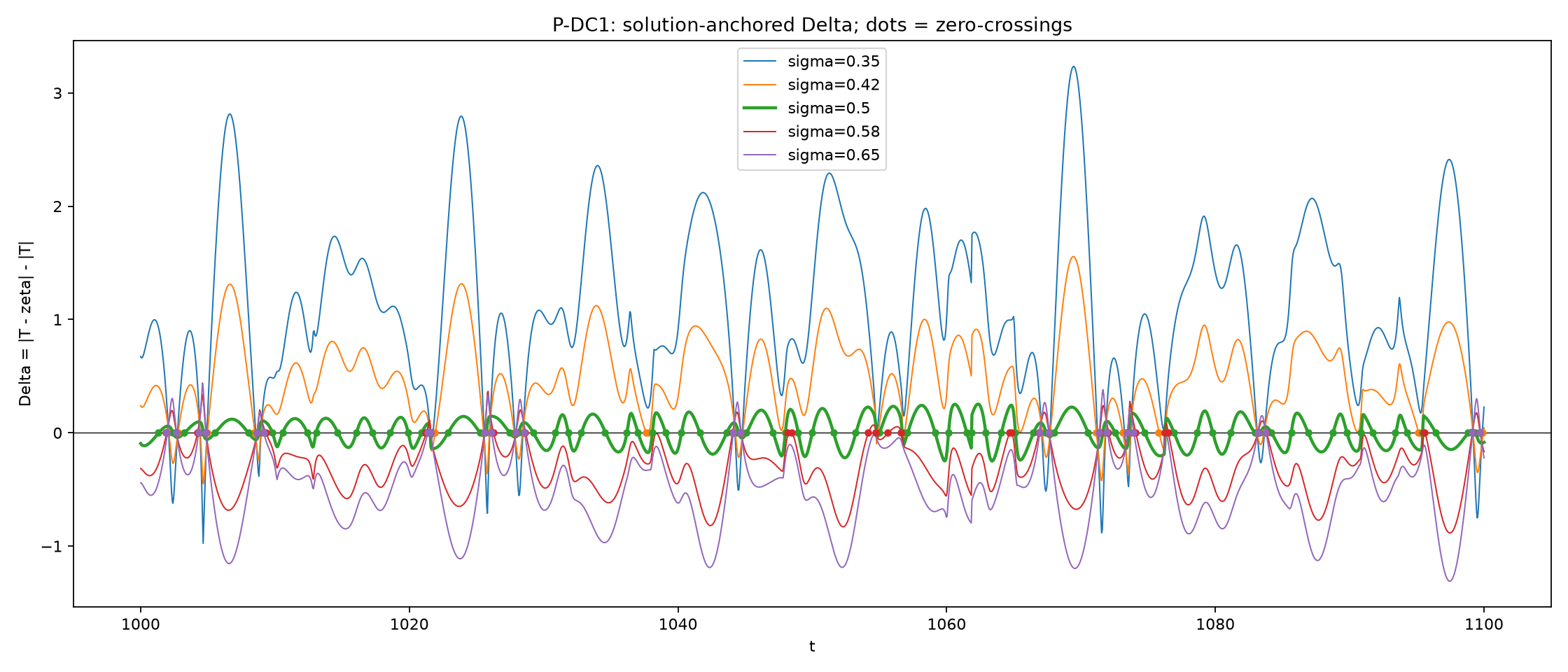
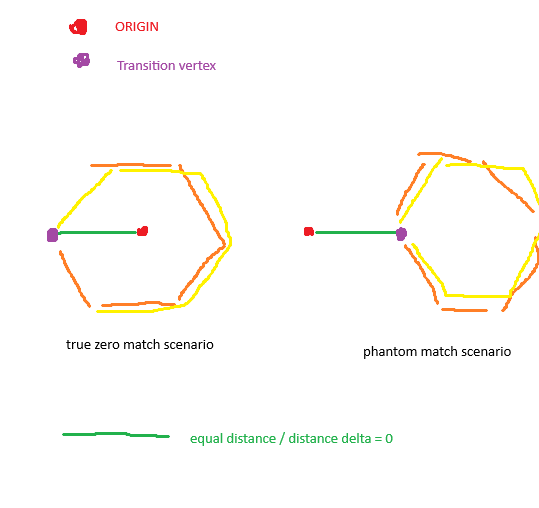
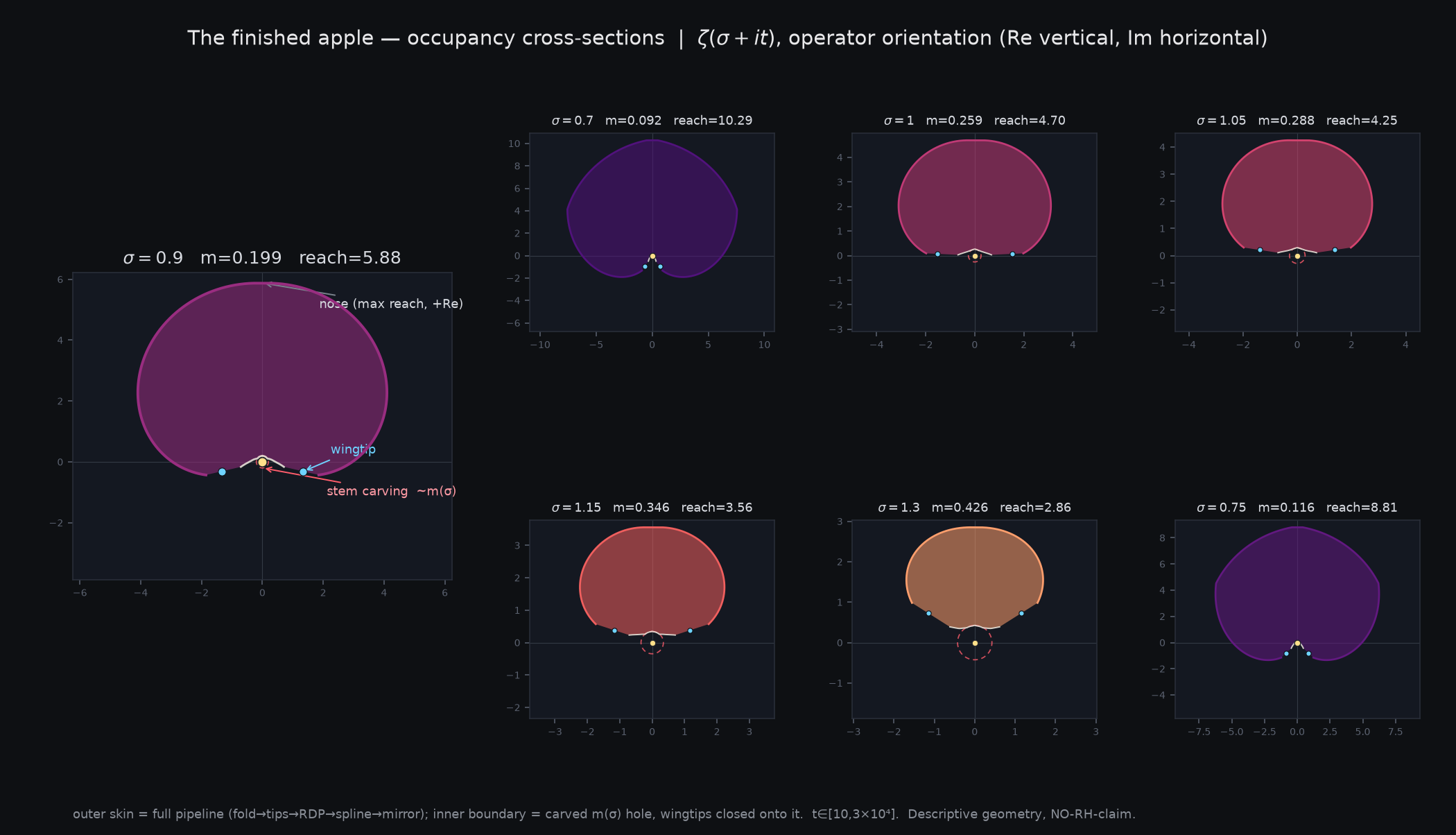
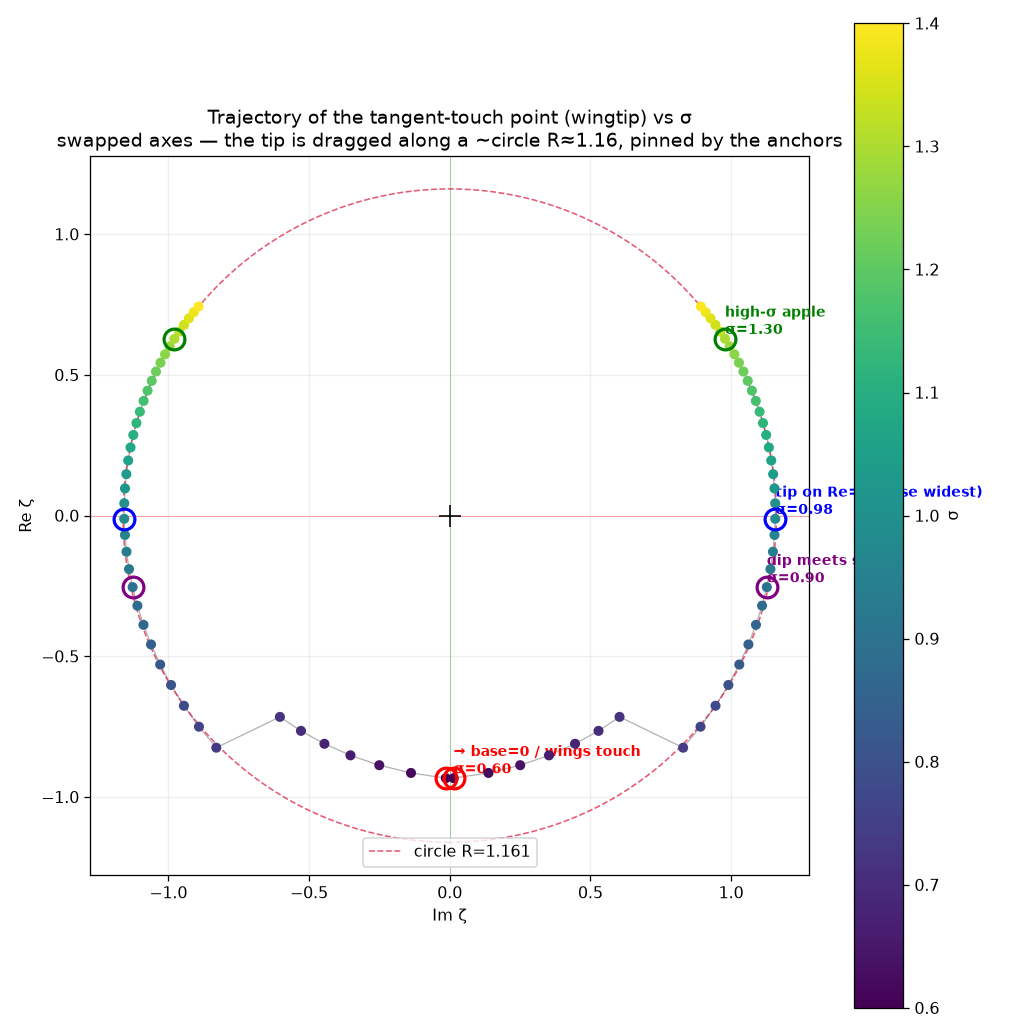
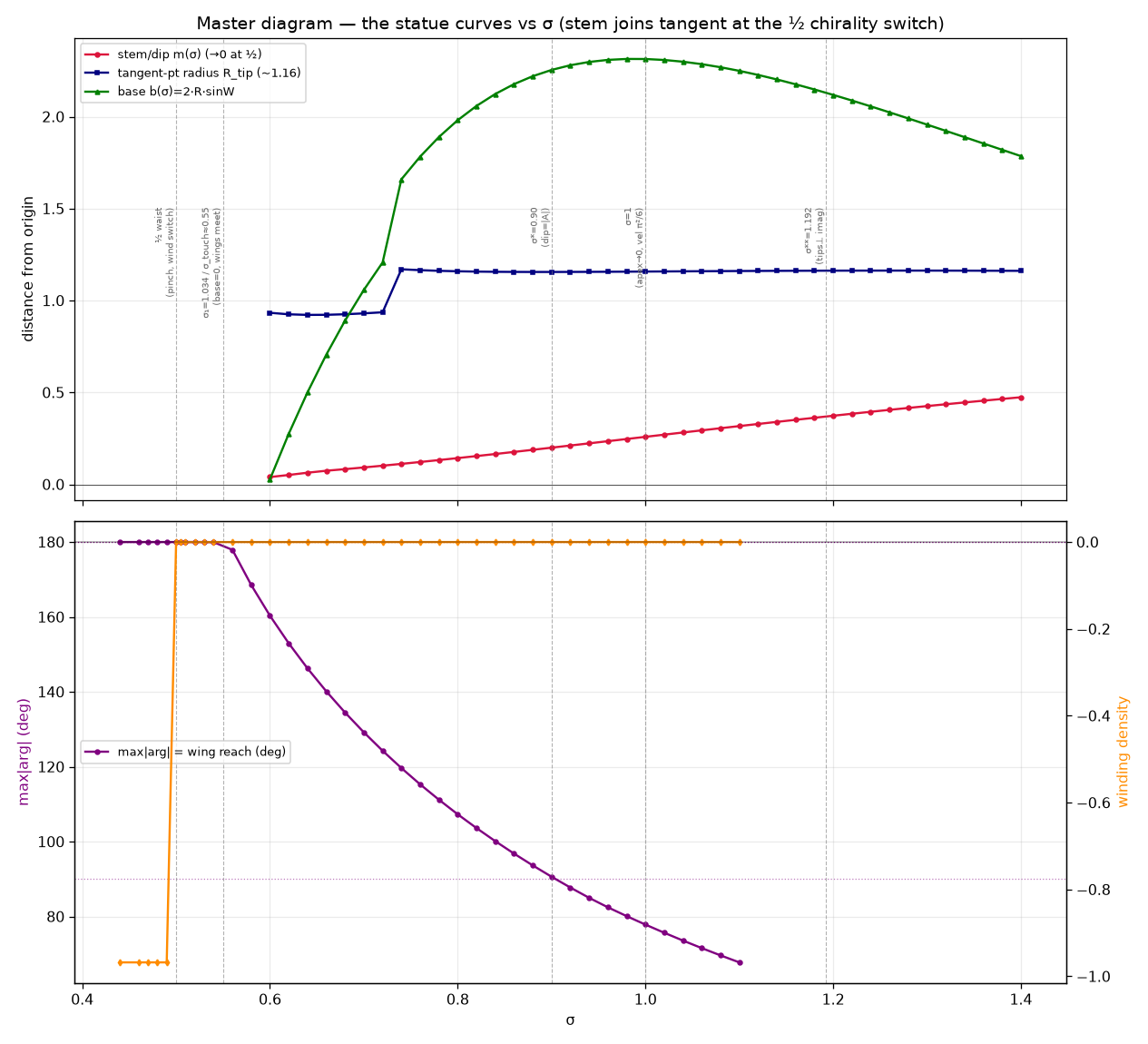
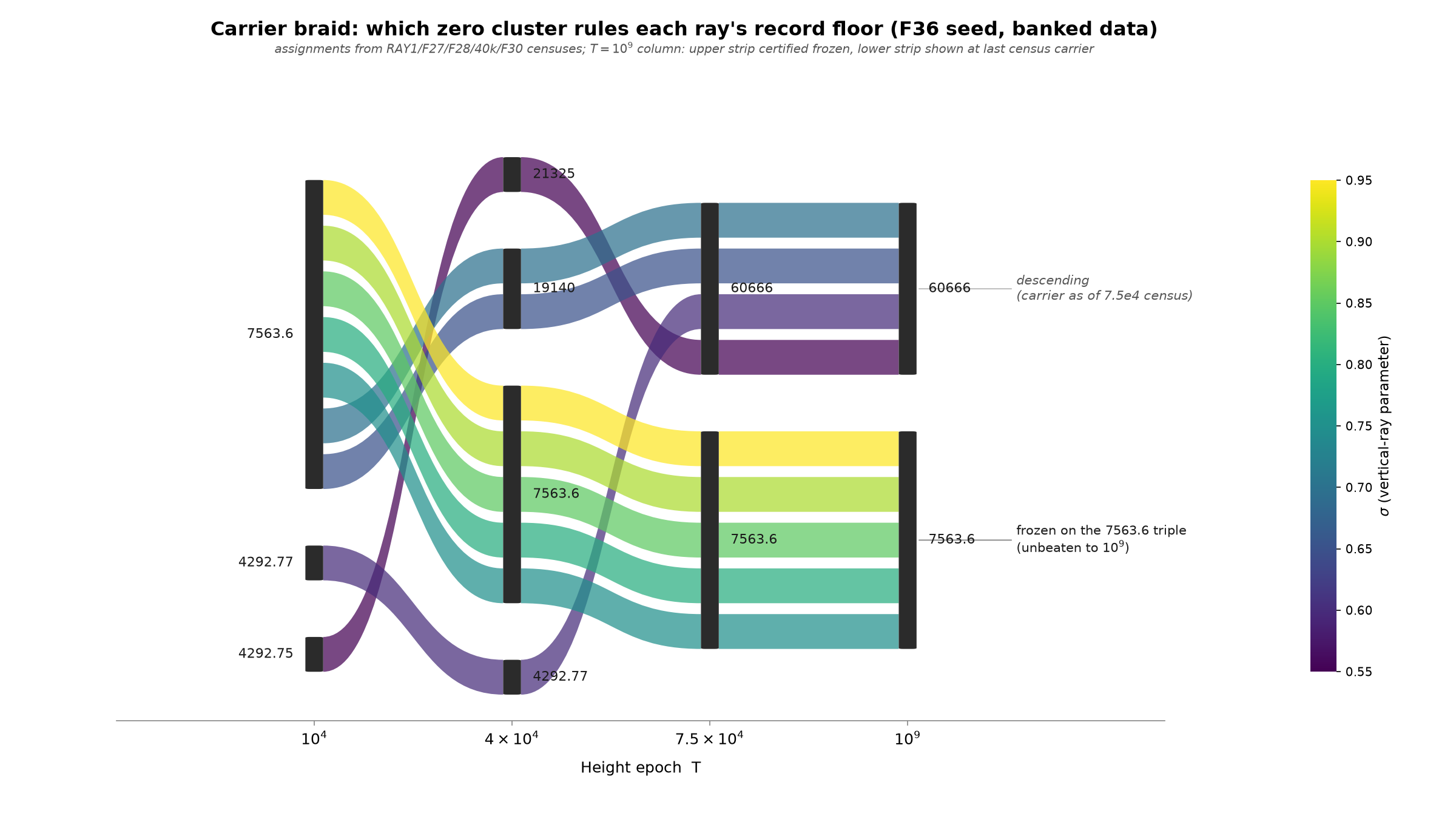
This file carries the paper's figures, each with its caption and the render behind it. No figure computes a mathematical quantity.
Note: these captions were converted mechanically from the graphical companion and are owed a read-through before the typeset build.
Figure 1
The -chart identity at t [1000,1100], five -legs. Dots mark zero-crossings. Only the =0.5 leg's crossings correspond to genuine zeros of Z; this is the census instrument of §5.2, which measures 7 orders of on/off-line separation at the exact evaluation rung.
Figure 2
Author's original conceptual sketch: a true zero match (left) versus a phantom match (right), both at equal reference distance (green segment) but with the transition vertex and origin in different relative positions — the geometric seed of the winding veto of §8.2.
Figure 3
The occupancy region's cross-sections across , with the carved stem, wingtips, and reach annotated at each value. Descriptive geometry; no claim about the Riemann Hypothesis.
Figure 4
The tangent-touch (wingtip) point's trajectory as varies, pinned to a near-circle of radius R 1.16 between the identified anchor values.
Figure 5
The statue's governing curves — stem/dip m(), tangent-point radius, and base width — together with the wing-reach angle and winding density, against the landmark values identified in the program (waist, _1, ^*, =1, ^**).
Figure 6
Carrier braid: which zero cluster rules each ray's record floor, by height epoch, banked from the RAY1/F27/F28/F30 census program. Two carriers dominate to T=10^9: the 7563.6 triple (frozen, unbeaten) and the 60666 cluster (descending).
Supplementary materials
The audit layer: how the numbers above were checked, what was corrected, and what is owed to whom.
Open the supplementary materials
This file carries the literature positioning, the negative results, the identity ledger and the audit concordance of the paper named above — the split executed for this paper in 2026-07-19 and preserved here.
S1. Assembly and revision record
an internal record — Paper 2, re-architected manuscript (Phase 4, assembly rev-3)
REV-3, 2026-07-29 — the App-B 43/43 patch, and nothing else. Built copy-first from REV2 (the project archive, md5-verified) under the unlock ruling (the project register §0b). The defect, standing since s61: the body cites [row 42] (§7.4, §8.2) and [row 43] (§8.2) and the standing-disciplines block already reads "42–43 s61 batch — annex total 43/43 PASS", but Appendix B's table stopped at row 41 and four prose sites still read "22–41, 41/41 PASS". The annex itself was 43/43 internally; only this manuscript's concordance lagged. Fixed here: rows 42–43 appended to the Appendix-B table, and the four sites (§1.2 recap, §1.4 audit discipline, §3.1 annex pointer, Appendix-B header) now read 43/43. NO measured quantity is changed and no other text is touched; the rev-2 changelog below is left verbatim as the historical record of that revision (R22).
Rev-2 assembly (Phase 4 of an internal record), Fable, 2026-07-16, s59. Merged per scaffold §1 order from the four Phase-3 draft files — PAPER2_DRAFT_CH123456_APP (ch. 1–6 + appendices, P2-K), PAPER2_DRAFT_CH789 (ch. 7–9, P2-I), PAPER2_DRAFT_CH1011 (ch. 10–11, P2-H), PAPER2_DRAFT_CH121314 (§12.8 + ch. 13–14, P2-J) — with §12.1–12.7 carried VERBATIM from an internal record ch. 7 (assembly-1 stays frozen as the assembly-1 record; the draft files remain the verbatim sources of their chapters). Boot reads §0.1 done in full this session (state + both essentials; assembly-1 opened in full; drafts read in full).
New-at-assembly (rev-2) items — all need operator eyes (Phase 5):
- Abstract REDRAFTED (five-part coverage; the assembly-1 abstract covered Parts I–II + old ch. 7 only) — sign-off Phase 5.
- References: entries [1]–[36] carried UNCHANGED (numbering frozen — it is embedded in the carried §12.1–12.7 text); NEW entries [37]–[55] appended in order of first appearance, tiered (V)/(†)/(M) per the Q7/F1 records (Nickel ×2 and Reglade are first-hand PDF extracts on disk). Author-year citations in Parts III–V now carry bracket numbers. The (M)-tagged details are the operator verification queue before submission (old + new).
- Relationship table (§12.6) EXTENDED: seven rows added for the Part III–IV material (Nickel ×2, Reglade, Booker, verification-practice frame, orientation-ledger ingredients, curlicue lineage).
- §6.1 leg-A3 audit flag RESOLVED: the third-height σ-sweep numbers were digit-verified this session against
ext_i_sigma_invariance_report.txt(leg-A3 blocks + READ (I2)) and assigned formal-audit row 41 (checklist §5.3); the annex tally is now 41/41 PASS. Two wording amendments against the P2-K draft, both from the report: scaling ratios "0.397–0.400" → "0.397–0.404 across both Δσ pairs" (derived from the printed dabs values), and shape "r ≥ 0.999 on every leg" scoped to the exact-matched reference path (r ≥ 0.9991 there; the interpolated-path dips to 0.976 are the interpolation floor, stated in row 41). - Notation normalized: Parts III–V converted from the drafts' plain notation to the manuscript's LaTeX math convention (formula-by-formula transcription, no content change). The appendix ledger/concordance tables deliberately keep compact plain notation (annex apparatus, matching the audit checklist itself) — recorded as a choice, not an omission.
- Cross-references resolved: "Chapter N.M" → "§N.M" throughout the new parts; the carried literature chapter renumbered §7.x → §12.x with internal references updated; the one delivery-file codename in the drafts ("§O4", ch. 10.4) resolved to §8.3. The two timetable windows are DIFFERENT windows, both verified against sources: [100000, 100025] in §8.3 (delta-stack window, ORIENTATION_VETO §O4) and [100000, 100015] in §10.4–10.5 (D-Z1/counting window, U1/U5).
- P2-K carry flags integrated into clean text. The three flagged deviations remain listed here for operator eyes: (i) §3.2 audit-annex anchor now reads rows 1–21 + 22–41, 41/41 PASS; (ii) §5.2 off-line-floor pointer (298 crossings, margin closed form, forward ref §10.4); (iii) §6.1 third-height fold-in (now row-41-anchored, item 4 above).
- One definition fix at carry (flagged): ch. 2.3 of the P2-K draft defined the coil walk as ζ − S_M; the source of record (an internal record §1) and ch. 7.1/Appendix A define D_M := S_M(s) − ζ(s) — the redrafted ch. 2.3 sentence now matches the source (sign convention only; every quoted number is a modulus, unaffected).
- Title ELECTED by operator s61-cont (2026-07-16): "Packet Centroids II: The Fresnel Mechanism, Coil Geometry, and Zero Conditions of the Partial-Sum Walk" (full-coverage candidate 1 of the s61-cont slate; supersedes both the assembly-1 title and the header's earlier broadening candidate). Applied to the title line and to Paper 1's [13] entry (provisional flag removed) same turn.
- Author block carried from Paper 1 / assembly-1 — CONFIRMED by operator s61-cont (2026-07-16): Ondřej Dvořák, independent researcher, Děčín, Czech Republic. AI-credit roster RESTRUCTURED per operator dictation, both papers: main coordinator Fable 5; distributed tasks Claude Code (Opus, Sonnet); consultations ChatGPT, Gemini, Grok (Grok added).
- Un-rowed numbers — RESOLVED s61 (Phase-6 pass): the W1 statistics 128/128 and 772/772 now carry audit rows 42–43 (checklist §5.4; WV1 halves recomputed digit-for-digit from the banked data table). Quoting sites §7.4/§8.2 anchored [row 42]/ [row 43]; the §8.2 dismissal line gained the two-round composition parenthetical (772 = certificates across two rounds; 474 distinct candidates, the 298 filed set measured in both). Annex total now 43/43.
Standing disciplines binding on the whole text: NO-RH-CLAIM framing (§1.4, §14.1); C2-safe wording; every quoted statistic carries its audit row [row n] (rows 1–21 s34 batch, 22–41 s57–s59 batch, 42–43 s61 batch — annex total 43/43 PASS); negative results are content (ch. 13); both-paths recording; rule 19 (every refuted line names its statistic and measure).
LOCKED s62 (2026-07-16, Phase 7): all Phase-5 operator gates signed s61-cont (abstract; title elected and applied; author block + AI-credit roster; full review incl. the s61 reference-block patches); Phase-6 verification complete ([13]-pointer sites verified against final numbering; W1 statistics rowed 42–43; curlicue citation [56] applied). This file is the Paper-2 manuscript of record, frozen — further changes only by operator instruction. Non-gating print-queue residuals remain listed in the References status block.
Chapter 12 — The Program in the Literature
(§§12.1–12.7 carry the census-in-literature chapter of the first assembly verbatim — Hurwitz identification, plateau reframe, split/skew, spacing stiffness, sum rule, relationship table, source status; the novelty language there is LOCKED and is untouched by Parts III–IV apart from the rows added to the §12.6 table for the new material. §12.8 extends the same protocol — fetched sources, verbatim quotes on file, explicit failed-search records, no memory-only citations — to the Part III–IV material.)
The census of Paper 1 §3 and the sum rule of Paper 1 §4 were published with four open literature questions (Paper 1 §6.2). This chapter closes them against the located literature and states precisely what in the census was already known, what sharpens known results, and what has no counterpart. The search protocol (fetched full-text sources, verbatim quotes on file, explicit failed-search records; no memory-only citations) and the per-question source lists are on record in the project archive; the survey chapter of Christ's dissertation (2013, arXiv:1405.1553) [8], ch. 4, is the frame of reference throughout. († marks sources cited via secondary quotation; see §12.7.)
The summary is asymmetric in an instructive way: the object at k=1 and the mean displacement law are classical, and we concede both prominently below; the distributional statistics — nearest-neighbor spacing, signed third moment, serial correlation — together with any numerical census of a-point displacements at all, and everything at k ≥ 2, have no located counterpart.
12.1 The object: Fk is a Hurwitz zeta function
The comparison function of Paper 1 satisfies the exact identity Fk(w) = ζ(w) − Sk(w) = ∑m ≥ k+1 m−w = ζ(w, k+1), the Hurwitz zeta function at integer parameter α = k+1 (immediate from ζ(w,α) = ∑n≥0(n+α)−w for Re w>1 and analytic continuation). The object of the census is therefore a named classical function, and the census is a zero census of ζ(w,α) at integer α ≥ 2.
Position against the Hurwitz zero literature. That literature — Davenport–Heilbronn (1936) [9], Cassels (1961) [10], Spira (1976) [11], through the recent survey of Mine (arXiv:2305.01262) [12] — normalizes 0 < α ≤ 1 exclusively, where ζ(s,α) for rational or transcendental α ≠ 1, 12 has zeros dense in σ-strips, including σ > 1. The phenomenology proved and measured in Paper 1 — clustering at σ = 12 at rate 1/log t, analytic right confinement u ≤ u*(k), a displacement sum rule — is qualitatively opposite. The novelty claim survives in exactly this form: the zero distribution of ζ(w,α) at integer α ≥ 3 (equivalently k ≥ 2) has apparently never been studied. One hole in the sweep is acknowledged: the Lithuanian/Russian Hurwitz literature (Laurinčikas, Garunkštis surveys) was not exhaustively covered (§12.7).
The k=1 concessions (classical, conceded prominently). At k=1 the roots are the 1-points of ζ, studied since Landau [13]. The counting function N1(T) = (T/2π)log(T/4π e) + O(log T) (Landau [13], c1 = 2; Levinson 1975 [14]) is classical — in particular the census density (1/2π)log(t/4π) used for the k=1 rescaling in Paper 1 §3.4 is the classical constant, not a project choice. Levinson [14] proved unconditionally that all but O(N1(T)/loglog T) of the 1-points lie within (loglog T)2/log T of the critical line; the refined clustering scale √loglog T/log T is due to Selberg† [15] and Tsang† [16] (via [8], Thm 4.7). Garunkštis–Steuding (2014, arXiv:1011.5339) [17] study a=1 through the normalization 2s(ζ(s)−1) = 1 + ∑n≥3(2/n)s — literally Lemma 4.1.1's G(w) = (k+1)w Fk(w) at k=1, which we cite at the recap of that lemma; their simplicity results for 1-points transfer to the k=1 family verbatim.
Disjointness from the partial-sum zero literature. The zeros of the partial sums SN(s) themselves (Spira 1966/68 [18]; Montgomery 1983† [19]; Borwein–Fee–Ferguson–van der Waall 2007† [20]; Gonek–Ledoan arXiv:0807.0019 [21]; Platt–Trudgian 2016 [22]; Gonek–Montgomery 2013 [23]) are a different object: roots of a Dirichlet polynomial, not of the comparison equation ζ(w) = Sk(w). A full-text search of Gonek–Ledoan found no ζ − Sk object; Roy–Wainaina (2023) [24] study a-points of SN — the mirror object. An instructive quantitative contrast: for zeros of SN Montgomery's right-boundary abscissa is σ ≤ 1 + (4/π − 1 − o(1))loglog N/log N — approaching the σ=1 line — whereas the Fk confinement bound grows linearly, u*(k) ∼ (k+1)ln 2 (Paper 1, Lemma 4.1.1). No antecedent was found for the bridge Fk → SN (perturbing the comparison equation to the partial-sum equation as N → ∞), which remains the natural open direction stated in Paper 1 §6.2(d); likewise no antecedent exists for averaging partial sums over the saddle gap (Jerby 2024 [25] works at fixed N and explicitly does not average).
12.2 The displacement constant c is a finite-height plateau
Paper 1 §3.2 measured c = ⟨|dσ|·log t⟩ = 1.023 ± 0.011, flat across seven windows spanning t ∈ [200, 105] (χ2/dof = 6.46/6), and asked whether the constant is known (§6.2(a)). The literature answer reframes the result.
The mean displacement is known — and it is not a constant. From Selberg's Amalfi lectures† [15] (eq. (3.5)) and Tsang's thesis† [16] (as surveyed in [8], eq. (4.12)): for fixed a ≠ 0, unconditionally, ∑βa > 1/2 , T < γa ≤ 2T (βa − 12) = 14π3/2 T√loglog T + O|a|(T), which per point gives the asymptotic law ⟨|dσ| ⟩ · log t ∼ 1√π√loglog t = 0.564 √loglog t. The literature's mean-displacement law therefore grows like √loglog t; no closed-form constant exists, and the literature asserts none. The statement of record is accordingly: c = 1.023 ± 0.011 is a finite-height plateau of a quantity whose asymptotic law is 0.564√loglog t (1+o(1)). The measured flatness over t ∈ [200, 105] is a finite-T phenomenon, not a contradiction: the main term predicts ⟨|dσ|⟩log t ≈ 0.76 at t ≈ 520 rising to ≈ 0.88 at t ≈ 105 (growth × 1.16 across the census range), while the unconditional O(T) error term is of the same order as the main term at these heights — the census can neither confirm nor refute the asymptotic law, and the law cannot produce the census numbers.
Direct confrontation on the frozen data. A one-shot weighted fit of the seven frozen window means settles what the census range can and cannot discriminate: the constant model gives χ2/dof = 5.79/6 = 0.97 (Paper 1's 6.46/6 for the same seven windows is the same frozen data under the window-mean-log t normalization; both values reproduce exactly under their stated conventions — clarification 2026-07-19); the pure Selberg–Tsang shape x = A√loglog t gives 9.17/6 = 1.53 with A = 0.698 measured against the theoretical 1/√π = 0.564; the mixed model A√loglog t + B leaves the growth coefficient unconstrained (A = 0.18 ± 0.26, Δχ2 = 0.46 for one extra parameter). Since √loglog t spans only a factor 1.154 over the census heights, the data prefer the constant but cannot exclude the asymptotic shape; we state all three fits and claim neither constancy-in-t nor the asymptotic law from the census. (Paper 1's rejection of a loglog-growth model, χ2/dof = 28.05/6, concerned a different exponent and is unaffected.)
What is claimed. The claims that survive, in the located literature, without counterpart: (i) the first numerical census of a-point displacements — no numerical study of a-point displacement distributions was found at all, for any a; (ii) the measured finite-height plateau value 1.023 ± 0.011 with its distribution-collapse across windows (KS p ≥ 0.45); (iii) the k-dependence c(k=2) = 1.079 ± 0.046, c(k=3) = 1.197 ± 0.049 and its mechanical explanation through the 1/|Fk'| landscape (Paper 1, Corollary 2.3), i.e. everything at k ≥ 2.
12.3 Split and skew: the classical asymmetry and the new statistics
Paper 1 §3.3/§3.5 measured a strip split of 49.3% right of the line at k=1 (z = −1.01, consistent with 50/50) and a robust negative skew of x = dσ·log t (pooled −0.713; −0.443 after trimming the boundary points u > 0.9), growing at high t, and asked whether the asymmetry is known (§6.2(c)).
The qualitative left-heaviness is classical — cite, not claim. Under RH (Selberg† [15], unpublished; proofs in Tsang's thesis† [16], ch. 8; quoted consistently in [8], Lester arXiv:1402.0169 [26], and Ha–Lee arXiv:1711.08928 [27]): the left-of-line displacements follow a one-sided Gaussian at scale √loglog T/log T, while right-of-line excursions are confined to the strictly smaller scale (logloglog T)3/(log T√loglog T); at least half of all a-points lie strictly left of the line, and Selberg conjectured the asymptotic split 3/4 left, 1/4 right. Ha–Lee [27] add a quantitative right-side pinning: right-tail density ∝ 1/h at mesoscopic distances h. Unconditionally almost nothing is known ([8], §4.4).
Confrontation: 3/4–1/4 vs the measured 49.3/50.7. The census split must be stated next to Selberg's conjecture, and the two are compatible: the census is strip-restricted and lives at t ≤ 105, where the asymmetry scale √loglog T/log T dwarfs neither tail; the conjectured 3/4–1/4 is an asymptotic statement about a mean-zero-width neighborhood of the line. The correct census-side counterpart of the classical asymmetry is not the split but the shape: the left tail is heavier (Paper 1 §3.5), exactly as the one-sided-Gaussian picture demands. The mechanism also anticipates the growth: the left component broadens like √loglog t while the right stays pinned, so the skew of dσ·log t must become more negative with t — qualitatively matching the measured growth of the skew with height.
What is claimed. No skewness coefficient, signed third moment, or shape statement at the 1/log t scale was found anywhere: the numbers −0.713 (pooled) and −0.443 (boundary-trimmed), the trim decomposition itself (∼40% of the pooled skew attributable to u → 1 boundary points), and the measurement of skew growth with t have no counterpart. The same holds for the serial statistics: the pooled lag-5 autocorrelation of successive dσ (−0.077, 3σ outside the white-noise band, multiple-comparisons caveat carried) has nothing remotely similar in the located literature. The closest theoretical companion is Fazzari–Gerspach (arXiv:2412.20099) [28], the third moment of logζ beyond Selberg's CLT — a natural companion because Littlewood's lemma transports moments of logζ on the line to displacement moments of a-points; that transport has apparently never been carried out, and we name it as an open direction rather than claim it. (Check of record: a first-hand full-text sweep of [8] — the detailed public rendition of Tsang's ch. 8 — finds no displacement moment beyond the first anywhere; the limit law is stated as distributional convergence only, and the only moment objects in the a-point literature are discrete moments of ζ' at a-points, known only at a = 0. The third-moment novelty sentence is final; residual caveat: the thesis print itself remains unread.)
12.4 Spacing stiffness: the strongest novelty
Paper 1 §3.4 measured the nearest-neighbor spacing of the k-families and found sub-GUE stiffness: small-gap fraction (<0.5 mean spacing) 0.0160 at k=1 and 0.0173 at k=2, against 0.0896 for the Riemann-zero control on the identical pipeline (GUE-consistent) — a factor-6 suppression — with the large-gap tail (frac > 2 ≈ 0.014) indistinguishable across all families. Paper 1 §6.2(b) asked whether this is known.
Failed-search record (the strongest negative result of the sweep). For nearest-neighbor spacing of a-points of ζ — any a, any height, theorem, conjecture, or numerics — nothing exists in the located literature. Pair correlation of a-points is equally absent: nothing Montgomery-type for any a ≠ 0. The negative evidence is strong: the survey-grade introduction of the most active group in the field (Sourmelidis–Steuding–Suriajaya, arXiv:2204.13887 [29], which is otherwise the reference adjacent to our functional-equation identity) contains no spacing content at all. The known vertical-distribution results are strictly coarser statistics: counting (Landau [13]), uniform distribution mod 1 of the ordinates γa (Jakhlouti–Mazhouda–Steuding 2014† [30]), discrepancy bounds (Baluyot–Gonek 2019 [31]), a maximal-gap bound of Littlewood type (Sourmelidis–Srichan–Steuding 2022 [32]), and simplicity proportions (Garunkštis–Steuding 2014 [17]; Gonek–Lester–Milinovich [33]). None constrains the spacing distribution.
The phenomenon class has an analog for a different derived family. For zeros of ξ' (the derivative of the completed zeta), Farmer–Gonek (arXiv:0803.0425) [34] prove that the pair correlation differs from Montgomery's F for 0 < |α| < 1 and give the mechanism: if ξ' has a small gap, ξ must have had an even smaller one; Farmer–Rhoades (2005)† [35] show differentiation drives zero spacings toward rigidity. We cite this as the analog-in-spirit — a derived-family spacing rigidification — while noting the object is different (ξ'-zeros vs a-points/Fk-roots) and the mechanism does not transfer as stated. Our distinguishing observation, which the ξ' analogy does not predict, is that the large-gap tail is identical across families: the anomaly is specifically a small-gap deficit, not a general variance reduction.
What is claimed. Novelty is claimed for both the object and the statistic: (i) the first spacing statistics of any kind for a-point families of ζ (and, via §12.1, for Hurwitz zeros at integer parameter); (ii) the nearest-neighbor measurement itself with its factor-6 small-gap suppression, its artifact checks (grid refinement Δ = 0.0000; GUE-consistent control), and the tail-identity observation. One residual check is carried: Garunkštis–Steuding's "regularity of the graph of t ↦ ζ(12+it)" heuristic could qualitatively anticipate spacing rigidity ("one a-point per loop"); their heuristic section is on the human-check list (§12.7) and the claim of no anticipation is limited accordingly.
12.5 The sum rule and the free cancellation
Proposition 2 (Paper 1 §4) states Dk(T1,T2) = T2−T14π log(k+1) + Ok(log T2) for the total signed displacement, proved by applying Littlewood's lemma twice and cancelling the line integrals identically (Remark 4.1.4).
k=1 is the standard computation — conceded, in two forms. For the one-sided sum, the classical route applies Littlewood's lemma once and evaluates the line integral ∫ log|ζ(12+it) − a| dt via Selberg's value-distribution theorem ([8], eqs. (4.10)–(4.11)). For the total signed sum, Steuding's monograph† [36] (LNM 1877, ch. 7; rendered in detail as Christ's Lemma 4.2 and Theorem 4.3, "Steuding, 2003") proves the pair ∑T<γa≤ 2T (βa − b) = (12 − b)·[RvM count] − c Tlog|1−a| + O(log T) (constant a ≠ 1, reference line b far left) and the a-point Riemann–von Mangoldt formula; one subtraction of the two yields the total signed displacement about 12 with a normalization-budget constant and no line integral. The a = 1 case uses the normalization qs a(q)(L(s)−1), q the least integer with a(q) ≠ 0 — for ζ this is 2s(ζ − 1), i.e. Lemma 4.1.1's G at k = 1 is Steuding's normalization (also used by Garunkštis–Steuding [17]) — and the subtraction then reproduces exactly D1 = (Δ T/4π)log 2 (consistency computation on record). The k = 1 sum rule, one-sided and total, is therefore classical and is cited as such.
What is claimed at k ≥ 2 and in method. The statement Dk = (Δ T/4π)log(k+1) for the integer-parameter Hurwitz families k ≥ 2 was not found in print — the check of record confirms Steuding's ch. 7 and the whole surveyed literature treat constant targets only; no |1−a|-type right normalization exists for a non-constant Dirichlet polynomial target, and the log(k+1) constant appears nowhere. The method claim is stated precisely: what is new in Remark 4.1.4 is the reflected two-Littlewood formulation — the exact line identity |H(12+it)| = |Fk(12+it)|, per-side capture by G and H over the same rectangle with no far-left reference line, which yields the per-side bijection and the strip/ROS anatomy — and its extension to Dirichlet-polynomial targets; not the bare fact that a total signed displacement can be had without value-distribution input, which at constant a is implicit in the classical lemma+count pair above. The pre-registered patch-census confirmation (≤ 0.6% closure at every tested k; Paper 1 §4.2.4) has no counterpart for any comparison-equation family. Residual: the LNM print itself remains unread; the tempered form above is final under Christ's rendition.
12.6 Relationship table
Legend: AGREE = mutual confirmation; DIFF = our result differs from or extends theirs; IMPROVE = our result sharpens theirs; NEW = no counterpart found (failed-search on record). † = content via secondary quotation, pending print check (§12.7).
| Reference | Bears on | Relationship |
|---|---|---|
| Levinson 1975 [14] | clustering of a-points | AGREE (qualitative floor) + IMPROVE: census gives the distribution and the finite-height constant |
| Selberg 1989/92 (Amalfi)† [15] | mean displacement √loglog law; 3/4–1/4 conjecture | DIFF (asymptotic law vs measured plateau, §12.2); AGREE (order of magnitude) |
| Tsang 1984 (thesis)† [16] | one-sided Gaussian; proofs of Selberg's results | AGREE (mechanism for the skew) + NEW (our third-moment numbers) |
| Christ 2013 [8] | survey, eqs. (4.10)–(4.13) | frame of reference for this chapter |
| Garunkštis–Steuding 2014 [17] | a=1; normalization 2s(ζ−1); simplicity | AGREE — their normalization is Lemma 4.1.1's G at k=1 |
| Lester 2014 [26] | a=1 count shift log 2; on-line a-points | AGREE (density constant = census density) |
| Ha–Lee 2018 [27] | right-tail 1/h profile | AGREE (right-side pinning ⇔ ROS/strip anatomy direction); DIFF (their scale (log T)−θ coarser) |
| Farmer–Gonek 2008 [34]; Farmer–Rhoades 2005† [35] | ξ'-zero spacing rigidity | phenomenon-class analog for the ×6 stiffness (NEW for a-points/NN) |
| Sourmelidis–Steuding–Suriajaya 2022 [29] | a-points + functional equation | adjacency to the off1/χ identity; negative evidence (no spacing content) |
| Jakhlouti–Mazhouda–Steuding 2014† [30]; Baluyot–Gonek 2019 [31] | vertical distribution of γa | DIFF: strictly coarser statistics than NN spacing |
| Spira 1966/68 [18]; Montgomery 1983† [19]; Borwein–Fee–Ferguson–van der Waall 2007† [20]; Gonek–Ledoan 2008 [21]; Platt–Trudgian 2016 [22]; Gonek–Montgomery 2013 [23] | zeros of SN / approximants | DIFF (disjoint object); contrast Montgomery's ψN constant 4/π−1 with u*(k) ∼ (k+1)ln 2 |
| Davenport–Heilbronn 1936 [9]; Cassels 1961 [10]; Spira 1976 [11]; Mine 2024 [12] | Hurwitz ζ(s,α) zeros, 0<α≤1 | DIFF + NEW: integer α ≥ 3 unstudied; opposite phenomenology (§12.1) |
| Steuding LNM 1877 ch. 7† [36] (via Christ's Lemma 4.2/Thm 4.3 rendition) | c-value RvM formula; total-signed-sum lemma; a=1 normalization qs a(q)(L−1) | AGREE at k=1 (constant conceded, §12.5); DIFF+NEW at k≥2 (constant targets only) |
| Fazzari–Gerspach 2024 [28] | third moment of logζ | theoretical companion of the skew (Littlewood-lemma transport — named open direction) |
| Arias de Reyna 2011 [4] (+ Siegel 1932 [2], Gabcke 1979 [3]) | RS remainder | integrated in Paper 1 rev 4c PS (tone template: rediscovery, no priority claim) |
| Nickel 2013 [37] | spiral step-angle/step-length laws; pendant-center estimator concept | ANTECEDENT conceded (§12.8.1–.2); closed-form tail modulus, δ(u), −0.250778, exact |2σ−1| split, axis construction with measured floors + error bracket = NEW |
| Nickel 2015 [54] | intra-spiral conjugate-region symmetry; | Q| = 1 ⟺ σ = 12 | ANTECEDENT conceded (§12.8.4) — the same-t mirror MAP is his; the two-point φdz sum rule on the free coordinate d = NEW |
| Reglade 2019 [38] | asymptotic circle 1/| y|; integer winding-type quantity at zeros | ANTECEDENT conceded (§12.8.1–.2) — direction of the winding veto; the quantized two-sided classifier with explicit bands, measured separations, and the budget/certificate frame = NEW |
| Booker 2006 [42] | parity of missed zeros (folklore parenthetical) | AGREE + concede (§12.8.3); window-frame proof + odd-mismatch instrument-error certificate = NEW |
| Backlund [43]; Titchmarsh [44]; Turing 1953 [45]; Hejhal–Odlyzko [46]; Trudgian 2016 [47]; Platt–Trudgian 2021 [50]; Bober–Hiary [51]; Büthe 2015 [52]; van de Lune–te Riele–Winter [53] | rectangle count; Turing's method; verification practice to 3×10¹² | classical frame conceded prominently (§12.8.2–.3); the per-candidate coil-scale veto + gated C(W) certificate = same principle, different instrument; S(T) wall untouched |
| Garunkštis–Steuding [17]; Ivić [48]; Arias de Reyna X-ray [49] | approach quadrant + tangent iζ'; Lehmer phenomenon; Speiser sheets | AGREE (classical ingredients of the orientation ledger, §12.8.2); the per-candidate veto instrument + danger timetable = NEW |
| Berry–Goldberg [39]; Coutsias–Kazarinoff [40]; Dekking–Mendès France [41]; Signerska-Rynkowska [56] | curlicues / quadratic-phase and pure-phase walks (exact circle + cosecant curvature classifier in [56]) | methodological cousin (§12.8.1); different object — equal-amplitude walks, no M1−σ/| s−1| structure |
12.7 Source status and residual checks
Source tiers: Christ 2013 [8] is first-hand — full arXiv PDF fetched and text-extracted; every quote from it in this chapter was re-verified against the full text directly. Cited via secondary quotation only (†): the Selberg Amalfi lectures [15] and Tsang's thesis [16] (not online; content vouched by [8] — itself first-hand — plus [26] and [27], mutually consistent), Steuding LNM 1877 ch. 7 [36] (print unread; content via Christ's explicit Lemma 4.2/Theorem 4.3 rendition), Montgomery 1983 [19], Borwein–Fee–Ferguson–van der Waall 2007 [20], Farmer–Rhoades 2005 [35], and Jakhlouti–Mazhouda–Steuding 2014 [30] (paywalled). Every other citation was verified against fetched full text. Residual checks carried — none gating; all print-verification residuals: (1) Tsang thesis print (§12.3 sentence final at survey depth); (2) Selberg Amalfi print (conjecture wording quoted first-hand from [8]); (3) Steuding LNM print (§12.5 final in tempered form; one extraction-mangled coefficient in the Lemma 4.2 display re-derived by consistency); (4) Garunkštis–Steuding "regularity of the graph" heuristic — limits the no-anticipation claim of §12.4; (5) the Lithuanian/Russian integer-parameter Hurwitz literature — the one acknowledged hole in the §12.1 sweep.
12.8 The geometry, the instruments, and the program (Parts III–IV)
Protocol note. Four independent scouted sweeps (winding/budget; pair product; coil geometry; approach orientation) with verbatim-quote discipline; the three load-bearing geometric antecedents were then re-extracted FIRST-HAND from the PDFs (Nickel 2013 [37], Nickel 2015 [54], Reglade 2019 [38] — full-text extracts on disk, equation numbers verified against print; one guessed equation number from the scouting stage was corrected by the extraction). Concessions are stated prominently; claims are stated with their failed-search records.
12.8.1 The coil law (Chapter 7). Conceded: the spiral's local law is Nickel's (2013 [37]) — per-step turning angle Δθ = −tlog((n+1)/n) ≈ −t/(n+12) (his eqs. (5)–(8)), step length n−σ, center ζ(s); and Reglade (2019 [38]) independently places the partial sums on an asymptotic circle of radius 1/|y| centered at ζ (his Thm 2.2). The curlicue lineage (Berry–Goldberg [39]; Coutsias–Kazarinoff [40]; Dekking–Mendès France [41]) is cited as the methodological cousin on quadratic-phase sums. For pure-phase, equal-amplitude walks the exact circle radius 1/(2|sinπϱ|) and a discrete curvature-of-spiral classifier 12|cosec(ηn/2)| are in print (Signerska-Rynkowska [56]) — the same cosecant form that appears in the tail modulus below, there as the generic resultant of an equal-step walk; the amplitude modulation M1−σ/|s−1|, its σ-structure, and the band constant have no counterpart there. Retained with failed-search records: the closed-form tail modulus (M1−σ/|s−1|)·(u/2)/sin(u/2) via the convergent Euler–Maclaurin Bernoulli series; the u = 2π pole as the last packet; the slope defect δ(u) and the derived band constant −0.250778; the exact |2σ−1| pair split; winding −1 proven at smooth order. None located anywhere.
12.8.2 The instruments (Chapter 8). Conceded: the classical winding object is the rectangle count (Backlund [43]; Titchmarsh [44], pp. 212–213), and Turing's method [45] deliberately avoids the argument principle (Hejhal–Odlyzko [46]); the sign-change count as lower bound is explicit in Trudgian [47]; the approach-quadrant regularity and tangent iζ' are in Garunkštis–Steuding [17]; the graze is the Lehmer phenomenon ("a negative local maximum would disprove RH", Ivić [48]); Speiser-sheet local orientation appears in Arias de Reyna's X-ray [49]. Reglade's integer at zeros (his Thm 3.1, eq. (62)) is the antecedent-in-spirit for the DIRECTION of the winding veto — an integer characterization at zeros. The ζ-free center-estimator CONCEPT is Nickel's (2013 [37]: pendant center P(s), with the O(np−1/4) error attached to the UNCORRECTED sum — his eqs. (28)/(30)). The closed-form FIRST-ORDER centre estimator is Reglade's (2019 [38], Thm 2.3/Eq. 44): vertex-anchored, ζ-free, three consecutive terms, convergent on σ>0 — and it is exactly the leading Euler–Maclaurin tail correction reached geometrically, its residual being the next Euler–Maclaurin term N−σ/2 (re-derived and verified first-hand, mpmath dps 30). What §8.4 retains is the HIGHER-ORDER (depth-4) model, its measured floors, its internal ζ-free error bracket, the bracket-contains-origin decision rule and the measured line-blindness on Davenport–Heilbronn. [E-P2R-1, REV4, 2026-07-31, REPORTING; no measured quantity changes.] Retained with failed-search records (ten targeted searches logged): the per-candidate quantized veto at the remainder-coil scale with explicit exclusion/flag bands and measured 100% phantom dismissal; the graze/alternation ledger as a threshold-free per-candidate filter; the triple-delta danger timetable; the axis CONSTRUCTION (vertex averaging with closed-form coil-shape subtraction, measured floors 10−8–10−12, self-contained error bracket).
12.8.3 The budget (§8.5–8.6). Conceded, prominently: the parity fact is folklore in print — Booker (2006) [42] states it verbatim ("one always misses an even number of them") as an unproved parenthetical; and both directions of the zero-level biconditional live separately in fifty years of verification practice (completeness: Platt–Trudgian [50], Bober–Hiary [51], Büthe [52]; simplicity from matching counts: van de Lune–te Riele–Winter [53]). Retained: the proof in the window frame, the contrapositive instrument-error certificate (odd mismatch ⇒ instrument error — no such framing located), and the single stated biconditional with the tempered sentence: implicit in fifty years of practice; we state and prove it as one proposition. Footnote of record: distinct from the Gram-point evenness of S(t) (Bober–Hiary [51]) — a different fact.
12.8.4 The pair product (Chapter 9). Conceded: the reflection→reality principle is standard (the Z-function), and our pointwise congruence lemma is presented as its elementary finite shadow; the s ↔ 1−s pairing is standard in second-moment theory (Ingham-type integrands); Nickel 2015 [54] is the closest thematic antecedent — a partial-sum-level internal symmetry whose coincidence condition holds only at σ = 12. The map-level identification is exact and is conceded in full: his conjugate-region symmetry (each step n−s, transformed to ns−1 and scaled by a factor Q(s) with |Q| = (t/2π)1/2−σ, equals the sum over a conjugate region of the same trajectory; "the functional equation ζ = Qζ(1−s) follows") IS the same-t mirror map — the functional equation composed with conjugation — realized inside a single spiral, and his two σ = 12-only equality statements are the |χ| = 1 criterion. The distinguishing sentence, equally exact: Nickel's conjugation relates a step to a region within one spiral at one s; our mirror relation pairs two evaluation points at mirrored σ and constrains the free coordinate d — a two-point phase sum rule on an observable with no counterpart in his construction. Retained with failed-search records (eight targeted searches): the exact finite criterion ΠM real for every M ⟺ σ = 12; the explicit pairwise Im formula; M ∈ {2, 3} deciding with no exceptional ordinates; the χ-free construction; and the deterministic-invariants obstruction reading.
12.8.5 An open literature gap, filed. The distribution of argζ' at zeros — the phase governing approach orientation — was not located in any form (only Hejhal's CLT for log|ζ'| [55]); filed as apparently unstudied, with the failed-search record.
[Erratum note, 2026-07-21 (found at the continuation paper's literature round): the gap claim above does not stand. J. Stopple, Notes on the phase statistics of the Riemann zeros, arXiv:2007.08008 (2020), is an empirical census of exactly this distribution — argζ'(12+iγ) at 5×10⁶ zeros, heights γ ≈ 2.6–5.0×10⁶ — concluding it is non-uniform and non-Gaussian (his stated premise is the extension of Hejhal's CLT [55] from modulus to argument). The failed-search record is corrected accordingly. The height-resolved concentration law and its S(t) mechanism reported by the continuation paper are verified absent in Stopple's paper (Packet Centroids III, in preparation).]
12.8.6 Source tiers (additions). (V) fetched-verified: Booker 2006 [42]; Hejhal–Odlyzko [46]; Platt–Trudgian 2021 [50]; van de Lune–te Riele–Winter [53]; Büthe 2015 [52]; Trudgian 2016 [47]; Kalpokas–Steuding; Ivić [48]; Arias de Reyna's X-ray [49]; Nickel 2013 [37], Nickel 2015 [54], Reglade 2019 [38] (first-hand PDF extracts on disk). (†)/(M) print queue: Edwards §6.7; Titchmarsh pp. 212–213 [44]; Backlund [43]; Turing 1953 [45]; Odlyzko primary; Berry–Goldberg [39]; Coutsias–Kazarinoff [40]; Dekking–Mendès France [41] bodies; Bober–Hiary venue confirm [51]; Hejhal 1989 [55]. The (M) queue remains the operator verification list before submission.
Chapter 13 — Negative Results: What We Tested, What Killed It, and Why It Failed
(Mandated chapter. Each entry names its statistic, its measure, and its identified root cause — nothing is listed as merely "didn't work". The negatives below are load-bearing: they are the measured statement of what the mechanisms do NOT see, and several later positives were reached only by climbing over them.)
13.1 Model-class kills
- Harmonic wobble models. All models of the centroid error in the two lattice phases alone fail twice: windowed single-phase on the λ proxy (median R2 = 0.179 vs a 0.6 pre-declared lock) and direct two-phase fit on measured Φk (R2 = 0.027). Root cause: Φk carries explicit t through the Fresnel scale √t/xν — the right refutation of a wrong model class, and the pointer to the parameter-free prediction that succeeded.
- The loglog growth model for c (χ2/dof = 28.05/6 vs 6.46/6 constant). Root cause: wrong asymptotic regime for census heights; the honest statement is the finite-height plateau (§12.2).
- Bleistein closed form at k ≤ 3, t ∈ [3×10⁴, 105] (flat ∼0.076 Φ-unit defect, ratios 2.9–188, exact-kernel-arbitrated). Root cause: a Δ-term-specific domain failure of the first-order closed form; the record model and exact kernel stand.
13.2 Instrument-read kills
- The fixed-ε off-line read, refuted by its own extension run (3/323 passes at ε = 10−3 — real continuum near-coincidences, not zero-adjacent). Root cause: the off-line joint-read scale shrinks with height as (t/2π)−σ/2, so any fixed absolute threshold degrades; the closed-form margin |cosφ| is the correct scale-relative read (§10.4).
- "w2 = 0.00000 exactly" — circular; the check evaluated what it assumed. Never cite (the honest replacement is the measured w2 = 1 with t−1/2 error decay).
- The in-box straggler hypothesis for the census deficits. Root cause: counting-density arithmetic off by an order; the deficits sat in few large-displacement ROS points outside the box (Paper 1 §4.2's instrument lesson).
13.3 Zero-conditioning kills (the program's spine)
Each of these was a candidate for "structure at zeros"; each died by a named mechanism, most by pre-registered reduction:
- χ coil ratio — closed null-negative TWICE by identical numbers (blinded, rb = +0.0298, p = 0.186, n = 1200+1200; the blind re-execution reproduced every digit).
- H1b rung phase — equidistribution kill, twice (p = 0.93/0.79).
- T1/T1b beyond-log k deviation + the verdict-B "tertiary carrier" — collapsed ×30–300 under exact Fresnel de-drift; the zero/mid "separation" was a Δ t pair-construction confound (null at every rung once removed, max |rb| = 0.036).
- D2 excess orthogonality at K = 20 — rank 0.292 inside a Fresnel-matched null; deterministic cross-k arrangement.
- P3 shared-Φ, P-NV2, the H5/D4 pseudozero duel — each closed by its own pre-declared statistic (the duel: the direct method beats the pseudozero ruler ×9–14 and the ruler's error saturates).
- U3 on-line raw fire (p = 6.1×10⁻¹⁹) — killed by the pre-declared derivative de-drift (p = 0.073); carrier = the classical derivative linkage, confirmed by ρ(log|d|, log|Z'|) = +0.65/+0.70 on both bands [row 26].
- U3/PD2 off-line mirror-split fire — replicated on fresh windows (p = 3.0×10⁻⁷), then killed by its own pre-registered depth partial (p = 0.14/0.09); the mirror split measured at source as φdz phase locking, which is the |χ| side-size mechanism (one walk dominates off the line); the faint residual chased at 3× the sample on a third window generation and discharged (Z = 1.89 < 2.576) [rows 37, 40].
- U4 chi/alpha cross-scale channels — dissolved under population-blind de-drift (strata leak); the d channel survives but is POPULATION-BLIND (zero ≈ mid everywhere) — a carrier fact, not a zero fact [row 27].
Root cause, common to the whole group and now theorem-shaped: the register's value statistics contain no zero-side content (§10.6); everything that fired was an identity consequence, a population-construction artifact, or a known carrier — and the discipline that found this out (pre-registered kill semantics, same-data reads may kill but never promote) is the chapter's real export.
13.4 Structural negatives (proven, not statistical)
- R(s) = χ(s)R(1−s) as a zero condition — identically true (one-line FE consequence), hence carries ZERO conditions; its actual role is exact transport of the mirror skeleton. The failed reading ("a new constraint") and the successful re-scope are both of record.
- The FE pairing as extra information — the paired zero-condition system has determinant 1 − χ(s)χ(1−s) ≡ 0, rank 1: the reflected zero is the same information (§10.1).
- The always-same-side chirality form — refuted on our own data (298 phantom crossings enter 151/147); the true law is SEQUENTIAL alternation (§8.1).
- The star-shape hypothesis for coil winding — superseded: the bearing is strictly monotone (−t + u/2 per log M), so winding −1 needs no shape hypothesis at all (§7.4).
- The naive "ΠM → ζ(s)ζ(1−s)" reading — false; both partial sums diverge in the strip and the product has a finite value window (measured drift at the spot cell), a mixed regime, and a coil regime (§9.3).
- The Δ-family as a source of further conditions — saturation at 2 real conditions is a theorem (§10.5); references beyond the second thin the phantom set only.
13.5 What the nulls protect
The null register is the paper's evidence that its instruments do not hallucinate zero structure: the remainder register and the packet register are measured zero-blind (double null, blinded χ closure, rung-phase closure — Part II); every filter of Part III is measured line-blind (re-anchoring; the Davenport–Heilbronn controls, which KEEP a genuine off-line zero by winding and by axis alike); and the one genuinely zero-conditioned observable (dpre) is decomposed exactly into a pinned channel the identity forces and a free channel the campaign proved empty. A program that had skipped any of these negatives would not know what its positives mean.
Appendix A — The identity ledger
Every identity the program discovered or defined, one row per identity. Status vocabulary: NEW = no antecedent found in our sources (failed-search records per the Chapter 12 protocol); CLASSICAL-IDENTIFIED = rediscovered by measurement, then matched to the literature (no priority claimed); PROGRAM-DEFINED = new coordinates or objects, exact by construction; ANTECEDENT-IDENTIFIED = stated independently, real antecedent subsequently located (concession in §12.8). Floors are verified numerical residuals at the stated precision, or "proof" where the statement is proven. Chapter homes use this paper's numbering. Notation as in the chapters named.
A.1 Skeleton-pair / RS-anchor identities
| # | Identity | Status | Floor / proof | Home | ||||
|---|---|---|---|---|---|---|---|---|
| A1 | R(s) = χ(s)·R(1−s) — the RS remainder satisfies its own functional equation; identically true, zero new conditions; role = exact transport (the mirror skeleton's remainder from direct data) | NEW (one-line consequence of the FE, unlisted in our sources) | ≤ 1.2e-34, 6 points [row 31] | ch. 10.1; transport use ch. 8; failed "condition" reading ch. 13.4 | ||||
| A2 | (p, d) coordinates: P = A + χB, D = A − χB; p, d, r = χ^(−1/2)·(P, D, R); branch-free P̃ = P²/χ, D̃ = D²/χ | PROGRAM-DEFINED | exact by construction | ch. 10.2 | ||||
| A3 | p + r ≡ χ^(−1/2)ζ — the identity owns exactly the pinned half; ζ = 0 ⟺ p = −r | NEW (form) | 1.3e-31 → 1.5e-51 (dps 30 → 50) [row 22] | ch. 10.2 | ||||
| A4 | P(1−s) = P/χ, D(1−s) = −D/χ; P̃, D̃ FE-invariant | NEW (form) | 5e-33 class [row 22] | ch. 10.2 | ||||
| A5 | On-line shadow: p = 2Re(e^(iθ)A) ∈ ℝ, d = 2i·Im(e^(iθ)A) ∈ iℝ, Z = p + r — the classical RS main sum/remainder is the on-line shadow of the pair | NEW (reading), classical ingredients | precision floor [row 22] | ch. 10.2 | ||||
| A6 | d_pre = \ | χ\ | ^(1/2)·\ | p + 2r − d\ | /2 — the record's only zero-conditioned observable decomposed into pinned + free parts | NEW | floor; mechanism closed [row 26] | ch. 10.2; mechanism ch. 5.3 |
| A7 | Z′ = −2θ′·Im(e^(iθ)A) + 2Re(e^(iθ)Ȧ) + Ṙ_Z — the free coordinate inside the derivative display (the on-line carrier) | NEW (display) | 3.1e-26 [row 22] | ch. 10.2; carrier kill ch. 11.2 | ||||
| A8 | D = 2A − ζ + R (free coordinate = doubled deviation from the identity midpoint) | NEW (trivial but load-bearing) | floor | ch. 10.2 | ||||
| A9 | ζ_n = a + b + r; 2a + r = d + ζ_n; 2b + r = −d + ζ_n — the mirror-split of the depth-subtracted read is pure interference algebra | NEW | ≤ 1e-30 [row 37] | ch. 11.4 | ||||
| A10 | Same-t mirror sum rule: φ_dz(σ) + φ_dz(1−σ) ≡ π (mod 2π); \ | d\ | mirror-equal | NEW (statement). Antecedent note: the underlying MAP is Nickel 2015's [54] conjugate-region symmetry (term-level FE∘conjugation; \ | Q\ | = 1 ⟺ σ = ½) — conceded §12.8; the two-point statement on the free coordinate d has no counterpart there | 1.6e-28 [row 37] | ch. 11.4; concession §12.8 |
A.2 Delta-family / crossing identities
| # | Identity | Status | Floor / proof | Home | ||||
|---|---|---|---|---|---|---|---|---|
| B1 | Δ-chart: \ | T−ζ\ | ² − \ | T\ | ² = Z·(Z − 2Re(e^(iθ)T)) on σ = ½ — sign crossings of Δ are exactly the zeros of Z | NEW (instrument identity) | exact; 100% census acceptance [row 9] | ch. 5.1 |
| B2 | Joint filter in closed form: Δ = g₁/den₁, Δ₂ = (g₁+g₂)/den₂ with g₂ = 2\ | ζ\ | N^(−σ)cos φ, φ = arg ζ + t·log N — joint accident ⟺ codimension 2; margin = \ | cos φ\ | NEW | floor dps 30/50; 298 crossings [row 24] | ch. 10.4; pointer ch. 5.2 | |
| B3 | Timetable: the m-th reference adds only parallel-ordinate conditions t·log(n/n′) ∈ πℤ — phantom ordinates computable from t alone | NEW | floors 0.0024 → 0.5825 (m = 2..6), 0 joint events m ≥ 3 [row 25] | ch. 10.5; ch. 8.3 | ||||
| B4 | Ψ(p) = 2Re F_AdR(1−2p) — the on-line crossing prefactor IS the classical RS leading coefficient; min Ψ = cos(3π/8), Ψ > 0 proven ⇒ crossing ⟺ zero unconditional, no exceptional ordinates | NEW proof on a classical object | proof + 60-pt sweep [row 23] | ch. 10.3 |
A.3 Comparison-function / paper identities
| # | Identity | Status | Floor / proof | Home | ||||
|---|---|---|---|---|---|---|---|---|
| C1 | F_k(w) = ζ(w) − S_k(w) ≡ ζ(w, k+1) — the root families are integer-parameter Hurwitz zeros | NEW (exact; the literature normalizes 0 < α ≤ 1 only) | exact | ch. 12.1 | ||||
| C2 | H(w) = χ(w)F_k(1−w) = ζ(w) − χ(w)P_k(w); line identity \ | H(½+it)\ | = \ | F_k(½+it)\ | — the two Littlewood line integrals cancel identically (the "free" sum rule) | NEW (method core of Proposition 2) | proven | Paper 1 §4; ch. 12.5 |
| C3 | \ | R\ | = (t/2π)^(−σ/2)·F(p), C₀(p) = F(p) exactly, σ-independent | CLASSICAL-IDENTIFIED (Siegel/Gabcke/Arias de Reyna; measured first, matched after) | 5 s.f.; n = 4858 collapse [rows 6, 7] | Paper 1 §5/PS; ch. 1.2 | ||
| C4 | Chirality ladder n_k = 1/(e^(kπ/t) − 1); even rungs = packet boundaries n_{2ν} = x_ν − ½ + O(ν/t) | NEW (then reduced to packet structure — not independent geometry) | 100% on 800 skeletons [row 17] | ch. 2.1 |
A.4 Coil-geometry identities
| # | Identity | Status | Floor / proof | Home | ||||
|---|---|---|---|---|---|---|---|---|
| D1 | Coil theorem: D_M = M^(−s)(−M/(s−1) + ½ + O(t/M)) [sign erratum 2026-07-19, ratified]; turn per step −t·log(1+1/n) (one sense for all n, σ, t > 0); invariants = sense (sign t), rate (t/M, σ-blind), radial exponent (1−σ) — nothing else | ANTECEDENT-IDENTIFIED: per-step angle/step-length law = Nickel 2013 [37]; asymptotic circle at σ = 1 + winding-type integer at zeros = Reglade 2019 [38] (conceded §12.8). Theorem form, invariant decomposition, and strip census ours | proof + 143,630 turns [row 30] | ch. 7.1; concession §12.8 | ||||
| D2 | Closed-form coil radius: W(M)(s−1)/M = iu/(e^(iu)−1) + O(1/t) ⇒ \ | D_M\ | = (M^(1−σ)/\ | s−1\ | )·(u/2)/sin(u/2)·(1+O(1/t)) — the E-M Bernoulli series converges on u < 2π and sums to the generating function; the u = 2π pole IS the last packet | NEW | rel 6.8e-6…2.3e-4 (= O(1/t)) [row 34]; certified [row 35] | ch. 7.2 |
| D3 | Slope defect δ(u) = −1 + (u/2)cot(u/2); complex slope −1 + iu·e^(iu)/(e^(iu)−1) (Im = u/2 → bearing monotone → winding −1 proven at smooth order); band constant δ_LSQ(2.5,6) = −0.250778 = the filed fit constant | NEW | slope diff ≤ 4.8e-5; all filed digits at t = 2e4 [rows 34, 35] | ch. 7.3–7.4 | ||||
| D4 | Pair-coil slope difference ≡ 1 − 2σ exactly (same δ(u) both sides — the digit-perfect \ | 2σ−1\ | split derived) | NEW | measured 0.3993/0.3999 vs 0.4 [row 31] | ch. 7.3 | ||
| D5 | Pair product Π_M = S_M(s)·S_M(1−s) (χ-free): Im Π_M = Σ_{m<n≤M} (mn)^(−σ)(n^(2σ−1) − m^(2σ−1))·sin(t·log(n/m)); Π_M ∈ ℝ for all M ⟺ σ = ½; joint M ∈ {2,3} test = complete iff, no exceptional ordinates | NEW | 0 exactly on line; 1e-29 formula check [row 36] | ch. 9.1 | ||||
| D6 | S_M(1−s) = conj(S_M(s)) for all M ⟺ σ = ½; the M = 2 increment alone decides (the increment is 2^(it)(2^(σ−1)−2^(−σ)), vanishing iff 2^(σ−1)=2^(−σ), i.e. σ=½ — a single real condition, no lattice) [erratum 2026-07-19, ratified] | NEW | proof [row 36] | ch. 9.1 | ||||
| D7 | Vertex tie: A·B = (p² − d²)/4 (pair product ⇄ program coordinates) | NEW (trivial) | 2.2e-31 [row 36] | ch. 9.3 | ||||
| D8 | Exterior winding bound \ | w_coil\ | ≤ ρ(M)/(t·(\ | ζ\ | − ρ(M))); zero-side ε ≤ u/(2t) leading | NEW (bounds, not identities) | consistent with 772 filed dismissals; ε ≤ ×2.9 of u/2t on 30 fresh reads [row 38] | ch. 8.2, 8.6 |
| D9 | Period-scaled band: clean coil band = [2.5, 6]·q·x₁ for q-periodic coefficients | NEW (instrument rule; q = 5 verified on Davenport–Heilbronn) | calibration 193–307% → 0.02–0.04% [row 33] | ch. 8.4 |
A.5 Counting/bookkeeping propositions
| # | Statement | Status | Home |
|---|---|---|---|
| E1 | Budget parity: B(W) = N − N₀ is always a non-negative EVEN integer (off-line FE-pairs cost 2; multiplicity excess even) — an odd mismatch is an instrument-error certificate | PROVEN. Antecedent concession: the evenness fact is Booker-2006 [42] folklore (§12.8); the window-frame proof + odd-mismatch certificate ours | ch. 8.5; concession §12.8 |
| E2 | B(W) = 0 ⟺ every zero in W is on-line AND simple (strictly stronger than off-line-clean; the graze veto flags the double-zero case) | PROVEN (classical ingredients, stated form ours) | ch. 8.5; gated certificate ch. 8.6 [row 38] |
A.6 Negative/structural identities
| # | Statement | Home |
|---|---|---|
| F1 | A1 (= the R functional equation) carries ZERO conditions: it is the rank-1 FE degeneracy det = 1 − χ(s)χ(1−s) = 0 seen from the remainder side | ch. 10.1; ch. 13.4 |
| F2 | Every line-selective coil-pair invariant is deterministic in (σ, t) — value-coupling absent (the obstruction) | ch. 9.4; ch. 13.4 |
| F3 | The Δ-reference family saturates at 2 real conditions (counting theorem); m ≥ 3 references add only the B3 timetable | ch. 10.5; ch. 13.4 |
Appendix B — Audit concordance
Every statistic quoted in this paper carries a bracketed row number referring to the formal statistics-audit annex, in which each row was verified digit-for-digit against its report of record (rows 1–21: first audit batch, mechanism/anchor/null statistics; rows 22–41: second batch, Parts III–IV; rows 42–43: third batch, the winding-classifier census; 43/43 PASS). This appendix is the claim-to-row concordance: for each row, the statistic in one line and the primary site(s) where this paper quotes it. Paper-frozen numbers of Paper 1 (census constants, spacing, Proposition-2 closure) are not audit rows — Paper 1 is their document of record. The Phase-6 verification pass checks this table for completeness in both directions (every quoted number has a row; every row's quoting sites are listed).
| Row | Statistic (one line) | Quoted at | ||||||
|---|---|---|---|---|---|---|---|---|
| 1 | Φ_k mechanism identity test: median R² = 0.993, all legs 0.985–1.000, \ | b₁\ | 0.973–1.011, zero fitted parameters; Φ medians 0.8–1.9 | §1.3, §2.2, §3.2, §3.4 | ||||
| 2 | Residual attribution: exact/ibp ratios 0.099/0.144/0.201 at k = 2/5/8, R² = 1.000, \ | b₁\ | 0.910/0.868/0.831 | §3.5 | ||||
| 3 | σ-panel attribution: σ ∈ {0.3, 0.7} pooled ratios 0.101/0.181/0.226, R² = 1.000 | §3.5 | ||||||
| 4 | k = 8 depth: ratio 0.098 full-identification; floor NOT reached | §3.5 | ||||||
| 5 | Prediction domain: amplitude-validated K = 9 (0.220, \ | b₁\ | 0.820); k = 12/16/20 amplitude gate fails; shape R² = 1.000 to k = 20 | §3.7 | ||||
| 6 | −σ/2 law + K-collapse: n = 4858, CV 5.0e-8, Fourier-3 R² = 0.993 | ch. 1.2 (recap); Paper 1 PS | ||||||
| 7 | σ = 0.0 leg: pointwise ratio deviation ≤ 6.1e-7, n = 300 | Paper 1 PS (carried) | ||||||
| 8 | Earlier off-line rejection 0/212 at fixed ε = 1e-3 (8 legs) | §5.2 (the consistency parenthesis) | ||||||
| 9 | Δ-chart census: counts −0.6%/+0.3%/+1.3%; on-line acceptance 100% after exact polish; off-line 3/323 fixed-ε passes, min exact d2x = 8.9e-5 > 0; ≥ 7 orders separation at the exact rung | §1.3, §5.2 | ||||||
| 10 | T1/T1b re-attribution: confound-free read null at every rung, p = 0.535/0.950/0.651/0.920, max \ | rb\ | = 0.036 | §3.8(1) | ||||
| 11 | D2 absorbed: V_real = 7.4826e-3 at rank 0.292 in the Fresnel-matched null | §3.8(2) | ||||||
| 12 | χ Tier A blinded null: rb = +0.0298, CI [−0.0378, +0.0992], p = 0.186, power 0.748 at rb = 0.10 | §3.8, §6.3 | ||||||
| 13 | H1b rung-phase null: R_ψ p = 0.93, D_KS p = 0.79 | §3.8, §6.3 | ||||||
| 14 | S7 divergent cells: 6 σ-key collisions + 5 boundary ±1; float64 exonerated | §3.8(5) | ||||||
| 15 | W1 halfratio extremum identity (band-independent, two bands) | record only (not quoted in this manuscript) | ||||||
| 16 | H5 reconstruction duel: thesis-negative (M1 ×14, M2 ×9; D4 saturates) | ch. 13.3 | ||||||
| 17 | Ladder/packet interleaving: ratio 1.00 every grid point; parity 1261/1261 | §2.1 | ||||||
| 18 | σ-response re-scope: rates 0.29–0.36/unit σ, shape r ≥ 0.9991; "1e-4" dropped | §6.1 | ||||||
| 19 | Packet-scale double null: 0/18 + 0/4 legs, \ | rb\ | ≤ 0.02 | §1.3, §6.2 | ||||
| 20 | G-CH1 Fresnel-null concordance (S2 pass, S3 null, k = 2 plateau cross-link) | record only (not quoted in this manuscript) | ||||||
| 21 | d_pre separation: Welch t = −4.53/−4.84, p < 1e-4, two bands; remainder observables null on the same pairs | §5.3 | ||||||
| 22 | Skeleton-pair structural facts verified at 11 points, dps 30/50 both at floor; R(s) = χ(s)R(1−s) exact | ch. 10.1 | ||||||
| 23 | Ψ(p) = 2Re F_AdR(1−2p); min Ψ = cos(3π/8); Ψ > 0 proven; sup\ | C₁\ | ≤ 0.02 | ch. 1.3, ch. 10.3 | ||||
| 24 | D-Z1 closed forms + 298-crossing exact floor: min d2x = 2.75e-4, min margin = 2.43e-3, 0/298 joint accidents | ch. 5.2 (carry pointer), ch. 10.4 | ||||||
| 25 | Counting theorem floors: 0.0024 → 0.5825 for m = 2..6; 0 joint events m ≥ 3; inequality 0 violations in 298×4 | ch. 1.3, ch. 10.5 | ||||||
| 26 | U3 on-line null of record: raw \ | d\ | fire killed by derivative de-drift, ρ = +0.65/+0.70 two bands | ch. 11.2; App. A row A6 | ||||
| 27 | Carrier dissolution: chi/alpha dissolve at variant S; d survives, population-blind; amplitude extension \ | b₁\ | to k = 20 | ch. 11.3; §3.7 context | ||||
| 28 | Kernel floor: depth ratios r₁, r₂ ∈ [0.509, 0.54], \ | b₁\ | → 0.957–0.974 at pb512; floor OPEN | ch. 14.4 (open list); §3.9 context | ||||
| 29 | Winding veto validation: 67/67 zeros kept, 474/474 phantoms dismissed, 100.0% by winding alone | ch. 8.2 | ||||||
| 30 | Orientation ledger: graze+alternation 61/61; universal chirality 100.0% of 143,630 turns | §1.3, §2.3, ch. 7.1, ch. 8.1 | ||||||
| 31 | Line-blindness cells: 10/10 keep, w_re σ-identical to 6 digits; D-H off-line zero KEPT; transport ≤ 1.2e-34; split slopes 0.3993/0.3999; band defect −0.2484…−0.2507 | ch. 7.3, ch. 8.2; App. A rows A1, D4 | ||||||
| 32 | Axis floor: 8.7e-12…3.6e-8 at depth 4; separation 1.0e4 → 4.0e7; error bar ×2–4 at depth 4 | ch. 8.4 | ||||||
| 33 | Axis elections: \ | ζ\ | to 0.02–0.04% at controls; D-H axis keeps the off-line zero at the period-scaled band (q = 5) | ch. 8.4; App. A row D9 | ||||
| 34 | Coil closed form verified: radius rel 6.8e-6…2.3e-4 (9 cells); slope ≤ 4.8e-5; δ_LSQ = −0.250778 | §2.3, ch. 7.2–7.3 | ||||||
| 35 | Coil certification: convergence ratios 0.157–0.160 vs per-height (u₁/2π)²; trend 0.00/0.08/0.35 vs derived 0/8.6/35.6%; lattice budget max 1.8e-6; sampling nuance ±2.6e-3 | ch. 7.2–7.3, 7.6 | ||||||
| 36 | Pair product: Lemma C2 formula at 1e-29; vertex tie 2.2e-31; M ∈ {2,3} criterion | ch. 9.1, 9.3 | ||||||
| 37 | Off-line replication + mechanical kill: R1 p = 3.0e-7/1.6e-5, rb = +0.59/+0.46; depth partial null p = 0.14/0.09; φ_dz locking resultants 0.71–0.82 | ch. 11.4 | ||||||
| 38 | C(W) gated certificate: B = 0 on all three filed windows, five clauses PASS; winding 30/30; L2 constant ≤ ×2.9 of u/2t; first live timetable-proximity zero t = 1047.09 | ch. 1.3, ch. 8.6 | ||||||
| 39 | Window-count consistency read: Δθ/π residuals −0.46/+0.16/+0.96 (descriptive precursor of row 38) | ch. 8.5–8.6 context | ||||||
| 40 | Residual round: R1 replicates 3rd generation (p = 1.2e-11/3.7e-9); R2b Stouffer Z = +1.8922 < 2.576 → residual DISCHARGED; rb ≲ 0.08 below resolution, stated | ch. 11.4–11.5 | ||||||
| 41 | Leg-A3 third-height σ-sweep (t ∈ [30000, 30010], n = 200 × 5 σ-legs, both paths): max drel 3.987e-2 (path2-exact) / 4.117e-2 (path1-interp); shape r ≥ 0.9991 on every exact-path leg; Δσ-scaling ratios 0.397–0.404; rate non-uniformity max/min 74.36/70.85 | §6.1 | ||||||
| 42 | Winding classifier, KEEP half: 128/128 true zeros carry per-coil winding w = −1, all in [−0.9999, −0.9963]; the deviation bound \ | ε\ | ≤ u/2t is derived, not fitted | §7.4, ch. 8.2 | ||||
| 43 | Winding classifier, DISMISS half: 772/772 phantom dismissals across two rounds (474 distinct candidates), \ | w\ | ≤ 6.4e-4, with the exterior bound \ | w_coil\ | ≤ ρ/(t(\ | ζ\ | −ρ)) | ch. 8.2 |
Standing caveats aggregated in the annex (§3 + §5.1 there) are carried in the chapters' thin-ice sections; none is silent.
References
[BIBLIOGRAPHY STATUS — the §12.7/§12.8.6 bibliography rule, applied. Entries marked (V) were verified against fetched full text (2026-07-15 or earlier, per the Q4/s38 check records). Entries marked (†) are cited via secondary quotation — content vouched as stated in §12.7, print unread. Entries marked (M) have bibliographic details compiled from model memory: the content citation is on record, but journal/volume/page details REQUIRE OPERATOR VERIFICATION before submission (Paper 1 References-block template). No entry is memory-only in content.]**
[Update, s61 bibliography check (2026-07-16): every (M)-tier and detail-flagged entry below was verified against fetched sources by the delegated five-agent check (reports BIBCHECK_*.md; adjudication the round adjudication). Corrections applied in place — notably [30] venue, [38] author/title, [49] year. New tier marker (V*) = verified at this check, 2026-07-16. Non-gating print-queue residuals: Backlund 1914 C.R. pages [43]; Titchmarsh pp. 212–213 content pin [44]; [51] Gram-point attribution; [55] editor triple; [7]/[10]/[11]/[13] rest on publishers' citation lines (publisher pages blocked to the fetcher) — one credentialed zbMATH/MathSciNet pass would close them.]
[1] O. Dvořák, Packet Centroids of the Riemann Zeta Function: A Smoothing Identity and a Displacement Sum Rule, manuscript rev 4c (2026), submitted to Experimental Mathematics. (V — this project)
[2] C. L. Siegel, Über Riemanns Nachlaß zur analytischen Zahlentheorie, Quellen und Studien zur Geschichte der Mathematik, Astronomie und Physik, Abt. B: Studien 2 (1932), 45–80. Reprinted in Gesammelte Abhandlungen, Vol. I, Springer, 1966. English translation: E. Barkan, D. Sclar, arXiv:1810.05198. (V — Paper 1)
[3] W. Gabcke, Neue Herleitung und explizite Restabschätzung der Riemann-Siegel-Formel, Dissertation, Georg-August-Universität zu Göttingen, 1979. DOI 10.53846/goediss-5113. (V — Paper 1)
[4] J. Arias de Reyna, High precision computation of Riemann's zeta function by the Riemann-Siegel formula, I, Math. Comp. 80 (2011), no. 274, 995–1009. (V — Paper 1, via arXiv:2201.00342 chain)
[5] J. E. Littlewood, On the zeros of the Riemann zeta-function, Proc. Cambridge Philos. Soc. 22 (1924), 295–318. DOI 10.1017/S0305004100014225. (V* — Cambridge Core)
[6] C. Chester, B. Friedman, F. Ursell, An extension of the method of steepest descents, Proc. Cambridge Philos. Soc. 53 (1957), 599–611. DOI 10.1017/S0305004100032655. (V* — Cambridge Core)
[7] N. Bleistein, Uniform asymptotic expansions of integrals with stationary point near algebraic singularity, Comm. Pure Appl. Math. 19 (1966), 353–370. DOI 10.1002/cpa.3160190403. (V* — via Wiley citation line; publisher page blocked)
[8] T. Christ, Value-distribution of the Riemann zeta-function and related functions near the critical line, Dissertation, Julius-Maximilians-Universität Würzburg, 2013; arXiv:1405.1553. (V — full text on disk, first-hand)
[9] H. Davenport, H. Heilbronn, On the zeros of certain Dirichlet series, J. London Math. Soc. 11 (1936), 181–185; II, ibid., 307–312. (V*)
[10] J. W. S. Cassels, Footnote to a note of Davenport and Heilbronn, J. London Math. Soc. 36 (1961), 177–184. (V* — via publisher citation lines)
[11] R. Spira, Zeros of Hurwitz zeta functions, Math. Comp. 30, no. 136 (1976), 863–866. (V* — via AMS citation line)
[12] M. Mine, New developments toward the Gonek Conjecture on the Hurwitz zeta-function, arXiv:2305.01262 (2023) — universality + zeros in the right half-strip at algebraic-irrational parameter. (V* — arXiv; title supplied)
[13] H. Bohr, E. Landau, J. E. Littlewood, Sur la fonction ζ(s) dans le voisinage de la droite σ = ½, Bull. Cl. Sci. Acad. R. Belg. 12 (1913), 1144–1175 — Landau's chapter carries the a-point count (c1 = 2 for a = 1); no single-author Landau citation is standard for this result; content cited after [8] ch. 4. (V* — via citation lines; page span print-queue)
[14] N. Levinson, Almost all roots of ζ(s) = a are arbitrarily close to σ = 1/2, Proc. Nat. Acad. Sci. USA 72 (1975), 1322–1324. (V — full text via PMC)
[15] A. Selberg, Old and new conjectures and results about a class of Dirichlet series, in Proceedings of the Amalfi Conference on Analytic Number Theory (Maiori, 1989), Univ. Salerno (1992), 367–385. († — via [8], [26], [27])
[16] K.-M. Tsang, The distribution of the values of the Riemann zeta-function, Ph.D. thesis, Princeton University, 1984 (ProQuest 8503306). († — via [8])
[17] R. Garunkštis, J. Steuding, On the roots of the equation ζ(s) = a, Abh. Math. Semin. Univ. Hambg. 84 (2014), 1–15; arXiv:1011.5339. DOI 10.1007/s12188-014-0093-7. (V* — arXiv journal ref; venue supplied)
[18] R. Spira, Zeros of sections of the zeta function. I, Math. Comp. 20 (1966), 542–550; II, Math. Comp. 22 (1968), 163–173. (V — Paper 1)
[19] H. L. Montgomery, Zeros of approximations to the zeta function, in Studies in Pure Mathematics: To the Memory of Paul Turán, Birkhäuser (1983), 497–506. (†)
[20] P. Borwein, G. Fee, R. Ferguson, A. van der Waall, Zeros of partial sums of the Riemann zeta function, Experiment. Math. 16 (2007), 21–39. (†)
[21] S. M. Gonek, A. H. Ledoan, Zeros of partial sums of the Riemann zeta-function, arXiv:0807.0019. (V — arXiv full text)
[22] D. J. Platt, T. S. Trudgian, Zeroes of partial sums of the zeta-function, LMS J. Comput. Math. 19 (2016), no. 1, 37–41; arXiv:1507.01340. DOI 10.1112/S1461157015000340. (V* — supplied)
[23] S. M. Gonek, H. L. Montgomery, Zeros of a family of approximations of the Riemann zeta-function, Int. Math. Res. Not. 2013, no. 20, 4712–4733. DOI 10.1093/imrn/rns187. (V* — supplied)
[24] A. Roy, S. Wainaina, a-Points of Partial Sums of the Riemann Zeta Function, J. Math. Sci. 270 (2023), no. 6, 803–814. DOI 10.1007/s10958-023-06391-4 — a-points of partial sums SN (the mirror object). (V* — Crossref)
[25] Y. Jerby, On the approximation of the Hardy Z-function via high-order sections, arXiv:2405.12557 (2024); Axioms 13 (2024), no. 9, art. 577 — partial-sum approximations at fixed N (explicitly no gap-averaging). (V* — arXiv; identification = adjudication §4 judgment call, operator may overrule)
[26] S. J. Lester, a-Points of the Riemann zeta-function on the critical line, Int. Math. Res. Not. IMRN (2015); arXiv:1402.0169 (2014). DOI 10.1093/imrn/rnt356. (V* — arXiv full text; exact title supplied — "on the", not "on and near")
[27] J. Ha, Y. Lee, The a-values of the Riemann zeta function near the critical line, arXiv:1711.08928 (2017) — right-tail 1/h profile. (V* — arXiv full text; authors Junsoo Ha, Yoonbok Lee; published JMAA version = unfetched lead, print-queue)
[28] A. Fazzari, M. Gerspach, The third moment of the logarithm of zeta and a twisted pair correlation conjecture, arXiv:2412.20099 (2024). (V* — arXiv full text; full title + initials supplied)
[29] A. Sourmelidis, J. Steuding, A. I. Suriajaya, arXiv:2204.13887 (2022) — a-points of the zeta-function and the functional equation. (V — arXiv full text)
[30] M.-T. Jakhlouti, K. Mazhouda, J. Steuding, On the distribution of the a-points of a Selberg class L-function modulo one, Arch. Math. 104 (2015), no. 5, 419–429. DOI 10.1007/s00013-015-0757-2. (V* — Crossref; VENUE CORRECTED — the manuscript's "UDT 9 (2014)" is the neighboring two-author Jakhlouti–Mazhouda derivative-values paper)
[31] S. Baluyot, S. M. Gonek, Explicit formulae and discrepancy estimates for a-points of the Riemann zeta-function, Pacific J. Math. 303 (2019), no. 1, 47–71. DOI 10.2140/pjm.2019.303.47. (V* — MSP page)
[32] A. Sourmelidis, T. Srichan, J. Steuding, On the vertical distribution of values of L-functions in the Selberg class, Int. J. Number Theory 18 (2022), no. 2, 277–302; arXiv:2006.16884. DOI 10.1142/S1793042122500191. (V* — arXiv + Crossref; descriptor CORRECTED — Littlewood vertical-distribution extension to a-points, not maximal gaps)
[33] S. M. Gonek, S. J. Lester, M. B. Milinovich, A note on simple a-points of L-functions, Proc. Amer. Math. Soc. 140 (2012), no. 12, 4097–4103. DOI 10.1090/S0002-9939-2012-11275-4. (V* — Crossref)
[34] D. W. Farmer, S. M. Gonek, Pair correlation of the zeros of the derivative of the Riemann ξ-function, arXiv:0803.0425. (V — arXiv full text)
[35] D. W. Farmer, R. C. Rhoades, Differentiation evens out zero spacings, Trans. Amer. Math. Soc. 357 (2005), no. 9, 3789–3811; arXiv:math/0310252. DOI 10.1090/S0002-9947-05-03721-9. († / V* — Crossref; page range supplied)
[36] J. Steuding, Value-Distribution of L-Functions, Lecture Notes in Mathematics 1877, Springer, 2007. († — ch. 7 via [8]'s Lemma 4.2/Theorem 4.3 rendition)
[Entries [37]–[55] added at rev-2 assembly for the Part III–V material (§12.8 protocol; Q7/F1 records). Same tier vocabulary. The three load-bearing geometric antecedents ([37], [38], [54]) are first-hand PDF extracts on disk, equation numbers verified against print.]
[37] G. H. Nickel, Geometry of the Riemann Zeta Function, arXiv:1310.6396 [math.CV] (2013). (V — first-hand PDF + full-text extract on disk; eqs. (5)–(8), (28), (30) verified against print)
[38] U. Reglade, A geometrical summation method for the Riemann zêta function, arXiv:1903.10853 (2019) — the partial sums of the Riemann series as asymptotic spirals: asymptotic circle of radius 1/|y| (Thm 2.2, eq. (13)) and an integer winding-type quantity at zeros (Thm 3.1, eq. (62)). (V* — first-hand PDF + full-text extract on disk; author initial CORRECTED S → U (Ulysse), title supplied from the arXiv page)
[39] M. V. Berry, J. Goldberg, Renormalisation of curlicues, Nonlinearity 1 (1988), 1–26. (V* — via fetched reference list; IOP page blocked)
[40] E. A. Coutsias, N. D. Kazarinoff, Disorder, renormalizability, theta functions and Cornu spirals, Physica D 26 (1987), no. 1–3, 295–310. DOI 10.1016/0167-2789(87)90230-2 — curlicues/Cornu spirals for quadratic-phase exponential sums. (V* — Crossref + Semantic Scholar; body text unfetched)
[41] F. M. Dekking, M. Mendès France, Uniform distribution modulo one: a geometrical viewpoint, J. reine angew. Math. 329 (1981), 143–153. (M — details at operator verification)
[42] A. R. Booker, Artin's conjecture, Turing's method, and the Riemann hypothesis, Experiment. Math. 15 (2006), no. 4, 385–407. DOI 10.1080/10586458.2006.10128976. (V* — fetched full text; the parity parenthetical quoted verbatim; issue + pages confirmed)
[43] R. J. Backlund, Über die Nullstellen der Riemannschen Zetafunktion, Acta Math. 41 (1918), 345–375. DOI 10.1007/BF02422950 — rectangle zero-counting via the argument principle. (V* — Crossref + citation lines; the 1914 C. R. Acad. Sci. Paris precursor's exact pages = print-queue)
[44] E. C. Titchmarsh, The Theory of the Riemann Zeta-Function, 2nd ed. (rev. D. R. Heath-Brown), Oxford Univ. Press, 1986, pp. 212–213. (V* — edition confirmed, Clarendon Press 1986, ISBN 0198533691; the pp. 212–213 content pin stays print-queue)
[45] A. M. Turing, Some calculations of the Riemann zeta-function, Proc. London Math. Soc. (3) 3 (1953), 99–117. DOI 10.1112/plms/s3-3.1.99. (V* — Oxford Academic)
[46] D. A. Hejhal, A. M. Odlyzko, Alan Turing and the Riemann zeta function, in S. B. Cooper, J. van Leeuwen (eds.), "Alan Turing: His Work and Impact", Elsevier (2013), 265–279. (V* — Odlyzko's publication list; editors + pages supplied)
[47] T. S. Trudgian, Improvements to Turing's method II, Rocky Mountain J. Math. 46 (2016), no. 1, 325–332. DOI 10.1216/RMJ-2016-46-1-325 — the sign-change count as lower bound. (V* — Project Euclid; exact paper supplied)
[48] A. Ivić, On some reasons for doubting the Riemann hypothesis, arXiv:math/0311162 (2003). (V — ar5iv render)
[49] J. Arias de Reyna, X-Ray of Riemann zeta-function, arXiv:math/0309433 (2003). (V* — arXiv; identifier supplied, year CORRECTED from "2002–03")
[50] D. J. Platt, T. S. Trudgian, The Riemann hypothesis is true up to 3·1012, Bull. London Math. Soc. 53 (2021), no. 3, 792–797. DOI 10.1112/blms.12460. (V* — Crossref)
[51] J. W. Bober, G. A. Hiary, New computations of the Riemann zeta function on the critical line, Exp. Math. 27 (2018), no. 2, 125–137; arXiv:1607.00709. DOI 10.1080/10586458.2016.1233083. (V* — Crossref + arXiv; the Gram-point-evenness-of-S(t) attribution remains unverified from the abstract — print-queue)
[52] J. Büthe, A method for proving the completeness of a list of zeros of certain L-functions, Math. Comp. 84 (2015), 2413–2431; arXiv:1308.6704. (V* — arXiv journal-ref; exact title supplied)
[53] J. van de Lune, H. J. J. te Riele, D. T. Winter, On the zeros of the Riemann zeta function in the critical strip. IV, Math. Comp. 46 (1986), 667–681. (V* — CUP reference list)
[54] G. H. Nickel, Symmetry in Partial Sums of n−s (or, Critical Line Zeros of ζ Are Easy), arXiv:1507.07631 [math.CV] (2015). (V — first-hand PDF + full-text extract on disk; conjugate-region symmetry and both σ = 12-only equality statements verified against print)
[55] D. A. Hejhal, On the distribution of |logζ'(12+it)|, in K. E. Aubert et al. (eds.), Number Theory, Trace Formulas and Discrete Groups, Academic Press, 1989, 343–370 — central limit theorem for log|ζ'(12+it)|. (V* — via CUP reference list; full editor triple lower-confidence, print-queue)
[Entry [56] added s61 (Phase-6 pass) — the bibliography-check rider's one adjacency find (adjudication §4.1): related geometry for the coil chapter; the ch. 7 novelty language is unaffected.]
[56] J. Signerska-Rynkowska, Curlicues generated by circle homeomorphisms, arXiv:1909.09892 (2020) — pure-phase partial-sum circle radius 1/(2|sinπϱ|) (Prop. 2.1); discrete curvature radius 12|cosec(ηn/2)| as spiral classifier (Prop. 5.2). (V* — fetched full text, s61 rider; quotes in the bibliography check §3)