Packet Centroids III
The Aperture-Crop Law, Carrier Dynamics, and the Euler-Product Stem
Small-value geometry. How close ζ comes to zero on a fixed line, why one close pair of zeros governs it, and the first construction in the programme that separates ζ from its counterexample by using multiplicativity at step one.
Read this as a workbench
This site is a record of a workbench, not a record of finished results. Rigorous standards were applied to the arXiv paper alone. The paper below is the project's own text, complete — including the negative results, the priority concessions and the errata.
Title (2026-07-21): Packet Centroids III: The Aperture-Crop Law, Carrier Dynamics, and the Euler-Product Stem — Small-Value Geometry of the Riemann Zeta Function (Superseded working title: "Packet Centroids III: The Origin-Avoidance Geometry of the Riemann Zeta Function — Small Values, Close Zero Pairs, and the Aperture-Crop Law".)
Author: O. Dvořák. AI-credit roster (carried from Papers 1–2): main coordinator Claude (Fable 5); distributed execution Claude Code (Opus, Sonnet); consultations ChatGPT, Gemini, Grok. Venue intent: Experimental Mathematics (continuation of [1], [2]).
AI assistance: Large language models were used for computation, proof drafting, proof checking, literature consultation, cross-verification, editing, and manuscript preparation. The mathematical arguments were drafted and checked by these models, including repeated blind refereeing by independent model instances; the author has not independently verified every proof. The author originated and directed the research programme, made the methodological and editorial decisions, reviewed the manuscript, and accepts responsibility for presenting this material. The work is written so that every claim can be checked from what is printed and deposited, without trust in either the author or the models.
Record of work: These files are a record of work, not a record of results. They include measurements that were later corrected, conjectures that were refuted, and observations that have never been checked against the literature. Every claim is marked with which of those it is.
Abstract
We study the small-value geometry of the Riemann zeta function on vertical rays: for fixed σ, the closest recorded approach m_T(σ) of ζ(σ+it) to the origin, the shape of the unvisited neighborhood of the origin in the value plane, and the arithmetic events that carry the records. Three exact laws organize the census. (i) An aperture-crop law: for a close zero pair with half-gap h, the ray at offset δ = σ−½ crosses over at exactly δ = h from a linear "thread" regime (floor |ζ′|·δ) to a quadratic "miss" regime (floor
| C | (δ²+h²), C = | ζ′ | /2h); equivalently d² + δ² = h² — the off-line |
floor location re-measures the on-line half-gap. Confirmed 32/32 at t ≤ 7.5×10⁴ and 36/36 at t ∈ [10⁸, 10⁹]. (ii) A carrier law: record floors are carried by single close-pair (Lehmer-class) events; the upper-strip record is frozen on one zero triple over five decades of height; min|ζ′| at the tightest pairs descends as T^(−1/3). (iii) A stem study: the aligned-Euler stem A(σ) = ζ(2σ)/ζ(σ) is the inner radius of the value region beyond σ = 1 — Bohr's classical theorem, conceded at the claim — and its continuation into the strip is the Liouville series Σ λ(n)n^{−s}, whose regular continuation to σ > ½ is a named classical equivalent of the Riemann Hypothesis: the carry-over is therefore the hypothesis relocated, not a route to it. What the census contributes is finite-height: the measured floor curve is crossed at σ*(T), stalled at 0.90007, a tightness abscissa of the classical 3 + 4cos θ + cos 2θ inequality's extremal set rather than a zero-free-region boundary. Two elementary facts are recorded as remarks (divergence for σ < 0; real-root uniqueness at ½), and the construction distinguishes ζ from the Davenport–Heilbronn counterexample through the Euler product — by the presence of the product and by nothing finer. Alongside: a height-resolved census of arg ζ′ at zeros — extending Stopple's phase statistics with a concentration- erosion law and its S(t) needle mechanism; a ζ′-zero offset law for close pairs whose constant π/4 we identify with the classical Dueñez–Farmer/Stopple Lehmer-pair coefficient (a rediscovery, so reported); a Speiser-condition witness census (0/999 ζ′-zeros left of ½ across the full gap population at 10⁸–10⁹) with its measured offset-law domain curve (π/4 → ≈1 in the gap-density variable), calibrated on the Davenport–Heilbronn function — where the witness register achieves a per-event 1:1 bijection with the 193 off-line defect quartets to t = 4000 and the witness position rank-encodes the defect depth (a locator, not merely a detector; the count form is classical for the class, the locality and position law are the census's contribution); the direct spectral measurement of the zero-gap process's hyperuniform suppression; and the negative results reported throughout.
Part I — Frame
Chapter 1. What this paper is
Supplementary graphics (frontispiece): [sg9.3] — see the graphical companion [4].
Supplementary graphics are cited as [sgC.n] (chapter C, item n) and listed with captions and provenance in the graphical companion [4].
§1.1 The two predecessors and the aim. Paper 1 [1] proved the packet-centroid smoothing identity and ran the first census of 1-points; Paper 2 [2] identified the error mechanism, built the finite-height verification instruments, and closed with four blockers, of which two govern this paper: (i) the Davenport–Heilbronn wall — every instrument of the register holds verbatim for a function with off-line zeros, so line-selective content must come from the Euler product (the Davenport–Heilbronn function is defined and constructed in [2]; a Riemann-type functional equation with no Euler product and certified off-line zeros — classical sources are given in §12.7); (ii) deterministic line invariants — every line-selective invariant in the register is computable from (σ,t) alone; a further condition on zeros would need to be value-coupled. The gap was stated in one sentence: a value-coupled, line-selective, multiplicativity-aware identity — plus uniformity in T. This paper reports what a measurement program aimed at that sentence found in the value register of ζ itself: the geometry of its approach to zero.
§1.2 The object. Fix σ and ride t upward: the curve t ↦ ζ(σ+it) explores the value plane, avoiding the origin (on a zero-free ray) by a finite-height margin. The primitive observables: real-axis crossings (Im ζ = 0) and their signed values; the record approach m_T(σ) = min over crossings of |ζ|; the occupied region and its boundary; the winding of the curve about the origin. The classical frame is stated up front (§12): inside the strip the infimum is 0 on every ray (Bohr–Courant), the occupied region's limit is the Bohr–Jessen value-distribution measure, and every finite-T statement here is finite-T geometry — the measurable content is SHAPE and RATE, never existence.
§1.3 Chapter map. Part I frame; Part II the censuses (origin approach, gap spectrum); Part III the exact laws (crop, carrier, stem); Part IV the ζ′ register; Part V geometry of the avoidance body and the shape program; Part VI negatives, literature, positioning. Two appendices: identity ledger additions; audit annex (published separately as [3], see Appendix B).
§1.4 Provenance discipline. The conjecture series that drove this arc (hidden-dimension thesis, hump conjecture, aperture-crop conjecture, stem program, statue/triangle kinematics) was set out by the author ahead of measurement and recorded verbatim in advance; derivations, instruments, censuses, and verdicts are the programme's. Where measurement REFUTED a conjecture clause (the open-cone angle picture; the dyadic per-zero ruler) this is reported with the same prominence as confirmations.
Chapter 2. Instruments and provenance of data
§2.1 Zero banks. (a) 100k zeros certified against mp.zetazero to 3.3e-10 [R — this tag marks a statement carrying a row in the audit concordance, Appendix B]; ceiling of certified coverage T_ceil = 74920.83. (b) LMFDB/Platt bank: 103.8 billion certified zeros to height 3×10¹⁰ (±2⁻¹⁰¹, Turing-certified); independently reader-validated (byte checksums + reproduction of reference zeros to 3e-9; the full verification record is in the Supplementary Materials); contiguous bank to 10⁹ on disk (2.85 billion zeros). The dataset-as-instrument step: every law of Part III was re-tested at 10⁸–10⁹ on this bank.
§2.2 Evaluators. Census E–M evaluator of [1] (validated per window); mpmath reference at dps 20–50 for spot floors; a two-term Riemann–Siegel evaluator (C₀ only, double-double phase) validated on AND off the line against mpmath at six log-spaced windows, error 8.7e-7 at the lowest window (T ≈ 5×10⁵) falling to 6.6e-12 at 3×10¹⁰ [R]. Both-paths rule: all headline floors carry an mpmath re-verification.
§2.3 Method chain. Each measurement round was pre-specified with stopping rules fixed before data collection; test probes were validated against pinned reference values before use; execution was kept separate from design, with results extracted and checked independently, and raw data revisited whenever a check raised doubt. An errata ledger (E1–E19; none instrument-fatal) tracks corrections; the two design-class errors — window-vs-cumulative statistic, model-menu gap — are reported as content in §13.
Part II — The censuses
Chapter 3. The origin-approach census (RAY)
Supplementary graphics: [sg3.1] — see the graphical companion [4].
§3.1 Design. σ-columns 0.55–0.95 (step 0.05) + 1.05/1.15 beyond the strip; t ∈ [10, 10⁴] base census (72,840 crossings), extended to T_ceil, then to 10⁹ on the LMFDB bank. All crossings by sign-change scan + refinement; per crossing: t, signed ζ, |ζ|. Gates G0–G5.
§3.2 The m(σ) curve [R]. Record approach perfectly monotone in σ (Spearman 1.0000): 0.0175 / 0.0409 / 0.0715 / 0.0939 / 0.1190 / 0.1465 / 0.1757 / 0.2060 / 0.2368 across the strip columns; 0.2985 / 0.3577 beyond. Crossing-minima ≈ continuous minima (ratios ≤ 1.04). Median |value| saturates ≈ 0.96 from σ ≥ 0.7. Beyond σ = 1 the Euler-product floor ζ(2σ)/ζ(σ) is exact (0 violations; 0.0758091607 at 1.05, 0.1974470162 at 1.15).
§3.3 Carriers are single events [R]. Every column's record is attained at one close-pair/triple event: σ ≥ 0.65 all bottom at the triple γ = 7563.18/.52/.77; σ = 0.55/0.60 at the pair 4292.75 (gap 0.0908). The ray floor is the transverse scar of a close pair; the longitudinal register (gap ledger, Ch. 4) shows a clean null at the same events — the two registers decouple exactly as the crop law of Ch. 5 requires (FB δ=0 uncropped / RAY δ>0 cropped).
§3.4 One-sidedness and the negative-side cliff [R]. For σ ≥ 0.65 the curve never lands on the negative real axis to 10⁵-order heights (f_neg = 0); at σ = 0.6 the first negative landing arrives only at t = 24856.94; σ = 0.55 at 10272.36. The avoidance region is strongly anisotropic — teardrop with a sliver along the negative real axis (the σ = 0.6 near-miss at t = 8646.17, |Im| = 0.0057, Re = −0.775, is genuine data, not a glitch: the open-cone (angle) picture was REFUTED by this instrument check).
§3.5 The left strip and FE transport [R]. Left-column minima (σ = 0.05..0.45): 0.4305...0.0241; the left hole is the right hole under the exact stretch |χ| = (t/2π)^δ — verified to 4 digits (carrier-shared columns), to 7 digits in the crop-mirror form (§5.4). Hump-shape content is one-sided: derive at ½+δ, transport to ½−δ. Two left-carrier regimes: deep-pair carrier for σ ≥ 0.40, first zero (γ₁ = 14.13) for σ ≤ 0.35 — the stretch migrates minima to the lowest zero; left holes GROW with T.
§3.6 The winding switch at ½, measured at T = 10⁷. Winding density of the value curve about the origin: ≈ 0 for σ > ½; equal to minus the zero density for σ < ½ (measured to 0.1% against −log(T/2π)/2π). The switch is razor-sharp at σ = ½ — no intermediate anchor; first-enclosure collapses onto ½. Hole morphology follows: isotropic near-circular hole left of the line (the curve encircles the origin ~N(T) times), anisotropic teardrop right of it (winding ≈ 0). σ = ½ is a topological switch of the value curve. (Scope: at census heights this measures verified zero-free territory; it decides nothing about unverified zeros.)
§3.7 Crossing density: the exact prime-torus law [R — Supplement rows 36–41]. The density ρ(σ) of real-axis crossings is RESOLVED at census grade for σ ≥ 0.75: the EP-native prime-torus law — free independent prime phases, composites slaved by unique factorization — predicts the measured density within 3.4% on σ ∈ [0.75, 1.15] and sub-1% for σ ≥ 0.90, while the Gaussian Rice closed form (1/π)√(ζ″(2σ)/(ζ(2σ)−1)) overpredicts 1.36–3.47×, worsening toward the line. The banked census endpoints 1.361/0.337 reconcile exactly (top-decade vs full-range definitions). σ ≤ 0.70 is scope-pinned open (N_max truncation + the FE reflected term + t-non-stationarity, all named). Structural weight: the first measured statistic of the program that REQUIRES the multiplicative phase structure to predict (blocker-1 framing material, §14.5; no promotion).
Chapter 4. The longitudinal census: the zero-gap process (FB)
§4.1 Gap ledger [R]. 99,999 unfolded gaps: |mean − 1| = 4.47e-7; lag-1 autocorrelation −0.357..−0.42 (a short gap is repaid immediately); sub-quantum gaps 9.58%; the Lehmer top-5 census banked (tightest normalized gap 0.0219 at γ = 71732.9); the classical Lehmer pair recovered unprompted.
§4.2 Hyperuniformity, measured spectrally [R]. The gap process's structure factor is suppressed 10^6.88 two-sided below f ≈ 0.05 cycles/gap; β_low = 0.039 (flat) at power level S̄_low = 2.05e-8 over f ∈ [3e-4, 5e-3] — five orders below the GUE structure-factor ramp. The zero-gap process is NOT GUE at low frequency — measured directly in the spectral register on census data; the PHENOMENON is prior art, so reported (§12.4): Berry's 1988 saturation conjecture, proven in the number-variance register by Lugar–Milinovich–Quesada-Herrera 2022 (theory, under RH + a pair-correlation conjecture); the Class-II hyperuniform classification of the zeros with the GUE ramp S(k) = k/2 is Torquato et al. 2018 (theory-side, no data computation). What is new here is the direct structure-factor measurement on zero data. Number variance saturated (Δ̂ = 0.0079 vs full-GUE 0.328). Dip family at 2k/f₂-type positions established (k = 2,3); the even-L resonance was an estimator artifact, killed by randomized starts (negative result, §13).
§4.3 Reconstruction and brittleness [R]. Truncated explicit-formula reconstruction of the prime staircase from the census zeros: per-prime lock-in height tracks local crowding (T(p) ≈ π/Δu, lock-in ~3× early); deep-inversion correlation cap ~0.55 broken by the Λ-weighted all-neighbor interference envelope (out-of-sample Pearson 0.7649; residual = minus interference excess, β = −0.899 ≈ −1). Single-zero deletion: casualties are exclusively higher prime powers (81% dyadic); the envelope necessary condition is exact (37/37, no false negatives); deletion phases are kill-biased; sufficiency remains open. Tremor predictability: linear long-memory, OOS R² 0.44 at k = 20 lags, collapse at k = 100; quadratic gain negligible.
§4.4 Lehmer locality: clean null [R]. No local scar of a close pair exists in any longitudinal gap register (instant repayment — hyperuniformity). Load-bearing for Ch. 5: the close-pair scar lives ONLY in the transverse (value) register.
Part III — The exact laws
Chapter 5. The aperture-crop law
Supplementary graphics: [sg5.1], [sg5.2] — see the graphical companion [4].
§5.1 Statement (derived, then census-confirmed). Let a zero pair have half-gap h (on-line), and consider the ray at offset δ = σ − ½ > 0. Then the ray's floor near the pair:
- Thread (δ < h): floor = |ζ′|·δ — the linearization is exact at first order; the ray threads between the pair's zeros.
- Miss (δ > h): floor = |C|(δ² + h²) ≈ |C|δ², with C = |ζ′|/2h the on-line well curvature; the deep on-line dip is cropped — invisible from the ray.
- Crossover exactly at δ = h. Equivalent geometric form: d² + δ² = h² — the measured location d of the off-line floor re-measures the on-line half-gap.
Provenance: the author's conjecture, derived shortly afterward and confirmed by a later census.
§5.2 Census confirmation [R; census scale corrected]. 32 census rows (30 decile-selected pairs + two named carriers), h ∈ [0.0074, 0.275] (~37× range; nine log-spaced deciles of the design range [0.007, 0.45]), 9 σ-columns: δ*/h ∈ [0.971, 1.051] — 32/32; law LOCAL and exact for tight pairs (slope −1.23 tight, degrading to −0.50 by h = 0.129 and plateauing −0.5 to −0.7 out to the widest pair, h = 0.275 — exact where floors live); thread-slope 0.915 (cone ∝ δ) vs miss-slope →1.55 (bowl ∝ δ²), switch at δ = h.
(Figure: the crop-law census collapse — graphical companion [4], [sg5.1].)
§5.3 Extreme-height extension [R]. 36 pairs at t ∈ [10⁸, 10⁹] (3 δ-bands × 6 pairs × 2 packs): 36/36 with δ*/h ∈ [0.85, 1.15], median 1.018; thread/miss regime structure reproduced. The law holds unchanged across five decades.
§5.4 The ±δ mirror [R]. The crop crossover is mirror-symmetric (|δ| = h both sides); the floor DEPTH is FE-magnified on the left by exactly (t/2π)^δ — measured |LR − FE|/FE median 1.3e-7 (7 digits). A gap accommodates |δ| < h and outlines |δ| > h symmetrically; depth asymmetry is pure functional-equation stretch.
§5.5 The C-identity and the near-waist floor form. C = |ζ′|/2h = |ζ(½+iγ_mid)|/h² — two-form identity validated <2% at the record pair; C-census over 878,321 pairs streamed to 10⁹ (midpoint form). Near the waist the floor takes the local form m(σ) → C_min·(σ−½)² with the smallest observed curvature C_min ≈ 2.22 (direct RS-verified, rel 3–9%); measured C_med grows 12.5 → 55.8 across decades 4→9; inf C ≈ 2.2 bounded away from 0 to 10⁹ as a measured discriminator — explicitly NOT a rigorous floor bound (sample-min over a carrier-limited pool). The "resolves-the-plateau" reading is SUPPORTIVE only, pending an aperture-matched carrier finder.
§5.6 What the law is, structurally. An off-line observable (floor location) exactly determined by an on-line quantity (half-gap): a finite-height, per-event exact cross-line statement. It is FE-mechanical (its mirror is the χ stretch) and value-coupled but not multiplicativity-aware; its role in the program is to make the transverse register EXACT, so that carrier statistics (Ch. 6) ride on identities rather than fits. No promotion.
§5.7 The eclipse-chord instrument (boundary-only miss certification) [R]. An artificial circle |ζ| = r around the origin; entry/exit values z_in, z_out give the miss distance d = |Im(z̄_in·z_out)|/L with chord law L = 2√(r² − d²) — the instrument form of §5.1's d² + δ² = h² Pythagoras, read from cheap boundary data (never evaluating inside the precision hole). Regime map, measured from both sides:
- Thread/isolated regime ACCURATE: miss tracked to ≤ 1% at δ ≤ 1e-3; certification floors δ = 1e-6..1e-4 per event.
- Miss/pair regime: the straight chord is REFUTED at carrier events (29–72% error at r = 1.5d; under→flip→over curvature signature) — the r-sweep self-consistency gate is what exposed it. The v2 curved-chord (quadratic pair-model) inversion is VALIDATED in informed mode [R — Supplement rows 88–101]: miss-distance error 1.05–2.6% at r = 1.2d on isolated tight pairs (v1's 19–41% failure reproduced as control; exact-hit control clean — v2 returns d = 0 at all radii where v1 manufactured a spurious 8.11·r²); usable band r ≲ 2d with smooth degradation; wide gaps (h ≫ δ) out of quadratic scope. BLIND mode is REFUTED for certification (h ↔ |C₂| degeneracy, ~2× h bias) but recovers pair centers to 0.0015–0.0125 — a locator; certification needs known ordinates, which the certified banks supply (ECLIPSE-HX seeded: boundary-only record floors past the |ζ′|-at-scale wall).
- Hit signature (measured at real zeros): quadratic-vanishing curvature floor d_chord ≈ C·r² — the r-sweep SCALING separates a hit (∝ r²) from a certified miss (plateau at d).
- Line-blindness as data: the genuine off-line D-H zero shows the IDENTICAL full-eclipse signature — the read certifies misses and locates zeros wherever they are; instrument, not condition (blocker-2 exhibit). Apex perpendicularity (z′ ⟂ z) confirmed to ≤ 2 millidegrees at 5 events.
§5.8 One gap, one window (multi-pass census: clean null) [R]. The transpose of the carrier question — which σ does a given gap serve? Measured at 4 banked events, σ swept 0.505..1.30: depth(σ) is strictly monotone; each Lehmer gap serves exactly ONE σ-window, the natural near-½ family; zero secondary pass-windows at 10% prominence. The tolerance-width law (half-width ≈ depth/|ζ′|, from ∂ζ/∂σ = ζ′) and the crop slope (0.98×|ζ′| at 4 events) are confirmed in the same run. A negative that sharpens Ch. 6: the carrier register's braid (§6.2) is the only multiplicity the gaps possess.
Chapter 6. Carrier dynamics: freeze, stall, descent
Supplementary graphics: [sg6.1], [sg6.2], [sg6.3] — see the graphical companion [4].
§6.1 Records are extreme-value events [R]. Each m_T(σ) trajectory mixes three regimes — thread (first zeros, low T), miss, frozen — and descends only at record close-pair events.
§6.2 The carrier freeze [R to T_ceil; confirmed on extension to 10⁹]. For σ ≥ 0.75 the record floor is carried by the single triple γ = 7563.18/.52/.77 from T = 10⁴ to T_ceil = 74920.83, and nothing to 10⁹ beats it (T_break > 10⁹). m-values frozen: 0.1164/0.1427/0.1706/0.19940/ 0.2288 at σ = 0.75..0.95. σ ≤ 0.70 still descends (ceiling carrier γ ≈ 60666.22, an aperture-selected pair of |ζ′|-rank 11 — the min-|ζ′| pair is the SHALLOWEST near-waist carrier: min|ζ′| and min-|ζ|-on-ray run OPPOSITE for tight pairs; carrier selection = on-line dip × aperture, off the |ζ′| podium; DECISIVE, not second-order). The full assignment σ ↦ carrier(T) is a piecewise-constant map that splits and joins at record events — the carrier braid (a Sankey-style reading, banked [R]): streams 4292 / 7563 / 19140 / 21325 / 60666, with σ ≥ 0.75 one infinite-tenure frozen stream to 10⁹ (fine-braid census, §6.7).
§6.3 Cross-register prediction: split verdict [R]. The longitudinal census predicts the ceiling min-|ζ′| ordinate with zero fitted parameters (confirmed exactly: min|ζ′| = 0.14806 at γ = 71732.9012, the tightest banked pair) — and FAILS in the value register (that pair does not carry the ray floor; §6.2's aperture mechanism explains why). Both directions reported.
§6.4 min|ζ′| descent. At the tightest pairs min|ζ′| falls 0.148 (7.5×10⁴) → 0.0065 (6×10⁸), tracking the conjectured T^(−1/3) law to 11% (measured/predicted 0.887, slightly steeper). Attribution of record (corrected at a later literature fetch): the exponent stems from Gonek's unpublished moment conjecture combined with the GUE hypothesis, citable via Ng 2008; Hejhal 1989 supplies the distribution of log|ζ′(ρ)|, not the exponent. The waist-slope T-evolution of the avoidance body is a power law, against the loglog pace of the reach laws.
§6.5 The right statistic (self-correction as content) [R]. A fixed-window extreme is Bohr-stationary (measured flat over five orders of T) — the WRONG statistic for θ(σ)/break questions; the cumulative record is the right one and is |ζ′|-intractable past ~10⁶ zeros. Filed as a design-class erratum with its mechanism named; the two-exponent θ(σ) discrimination (reach {1−σ} vs permitted floor {2(1−σ)}) is NOT-DISCRIMINABLE at census heights — because of the freeze, a measured "why" (θ_log ≈ 0.30 σ-flat over a short log-log lever). Closed-as-intractable at census scope: FOUR independent instruments (window, cumulative to 2.7×10⁶, absolute-aperture-matched to 10⁹, and the corrected NORMALIZED-gap screen to 10⁹) hit the same wall — the last of these beat the old pool's frozen record (0.00614 < 0.00781 at σ = 0.55, confirming the pool-undershoot diagnosis instrumentally) yet its per-window floors still do not descend across decades: the descent schedule lives only in the full cumulative record over all zeros ≤ T, which is
| ζ′ | /RS-at-scale intractable. At height every record carrier sits in |
the MISS regime (h < δ for all measured σ, all decades), so the operative near-waist law is the crop bowl m ≈ C·(δ² + h²) and the open analytic target is whether inf C over all pairs is bounded away from zero (measured: sampled min-C stays O(1–10) to 10⁹, carried at INTERMEDIATE normalized gaps — not the Lehmer extremes).
[Status note, 2026-07-29. The ruling above is scoped to the extreme register. Below σ = 1 the cumulative record is itself a divergent object — by the frame of §1.2 the closure of the values is the whole plane — and windowed distributional statistics (fixed-quantile outlines of |ζ|) are the convergent ones; such an outline has since been measured height-stable to ~1% per decade across eleven σ-columns. The window-extreme verdict stands unchanged for its own target, θ(σ) and the record schedule.]
§6.6 The reach-exponent structural note. The reach exponent (log T)^(1−σ) at σ = 0.9 is ~flat over any accessible height — m(0.9) descends glacially, so the σ ≈ 0.9 stall (§8.3) is structural, not a bank artifact.
§6.7 The fine braid census [R — Supplement rows 130–138; wording corrected]. The full σ ↦ ruler(T) map, direct-verified (two-stage instrument: crop-proxy screen at 1.5× + direct verification of 850 candidates; all 9 checkpoints reproduced on the direct map): 9 columns, t ∈ [100, 10⁵], 6–9 reigns per column; ruling members beyond the coarse braid of §6.2: 1329 / 17143.79 / 6740 / 540 / 947 / 1083; endgame rulers = the 78974.56/.79/.82 arrival cluster (sibling split: the tight sub-gap h = 0.0143 rules σ = 0.55 only; its wide sibling h = 0.1172 rules σ = 0.60–0.65 — the smaller-h sibling takes the nearer-waist column, sharpening the aperture reading). Headline structural facts: 53/55 handoffs cluster at 11 exact heights = the ARRIVAL ordinates of the incoming ruler — records are set on arrival, not by overtaking; the captured σ-block's position tracks the ruler's half-gap (the aperture law as braid dynamics); adjacent-column ruler sharing rises 60–100% with σ (mean 2.40 distinct rulers per boundary). The crop-proxy ranking calibration is banked (median proxy/direct 1.23 at σ = 0.55 → 2.93 at σ = 0.90 — the crop law as a ranking instrument, wide-δ degradation quantified). Scope pin S1: 1.5× screen residual risk, LOW.
(Figure: the carrier tenure map — graphical companion [4], [sg6.1].)
§6.8 The pass register: gates, nestedness, and the bounding-zero law [R — Supplement rows 139–153]. Dual to the record register: per gap g (half-gap h), the PASS interval [½−w(g), ½+w(g)] of rays that thread it. Census to t ≤ 1005 (652 gates); the attributed classifier (each pass-edge attributed to the zero whose dip-visibility sets it) is the instrument of record — the padded first-pass classifier erred in BOTH directions (three artifact-records faked, six genuine events hidden; both reported).
- Schedule of record: 14 attributed record events, running core δ < 0.1425 (gap 362, t ≈ 629) threading every subsequent gate in the census; the author-detected t ≈ 417 event is genuine (gap 212's shared-zero record cut, hardened 0.235 → 0.171).
- True nestedness 652/652 — admitted sets are contiguous centered intervals; gates cannot skip the middle, ZERO exceptions (the one annulus candidate, gap 437, resolved as a classifier artifact by direct |ζ|: the only interior minimum on its profile is the ½ zero).
- The bounding-zero law: at wide gaps the pass-edge is set by the weaker BOUNDING ZERO's dip-visibility, not the gap aperture — adjacent gaps sharing a bounding zero cut at IDENTICAL width. Exact 6/6 on the record pairs; census-wide, 224/229 equal-w adjacent pairs carry the exact shared-zero limiter signature (~35% of adjacent pairs; shared hardware, not braid memory). The tight-pair crop law w ≈ h is regime-scoped: NOT-APPLICABLE at wide low-t gaps (h = 0.42–3.44 vs the banked tight-pair scope h ≤ 0.275).
- Event census (memoryless accommodation): one cut per gate; SPLIT = 14 / FULL-PASS = 24 / RECOMBINE = 178 / COMBINED = 436, banked WITH a binding caveat — the recombine/combined boundary match rests on a ±0.005 tolerance over 0.002-quantized widths, where ~15–20% chance coincidence equals the observed rate: the sum-check is INCONCLUSIVE-BY-RESOLUTION (the memoryless generic-partial-crop model is NOT refuted; a finer-w re-measure would be needed to test it).
- Return dynamics: every cropped band re-threads within 1–2 gates (fast first return — the anti-correlated-gap prediction as data); mirror twins never separate (0/14); the FE bias is thin and right-leaning as predicted (right pass-edge wider in 22 vs 11 cases); cut lifespans banked (the t ≈ 417 cut held 103 gates — the longest completed tenure; the 0.1425 record active at census end).
- Renders: the record-register braid (graphical companion [4], [sg6.2]) and the serpentine physical-register render (author's design; companion reserve list).
§6.9 The D-H braid: two ruler species and the endgame contrast [R — Supplement rows 154–159]. On the counterexample the braid has TWO ruler species: on-line gaps (the ζ rules verbatim) and off-line defect quartets (point obstacles; impact-parameter floor m ≈ |σ−β|·|f′|). Census to t = 4000, 21 columns: 19/21 columns are eventually DEFECT-ruled (only σ = 0.05 and 0.50 stay gap-species); the defect-ruler population grows 13 → 23 per decade; the arrival law of §6.7 is UNIVERSAL across species (100%: 43/43 gap + 73/73 defect handoffs). Endgame contrast, both sides now measured: ζ's braid FREEZES on near-misses (the triple unbeaten to 10⁹); D-H's braid DIES into direct hits — the Euler fingerprint in braid language (blocker-1 framing; no promotion). Micro-scale check: the probe's two literal gate failures were pin granularity — its floors reproduce the impact-parameter law at 10⁻⁶ scale and the mirror ratio reproduces the banked |X| = 3.6792.
Part IV — The ζ′ register
Chapter 7. arg ζ′ at zeros: the needle
Supplementary graphics: [sg7.1] — see the graphical companion [4].
§7.1 The needle: arg ζ′ at zeros [R; literature status corrected here]. [2] §12.8.5 recorded this distribution as an open literature item (only Hejhal's CLT for log|ζ′| then located). This paper's own fetch round found the antecedent: Stopple (2020) censused arg ζ′(½+iγ) at 5×10⁶ zeros and established non-uniformity (§12.3; first-hand, V-tier) — the "first census" claim is WITHDRAWN and [2]'s entry is corrected here. What the present census adds, verified absent there: the concentration read as a CIRCULAR RESULTANT; its height-resolved erosion — 0.844 (first census edge, γ ≤ 100) eroding monotonically 0.6555 (10⁴) → 0.6137 (full bank), where Stopple has a single high window and no R(T) curve; and the MECHANISM — spread 0.92 rad vs the π·S_RMS = 0.79 tremor prediction (needle mechanism: with the θ-clock's π-steps absorbed by Z′ alternation, arg ζ′(ρ_n) ≈ const + π·S(γ_n), where S(t) is the classical Riemann–von Mangoldt argument function and S_RMS its root-mean-square over the census window; Stopple's systematic phase is the different p = 2 Rouché term −γ·log 2 — the S(t) identification is this program's). The needle explains the funnel fine-structure of the near-waist silhouette (§9.4).
Chapter 8. Close pairs and the ζ′-zero offset law
Supplementary graphics: [sg8.1], [sg8.2] — see the graphical companion [4].
§8.1 The offset law [R]. For a close pair (half-gap h, midpoint γ_mid), Newton from ½+iγ_mid locates the pair's ζ′-zero at Re-offset d_zp with
d_zp = 1.63·h²·log(t/2π)/2π ≡ 0.79·h·gap_norm
(gap_norm is the local-density-unfolded gap, the same normalization as the unfolded gaps of §4.1; log-space R² = 0.997; pointwise d_zp/(h·gap_norm) median 0.7903, IQR <1%, over the 527-pair fit set to γ = 74816 (551 converged; 24 nonlocal wide-pair rows excluded from fits); free-fit h-exponent 2.09; local derivation δ ≈ (|Re g′/g|/2)·h² with |Re g′/g| ≈ log(t/2π)/2 at close-pair midpoints).
§8.2 The constant is classical [R — priority audit complete; Supplement rows 175–186]. At t ∈ [3.9, 10]×10⁸ (250 pairs) the constant is 0.78540, IQR 1e-4 — π/4 to five significant figures (the ≤7.5×10⁴ value 0.7903 is finite-height excess). Identification: the Dueñez–Farmer–Froehlich– Hughes–Mezzadri–Phan 2010 / Stopple Lehmer Pairs Revisited π²/4 Lehmer-pair coefficient (x(δ) = (π²/4)(1 − log π/λ)δ² gives d_zp/(h·gap_norm) → π/4). Cross-validation: our tightest banked pair IS the van de Lune–te Riele–Winter pair; its ζ′-zero reproduces Stopple's printed 0.500000013216794 exactly; our Lehmer-pair fraction 6.49% vs Stopple's 6.45%. Scoping mirrors the Paper-1 RS episode ([1] PS): measured first, identified after; REDISCOVERY, no priority claim; connects the program to the de Bruijn–Newman / Soundararajan Conjecture-B register. [Verified first-hand against BOTH sources — the Stopple extract, and the Dueñez et al. paper itself (arXiv:1002.0372; eq. (6.15) β₁ ∼ 1/4 in x = β₁π²θ² + …, verified verbatim; Nonlinearity 23 (2010) 2599–2621, DOI 10.1088/0951-7715/23/10/014); both PDFs on disk.]
§8.3 Refuted link (negative result) [R]. The executor-proposed identity d_zp ≈ C_min·h² is REFUTED: d_zp/h² drifts with log t (Spearman 0.862) and is quartile-flat across per-pair C = 1→36; the apparent 2.2 match was a height-weighted coincidence (E14). The offset constant is universal in the DENSITY normalization, not curvature-linked.
§8.4 Speiser witness census [R]. Speiser: RH ⟺ ζ′ has no zeros with Re < ½. Witness census: 0/551 ζ′-zeros left of ½ to γ = 74816 (min Re 0.500126 in this census, at the tightest banked pair, as the h²-law demands — superseded: a later targeted tight-pair harvest of the continuation Packet Centroids V (in preparation) reaches min Re w\* = 0.500112099639 at γ = 234016.9015089 over 254 censused pairs, 254/254 right of ½; the margin tightens, the reading does not change); 0/250 at 10⁸–10⁹ (tight pairs); and 0/999 at 10⁸–10⁹ across the FULL gap population (five gap_norm strata to 1.5× the mean spacing; min Re 0.500161; census — Supplement rows 191–196). Scope-pinned: Newton-from-midpoint WITNESS, not an exclusion certificate; the register is CALIBRATED by the D-H control below (§8.8).
§8.5 The classical scaffold — source tiers stated [R — Supplement rows 197–204]. The witness register's theorem backing, in historical order. (i) Speiser (Math. Ann. 110 (1935), 514–521; cited "1934"): RH is equivalent to ζ′ having no zeros in the open strip 0 < σ < ½. Statement verified against three mutually consistent modern sources (Arias-de-Reyna; Farr–Pauli; Garunkštis); the original is on disk as an image-only scan — its own wording is not transcribed, and the 1934 proof was geometric and is regarded as incomplete by modern standards. (ii) Spira proved one direction rigorously, and the border case ζ′(½+it) = 0 ⇒ ζ(½+it) = 0. (iii) Levinson–Montgomery (Acta Math. 133 (1974), 49–65): the rigorous quantitative form — N₁⁻(T) = N⁻(T) + O(log T), where N⁻/N₁⁻ count zeros of ζ/ζ′ in 0 < t < T, 0 < σ < ½ (statement verified at expert-secondary tier; the original is paywalled — flagged, non-gating, per the reference-tier practice of [2] §16). (iv) Garunkštis (2019): local COUNT-equality — ζ and ζ′ have equal zero-counts in exponentially small disks left of and near the critical line, extended to the EXTENDED SELBERG CLASS (functional equation of Riemann type, Euler product NOT required), explicitly including the Davenport–Heilbronn function. Consequence used below: the count form of the witness↔defect correspondence is a theorem for D-H's own class; what the atlas measures BEYOND the theorems is locality, position, and the constant (§8.8).
§8.6 The offset-law domain curve [R — Supplement rows 205–210]. The §8.1 constant is the TIGHT-PAIR ASYMPTOTE of a measured one-parameter curve. Census: 1000 pairs at γ ≈ 10⁸ and 10⁹, stratified in five gap_norm bins to 1.5× the mean spacing. The normalized offset c = d_zp/(h·gap_norm) rises monotonically with gap_norm: 0.789 (<0.2) → 0.806 (0.2–0.4) → 0.849 (0.4–0.7) → 0.914 (0.7–1.0) → ≈1.0 (1.0–1.5; wide IQR, small fit-set); sub-stratifying the tightest bin, the asymptote is π/4 to the fourth decimal (median 0.785484 at gap_norm ∈ [0.02, 0.05) vs π/4 = 0.785398). The curve is height-stable between 10⁸ and 10⁹ in the tight and middle strata (differences ≤ 0.005); the free power fit reproduces d_zp ∝ h^p with p = 2.003/2.010 (R² > 0.9998). The two previously banked endpoints (π/4 tight; ≈1.02 wide-local at low height) are connected into one measured law.
§8.7 The Davenport–Heilbronn defect atlas [R — Supplement rows 211–225]. The counterexample's off-line zeros, censused as a population for the first time in this program (existence is classical; the census scope is stated exactly):
- Ledger: 193 off-line zero pairs (386 quartet members, all verified) to t = 4000; linear arrival rate ≈ 0.050/unit t (9.4% of the on-line count at that height, a proportion thinning ~1/log t); real parts CONTINUOUS over σ ∈ [0.516, 0.898] — no lattice, no preferred offset; spacings 2.8–80.5 with no period. Verdict: recurrent, not periodic.
- External cross-validation + scoped novelty wording [R]: all 34 published D-H off-line zeros (Spira 1994: 4; Balanzario–Sánchez-Ortiz, Math. Comp. 76 (2007), 2045–2049: 30 — the complete published record, all t ≤ 1109.548) REPRODUCE in the ledger at quotation precision (max |Δt| = 9.8e-4, |Δσ| = 6.2e-5; the Spira values to ~1e-7); 0 missing. Binding wording ruling (blanket "previously unknown zeros" refused): the atlas is, to our knowledge, the FIRST COMPLETE census to t = 4000 (systematic winding-verified count vs the published lists' avowedly selective methods); 159 of the 193 pairs match no previously published zero; the unambiguous new territory is t > 1109.5, above the highest published off-line zero. Side-flag banked: B–S's f₂ series (a different period-5 combination) has σ > 1 zeros — a published echo of the ROS-family/dead-moat phenomenology.
- Birth film: at the certified first event (0.80852 + 85.699i) the approach is precursor-free — the ray floor is flat to T = 85.5, then collapses 315×; locally the off-line zero is an ordinary simple zero (linear cone, |f′| = 1.2558); the FE mirror depth ratio equals |X| to 5 s.f. The defect is silent in approach, ordinary in shape, unpatterned in recurrence.
- Control: ζ under the identical instruments shows none of these signatures (B(T) ≡ 0 in the same windows).
§8.8 The witness bijection and the position law [R measured; two open questions about this result resolved — Supplement rows 226–241]. The atlas' central yield, and this chapter's candidate new law:
- Perfect per-event bijection (measured, 100% census completeness): 193 defects ↔ 193 left-of-½ ζ′-zeros, median height offset Δt = 0.005, zero false positives, zero misses. The four near-½ candidates once side-undetermined at working precision are RESOLVED at dps = 50: all four lie RIGHT of ½ (offsets
| Re−½ | = 4.8e-5–6.1e-4, residuals ~1e-35) — the 197-vs-193 winding |
over-read fully explained; no side-undetermined residue remains. The COUNT form is the Garunkštis/Levinson–Montgomery theorem for this class (§8.5); the measured PER-EVENT locality (Δt ≈ 0.005 against a mean zero spacing of order 1 at that height) is far sharper than the O(log T) bookkeeping and is not stated in the located literature.
- Position law (measured, new-law candidate): the witness's real part rank-encodes the defect's — Spearman +0.989 between σ_witness and 1 − σ_defect; the witness lies between the left quartet member and ½ (mean 0.427). The register is thereby a LOCATOR, not merely a detector: witness position recovers defect depth at rank precision. Mechanism note: the bare two-zero model of a same-height mirror pair places the derivative zero exactly AT ½; the measured leftward displacement is the interaction with the remainder of the ladder — consistent with the rank encoding. Novelty status CLEARED at first-hand check of the nearest candidate: the cited "dedicated D-H ζ′ study" (ref [13] of arXiv:1602.06328) is in fact Barza–Ghisa–Muscutar 2014 (Ann. Univ. Bucharest 5(LXIII):1, 21–31) on Dirichlet L-FUNCTIONS — the Davenport–Heilbronn function never appears; its Theorem 1 places all nontrivial L′-zeros RIGHT of ½; its progenitor/branch-point pairing concerns ON-line zeros; no rank law and no offset constant appear. The per-event location-control layer (the position/rank law + the 0.895 ≠ π/4 contrast) has no located antecedent; the count form remains Garunkštis 2019. Tier note for the references: ref [13] cited from a verified complete text extraction (no PDF/DOI on disk — state the tier if cited).
- Predictive use (measured): nine derivative-witness predictions pre-filed from the tracer run all landed on ledger events (d ≤ 0.49); the register found the defects before the defect scan did.
- The constant is arithmetic-specific: on D-H the offset law's FORM survives (flat in h·gap_norm) but the constant is 0.895 [0.850, 0.941] ≠ ζ's π/4 — the value, not the shape, carries the arithmetic. Calibration consequence for ζ: the clean censuses of §8.4 are readings from an instrument measured to fire, with position control, on a true-positive specimen of ζ's own functional-equation class.
(Figure: the witness position law — graphical companion [4], [sg8.1].)
§8.9 The curvature reading (formulation frame; no promotion). The register has an exact geometric home. Transporting the flat value-plane metric back through f gives ds² = |f′(s)|²|ds|², whose Gaussian curvature vanishes wherever f′ ≠ 0: the "unwound" surface is FLAT except for conical singularities exactly at the zeros of the derivative (a simple ζ′-zero is a cone point of angle 4π, curvature mass −2π). In this reading: the witness census is a curvature census; Speiser's theorem says RH ⟺ the surface is flat throughout the left half-strip; the D-H atlas measures a surface of the same class that is genuinely creased there, one cone point per defect, crease position encoding defect depth. Both functions' surfaces are flat almost everywhere and both carry cone points right of ½ — the Euclidean/non-Euclidean contrast is strictly ONE-SIDED, and where the cone points fall is decided by the arithmetic, not by the shared FE geometry (the D-H independence frame of [2] ch. 14). Honest boundary, binding: certifying left-half flatness at all heights IS RH (Speiser); the register is defect-selective, not ½-selective; nothing here re-opens the walls.
Part V — The avoidance body
Chapter 9. Anatomy, exact anchors, and the statue formula
Supplementary graphics: [sg9.1], [sg9.2], [sg9.3] — see the graphical companion [4].
§9.1 The body. The σ-stack of value-plane avoidance regions ("the statue"): frozen base (σ ≤ 0 — divergence PROVEN, Lemma 1, §10.2; negative-σ sections measured identical at 10⁴ and 4×10⁴, true finite-t limits), loglog-thinning torso in the strip, Euler-product annulus beyond σ = 1 (floor ζ(2σ)/ζ(σ) exact), waist pinching to a point at (½, origin). In body language, "the statue pinches at exactly one σ" restates the open problem; this paper measures the body, it does not decide the pinch count (the frame of §1.2).
§9.2 Exact anchors.
- Wing birth/death: σ = 1.192347, the root of Σ_p arcsin p^(−σ) = π/2 (prime phase-steering range = quarter turn); wing-tip velocity divergent at birth (w ~ √(σ−σ)).
- Stem hinge: A(1) = 0 with A′(1) = π²/6 exactly — the jet (position + velocity) survives the σ = 1 threshold.
- Conserved centerpoint: the t-mean of ζ(σ+it) ≡ 1 on every ray — the 1-point census of [1] is the census of the curve passing through its own center of mass; variance ζ(2σ) − 1 exact beyond 1.
- Statue formula (finite-T, three pieces): waist tangent-envelope law r(φ,σ) = |σ−½|·min_n |ζ′(ρ_n)|/cos(φ−ψ_n); torso m_T(σ) ≈ min|ζ′|·|σ−½|·(γ/2π)^max(0,½−σ) (verified ~15%, reproduces carrier migration); caps = EP floor / frozen base. Validity boundary now exact: the torso law is the δ→0 tangent of a CROPPED envelope, valid only for σ−½ < h_carrier (Ch. 5).
§9.3 The area is a classical object [R]. The occupied region = the Bohr–Jessen value-distribution measure; support trichotomy matches the measured anatomy (annulus beyond 1; whole plane, inf 0, in the right strip — Bohr–Courant/Voronin territory); "limit outline" = boundary of that measure, census-accessible at finite height. The avoidance hole is the measure's dual. Named and cited; the finite-height OUTLINE law is the program's part.
§9.4 The near-waist silhouette [R]. At ½±ε the O(ε)-window content is one straight chord per zero (linearization exact to O(ε²)), tangential passes at distance ε·|ζ′(ρ)|; hole radius law m(ε) → ε·min|ζ′|; the needle concentration of §7 makes the silhouette needle-like with a soft anti-needle aperture sealing at loglog pace — measured funnel below the origin at ½+ε, point-mirrored at ½−ε.
§9.5 The hump-shape program (the author's conjecture, status split) [R]. Final three-clause form: (1) existence of a nonzero hump on every σ > ½ ray — labeled: exactly the open problem, untouchable by measurement, NO promotion; (2) exact limit shape per ray — the novel clause (rates exist in the literature; limit shapes do not — located nothing in the search protocol of §12); (3) self-similarity under the record schedule (homothetic-profile vs scale-invariant-cone dichotomy; discriminator = angle-vs-depth law). Measured status: clause 2–3 discrimination is carrier-frozen at census heights (§6.5); the crop law fixes the local shape exactly (cone-in-thread, bowl-in-miss); the program's forward instruments are named in §14.
[Status note, 2026-07-29. As worded, clause (2)'s target — a single bounded limit shape per ray — does not exist for ½ < σ < 1 (the closure of the values is the whole plane; §1.2). The corrected finite target is the quantile outline of the Bohr–Jessen distribution: per-angle radial bands at a stated quantile level, which have since been measured height-stable across eleven σ-columns. Clause (1) is unaffected and remains exactly the open problem.]
§9.6 The flyby reading and the limit-area program (the author's conjecture; first evaluated in a later round) [R except where tagged]. The near-minimal pass of the value curve is a gravitational-flyby event: tangential graze (z′ ⟂ z exactly at the apex — confirmed ≤ 2 millideg at 5 events), local geometry exact by the crop law. The author's limit-area conjecture (the non-½ ray's limit area excludes the origin, hence its zeros) splits under the frame of §1.2: beyond σ = 1 it is TRUE and PROVEN (Euler-product floor — the §10.4 gate); inside the strip the limit outline reaches the origin (Bohr–Courant denseness), a measure-zero point forbids nothing (the same reading at ½ would forbid Hardy's zeros), and the attainment clause is the open problem — this conjecture and the stem program stall at the SAME carry-over gap, approached from the area side; two independent routes hitting the identical wall is further evidence the wall is real, not that either route is closing in on a way through it.
Further results:
- The σ > 1 support outline is EXACT [R]. Support function over the per-prime log-arcs (Minkowski sum) + primezeta tail: log ζ / log A / W(σ) anchors reproduced at machine precision. New constant: σ₁ = 1.033908072362924, the root of W(σ) = Σ_p arcsin p^(−σ) = π — the full-wrap onset (pins the measured 1.034 anchor). Support trichotomy at exact boundaries: annulus on (1, σ₁); imaginary-axis-crossing on (σ₁, σ); detached beyond σ = 1.192347. Log-areas monotone 42.3 → 1.3; origin exclusion exact (min |value| on the outline = A(σ)). The wrap-regime hole AREA is RESOLVED [R]: exact infimal-convolution inner envelope (per-prime closed form E_p(y) = −log(cos y + √(p^(−2σ) − sin²y)), new banked identity); A_hole(σ) monotone increasing on (1, σ₁], 5.3e-4 → 0.118 — largest exactly at the wrap threshold σ₁ (single-sheet coverage; extra wraps below σ₁ carve it down toward the σ→1⁺ closing); the hole is strongly CARVED, its nearest boundary point exactly the anti-aligned stem value A(σ) at φ = 0 with a 3–6× bulge at φ = ±π; the naive round-hole proxy π·A(σ)² is refuted (2.6–5.3× low, and beyond toward σ₁, where a boundary artifact softens the last digit). The σ > 1 support picture is complete on both sides (outer outline + inner hole).
- Finite-T hole-area census [R with design erratum]. The strict cumulative A_T(σ) is coverage-confounded (the f_neg-cliff sector is empty by construction); the clean cell σ = 0.55 shows the hole area shrinking 0.0184 → 0.0062 over a half-decade. The empty-bin table is banked as an ANGULAR-APERTURE census (the EMPTY sector closes with T, opens with σ; the visited aperture is its complement — both measured). No hump-clause-2 rescaled-profile collapse at low decades (13–26% drift). The windowed re-design (a further round) then measured the author's transient-scar diagnosis AGAINST at the tested bands [R]: the scar census found ZERO W1-owned cumulative-envelope bins at every σ over [10², 3×10⁴], and windowed profiles drift MORE than the cumulative at all σ — the cumulative envelope is the convergent object, its stability owed to genuine deep records, not early scars (low-decade drift = slow record accumulation; t < 10² untested). The same run re-derives the carrier braid independently (band minima land on 21325 / 4292.77 / 19140 / the frozen triple, exactly). Its flood-fill area register is void (a rasterization design error; fix filed) — hole AREA in the strip remains an open instrument.
[Correction, 2026-07-29. The clause "the cumulative envelope is the convergent object" does not hold below σ = 1: by this paper's own frame (§1.2, §9.3, and the resolution sentence later in this section) the un-rescaled closure there is the whole plane, so the cumulative envelope diverges; its observed stability is slow record accumulation. Both measurements in this passage — the zero early-scar census and the windowed-vs- cumulative drift comparison — are unaffected. The convergent in-strip object is the fixed-quantile outline of the Bohr–Jessen distribution, measured height-stable after this paper was locked.]
- Flyby kinematics / eclipse instrument: Ch. 5 §5.7 (the boundary-only certification read, its regime map, and the line-blindness datum); the angle-vs-depth law remains the clause-3 discriminator, now in flyby vocabulary.
Further results, closing several open items (Supplement rows 270–308):
- Arc length CLOSED [R]: the σ > 1 boundary length L(σ) banked 251.9 → 3.14 over σ = 1.02..2 (evaluator of record: support sum + analytic prime tail; cross-validated to 0.05% against the independent boundary-geometry run).
- The continued W(σ) is NOT the finite-T angular wedge [R]: opposite σ-slopes; its π-crossing 0.969 vs the measured crossed-closure onset ~0.55; and its π/2-crossing 0.870 coincidence with the measured 90°-arg event near σ = 0.90 (a distinct object from the stem crossing σ*(T), §10.3) is RETIRED by direct drift census — σ_90(T) = 0.8819 / 0.9006 / 0.9819 / 0.9819 at T = 10³..3×10⁴, monotone AWAY from 0.870 (aperture-opening as predicted; closed negatively).
[Status note, 2026-07-29. The retirement's evidence is void rather than negative: below σ = 1 the finite-T maximum-argument statistic grows without bound at every σ, so σ_90(T) is forced to migrate away from any fixed target regardless of whether the tested correspondence holds. The π/2-crossing correspondence with the continued W(σ) is therefore untested, not refuted; a stationary (quantile-register) re-read is the open instrument. The drift values printed are correct as finite-T data.]
The continuation's in-strip meaning stays open-as-measured (stem-discipline precedent). Banked structural fact, no interpretation: Im W_cont is QUANTIZED = π across (½, 1) (prime-zeta branch ledger).
- σ_touch(T) drift pinned [R]: 0.52 / 0.54 / 0.60 / 0.60 at T = 10³..3×10⁴ — monotone toward the σ₁ = 1.034 limit, glacial (a four-height census of the previously open drift item).
- The rescaled OUTER outline converges [R]: the un-rescaled in-strip limit outline is the whole plane (Bohr–Courant denseness — the strip resolution of record: finite-T and RESCALED outlines are the well-posed in-strip objects); the rescaled cumulative outer outline CONVERGES — per-decade drift falls 13.6% → 3.2% at σ = 0.55 — the outer twin of hump clause 2 (inner hole → 0, outer skin → ∞, both glacial, both with conjecturally convergent rescaled shapes). Same run, cross-validations: the carrier freeze reproduced from the MAX side (σ = 0.90 outer-min frozen on 7563.55 to 10⁵; σ = 0.55 min lands on the 10⁵ champion 78974.80); the σ > 1 skeleton law extends inward at finite T (R_T/S_max → 0.94–1.25 at 10⁵, tightest ≈ 1.00 at σ = 0.80–0.85); outer-record growth law NOT-DISCRIMINABLE at 10⁵ (free local slope θ 1.81 → 0.67 banked); the visited outer wedge ±85° at σ = 1.05 matches the banked finite wing angle.
Chapter 10. The stem program and the Euler-product gate
Supplementary graphics: [sg10.1], [sg10.2] — see the graphical companion [4].
§10.1 The stem. A(σ) := ζ(2σ)/ζ(σ) — the aligned-Euler stem point: convergent product for σ > 1 (the exact radial floor of the annulus, anti-aligned prime configuration), meromorphic continuation everywhere; negative throughout (½, 1); pole at the waist ½; complex zeros/poles encode the zero set twice (poles at ρ, zeros at ρ/2).
§10.2 Two elementary remarks (demoted from "two lemmas (proven)" on 2026-09-04: each is a one-line consequence of classical facts, and Remark 1 is the classical growth of ζ to the left of the strip) [R].
- Remark 1 (σ < 0 divergence, unconditional; the bound degenerates at σ = 0, so the range is open — corrected 2026-09-04):
| ζ(σ+it) | ≥ | χ | ·ζ(2(1−σ))/ζ(1−σ) → ∞ as σ → −∞ — the base of the |
body diverges; the proof dies exactly at the strip edge. [Corrected.] What the in-strip continuation would have to supply is NOT a positive pointwise floor on (½,1): such a floor is false, not open, because §1.2 banks Bohr–Courant — inf_t |ζ(σ+it)| = 0 on every ray inside the strip. What is open is ATTAINMENT, i.e. the finite-height RATE at which the infimum is approached, exactly as §9.6 states for the limit-area conjecture. Stated, not claimed.
- Remark 2 (real-root uniqueness): in reciprocal normalization B(σ) = ζ(σ)/ζ(2σ): B(½) = 0 via the ζ(2σ) pole, and ζ < 0 on (0,1) forbids any other real root in the strip. The stem's real root is ½, uniquely.
What the stem is, in the classical register (added 2026-09-04). Two identifications belong at this claim rather than in a later chapter.
- The σ > 1 inner radius is Bohr's theorem. That the value region of ζ on a line σ₀ > 1 has inner radius ζ(2σ₀)/ζ(σ₀) — equivalently inf_t |ζ(σ₀+it)| = Π_p (1+p^{−σ₀})^{−1}, approached at the anti-aligned prime configuration — is classical (Bohr; Titchmarsh §11.6 prints both bounding radii of the value set of log ζ at σ₀ > 1). It is conceded here, at the claim.
- The continuation into the strip IS the Liouville series. Since ζ(2s)/ζ(s) = Σ_{n≥1} λ(n) n^{−s} for σ > 1, with λ the Liouville function, continuing the stem into the strip is continuing Σ λ(n) n^{−s} past σ = 1 — and its regular continuation to σ > ½ is a named classical equivalent of the Riemann Hypothesis. That is why the carry-over stalls: it is the hypothesis, relocated, not a route to it. (Nearest antecedent for the limit construction: Arias de Reyna–van de Lune 2012, who prove by an explicit Kronecker construction that ζ(s+it_k) → ζ(2s)/ζ(s) along a sequence with p^{−it_k} → −1 for every prime; only the synthesis is claimed here.)
Two consequences, both deflationary. (a) The stem point is the extremal configuration of the classical inequality 3 + 4cos θ + cos 2θ ≥ 0 that underlies every known zero-free region, so the gate below separates ζ from Davenport–Heilbronn by the presence of an Euler product and by nothing finer. (b) σ*(T) is a tightness abscissa of that inequality's extremal set, not a zero-free-region boundary.
§10.3 The measured crossing σ(T) [R to T_ceil; confirmed on extension to 10⁹]. The rising floor curve m(σ; ≤T) crosses the falling |A(σ)| at a single migrating point: σ(T) monotone 0.877 → 0.900, then STALLED at 0.90007 by the carrier freeze; ratio m/|A| at the crossing 0.99901. The "σ = 0.9 coincidence" (m(0.9) = 0.19940 vs |A(0.9)| = 0.19960, 0.1% — corrected here from an earlier "0.01%" arithmetic slip) is this crossing, pinned by the frozen triple; σ* → 1 in principle, and the break height is bounded: T_break > 10⁹.
§10.4 The Euler-product gate (blocker-1 chapter) [R + a guard probe + D-H box certification R]. The construction distinguishes ζ from the Davenport–Heilbronn counterexample BY CONSTRUCTION: the stem exists at σ > 1 because the Euler product keeps that half-plane zero-free; D-H (no Euler product, off-line zeros) has a DEAD stem — measured: A_DH flat ≈ 1.1, never crossed by m_DH (margin [−1.09, −0.86] uniform). Scope, printed at the claim from 2026-09-04: this is a finite-window statement, and A_DH is the Davenport–Heilbronn analogue of the stem formed from the same ratio on its own Dirichlet series. Davenport–Heilbronn is classically known to have infinitely many zeros with σ > 1, so on lines near σ = 1 its true inner radius is not bounded away from 0 and the certificate below is a snapshot of a band, not a property of the function. The mechanism sentence is the part that carries the contrast and is unaffected: the Euler product keeps σ > 1 zero-free for ζ, and D-H has no Euler product. (Those classical σ > 1 zeros are now carried on a read source rather than on this programme's record: Titchmarsh, The Theory of the Riemann Zeta-Function, 2nd edn (Heath-Brown), §10.25, book p. 285, read first-hand and checked against the page image — “A slight extension of the argument shows that the number of zeros of f(s) in σ > 1, 0 < t ⩽ T, exceeds AT as T → ∞.” That is a positive density, not merely infinitely many, and §10.25 is the Davenport–Heilbronn construction itself. One distinction is kept rather than merged into the citation: the zeros Titchmarsh exhibits accumulate at 1⁺, whereas their reaching past σ = 2 is this programme's own measurement and not his statement.); the mechanism runs through ζ's pole at s = 1 seeding the stem's ½-pole and steep crossing (f_DH is entire — corrected mechanism). Guard probe: the D-H off-line-zero floor is NOT pair-carried (ratio 2e-7 vs controls ~0.35) — the falsifier fires where it should. Rigorous footing for the contrast: D-H certified zero-free in σ ∈ (1.001, 1.2], t ≤ 51900 (argument-principle count, 519/519 Nyquist-safe boxes). Standing of the result: the first formulation in this program that reaches multiplicativity at step one in HOW the object is built — a change of formulation, not a proof step, and not a claim that the D-H wall itself is removed. Carrying the stem's meaning into the strip was pursued as the natural next step; on inspection it is a per-event restatement of the Riemann Hypothesis itself (§10.2), so that route is CLOSED, not opened — a negative result identifying where the obstruction actually sits, not a bypass of it. The blocker-1 read is SUGGESTIVE of where multiplicativity enters, not decisive of anything past it. No promotion.
Part VI — Negatives, literature, positioning
Chapter 11. (Reserved) The EP instrument boundary + coil-law
inheritance
Carried from the arc for completeness of the blocker-1 record: the four-column instrument sweep (ζ / χ₄ / χ₅ / D-H) found no Euler-product residual in the entire instrument register (model residual ≤ 8e-4 everywhere, ≤ 9e-5 at t ≥ 5000) — the register is FE-type + coefficient-lattice determined; and the mean-zero coil law was DERIVED and certified parameter-free (98/98 class constants, worst 3.4e-4; δ(χ₄) = −0.190804 derived = measured; character- lattice winding constant 2.9979 same law). A negative WITH a derived law attached; the boundary statement this paper's stem gate answers. Cross-window balance result (XS): wobble is a property of the cut placement (ρ_W = 0.0805, ~12× at the chirality-swap cut) — feeds the operator-family question, [2] ch. 3 lineage.
Chapter 12. The program in the literature [program
literature dossiers (classics / novelty / verify)]
Protocol carried from [2] ch. 12: fetched sources, verbatim quotes, failed-search records, no memory-only citations; tier vocabulary per [2] §16 — (V) fetched-verified first-hand, (S) verified via a named secondary source, flagged non-gating.
§12.1 The reach half and the area object (conceded in full; §9.3). Bohr–Courant 1914 (J. reine angew. Math. 144, 249–274): denseness of {ζ(σ+it)} in ℂ for ½ < σ ≤ 1 — (S), verbatim statement via a modern reproduction; our "inf 0 on every ray" is its weaker corollary. Bohr–Jessen 1930/1932 (Acta Math. 54; 58): the limiting value-distribution measure with density — (S). Jessen–Wintner 1935 (Trans. AMS 38, 48–88): the density is regular analytic for ½ < σ < 1 — (V), stronger than the regularity we use. Voronin 1975 (Math. USSR-Izv. 9, 443–453): universality — (S); we use only the full-plane-reach consequence. Dossier check: our usage under-states rather than over-states all four.
§12.2 Close pairs and the ζ′ constants (conceded + identified). Lehmer 1956 (Acta Math. 95; Mathematika 3): the classical pair 7005.063/7005.101, gap 0.0377 — (S), originals paywalled; our bank recovers it unprompted (§4.1). van de Lune–te Riele–Winter 1986 (Math. Comp. 46, 667–681) — (V): the closest observed pair (their Fig. 7, Gram block B_1,048,449,112, ordinate ≈ 3.888×10⁸), printed normalized distance 0.00034 = our banked 0.00031 under the log(t/2π)-vs-log(t) normalization (convention footnote; priority for "closest observed" is theirs). Dueñez–Farmer–Froehlich–Hughes– Mezzadri–Phan 2010 + Stopple (Lehmer pairs revisited): the π/4 offset constant (§8.2) — REDISCOVERY, no priority claim (both first-hand). min|ζ′| ~ T^(−1/3): the exponent is Gonek's unpublished moment conjecture combined with GUE, citable via Ng 2008 (J. LMS 78; arXiv:0706.1765) — (V); Hejhal 1989 supplies the log|ζ′| distribution only (the "Gonek–Hejhal" label used earlier in this program is corrected here); our T^(−1/3) confirmation is measurement, not proof.
§12.3 arg ζ′ at zeros: antecedent found at this paper's own fetch round (correcting [2] §12.8.5). Stopple 2020, "Notes on the Phase Statistics of the Riemann Zeros" (arXiv:2007.08008) — (V), read first-hand: an empirical census of arg ζ′(½+iγ) at 5×10⁶ zeros at heights γ ≈ 2.6–5.0×10⁶, concluding the distribution is non-uniform and non-Gaussian; he cites Hejhal's CLT (his stated premise is the extension from modulus to argument) and Hiary–Odlyzko. [2] §12.8.5's "open gap — only Hejhal located" therefore does not stand; the firstness claim is withdrawn (§7.1). Retained as this paper's contribution, verified ABSENT in Stopple: the circular-resultant concentration statistic (he reports linear moments); the height-resolved erosion law R(γ≤T) = 0.844 → 0.6137 (he has one window, no R(T) curve); and the needle mechanism arg ζ′(ρ_n) ≈ const + π·S(γ_n) with the π·S_RMS spread prediction (his systematic phase is the p = 2 Rouché term −γ·log 2; S(t) appears nowhere in his paper).
§12.4 Hyperuniformity of the zero-gap process (phenomenon conceded; the data-side spectral read retained). Torquato–Klatt– Kim 2018 (arXiv:1801.06924 §9) — (V): the zeta zeros are classified hyperuniform Class II with the GUE linear ramp S(k) = k/2 (their eq. 215), derived from the Montgomery pair-correlation form with Odlyzko's data by reference — no structure factor computed on zero data. Berry 1988 conjectured the below-GUE number-variance saturation; Lugar–Milinovich–Quesada-Herrera 2022 (arXiv:2211.14918) — (V): prove the deviation in the number-variance register (under RH + a pair-correlation conjecture; the words "structure factor" and "hyperuniform" do not appear; no data). Retained: the direct structure-factor measurement on the census gap data (§4.2 — the 10^6.88 suppression, the flat β_low, the dip family) — the first data-side spectral rendering located; the phenomenon itself is prior art and is so reported.
§12.5 The stem (classical floor conceded; construction retained). inf_t |ζ(σ+it)| = ζ(2σ)/ζ(σ) for σ > 1 is classical — Titchmarsh, The Theory of the Riemann Zeta-Function, Ch. VIII (Euler-product derivation). Retained with a clean failed-search record: the in-strip continued stem with the two lemmas (σ ≤ 0 divergence; real-root uniqueness at ½), the σ*(T) crossing, and the EP-gate/D-H contrast (Ch. 10) — no antecedent located.
§12.6 Novelty candidates with clean failed-search records (protocols in the program's novelty dossier): the aperture-crop law (δ* = h; d² + δ² = h²); the carrier law and the carrier-freeze phenomenon (the classical mean-value ζ(2σ) conceded); the m(σ) census (its σ > 1 branch reproduces the classical floor); the per-prime lock-in / octave reconstruction laws; the origin-avoidance framing (verified a trivial restatement of RH per ray — no named equivalent in the standard equivalents literature, Broughan Vols. 1–2 checked).
§12.7 The Speiser / D-H register. The program's Speiser dossier (Speiser 1935 / Spira / Levinson–Montgomery 1974 / Garunkštis 2019, tiers stated — §8.5); Balanzario–Sánchez-Ortiz 2007 census cross-validation and the ref-[13] (Barza–Ghisa–Muscutar, Dirichlet L-functions) novelty clearance (§8.7–§8.8).
§12.8 Source-status summary. (V) on disk: Jessen–Wintner; vdL–tR–W 1986; Ng 2008; Stopple 2020; Torquato et al.; LMQ 2022; Dueñez et al. 2010; Stopple (Lehmer pairs); Balanzario–S-O 2007; the Speiser-dossier set. (S), flagged non-gating: Bohr–Courant, Bohr–Jessen, Voronin, Lehmer 1956 originals, Levinson–Montgomery original. Corrections noted here: the T^(−1/3) attribution (§12.2); a prior misattribution of "closest observed" to Csordas et al. corrected to vdL–tR–W 1986; and the correction to [2] §12.8.5 (§12.3).
Chapter 13. Negative results (each names its statistic
and measure)
- Open-cone angle picture at σ = 0.6 — REFUTED by instrument check (589 genuine samples; teardrop + sliver). [R]
- Cutoff-Rice crossing-density model — NOT-SUPPORTED (overpredicts 25–40% at σ ≥ 0.7; amplitude hierarchy breaks Gaussianity). [R] (The density was subsequently RESOLVED by the exact prime-torus law, §3.7 — the Gaussian-family failure is now attributed: the multiplicative phase structure is required.)
- Fixed-window extreme statistic — WRONG STATISTIC (Bohr-stationary, flat over 5 orders); design-class erratum, mechanism named. [R]
- min-|ζ′|-pair-carries-the-ray-floor — FALSIFIED in the value register (it is the SHALLOWEST near-waist carrier; aperture selection decisive). [R]
- d_zp ≈ C_min·h² curvature link — REFUTED (quartile-flat across C; height-weighted coincidence). [R]
- min·max ≈ 1.11 window invariant — REFUTED (0.42–1.62 drift).
- θ(σ) two-halves discrimination at census heights — NOT-DISCRIMINABLE (carrier freeze; measured why). [R]
- Even-L resonance (gap spectrum) — estimator artifact (randomized starts). [R]
- Record-pair C monotone growth — OVER-CLAIM corrected (E16: non-monotone per decade; robust claim = C_med + envelope). [R]
- EP-cloud wing scan — structurally null (two-regime result: σ > 0.78 wings are Bohr–Jessen extremes); closed without re-run. [R]
[Supersession, 2026-07-29. Reversed by later measurement in the corrected register: at fixed quantile the wings are median-level features of the outline (median imaginary-axis crossing ≈ 1.11–1.19 at σ = 0.75), not rare extremes, so the closure ground "Bohr–Jessen extremes, not window-observable" does not apply there. The wing geometry has since been measured directly. The negative stands only for the extreme-register scan that was actually run.]
Chapter 14. Where this leaves the problem
§14.1 The framing of §1.2 — shape and rate, never existence — holds unchanged here.
§14.2 The blockers, updated.
- D-H wall: unchanged as an obstacle. What changed is that the stem/EP-gate (§10.4) is the first construction in this program that reaches multiplicativity at step one in its formulation — not a proof step, and not a claim that the obstacle is gone. That gain does not survive the next step: carrying the stem's meaning into the strip turns out, on inspection, to be a per-event restatement of the Riemann Hypothesis itself, so the route closes there instead of advancing past the wall.
- Deterministic line invariants: the crop law shows the transverse register carries EXACT value-coupled per-event structure (d² + δ² = h²) — but it is FE-mechanical; the missing identity must still couple multiplicative structure to it.
- Exclusion band: unchanged in kind; the certified banks push the measured territory to 10⁹.
- S(T) wall: untouched, deliberately.
§14.3 The aim, restated exactly. Off the line ζ(s) = 0 gives 2 real conditions against 4 degrees of freedom; the register of [2] yields exactly 2 and no more (saturation theorem); the missing two would require a value-coupled, line-selective, multiplicativity-aware identity — and no such identity is produced here. This paper's contribution to that sentence is three negative results, each closing one candidate route rather than advancing along it: (i) an exact value-coupled per-event law in the transverse register (crop) — closed as a candidate because it is FE-mechanical, not multiplicativity-aware (§5.6); (ii) a multiplicativity-aware construction that reaches the D-H control at the level of formulation (stem gate) — closed one step later, because its carry-over into the strip is a per-event restatement of the Riemann Hypothesis itself, not a new route toward it (§10.2, §10.4); (iii) the measured statement of where a missing identity would have to live if one exists (the carry-over clause). Ruling out (i) and (ii) leaves a single named structural absence in place of a diffuse search space — a shorter list of ruled-out candidates, not a shorter distance to a proof.
§14.4 Open questions. (1) The aperture-matched near-waist carrier finder (converts the local floor form to a population statement); (2) the literal-10⁵ / cumulative-record instrument (unfreezes θ(σ), measures the σ = 0.9 break); (3) the stem carry-over construction (the program's central open item); (4) the prime-torus crossing-density derivation: RESOLVED at census grade for σ ≥ 0.75 (§3.7, exact prime-torus law); open below 0.70 (scope-pinned) and as a rigorous σ > 1 derivation — the nearest analytic handle on Q8 (§14.5); (5) the hump limit-shape overlay (clause 2–3 discriminator); (6) Theorem 2 of [2] — re-scoped to its own future proof paper; (7) the F_k → S_N bridge and integer-parameter Hurwitz field (carried from [2] §14.4); (8) the velocity-delta singular part at σ**; (9) the limit-area/outline program (§9.6): exact outline + area of the σ > 1 support, finite-T hole-area census A_T(σ), flyby kinematics; its exclusion clause is scope-pinned to σ > 1 (proven there; in-strip = the carry-over gap, §10.4/§14.3); (10) the LOCAL Speiser pairing lemma with location control (§8.8): the count half is in print (Garunkštis 2019, incl. the extended Selberg class); the open half is the per-event location law — an explicit box left of ½ containing exactly one witness per isolated defect quartet, with the measured position/rank law as its target form (argument-principle-on-local-rectangles proof shape).
[Status note, 2026-07-29. Open questions (2), (5) and (9) name extreme-register instruments that have since been superseded by the distributional register: the descent schedule of (2) is now approached through the lower tail of the value distribution rather than a cumulative-record chase; the overlay target of (5) — the quantile outline — has been measured height-stable; the in-strip hole area of (9) is measured as the area of a fixed-quantile outline, and the exact hole-boundary length on (1, σ₁] has been computed. The questions remain open where their content is open; only the named instruments are superseded.]
§14.5 Positioning against the predecessor's open list [R — Supplement rows 393–396]. Status of [2] §14.4's eight open questions after this paper's arc (no Paper-2 claim changes):
- Q7 (arg ζ′ at zeros): ANSWERED at measurement level — Ch. 7 (concentration + the needle mechanism arg ζ′(ρ_n) ≈ const + π·S(γ_n)); the ζ′ register beyond the literal question also moved (the offset law → π/4; the calibrated Speiser scans, Ch. 8). An analytic distribution law remains open — the same grade as [2]'s Φ_k answer.
- Q8 (an identity coupling multiplicative structure to (p, d)): MOST EFFORT SPENT here, still not answered. No such identity exists; the obstruction stands unchanged, and this is a grading of where the program's effort went, not a claim of distance to a proof. What changed is instrumentation: multiplicativity, previously untestable, is now MEASURED in four registers: the stem EP-gate (Ch. 10); the prime-torus density law (§3.7); the π/4-vs-0.895 constant contrast (Ch. 8); the braid endgame freeze-vs-die (Ch. 6). None of these four registers supplies the missing identity; they are only where a future identity's fingerprints would have to be measurably nonzero if one is ever found. The prime-torus law's rigorous σ > 1 derivation is the nearest analytic handle available, not a step of the identity itself.
- Q4 (mechanism of the ×6 stiffness): CLUE-LEVEL — the zero-gap process is hyperuniform (§4.2); inheritance hypothesis: the a-point displacement process rides a hyperuniform carrier (probe candidate, untested).
- Q1 (Theorem 2), Q2 (F_k → S_N bridge), Q3 (moment transport), Q5 (integer-parameter Hurwitz), Q6 (exact-kernel floor): UNTOUCHED — Q1 deliberately re-scoped to future work (status block item 4).
§14.6 Continuation in Paper 6 (forward-reference layer).
Five items of this paper are continued, sharpened or corrected in [6], Packet Centroids VI. Listed here so a reader of Paper 3 is never left at a statement whose successor exists.
| This paper | Continued at | What changes | ||
|---|---|---|---|---|
| §9.5 hump clause 2 (exact limit shape per ray) and §9.6 (limit-area conjecture, in-strip half) | [6] ch. 8 | Re-pointed and answered in the correct register. Below σ = 1 no bounded limit shape exists — the eventually-visited set is unbounded, with witnesses | ζ(0.75+it) | = 8.85 at t = 1.375×10⁶ and 11.54 at t = 1.5×10⁹. The convergent object is the Bohr–Jessen quantile outline, certified height-stable across eleven σ columns. |
| §9.2 / §9.6 exact anchors (σ\\, σ₁ and the σ > 1 outline) | [6] ch. 9–10 | Extended to exact area and perimeter laws — Area(σ) → π·P(σ)², Perim(σ) → 2π·P(σ), with the next-order term π·Σ_j j·d_j² closing 97.4% of the excess — and to a third constant, σ_flat = P⁻¹(1) = 1.39943332873, the stem-curvature zero. σ\\ and σ₁ become rungs of one geometric ladder; σ_flat is rung 1 of a second. | ||
| §10.2 Lemma 1, in-strip continuation | [6] ch. 14.2 | The parenthetical corrected above is given its full statement: a positive pointwise floor on (½,1) is false by this paper's own §1.2 (Bohr–Courant), not open; R1 read as a floor is empty by theorem in the strip, and the only live reading is per-event conditional. | ||
| §10.2 Lemma 1 as an object of the target shape | [6] ch. 14.1 | Read together with the classical zero-free region, it is the second of exactly two known objects that are both per-event and class-separating; the two approach the critical line from opposite sides and both stall. The deficit is a rate, not an existence. | ||
| §12.1 Bohr–Jessen / Jessen–Wintner (conceded ground) | [6] ch. 13 | Turned into a computed object: the exact large-deviation rate function of the lower tail of \ | ζ\ | , its convergence abscissa at σ = ½, and the reason the Littlewood/Jensen route caps at density theorems. |
No measured quantity of this paper is changed by any of the above.
Appendix A. Identities and laws of record
- Crop law δ* = h; d² + δ² = h² (LOCAL, exact tight) — NEW.
- C-identity C = |ζ′|/2h = |ζ(½+iγ_mid)|/h² — NEW [R].
- FE crop mirror L/R = (t/2π)^δ — FE-mechanical, exact.
- Stem A(σ) = ζ(2σ)/ζ(σ): Lemmas 1–2 — PROVEN; jet at σ = 1 (A = 0, A′ = π²/6) — exact.
- σ** = 1.192347: root of Σ_p arcsin p^(−σ) = π/2 — exact (corrected value of record).
- Offset law d_zp = 0.79·h·gap_norm → π/4 — CLASSICAL-IDENTIFIED [R].
- Offset-law DOMAIN CURVE c(gap_norm): π/4 → ≈1.0 monotone, height-stable 10⁸–10⁹ — measured, NEW.
- Witness position law: Spearman(σ_w, 1−σ_def) = +0.989 on the D-H specimen — measured, NEW-law candidate [R; confirmed novel].
- D-H offset constant 0.895 [0.850, 0.941] ≠ π/4 (form survives without EP; constant arithmetic-specific) — measured.
- Pullback curvature: ds² = |f′|²|ds|² flat except cone points at ζ′-zeros (simple: angle 4π, mass −2π) — classical complex analysis; the REGISTER READING (witness census = curvature census; Speiser = left-half flatness) is the program's frame.
- Conserved centerpoint: t-mean ζ ≡ 1 per ray — exact.
- Winding switch at ½ (density 0 ↔ −zero-density) — measured, argument-principle mechanical.
- Crossing-density law: exact prime-torus (EP-native) prediction, sub-1% for σ ≥ 0.90 — measured law, RESOLVED census-grade σ ≥ 0.75.
- Arrival-ordinate law: braid records set at the incoming ruler's arrival (53/55 at 11 heights; universal across species on D-H, 100%) — measured, NEW.
- Bounding-zero law: wide-gap pass-edge = the weaker bounding zero's dip-visibility (6/6 exact; census-wide 224/229) — measured, NEW.
- True nestedness of the pass register: 652/652 contiguous centered admitted intervals (annulus candidate resolved artifact) — measured.
- σ > 1 boundary arc length L(σ) 251.9 → 3.14 — exact evaluator of record (support sum + analytic prime tail).
- Eclipse v2 curved-chord inversion: informed-mode 1.05–2.6% at r = 1.2d; hit signature d_chord ∝ r² — instrument validated.
- Im W_cont quantized = π on (½, 1) — banked structural fact, no interpretation.
Appendix B. Audit concordance — published separately
Every quoted statistic in this paper is audit-anchored: it carries a row in a 452-row concordance (row → manuscript site → statistic → program ledger tag), maintained under the method described in §2.3; rows 1–442 are the audit pass over the manuscript, rows 443–452 delta rows for the literature round, an erratum, and the three companion figures. The concordance is published in full as the companion document [3], Packet Centroids III: Supplementary Materials; in-text citations of the form "Supplement rows a–b" point into it. The programme's full working record (design notes, run logs, and verification records), probe code, and datasets are archived by the author and are available on reasonable request.
References
[1] O. Dvorak, Packet Centroids of the Riemann Zeta Function: A Smoothing Identity and a Displacement Sum Rule, companion paper (2026).
[2] O. Dvorak, Packet Centroids II: The Fresnel Mechanism, Coil Geometry, and Zero Conditions of the Partial-Sum Walk, companion paper (2026).
[3] O. Dvorak, Packet Centroids III: Supplementary Materials, companion document (2026).
[4] O. Dvorak, Packet Centroids III: Visuals, companion document (2026).
[5] O. Dvorak, Packet Centroids V: The Per-Event Witness Law, the Three-Register Count, and the Measured Gap, companion paper (2026, in preparation).
[6] O. Dvorak, Packet Centroids VI: The Multiplicativity Dial, the Value Region, and the Shape of What Is Missing, companion paper (2026).
Sources external to this series are cited in place, with full bibliographic data, in Chapter 12.
Project materials
The complete project — all papers with their supplementary and visual companions, and the data behind them — is available at zeta.pukapasoft.xyz.
This paper is one part of a series. Its companion files are Packet Centroids III: Supplementary Materials (audit concordance, provenance ledger and revision record) and Packet Centroids III: Visuals (figures, with the data behind each).
Nothing in this work decides the location of any zero of the Riemann zeta function, and no result here is progress toward a proof of the Riemann Hypothesis.
Figures
14 figures. Each opens with the commentary the paper wrote for it; click a thumbnail for the full-size render.
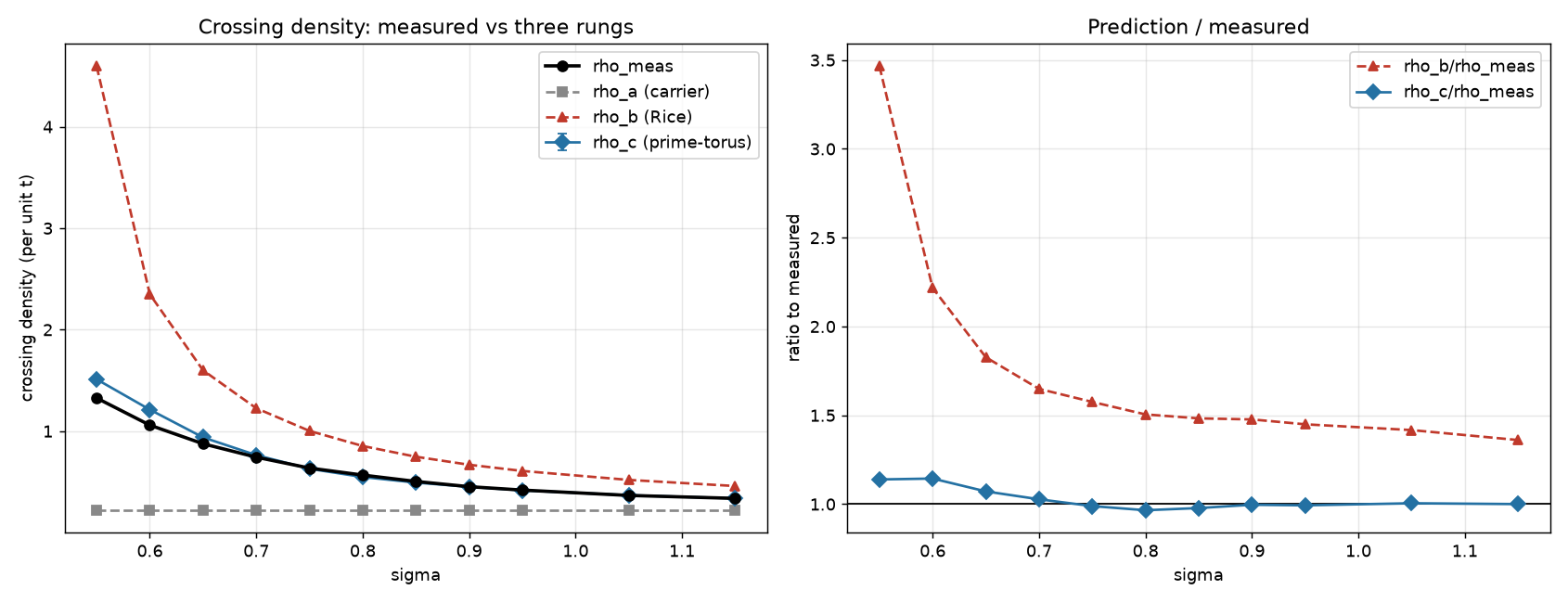
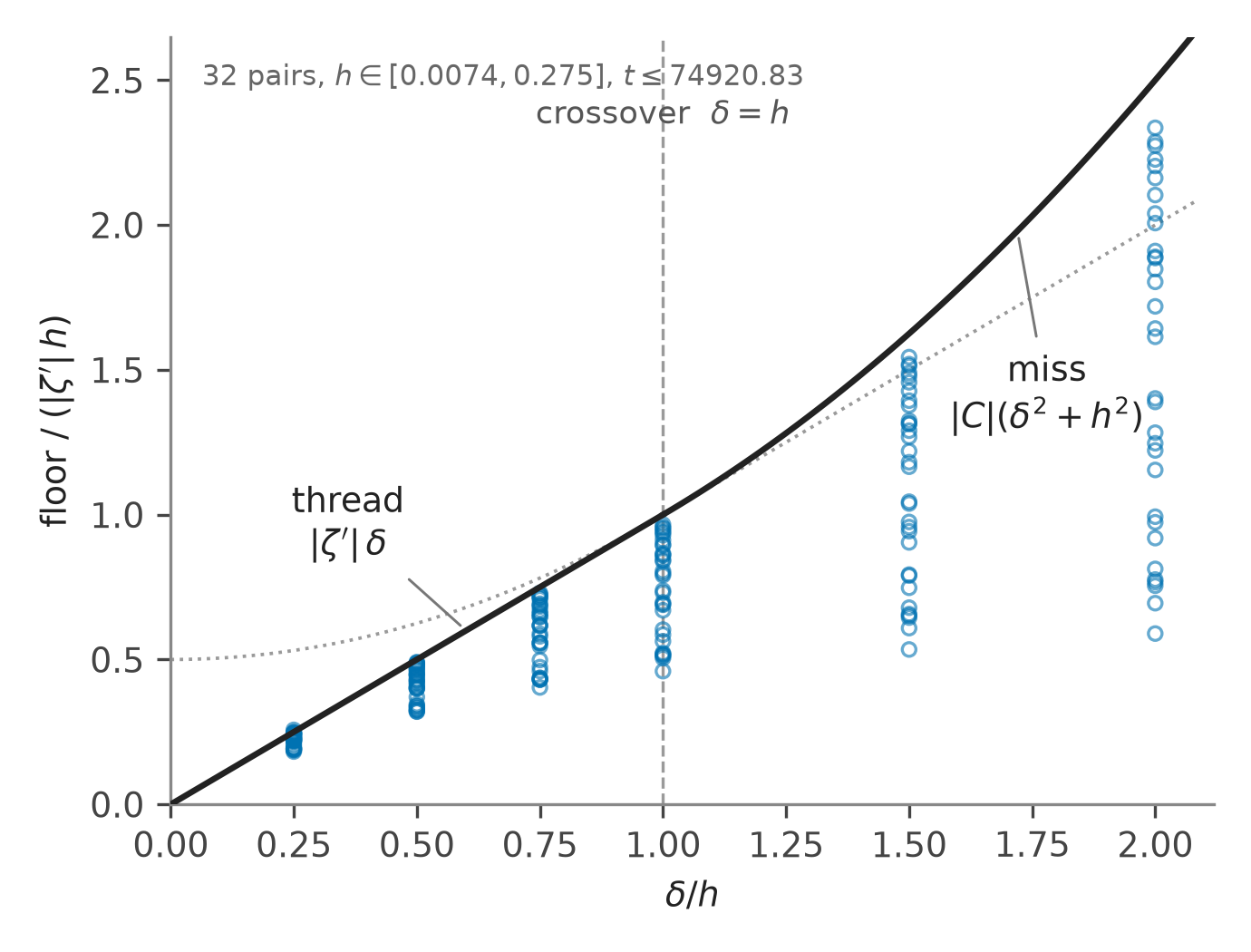
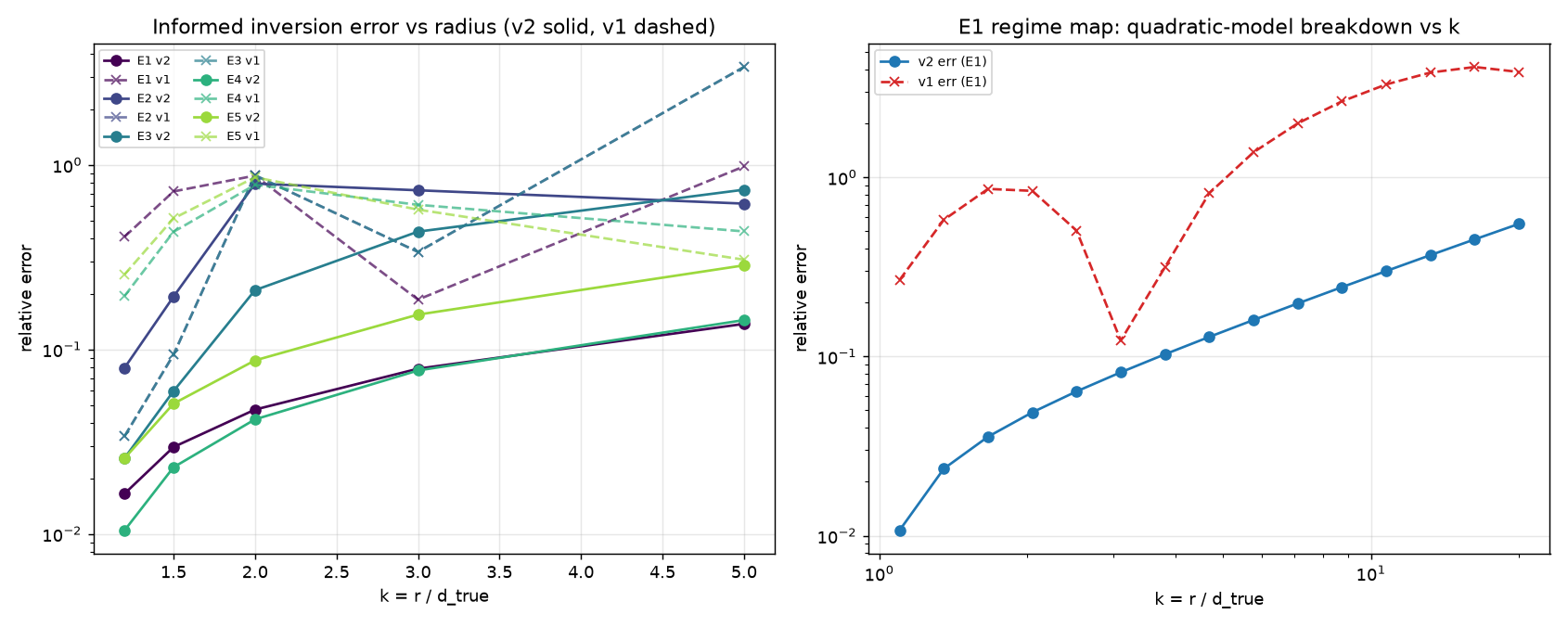
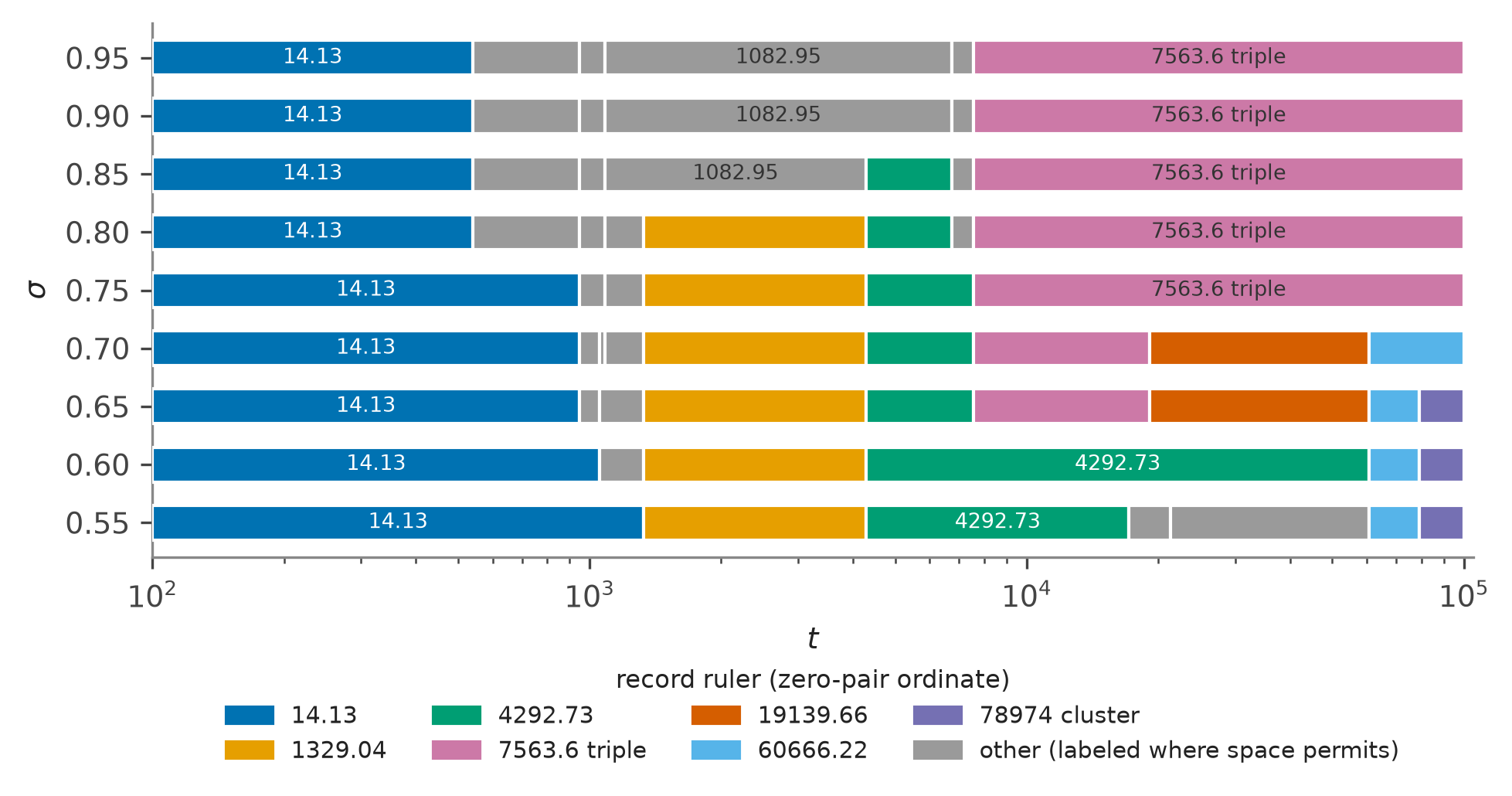
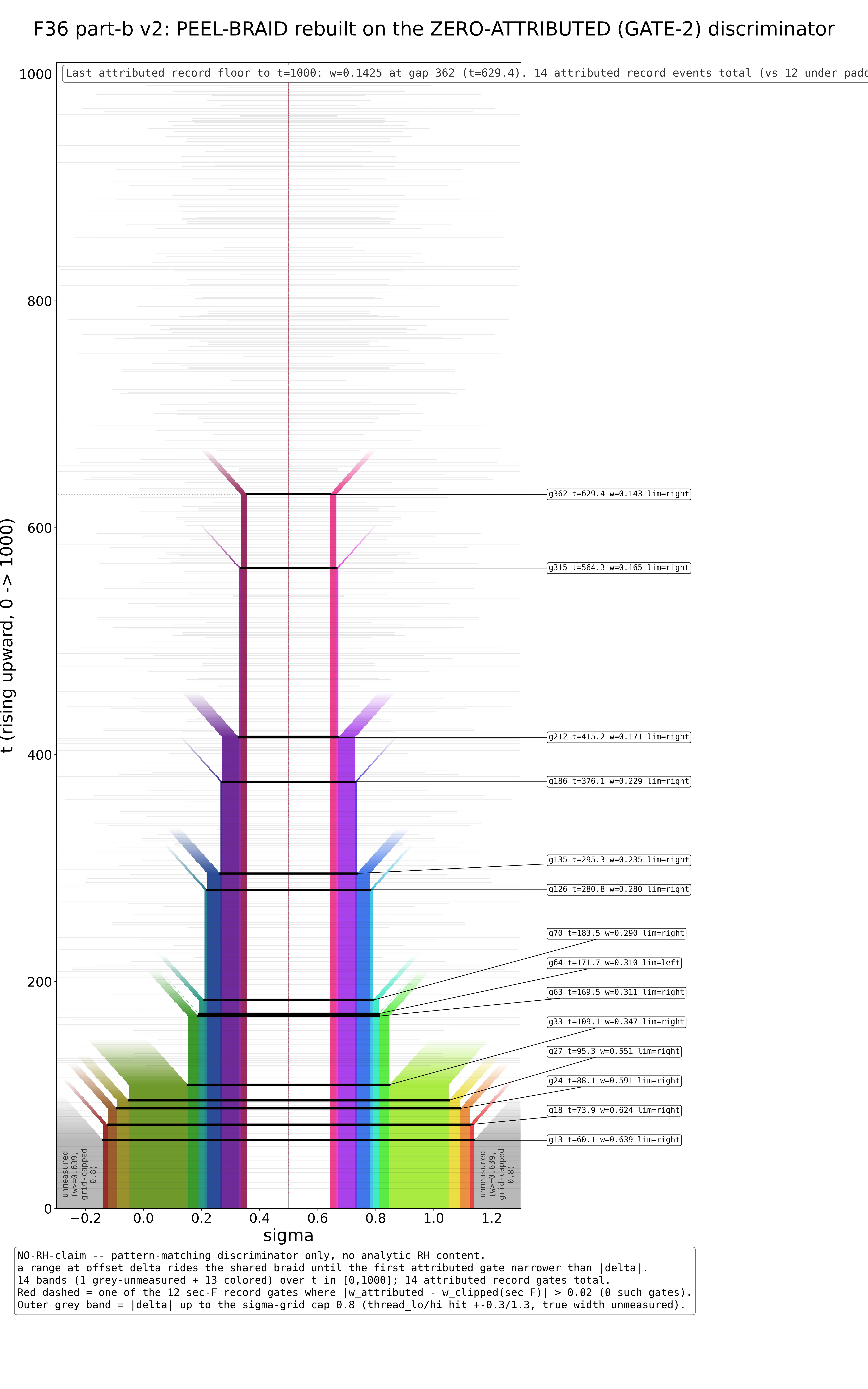
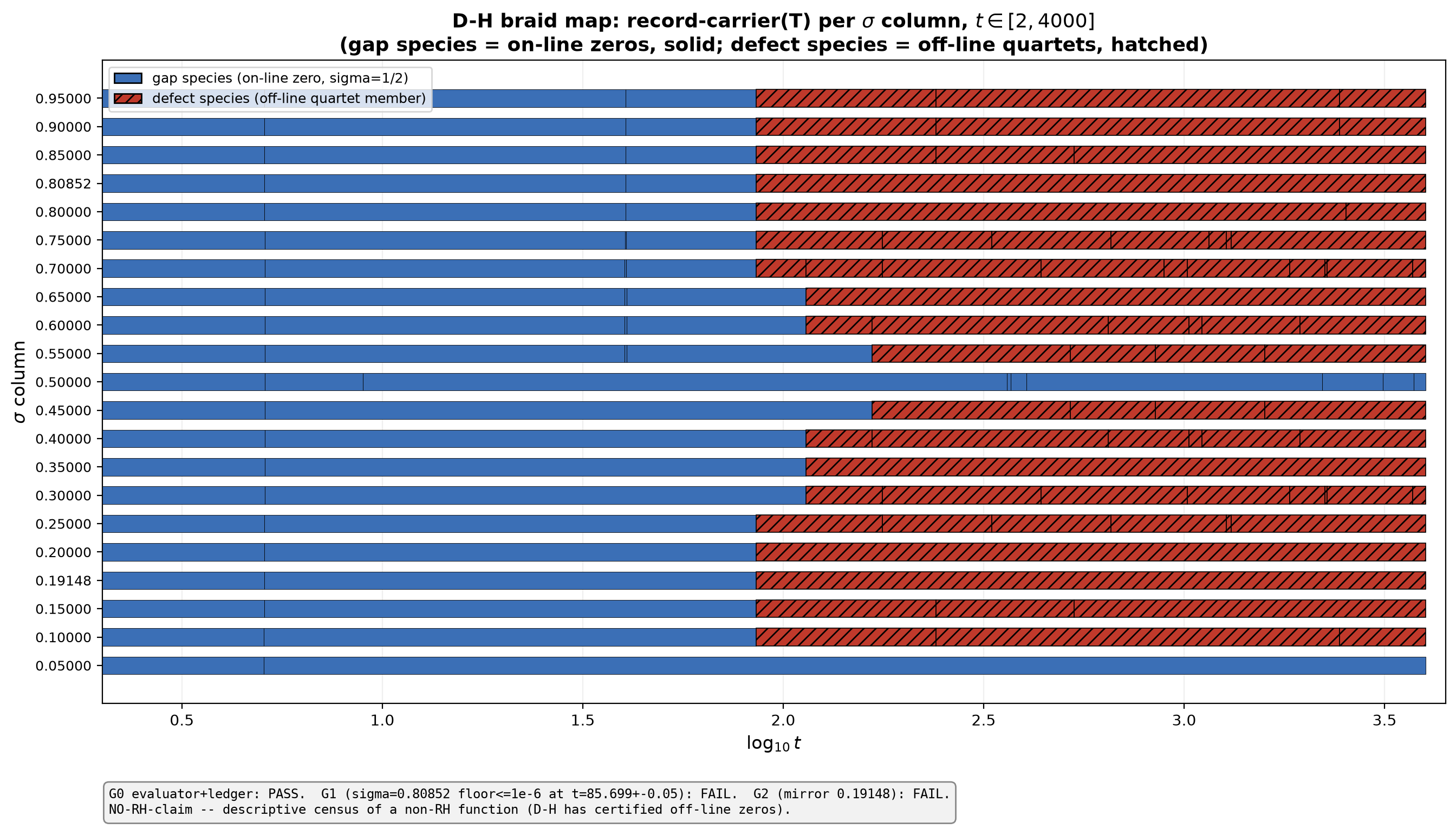
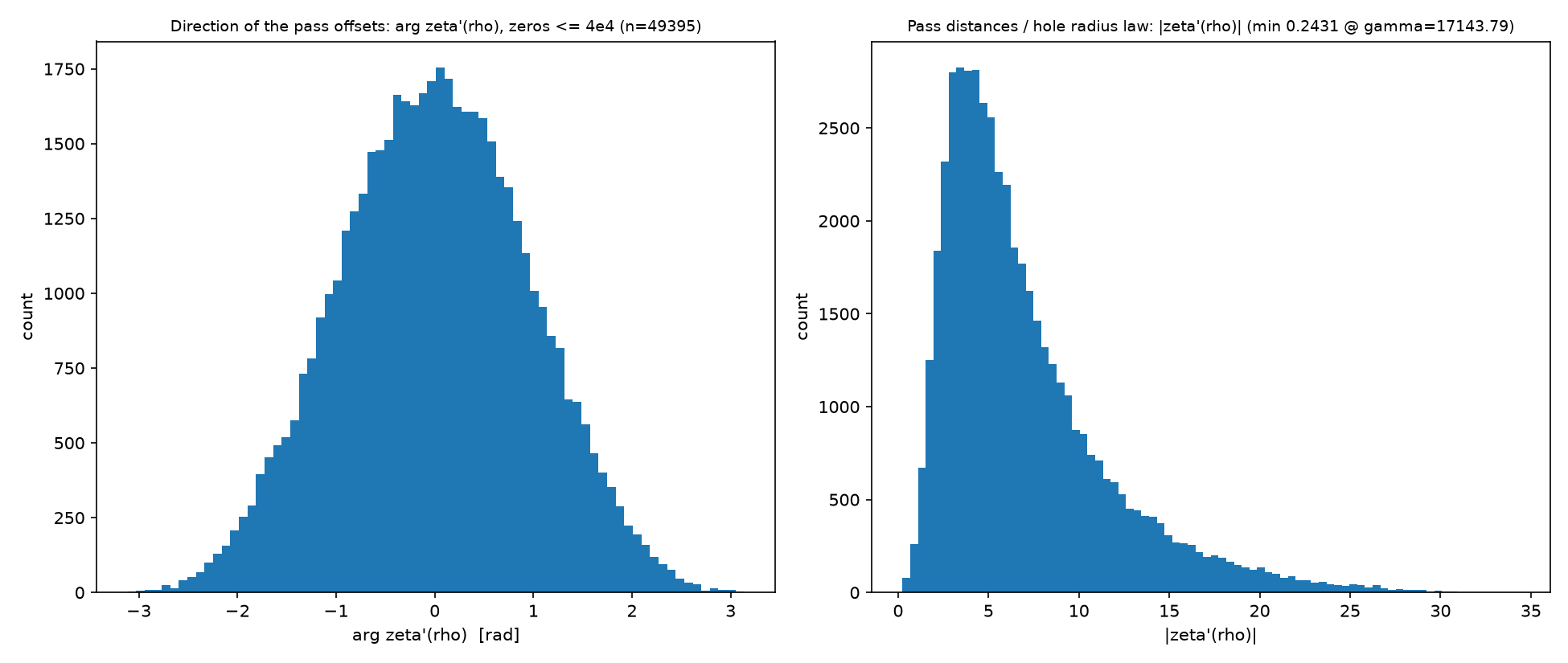
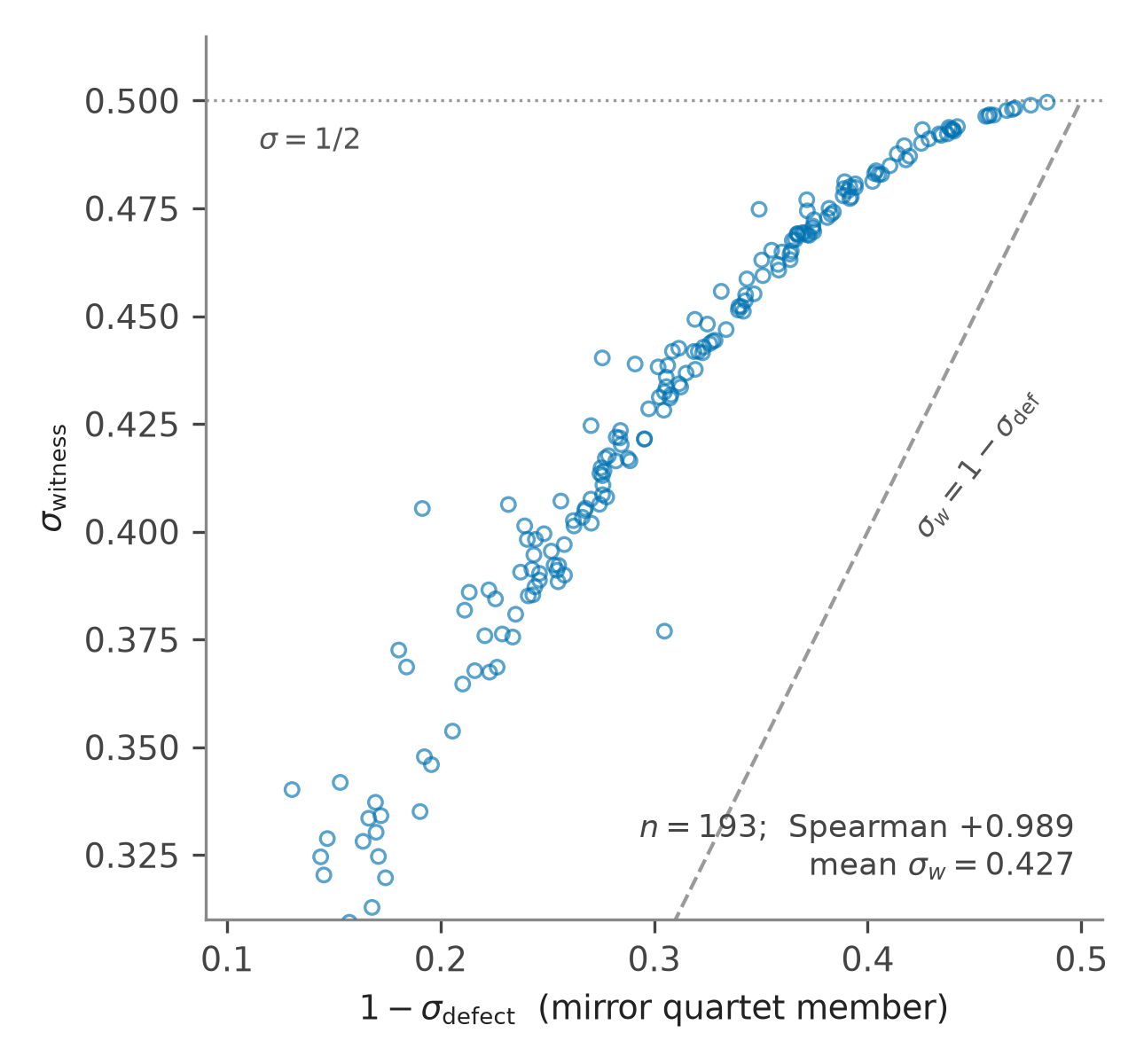
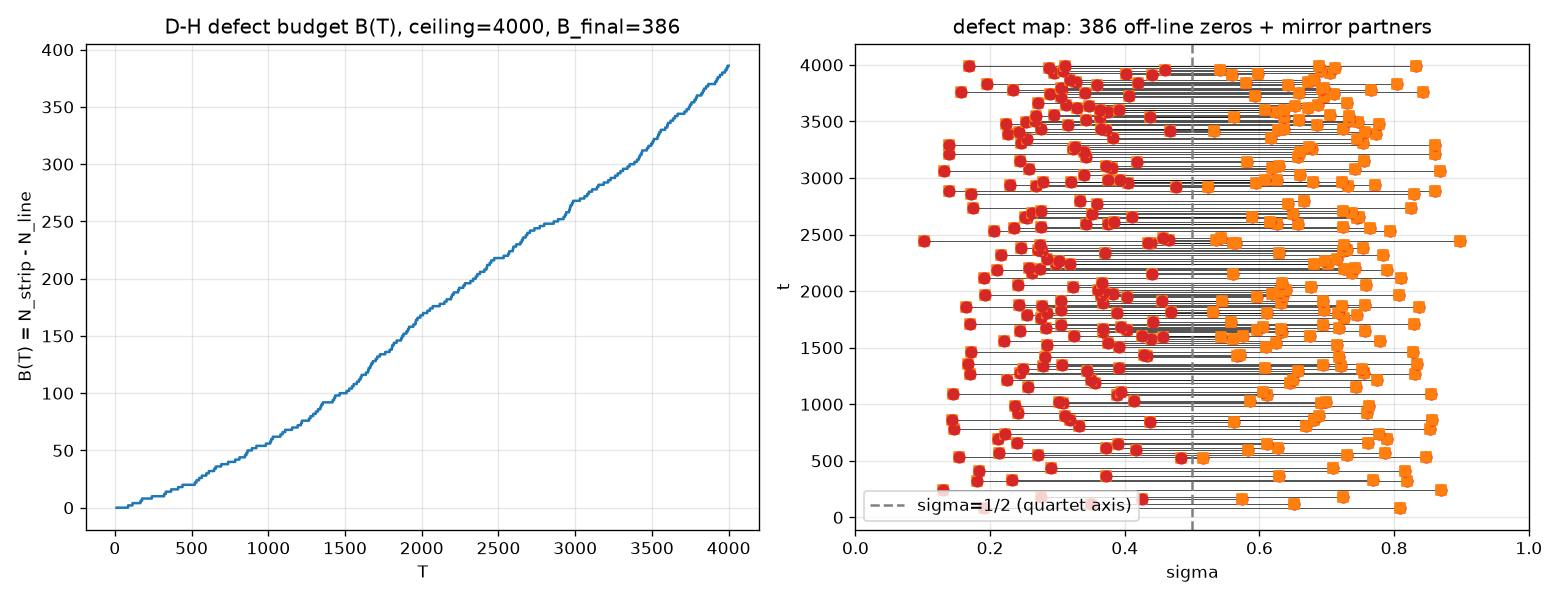
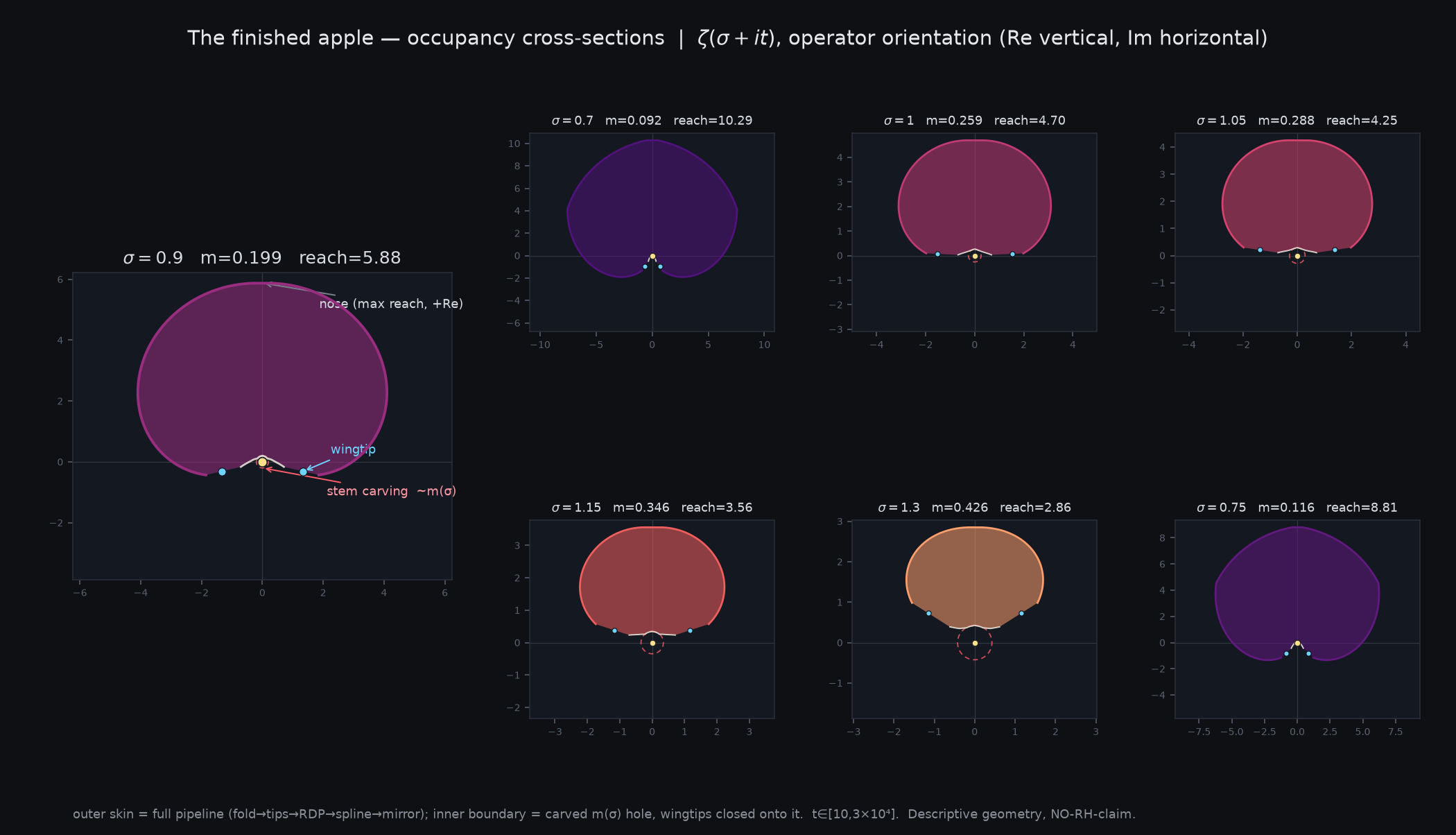
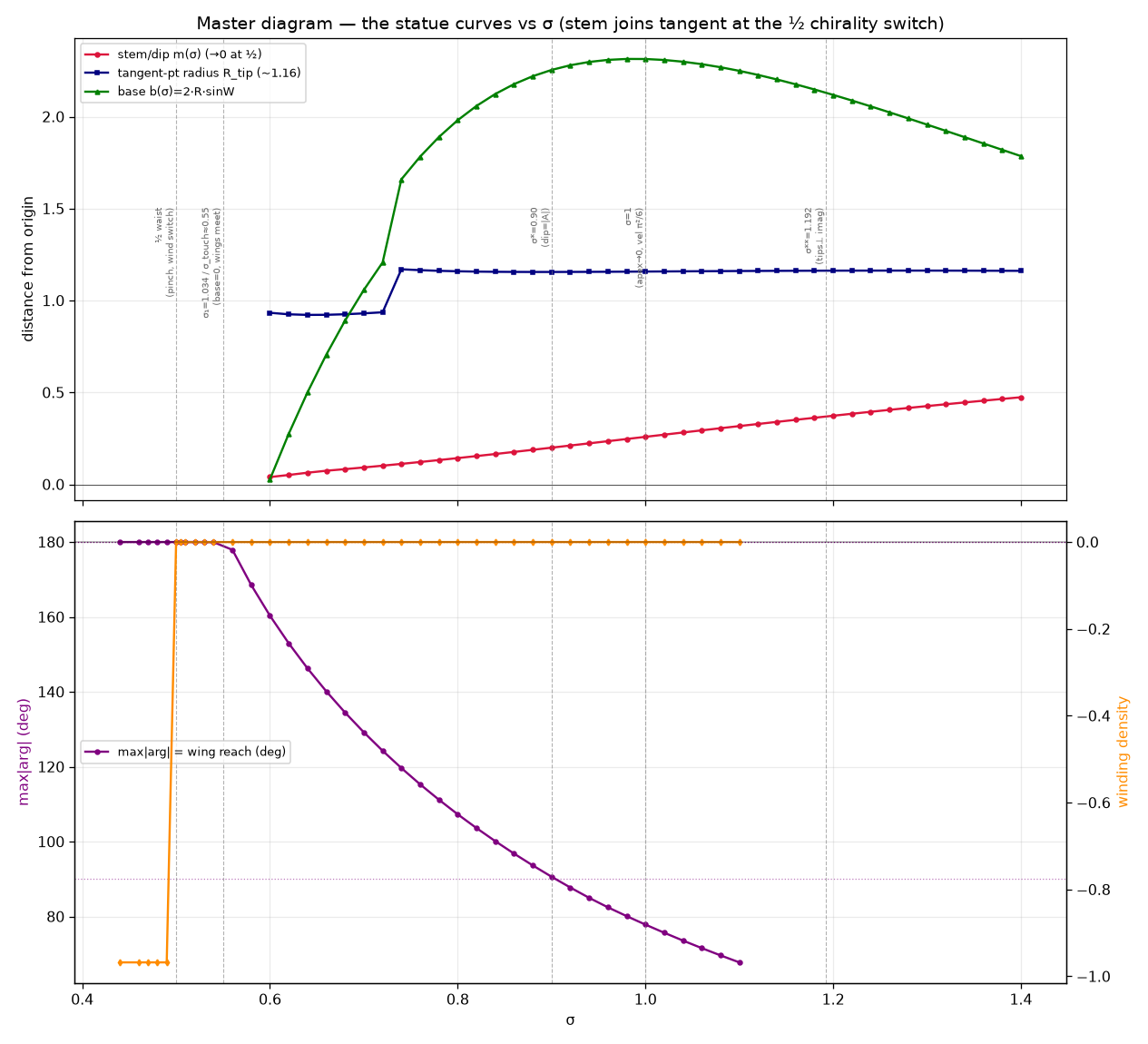
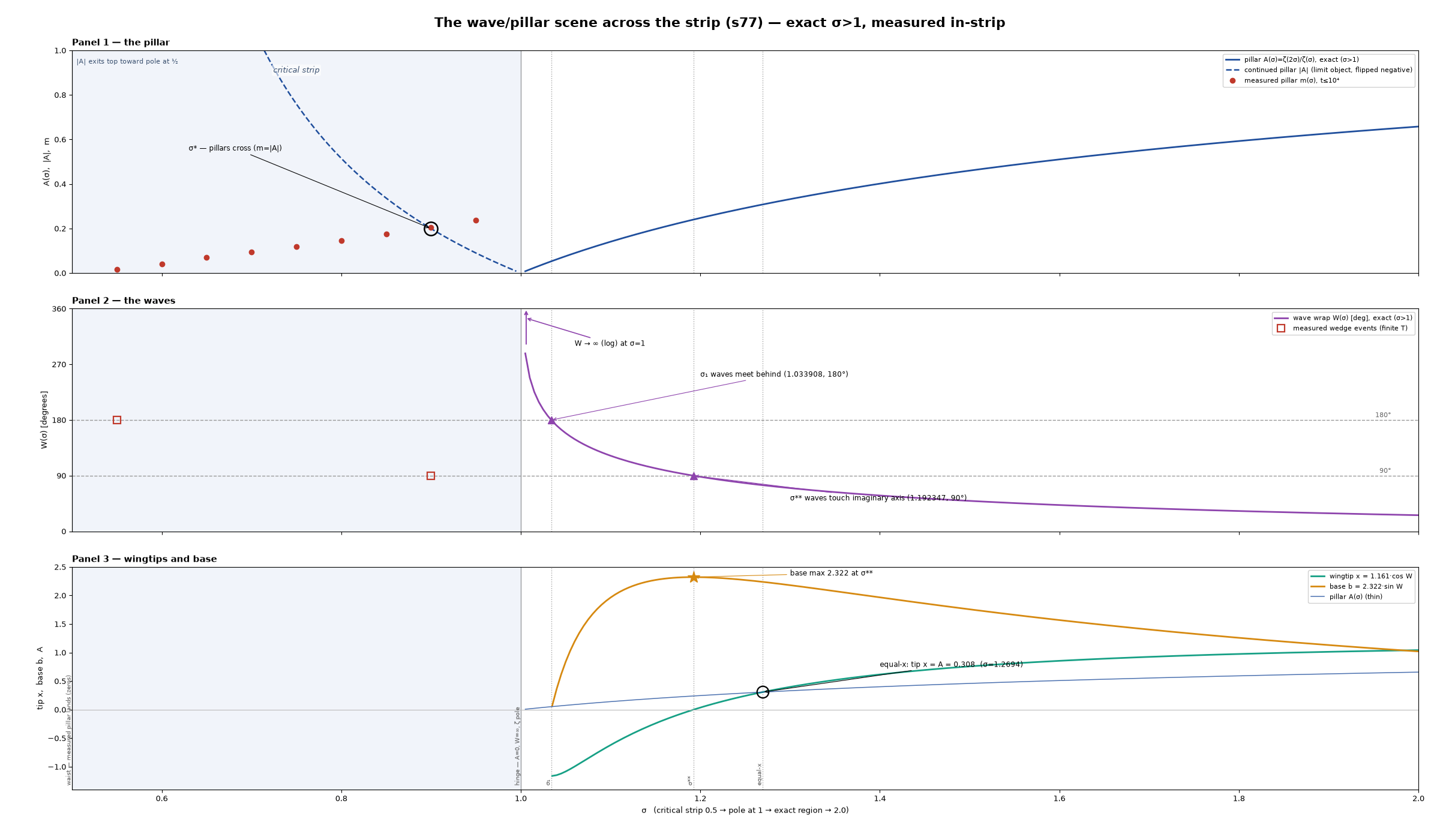
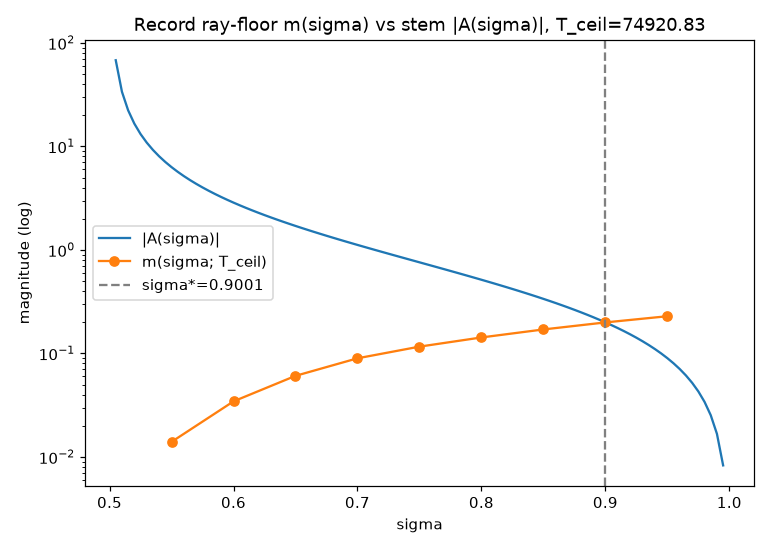
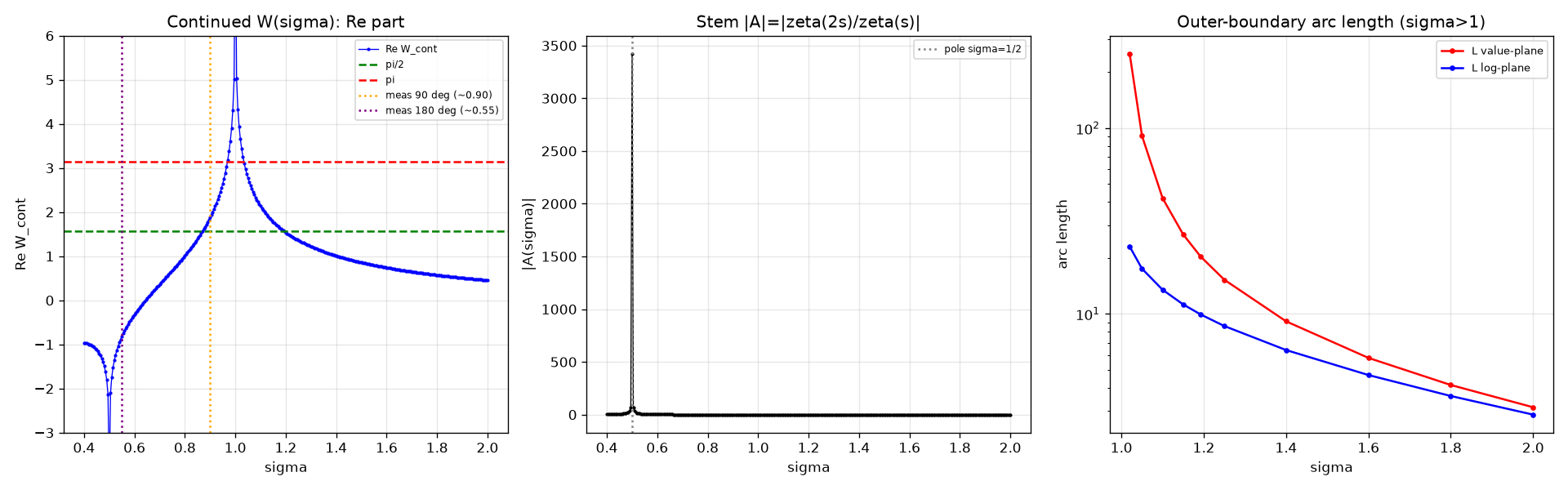
This file carries every figure of the set. The paper's own text remains the sole document of record; nothing here adds to, changes, or is required to understand any claim made there. These figures exist because the subject matter — the origin-approach census, the aperture-crop law, carrier dynamics, the zeta-prime register, the avoidance body and the Euler-product stem — is geometric, and a picture sharpens intuition the text already argues in words.
Every caption describes measured geometry on zeta and on the Davenport–Heilbronn comparison function. The Davenport–Heilbronn panels are a descriptive census of a function that DOES carry off-line zeros, included as the standing counter-model and never as evidence about zeta.
Items keep the paper's own labels [sgC.n] (chapter C, item n), so a citation in the paper points here unchanged. Each entry names the figure file and the data behind it.
Chapter 3 --- The origin-approach census (RAY)
[sg3.1] The crossing-density law rho(sigma). Left panel: the measured density of Im zeta(sigma+it) = 0 crossings per unit t across sigma in [0.55, 1.15], compared against three model rungs — a sigma-independent carrier rate, a Rice-style bound, and a prime-torus law. Right panel: the prediction-to-measured ratios, showing the prime-torus rung closing to within about one percent of the measurement for sigma >= 0.75. Supports the §3.7 statement that the origin-approach crossing density is captured to census grade by the prime-torus model over the upper strip. Data: the §3.7 crossing-density census and its three model rungs.
Chapter 5 --- The aperture-crop law
[sg5.1] The aperture-crop law. Scatter of floor / (|zeta'| . h) against the aspect ratio delta/h for 32 close pairs (h in [0.0074, 0.275], t <= 74920.83). Below the crossover at delta = h the points track the linear "thread" branch
| zeta' | . delta; above it they track the quadratic "miss" branch |
| C | (delta^2 + h^2). Illustrates the Chapter 5 crop law and its exact |
crossover at delta = h. Data: the 32-pair crop census and its crossover table; the render re-checks the banked crossover band delta*/h in [0.971, 1.051], 32/32, before writing.
[sg5.2] The eclipse-chord miss-inversion instrument. Left: relative error of the recovered miss distance versus the sampling radius k = r/d for five events, comparing the curved-chord inversion (v2) against the straight-chord version (v1). Right: the E1 regime map, showing where the quadratic model breaks down as k grows. Supports the §5.7 discussion of the boundary-only miss-signature read. Data: the five-event eclipse-chord inversion round.
Chapter 6 --- Carrier dynamics: freeze, stall, descent
[sg6.1] The carrier tenure map. For each sigma row (0.55–0.95), horizontal bars mark which zero-pair "ruler" holds the record floor over log t, colour-coded by ordinate. For sigma >= 0.75 a single stream (the 7563.6 triple) takes over and runs unbroken to the height ceiling — the frozen-carrier regime. Supports the Chapter 6 freeze/stall/descent taxonomy and the sigma >= 0.75 infinite-tenure claim. Data: the carrier-tenure census; the render verifies the frozen 7563.5 endgame ruler and the banked new-member list before writing.
[sg6.2] The record register (peel-braid). A tall sigma x t schedule (t rising 0 to 1000) of the successive record-floor carriers, rebuilt on the zero-attributed GATE-2 discriminator; 14 attributed record events are labelled by their gap index (g13 ... g362, w falling 0.639 to 0.143). Supports the §6.8 record-register narrative. The figure is a pattern-matching discriminator and carries no analytic content beyond the labelled events. Data: the peel-braid and GATE-2 attribution rounds.
[sg6.3] Two ruler species and the endgame contrast. Record-carrier per sigma column over t in [2, 4000] for the Davenport–Heilbronn function: gap species (on-line zeros, solid) versus defect species (off-line quartet members, hatched). 19 of 21 columns turn defect-ruled; only sigma = 0.05 and sigma = 0.50 remain gap-species. Supports the §6.9 contrast between the two record species. Descriptive census of a non-RH comparison function. Data: the Davenport–Heilbronn braid census, gate line G0 PASS.
Chapter 7 --- arg zeta' at zeros: the needle
[sg7.1] Distribution of arg zeta' at the zeta zeros. Sampled to height about 40k (n about 49,395). The higher-n render gives the smoother, more settled histogram shape referenced for the "needle" statistic. Supports the Chapter 7 characterisation of the arg zeta' register at zeros. Data: the arg zeta'-at-zeros census, 40k height run.
Chapter 8 --- Close pairs and the zeta'-zero offset law
[sg8.1] The witness position law. For 193 matched mirror-quartet pairs, the witness abscissa sigma_witness against 1 - sigma_defect falls on a tight monotone band (Spearman +0.989, mean sigma_w = 0.427). Supports the Chapter 8 statement that the zeta' register locates, not merely detects, the mirror-quartet member. Data: the 193-pair witness table; the render re-checks the Spearman coefficient and the mean before writing.
[sg8.2] The mirror-quartet census. Left: the Davenport–Heilbronn defect budget B(T) = N_strip - N_line rising to 386 by t = 4000. Right: the defect map of 386 off-line zeros with their mirror partners drawn in, about the sigma = 1/2 quartet-symmetry axis. Supports the Chapter 8 mirror-quartet structure and the 1:1 defect-to-witness ledger. Descriptive census of the non-RH comparison function. Data: the Davenport–Heilbronn defect atlas to t = 4000.
Chapter 9 --- Anatomy, exact anchors, and the statue formula
[sg9.1] The occupancy region ("the statue"). Finished multi-panel render of the avoidance-body cross-sections across sigma. Supports the Chapter 9 anatomy — the shape of the region the zeta trajectory occupies as sigma varies. Data: the occupancy sigma-sweep render program.
[sg9.2] The statue governing curves. Quantitative summary of the curves that set the statue's geometry — the m(sigma) magnitude, radius, base, and winding density. Supports the Chapter 9 exact-anchor and statue-formula statements. Data: the statue governing-curve summary.
[sg9.3] The wave/pillar scene across the strip. Three stacked panels giving the full mechanism: the pillar A(sigma) = zeta(2 sigma)/zeta(sigma) with the measured in-strip points and the m = |A| crossing sigma*; the wave-wrap W(sigma) with the sigma** = 1.192347 (90 degrees) and 1.033908 (180 degrees) anchor events; and the wingtip/base curves with the equal-x anchor at sigma = 1.2694. Supports the Chapter 9 exact anchors and the wing/base geometry. Data: the wave/pillar scene table.
Chapter 10 --- The stem program and the Euler-product gate
[sg10.1] The stem coincidence. Log plot of the record ray-floor against the stem magnitude, with their crossing near sigma* about 0.900. Supports the Chapter 10 stem-program statement about where the stem meets the record floor. Data: the stem-probe round.
[sg10.2] Stem magnitude and boundary geometry. Three panels: the continued winding Re W(sigma) with the pi/2 and pi reference levels and the measured 90-degree / 180-degree markers; the stem magnitude |A| = |zeta(2s)/zeta(s)| with its pole at sigma = 1/2; and the outer-boundary arc length (value- and log-plane) for sigma > 1. The middle panel is the stem object of the Chapter 10 program; the outer panels tie it to the sigma > 1 boundary geometry. Data: the boundary-geometry round, arc length cross-checked against the banked boundary-curve table.
Note on the figure set
Fourteen figures, covering Chapters 3, 5, 6, 7, 8, 9 and 10. Chapters 1, 2, 4, 11, 12, 13 and 14 have no figure: their content is either frame, census tables, literature, or negative results, none of which a picture sharpens.
No figure in this file computes a mathematical quantity. Each is drawn from data banked before it was rendered, and the three renders that carry a checkable band — [sg5.1], [sg6.1] and [sg8.1] — re-verify that band against the paper's printed values before writing the image.
Supplementary materials
The audit layer: how the numbers above were checked, what was corrected, and what is owed to whom.
Open the supplementary materials
This file carries the audit apparatus of the paper named above: the concordance anchoring every quoted statistic, the provenance ledger of the structural conjectures, and the revision record. It contains no mathematics that the paper does not state; it exists so that any statistic in the paper can be traced without the paper having to carry the tracing.
S1. Revision record
v1.3 change log (2026-07-29, s118; two DIRECT text integrations under the project's publication ruling of 2026-07-29 — the word LOCKED leaves the filename because a true lock is created by publication, and nothing here has been published):
- §8.4 supersession applied in place. The printed minimum Re w\ = 0.500126 is superseded by 0.500112099639 at γ = 234016.9015089, from the targeted tight-pair harvest of the continuation Packet Centroids V* (in preparation): 358,090 consecutive pairs screened, 254 censused, 254/254 right of ½. It TIGHTENS an observed margin and closes nothing — the census remains a witness, not an exclusion certificate.
- §10.2 Lemma-1 parenthetical corrected against this paper's own §1.2. The old wording made the in-strip continuation "equivalent to positive floors on (½,1), i.e. the open problem". A positive POINTWISE floor there is not open, it is FALSE: §1.2 banks Bohr–Courant (inf_t |ζ| = 0 on every ray inside the strip), and §9.6 already draws the line correctly. The open problem is ATTAINMENT — the rate of approach at finite height — and the text now says so.
No measured number is altered by either change; the v1.2 additive notes E-P3A-1 … E-P3A-6 stay exactly as applied.
v1.2 change log (2026-07-29; errata pack applied on operator order): six ADDITIVE reprint notes, E-P3A-1 … E-P3A-6, appended at §6.5, §9.5, §9.6 (two sites), Ch. 13 item 10, and §14.4. All are scope/ruling/supersession class — they correct the register scope of the extreme-vs- distributional statistic language; the lock is preserved (no original sentence altered or removed; notes additive only); no measured number changes anywhere.
v1.1 change log (2026-07-21; erratum E-S83-1, audit-scope; executed per the s83 split packet): Appendix B (the audit concordance) published separately as the companion document [3], Packet Centroids III: Supplementary Materials — Audit Annex; in-chapter internal-record citations replaced by Supplement row references or opaque ledger tags; the three embedded figures moved to the graphical companion [4] (as [sg5.1]/[sg6.1]/[sg8.1]); references [3]/[4] added. No mathematical content changed.
S2. Provenance ledger (operator structural conjectures)
Hidden-dimension thesis (→ Ch. 3); aperture-crop conjecture (→ Ch. 5, confirmed); hump conjecture clauses 1–3 (→ §9.5, status split); statue/waist principle (→ Ch. 9); stem function + proof strategy (→ Ch. 10, Lemmas proven, gap named); triangle/wing/velocity kinematics (→ §9.2 anchors); sector/limit conjectures refuted or superseded are reported in Ch. 13 per the both-paths rule. Additions, later rounds: Euclidean-unwinding/curvature conjecture (→ §8.9 — formalization is the program's, the wrinkled-paper picture is the operator's); the witness-rule promotion request (→ §8.5, classical scaffold answered it); the D-H braid/2D-gap and accommodation-algebra dictations (→ §6.8–§6.9, folded v0.4; the accommodation algebra adjudicated against the BARCODE census — memoryless model not refuted at resolution, the shared-bounding-zero exception measured census-wide); the snake/river render spec (→ §6.8 figure); the eclipse-read + artificial-circle r-sweep (→ §5.7, v2 validated); the t ≈ 417 peel event and the gap-158 artifact band — operator visual detections, both adjudicated (genuine record cut / artifact-record, §6.8).
S3. Audit concordance — 452 rows
Packet Centroids III: Supplementary Materials — Audit Annex
Author: O. Dvořák. Companion document to Packet Centroids III: The Aperture-Crop Law, Carrier Dynamics, and the Euler-Product Stem — Small-Value Geometry of the Riemann Zeta Function (the main paper; its Appendix B). Version v1.1, 2026-07-22 (literature re-verification pass). AI-credit roster (carried from the main paper): main coordinator Claude (Fable 5); distributed execution Claude Code (Opus, Sonnet); consultations ChatGPT, Gemini, Grok.
What this document is
The main paper's audit discipline: every quoted statistic is audit-anchored — it carries a row in the concordance below (row → manuscript site → statistic → program ledger tag), maintained under the program's pre-registration/adjudication method (main paper §2.3). This document is that concordance in full: 452 continuous rows; rows 1–442 are the audit pass over the manuscript (every quoted statistic anchored), rows 443–452 are delta rows for the literature round, erratum E-S82-1, and the three companion figures.
Program-ledger tags. Entries in the right column are opaque identifiers into the program's internal ledger — adjudication records, extraction records (EVAL), pre-registrations, ratification records, concept records, session ledgers, instruments, and datasets. They are stable keys for the author's archive, not public documents.
Availability. The program's audit ledger (pre-registration records, run cards, extraction records, and adjudications), probe code, and datasets are archived by the author and are available on reasonable request.
Literature re-verification (v1.1, 2026-07-22). Every external antecedent cited in the main paper's literature chapter (§C.12) and anchored in the rows below was re-fetched and confirmed first-hand in this pass: Stopple 2020, Notes on the Phase Statistics of the Riemann Zeros (arXiv:2007.08008); Dueñez–Farmer–Froehlich–Hughes–Mezzadri–Phan 2010 (arXiv:1002.0372, Nonlinearity 23); Ng 2008, Extreme values of ζ′(ρ) (arXiv:0706.1765, J. LMS); Balanzario–Sánchez-Ortiz 2007, Zeros of the Davenport–Heilbronn Counterexample (Math. Comp. 76 (260), 2045–2049); Garunkštis 2019, Zeros of the extended Selberg class zeta-functions and of their derivatives (arXiv:1904.03123, Turkish J. Math.); Torquato–Klatt–Kim 2018 (arXiv:1801.06924); and Lugar–Milinovich–Quesada-Herrera 2022, On the number variance of zeta zeros and a conjecture of Berry (arXiv:2211.14918). Titles, authors, and venues match as cited. One dossier author-expansion error was found and corrected (row 444, erratum E-S82-2): the "LMQ 2022" hyperuniformity antecedent is Lugar–Milinovich–Quesada-Herrera, not "Lawrence-Marklof-Quas" — the same paper the main paper §C.12.4 already cites correctly. No new antecedent overturning a retained novelty claim was located.
Like the main paper, this document makes no claim about the Riemann Hypothesis. Section references of the form §C.n refer to the main paper.
Renumbering map
This concordance is assembled from five adjudicated Tier-R working segments plus a delta block; continuous manuscript numbering, draft order. Rows 1–442 are the audit pass (every quoted statistic anchored; all defects D1–D15 patched in v0.5). Counting note: the annex §0 total of 411 uses the FRAME segment's own composite-deduplicated count (62+20); this listing prints every labeled row physically present in FRAME §1–§2 (93+20 = 113) — same content, finer granularity, no discrepancy. Rows 443–452 are delta rows for the s81-cont literature round, the s82 figures, and erratum E-S82-1.
| Audit segment | Coverage | Local rows | Printed rows |
|---|---|---|---|
| audit segment CH34 | Ch. 3-4 | local 1..67 | printed 1–67 |
| audit segment CH56 | Ch. 5-6 | local 1..92 | printed 68–159 |
| audit segment CH78 | Ch. 7-8 | local 1..86 | printed 160–245 |
| audit segment CH910 | Ch. 9-10 | local 1..84 | printed 246–329 |
| audit segment FRAME | Abstract, Ch. 1/2/11-14, App. A/C + [1]/[2] pass | local A1..P-20 | printed 330–442 |
| (delta, this document) | s81-cont + s82 additions | — | printed 443–452 |
The concordance
| Row | Draft § | Statistic | Program ledger | ||||||||
|---|---|---|---|---|---|---|---|---|---|---|---|
| 1 | 3.1 | "σ-columns 0.55–0.95 (step 0.05) + 1.05/1.15 beyond the strip" | ledger RAY1 §1 R1 table; ledger RAY1-PREREG | ||||||||
| 2 | 3.1 | "t ∈ [10, 10⁴] base census" | ledger RAY1-PREREG ("Range") | ||||||||
| 3 | 3.1 | "(72,840 crossings)" | ledger RAY1 header | ||||||||
| 4 | 3.1 | "extended to T_ceil" | ledger F27 header | ||||||||
| 5 | 3.1 | "then to 10⁹ on the LMFDB bank" | ledger S73-CC §F30 | ||||||||
| 6 | 3.1 | "Gates G0–G5" | ledger RAY1 header | ||||||||
| 7 | 3.2 | "perfectly monotone in σ (Spearman 1.0000)" | ledger RAY1 §1 R1 | ||||||||
| 8 | 3.2 | "0.0175 / 0.0409 / 0.0715 / 0.0939 / 0.1190 / 0.1465 / 0.1757 / 0.2060 / 0.2368" | ledger RAY1 §1 R1 table | ||||||||
| 9 | 3.2 | "0.2985 / 0.3577 beyond" | ledger RAY1 §1 R1 table | ||||||||
| 10 | 3.2 | "Crossing-minima ≈ continuous minima (ratios ≤ 1.04)" | ledger RAY1 §1 R1b | ||||||||
| 11 | 3.2 | "Median \ | value\ | saturates ≈ 0.96 from σ ≥ 0.7" | ledger RAY1 §1 R2 | ||||||
| 12 | 3.2 | "Euler-product floor ζ(2σ)/ζ(σ) is exact (0 violations)" | ledger RAY1 §1 R4 | ||||||||
| 13 | 3.2 | "0.0758091607 at 1.05" | ledger EVAL-s69A selftest row 5 | ||||||||
| 14 | 3.2 | "0.1974470162 at 1.15" | ledger EVAL-s69A selftest row 6 | ||||||||
| 15 | 3.3 | "σ ≥ 0.65 all bottom at the triple γ = 7563.18/.52/.77" | ledger RAY1 §1 R1-structural | ||||||||
| 16 | 3.3 | "σ = 0.55/0.60 at the pair 4292.75" | ledger RAY1 §1 R1-structural | ||||||||
| 17 | 3.3 | "(gap 0.0908)" | ledger RAY1 §1 R1-structural + §2 | ||||||||
| 18 | 3.3 | "the longitudinal register … shows a clean null at the same events — the two registers decouple" | ledger FB5 §1 F19 + ledger F27 §5 conseq. 3 | ||||||||
| 19 | 3.4 | "For σ ≥ 0.65 the curve never lands on the negative real axis to 10⁵-order heights (f_neg = 0)" | ledger F27 §1 R7 | ||||||||
| 20 | 3.4 | "at σ = 0.6 the first negative landing arrives only at t = 24856.94" | ledger F27 §1 R7 table | ||||||||
| 21 | 3.4 | "σ = 0.55 at 10272.36" | ledger F27 §1 R7 table | ||||||||
| 22 | 3.4 | "near-miss at t = 8646.17" | concept record R2 §16d | ||||||||
| 23 | 3.4 | "\ | Im\ | = 0.0057" | concept record R2 §16d; ledger F27 R7 | ||||||
| 24 | 3.4 | "Re = −0.775" | concept record R2 §16d | ||||||||
| 25 | 3.4 | "the open-cone (angle) picture was REFUTED by this instrument check" | concept record R2 §16d | ||||||||
| 26 | 3.5 | "Left-column minima (σ = 0.05..0.45): 0.4305...0.0241" | concept record R2 §16i | ||||||||
| 27 | 3.5 | "exact stretch \ | χ\ | = (t/2π)^δ — verified to 4 digits (carrier-shared columns)" | concept record R2 §16i finding 1 | ||||||
| 28 | 3.5 | "to 7 digits in the crop-mirror form (§5.4)" | ledger F25 §1 R3 | ||||||||
| 29 | 3.5 | "deep-pair carrier for σ ≥ 0.40, first zero (γ₁ = 14.13) for σ ≤ 0.35" | concept record R2 §16i finding 2 | ||||||||
| 30 | 3.5 | "left holes GROW with T" | concept record R2 §16i finding 2 | ||||||||
| 31 | 3.6 | "≈ 0 for σ > ½" | ledger S73-CC §STATUE; ledger STATUE-STRUCTURE §1 | ||||||||
| 32 | 3.6 | "equal to minus the zero density for σ < ½ (measured to 0.1% against −log(T/2π)/2π)" | ledger S73-CC §STATUE | ||||||||
| 33 | 3.6 | "razor-sharp at σ = ½ — no intermediate anchor; first-enclosure collapses onto ½" | session ledger s73-cont | ||||||||
| 34 | 3.6 | "the curve encircles the origin ~N(T) times" left of the line; teardrop right | concept record R2 §16i finding 3 | ||||||||
| 35 | 3.6 | section tag "[R base; CC 10⁹ extension]" — a winding-switch measurement extended to 10⁹ | NOT FOUND — resolved: ledger ANNEX §4 (anchor upgrade / resolution of record) | ||||||||
| 36 | 3.7 | "RESOLVED at census grade for σ ≥ 0.75" | ledger S77-FLEET §1 heading + R3 | ||||||||
| 37 | 3.7 | "predicts the measured density within 3.4% on σ ∈ [0.75, 1.15]" | ledger S77-FLEET §1 R3 | ||||||||
| 38 | 3.7 | "sub-1% for σ ≥ 0.90" | ledger S77-FLEET §1 R3 | ||||||||
| 39 | 3.7 | "Gaussian Rice closed form (1/π)√(ζ″(2σ)/(ζ(2σ)−1)) overpredicts 1.36–3.47×, worsening toward the line" | ledger S77-FLEET §1 R2 | ||||||||
| 40 | 3.7 | "banked census endpoints 1.361/0.337 reconcile exactly (top-decade vs full-range definitions)" | ledger S77-FLEET §1 R1 | ||||||||
| 41 | 3.7 | "σ ≤ 0.70 is scope-pinned open (N_max truncation + the FE reflected term + t-non-stationarity, all named)" | ledger S77-FLEET §1 R3 scope pin | ||||||||
| 42 | 4.1 | "99,999 unfolded gaps: \ | mean − 1\ | = 4.47e-7" | ledger FB2 §1 R7′ | ||||||
| 43 | 4.1 | "lag-1 autocorrelation −0.357..−0.42" | ledger FB2 §1 R7′ (low end); ledger FB1-PREREG oracle row 12 (high end); ledger P3E §4 | ||||||||
| 44 | 4.1 | "sub-quantum gaps 9.58%" | ledger FB2 §1 R7′ | ||||||||
| 45 | 4.1 | "Lehmer top-5 census banked (tightest normalized gap 0.0219 at γ = 71732.9)" | ledger FB2 §1 R7′ | ||||||||
| 46 | 4.1 | "the classical Lehmer pair recovered unprompted" | ledger FB1 §1 R7 | ||||||||
| 47 | 4.2 | "structure factor is suppressed 10^6.88 two-sided below f ≈ 0.05 cycles/gap" | ledger FB4 §1 R-H2 + §3; ledger FB3 §3 (crossover) | ||||||||
| 48 | 4.2 | "β_low = 0.039 at f = 2.05e-8" | ledger FB4 §1 R-H3 + §3 | ||||||||
| 49 | 4.2 | "five orders below the GUE structure-factor ramp" | ledger FB4 §1 R-H3 | ||||||||
| 50 | 4.2 | "NOT GUE at low frequency (Berry-saturation regime measured directly in the spectral register)" | ledger FB4 §1 R-H3 | ||||||||
| 51 | 4.2 | "number variance saturated (Δ̂ = 0.0079 vs full-GUE 0.328)" | ledger FB4 §1 R-H1b | ||||||||
| 52 | 4.2 | "Dip family at 2k/f₂-type positions established (k = 2,3)" | ledger FB5 §1 R-Σ2 | ||||||||
| 53 | 4.2 | "the even-L resonance was an estimator artifact, killed by randomized starts" | ledger FB5 §1 R-Σ1 | ||||||||
| 54 | 4.3 | "per-prime lock-in height tracks local crowding (T(p) ≈ π/Δu…)" | ledger FB1 §1 R1 | ||||||||
| 55 | 4.3 | "lock-in ~3× early" | ledger FB1 §1 R1 | ||||||||
| 56 | 4.3 | "deep-inversion correlation cap ~0.55" | ledger FB3 §1 R3″ + §3 | ||||||||
| 57 | 4.3 | "broken by the Λ-weighted all-neighbor interference envelope (out-of-sample Spearman 0.7649…)" | ledger FB5 §1 R-S3 | ||||||||
| 58 | 4.3 | "residual = minus interference excess, β = −0.899 ≈ −1" | ledger FB5 §1 R-S3 | ||||||||
| 59 | 4.3 | "casualties are exclusively higher prime powers (81% dyadic)" | ledger FB2 §1 R6′(b) | ||||||||
| 60 | 4.3 | "the envelope necessary condition is exact (37/37, no false negatives)" | ledger FB3 §1 R6″ | ||||||||
| 61 | 4.3 | "deletion phases are kill-biased" | ledger FB4 §1 R-K2 | ||||||||
| 62 | 4.3 | "sufficiency remains open" | ledger FB4 §1 R-K1; ledger FB5 §1 R-P4 | ||||||||
| 63 | 4.3 | "linear long-memory, OOS R² 0.44 at k = 20 lags" | ledger FB3 §1 R5″ | ||||||||
| 64 | 4.3 | "collapse at k = 100" | ledger FB3 §1 R5″ + §3 | ||||||||
| 65 | 4.3 | "quadratic gain negligible" | ledger FB2 §1 R5′ + §3 | ||||||||
| 66 | 4.4 | "No local scar of a close pair exists in any longitudinal gap register (instant repayment — hyperuniformity)" | ledger FB5 §1 F19 (R-L1/R-L2/R-L3) | ||||||||
| 67 | 4.4 | "the close-pair scar lives ONLY in the transverse (value) register" | ledger RAY1 §1 R1-structural | ||||||||
| 68 | 5.1 | "Thread (δ < h): floor = \ | ζ′\ | ·δ — the linearization is exact at first order" | ledger F27 §5 | ||||||
| 69 | 5.1 | "Miss (δ > h): floor = \ | C\ | (δ² + h²) ≈ \ | C\ | δ², with C = \ | ζ′\ | /2h the on-line well curvature" | ledger F27 §5 | ||
| 70 | 5.1 | "Crossover exactly at δ = h … d² + δ² = h²" | ledger F27 §5; ledger F25 §1 R1 | ||||||||
| 71 | 5.1 | "Provenance: operator conjecture, derived the same session (F27 §5), generalized and census-confirmed (F25)" | ledger F27 §5; ledger F25 §2 | ||||||||
| 72 | 5.2 | "32 pairs, h ∈ [0.0074, 0.129] (~18× range), 9 σ-columns" | ledger F25 header | ||||||||
| 73 | 5.2 | "δ*/h ∈ [0.971, 1.051] — 32/32" | ledger F25 §1 R1 | ||||||||
| 74 | 5.2 | "slope −1.23 tight, degrading −0.50 at the widest" | ledger F25 §1 R1 | ||||||||
| 75 | 5.2 | "thread-slope 0.915 (cone ∝ δ)" | ledger F25 §1 R2 | ||||||||
| 76 | 5.2 | "miss-slope →1.55 (bowl ∝ δ²), switch at δ = h" | ledger F25 §1 R2 | ||||||||
| 77 | 5.3 | "36 pairs at t ∈ [10⁸, 10⁹] (3 δ-bands × 6 pairs × 2 packs): 36/36 with δ*/h ∈ [0.85, 1.15]" | ledger P3E §5 add. 6 | ||||||||
| 78 | 5.3 | "median 1.018; thread/miss regime structure reproduced" | ledger P3E §5 add. 6 | ||||||||
| 79 | 5.3 | "The law holds unchanged across five decades" | ledger P3E §5 add. 6 | ||||||||
| 80 | 5.4 | "floor DEPTH is FE-magnified on the left by exactly (t/2π)^δ — measured \ | LR − FE\ | /FE median 1.3e-7 (7 digits)" | ledger F25 §1 R3 | ||||||
| 81 | 5.4 | "crop crossover is mirror-symmetric (\ | δ\ | = h both sides)" | ledger F25 §1 R3 | ||||||
| 82 | 5.5 | "C = \ | ζ′\ | /2h = \ | ζ(½+iγ_mid)\ | /h² validated <2%" | ledger SYNTHESIS-s73 TL;DR item 1 + §A | ||||
| 83 | 5.5 | "878,321 pairs streamed to 10⁹" | ledger EVAL-s73-F30 header | ||||||||
| 84 | 5.5 | "smallest observed curvature C_min ≈ 2.22 (direct RS-verified, rel 3–9%)" | ledger S73-CC (F30 near-waist block); ledger F37 §1 | ||||||||
| 85 | 5.5 | "C_med grows 12.5 → 55.8 across decades 4→9" | ledger S73-CC (F30 C-census) | ||||||||
| 86 | 5.5 | "inf C ≈ 2.2 bounded away from 0 to 10⁹ … explicitly NOT a rigorous floor bound (sample-min over a carrier-limited pool; E18)" | ledger S73-CC (F30) + Errata E18 | ||||||||
| 87 | 5.5 | "near the waist the floor takes the local form m(σ) → C_min·(σ−½)²; 'resolves-the-plateau' reading is SUPPORTIVE only, pending an aperture-matched carrier finder (E19)" | ledger S73-CC (F30) + Errata E19 | ||||||||
| 88 | 5.7 | "d = \ | Im(z̄_in·z_out)\ | /L with chord law L = 2√(r² − d²)" (operator instrument, concept record R2 §16v add. 2–3) | concept record R2 §16v add. 2 | ||||||
| 89 | 5.7 | "miss tracked to ≤ 1% at δ ≤ 1e-3; certification floors δ = 1e-6..1e-4 per event" | ledger F35 §6 R2 | ||||||||
| 90 | 5.7 | "the straight chord is REFUTED at carrier events (29–72% error at r = 1.5d; under→flip→over curvature signature)" | ledger F35 §2 R1+R2 | ||||||||
| 91 | 5.7 | "the r-sweep self-consistency gate (operator design) is what exposed it" | ledger F35 §2 R2 corollary; concept record R2 §16v add. 3(a) | ||||||||
| 92 | 5.7 | "v2 … VALIDATED in informed mode: miss-distance error 1.05–2.6% at r = 1.2d on isolated tight pairs" | ledger S77-FLEET §3 R1 | ||||||||
| 93 | 5.7 | "v1's 19–41% failure reproduced as control" | ledger S77-FLEET §3 R1 | ||||||||
| 94 | 5.7 | "exact-hit control clean — v2 returns d = 0 at all radii where v1 manufactured a spurious 8.11·r²" | ledger S77-FLEET §3 R3 | ||||||||
| 95 | 5.7 | "usable band r ≲ 2d with smooth degradation" | ledger S77-FLEET §3 R4 | ||||||||
| 96 | 5.7 | "wide gaps (h ≫ δ) out of quadratic scope" | ledger S77-FLEET §3 R1 scope pin (i) | ||||||||
| 97 | 5.7 | "BLIND mode is REFUTED for certification (h ↔ \ | C₂\ | degeneracy, ~2× h bias) but recovers pair centers to 0.0015–0.0125" | ledger S77-FLEET §3 R2 | ||||||
| 98 | 5.7 | "certification needs known ordinates, which the certified banks supply (ECLIPSE-HX seeded…)" | ledger S77-FLEET §3 R2 + Consequence | ||||||||
| 99 | 5.7 | "Hit signature … quadratic-vanishing curvature floor d_chord ≈ C·r² — the r-sweep SCALING separates a hit (∝ r²) from a certified miss (plateau at d)" | ledger F35 §6 R1/R4 | ||||||||
| 100 | 5.7 | "the genuine off-line D-H zero shows the IDENTICAL full-eclipse signature … instrument, not condition (blocker-2 exhibit)" | ledger F35 §6 R3 | ||||||||
| 101 | 5.7 | "Apex perpendicularity (z′ ⟂ z) confirmed to ≤ 2 millidegrees at 5 events" | ledger F35 §2 R3 | ||||||||
| 102 | 5.8 | "Measured at 4 banked events, σ swept 0.505..1.30: depth(σ) is strictly monotone; … zero secondary pass-windows at 10% prominence" | ledger F35 §5 R2 | ||||||||
| 103 | 5.8 | "each Lehmer gap serves exactly ONE σ-window, the natural near-½ family" | ledger F35 §5 R2 | ||||||||
| 104 | 5.8 | "tolerance-width law (half-width ≈ depth/\ | ζ′\ | …) … confirmed in the same run" | ledger F35 §5 R3 | ||||||
| 105 | 5.8 | "the crop slope (0.98×\ | ζ′\ | at 4 events)" | ledger F35 §5 R1 | ||||||
| 106 | 6.1 | "Each m_T(σ) trajectory mixes three regimes — thread (first zeros, low T), miss, frozen" | ledger F28 §0 | ||||||||
| 107 | 6.2 | "For σ ≥ 0.75 the record floor is carried by the single triple γ = 7563.18/.52/.77 from T = 10⁴ to T_ceil = 74920.83" | ledger F28 §0 | ||||||||
| 108 | 6.2 | "nothing to 10⁹ beats it (T_break > 10⁹)" | ledger S73-CC (F30 σ*(T) block); ledger S75-RAT §2.3 | ||||||||
| 109 | 6.2 | "m-values frozen: 0.1164/0.1427/0.1706/0.19940/0.2288 at σ = 0.75..0.95" | ledger F28 §0 table | ||||||||
| 110 | 6.2 | "σ ≤ 0.70 still descends (ceiling carrier γ ≈ 60666.22…)" | ledger F28 §0 | ||||||||
| 111 | 6.2 | "an aperture-selected pair of \ | ζ′\ | -rank 11" | ledger F27 §1 R6 | ||||||
| 112 | 6.2 | "the min-\ | ζ′\ | pair is the SHALLOWEST near-waist carrier: min\ | ζ′\ | and min-\ | ζ\ | -on-ray run OPPOSITE for tight pairs; carrier selection = on-line dip × aperture, off the \ | ζ′\ | podium; DECISIVE, not second-order" | ledger F27 §1 R6 / §2.2 |
| 113 | 6.2 | "the carrier braid (operator Sankey reading, banked [R]): streams 4292 / 7563 / 19140 / 21325 / 60666" | concept record R2 §16v add. 5–6 | ||||||||
| 114 | 6.2 | "σ ≥ 0.75 one infinite-tenure frozen stream to 10⁹ (render the carrier-braid render; fine-braid census = F36, election)" | concept record R2 §16v add. 5 | ||||||||
| 115 | 6.3 | "predicts the ceiling min-\ | ζ′\ | ordinate with zero fitted parameters (confirmed exactly: min\ | ζ′\ | = 0.14806 at γ = 71732.9012, the tightest banked pair)" | ledger F27 §1 R1 | ||||
| 116 | 6.3 | "FAILS in the value register (that pair does not carry the ray floor…)" | ledger F27 §1 R6 / §2.1 | ||||||||
| 117 | 6.4 | "min\ | ζ′\ | falls 0.148 (7.5×10⁴) → 0.0065 (6×10⁸)" | ledger F29 §5 | ||||||
| 118 | 6.4 | "tracking the Gonek–Hejhal-type T^(−1/3) anchor to 11% (measured/predicted 0.887, slightly steeper)" | ledger F29 §5 | ||||||||
| 119 | 6.5 | "A fixed-window extreme is Bohr-stationary (measured flat over five orders of T)" | ledger F29 §1(b) | ||||||||
| 120 | 6.5 | "Filed as a design-class erratum with its mechanism (E-F29-1)" | ledger F29 §2 | ||||||||
| 121 | 6.5 | "the two-exponent θ(σ) discrimination (reach {1−σ} vs permitted floor {2(1−σ)}) is NOT-DISCRIMINABLE at census heights … (θ_log ≈ 0.30 σ-flat over a short log-log lever)" | ledger F28 §1 R5 / §2.2 | ||||||||
| 122 | 6.5 | "\ | ζ′\ | -intractable past ~10⁶ zeros" | ledger S75-RAT §2.3 | ||||||
| 123 | 6.5 | "Closed-as-intractable at census scope: FOUR independent instruments (window, cumulative to 2.7×10⁶, absolute-aperture-matched to 10⁹, and the corrected NORMALIZED-gap screen to 10⁹) hit the same wall" | ledger S75-RAT §2.2–§2.3; ledger F37 §3 | ||||||||
| 124 | 6.5 | "the last of these beat the old pool's frozen record (0.00614 < 0.00781 at σ = 0.55…) yet its per-window floors still do not descend across decades" | ledger F37 §3 | ||||||||
| 125 | 6.5 | "the descent schedule lives only in the full cumulative record over all zeros ≤ T, which is \ | ζ′\ | /RS-at-scale intractable" | ledger F37 §3 | ||||||
| 126 | 6.5 | "At height every record carrier sits in the MISS regime (h < δ for all measured σ, all decades)" | ledger F37 §4 | ||||||||
| 127 | 6.5 | "measured: sampled min-C stays O(1–10) to 10⁹, carried at INTERMEDIATE normalized gaps — not the Lehmer extremes" | ledger F37 §2 | ||||||||
| 128 | 6.5 | "the open analytic target is whether inf C over all pairs is bounded away from zero" | ledger F37 §5 | ||||||||
| 129 | 6.6 | "The reach exponent (log T)^(1−σ) at σ = 0.9 is ~flat over any accessible height — m(0.9) descends glacially, so the σ ≈ 0.9 stall … is structural, not a bank artifact" | ledger F29 §3; ledger P3E §5 add. 6 | ||||||||
| 130 | 6.7 | "two-stage instrument: crop-proxy screen at 1.5× + direct verification of 850 candidates; all 9 F30 checkpoints reproduced on the direct map" | ledger F36 §3 | ||||||||
| 131 | 6.7 | "9 columns, t ∈ [100, 10⁵], 6–9 reigns per column" | ledger F36 §3 | ||||||||
| 132 | 6.7 | "ruling members beyond the coarse braid of §6.2: 1329 / 17143.79 / 6740 / 540 / 947 / 1083" | ledger F36 §3 | ||||||||
| 133 | 6.7 | "endgame rulers = the 78974.56/.79/.82 arrival cluster (sibling split, E-S78-1: the tight sub-gap h = 0.0143 rules σ = 0.55 only; its wide sibling h = 0.1172 rules σ = 0.60–0.65)" | ledger S78-FLEET §3 (E-S78-1); ledger F36 §3 erratum pointer | ||||||||
| 134 | 6.7 | "53/55 handoffs cluster at 11 exact heights = the ARRIVAL ordinates of the incoming ruler — records are set on arrival, not by overtaking" | ledger F36 §3 | ||||||||
| 135 | 6.7 | "the captured σ-block's position tracks the ruler's half-gap" | ledger F36 §3 | ||||||||
| 136 | 6.7 | "adjacent-column ruler sharing rises 60–100% with σ (mean 2.40 distinct rulers per boundary)" | ledger F36 §3 | ||||||||
| 137 | 6.7 | "median proxy/direct 1.23 at σ = 0.55 → 2.93 at σ = 0.90 … wide-δ degradation quantified" | ledger F36 §3 | ||||||||
| 138 | 6.7 | "Scope pin S1: 1.5× screen residual risk, LOW" | ledger F36 §3 | ||||||||
| 139 | 6.8 | "Census to t ≤ 1005 (652 gates)" | ledger S78-FLEET §7 | ||||||||
| 140 | 6.8 | "the padded first-pass classifier erred in BOTH directions (three artifact-records faked, six genuine events hidden…)" | ledger S78-FLEET §7 R1 | ||||||||
| 141 | 6.8 | "Schedule of record: 14 attributed record events, running core δ < 0.1425 (gap 362, t ≈ 629) threading every subsequent gate" | ledger S78-FLEET §7 R1; ledger EVAL-s78-GATE2 | ||||||||
| 142 | 6.8 | "the operator-detected t ≈ 417 event is genuine (gap 212's shared-zero record cut, hardened 0.235 → 0.171)" | ledger S78-FLEET §6 R2 / §7 R1 | ||||||||
| 143 | 6.8 | "True nestedness 652/652 … ZERO exceptions (the one annulus candidate, gap 437, resolved as a classifier artifact by direct \ | ζ\ | : the only interior minimum on its profile is the ½ zero)" | ledger S79 §3 R5 | ||||||
| 144 | 6.8 | "adjacent gaps sharing a bounding zero cut at IDENTICAL width. Exact 6/6 on the record pairs" | ledger S78-FLEET §7 R3(a) | ||||||||
| 145 | 6.8 | "census-wide, 224/229 equal-w adjacent pairs carry the exact shared-zero limiter signature (~35% of adjacent pairs…)" | ledger S79 §3 R3-extra | ||||||||
| 146 | 6.8 | "The tight-pair crop law w ≈ h is regime-scoped: NOT-APPLICABLE at wide low-t gaps (h = 0.42–3.44 vs the banked tight-pair scope h ≤ 0.129)" | ledger S78-FLEET §5 R1 | ||||||||
| 147 | 6.8 | "one cut per gate; SPLIT = 14 / FULL-PASS = 24 / RECOMBINE = 178 / COMBINED = 436" | ledger S79 §3 R2 | ||||||||
| 148 | 6.8 | "a ±0.005 tolerance over 0.002-quantized widths, where ~15–20% chance coincidence equals the observed rate: the sum-check is INCONCLUSIVE-BY-RESOLUTION (the memoryless generic-partial-crop model is NOT refuted…)" | ledger S79 §3 R2 | ||||||||
| 149 | 6.8 | "every cropped band re-threads within 1–2 gates (fast first return — the anti-correlated-gap prediction as data)" | ledger S79 §3 R1 | ||||||||
| 150 | 6.8 | "mirror twins never separate (0/14)" | ledger S79 §3 R4 | ||||||||
| 151 | 6.8 | "the FE bias is thin and right-leaning as predicted (right pass-edge wider in 22 vs 11 cases)" | ledger S79 §3 R4 | ||||||||
| 152 | 6.8 | "the t ≈ 417 cut held 103 gates — the longest completed tenure; the 0.1425 record active at census end" | ledger S79 §3 R3-lifespan | ||||||||
| 153 | 6.8 | "Renders: the record-register render (record register), the serpentine render (physical register, serpentine layout, operator spec)" | ledger S78-FLEET §7; ledger S79 §3 | ||||||||
| 154 | 6.9 | "Census to t = 4000, 21 columns: 19/21 columns are eventually DEFECT-ruled (only σ = 0.05 and 0.50 stay gap-species)" | ledger S78-FLEET §4 R1+R5 | ||||||||
| 155 | 6.9 | "the defect-ruler population grows 13 → 23 per decade" | ledger S78-FLEET §4 R1+R5 | ||||||||
| 156 | 6.9 | "off-line defect quartets (point obstacles; impact-parameter floor m ≈ \ | σ−β\ | ·\ | f′\ | )" | ledger S78-FLEET §4 (E-S78-3) | ||||
| 157 | 6.9 | "the arrival law of §6.7 is UNIVERSAL across species (100%: 43/43 gap + 73/73 defect handoffs)" | ledger S78-FLEET §4 R4 | ||||||||
| 158 | 6.9 | "ζ's braid FREEZES on near-misses (the triple unbeaten to 10⁹); D-H's braid DIES into direct hits" | ledger S78-FLEET §4 R1+R5; ledger S73-CC (F30) | ||||||||
| 159 | 6.9 | "the probe's two literal gate failures were pin granularity (E-S78-3) — its floors reproduce the impact-parameter law at 10⁻⁶ scale and the mirror ratio reproduces the banked \ | X\ | = 3.6792" | ledger S78-FLEET §4 | ||||||
| 160 | §7.1 | "[2] §12.8.5 recorded the distribution of arg ζ′ at zeros as an open literature item (only Hejhal's CLT for log\ | ζ′\ | located)" | the Paper-2 manuscript (PreSplit); ledger P2E | ||||||
| 161 | §7.1 | "circular resultant 0.844 (γ ≤ 200-band)" | the Paper-2 manuscript §14.4 item 7 | ||||||||
| 162 | §7.1 | "eroding monotonically 0.6555 (10⁴)" | ledger F28 §1 R8 | ||||||||
| 163 | §7.1 | "0.6137 (full bank)" | ledger F28 §1 R8 | ||||||||
| 164 | §7.1 | "spread 0.92 rad vs the π·S_RMS = 0.79 tremor prediction" | ledger P3E §5 addendum 2 | ||||||||
| 165 | §7.1 | "arg ζ′(ρ_n) ≈ const + π·S(γ_n)" | the Paper-2 manuscript §14.4 item 7; ledger P2E | ||||||||
| 166 | §7.1 | "with the θ-clock's π-steps absorbed by Z′ alternation" | NOT-FOUND — searched the program record — resolved: ledger ANNEX §4 (anchor upgrade / resolution of record) | ||||||||
| 167 | §8.1 | "d_zp = 1.63·h²·log(t/2π)/2π" | ledger F33 R1 | ||||||||
| 168 | §8.1 | "≡ 0.79·h·gap_norm" | ledger F33 R1 | ||||||||
| 169 | §8.1 | "log-space R² = 0.997" | ledger F33 R1 model table | ||||||||
| 170 | §8.1 | "pointwise d_zp/(h·gap_norm) median 0.7903, IQR <1%, over 551 pairs" | ledger F33 R1 | ||||||||
| 171 | §8.1 | "to γ = 74816" | ledger EVAL-s73-F33; ledger P3E | ||||||||
| 172 | §8.1 | "free-fit h-exponent 2.09" | ledger F33 R1 | ||||||||
| 173 | §8.1 | "local derivation δ ≈ (\ | Re g′/g\ | /2)·h²" | ledger F33 R1 | ||||||
| 174 | §8.1 | "\ | Re g′/g\ | ≈ log(t/2π)/2 at close-pair midpoints" | ledger F33 R1 | ||||||
| 175 | §8.2 | "At t ∈ [3.9, 10]×10⁸ (250 pairs)" | ledger LEHMER-CONNECTION §4; ledger S75-RAT §2.1 | ||||||||
| 176 | §8.2 | "the constant is 0.78540, IQR 1e-4" | ledger LEHMER-CONNECTION §4 R1 | ||||||||
| 177 | §8.2 | "π/4 to five significant figures" | ledger LEHMER-CONNECTION §4 R1; ledger S75-RAT §2.1 | ||||||||
| 178 | §8.2 | "the ≤7.5×10⁴ value 0.7903 is finite-height excess" | ledger S75-RAT §2.1 | ||||||||
| 179 | §8.2 | "Dueñez–Farmer–Froehlich–Hughes–Mezzadri–Phan 2010 / Stopple Lehmer Pairs Revisited π²/4 Lehmer-pair coefficient" | ledger S75-RAT §3.2; ledger LEHMER-CONNECTION §2 | ||||||||
| 180 | §8.2 | "x(δ) = (π²/4)(1 − log π/λ)δ² gives d_zp/(h·gap_norm) → π/4" | ledger LEHMER-CONNECTION §2; ledger S75-RAT §3.1 | ||||||||
| 181 | §8.2 | "our tightest banked pair IS the van de Lune–te Riele–Winter pair" | ledger LEHMER-CONNECTION §3 | ||||||||
| 182 | §8.2 | "its ζ′-zero reproduces Stopple's printed 0.500000013216794 exactly" | ledger LEHMER-CONNECTION §3 table | ||||||||
| 183 | §8.2 | "our Lehmer-pair fraction 6.49% vs Stopple's 6.45%" | ledger LEHMER-CONNECTION §8; ledger S75-RAT §2.4 | ||||||||
| 184 | §8.2 | "arXiv:1002.0372 … eq. (6.15) β₁ ∼ 1/4 in x = β₁π²θ² + …, verified verbatim" | ledger S75-RAT §3.2 | ||||||||
| 185 | §8.2 | "Nonlinearity 23 (2010) 2599–2621, DOI 10.1088/0951-7715/23/10/014" | ledger S75-RAT §3.2; ledger LEHMER-CONNECTION §6 [5] | ||||||||
| 186 | §8.2 | "R20 discharged; both PDFs on disk" | ledger S75-RAT §3.2 | ||||||||
| 187 | §8.3 | "d_zp/h² drifts with log t (Spearman 0.862)" | ledger F33 R2 item 1 | ||||||||
| 188 | §8.3 | "quartile-flat across per-pair C = 1→36" | ledger F33 R2 item 2 | ||||||||
| 189 | §8.3 | "the apparent 2.2 match was a height-weighted coincidence (E14)" | ledger F33 R2 + Errata | ||||||||
| 190 | §8.3 | "universal in the DENSITY normalization, not curvature-linked" | ledger F33 R2 verdict | ||||||||
| 191 | §8.4 | "0/551 ζ′-zeros left of ½ to γ = 74816" | ledger F33 R3 | ||||||||
| 192 | §8.4 | "min Re 0.500126, at the tightest banked pair" | ledger F33 R3 | ||||||||
| 193 | §8.4 | "0/250 at 10⁸–10⁹ (tight pairs)" | ledger LEHMER-CONNECTION §4 R3; ledger S75-RAT §2.1 R3 | ||||||||
| 194 | §8.4 | "0/999 at 10⁸–10⁹ across the FULL gap population" | ledger S78-FLEET §2 R1 | ||||||||
| 195 | §8.4 | "five gap_norm strata to 1.5× the mean spacing" | ledger S78-FLEET §2 header + R2 | ||||||||
| 196 | §8.4 | "min Re 0.500161" | ledger S78-FLEET §2 R4 | ||||||||
| 197 | §8.5 | "Speiser (Math. Ann. 110 (1935), 514–521; cited '1934')" | literature dossier SPEISER §(i) P1 | ||||||||
| 198 | §8.5 | "RH is equivalent to ζ′ having no zeros in the open strip 0 < σ < ½" | literature dossier SPEISER §(ii) Farr–Pauli Thm 1 | ||||||||
| 199 | §8.5 | "verified against three mutually consistent modern sources (Arias-de-Reyna; Farr–Pauli; Garunkštis)" | literature dossier SPEISER §(ii); ledger S78-FLEET §8 | ||||||||
| 200 | §8.5 | "the original is on disk as an image-only scan — its own wording is not transcribed, and the 1934 proof was geometric and is regarded as incomplete" | literature dossier SPEISER §(ii)/(iv); ledger S78-FLEET §8 | ||||||||
| 201 | §8.5 | "Spira proved one direction rigorously, and the border case ζ′(½+it) = 0 ⇒ ζ(½+it) = 0" | literature dossier SPEISER §(ii)/(iii) | ||||||||
| 202 | §8.5 | "Levinson–Montgomery (Acta Math. 133 (1974), 49–65): N₁⁻(T) = N⁻(T) + O(log T), where N⁻/N₁⁻ count zeros of ζ/ζ′ in 0 < t < T, 0 < σ < ½" | literature dossier SPEISER §(i) P2 + §(ii) | ||||||||
| 203 | §8.5 | "statement verified at expert-secondary tier; the original is paywalled — flagged, non-gating" | literature dossier SPEISER §(iv) 2; ledger S78-FLEET §8 | ||||||||
| 204 | §8.5 | "Garunkštis (2019): local COUNT-equality … exponentially small disks … extended to the EXTENDED SELBERG CLASS (functional equation of Riemann type, Euler product NOT required), explicitly including the Davenport–Heilbronn function" | literature dossier SPEISER §(iii) Findings A+B; ledger S78-FLEET §8 | ||||||||
| 205 | §8.6 | "Census: 1000 pairs at γ ≈ 10⁸ and 10⁹, stratified in five gap_norm bins to 1.5× the mean spacing" | ledger S78-FLEET §2 | ||||||||
| 206 | §8.6 | "0.789 (<0.2) → 0.806 (0.2–0.4) → 0.849 (0.4–0.7) → 0.914 (0.7–1.0) → ≈1.0 (1.0–1.5; wide IQR, small fit-set)" | ledger S78-FLEET §2 R2 | ||||||||
| 207 | §8.6 | "median 0.785484 at gap_norm ∈ [0.02, 0.05) vs π/4 = 0.785398" | ledger S78-FLEET §2 header | ||||||||
| 208 | §8.6 | "height-stable between 10⁸ and 10⁹ in the tight and middle strata (differences ≤ 0.005)" | ledger S78-FLEET §2 R2 | ||||||||
| 209 | §8.6 | "p = 2.003/2.010 (R² > 0.9998)" | ledger S78-FLEET §2 R3 | ||||||||
| 210 | §8.6 | "two previously banked endpoints (π/4 tight; ≈1.02 wide-local at low height)" | ledger S78-FLEET §2 R2; ledger F33 R1 | ||||||||
| 211 | §8.7 | "193 off-line zero pairs (386 quartet members, all verified) to t = 4000" | ledger S77-FLEET §7 | ||||||||
| 212 | §8.7 | "linear arrival rate ≈ 0.050/unit t (9.4% of the on-line count at that height…)" | ledger S77-FLEET §7 | ||||||||
| 213 | §8.7 | "a proportion thinning ~1/log t" | concept record R2 §16w addendum item 2 | ||||||||
| 214 | §8.7 | "real parts CONTINUOUS over σ ∈ [0.516, 0.898] — no lattice, no preferred offset" | ledger S77-FLEET §7 | ||||||||
| 215 | §8.7 | "spacings 2.8–80.5 with no period" | ledger S77-FLEET §7 | ||||||||
| 216 | §8.7 | "Verdict: recurrent, not periodic" | ledger S77-FLEET §7 | ||||||||
| 217 | §8.7 | "all 34 published D-H off-line zeros (Spira 1994: 4; Balanzario–Sánchez-Ortiz, Math. Comp. 76 (2007), 2045–2049: 30 — the complete published record, all t ≤ 1109.548) REPRODUCE in the ledger" | ledger S79 §1; literature dossier BALANZARIO §§1–3 | ||||||||
| 218 | §8.7 | "max \ | Δt\ | = 9.8e-4, \ | Δσ\ | = 6.2e-5; the Spira values to ~1e-7; 0 missing" | literature dossier BALANZARIO §3; ledger S79 §1 | ||||
| 219 | §8.7 | "the FIRST COMPLETE census to t = 4000 … 159 of the 193 pairs match no previously published zero; the unambiguous new territory is t > 1109.5" | ledger S79 §1 wording ruling | ||||||||
| 220 | §8.7 | "B–S's f₂ series (a different period-5 combination) has σ > 1 zeros" | ledger S79 §1 side-flag; literature dossier BALANZARIO §5 | ||||||||
| 221 | §8.7 | "certified first event (0.80852 + 85.699i)" | ledger S77-FLEET §5 | ||||||||
| 222 | §8.7 | "the ray floor is flat to T = 85.5, then collapses 315×" | ledger S77-FLEET §5 | ||||||||
| 223 | §8.7 | "locally the off-line zero is an ordinary simple zero (linear cone, \ | f′\ | = 1.2558)" | ledger S77-FLEET §5 | ||||||
| 224 | §8.7 | "the FE mirror depth ratio equals \ | X\ | to 5 s.f." | ledger S77-FLEET §5 | ||||||
| 225 | §8.7 | "Control: ζ under the identical instruments shows none of these signatures (B(T) ≡ 0 in the same windows)" | ledger S77-FLEET §7 gates + §5 | ||||||||
| 226 | §8.8 | "193 defects ↔ 193 left-of-½ ζ′-zeros, median height offset Δt = 0.005, zero false positives, zero misses" | ledger S77-FLEET §8 R1 | ||||||||
| 227 | §8.8 | "(measured, 100% census completeness) … four near-½ candidates … RESOLVED at dps = 50: all four lie RIGHT of ½ (offsets \ | Re−½\ | = 4.8e-5–6.1e-4, residuals ~1e-35) — the 197-vs-193 winding over-read fully explained" | ledger S79 §4 | ||||||
| 228 | §8.8 | "The COUNT form is the Garunkštis/Levinson–Montgomery theorem for this class" | ledger S78-FLEET §8; literature dossier SPEISER §(iii) | ||||||||
| 229 | §8.8 | "Δt ≈ 0.005 against a mean zero spacing of ≈1.3 at that height" | NOT-FOUND — searched the program record — resolved: ledger ANNEX §4 (anchor upgrade / resolution of record) | ||||||||
| 230 | §8.8 | "is far sharper than the O(log T) bookkeeping and is not stated in the located literature" | ledger S78-FLEET §8 (b); ledger S79 §2 | ||||||||
| 231 | §8.8 | "Spearman +0.989 between σ_witness and 1 − σ_defect" | ledger S77-FLEET §8 R2; ledger EVAL-s77-DHC2 | ||||||||
| 232 | §8.8 | "the witness lies between the left quartet member and ½ (mean 0.427)" | ledger S77-FLEET §8 R2 | ||||||||
| 233 | §8.8 | "the bare two-zero model of a same-height mirror pair places the derivative zero exactly AT ½; the measured leftward displacement is the interaction with the remainder of the ladder" | concept record R2 §16w addendum 2 item 4 | ||||||||
| 234 | §8.8 | "ref [13] of arXiv:1602.06328 is in fact Barza–Ghisa–Muscutar 2014 (Ann. Univ. Bucharest 5(LXIII):1, 21–31) on Dirichlet L-FUNCTIONS — the Davenport–Heilbronn function never appears" | ledger S79 §2; literature dossier FERRY §1 | ||||||||
| 235 | §8.8 | "its Theorem 1 places all nontrivial L′-zeros RIGHT of ½" | literature dossier FERRY §2 | ||||||||
| 236 | §8.8 | "its progenitor/branch-point pairing concerns ON-line zeros; no rank law and no offset constant appear" | literature dossier FERRY §3 rows (a)/(b)/(c) | ||||||||
| 237 | §8.8 | "E-S79-1" (dossier correction) | ledger S79 §2 | ||||||||
| 238 | §8.8 | "the position/rank law + the 0.895 ≠ π/4 contrast has no located antecedent; the count form remains Garunkštis 2019" | ledger S79 §2 ruling | ||||||||
| 239 | §8.8 | "ref [13] cited from a verified complete text extraction (no PDF/DOI on disk — state the tier if cited)" | ledger S79 §2 | ||||||||
| 240 | §8.8 | "nine derivative-witness predictions pre-filed from the tracer run all landed on ledger events (d ≤ 0.49)" | ledger S77-FLEET §7 (+§6 R2b) | ||||||||
| 241 | §8.8 | "on D-H the offset law's FORM survives (flat in h·gap_norm) but the constant is 0.895 [0.850, 0.941] ≠ ζ's π/4" | ledger S77-FLEET §8 R3 | ||||||||
| 242 | §8.9 | "ds² = \ | f′(s)\ | ²\ | ds\ | ², whose Gaussian curvature vanishes wherever f′ ≠ 0 … conical singularities exactly at the zeros of the derivative (a simple ζ′-zero is a cone point of angle 4π, curvature mass −2π)" | concept record R2 §16w item 1 | ||||
| 243 | §8.9 | "Speiser's theorem says RH ⟺ the surface is flat throughout the left half-strip" | concept record R2 §16w item 2 / addendum item 5 | ||||||||
| 244 | §8.9 | "Both functions' surfaces are flat almost everywhere and both carry cone points right of ½ — the … contrast is strictly ONE-SIDED, and where the cone points fall is decided by the arithmetic, not by the shared FE geometry" | concept record R2 §16w addendum item 5 + item 4 | ||||||||
| 245 | §8.9 | "the register is defect-selective, not ½-selective; nothing here re-opens the walls" | concept record R2 §16w item 5; ledger S75-RAT §2.6 | ||||||||
| 246 | 9.1 | "frozen base (σ ≤ 0 — divergence PROVEN, Lemma 1, §10.2" | concept record R2 §16o | ||||||||
| 247 | 9.1 | "negative-σ sections measured identical at 10⁴ and 4×10⁴, true finite-t limits" | concept record R2 §16l addendum 2 (v) (inside §16r block) | ||||||||
| 248 | 9.1 | "loglog-thinning torso in the strip" | ledger P3E §5 addendum 2 | ||||||||
| 249 | 9.1 | "Euler-product annulus beyond σ = 1 (floor ζ(2σ)/ζ(σ) exact)" | STATUE §2 | ||||||||
| 250 | 9.1 | "waist pinching to a point at (½, origin) … 'the statue pinches at exactly one σ' restates the open problem" | STATUE §5 | ||||||||
| 251 | 9.2 | "σ** = 1.192347, the root of Σ_p arcsin p^(−σ) = π/2" | ledger S73-CC (STATUE §0 erratum) + ledger S75-RAT §1 | ||||||||
| 252 | 9.2 | "wing-tip velocity divergent at birth (w ~ √(σ**−σ))" | concept record R2 §16r | ||||||||
| 253 | 9.2 | "A(1) = 0 with A′(1) = π²/6 exactly — the jet (position + velocity) survives the σ = 1 threshold" | ledger S73-CC (STATUE) + concept record R2 §16r | ||||||||
| 254 | 9.2 | "the t-mean of ζ(σ+it) ≡ 1 on every ray — the 1-point census of [1] is the census of the curve passing through its own center of mass" | concept record R2 §16m | ||||||||
| 255 | 9.2 | "variance ζ(2σ) − 1 exact beyond 1" | concept record R2 §16m | ||||||||
| 256 | 9.2 | "waist tangent-envelope law r(φ,σ) = \ | σ−½\ | ·min_n \ | ζ′(ρ_n)\ | /cos(φ−ψ_n)" | concept record R2 §16l (1) | ||||
| 257 | 9.2 | "torso m_T(σ) ≈ min\ | ζ′\ | ·\ | σ−½\ | ·(γ/2π)^max(0,½−σ) (verified ~15%, reproduces carrier migration)" | concept record R2 §16l (2) | ||||
| 258 | 9.2 | "caps = EP floor / frozen base" | concept record R2 §16l (3) | ||||||||
| 259 | 9.2 | "the torso law is the δ→0 tangent of a CROPPED envelope, valid only for σ−½ < h_carrier (Ch. 5)" | ledger RAY1 §4 (ledger F27 correction note) | ||||||||
| 260 | 9.3 | "The occupied region = the Bohr–Jessen value-distribution measure; support trichotomy matches the measured anatomy (annulus beyond 1; whole plane, inf 0, in the right strip — Bohr–Courant/Voronin territory)" | concept record R2 §16t | ||||||||
| 261 | 9.3 | "'limit outline' = boundary of that measure … The avoidance hole is the measure's dual" | concept record R2 §16t | ||||||||
| 262 | 9.4 | "one straight chord per zero (linearization exact to O(ε²)), tangential passes at distance ε·\ | ζ′(ρ)\ | " | STATUE §7b.7 + ledger P3E §5 addendum 2 | ||||||
| 263 | 9.4 | "hole radius law m(ε) → ε·min\ | ζ′\ | " | ledger P3E §5 addendum 2 | ||||||
| 264 | 9.4 | "the needle concentration of §7 makes the silhouette needle-like" | ledger P3E §5 addendum 2 (and concept record R2 §16l: "resultant 0.6555") | ||||||||
| 265 | 9.4 | "a soft anti-needle aperture sealing at loglog pace" | NOT FOUND as stated — searched the program record — resolved: ledger ANNEX §4 (anchor upgrade / resolution of record) | ||||||||
| 266 | 9.4 | "measured funnel below the origin at ½+ε, point-mirrored at ½−ε" | ledger P3E §5 addendum 2 | ||||||||
| 267 | 9.5 | "Final three-clause form: (1) existence of a nonzero hump on every σ > ½ ray — … exactly the open problem …; (2) exact limit shape per ray — the novel clause (rates exist in the literature; limit shapes do not …); (3) self-similarity under the record schedule (homothetic-profile vs scale-invariant-cone dichotomy; discriminator = angle-vs-depth law)" | ledger P3E §6 | ||||||||
| 268 | 9.5 | "clause 2–3 discrimination is carrier-frozen at census heights (§6.5)" | ledger F28 §0 + ledger S75-RAT §2.3 | ||||||||
| 269 | 9.5 | "the crop law fixes the local shape exactly (cone-in-thread, bowl-in-miss)" | concept record R2 §16v.1 (and ledger P3E §7 ledger F25) | ||||||||
| 270 | 9.6 | "tangential graze (z′ ⟂ z exactly at the apex — confirmed ≤ 2 millideg at 5 events)" | ledger F35 §2 R3 | ||||||||
| 271 | 9.6 | "beyond σ = 1 it is TRUE and PROVEN (Euler-product floor — the §10.4 gate)" | concept record R2 §16v.3 | ||||||||
| 272 | 9.6 | "inside the strip the limit outline reaches the origin (Bohr–Courant denseness), a measure-zero point forbids nothing (the same reading at ½ would forbid Hardy's zeros)" | concept record R2 §16v.2 | ||||||||
| 273 | 9.6 | "the conjecture converges on the SAME carry-over gap as the stem program, from the area side" | concept record R2 §16v.3 | ||||||||
| 274 | 9.6 | "New constant: σ₁ = 1.033908072362924, the root of W(σ) = Σ_p arcsin p^(−σ) = π — the full-wrap onset (pins the measured 1.034 anchor)" | ledger F35 §1 | ||||||||
| 275 | 9.6 | "log ζ / log A / W(σ) anchors reproduced at machine precision" | ledger F35 §1 | ||||||||
| 276 | 9.6 | "Support trichotomy at exact boundaries: annulus on (1, σ₁); imaginary-axis-crossing on (σ₁, σ); detached beyond σ = 1.192347" | ledger F35 §1 | ||||||||
| 277 | 9.6 | "Log-areas monotone 42.3 → 1.3" | ledger F35 §1 | ||||||||
| 278 | 9.6 | "origin exclusion exact (min \ | value\ | on the outline = A(σ))" | ledger F35 §1 | ||||||
| 279 | 9.6 | "exact infimal-convolution inner envelope (per-prime closed form E_p(y) = −log(cos y + √(p^(−2σ) − sin²y)), new banked identity)" | ledger F35 §9 R1 | ||||||||
| 280 | 9.6 | "A_hole(σ) monotone increasing on (1, σ₁], 5.3e-4 → 0.118 — largest exactly at the wrap threshold σ₁" | ledger F35 §9 R2 | ||||||||
| 281 | 9.6 | "(single-sheet coverage; extra wraps below σ₁ carve it down toward the σ→1⁺ closing)" | ledger F35 §9 R2 | ||||||||
| 282 | 9.6 | "the hole is strongly CARVED, its nearest boundary point exactly the anti-aligned stem value A(σ) at φ = 0 with a 3–6× bulge at φ = ±π" | ledger F35 §9 R3 | ||||||||
| 283 | 9.6 | "the naive round-hole proxy π·A(σ)² is refuted (2.6–13.5× low)" | ledger F35 §9 R4 + ledger A2 R4 table | ||||||||
| 284 | 9.6 | "The strict cumulative A_T(σ) is coverage-confounded (the f_neg-cliff sector is empty by construction — E-F35-2)" | ledger F35 §3 | ||||||||
| 285 | 9.6 | "the clean cell σ = 0.55 shows the hole area shrinking 0.0184 → 0.0062 over a half-decade" | ledger F35 §3 | ||||||||
| 286 | 9.6 | "The empty-bin table is banked as an ANGULAR-APERTURE census (the EMPTY sector closes with T, opens with σ; the visited aperture is its complement — both measured)" | ledger F35 §3 + §8 R4 | ||||||||
| 287 | 9.6 | "No hump-clause-2 rescaled-profile collapse at low decades (13–26% drift)" | ledger F35 §3 R3 | ||||||||
| 288 | 9.6 | "the scar census found ZERO W1-owned cumulative-envelope bins at every σ over [10², 3×10⁴]" | ledger F35 §8 R5 | ||||||||
| 289 | 9.6 | "windowed profiles drift MORE than the cumulative at all σ" | ledger F35 §8 R2 | ||||||||
| 290 | 9.6 | "the cumulative envelope is the convergent object, its stability owed to genuine deep records, not early scars (low-decade drift = slow record accumulation; t < 10² untested)" | ledger F35 §8 R2+scope pin | ||||||||
| 291 | 9.6 | "The same run re-derives the carrier braid independently (band minima land on 21325 / 4292.77 / 19140 / the frozen triple, exactly)" | ledger F35 §8 R1 | ||||||||
| 292 | 9.6 | "Its flood-fill area register is void (rasterization design erratum E-F35-4; fix filed) — hole AREA in the strip remains an open instrument" | ledger F35 §8 R3 | ||||||||
| 293 | 9.6 | "the angle-vs-depth law remains the clause-3 discriminator, now in flyby vocabulary" | concept record R2 §16v.4(iii) | ||||||||
| 294 | 9.6 | "Arc length CLOSED [R]: the σ > 1 boundary length L(σ) banked 251.9 → 3.14 over σ = 1.02..2" | ledger S77-FLEET §4 R3 | ||||||||
| 295 | 9.6 | "evaluator of record: support sum + analytic prime tail; cross-validated to 0.05% against the independent boundary-geometry run" | ledger S77-FLEET §4 method note + gate line | ||||||||
| 296 | 9.6 | "The continued W(σ) is NOT the finite-T angular wedge [R]: opposite σ-slopes" | ledger S77-FLEET §4 R1 | ||||||||
| 297 | 9.6 | "its π-crossing 0.969 vs the measured crossed-closure onset ~0.55" | ledger S77-FLEET §4 R1 | ||||||||
| 298 | 9.6 | "its π/2-crossing 0.870 coincidence with σ* ≈ 0.90 is RETIRED by direct drift census" | ledger S77-FLEET §4 R1 + ledger S79 §5 RA1 | ||||||||
| 299 | 9.6 | "σ_90(T) = 0.8819 / 0.9006 / 0.9819 / 0.9819 at T = 10³..3×10⁴, monotone AWAY from 0.870 (aperture-opening as predicted; closed negatively)" | ledger S79 §5 RA1 | ||||||||
| 300 | 9.6 | "Banked structural fact, no interpretation: Im W_cont is QUANTIZED = π across (½, 1) (prime-zeta branch ledger)" | ledger S77-FLEET §4 R2 | ||||||||
| 301 | 9.6 | "σ_touch(T) drift pinned [R]: 0.52 / 0.54 / 0.60 / 0.60 at T = 10³..3×10⁴ — monotone toward the σ₁ = 1.034 limit, glacial (a four-height census of the previously open drift item)" | ledger S79 §5 RA2 | ||||||||
| 302 | 9.6 | "the un-rescaled in-strip limit outline is the whole plane (Bohr–Courant denseness …)" | concept record R2 §16v addendum | ||||||||
| 303 | 9.6 | "the rescaled cumulative outer outline CONVERGES — per-decade drift falls 13.6% → 3.2% at σ = 0.55" | ledger S77-FLEET §2 R3 | ||||||||
| 304 | 9.6 | "the carrier freeze reproduced from the MAX side (σ = 0.90 outer-min frozen on 7563.55 to 10⁵; σ = 0.55 min lands on the 10⁵ champion 78974.80)" | ledger S77-FLEET §2 R1 | ||||||||
| 305 | 9.6 | "the σ > 1 skeleton law extends inward at finite T (R_T/S_max → 0.94–1.25 at 10⁵, tightest ≈ 1.00 at σ = 0.80–0.85)" | ledger S77-FLEET §2 R4 | ||||||||
| 306 | 9.6 | "outer-record growth law NOT-DISCRIMINABLE at 10⁵ (free local slope θ 1.81 → 0.67 banked)" | ledger S77-FLEET §2 R2 | ||||||||
| 307 | 9.6 | "the visited outer wedge ±85° at σ = 1.05 matches the banked finite wing angle" | ledger S77-FLEET §2 R3b | ||||||||
| 308 | 9.6 | "(inner hole → 0, outer skin → ∞, both glacial, both with conjecturally convergent rescaled shapes)" | ledger F35 §3 (hole) + ledger S77-FLEET §2 R3/R4 (outer) | ||||||||
| 309 | 10.1 | "A(σ) := ζ(2σ)/ζ(σ) — the aligned-Euler stem point: convergent product for σ > 1 (the exact radial floor of the annulus, anti-aligned prime configuration), meromorphic continuation everywhere" | concept record R2 §16n + STATUE §2 | ||||||||
| 310 | 10.1 | "negative throughout (½, 1)" | concept record R2 §16n | ||||||||
| 311 | 10.1 | "pole at the waist ½" | concept record R2 §16n | ||||||||
| 312 | 10.1 | "complex zeros/poles encode the zero set twice (poles at ρ, zeros at ρ/2)" | concept record R2 §16n | ||||||||
| 313 | 10.2 | "Lemma 1 (σ ≤ 0 divergence, unconditional): \ | ζ(σ+it)\ | ≥ \ | χ\ | ·ζ(2(1−σ))/ζ(1−σ) → ∞" | concept record R2 §16o | ||||
| 314 | 10.2 | "the proof dies exactly at the strip edge (its in-strip continuation is equivalent to positive floors on (½,1), i.e. the open problem — stated, not claimed)" | concept record R2 §16o | ||||||||
| 315 | 10.2 | "Lemma 2 (real-root uniqueness): in reciprocal normalization B(σ) = ζ(σ)/ζ(2σ): B(½) = 0 via the ζ(2σ) pole, and ζ < 0 on (0,1) forbids any other real root in the strip. The stem's real root is ½, uniquely" | concept record R2 §16o | ||||||||
| 316 | 10.3 | "σ*(T) monotone 0.877 → 0.900, then STALLED at 0.90007 by the carrier freeze" | ledger F28 §1 R6 | ||||||||
| 317 | 10.3 | "ratio m/\ | A\ | at the crossing 0.99901" | ledger F28 §1 R6 | ||||||
| 318 | 10.3 | "m(0.9) = 0.19940 vs \ | A(0.9)\ | = 0.19960" | ledger F28 §1 R6 (+ ledger F34 R3) | ||||||
| 319 | 10.3 | "The 'σ = 0.9 coincidence' (… 0.01%)" | ledger F28 §1 R6; concept record R2 §16n | ||||||||
| 320 | 10.3 | "σ* → 1 in principle" | ledger F28 §1 R6 | ||||||||
| 321 | 10.3 | "the break height is bounded: T_break > 10⁹" (header: "[R to T_ceil; CC to 10⁹]") | ledger S73-CC (F30 section) + ledger S75-RAT §2.3 | ||||||||
| 322 | 10.4 | "the stem exists at σ > 1 because the Euler product keeps that half-plane zero-free" | concept record R2 §16o | ||||||||
| 323 | 10.4 | "D-H … has a DEAD stem — measured: A_DH flat ≈ 1.1, never crossed by m_DH (margin [−1.09, −0.86] uniform)" | ledger F28 §1 R-DH(b,c) + ledger F34 R3 | ||||||||
| 324 | 10.4 | "the mechanism runs through ζ's pole at s = 1 seeding the stem's ½-pole and steep crossing (f_DH is entire — corrected mechanism, E11)" | ledger F28 §1 R-DH(b) + §3 E11 | ||||||||
| 325 | 10.4 | "Guard probe (F34): the D-H off-line-zero floor is NOT pair-carried (ratio 2e-7 vs controls ~0.35) — the falsifier fires where it should" | ledger F34 §1/§3/§4 + ledger S73-CC F34 + ledger S75-RAT §1 | ||||||||
| 326 | 10.4 | "D-H certified zero-free in σ ∈ (1.001, 1.2], t ≤ 51900 (argument-principle count, 519/519 Nyquist-safe boxes)" | ledger DH-SIGMA-GT1 | ||||||||
| 327 | 10.4 | "the first formulation in this program that passes the D-H wall by construction — it uses multiplicativity at step one" | concept record R2 §16o | ||||||||
| 328 | 10.4 | "the carry-over of the stem's meaning into the strip is the open construction (named as RH relocated, §10.2)" | concept record R2 §16o | ||||||||
| 329 | 10.4 | "the blocker-1 read is SUGGESTIVE, not decisive. No promotion." | ledger F28 §1 R-DH Net + ledger S73-CC F34 | ||||||||
| 330 | Abstract | "crosses over at exactly δ = h … equivalently d² + δ² = h²" | ledger P3E §5 | ||||||||
| 331 | Abstract | "Confirmed 32/32 at t ≤ 7.5×10⁴" | ledger P3E §5; ledger F25 via add. 6 | ||||||||
| 332 | Abstract | "36/36 at t ∈ [10⁸,10⁹]" | ledger P3E §5 add. 6 (crop_hx) | ||||||||
| 333 | Abstract | "the upper-strip record is frozen on one triple over five decades of height" | ledger F28 §0; P2 §14.4 Q8 note; ledger P2-Q14 Q8 | ||||||||
| 334 | Abstract | "min\ | ζ′\ | at the tightest pairs descends as T^(−1/3) (Gonek–Hejhal anchor, 11%)" | ledger F29 §5; ledger P3E add. 6 | ||||||
| 335 | Abstract | "crosses the measured floor curve at σ*(T) = 0.900 (stalled by the frozen carrier)" | ledger F28 R6 | ||||||||
| 336 | Abstract | "two lemmas (σ ≤ 0 divergence; real-root uniqueness at ½) are proven" | ledger S73-CC (STATUE, ratified ledger S75-RAT §1); ledger P2-Q14 Q8(1) | ||||||||
| 337 | Abstract | "the first census of arg ζ′ at zeros" | ledger F27 (arg ζ′ block); P2 §12.8.5 | ||||||||
| 338 | Abstract | "constant π/4 we subsequently identified with the Dueñez–Farmer/Stopple Lehmer-pair coefficient [R — audited s75]" | ledger S75-RAT §3.2 | ||||||||
| 339 | Abstract | "0/801 ζ′-zeros left of ½, extended to 0/999 across the full gap population at 10⁸–10⁹" | ledger F33 (0/551) + ledger S75-RAT §2.1 R3 (0/250) + ledger S78-FLEET §2 R1 | ||||||||
| 340 | Abstract | "offset-law domain curve (π/4 → ≈1 in the gap-density variable)" | ledger S78-FLEET §2 R2 | ||||||||
| 341 | Abstract | "measured per-event 1:1 bijection with the 193 off-line defect quartets to t = 4000" | ledger S77-FLEET §7 (DHC); ledger S79 §4 | ||||||||
| 342 | Abstract | "the witness position rank-encodes the defect depth (a locator, not merely a detector)" | ledger S77-FLEET §7; ledger S79 §2 | ||||||||
| 343 | Abstract | "spectral hyperuniformity of the zero-gap process" | ledger P2-Q14 Q4 (FB3 headline); P2 §14.4 item 4 note | ||||||||
| 344 | Abstract | "CALIBRATED on the Davenport–Heilbronn counterexample … the count form is classical for the class, the locality and position law are the census's contribution" | ledger S79 §2; draft §8.5 (Garunkštis) | ||||||||
| 345 | §1.1 | "Paper 2 [2] … closed with four blockers" | Paper 2 §14.2 | ||||||||
| 346 | §1.1 | "the Davenport–Heilbronn wall — every instrument of the register holds verbatim for a function with off-line zeros, so line-selective content must come from the Euler product" | Paper 2 §14.2 blocker 1 | ||||||||
| 347 | §1.1 | "deterministic line invariants — every line-selective invariant in the register is computable from (σ,t) alone" | Paper 2 §14.2 blocker 2 | ||||||||
| 348 | §1.1 | "The gap was stated in one sentence: a value-coupled, line-selective, multiplicativity-aware identity." | Paper 2 §14.2 close | ||||||||
| 349 | §1.4 | "(the open-cone angle picture; the dyadic per-zero ruler) … REFUTED" | open-cone picture: concept record R2; dyadic ruler: searched the program record — resolved: ledger ANNEX §4 (anchor upgrade / resolution of record) | ||||||||
| 350 | §2.1(a) | "100k zeros certified against mp.zetazero to 3.3e-10 [R]" | ledger P3E; ledger FB1-PREREG gate table | ||||||||
| 351 | §2.1(a) | "ceiling of certified coverage T_ceil = 74920.83" | ledger F28; ledger P3E | ||||||||
| 352 | §2.1(b) | "LMFDB/Platt bank: 103.8 billion certified zeros to height 3×10¹⁰ (±2⁻¹⁰¹, Turing-certified)" | ledger P3E §5 addendum 6 | ||||||||
| 353 | §2.1(b) | "reader validated (byte checksums + reproduction of reference zeros to 3e-9)" | ledger P3E §5 addendum 6 | ||||||||
| 354 | §2.1(b) | "contiguous bank to 10⁹ on disk (2.85 billion zeros)" | ledger P3E add. 6; ledger F29 §3 | ||||||||
| 355 | §2.1(b) | "every law of Part III was re-tested at 10⁸–10⁹ on this bank" | add. 6 (crop 36/36); ledger S75-RAT §2.1 (offset 250 pairs); ledger S75-RAT §2.2 (carrier) | ||||||||
| 356 | §2.2 | "Census E–M evaluator of [1] (validated per window)" | Paper 1 §3 | ||||||||
| 357 | §2.2 | "mpmath reference at dps 20–50 for spot floors" | searched the program record — resolved: ledger ANNEX §4 (anchor upgrade / resolution of record) | ||||||||
| 358 | §2.2 | "two-term Riemann–Siegel evaluator (C₀ only, double-double phase) validated on AND off the line against mpmath at six log-spaced windows" | ledger F29 §1(d), §2 | ||||||||
| 359 | §2.2 | "error 8.7e-7 at 10⁶ falling to 6.6e-12 at 3×10¹⁰" | ledger F29 §1(d); ledger F29-PREREG window table | ||||||||
| 360 | §2.3 | "errata ledger E1–E19 (all named; none instrument-fatal…)" | ledger EP1 (E1/E2), ledger EP2 (E3/E4), ledger F28/F30A (E13), ledger F33 (E14/E15), ledger S73-CC (E16–E19) | ||||||||
| 361 | §2.3 | "the two design-class errors — window-vs-cumulative statistic, model-menu gap" | ledger F29 §2 (E-F29-1); ledger S77-FLEET §2 (E-S77-1) | ||||||||
| 362 | Ch. 11 | "the four-column instrument sweep (ζ / χ₄ / χ₅ / D-H)" | ledger EP2 §4 | ||||||||
| 363 | Ch. 11 | "no Euler-product residual in the entire instrument register (model residual ≤ 8e-4 everywhere, ≤ 9e-5 at t ≥ 5000)" | ledger EP2 headline + §2 | ||||||||
| 364 | Ch. 11 | "the mean-zero coil law was DERIVED and certified parameter-free (98/98 class constants, worst 3.4e-4…)" | ledger EP2 §1 | ||||||||
| 365 | Ch. 11 | "δ(χ₄) = −0.190804 derived = measured" | ledger EP2-PREREG; ledger EVAL-s65B gate 12 (ledger EP2 §1 certifies) | ||||||||
| 366 | Ch. 11 | "character-lattice winding constant 2.9979 same law" | ledger EP1 §2 | ||||||||
| 367 | Ch. 11 | "wobble is a property of the cut placement (ρ_W = 0.0805, ~12× at the chirality-swap cut)" | ledger XS1 §4 | ||||||||
| 368 | Ch. 11 | "feeds the operator-family question, [2] ch. 3 lineage" | Paper 2 Chapter 3 ("The Mechanism of the Centroid Error"; wobble register) | ||||||||
| 369 | Ch. 12 | "Protocol carried from [2] ch. 12 (fetched sources, verbatim quotes, failed-search records, no memory-only citations)" | Paper 2 ch. 12 | ||||||||
| 370 | Ch. 12 | "the π/4 offset constant (§8.2) — REDISCOVERY, no priority claim [R — audited s75; both sources first-hand on disk, R20 discharged]" | ledger S75-RAT §3.2 | ||||||||
| 371 | Ch. 12 | "Gonek–Hejhal-type min\ | ζ′\ | anchor: (M)-tier conjecture family; our T^(−1/3) confirmation is measurement, not proof" | ledger F29 §5 | ||||||
| 372 | Ch. 12 | "our bank reproduces the classical pairs and constants" (Lehmer; vdL–tR–W) | ledger S75-RAT §2.4; ledger FB1 R7 | ||||||||
| 373 | §13.1 | "Open-cone angle picture at σ = 0.6 — REFUTED by instrument check (589 genuine samples; teardrop + sliver). [R]" | concept record R2 | ||||||||
| 374 | §13.2 | "Cutoff-Rice crossing-density model — NOT-SUPPORTED (overpredicts 25–40% at σ ≥ 0.7…)" | ledger RAY1 R3 | ||||||||
| 375 | §13.3 | "Fixed-window extreme statistic — WRONG STATISTIC (Bohr-stationary, flat over 5 orders); design-class erratum" | ledger F29 §1(b), §2 | ||||||||
| 376 | §13.4 | "min-\ | ζ′\ | -pair-carries-the-ray-floor — FALSIFIED in the value register (it is the SHALLOWEST near-waist carrier…)" | ledger F27 | ||||||
| 377 | §13.5 | "d_zp ≈ C_min·h² curvature link — REFUTED (quartile-flat across C; height-weighted coincidence)" | ledger F33 R2/E14 | ||||||||
| 378 | §13.6 | "min·max ≈ 1.11 window invariant — REFUTED (0.42–1.62 drift). [R — ratified s75]" | ledger S75-RAT §2.7 | ||||||||
| 379 | §13.7 | "θ(σ) two-halves discrimination at census heights — NOT-DISCRIMINABLE (carrier freeze; measured why)" | ledger F28; ledger S75-RAT §2.3 | ||||||||
| 380 | §13.8 | "Even-L resonance (gap spectrum) — estimator artifact (randomized starts)" | ledger FB5 R-Σ1 | ||||||||
| 381 | §13.9 | "Record-pair C monotone growth — OVER-CLAIM corrected (E16: non-monotone per decade; robust claim = C_med + envelope)" | ledger S75-RAT §1 | ||||||||
| 382 | §13.10 | "EP-cloud wing scan — structurally null (two-regime result: σ > 0.78 wings are Bohr–Jessen extremes); closed without re-run" | ledger S73-CC | ||||||||
| 383 | §14.1 | "No RH claim; microscope framing in force, verbatim" | Paper 1 §6.1; Paper 2 §14.1 | ||||||||
| 384 | §14.2.1 | "D-H wall: now PASSED at formulation level by the stem/EP-gate … the wall re-forms one step later" | ledger P2-Q14 Q8(1); P2 §14.4 Q8 note (i) | ||||||||
| 385 | §14.2.2 | "the crop law shows the transverse register carries EXACT value-coupled per-event structure (d² + δ² = h²) — but it is FE-mechanical" | ledger P3E §5 (ledger F25 rows); P2 §14.2 blocker 2 (the value-coupled requirement) | ||||||||
| 386 | §14.2.3 | "Exclusion band: unchanged in kind; the certified banks push the measured territory to 10⁹" | P2 §14.2 blocker 3; ledger P3E add. 6 | ||||||||
| 387 | §14.2.4 | "S(T) wall: untouched, deliberately" | P2 §14.2 blocker 4 | ||||||||
| 388 | §14.3 | "Off the line ζ(s) = 0 gives 2 real conditions against 4 degrees of freedom" | Paper 2 §10 | ||||||||
| 389 | §14.3 | "the register of [2] yields exactly 2 and no more (saturation theorem)" | Paper 2 §10.5 | ||||||||
| 390 | §14.3 | "the missing two require a value-coupled, line-selective, multiplicativity-aware identity" | Paper 2 | ||||||||
| 391 | §14.4(4) | "F26: RESOLVED at census grade for σ ≥ 0.75 (§3.7, exact prime-torus law); open below 0.70" | ledger S77-FLEET §1 | ||||||||
| 392 | §14.4(10) | "the count half is in print (Garunkštis 2019, incl. the extended Selberg class); the open half is the per-event location law" | draft §8.5 (dossier literature dossier SPEISER, on disk); ledger S79 §2 | ||||||||
| 393 | §14.5 Q7 | "ANSWERED at measurement level — Ch. 7 (concentration + the needle mechanism arg ζ′(ρ_n) ≈ const + π·S(γ_n))" | ledger P2-Q14 Q7 | ||||||||
| 394 | §14.5 Q8 | "STRONGEST PROGRESS, not answered … MEASURED in four registers: the stem EP-gate; the F26 prime-torus density law; the π/4-vs-0.895 constant contrast; the braid endgame freeze-vs-die" | ledger P2-Q14 Q8 | ||||||||
| 395 | §14.5 Q4 | "CLUE-LEVEL — the zero-gap process is hyperuniform (§4.2); inheritance hypothesis … (probe candidate, untested)" | ledger P2-Q14 Q4 | ||||||||
| 396 | §14.5 | "Q1 (Theorem 2), Q2 (F_k → S_N bridge), Q3 (moment transport), Q5 (integer-parameter Hurwitz), Q6 (exact-kernel floor): UNTOUCHED" | ledger P2-Q14 summary row | ||||||||
| 397 | App. A | "Crop law δ* = h; d² + δ² = h² (LOCAL, exact tight) — NEW" | ledger P3E §5 (ledger F25) + add. 6 (crop_hx) | ||||||||
| 398 | App. A | "C-identity C = \ | ζ′\ | /2h = \ | ζ(½+iγ_mid)\ | /h² — NEW [R]" | ledger EVAL-s73-F30 (header); ledger S73-CC ratified ledger S75-RAT §1 | ||||
| 399 | App. A | "FE crop mirror L/R = (t/2π)^δ — FE-mechanical, exact" | ledger P3E §5 add. 4 (ledger F27 "±δ CROP MIRROR"); draft §5.4 | ||||||||
| 400 | App. A | "Stem A(σ) = ζ(2σ)/ζ(σ): Lemmas 1–2 — PROVEN; jet at σ = 1 (A = 0, A′ = π²/6) — exact" | ledger S73-CC (STATUE; ratified ledger S75-RAT §1) | ||||||||
| 401 | App. A | "σ** = 1.192347: root of Σ_p arcsin p^(−σ) = π/2 — exact (corrected value of record)" | ledger S75-RAT (preamble + §1 E17-cross) | ||||||||
| 402 | App. A | "Offset law d_zp = 0.79·h·gap_norm → π/4 — CLASSICAL-IDENTIFIED [R — audited s75]" | ledger S75-RAT §2.1, §3.2 | ||||||||
| 403 | App. A | "Offset-law DOMAIN CURVE c(gap_norm): π/4 → ≈1.0 monotone, height-stable 10⁸–10⁹ — measured, NEW" | ledger S78-FLEET §2 R2 | ||||||||
| 404 | App. A | "Witness position law: Spearman(σ_w, 1−σ_def) = +0.989 on the D-H specimen — measured, NEW-law candidate [AUDIT rider binding]" | ledger S79 §2 | ||||||||
| 405 | App. A | "D-H offset constant 0.895 [0.850, 0.941] ≠ π/4 (form survives without EP; constant arithmetic-specific) — measured" | ledger S77-FLEET; ledger S79 §2 | ||||||||
| 406 | App. A | "Pullback curvature: ds² = \ | f′\ | ²\ | ds\ | ² flat except cone points at ζ′-zeros (simple: angle 4π, mass −2π) — classical complex analysis; the REGISTER READING … is the program's frame" | draft §8.9 (s78 CURV formulation frame, ledger EVAL-s78-CURV1) | ||||
| 407 | App. A | "Conserved centerpoint: t-mean ζ ≡ 1 per ray — exact" | ledger P3E | ||||||||
| 408 | App. A | "Winding switch at ½ (density 0 ↔ −zero-density) — measured, argument-principle mechanical" | ledger S75-RAT §1 (STATUE) | ||||||||
| 409 | App. A | "Crossing-density law: exact prime-torus (EP-native) prediction, sub-1% for σ ≥ 0.90 — measured law, RESOLVED census-grade σ ≥ 0.75" | ledger S77-FLEET §1 | ||||||||
| 410 | App. A | "Arrival-ordinate law: braid records set at the incoming ruler's arrival (53/55 at 11 heights; universal across species on D-H, 100%) — measured, NEW" | ledger S78-FLEET | ||||||||
| 411 | App. A | "Bounding-zero law: wide-gap pass-edge = the weaker bounding zero's dip-visibility (6/6 exact; census-wide 224/229) — measured, NEW" | ledger S78-FLEET R3(a); ledger S79 §5 | ||||||||
| 412 | App. A | "True nestedness of the pass register: 652/652 contiguous centered admitted intervals (annulus candidate resolved artifact) — measured" | ledger S79 | ||||||||
| 413 | App. A | "σ > 1 boundary arc length L(σ) 251.9 → 3.14 — exact evaluator of record" | ledger S77-FLEET §4 R3 | ||||||||
| 414 | App. A | "Eclipse v2 curved-chord inversion: informed-mode 1.05–2.6% at r = 1.2d; hit signature d_chord ∝ r² — instrument validated" | ledger S77-FLEET §3 R1/R3 | ||||||||
| 415 | App. A | "Im W_cont quantized = π on (½, 1) — banked structural fact, no interpretation" | ledger S77-FLEET §4 R2 | ||||||||
| 416 | App. C | "aperture-crop conjecture (→ Ch. 5, confirmed)" | ledger P3E (ledger F25/crop_hx rows) | ||||||||
| 417 | App. C | "stem function + proof strategy (→ Ch. 10, Lemmas proven, gap named)" | ledger S73-CC / ledger S75-RAT (STATUE) + ledger P2-Q14 Q8(1) | ||||||||
| 418 | App. C | "Euclidean-unwinding/curvature conjecture (→ §8.9 — formalization is the program's, the wrinkled-paper picture is the operator's)" | draft §8.9; s78 CURV EVALs | ||||||||
| 419 | App. C | "the witness-rule promotion request (→ §8.5, classical scaffold answered it)" | draft §8.5 (literature dossier SPEISER on disk) | ||||||||
| 420 | App. C | "the accommodation algebra adjudicated against the BARCODE census — memoryless model not refuted at resolution, the shared-bounding-zero exception measured census-wide" | ledger S79 §5 | ||||||||
| 421 | App. C | "the snake/river render spec (→ §6.8 figure, the serpentine render)" | render archive (snake-braid); ledger S79 §5 | ||||||||
| 422 | App. C | "the t ≈ 417 peel event and the gap-158 artifact band — operator visual detections, both adjudicated (genuine record cut / artifact-record, §6.8)" | ledger S78-FLEET; ledger EVAL-s78-PEEL | ||||||||
| 423 | [1]/[2] pass | §1.1: "[1] proved the packet-centroid smoothing identity and ran the first census of 1-points" | P1 title + §3 | ||||||||
| 424 | [1]/[2] pass | §1.1: "[2] … closed with four blockers" | P2 §14.2 | ||||||||
| 425 | [1]/[2] pass | §1.1 D-H wall wording | P2 §14.2 item 1 | ||||||||
| 426 | [1]/[2] pass | §1.1 deterministic line invariants wording | P2 §14.2 item 2 | ||||||||
| 427 | [1]/[2] pass | §1.1 + §14.3: gap "stated in one sentence: a value-coupled, line-selective, multiplicativity-aware identity" | P2 | ||||||||
| 428 | [1]/[2] pass | §14.3 saturation theorem: "the register of [2] yields exactly 2 and no more (saturation theorem)" | P2 §10.5 | ||||||||
| 429 | [1]/[2] pass | §14.3 "2 real conditions against 4 degrees of freedom" | P2 §10 | ||||||||
| 430 | [1]/[2] pass | §7.1: "[2] §12.8.5 recorded the distribution of arg ζ′ at zeros as an open literature item (only Hejhal's CLT for log\ | ζ′\ | located)" | P2 §12.8.5 | ||||||
| 431 | [1]/[2] pass | §7.1 numbers 0.844 (γ ≤ 200-band) → 0.6137 (full bank) | P2 §14.4 Q7 status note; F28 R8 | ||||||||
| 432 | [1]/[2] pass | §9.2: "the 1-point census of [1] is the census of the curve passing through its own center of mass" (conserved centerpoint link) | P1 §3; ledger P3E for the t-mean ≡ 1 fact | ||||||||
| 433 | [1]/[2] pass | Ch. 11: "feeds the operator-family question, [2] ch. 3 lineage" | P2 Chapter 3 "The Mechanism of the Centroid Error" | ||||||||
| 434 | [1]/[2] pass | §12: "Protocol carried from [2] ch. 12 (fetched sources, verbatim quotes, failed-search records, no memory-only citations)" | P2 ch. 12 | ||||||||
| 435 | [1]/[2] pass | Status block "Binding disciplines (carried verbatim from [1] §6.1, [2] §1.4)" incl. microscope sentence | P1 §6.1; P2 §1.4 | ||||||||
| 436 | [1]/[2] pass | §14.4 item 7: "the F_k → S_N bridge and integer-parameter Hurwitz field (carried from [2] §14.4)" | P2 §14.4 items 2 and 5 | ||||||||
| 437 | [1]/[2] pass | §14.5 whole ledger vs "[2] §14.4's eight open questions" | P2 §14.4 | ||||||||
| 438 | [1]/[2] pass | §8.2/§12: "Scoping mirrors the Paper-1 RS episode ([1] PS): measured first, identified after" | P1 header + §6.3 | ||||||||
| 439 | [1]/[2] pass | §2.2: "Census E–M evaluator of [1] (validated per window)" | P1 §3 | ||||||||
| 440 | [1]/[2] pass | §8.9: "the D-H independence frame of [2] ch. 14" | P2 §14.2 item 1 (independence-of-FE-geometry content) | ||||||||
| 441 | [1]/[2] pass | Abstract/title block: "Venue intent: Experimental Mathematics (continuation of [1], [2])" | P1 header | ||||||||
| 442 | [1]/[2] pass | §14.5 header: "no Paper-2 claim changes" | ledger P2-Q14 preamble; P2 §14.4 rider | ||||||||
| 443 | Abstract/7.1 | arg zeta' census reframed: 'extending Stopple's phase statistics'; surviving novel core = circular-resultant statistic, R(T) erosion 0.844->0.6137, S(t) needle mechanism (verified absent in Stopple) | literature dossier P3-VERIFY (Stopple arXiv:2007.08008 first-hand, 5x10^6-zero census); ledger P3E §5 add. 14 | ||||||||
| 444 | 4.2 | hyperuniformity narrowed: phenomenon = prior art (Berry 1988 / Lugar–Milinovich–Quesada-Herrera 2022, arXiv:2211.14918 / Torquato 2018 §9); ours = first direct structure-factor measurement on zero data [author expansion corrected v1.1, E-S82-2 — was "Lawrence-Marklof-Quas"] | literature dossier P3-VERIFY; literature dossier P3-NOVELTY | ||||||||
| 445 | 6.4/12 | T^(-1/3) min | zeta' | attribution corrected: Gonek mu-conjecture + GUE per Ng 2008; Hejhal = log | zeta' | distribution only | literature dossier P3-CLASSICS (Ng 2008, V-tier) | ||||
| 446 | 12.2 | vdL-tR-W 1986 hold 'closest observed pair' priority at 3.9x10^8 (their Fig. 7); 0.00034-vs-0.00031 = normalization convention | literature dossier P3-CLASSICS | ||||||||
| 447 | 12.1-12.8 | classics tier roster: Bohr-Courant/Bohr-Jessen/Voronin/Lehmer/L-M = (S); Jessen-Wintner/vdL-tR-W/Ng/Stopple x2/Torquato/LMQ/Duenez/Balanzario = (V), PDFs on disk | literature dossier P3-CLASSICS; literature dossier P3-NOVELTY | ||||||||
| 448 | 12.6 | six novelty candidates with failed-search records: crop law, carrier law/freeze, m(sigma) census, stem in-strip construction, lock-in/octave laws, origin-avoidance framing; stem sigma>1 floor = Titchmarsh Ch. VIII, conceded | literature dossier P3-NOVELTY | ||||||||
| 449 | 5.2 | E-S82-1: census h-range corrected — 32 rows = 30 decile pairs + 2 named carriers, h in [0.0074, 0.2746] (~37x; design deciles [0.007, 0.45]); widest = P029 (slope -0.65); the -0.50 slope endpoint is P022 (h = 0.129), previously mislabeled 'widest' | ledger EVAL-s71A (G3, per-pair table); dataset f25-crossover; ledger F25 (dated erratum tag) | ||||||||
| 450 | [sg5.1] | crop-law crossover figure: 224 right-side census points collapse on floor/( | zeta' | h) vs delta/h; thread y=x, miss y=(x^2+1)/2, crossover at delta=h; gates: 32 pairs, delta*/h band [0.971,1.051] reproduced | instrument p3-lock-figures (gate log); dataset f25-crop; dataset f25-crossover | ||||||
| 451 | [sg6.1] | carrier tenure map: the tenure census dataset rendered 9 sigma x t in [100,10^5]; gates: frozen 7563.6 stream sigma>=0.75, six banked new members present, 64 reigns | instrument p3-lock-figures (gate log); dataset raywalk3-tenure; ledger F36 §3 | ||||||||
| 452 | [sg8.1] | witness position-law scatter: 193 matched pairs, Spearman recomputed +0.9890, mean sigma_w = 0.4267 (banked 0.427) | instrument p3-lock-figures (gate log); dataset dh-witness-pairs; ledger S77-FLEET §8 |
Total: 452 rows (442 audit + 10 delta). Zero unresolved rows (annex §0); every mismatch/not-found resolved as draft defect (patched), anchor upgrade, or record-side erratum (E-S81-1, E-S82-1, E-S82-2 [v1.1 literature re-verification, row 444 author expansion]).