Packet Centroids IV
The Spectral-Dual Support Law, the Prime-Steering Bridge, and the Primitivity Frame
The counterexample put under the instruments as the measured object. A zero set reads its own coefficient arithmetic back, to 12–14 digits, on five different constructions.
Read this as a workbench
This site is a record of a workbench, not a record of finished results. Rigorous standards were applied to the arXiv paper alone. The paper below is the project's own text, complete — including the negative results, the priority concessions and the errata.
Packet Centroids IV: Landau's Formula on the Counterexample, the Continued Steering Curve, and the Primitivity Frame — the Davenport–Heilbronn Counterexample as Measured Boundary
AI assistance: Large language models were used for computation, proof drafting, proof checking, literature consultation, cross-verification, editing, and manuscript preparation. The mathematical arguments were drafted and checked by these models, including repeated blind refereeing by independent model instances; the author has not independently verified every proof. The author originated and directed the research programme, made the methodological and editorial decisions, reviewed the manuscript, and accepts responsibility for presenting this material. The work is written so that every claim can be checked from what is printed and deposited, without trust in either the author or the models.
Record of work: These files are a record of work, not a record of results. They include measurements that were later corrected, conjectures that were refuted, and observations that have never been checked against the literature. Every claim is marked with which of those it is.
Abstract
We report the closing arc of the packet-centroids measurement program [1],[2],[3]: thirty-seven probe rounds and three maintenance rounds, executed in eight rounds (plus a further extension round and a remainder sweep, §2.3), on the Riemann zeta function, the Davenport–Heilbronn counterexample f (a Dirichlet series with functional equation, no Euler product, and off-line zeros), and three quadratic-character L-functions. Three results organize the paper. (i) Landau's formula on the counterexample, read per population (the spine): Landau's classical formula — the x-derivative of the explicit formula, conceded in full — is confirmed numerically on five constructions, and the one statement beyond it is measured here: the zero/landing set of each function in the class is the spectral dual of its own coefficient arithmetic — resonance sums over each zero population separately reproduce the coefficient function Λ_f in value and sign (including character sign-flips) and land its predicted silences as deep nulls, across five constructions with zero free parameters; the quartet population alone carries the support at 3.2–3.5 σ on disjoint ordinate blocks (§4.3), which is what separates primitive ζ from the counterexample at population level. (ii) A bridge exhibit: the continued prime-steering curve W_cont(σ) (= Σ_p arcsin p^(−σ) continued through the strip) is one real-analytic object living in both worlds — a literal prime sum on the Euler side, carrying ζ's pole and every zero as logarithmic singularities with μ-rational weights on the analytic side; its seam expansion at σ = 1 is derived through second order (constants c, β in closed form; the ladder second-order constant obeys C₂ = βC² exactly), and a heat-kernel explicit formula computes coefficient side = zero side (for f the coefficient side is Λ_f, supported on composites: there is no prime side) to 12–14 significant digits at strip points on our own certified lists, the counterexample's 193 off-line quartets entering as explicit stones, with per-window list-completeness certificates at 2.3e-15–1.0e-12. (iii) A primitivity frame: the counterexample's off-line zeros are pure phase anti-alignments of its two healthy Euler-product constituents — cooperation toward small values is carried by zeros of f, on or off the line, and nothing else at all measured depths — so the missing object of the program's gap sentence (a value-coupled, line-selective, multiplicativity-aware identity) is still missing: what this Part supplies is not the object but the reason the search comes up empty here — ζ has no partner construction of the kind f's off-line zeros exploit. Alongside: the layered-apple geometry of the value region (sheet census, blade-threshold ladder σ_k − 1 ~ C e^(−kπ/2) with C derived in closed form, sheet handoff across σ = 1, one fold class of exponent ½), the σ>1 crossing-density theorem with its prime-torus Kac–Rice form, a certified line-blindness negative for the continuation machinery, the exact FE-mechanical needle identity, and the negative results the programme reports throughout.
Part I — Frame
Chapter 1. What this paper is
§1.1 The three predecessors and the aim. Paper 1 [1] proved the packet-centroid smoothing identity and ran the first displacement census; Paper 2 [2] identified the error mechanism, built the finite-height verification instruments, and closed with four blockers; Paper 3 [3] measured the small-value geometry of ζ on vertical rays and ended with the same gap sentence sharpened: a value-coupled, line-selective, multiplicativity-aware identity — plus uniformity in T. Two of [2]'s blockers govern this paper as they governed [3]: the Davenport–Heilbronn wall (every register instrument holds verbatim for a function with off-line zeros, so line-selective content must come from the Euler product) and deterministic line invariants (a further condition on zeros must be value-coupled). This paper reports what a probe program aimed directly at that sentence found when it put the counterexample itself under the instruments — not as a control this time, but as the measured object.
§1.2 The paper in three sentences (thesis of record).
- Bridge: the continued prime-steering curve W_cont(σ) is ONE
object living in both worlds — literal prime sum on the Euler side, analytic in the strip — carrying ζ's pole and every zero as logarithmic singularities with μ-rational weights; its seam expansion at σ = 1 is derived through second order, and the explicit-formula bridge computes prime side = zero side to 12–14 digits at strip points on our own certified lists, the counterexample's off-line quartets entering as explicit stones.
- Spine: the zero/landing set of each function in the class is the
SPECTRAL DUAL of its own coefficient arithmetic — value, sign (including character sign-flips), and both silence species (composite and ramified), each population separately, five constructions, zero free parameters; this measured law is what separates primitive ζ from the Davenport–Heilbronn counterexample at population level.
- Frame: the counterexample's off-line zeros are pure phase
anti-alignments of its two healthy Euler-product constituents — cooperation toward small values is zeros-of-f and NOTHING else at all measured depths — so the missing object of the program's gap sentence lives in what ζ LACKS: a partner. None of this decides zero location (Part VI).
§1.3 Chapter map. Part I frame and instruments; Part II the spine (the per-population support law, Chs. 3–5); Part III the bridge (the curve, the derived seam, the image ladders, the explicit-formula exhibit, Chs. 6–9); Part IV the primitivity frame (constituent anatomy, the cooperation boundary, the ζ contrast, the Euler-product gate and the σ>1 crossing theorem, Chs. 10–13); Part V the geometry of the value body (layers, handoff, folds, atlas, Chs. 14–16); Part VI boundaries, negatives, literature, and where this leaves the problem (Chs. 17–20). Appendices: A identity-ledger additions and the constants table; B audit concordance (published separately, see Appendix B); C provenance ledger; D–F the three formulation/derivation write-ups (Local Speiser Pairing Lemma — formulated, with its proof half explicitly left open; Kac–Rice torus pair correlation; within-function c(g)).
§1.4 Framing. The governing frame of [1] §6.1 is verbatim in force: partial-sum and value-register geometry is a high-precision microscope on finite-T value distribution; mechanisms are explained by classical theorems, not enforcing them.
§1.5 Provenance. The conjecture series that drove this arc — the apple-continuation thesis, the integer-skeleton/gearbox dictations, the triangulation program, the layered-apple principle (eleven clauses), and the visual identification of the bridge curve — is the author's own conjectural work, set down ahead of measurement; the derivations, instruments, censuses, and verdicts that tested it are the programme's. Appendix C maps every conjecture to the section that measured it. Where measurement refuted or regraded a clause (the blade-rung correspondence, Ch. 18; the crossover-doubling modifier off-ray, §14.2), this is reported with the same prominence as confirmations.
Chapter 2. Instruments, data, and the probe program
§2.1 Zero banks and lists (certified). (a) ζ: 100k zeros certified to 3.3e-10, ceiling T_ceil = 74920.83 — this is the list this paper's own ζ computations draw on; the much larger LMFDB/Platt bank (103.8 billion certified zeros to 3×10¹⁰, as in [3]) is noted here as available background, not as data used in this paper. (b) The counterexample's on-line list (data availability for all lists named in this chapter: see "Project materials" at the end of this paper), 4112 ordinates, certified against the Riemann–von Mangoldt count for the completed zero set (4112 on-line + 386 quartet members = 4498 vs RvM 4496, within 0.044%; residuals ≤ 1.1e-29); the first harvested list it replaces was defective (10 genuine zeros missing, 1 off-line member admitted; a correction recorded in the Supplementary Materials) — the defect, its triple-closure diagnosis (1442+10 = 1452 vs RvM 1452.262), and the regeneration are part of the record. (c) The off-line defect ledger: 193 quartets (386 members, all verified) to t = 4000, cross-validated against the complete published record (34/34: Spira; Balanzario–Sánchez-Ortiz) as in [3]. (d) Character harvest lists: zero lists for the L-functions of the three real quadratic characters of conductors 3, 4, 5 — written χ₃, χ₄, χ₅ (χ₃ and χ₄ odd, χ₅ even; χ₅ is NOT the odd character mod 5 of the counterexample's decomposition, Ch. 10) — on (10, 1500] (first harvest (10, 800], extended by the remainder sweep, §2.3), harvest-grade (counts within 0.7% of the q-adjusted RvM count per function).
§2.2 Evaluators. The E–M census evaluator of [1] (per-window acceptance gates); mpmath reference at dps 25–50 for all keystone legs; the D-H evaluator verified at 2.9e-24 with derivatives by explicit-step differencing; the two-term Riemann–Siegel evaluator of [3] in its own validated regime. Both-paths rule: every headline constant in Appendix A carries two independent computational routes.
§2.3 The probe program. Thirty-seven probe rounds plus three maintenance rounds were run between 2026-07-21 and 2026-07-23, in eight batches; each probe's pass/fail criteria and gates were fixed against banked constants before it ran, and each was checked independently before its result was accepted. The programme was complete after the eighth batch: no unresolved probe-grade question remained. Two further batches of work followed under the same discipline (both 2026-07-23): an extension on the literature pass's discovery board — five probes, two follow-ups, and one further re-run of the record-grade measurement (Chs. 7, 8, 13); and a four-probe remainder sweep that cleared the residual open items (§20.4). What remained beyond the probes — the formal write-ups — is folded into this paper.
§2.4 Statistical conventions. Census bars use twice the binomial σ; random-phase bands on weighted phasor sums use 2√(Σw²), never 2√n (a correction to the defect-band normalization, recorded in the Supplementary Materials: the printed "8–12σ on-support" gloss is superseded by "≈3–5 RMS on-support"); resolution-bounded reads are named as such; cliff-capable claims are existence-not-trend.
§2.5 Errata ledger. Twenty-six corrections were made across this arc; they are named and listed in full in the companion Supplementary Materials file (§S4), with their identifiers preserved there, and none is instrument-fatal. Each is also described, in words, in the section of this paper whose result it touches.
Part II — The spine: the per-population support law
Concession, printed with the law, and sharpened 2026-09-04: what Part II measures is LANDAU'S FORMULA ON THE COUNTEREXAMPLE AND ON THREE CHARACTER L-FUNCTIONS. Landau's formula is the x-derivative of the explicit formula this paper's own Chapter 9 states and concedes, and it holds for f because f has a Dirichlet series for f′/f and a Riemann-type functional equation — so the composite resonances at x = 6, 12, the exact null at x = 10 and the silences at 5 | x are the VALUES of Λ_f, provable rather than measured, exactly as §3.1 says. "Zero free parameters" is a property of a theorem. The register is classical — Landau proved the total-sum form in 1911/12, Gonek made it uniform in both variables, Fujii sharpened it under RH, and Kaczorowski–Languasco–Perelli identified it as the derivative of the classical explicit formula (Ch. 19) — the program's part is the per-population instantiation on our own certified and harvested lists, and the separation content. The explicit formula and its Landau derivative constrain only the total over the full zero set; the per-population statement has no located antecedent (failed searches on file, Ch. 19) — and of the two populations only ONE carries independent evidence, the off-line quartets, since the on-line sum is the total minus the quartet sum at every silent x (§4.3). What Part II contributes beyond the theorem is therefore the numerical confirmation on five constructions, and the quartet-only statistic of §4.3.
Chapter 3. The resonance register and the Λ_f law
§3.1 The register. For a Dirichlet series f with completed zero set {ρ = β + iγ} and coefficient function Λ_f (the von Mangoldt-type function of its logarithmic derivative), form the ½-shifted resonance sums over the zeros up to height T at integer test points x: on-line terms x^(½+iγ) (modulus √x), off-line quartet terms x^(β+iγ) + x^(1−β+iγ); prediction −(T/2π)Λ_f(x). For the counterexample f = c₊L(s,χ) + c₋L(s,χ̄) (Ch. 10), Λ_f is supported on primes and prime powers and on composites built from its two characters' interference — in particular Λ_f(x) ≠ 0 at composite x such as 6 and 12, Λ_f(10) = 0 exactly, and Λ_f vanishes at every x divisible by 5. Multiplicativity, in this register, is the absence of composite resonances: by the standard definitions just given — Λ supported only on prime powers for ζ, and Λ_f carrying the two-character interference term for f — ζ cannot resonate at composite x, while f, whose Λ_f is not restricted that way, must.
§3.2 The two-sided law lands (first read). On the full D-H zero set to T = 4000: composite resonance ratios (measured/predicted, sign included) 0.980 at x = 6 and 1.036 at x = 12; the predicted exact null at x = 10 lands inside the noise band. Zero free parameters. Supporting arithmetic of the same round: the landing budget N(T) ≈ log(⌊T/2π⌋!) pins at 0.004%; the Landau register validates at 0.02–0.05% at prime powers with clean nulls off support.
§3.3 The law on the full support (law grade). At T = 4000, over all ten powered composite cells x ≤ 30: value AND sign match with maximum deviation 2.4% (nine of ten ≤ 0.8%); all six predicted silences (5|x: x = 5, 10, 15, 20, 25, 30) land as deep nulls, ×13–77 below the noise RMS; the resonance phase locks to {0, π} within 0.023 rad. The completion split between populations: the closure quotient (quartet share of what the on-line population leaves) is 0.958–1.025 at every rung — the quotient is the invariant; the share itself is rung-dependent (7–94%), and the earlier "quartets carry ≈ half" gloss is superseded.
§3.4 The sharpened cut: each population separately. The on-line population alone reads ×7–30 below its own RMS at the silent x; the 193 quartet ordinates anti-concentrate at the predicted silences (jointly P ~ 1e-7). The landing set does not enforce the support by cancellation between populations; silence lives inside each population. This is the spine sentence in its first measured form — and only the quartet half of it is independent evidence: with Landau's formula for the total, the on-line sum equals minus the quartet sum at every silent x up to the theorem's error, so the on-line reading above is implied by the quartet reading and adds nothing (2026-09-04). The joint P ~ 1e-7 for phase anti-concentration is superseded by §4.2's own finding that the phase-register flags fade to 0/6 by T = 4000; the law is carried in the modulus register.
Chapter 4. The law in T, each population separately
§4.1 The T-ladder, both constructions. D-H, T ∈ {500, 1000, 2000, 4000}: silent-x median suppression ρ_on = 0.1646 / 0.1614 / 0.1450 / 0.2358 — law grade at every rung (bar: the on-line-register constant 0.35; the rise at the last rung is the band-edge boundary printed in §5.3). ζ mirror, T ∈ {4000, 10000, 30000, 74920}: value register 7/7 prime-power cells at all four rungs; composite silence deepening 0.0225 → 0.0085 up to T = 74920. Closure quotient invariant 16/16 across all powered (x, T) cells. The law is a law in T, not a T = 4000 accident.
§4.2 The quartet register decider. The one graded cell of the first T-ladder (quartet silence at T = 4000: median 0.4984 against a 0.35 bar) was re-run as a dedicated decider on a finer ladder T = 2000..4000 against an honest scrambled-phase null (2000 draws, same weight multisets): the quartet median-of-6 sits BELOW the null's q05 at every rung (data/q05 = 0.591 / 0.866 / 0.669 / 0.939 / 0.962), no single x driving the median. The 0.35 bar was an on-line-register constant misapplied to a median-of-6 whose null median is ≈ 0.83; it is retired for the quartet leg, and the null band is the bar of record (both-paths: the earlier graded reading stands alongside this one). The law is carried in the MODULUS register — the phase-register anti-concentration flags fade (2/6 → 0/6) by T = 4000; the rising median toward the band edge across the ladder is filed as an honest boundary (existence, not trend). Verdict of record: LAW. The ladder above is CUMULATIVE in T — nested zero sets, five looks at one growing sample, not five trials — so read once at the full data it is p ≈ 0.05 (data/q05 = 0.962). That is the weakest form of the statement, and §4.3 replaces it.
§4.3 The quartet statistic on disjoint blocks (added 2026-09-04).
The one sentence in the spine that is not a theorem, tested once on DISJOINT blocks (2026-09-04). Given Landau's formula for the total, the on-line population's silence is implied by the quartet population's and adds no independent evidence; the one new statistic is the 193-quartet sum alone at the six silent x. Its earlier support was a cumulative T-ladder — nested zero sets, five looks at one growing sample, the last at data/q05 = 0.962, i.e. p ≈ 0.05 read once. Re-tested on an independent code path, splitting the 193 quartets into disjoint blocks by ordinate rank (null: iid uniform phases on the same weight multiset, 4000 draws):
| split | block medians (data) | per-block one-sided p | pooled |
|---|---|---|---|
| whole set, one look | 0.4984 | 0.046 | — |
| 3 disjoint blocks (65/64/64) | 0.4234 · 0.3853 · 0.4013 | 0.018 · 0.007 · 0.011 | mean 0.4033 against null 0.8470 ± 0.1258 ⇒ 3.53 σ, p < 0.001 (Fisher χ²₆ = 27.1) |
| 4 disjoint blocks (49/48/48/48) | 0.2577 · 0.6834 · 0.7487 · 0.3170 | 0.0003 · 0.224 · 0.335 · 0.003 | mean 0.5017 against null 0.8521 ± 0.1094 ⇒ 3.20 σ, p = 0.0005 (Fisher χ²₈ = 33.2) |
Positive control on the same instrument: at six non-silent x (6, 7, 11, 12, 13, 14, where Λ_f ≠ 0) the same statistic reads 6.71 against the same null band — p = 1.000, the opposite end. The quartet population by itself obeys the coefficient support, at 3.2–3.5 σ on blocks that share no zeros. The path reproduces the full-set median 0.4984 (0.49837850 against the recorded 0.4983786798), which is what licenses the comparison.
Verdict of record, restated on this test: LAW — the spine wording is unqualified for the quartet population, which is the population carrying the evidence.
Chapter 5. Five constructions, zero free parameters
§5.1 The universality rung. The same ½-shifted register read on the χ₃, χ₄, χ₅ harvest lists (first read on (10, 800]; the window of record is T ≤ 1500 — honesty line below), with the window-matched prediction −(ΔT/2π)χ(x)Λ(x) from each function's own coefficients:
- Sign flips at non-residue primes: 5/5 flip cells (x = 5 for χ₃; x = 3, 7 for χ₄; x = 3, 7 for χ₅) — the character's sign is read off the zeros.
- A NEW silence species, ramified: 9/9 — deep nulls at each conductor prime (suppression ρ ≤ 0.134), a silence with no ζ counterpart (Λ(x) ≠ 0 there; χ(x) = 0 kills it).
- Composite silences: 15/15; powered-cell magnitudes within 0.7–4.1%; all 21 cells with nonzero prediction match in sign (including underpowered cells, reported as such; the powered set is 8 cells).
Honesty line, printed with the claim: the character lists are harvest-grade; the window of record is T ≤ 1500 (the census above, first read at T ≤ 800 with 8 powered cells, was re-run at the full harvest extent: 10 powered cells — both predicted x = 2 crossings land as new powered sign-flip cells (χ₃, χ₅, both matching) — powered deviations ≤ 2.4%, every silence species intact, verdicts unchanged-or-strengthened; the extension was sentence-neutral, as predicted).
§5.2 The spine sentence of record. The landing set is the spectral dual of the coefficient arithmetic — measured at the counterexample, enforced by each population separately, read identically across five constructions (ζ; D-H's on-line and off-line populations; three quadratic-character L-functions). Extension clause (record grade, §8.5): and the duality runs in both directions — the zero-built Cramér object is singular exactly on the coefficient support, reading −Λ_f/2 in value and sign on the same certified lists, its off-support regularity enforced by cross-population interference.
§5.3 Honest boundaries (printed with the law). The defect ledger ends at t = 4000 (extension = standing non-election); the quartet median rises toward the band edge across the T-ladder (existence-not-trend); χ lists are harvest-grade at T ≤ 1500 with 10 powered cells. What the law is NOT: it does not locate any zero; it is a population statistic of certified finite lists, exactly as finite as they are.
Part III — The bridge: one curve, derived seam, explicit stones
Concessions, printed where each claim lives: the explicit-formula identity of Ch. 9 is classical (Riemann–von Mangoldt/Weil family, heat-kernel form) — the program's part is the counterexample instantiation with measured quartets and the certified-list closure; the seam expansion mechanics of Ch. 7 are classical Laurent bookkeeping — the program's part is the constant, its two banked registers, and the C₂ identity; the monodromy mechanics of the image ladders are classical function theory — the program's part is the certified μ-weight census including off-line images. The singularity skeleton of the underlying chain P(s) — logarithmic branch points at the pole images s = 1/k AND at the zero images ρ/k, continuation into 0 < σ ≤ 1, natural boundary σ = 0 — is classical (Glaisher; Landau–Walfisz; Fröberg; Ch. 19), and a closed-form seam expansion of P itself at s = 1 is in print (Kawalec; Ch. 19); the program's ownable content in this Part is the arcsin-composite weight arithmetic across the (2m+1)-dilated family, the derived ladder constants with the C₂ = βC² identity, the Im partial-sum register, and the certified monodromy census.
Chapter 6. The bridge curve
Figure 1 (candidate of record): p4r21.png — the bridge curve Re W_cont(σ) over σ ∈ [0.4, 2.0], with the pole at 1, the −½ wedge at ½, the Euler-side rungs σ₁, σ₂, the strip rungs σ̃₁, σ̃₂, the π/2 and π levels, and the Im-jump annotation; regenerated from certified data.
§6.1 The object and its identification. Define the prime-steering function on the Euler side, W(σ) = Σ_p arcsin p^(−σ), σ > 1 — each prime's maximal angular steering budget, the wing function of [3] (W(σ) = π/2 at σ = 1.192347; W(σ₁) = π at σ₁ = 1.033908072362924). Its continuation through the strip is obtained termwise through the prime zeta function: W_cont(s) = Σ_{m≥0} c_m·P((2m+1)s), c_m = (2m)!/(4^m (m!)² (2m+1)), P(s) = Σ_{k≥1} (μ(k)/k)·log ζ(ks). The singularity skeleton P rides on is classical (Fröberg 1968; Landau–Walfisz 1920; Ch. 19): logarithmic branch points at s = 1/k and at the zero images ρ/k, natural boundary at σ = 0 — what this Part adds is the composite curve, its weights, and their certification.
The word "termwise" carries two steps, and both are justified here, since the whole Part stands on them; neither needs more than the classical facts just cited plus absolute convergence. (i) The termwise identity holds on Re s > 1. The Maclaurin coefficients c_m of arcsin are positive, so for σ = Re s > 1 the double series Σ_p Σ_{m≥0} c_m·p^(−(2m+1)s) converges absolutely — its absolute-value sum is Σ_p arcsin(p^(−σ)) ≤ (π/2)·P(σ) < ∞ — and it may therefore be summed in either order: W(s) = Σ_{m≥0} c_m·P((2m+1)s), every P on the right an absolutely convergent prime sum. (ii) In the strip, only finitely many terms are ever continued; the rest never leave the Euler side. Each factor P((2m+1)s) is continued by the μ-chain displayed above — the classical continuation of the prime zeta function into 0 < σ ≤ 1 (Glaisher 1891; Landau–Walfisz 1920; Fröberg 1968; Ch. 19) — and no continuation principle of any kind is applied to the m-series as a whole: fix δ > 0; on the closed half-plane Re s ≥ δ every term with (2m+1)δ > 3 satisfies |P((2m+1)s)| ≤ P((2m+1)δ) < 2·2^(−(2m+1)δ) (the first bound is term-by-term positivity, the second the integral estimate on Σ_{n≥2} n^(−x) for x ≥ 3), so the tail of the m-series converges geometrically, uniformly in s — uniformly in Im s in particular — and is analytic by the Weierstrass convergence theorem, while the finitely many head terms with (2m+1)δ ≤ 3 are each a single classically continued function. Since δ > 0 was arbitrary: W_cont is analytic on Re s > 0 away from the scaled images of ζ's pole and zeros — the points s = 1/(k(2m+1)) and s = ρ/(k(2m+1)) with μ(k) ≠ 0, a set locally finite in every closed substrip {Re s ≥ δ, |Im s| ≤ T} — where it carries logarithmic branch points with the composite weights a_n of §8.1, and is regular wherever the composite weight vanishes (as at s = 1/4: the only decomposition 4 = k(2m+1) forces k = 4, and μ(4) = 0). Since W_cont agrees with the Euler-side prime sum on Re s > 1 by (i), it is the analytic continuation of W — single-valued on a cut domain, multivalued around the branch points, exactly as the monodromy census of §6.4 and Ch. 8 treats it. The natural boundary at σ = 0 belongs to each chain factor separately (Landau–Walfisz 1920); nothing in this paper evaluates or claims W_cont at or beyond σ = 0.
The identification of this curve as the bridge — the one object in the record that lives pointwise in both worlds — was identified as such by the author ahead of the certifying measurements (Appendix C): on σ > 1 it is literally the prime sum; the same real-analytic curve, continued across, carries as personal features every bridge phenomenon the program had measured separately: the logarithmic pole at σ = 1 (ζ's pole through the k = 1 chain term), the Im-jump 0 → π at the seam (ζ turning negative on the real strip axis), branch points at every complex zero of ζ, a second real-axis singularity at σ = ½ with coefficient exactly μ(2)/2 = −½, and the full blade ladder W = kπ/2 with a prime-built constant (§6.3).
§6.2 Certification (zero-free-parameter preregistrations, all landed). (i) Seam glued: the two shores share one logarithm and one constant — approach slopes 1.0000, two-sided difference at ε = 1e-4 equal to 2.5e-4, and the two-sided average minus log(1/ε) reproduces the banked constant c at 1.1e-6. (ii) Mirror ladder, same C from below: the strip-side crossings Re W_cont = kπ/2 obey 1 − σ̃_k ~ C·e^(−kπ/2) with the SAME constant C as the Euler-side blade ladder (agreement 1.4e-7 at k = 10), approached from below with the opposite-signed second-order coefficient — which Ch. 7 then derives rather than fits. (iii) The half-weight at ½: the real-axis singularity at σ = ½ carries measured coefficient −0.500574 → μ(2)/2 = −½ (only the k = 2 chain term log ζ(2σ) is singular there): the Möbius function writes a half-weighted logarithm exactly at the half-line's real point. A cross-pin found at certification: the measured seam slope β = 1.244787 equals C₂/C² = 1.2446 from the independently measured ladder correction (2e-4, two independent registers) — promoted to an identity in Ch. 7.
§6.3 The blade ladder σ_k. The thresholds W(σ_k) = kπ/2 (blade count of the value-region "apple", Part V) obey σ_k − 1 ~ C·e^(−kπ/2), with the constant DERIVED in closed form C = exp(Σ_{n≥2} (μ(n)/n)·log ζ(n) + Σ_{m≥1} c_m·P(2m+1)) = 0.753169266704793, double-pinned by two independent dps-30 evaluations (difference 2e-13) and converged to all printed digits by the measured rung ratios at k = 8 (successive ratios → e^(π/2) = 4.810477). The banked anchors σ and σ₁ of [3] are rungs k = 1, 2 of an infinite geometric ladder (the anchor names are inherited from [3] and kept: σ = σ_{k=1}, σ₁ = σ_{k=2} — the subscript on σ₁ is historical, not the ladder index). The ladder residual is exactly geometric, giving a measured second-order constant C₂ ≈ 0.70612 — derived in Ch. 7.
§6.4 Branch points at zeros. Numerical monodromy of W_cont around ρ₁ = ½ + 14.134725i: ΔW = 2πi to 2.5e-16 (control loop clean); around the scaled image ρ₁/3: ΔW = a₃·2πi with a₃ = −1/6 to 3.7e-17. The continued curve is value-coupled and prime-built by construction: branch points AT the zeros, with rational weights from the μ-chain (Ch. 8). The Im-register quantization Im W_cont = π on (½,1) is mechanism-identified: the entire π is Im log ζ(σ) (ζ < 0 on the real strip axis); all other chain terms are regular there.
Chapter 7. The derived seam and the ladder identity
§7.1 The seam expansion (derived through second order). Write h(σ) := log((σ−1)ζ(σ)) + Σ_{k≥2} (μ(k)/k)·log ζ(kσ) + Σ_{m≥1} c_m·P((2m+1)σ), analytic at σ = 1 — on the disc |σ−1| < ½, in fact: by the domain statement of §6.1 every singularity of the two chain blocks lies at distance ≥ ½ from σ = 1 (the nearest is the k = 2 term's branch point at σ = ½; the images from the m ≥ 1 block lie at distance ≥ 2/3), and (σ−1)ζ(σ) is entire and zero-free on that disc (the nearest zero of ζ is ρ₁, §6.4). Then Re W_cont(σ) = log(1/|σ−1|) + c + β(σ−1) + (h″(1)/2)(σ−1)² + O((σ−1)³), with c = h(1) = −0.283465286663079 (the seam constant, previously banked as a measurement), β = h′(1) = γ_E + Σ_{k≥2} μ(k)(ζ′/ζ)(k) + Σ_{m≥1} c_m(2m+1)P′(2m+1) = 1.24478699824623 (equivalently, in plain form — added 2026-09-04, verified to 13 digits: c = M − γ + Σ_p (arcsin(1/p) − 1/p) and β = α₁ − Σ_p (log p / p)(1/√(1−p⁻²) − 1), with α₀ = M − γ and α₁ = 1.33258227573322 the prime-zeta seam Stieltjes coefficients, the second sums reading 0.0322531653908 and 0.0877952774869: conceded classical constants plus elementary convergent prime sums) (β denotes this seam slope throughout Part III and Appendix A; the zero real part of §3.1's ρ = β + iγ reuses the letter — each occurrence is named where the two could meet, §13.1) (components 0.577215664901533 / 0.755366610831688 / −0.0877952774869883; series tails < 1e-55; both-paths P′ evaluation agreeing to ≤ 5e-15 at four test arguments), and h″(1) = α₂ + Σ_{m≥1} c_m(2m+1)²P″(2m+1) = −2.27771636624724752, α₂ = −2.55510761544644524 (double-routed: chain formula vs seam-fit second derivative, agreement 1.0e-22). Three paths, one pin: c and β are now computed by three independent routes — the direct seam fit, the derivation chain, and the Stieltjes/Mertens α-register of the prime-zeta seam expansion (P(s) = log(1/(s−1)) + Σ αₙ(s−1)ⁿ/n!, whose α₀, α₁, α₂ enter exactly through the k = 1 seam block; the P(2m+1) blocks lie outside the expansion's radius-½ disc and stay direct) — agreeing at the print-truncation floor (2.1e-17 / 2.6e-15). Concession: the expansion mechanics are classical Laurent bookkeeping, and the α-register identity is Kawalec's (the αₙ formula in terms of Stieltjes constants and the μ-chain); the program's part is the constants, their three pinned routes, and the identity below.
§7.2 The ladder identity C₂ = βC² — and the third rung. Inverting the expansion gives the blade-ladder rung law σ_k − 1 = C·e^(−kπ/2) ± β·C²·e^(−kπ) + b·C³·e^(−3kπ/2) + O(e^(−2kπ)), with b = (3/2)β² + h″(1)/2 = 1.185384, b·C³ = 0.506450 (+ on the Euler side, − in the strip on the second-order term; the strip ladder's from-below approach is automatic; the third-order coefficient follows from the same substitution on each side). Hence C₂ = βC² exactly — the cross-pin of §6.2 is an identity, not a coincidence: βC² = 0.706122782449265. Both prior measurements are hereby reclassified as confirmations of one closed form at their own print precision: the seam-slope Richardson value 1.244787 sits 1.4e-9 from β; the strip per-k ladder value 0.7061227 sits 1.2e-7 from βC². The third-order coefficient is derived AND measured: on Newton rungs k = 4..9 (dps 50, residuals ≤ 1e-46) the residual after the first two terms, rescaled by e^(kπ), converges monotonically onto b·C³ — cleanest rung k = 8 within 5.0e-7, finest usable rung k = 9 within 3.6e-5 (k = 10 is register-floor-limited and excluded by a printed precision guard); a separate consistency check — fitting the residual's decay exponent freely, rather than fixing it at the predicted value — gives exponent 3.000126 against the predicted 3, and the next-order (e^(−2kπ)) coefficient is visible at ≈ 0.3. The derived ladder law itself has zero fitted parameters; this free-exponent fit is an independent check on it, not a parameter inside it.
Chapter 8. Two image ladders, one weight arithmetic
§8.1 The weights. The chain P(s) = Σ_k (μ(k)/k) log ζ(ks) plants images of every singularity of log ζ at scaled locations. For the composite curve W_cont the weight at scale n is a_n = Σ_{k(2m+1)=n} μ(k)·c_m/k — one rational-weight arithmetic shared by the pole's images and every zero's images. First values: a₁ = 1, a₂ = −½, a₃ = −1/6, a₄ = 0, a₅ = −1/8, a₆ = +1/12, a₇ = −11/112 — all measured (below).
§8.2 The zero-image ladder (certified rungs: 2). Branch point AT ρ₁ with weight 1 (ΔW = 2πi at 2.5e-16); scaled image at ρ₁/3 with weight a₃ = −1/6 (3.7e-17). §6.4's monodromy census.
§8.3 The pole-image ladder (certified rungs: 5). Real-axis singularities at σ = 1/n: at σ = ½, slope −½ = μ(2)/2 (measured −0.500574); at σ = 1/3, slope −1/6 — the first STACKED rational, two chain families interfering: μ(3)/3·c₀ + μ(1)·c₁ = −1/3 + 1/6 = −1/6 (log-slope ladder −0.15949 → −0.166466 at the finest step; Richardson −0.166665, 1.7e-6 from exact). Three deeper rungs measured on the same δ-ladder instrument (evaluator truncation raised by derived requirement, certified against the banked ½-rung): a₅ = −1/8 (finest −0.124453, Richardson 1.4e-5 from exact), a₆ = +1/12 (finest +0.083573) — the first POSITIVE weight in either ladder: the measured slope flips sign exactly where μ(6)/6 + μ(2)/2·c₁ says it must, and a₇ = −11/112 (finest −0.098265, Richardson 9e-6 from exact — a genuinely composite rational, the deepest and cleanest rung despite the tightest crowding). Five certified rungs on the pole ladder, two on the zero ladder, one weight table — now carrying a sign prediction, not just magnitudes.
§8.4 The Im register as an independent read of the same weights. Im W_cont(σ) = π·Σ_{n<1/σ} a_n on the real axis: π on (½,1) (= π·a₁); π/2 on the (1/3,½) side (= π(a₁+a₂), measured exactly); and now four more windows, all measured exact at print precision: π/3 on (1/4,1/3) AND on (1/5,1/4) — one predicted value landing in two adjacent windows because a₄ = 0, so the second window is an independent monodromy-free read of μ(4) = 0; then 5π/24 on (1/6,1/5) and 7π/24 on (1/7,1/6), including the predicted NON-monotone step 5/24 → 7/24 (a₆ > 0). The imaginary part is a partial-sum counter of the same rational weights the singularities carry, verified across five windows.
§8.5 The dual ladder (the bridge's mirror, at record grade). Concession first: the object is classical — Cramér's zero-built function k(z) = Σ_{γ>0} e^{ρz}, whose analytic continuation has simple poles at the logarithms of the prime powers with residues Λ(q)/2πi (Cramér 1919; Kaczorowski–Landau–Perelli exposition). It is the exact mirror of the bridge curve of Ch. 6: W_cont is prime-built and singular at the zeros; k is zero-built and singular at the primes. The program's part is the census of that mirror on our own certified finite lists, both constructions, per population. Instrument: Gaussian-damped sums k_G(z) = Σ e^{ρz}e^{−(γ/G)²} on the certified lists, Richardson-extrapolated over G ∈ {500,…,4000}; the finite-register read of each residue is the real-axis window integral (upper-boundary value: −(weight)/2 per singularity), on windows verified crowding-free against the integer-log lattice. An instructive history is worth reporting in full: the first run gated on contour integrals of the damped sums — which are entire functions, so those integrals are identically zero and the run correctly failed its own gates (a specification defect, recorded in the Supplementary Materials); a second window defect at x = 25 (neighboring composites inside the scan window) manufactured a spurious ramified signal (closed by the re-run: ×1830 drop in a clean window); and one cross-population gate of the re-run failed as printed and was retired as wrong-model (it demanded each population ring above its own control RMS at the silences, where the measured fields ring at generic level — the corrected cancellation law below is the reading that replaces it). All numbers below are from the re-run on the corrected gates.
- ζ (positive control that doubles as a census): 12/12. Peaks located at log q (10/10, machine floor to 6.7e-5); window reads match −Λ(q)/2 + q·sinh(w) — the second term is ζ's own pole entering the γ>0 half-sum as e^z/2, identified quantitatively (at the silent points log 6, log 10 the read IS the background, to 0.5% and 0.1%) — with corrected residuals declining monotonically 6.7e-3 → 2.5e-4 across the supports, through three large-z cells (16, 25, 27).
- The counterexample: 8/8 powered cells, value and sign, no background at all — f is pole-free, and the absence of the e^z/2 term is itself the construction contrast, measured. Two cells were blind predictions from the coefficient recursion never previously read (Λ_f(24) = +0.27717, Λ_f(27) = −0.02519): both land (residuals 1.2e-3, 2.0e-3). The three coefficient silences (5, 10, 15) read 4.0e-3 / 2.6e-3 / 4.4e-4 against powered values 0.1–1.1; the ramified square x = 25 reads 1.0e-3 — the conductor silence holds in the dual register.
- The cancellation law. Read per population, the dual field of the on-line zeros and the dual field of the 193 off-line quartets are each O(0.1–0.4) at every off-support point — and they are near-perfect negatives of each other: their union is regular (≤ 6e-3) everywhere off the support. The union object's off-support analyticity is not carried by either population; it is cross-population interference. On the support the interference lands the arithmetic exactly — showcase: at n = 27, the weakest support (prediction +0.0126), the populations carry −0.5199 and +0.5345, and the sum is +0.0146, on prediction within 0.002 while each field is forty times the answer. (Per-point numbers are record-grade; the "everywhere off-support" phrasing generalizes the nine measured off-support cells — tier stated. The coefficient-register law of Ch. 4 is per-population; the dual register weights members by x^β + x^{1−β} — a different statistic; together they sharpen to: coefficient-side silence is enforced by each population separately, dual-side regularity by their interference.)
The chapter's two ladders and this section close the paper's two halves into each other: the zeros read the coefficients (Part II), and the zero-built dual object is singular exactly on the coefficient support (this section) — the bridge and its mirror, censused.
Chapter 9. The explicit-formula exhibit and the completeness certificates
§9.1 The identity of record. The heat-kernel explicit formula (Mellin transform of e^(−n/X) against −f′/f, contour shift) equating the coefficient side Σ Λ_f(n)e^(−n/X) with the zero side (pole term, zero sum over the completed zero set, and the Γ-pole family Σ_m ((−1)^m/m!)·X^(−m)·(−g′/g)(s−m)). The Γ-pole family was omitted from the first-run specification; the run's residuals reproduced exactly that family (X^(−1) scaling), the probe correctly STOPPED, and the corrected identity is the one used throughout this paper (a load-bearing correction, recorded in the Supplementary Materials). Concession: the identity is classical; the program's part is the instantiation below.
§9.2 The exhibit at record grade. On our own certified lists, both constructions, at dps 30: the σ>1 gate rungs self-certify at 8.1e-17–2.8e-15; all ten strip rungs close to 12–14 significant digits, both constructions, at both cutoffs X ∈ {1e4, 1e5} independently. The counterexample rungs carry the 193 off-line quartets as explicit stones in the zero sum — 63 of 104 zero terms at the D-H strip points are quartet terms. Coefficient side = zero side, on data this program certified itself, with a counterexample's off-line zeros as named summands. Two wordings corrected 2026-09-04: for f the coefficient side is Λ_f, supported on composites as well as primes, so "prime side" names nothing for the counterexample; and this exhibit is the heat-kernel explicit formula for −f′/f, which uses no part of the W_cont curve of Chapters 6–8 — "through the continuation" is withdrawn, and the curve stands as a separate exhibit.
§9.3 Completeness certificates (record rows). Concession first (sharpened by this arc's literature pass, Ch. 19): completeness certification of numerical zero lists is classical — Turing's method — and an explicit-formula completeness method is in print for an extension of the Selberg class (Büthe 2015, Weil–Barner form); what is new here is the instantiation on the counterexample with the heat-kernel/Γ-pole identity and the per-window quantitative bounds on self-certified lists. The residual of a closed rung bounds any missing zero's contribution: implied missing-zero bound 2.3e-15–1.0e-12 per rung — the v2 on-line list (4112) and the quartet ledger are locally complete at every probed window. Floor pattern (banked): relative residual grows with Im s₀; the D-H floor sits ~40× the ζ floor = the list-precision difference. One stability gate (X-budget) failed as printed and was retired as spec-defective — its budget summed truncation sources only while the measured residual is set by the precision of the zero lists the sum is evaluated on (a correction recorded in the Supplementary Materials); the dual-X independent closure carries the stability content. Corrected 2026-09-04: "the measured residual sits at the arithmetic/list floor" was loose enough to be read as an arithmetic floor of the dps-30 computation, which would be ~1e-25 and cannot describe a 12–14-digit closure. What limits the closure is the ζ ordinate list's own precision — the bank of §2.1 carries ζ ordinates to 3.3e-10, and a zero term's sensitivity to its ordinate makes that the binding term at the strip rungs; the D-H list, polished to ≤1.1e-29, sits ~40× better in the same register, which is the "list-precision difference" already printed. Re-deriving the exact floor from list precision, and re-running the retired gate against it, are not done here and are named as owed. Both paths recorded: the gate itself is reported as a failure; the content it was meant to check is sound at record grade.
Part IV — The primitivity frame
This Part names WHERE line-selective content must come from; it proves no location statement.
Chapter 10. The constituents and the landing anatomy
§10.1 The decomposition. The counterexample's coefficient pattern is odd modulo 5, hence f(s) = c₊·L(s,χ) + c₋·L(s,χ̄) exactly, χ the odd character mod 5, c± solved by finite linear algebra from the coefficient tuple — two independent Euler products. The decomposition is certified at ≤ 3e-31 at all 193 defect quartets (both solution routes agreeing at 4e-31). Off the line, f(ρ) = 0 ⟺ c₊L₊ = −c₋L₋: an anti-alignment coincidence of two independent prime systems (two real conditions); on the line, Schwarz + FE tie the constituents (one real condition) — the (p, d) dichotomy of [2] realized in prime coordinates, with 193 certified off-line landings to measure. Concession (Ch. 19): the two-constituent form and the anti-alignment equation are the standard device of the σ > 1 literature on zeros of combinations of Euler products (Gonek 1981; Bombieri–Mueller 2008; Bombieri–Ghosh 2011; Righetti 2017); the program's part is the in-strip anatomy at the actual landings — the census below.
§10.2 Landings are anti-alignment-generic. At the 193 defect ordinates, med|L₊| = 0.722 against 0.749 at matched on-line controls — healthy constituent magnitude — and ×1.38 [1.34, 1.46] against the generic-ordinate 0.523; re-certified unclamped ratio_M = 1.4663 [1.40, 1.53], 0/193 clamped. No small–small suppression: an off-line landing happens at typical prime-system magnitudes, by pure phase anti-alignment. Primitivity frame of record: the object, if it exists, is not exhibited here — what is exhibited is the absence it would require: ζ has no partner construction of the kind measured at these off-line landings.
§10.3 Depth anatomy of cooperation. With the validated τ-ensemble independence surrogate (n = 64): deep small-value occupancy is zero-set-carried — at depth k ≥ 4 every hit lies within 0.034 of a ledger defect (100%); the k = 3 remnant is independence-consistent (1.298 [0.29, 2.43]). The first-run independence read at fixed τ was ruled NOT-A-READ (the τ-coset surrogate was broken: per-τ spread ×70; its anchor predicted the suppressed side while the print showed enhancement) — reported as a negative in Ch. 18; the repaired surrogate is the baseline of record.
Chapter 11. The cooperation boundary
Figure 2 (candidate): p4r24.png — the union-mask field: out-of-mask ratio vs depth k and the N_out die-off; the primitivity sentence as a picture.
§11.1 The full-mask read. Masking all 193 quartets: the k = 2 out-of-mask field ratio drops to 0.1833 [0.00, 0.37], with 99.04% of all hits within 0.5 of a defect (grid null: 5.5%); k ≥ 2.25 has zero out-of-mask hits; the out-of-mask field is SUPPRESSED below independence. Class of record: ZERO-SET-COMPLETE-AND-FIELD-SUPPRESSED.
§11.2 The residual texture resolved. The 21 residual k = 2 hits are ONE contiguous grid run (t = 1183.18..1183.38) centered on the v2 ON-line zero γ = 1183.2801 (distances 0.0001–0.1001; the σ-profile bottoms at 9.1e-05 AT σ′ = 0.500, FE-mirror self-consistent; phases inside the generic surrogate band). An earlier "×14 tight spread" reading was single-event autocorrelation — 21 samples of one transverse crop-law event of an on-line zero.
§11.3 The final gated read. Union mask (193 quartets ∪ the 3264 v2 on-line zeros in-window), on-line window ladder w_on = 0.05 / 0.10 / 0.15 / 0.25: out-of-mask counts N_out(k = 2) = 11 / 1 / 0 / 0 — the registered prediction (0 at w_on = 0.15) MET; k = 2.25 and 2.5 empty at every w_on; suppression 0.117 → 0.013 → 0. Final sentence of record (σ₀ = 0.85, t ∈ [1000, 4000], k ≥ 2): cooperation = zeros of f — landings on or off the line — and nothing else, at all measured depths.
§11.4 The primitivity sentence. An off-line landing of f is a two-condition anti-alignment coincidence of two independent Euler products; ζ, having no second Euler-product constituent to align against, would need the analogous coincidence to arise from a single product interfering with itself — a different, unmeasured configuration that this paper neither observes nor rules out. This names where line-selective content must come from; it is not a proof, and it settles nothing about whether such a configuration occurs.
Chapter 12. The ζ contrast and the offset-constant accounting
§12.1 Same instruments, primitive object. Record ζ dips are NOT prime-front-carried: at record dips the truncated Euler-product front P_X participates ×0.17–0.43 below controls, saturating by X ≈ 500, absent entirely at the tightest-pair carrier; against the conditioned generic baseline the front is P-SHIELDED at all 8 (X, σ) cells (participation below conditioned-generic). ζ's small-value occupancy in the same split is INDEPENDENCE-CONSISTENT (k = 2 ratio 0.933 [0.78, 1.07]) — against the counterexample's ×4.1 in the same register before masking: the named construction contrast. The stem-residue channel is DECOUPLED (Spearman −0.038, n = 2000; clean negative).
§12.2 The offset-constant accounting (D-H 0.895 vs ζ's π/4). [3] measured the ζ′-offset-law constant π/4 for ζ and 0.895 [0.850, 0.941] for the counterexample. The program decomposed the gap: the analytic rest term Re C(t) = −½·log(qt/2π) is DERIVED (intercepts exact to 5 dp across five functions; slope −½ universal) and load-bearing (0.6–0.9% reconstruction across the pack); within-function c is ENSEMBLE-CARRIED (21/21 usable bins across five functions — a functional of the exchangeable gap environment, Appendix F); the corrected-coordinate decomposition of the dh−ζ gap gives normalization 72% / shape 10% / residual 15%, and the closure round with the measured (anti-correlated) defect-placement law lands S_resid = 0.009734 ≤ bar 0.011461 (the bar was fixed in advance of the run), inside the Euler-product-pack ("EP-pack", the five tested functions) family scatter 0.0230. Accounting of record: 0.895 = density bookkeeping 72% + shape 10% + defect placement + remainder within family scatter — closed at measurement level. (The Poisson defect-placement model is NOT-VALIDATED — placement is anti-correlated, radial gradient ≈ 3.5σ; both the failed model and the measured law are recorded.)
Chapter 13. The Euler-product gate and the σ>1 crossing theorem
§13.1 The stem gate (imported anchor, [3] Ch. 10). The aligned-Euler stem A(σ) = ζ(2σ)/ζ(σ): Lemmas 1–2 of [3] are proven (σ ≤ 0 divergence; unique real strip root ½); the counterexample's stem is DEAD (A_DH ≈ 1.1 flat, never crossed; margin uniform in [−1.09, −0.86]), and f is certified zero-free on σ ∈ (1.001, 1.2], t ≤ 51900 (519/519 argument-principle boxes) — the first construction in the program that passes the D-H wall by using multiplicativity at step one. The carry-over of the stem's in-strip meaning remains the standing wall: this in-strip route was traced far enough to identify it as a restatement of the Riemann Hypothesis itself, not a step toward proving it — a closed line, already known to be equivalent to the open problem, that buys nothing further. Class-level context (Ch. 19): Dirichlet series without Euler products are forced to have zeros in the region of absolute convergence in wide generality (Booker–Thorne 2014), and for the D-H family the real parts of the σ > 1 zeros are dense in subintervals of [1, σ] with σ = 2.3822861089… (Righetti 2017) — the zero-free certification above is a finite-height window statement, consistent with and now positioned against that density theorem; the program's ROS-family harvest ([1]'s reflected-outer-strip census family: 1-points of ζ — zeros of ζ(s) − 1, an Euler-product-free series — reflected to real part > 1) is the measured instance of the class-level statement. Both sides of that positioning are now measured: an argument-principle census of f itself over σ ∈ (1, 2.5], t ∈ [0, 4000] finds zero σ>1 zeros (40 boxes, polish residual bar 1e-25; external pin: all 14 published in-window σ>1 zeros of the sibling function f₂ reproduced at 1e-29-class residuals), while the SAME instrument in the SAME window finds 497 zeros of f₂ (14 published + 483 previously unlisted; max zero real part β = 2.3747 < σ* = 2.3823, the census filling toward the theorem's ceiling). Here f₂ is the second function of the Davenport–Heilbronn period-5 family, f₂(s) = 1 − (1/ξ)2^(−s) + (1/ξ)3^(−s) − 4^(−s) + 0·5^(−s) + …, built from the same constant ξ = (√(10 − 2√5) − 2)/(√5 − 1) = 0.284079… as f — the function whose σ>1 zeros Balanzario–Sánchez-Ortiz published. Within this two-member family, the window emptiness of f is measured capability, not blindness, and the density theorem's territory is charted where it lives. The family is also closed from above by an elementary full-tail triangle bound: with the coefficient period of f₂ (|a| ≤ 1/ξ = 3.5201… beyond the leading 1), 1 − (1/ξ)(2^(−σ) + 3^(−σ)) − 4^(−σ) − (1/ξ)Σ_{n≥6} n^(−σ) is positive and increasing for σ ≥ 2.6 (root at 2.5545; the statement survives on an integral overbound of the tail alone), so f₂ is zero-free for Re s ≥ 2.6, uniformly in t — the censused band and the bound bracket the density theorem's territory from both sides. (This argument-principle census is a second, independent measurement — narrower in T but wider in σ than the certified zero-free result given above; the two are complementary and neither subsumes the other.) The zero-free gate windows also carry an independent corroboration in the mean-motion school's own register: the finite-T Jensen function φ_f(σ;T) = (1/T)∫ log|f| dt is linear on the gate strip within the quadrature floor (max second difference 1.7e-10 at T = 51900, declining in T; positive control below σ = 1 shows curvature at 2.0e-5) — by Jessen–Tornehave Thm 8, zero-free strip ⟺ Jensen linearity; corroboration, not proof (the finite-T mean is not the almost-periodic mean).
§13.2 The σ>1 crossing-density theorem. For fixed σ > 1 the density of sign-change solutions of Im ζ(σ+it) = 0 per unit t exists and equals the Kac–Rice functional of the Kronecker flow on the prime torus 𝕋 = Π_p S¹ (Haar measure, flow θ_p ↦ θ_p − t·log p): with A(θ) = Σ_p g_p(θ_p), g_p(θ) = −arg(1 − p^(−σ)e^(iθ)), and B = dA/dt along the flow, ρ(σ) = Σ_{|k|π ≤ W(σ)} ∫ |b| f(kπ, b) db, f the bounded continuous joint density of (A, B) under Haar. Ingredients: the phase representation Im ζ = 0 ⟺ A ∈ πℤ (the stem floor keeps |ζ| > 0); unique ergodicity of the flow (ℚ-linear independence of {log p} = unique factorization); absolute continuity of (A, B) by van der Corput bounds on the per-prime characteristic factors. Verified at census grade: ρ_exact = 0.368469 / 0.334734 / 0.262710 / 0.228426 at σ = 1.05 / 1.15 / 1.5 / 2.0, against the measured census at +0.52% / −0.77% / +0.094% / −0.001%. A directional consistency print: up-crossings and down-crossings balance exactly (|N_up − N_down| = 0 at all six censused σ, counts bit-exact against the banked census) — stated honestly, this balance is continuity-forced (consecutive sign changes alternate, so the difference is at most 1 identically); its content is the bit-exact regression of the census and the measured form of the Weyl mean-motion consistency, not new mathematics. Concession of frame and engine (found by this arc's literature pass, conceded in full — Ch. 19): the engine — the Kronecker flow on the prime torus with the logarithms of the primes as linearly independent frequencies, Weyl equidistribution — is the classical Bohl–Weyl–Bohr method, and the neighbouring line statistics are theorems of the mean-motion school: for EVERY σ > ½, mean motions of arg(ζ − x) exist on vertical lines and zero-frequencies of ζ(s) − x exist in every vertical strip, with Jensen-function formulas (Jessen–Tornehave 1945; Borchsenius–Jessen 1948, Thms 13–14). The statistic treated here — sign changes of Im ζ on a FIXED line — is a different observable (it counts crossings, not net winding, and lives on a line, not a strip); its Kac–Rice form, the threshold σ₀, and the terminal law log 2/π are not located in that literature (searches on file, Ch. 19).
§13.3 Corollaries. (C1) Single branch for σ > σ₁ (only k = 0 survives). (C2) Exact quantization: above the edge-corrected threshold σ₀ = 2.92 (derivation summarized in Appendix A.2) every crossing is slaved to the p = 2 clock and ρ(σ) = log 2/π exactly — confirmed by count: 2204 = 2204 exactly at σ = 3.0, with the +4 residual at σ = 2.5 bracketing the threshold from below. (C3) The carrier-only rung is the terminal law, not an asymptote. (C4) Three-object identity: ζ-census density (one orbit) = torus Kac–Rice value = the Monte-Carlo limit of the slaved-composite truncation; the independent-phase (Gaussian/Rice) model's measured overprediction (1.36–3.47×, worsening toward the line) is thereby the measured cost of dropping unique factorization from the phase structure. Blocker-1-adjacent framing, no promotion: everything in this section lives at σ > 1.
§13.4 Self-contained upper-bound write-out (discharging the one thin-ice step). The Theorem's upper bound as first recorded leaned on the stationary Rice identity (Azaïs–Wschebor Thm 3.4 class) plus a truncated block-count interchange — textbook-standard, but imported. The self-contained route, written out: A extends analytically to the complex-time strip |Im t| < σ − 1 with the uniform bound
| p^(−σ)e^(iθ_p) | ≤ p^(−(σ−η)) on | Im t | ≤ η < σ − 1, so A − kπ is, |
on every unit time interval, a bounded analytic function; by Jensen's inequality its zero count on the interval is ≤ C(η)·log(2W/m_j), where m_j is the maximum of |A − kπ| on the interval. Partition the orbit's unit intervals into dyadic shells m_j ∈ [2^(−(j+1)), 2^(−j)]: the orbit-frequency of shell j is, by unique ergodicity, asymptotically ≤ μ{|A − kπ| ≤ 2^(−j)} ≤ ‖f_A‖_∞·2^(1−j) (f_A the bounded density of A — the absolute-continuity ingredient named informally in §13.2's ingredient list, not separately numbered as a lemma); hence the mean crossing count per unit time is bounded by Σ_j C(η)·(j+1)·‖f_A‖_∞·2^(1−j) < ∞, and the same shell decomposition applied to the excess of the true count over the step-h transversal count shows that excess is carried by shells j ≥ log₂(1/h) whose contribution → 0 as h → 0. Together with the lower bound (step counts + no-tangency), this closes the Theorem without the imported stationary-process identity. [Both routes are on record per the both-paths rule: the imported-identity proof and this self-contained write-out.]
Part V — The geometry of the object
The conjecture series measured here (the layered apple, eleven clauses; the gearbox dictations; the triangulation program) is the author's own conjectural work, recorded ahead of measurement — Appendix C.
Chapter 14. The layered apple and the sheet handoff
§14.1 The layered principle. Once the angular budget W(σ) exceeds π the value-region "apple" crosses itself in the value plane and must be treated as a LAYERED object: the true object is the unwrapped log-band surface, on which the apple is embedded; the projection collapses a discrete stacking coordinate — the winding index k, a label without order or altitude ("3D space with z = 0", Appendix C). Measured instrumentation of the principle: the winding-weighted area equals the sheet-sum (Green identity at 6e-7); the flattened silhouette is off by ×9–15 per rung — the winding-weighted functional is the BINDING one for any area identity. The half-apple's x-axis footprint is exactly [A(σ), ζ(σ)] — stem anchor at one end, ζ value at the other (the endpoints' status as the sharp classical bounds ζ(2σ)/ζ(σ) ≤ |ζ(σ+it)| ≤ ζ(σ) is conceded ground, Ch. 19; the sheet-resolved reading is the program's). Doubling at the crossover is exact AT the mirror ray (conjugate symmetry; removable by ½ per side) with a measured wedge modifier 1.30 off-ray — the registered exact-doubling prediction confirmed at the ray and refined off it; the ½ reduction is a last step, never a starting assumption (clause-10 bookkeeping, binding).
§14.2 Lock vs mixing. The apparent ×60 starvation of far blades under the t-flow is finite-T lag, not a lock: flow/iid occupancy 0.017 → 0.556 → 0.867 at T = 2e4 / 2e5 / 2e6, mixing time T_mix ≈ 1.3e6. The sheet register MIXES; the weld (§15.2) is a different register and is untouched by this.
§14.3 Sheet carriage of the floors. σ > 1: every sector floor is base-sheet-carried (k = 0). In-strip (pilot): floors are WOUND-sheet-carried — k ∈ [−3, −1], with 99.98% occupancy on k = −3. The strip's small values live on wound sheets; the Euler side's live on the base sheet.
§14.4 The handoff across σ = 1. Crossing from the Euler side the walk stays base-sheet until σ_h ≈ 0.98, then switches near-TOTALLY (base share 1 → 5e-5 in ONE rung, reproduced at N ∈ {200, 400}), deepening to max|k| = 3 by σ = 0.85; the partition identity is exact at every cell. The handoff enters the record as a STANDALONE banked fact with its N-dependence stated: the candidate correspondence with the blade-ladder rungs σ̃₂, σ̃₁ was REFUTED by the dedicated fine-grid decider — the onset moves UP with N (0.98 → 0.985), sitting 0.011–0.016 ABOVE σ̃₂ = 0.96873 and resolution-bounded with the N → ∞ limit moving away from the rung; the completion is censored ≥ +0.035 above σ̃₁ = 0.86992 and non-monotone at one-sector granularity. The earlier one-grid-step alignments were grid coincidence (Ch. 18).
Chapter 15. Folds, gearbox, weld
§15.1 One fold class, exponent ½. The wing tangency→crossing fold at σ has exponent ½, FINAL by the micro-ladder (width exponent 0.5122 full-window, 0.5038 inner, monotone → ½; the angle register obeys the same law; the mirror gate holds at ≤ 6.7e-16). The lap-2 blade births obey the SAME ½ fold class in the log register (inner exponent 0.5089 → ½; the value-plane register's drift to ≈ 0.90–1.11 is register distortion, reported). The σ_k ladder is ONE fold class.** Two window artifacts en route are recorded as corrections in the Supplementary Materials (one: asymptotic bars applied to a corrections-bearing window; another: a grid step at the discrete infimal-convolution feasibility boundary), both diagnosed, neither surviving to the final read. Axis crossings are RANGES with max/min endpoints, confirmed exact on inspection (mirror-exact at 8.9e-16).
§15.2 The gearbox and the weld. The skeleton in gearbox form (hand n of length n^(−σ) rotating at rate log n, tip-anchored; free hands = prime hands; the amplitude–frequency lock n^(−σ) ↔ log n is the rigidity): interlocking is the ENTIRE σ>1 obstruction on (1, σ_c), σ_c = 1.728647 (root of ζ(σ) = 2), dying at the edge with slope π²/6; the EVEN-rate control closes into a periodic orbit (316 vs 4090 occupied cells) — the continuous unevenness of the rates is why the apple exists. In-strip at finite T the hole is WELD-carried: unlocking multiplies occupancy ×37.4 [29.9, 43.5] at σ = 0.85, while scrambled = detuned = static-iid all sit at the predicted sampling floor (1.2e-3). The "death at σ = 0.75" of the X-ladder (44/83/37/2.5/1.2/0.9 across σ = 0.95→0.70) is a RESOLUTION boundary, not structure — the real find is that the N = 200 skeleton's hole closes ×15 between σ = 0.85 and 0.80. Deeper lock-carriage at larger T/N is open (tagged), not refuted.
Chapter 16. The triangulation atlas and STEM-RIDES
§16.1 The atlas. 116 rows (the banked data table) — every exactly identifiable distinguished point family with its σ>1 closed form (Euler-domain anchor) and its continuation route into the strip: stem A(σ); axis crossings ±y*(σ) (real/complex branch tagged); wing tips; tangency thresholds; middle-triangle vertices and area; W_cont values. The dependency search (PSLQ, positive control = the known stem relation log A − log ζ(2σ) + log ζ(σ) = 0, recovered at every σ): NONE-BEYOND-KNOWN — the atlas families are independent generators; a clean negative that makes the atlas a basis, not a web of hidden relations.
§16.2 Triangles and front angles. The middle triangle {(0, ±y*), (A(σ), 0)} is exact-side in the crossing regime; the neighbouring ranges are confirmed EXACT-side on (σ₁, σ**); the in-strip N = 200 skeleton develops MIDDLE structure only, at σ ∈ [0.85, 0.95] (bracketing the conjectured value 0.9; a settings-bounded null beyond it). Front-angle conventions between the two instruments are reconciled on the log surface (60.36° ≈ 60.82°; the two instruments' angle conventions are complementary).
§16.3 STEM-RIDES. The stem rides the hole: y_min/A(σ) → 1 as σ → 1⁺, with the first-order rate model E = (π/2)²/(2P(σ)) verified as an asymptote (deviation +36% → +3.6%, dying at the waist) — the hole is asymptotically round at the Euler waist. The formal next-order expansion is queued future work (§20.4).
Part VI — Boundaries, negatives, positioning
Chapter 17. Line-blindness and the needle identity
§17.1 The line-blindness certificate. The continuation machinery of Part III is measurably LINE-BLIND: all 12 μ-chain monodromy loops return μ(k)/k·2πi to ≤ 2.4e-16, including μ(4) = 0 measured at 9.0e-19/1.1e-18 against ~1e-19 controls; the off-line image = the on-line image = ζ's image at every common k. The bridge's Euler-only content provably does NOT live in the analytic machinery; it lives in the coefficient arithmetic — which is exactly the Part-II law. This closes the W_cont line-selectivity question at measurement level: the ladder mechanics are class-general; the Euler-only content is that the chain is prime-supported, whose failure for the counterexample is exactly Λ_f's composite content.
§17.2 The needle identity (permanent negative, write-up). [3] measured the needle arg ζ′(ρ_n) ≈ const + π·S(γ_n). The mechanism is an EXACT FE-mechanical identity, class-general: arg f′(ρ_n) − π·S_f(γ_n) ≡ const, because on the completed line the θ-clock's π-steps are absorbed by the alternation of Z′ at consecutive simple zeros — writing Z(t) = e^(iθ(t))f(½+it) with real Z, one has at a simple zero f′(ρ_n) = e^(−iθ(γ_n))Z′(γ_n), and arg f′ = −θ(γ_n) + π·1[Z′<0]; consecutive simple zeros alternate the sign of Z′ while S_f jumps by exactly 1, so the two π-steps cancel identically and the residual phase is the smooth −θ drift absorbed into the constant. Measured: ζ S-corrected correlation R_corr = 0.999998 with constant −π (±5e-4); the banked concentration 0.844 of [3] is exactly π·S wander (raw resultant 0.844381 reproduced); the counterexample obeys the same identity (R = 0.999996 S-corrected), and its first-ever off-line-landing needle read shows the convention-mechanical π offset with 0.16 rad landing scatter. The needle is excluded as an object channel for both constructions, by identity. (Priority: Stopple's census of arg ζ′ non-uniformity is acknowledged, following a correction noted in [2]; the S(t) identification and the identity here are the programme's own.)
Chapter 18. Negative results (each names its statistic and measure)
- Blade-rung correspondence REFUTED — statistic: first-crossing
σ_on and completion σ vs the ladder rungs σ̃₂, σ̃₁ at tolerance 0.002, fine grids Δσ = 0.001–0.005, N ∈ {200, 400}; onset moves UP with N, 0.011–0.016 above σ̃₂; completion censored ≥ +0.035 and non-monotone; the earlier one-grid-step alignments were grid coincidence. The handoff itself stands as a standalone fact (§14.4).
- An independence read tied to a broken surrogate is NOT-A-READ — statistic: occupancy
ratio D/D_shuf under the fixed-τ shuffle; the τ-coset surrogate was broken (per-τ spread ×70; anchor ρ_pred = 0.563 predicts the suppressed side while the print showed 2.9–4.8 enhancement, sign-opposite). Replaced by the validated τ-ensemble surrogate (§10.3); the thread's conclusions rest only on the repaired baseline.
- Needle channel excluded BY IDENTITY (§17.2) — the one
zero-side law that could have been prime-class is FE-class, both constructions.
- Poisson defect-placement model NOT-VALIDATED — statistic:
transplant overshoot 1.7–4.4×; the measured placement law is anti-correlated (radial gradient 86→139, ≈ 3.5σ) (§12.2).
- Quartet-silence graded cell SUPERSEDED — the earlier bar 0.35
was an on-line-register constant misapplied to a median-of-6 (null median ≈ 0.83); the honest scrambled-phase null band is the bar of record and the law holds below its q05 at every rung (§4.2).
- "Quartets ≈ half" gloss SUPERSEDED — the invariant is the
closure quotient (0.96–1.03); the share is rung-dependent (7–94%) (§3.3).
- The first D-H zero list was DEFECTIVE — 10 genuine zeros
missing, 1 impostor; diagnosed by triple closure; regenerated and certified as the list used throughout (§2.1). Downstream results were repointed to the corrected list; the effect of the defect on results already run was bounded (counts 0.7% low inside gates).
- The explicit-formula specification was INCOMPLETE — the
Γ-pole family was missing; the run's own residuals identified it; the corrected identity is of record (§9.1).
- The X-stability gate was RETIRED as spec-defective —
truncation-only budget against an arithmetic/list floor; dual-X closure carries the stability content (§9.3).
- Model-0 agreement COINCIDENTAL-AT-HEIGHT — the closed-form
c₀(0.2) = 0.8058 vs banked 0.806 match is not the mechanism; the correlation term is proven nonzero and the M2 (configuration) rung, not M0, matches (Appendix F).
- "Death at σ = 0.75" of the weld ladder = RESOLUTION BOUNDARY,
not structure (§15.2); below-onset sheet maps resolution-bounded at N ≤ 400 (§14.4); behind-origin sheets at σ>1 rungs are MODEL-REACH-LIMITED (carried by the infinite prime tail, outside every truncation P_X, X ≤ 1e6).
- **An open item inherited from [2] (its fourth open question)
remains UNRESOLVED** — intrinsic a-point floor S_low = 0.00164 vs the inherited bar 0.00119 (miss ×1.38), ~600× Poisson suppression; a dedicated check exonerated deduplication, and the estimator's own uncertainty envelope covers the miss, while the contrast grows at seg-1024 (4.14 → 5.87); measured, but not explained, and left as such in this paper.
- PSLQ dependency sweep: NONE-BEYOND-KNOWN (§16.1) — clean
negative; the atlas families are independent generators.
- **Fixed-τ/coset-geometry and first-order anchor readings retired
where measured against** — the ρ_pred = 0.563 first-order anchor is sign-opposite the measured occupancy in both directions of the k = 2 story; the resolved carrier is the zero set (§11).
Chapter 19. The program in the literature (concessions and claims)
Tier vocabulary as in [2] §16 / [3] Ch. 12: (V) fetched and verified first-hand, (S) via named secondary, non-gating.
§19.1 Conceded classical ground. (i) The resonance register of Part II is the classical Landau/explicit-formula family. Landau proved in 1911/12 that Σ x^ρ over the zeta zeros up to height T detects Λ(x); Gonek made the formula uniform in both variables (1985, 1993); Fujii sharpened it under RH (1989, 1990); Kaczorowski–Languasco–Perelli gave a weighted form and identified Landau's formula as the derivative of the classical explicit formula (2000). All of this constrains the TOTAL over the full zero set. Claimed: the per-population instantiation (each population separately) on self-certified lists, the composite-resonance and ramified-silence registers, and the five-construction separation content. (ii) The heat-kernel explicit formula of Ch. 9 is classical (Riemann–von Mangoldt/Weil family) — and, a concession sharpened by this search, the USE of explicit-formula identities as numerical completeness certificates for zero lists is also in print: Turing's method is the classical certificate (1953; Booker 2006), and Büthe proved a completeness method based on the Weil–Barner explicit formula for an extension of the Selberg class (2015). Claimed, narrower: the heat-kernel instantiation with the Γ-pole family carried out ON the counterexample — a function with no Euler product, outside the application classes instantiated in that literature — with the 193 off-line quartets as named summands and per-window quantitative residual bounds on lists the program certified itself. (iii) The seam expansion of Ch. 7 is classical Laurent bookkeeping, and for the prime zeta function itself the expansion about s = 1 with closed-form coefficients (Stieltjes-type constants plus derivatives of the μ-chain) has recently been written out (Kawalec 2026). Claimed: the constants c and β for the arcsin-weighted curve W_cont, their two independently measured registers, and the ladder identity C₂ = βC². (iv) The singularity skeleton the bridge curve rides on is classical: P(s) has logarithmic branch points at the pole images s = 1/k and at the zero images ρ/k with μ-weights, continues into 0 < σ ≤ 1, and has the natural boundary σ = 0 (Glaisher 1891; Landau–Walfisz 1920; Fröberg 1968). The nearest structural cousins of W itself are the P-seam expansion (Kawalec 2026) and prime-restricted arctanh sums (Goulden 2026), both adjacent, neither containing the arcsin combination. Claimed: the composite weight arithmetic a_n = Σ_{k(2m+1)=n} μ(k)c_m/k on BOTH image ladders (certified by monodromy census, including off-line images), the blade-threshold ladder with its derived constant, and the Im partial-sum register. (v) The constituent frame of Part IV is classical at formulation level: the counterexample class is studied throughout the literature in exactly the two-constituent form c₊L(s,χ) + c₋L(s,χ̄) (Davenport–Heilbronn 1936a,b; Cassels 1961; Bombieri–Ghosh 2011; Righetti 2017), and the anti-alignment equation — f = 0 iff log(L₊/L₋) hits a prescribed value — is the standard device for σ > 1 zeros (Gonek 1981; Bombieri–Mueller 2008; Bombieri–Ghosh 2011). Under GRH plus a weak pair-correlation hypothesis, linear combinations of Euler products with the same functional equation have almost all zeros on the line (Bombieri–Hejhal 1995); without an Euler product, zeros in the region of absolute convergence are forced in wide generality (Booker–Thorne 2014; Righetti 2016), and for the D-H family the real parts of the σ > 1 zeros are dense in subintervals of [1, σ], σ = 2.3822861089… (Righetti 2017). Also classical, and added 2026-09-04: the degree-1 classification of the extended Selberg class — every degree-1 member is a combination of shifted primitive Dirichlet L-functions of one conductor and parity (Kaczorowski–Perelli, On the structure of the Selberg class I, Acta Math. 182 (1999) 207–241, read first-hand) — which makes "an off-line zero of f is an anti-alignment of two Euler products" a structure theorem plus a count of real conditions, and "ζ has no partner" the statement that ζ is primitive. Claimed: the in-strip constituent ANATOMY at the actual off-line landings — the 193-event census showing generic constituent magnitudes and pure phase anti-alignment — and the union-mask cooperation-boundary results. (vi) The σ>1 crossing theorem of Ch. 13 stands on conceded ground on two sides. The engine — the Kronecker flow on the prime torus with Haar equidistribution, powered by the linear independence of {log p} — is the Bohl–Weyl–Bohr method (Bohr 1911; Jessen–Tornehave 1945; Borchsenius–Jessen 1948), and the neighbouring density statistics are classical theorems of that school: mean motions of arg(ζ − x) exist on every vertical line σ > ½, and the zero-frequency of ζ(s) − x in every vertical strip in σ > ½ exists and is given by the Jensen-function derivative (Borchsenius–Jessen 1948, Thms 13–14); for general Dirichlet series the strip zero-frequency exists for every strip (Jessen–Tornehave 1945). Claimed: the crossing statistic itself (density of solutions of Im ζ(σ+it) = 0 on a fixed line — sign changes, not net winding, not strip populations), its Kac–Rice form, the derived threshold σ₀ with the exact terminal law ρ = log 2/π, and the census verification. The Kac–Rice/stationary-process machinery cited in the derivation is textbook (Azaïs–Wschebor 2009; Bulinskaya); the self-contained route of §13.4 removes that import. (vii) The value region of ζ on a vertical line σ > 1 is classical ground: bounded by the sharp radii ζ(2σ)/ζ(σ) and ζ(σ) — the program's stem A(σ) is the classical sharp lower bound — and the value set of log ζ is dense in a convex-curve-bounded or ring-shaped region (Bohr 1911; Bohr–Jessen 1930, 1932; Titchmarsh §11.6; Apostol Ch. 7.6), with the convex-curve-addition machinery going back to Kershner (1936). Claimed: the layered (winding-indexed) sheet census, the winding-weighted area functional as the binding one, the sheet handoff across σ = 1, the fold class, and the blade ladder. (viii) The Speiser register: the count half of the witness↔defect correspondence (Appendix D) is a theorem of Garunkštis (2019) for the extended Selberg class (explicitly including D-H); claimed: the per-event locality (Δt ≈ 0.005 vs O(log T)), the position/rank law (Spearman +0.989), and the constant contrast 0.895 ≠ π/4. The π/4 offset constant is the Dueñez–Farmer–Froehlich–Hughes–Mezzadri–Phan / Stopple Lehmer-pair coefficient (rediscovery, so reported in [3]; carried here unchanged; bibliography re-verified this arc).
§19.2 Claims with clean failed searches (each searched this arc, with the queries used recorded in the Supplementary Materials): the per-population support law (no per-population or off-line-only Landau-type statistic located); any prior numerical Landau-formula census on the Davenport–Heilbronn zeros; the arcsin steering combination W and its continued curve as one object; the blade-threshold ladder σ_k − 1 ~ C e^(−kπ/2) with C derived, the identity C₂ = βC², the two-ladder weight arithmetic a_n, and the Im partial-sum register; the crossing-density theorem's Kac–Rice form, quantization threshold, and terminal law (the existence-and-formula frame for allied statistics is conceded to the mean-motion school, §19.1(vi)); the deterministic prime-torus pair correlation R₂; the 193-event constituent-anatomy census and the union-mask cooperation boundary; the layered-apple sheet census, handoff, and fold class; the within-function ensemble carriage of c(g); the gap-normalized offset-constant domain curve.
§19.3 Source status. The per-source verification tiers for the literature of this arc are given in the Supplementary Materials.
Chapter 20. Where this leaves the problem
§20.1 The four blockers, updated through this arc. (1) D-H wall — every register instrument still holds verbatim for the counterexample; this paper ADDS: the stem gate passes the wall at formulation level (multiplicativity at step one, [3] + §13.1), AND the Part-II law separates the constructions at population level. The wall re-forms at the carry-over of either into a strip mechanism. (2) Deterministic line invariants — the crop law ([3]) is exact and value-coupled but FE-mechanical; W_cont is value-coupled + prime-built with branch points AT zeros, but LINE-BLIND (§17.1); the missing identity must couple the coefficient arithmetic (Part II) to the landing register ([2]'s (p, d)). The gap sentence stands, unchanged in shape and sharpened in address: a value-coupled, line-selective, multiplicativity-aware identity — plus uniformity in T — and the primitivity frame (§11.4) names where its line-selective content must come from: what ζ lacks, a partner. (3) Exclusion band never closes — finite instruments certify windows, never all-height quantifiers. (4) S(T) wall — untouched, deliberately.
§20.2 What genuinely improved. The bridge is now an exhibited computation, not a metaphor: one curve, derived seam constants, two certified image ladders, and a 12–14-digit identity closing on self-certified data with off-line zeros as named summands. The quartet-population support statistic — Landau's formula for the total being classical (Part II header) — gives the first population-level statistic separating primitive ζ from the counterexample, at 3.2–3.5 σ on disjoint blocks (§4.3). The primitivity frame does not reduce the search for that identity — it names, precisely, the one place the search came up empty: ζ has no partner construction for the anti-alignment mechanism found in f. Measured→derived conversions this arc: c, β, C, C₂ = βC², the a_n table, ρ(σ) at σ > 1 with its quantization threshold.
§20.3 What did not. No value-coupled, line-selective, multiplicativity-aware identity exists on record; the obstruction of [2] stands. Every exact law found here is either line-blind (the continuation machinery), FE-mechanical (the needle, the crop law), or lives at σ > 1 (the torus theorem, the gate). The program ends with the gap named, instrumented, and measured on both sides — not crossed.
§20.4 Open questions. (1) The formal STEM-RIDES next-order expansion. (2) Theorem 2 of [2] — dedicated future paper, unchanged. (3) Defect-ledger extension t > 4000 (not pursued in this paper; the t ≤ 4000 boundary stays printed beside the law). (4) The open item inherited from [2] (Ch. 18 item 12) — accepted as final, measured-but-unexplained; that item's text is the last word on it at these settings. (5) The Local Speiser Pairing Lemma's proof half (Appendix D states the formulation, the measured support, and the proof shape). (6) F26 below σ = 0.70 (scope-pinned); the exact-kernel floor of [2] (unchanged). (7) A richer-skeleton extension at LMFDB heights ([3] program, future work). (A further set of items — χ window → 1500, pole rungs n ≥ 5, Im π/3, ladder third-rung verification, f₂ tail bound — was completed in full; the results are integrated above at their sections.)
§20.5 Continuation in Paper 6. Four items of this paper are continued or extended in [6], Packet Centroids VI, and two of its constants are independently re-verified there on a second route. Listed here so a reader is never left at a statement whose successor exists. No measured quantity of this paper is changed by any of the below, and the two re-verifications agree with the values printed here.
| This paper | Continued at | What changes |
|---|---|---|
| §6.3 the blade ladder, C = 0.753169266704793, and §7.1 the seam constant c = h(1) = −0.283465286663079 | [6] ch. 10 | Both re-derived on an independent route and reproduced — c to 22 digits, C via e^{A+B}. More: the seam constant splits, c = A + B, into the part two ladders share and the part only the width ladder carries, with A = Σ_{n≥2}(μ(n)/n)·log ζ(n) = M − γ exactly (Meissel–Mertens minus Euler, agreement 1.59×10⁻³⁹). |
| §6.1 / §6.3 the wing function W(σ) = Σ_p arcsin p^{−σ} and its threshold ladder | [6] ch. 10 | In u = log(1/(σ−1)) the width ladder and a second, curvature ladder are both arithmetic progressions sharing A, with steps π/2 and 1. Rotation number 2/π is irrational, so no rung of one ladder ever coincides with a rung of the other. New constant e^A = 0.7292647442571190. |
| §16.3 STEM-RIDES and the σ > 1 value-region geometry of ch. 14–16 | [6] ch. 9 | Extended to exact area and perimeter laws — Area(σ) → π·P(σ)², Perim(σ) → 2π·P(σ) — with the next-order term Area(σ) = π·Σ_j j·d_j² over almost-prime zeta coefficients, closing 97.4–97.5% of the measured excess flat over σ ∈ [1.5, 3.0]. |
| §13.1 the f₂ contrast — 497 zeros with max β = 2.3747, same period-5 family, same functional equation, no Euler product | [6] ch. 14.1 | Re-read there as part of a classification of candidate zero-free-region constructions, not as new content of this paper: [6] scores this datum against criteria defined there (named and explained in that paper, not restated here) and reports that two of its criteria are jointly satisfied by it — a classification exercise, not a location statement about any zero. |
| §20.1 blocker 2, the missing identity must couple coefficient arithmetic to the landing register | [6] ch. 6, ch. 14 | Narrowed twice, in both cases by ruling something out rather than finding it: the required register is positivity of local data, not multiplicativity (a genuine Euler product can carry Λ < 0); and the missing object cannot be any of the equalities this programme built — all of them are inherited from the functional equation and therefore class-universal — so if it exists at all it must be an inequality, a kind of object this programme has not produced. |
Appendix A — Identity-ledger additions and the constants of record
A.1 New identities (status tags as in [2] App. A).
- Seam expansion: Re W_cont(σ) = log(1/|σ−1|) + c + β(σ−1) + (h″(1)/2)(σ−1)² + O((σ−1)³), c = h(1), β = h′(1), h″(1) in closed form; three-path pin via the Stieltjes/Mertens α-register (α₀, α₁, α₂ double-routed; Kawalec identity conceded) — NEW (derived).
- Ladder law: σ_k − 1 = C·e^(−kπ/2) ± βC²·e^(−kπ) + bC³·e^(−3kπ/2) + O(e^(−2kπ)), b = (3/2)β² + h″(1)/2; C₂ = βC² exactly — NEW (identity; third order derived AND measured, k = 8 rung at 5.0e-7, free exponent 3.000126).
- Weight arithmetic: a_n = Σ_{k(2m+1)=n} μ(k)c_m/k on BOTH singularity families (pole images at σ = 1/n; zero images at ρ/k(2m+1)) — NEW (five pole rungs + two zero rungs certified, sign-carrying: a₆ = +1/12 flip measured).
- Im partial-sum register: Im W_cont = π·Σ_{n<1/σ} a_n — NEW (measured across five windows: π; π/2; π/3 twice — the doubled window is an independent μ(4) = 0 read; 5π/24; 7π/24 with the predicted non-monotone step).
- Rest term: Re C(t) = −½·log(qt/2π) — NEW (derived, five functions).
- Needle identity: arg f′(ρ_n) − π·S_f(γ_n) ≡ const — CLASSICAL-MECHANISM-IDENTIFIED (FE-mechanical; priority acknowledged per [2] §12.8.5).
- Explicit-formula instantiation with Γ-pole family on certified lists + completeness certificates — CLASSICAL identity, PROGRAM-DEFINED use.
- Prime-torus crossing theorem σ>1 with quantization threshold σ₀ = 2.92 and terminal law log 2/π — NEW (theorem + census verification).
- Landau's formula per population — the TOTAL-sum form CLASSICAL (Landau 1911/12; K–L–P 2000 as the explicit formula's derivative); NEW and measured: the quartet population alone at the silences, 3.2–3.5 σ on disjoint ordinate blocks (§4.3).
- Budget identity N(T) ≈ log(⌊T/2π⌋!) — CLASSICAL-IDENTIFIED (Stirling/RvM), pin 0.004%.
A.2 Constants of record. (Each constant's measurement round is traceable via the audit concordance, Appendix B, in the Supplementary Materials.)
| Constant | Value | Status |
|---|---|---|
| c = h(1) (seam constant) | −0.283465286663079 | derived closed form |
| C = e^c (blade ladder) | 0.753169266704793 | derived, double-pinned |
| β = h′(1) (seam slope) | 1.24478699824623 | DERIVED; measurements = confirmations (1.4e-9 / 1.2e-7); three-path-pinned |
| C₂ = βC² (ladder 2nd order) | 0.706122782449265 | IDENTITY; measured 0.7061227 |
| α₂ (seam register, 2nd) | −2.55510761544644524 | derived, double-routed (1.0e-22) |
| h″(1) (seam curvature) | −2.27771636624724752 | derived (α₂ + m″-sum) |
| bC³ (ladder 3rd order) | 0.50645029859644 (b = (3/2)β² + h″(1)/2 = 1.185384) | derived + MEASURED (k=8 rung 5.0e-7; exponent 3.000126) |
| f σ>1 census | 0 zeros in (1, 2.5]×[0, 4000] | census grade; external pin 14/14 |
| f₂ σ>1 census | 497 zeros; max β = 2.3747 < σ* = 2.3823 | census grade; 483 unlisted |
| f₂ zero-free edge | Re s ≥ 2.6 (t-uniform; B_full root 2.5545) | full-tail triangle bound, elementary |
| a₂; a₃ (pole-image weights) | −1/2; −1/6 | rationals exact, certified |
| a₅; a₆; a₇ | −1/8; +1/12; −11/112 | MEASURED (devs 5.5e-4 / 2.4e-4 / 5.0e-5; a₆ sign flip confirmed) |
| Im W_cont law | π·Σ_{n<1/σ} a_n | banked structural fact |
| Re C(t) rest term | −½·log(qt/2π) | derived |
| D-H offset accounting | 0.895 = density 72% + shape 10% + placement + scatter-remainder | closed at measurement level |
| ratio_M (anti-alignment) | 1.4663 [1.40, 1.53] | certified unclamped |
| ratio_bg (masked field) | 0.1833 → 0 (EMPTY at w_on = 0.15) | final |
| σ_c (unlock edge) | 1.728647 (root of ζ(σ) = 2) | exact |
| T_mix (sheet mixing) | ≈ 1.3e6 | measured |
| σ_h (handoff) | ≈ 0.98, N-parametrized | standalone banked |
| Fold exponent (both ladders) | ½ | final |
| σ₀ (quantization threshold) | 2.92 | derived (edge-corrected) |
| ρ(σ) terminal law | log 2/π | exact above σ₀ |
| Speiser-box constants | r_lo = 0.015986, r_hi = 0.946163, Δ = 0.046648 | fixed |
(Inherited [3] anchors used throughout: σ** = 1.192347 (W = π/2); σ₁ = 1.033908072362924 (W = π); A(1) = 0 with A′(1) = π²/6.)
Appendix B — Audit concordance
Carried in full in the companion Packet Centroids IV: Supplementary Materials file, under its own Appendix B heading.
Appendix C — Provenance ledger
Carried in full in the companion Packet Centroids IV: Supplementary Materials file, under its own Appendix C heading.
Appendix D — The Local Speiser Pairing Lemma (formulation + measured support; proof half open)
D.1 Classical scaffold (tiers as recorded in [3] §8.5). Speiser: RH ⟺ ζ′ has no zeros in the open left half-strip. Levinson– Montgomery: N₁⁻(T) = N⁻(T) + O(log T). Garunkštis (2019): local count-equality in exponentially small regions near the line, valid for the extended Selberg class — FE of Riemann type, Euler product NOT required, explicitly including the counterexample. The COUNT half of any witness↔defect correspondence is therefore in print for this class.
D.2 Formulation (candidate theorem; the ownable half is per-event location). Let f be in the class, with an isolated off-line zero quartet Q centered at height γ_Q (isolation: no other zero of f within the pairing box). Then the pairing box B(Q) = {σ ∈ [½ − r_hi, ½ − r_lo], |t − γ_Q| ≤ Δ}, with the fixed constants r_lo = 0.015986, r_hi = 0.946163, Δ = 0.046648, contains EXACTLY ONE zero of f′ left of ½, and (1) its position rank-encodes the defect's: σ_witness increases with 1 − σ_defect.
(2) Second coordinate, added 2026-09-04, at the same standing as (1) and on the same 193-event support: the witness's ORDINATE offset from the defect is given by the imaginary part of the same two-zero displacement — with a real at a straddling pair, the real part of that displacement carries clause (1) and its imaginary part carries clause (2). Measured at the 193 quartets: correlation +1.0000 and regression slope +1.0165 on the tight third by cluster width |aR| (n = 65), +0.9999 / +0.9989 on the middle third, and +0.9372 / +0.7364 on the wide third where the identity's dropped R-order term lives; pooled over all 193, correlation +0.9487 with median relative deviation 0.0123.
⚠ The two clauses are not equally cheap, and the difference is the point. Clause (1) inherits from the functional equation, which fixes the real part of the local background and thereby makes the leftward sign a corollary. Clause (2) inherits nothing: the imaginary part is the uncontrolled O(log T) neighbour sum, about which the functional equation says nothing. A proof of the second clause must therefore consume an input the first does not need.
D.3 Measured support (calibrated on the counterexample). Bijection 193/193 re-closed with the frozen constants (8/8 seed-independent dps-50 left-convergences; full-193 left 193/193; validation 96/96; anchors reproduce: mean σ_w = 0.4267, Spearman +0.9890, median height offset 0.00511); zero false positives, zero misses; the four once-ambiguous near-½ candidates resolved RIGHT of ½ at dps 50 (offsets 4.8e-5–6.1e-4). Per-event locality Δt ≈ 0.005 against mean spacing O(1) — far sharper than the in-print O(log T) count bound. Constant contrast: the counterexample's offset constant 0.895 [0.850, 0.941] ≠ ζ's π/4 — the form is class-general, the value is arithmetic-specific.
D.4 Proof shape (stated, not claimed). Argument principle for f′/f on the local rectangle B(Q): the quartet contributes a fixed winding; the FE symmetry pairs the box with its mirror; isolation bounds the ladder remainder; the count half then follows the Garunkštis route, and the location half requires the explicit two-zero-plus-remainder model whose leading term places the witness AT ½ with the measured leftward displacement as the interaction term. The displacement bound in the box constants is the open analytic content. Status: formulation + census; the lemma is a theorem CANDIDATE, not a theorem of this paper.
Appendix E — Kac–Rice pair correlation on the prime torus (derivation frame; verified targets)
E.1 Object. Second-order refinement of the Ch. 13 theorem: for σ > 1 the pair correlation of the crossing process {t: Im ζ(σ+it) = 0} exists and equals the two-point Kac–Rice functional of the Kronecker flow: R₂(τ) = Σ_{k,k′} ∫∫ |b₁||b₂|·f_τ(kπ, b₁; k′π, b₂) db₁ db₂, f_τ the joint density of (A, B) at time 0 and (A, B) at time τ under Haar measure. E.2 Ingredients carried over. The phase-representation and unique-ergodicity ingredients of §13.2 (informal ingredients there, not separately numbered as lemmas) carry over verbatim to pair observables (indicators of two-time crossing configurations have μ-null discontinuity sets under E.3). New ingredient: absolute continuity of the FOUR-dimensional vector (A(θ), B(θ), A(Φ_τθ), B(Φ_τθ)) — the per-prime characteristic factor is now a two-time integral, and the van der Corput bound (the same absolute-continuity ingredient of §13.2) holds in every direction of S³ for all τ with {τ·log p mod 2π} avoiding the finitely many per-prime degeneracies; the ℚ-linear independence of {log p} keeps the degenerate τ-set countable, and R₂ extends by continuity. [Care: this last continuity step is the analogue of Ch. 13's named thin-ice interchange; it is stated as the one non-textbook step of the write-up.] E.3 Verified targets. The measured census (σ = 1.05, 1.3, 1.5) against the torus prediction: densities within 0.42%; NN-gap distribution 20/20 bins at every leg (binning of record 20×0.2 on [0, 4], corrected as recorded in the Supplementary Materials); the iid-phase control is violated at 13 / 11 / 14 bins at 3σ — the process is TORUS-supported and DISCRIMINATING against independent phases at second order; evaluator cross-check 7.91e-12. Target file of record: the banked data table.
Appendix F — The within-function c(g) write-out
F.1 The object. The ζ′-offset-law constant as a function of the normalized gap, c(g) = d_zp/(h·gap_norm) — the domain curve of [3] §8.6 (π/4 in the tight-pair limit, rising to ≈ 1 at wide gaps). F.2 The decomposition ladder. Model-0 (function-universal closed form from the two-zero configuration alone): c₀(g) = 2(1 − √(1 − (πg/2)²))/(πg²), with c₀(g→0) = π/4 — the Dueñez et al/Stopple coefficient recovered as the rigid-pair limit. Measured status: the M0 point-match at g = 0.2 (0.8058 vs banked 0.806) is COINCIDENTAL-AT-HEIGHT — the correlation term is proven nonzero (−0.0175 in [0.1, 0.3)), and the matching rung of the decomposition ladder is M2: the constant is carried by the on-line zero CONFIGURATION (conditional pair correlation), universally across all five tested constructions, with the counterexample's excess NOT carried by explicit defect poles. F.3 The ensemble representation. The analytic rest term Re C(t) = −½·log(qt/2π) is derived and load-bearing (intercepts ½·log(2π/q) exact to 5 dp across five functions; median reconstruction 0.6–0.9%). Within a function, c(g) is a functional of the exchangeable gap-environment ensemble — ENSEMBLE-CARRIED at census grade in 21/21 usable bins across five functions. Write-out: c(g) = π/4 + E[neighbor-kernel correction | pair at gap g], the expectation over the function's own gap environment under its conditional R₂; the g → 0 limit kills the correction (rigid pair), the wide-gap limit restores the unconditioned density (c → 1). F.4 Scope. The cross-function constant contrast (0.895 vs π/4) is OUTSIDE c(g)'s scope by construction — it is closed at measurement level by the Ch. 12 accounting (density 72% + shape 10% + placement + family scatter). What remains analytic here is the explicit conditional-R₂ kernel, which Appendix E supplies at σ > 1 and the census supplies as measurement in the strip.
Figures (candidates of record; final selection = production task)
Fig. 1 — p4r21.png: the bridge curve (shores, seam, blade ladder; the panel identified in Ch. 6 above, regenerated from certified data). Fig. 2 — p4r24.png: the union-mask cooperation field (ratio vs depth, N_out die-off). Fig. 3 — p4r25.png: EP-pack resonance bars (sign-flips + ramified silences, three characters). Additional candidates: atlas/triangle renders (the banked data table); fold micro-ladder (the banked data table); a residual-vs-rung table (typeset, render optional).
References (tiers per §19.3)
[1] Dvořák, Packet Centroids of the Riemann Zeta Function: A Smoothing Identity and a Displacement Sum Rule (Paper 1). [2] Dvořák, Packet Centroids II: The Fresnel Mechanism, Coil Geometry, and Zero Conditions of the Partial-Sum Walk (+ Supplementary Materials). [3] Dvořák, Packet Centroids III: The Aperture-Crop Law, Carrier Dynamics, and the Euler-Product Stem (v1.1; + Audit-Annex Supplement; + Graphical Companion). [4] This paper's audit-annex supplement (published form of Appendix B). [5] Davenport, H., Heilbronn, H.: On the zeros of certain Dirichlet series I; II. J. London Math. Soc. 11 (1936), 181–185; 307–312. (V fields) [6] Cassels, J.W.S.: Footnote to a note of Davenport and Heilbronn. J. London Math. Soc. 36 (1961), 177–184. (S) [7] Spira, R.: Some zeros of the Titchmarsh counterexample. Math. Comp. 63, no. 208 (1994), 747–748. (S this arc; V-dossier via [3]) [8] Balanzario, E.P., Sánchez-Ortiz, J.: Zeros of the Davenport-Heilbronn counterexample. Math. Comp. 76, no. 260 (2007), 2045–2049. (S this arc; V-dossier via [3]) [9] Vaughan, R.C.: Zeros of Dirichlet series. Indag. Math. (2015). (S; fields at publication layer) [10] Bombieri, E., Ghosh, A.: Around the Davenport–Heilbronn function. Uspekhi Mat. Nauk 66:2 (2011), 15–66; Russian Math. Surveys 66:2 (2011), 221–270. (V) [11] Bombieri, E., Hejhal, D.A.: On the distribution of zeros of linear combinations of Euler products. Duke Math. J. 80, no. 3 (1995), 821–862. (V fields) [12] Bombieri, E., Mueller, J.: On the zeros of certain Epstein zeta functions. Forum Math. 20, no. 2 (2008), 359–385. (S) [13] Righetti, M.: On the density of zeros of linear combinations of Euler products for σ > 1. Algebra & Number Theory 11, no. 9 (2017), 2131–2163. (V, full text) [14] Righetti, M.: Zeros of combinations of Euler products for σ > 1. Monatsh. Math. 180, no. 2 (2016), 337–356. (V) [15] Booker, A.R., Thorne, F.: Zeros of L-functions outside the critical strip. Algebra & Number Theory 8 (2014), 2027–2042. (V) [16] Gonek, S.M.: The zeros of Hurwitz's zeta function on σ = ½. In: Analytic Number Theory (Philadelphia 1980), Lecture Notes in Math. 899, Springer, 1981, 129–140. (S) [17] Landau, E.: Über die Nullstellen der Zetafunction. Math. Ann. 71 (1911/12), 548–564. (S; fields via [21]) [18] Gonek, S.M.: A formula of Landau and mean values of ζ(s). In: Topics in Analytic Number Theory, Univ. Texas Press, 1985, 92–97. (S) [19] Gonek, S.M.: An explicit formula of Landau and its applications to the theory of the zeta-function. Contemp. Math. 143 (1993), 395–413. (S) [20] Fujii, A.: On a theorem of Landau. Proc. Japan Acad. Ser. A 65, no. 2 (1989), 51–54 (V); On a theorem of Landau, II. Proc. Japan Acad. 66 (1990), 291–296. (S) [21] Kaczorowski, J., Languasco, A., Perelli, A.: A note on Landau's formula. Funct. Approx. Comment. Math. 28 (2000), 173–186. (V, full text) [22] Jessen, B., Tornehave, H.: Mean motions and zeros of almost periodic functions. Acta Math. 77 (1945), 137–279. (V, full text) [23] Borchsenius, V., Jessen, B.: Mean motions and values of the Riemann zeta function. Acta Math. 80 (1948), 97–166. (V, full text) [24] Bohr, H.: Über das Verhalten von ζ(s) in der Halbebene σ > 1. Nachr. Akad. Wiss. Göttingen, Math.-phys. Kl. (1911), 409–428. (S) [25] Bohr, H., Jessen, B.: Über die Werteverteilung der Riemannschen Zetafunktion, I; II. Acta Math. 54 (1930), 1–35; 58 (1932), 1–55. (S) [26] Kershner, R.: On the addition of convex curves. Amer. J. Math. 58, no. 4 (1936), 737–746. (S) [27] Turing, A.M.: Some calculations of the Riemann zeta-function. Proc. London Math. Soc. (3) 3 (1953), 99–117. (S) [28] Booker, A.R.: Turing and the Riemann hypothesis. Notices Amer. Math. Soc. 53, no. 10 (2006), 1208–1211. (S) [29] Büthe, J.: A method for proving the completeness of a list of zeros of certain L-functions. Math. Comp. 84 (2015), 2413–2431. (V) [30] Glaisher, J.W.L. (1891, prime zeta expansions); Landau, E., Walfisz, A.: Über die Nichtfortsetzbarkeit einiger durch Dirichletsche Reihen definierter Funktionen. Rend. Circ. Mat. Palermo 44 (1920), 82–86. (S) [31] Fröberg, C.-E.: On the prime zeta function. BIT 8 (1968), 187–202. (S) [32] Kawalec, A.: On the series expansion of the prime zeta function about s=1 and its coefficients. arXiv:2603.21535 (2026), preprint. (V) [33] Goulden, R.: Arctanh sums: analytic continuation and prime-restricted theory. arXiv:2603.06682 (2026), preprint. (V) [34] Speiser, A.: Geometrisches zur Riemannschen Zetafunktion. Math. Ann. 110 (1935), 514–521. (V-dossier via [3]) [35] Levinson, N., Montgomery, H.L.: Zeros of the derivatives of the Riemann zeta-function. Acta Math. 133 (1974), 49–65. (S, expert-secondary) [36] Garunkštis, R.: Zeros of the extended Selberg class zeta-functions and of their derivatives. Turkish J. Math. (2019); arXiv:1904.03123. (V) [37] Dueñez, E., Farmer, D.W., Froehlich, S., Hughes, C., Mezzadri, F., Phan, T.: Roots of the derivative of the Riemann zeta function and of characteristic polynomials. Nonlinearity 23 (2010), 2599–2621. (V) [38] Stopple, J.: Lehmer pairs revisited. Exp. Math. 26, no. 1 (S, DOI held); Notes on the phase statistics of the Riemann zeros. arXiv:2007.08008 (2020). (V) [39] Ng, N.: Extreme values of ζ′(ρ). J. London Math. Soc.; DOI 10.1112/jlms/jdn022; arXiv:0706.1765. (V identity; volume/pages to confirm at publication layer) [40] Azaïs, J.-M., Wschebor, M.: Level Sets and Extrema of Random Processes and Fields. Wiley, 2009. (S; textbook) [Titchmarsh (Theory of the Riemann Zeta-Function) and Apostol (Ch. 7.6 sharp bounds) cited as standard treatises; formats at publication layer per the publication interface; no claim gates on them.]
References
[1] Dvořák, Packet Centroids of the Riemann Zeta Function: A Smoothing Identity and a Displacement Sum Rule (Paper 1).
[2] Dvořák, Packet Centroids II: The Fresnel Mechanism, Coil Geometry, and Zero Conditions of the Partial-Sum Walk (+ Supplementary Materials).
[3] Dvořák, Packet Centroids III: The Aperture-Crop Law, Carrier Dynamics, and the Euler-Product Stem (v1.1; + Audit-Annex Supplement; + Graphical Companion).
[4] This paper's audit-annex supplement (published form of Appendix B).
[5] Davenport, H., Heilbronn, H.: On the zeros of certain Dirichlet series I; II. J. London Math. Soc. 11 (1936), 181–185; 307–312. (V fields)
[6] Cassels, J.W.S.: Footnote to a note of Davenport and Heilbronn. J. London Math. Soc. 36 (1961), 177–184. (S)
[7] Spira, R.: Some zeros of the Titchmarsh counterexample. Math. Comp. 63, no. 208 (1994), 747–748. (S this arc; V-dossier via [3])
[8] Balanzario, E.P., Sánchez-Ortiz, J.: Zeros of the Davenport-Heilbronn counterexample. Math. Comp. 76, no. 260 (2007), 2045–2049. (S this arc; V-dossier via [3])
[9] Vaughan, R.C.: Zeros of Dirichlet series. Indag. Math. (2015). (S; fields at publication layer)
[10] Bombieri, E., Ghosh, A.: Around the Davenport–Heilbronn function. Uspekhi Mat. Nauk 66:2 (2011), 15–66; Russian Math. Surveys 66:2 (2011), 221–270. (V)
[11] Bombieri, E., Hejhal, D.A.: On the distribution of zeros of linear combinations of Euler products. Duke Math. J. 80, no. 3 (1995), 821–862. (V fields)
[12] Bombieri, E., Mueller, J.: On the zeros of certain Epstein zeta functions. Forum Math. 20, no. 2 (2008), 359–385. (S)
[13] Righetti, M.: On the density of zeros of linear combinations of Euler products for >1. Algebra & Number Theory 11, no. 9 (2017), 2131–2163. (V, full text)
[14] Righetti, M.: Zeros of combinations of Euler products for >1. Monatsh. Math. 180, no. 2 (2016), 337–356. (V)
[15] Booker, A.R., Thorne, F.: Zeros of L-functions outside the critical strip. Algebra & Number Theory 8 (2014), 2027–2042. (V)
[16] Gonek, S.M.: The zeros of Hurwitz's zeta function on =12. In: Analytic Number Theory (Philadelphia 1980), Lecture Notes in Math. 899, Springer, 1981, 129–140. (S)
[17] Landau, E.: \"Uber die Nullstellen der Zetafunction. Math. Ann. 71 (1911/12), 548–564. (S; fields via [21])
[18] Gonek, S.M.: A formula of Landau and mean values of (s). In: Topics in Analytic Number Theory, Univ. Texas Press, 1985, 92–97. (S)
[19] Gonek, S.M.: An explicit formula of Landau and its applications to the theory of the zeta-function. Contemp. Math. 143 (1993), 395–413. (S)
[20] Fujii, A.: On a theorem of Landau. Proc. Japan Acad. Ser. A 65, no. 2 (1989), 51–54 (V); On a theorem of Landau, II. Proc. Japan Acad. 66 (1990), 291–296. (S)
[21] Kaczorowski, J., Languasco, A., Perelli, A.: A note on Landau's formula. Funct. Approx. Comment. Math. 28 (2000), 173–186. (V, full text)
[22] Jessen, B., Tornehave, H.: Mean motions and zeros of almost periodic functions. Acta Math. 77 (1945), 137–279. (V, full text)
[23] Borchsenius, V., Jessen, B.: Mean motions and values of the Riemann zeta function. Acta Math. 80 (1948), 97–166. (V, full text)
[24] Bohr, H.: \"Uber das Verhalten von (s) in der Halbebene >1. Nachr. Akad. Wiss. Göttingen, Math.-phys. Kl. (1911), 409–428. (S)
[25] Bohr, H., Jessen, B.: \"Uber die Werteverteilung der Riemannschen Zetafunktion, I; II. Acta Math. 54 (1930), 1–35; 58 (1932), 1–55. (S)
[26] Kershner, R.: On the addition of convex curves. Amer. J. Math. 58, no. 4 (1936), 737–746. (S)
[27] Turing, A.M.: Some calculations of the Riemann zeta-function. Proc. London Math. Soc. (3) 3 (1953), 99–117. (S)
[28] Booker, A.R.: Turing and the Riemann hypothesis. Notices Amer. Math. Soc. 53, no. 10 (2006), 1208–1211. (S)
[29] B\"uthe, J.: A method for proving the completeness of a list of zeros of certain L-functions. Math. Comp. 84 (2015), 2413–2431. (V)
[30] Glaisher, J.W.L. (1891, prime zeta expansions); Landau, E., Walfisz, A.: \"Uber die Nichtfortsetzbarkeit einiger durch Dirichletsche Reihen definierter Funktionen. Rend. Circ. Mat. Palermo 44 (1920), 82–86. (S)
[31] Fröberg, C.-E.: On the prime zeta function. BIT 8 (1968), 187–202. (S)
[32] Kawalec, A.: On the series expansion of the prime zeta function about s=1 and its coefficients. arXiv:2603.21535 (2026), preprint. (V)
[33] Goulden, R.: Arctanh sums: analytic continuation and prime-restricted theory. arXiv:2603.06682 (2026), preprint. (V)
[34] Speiser, A.: Geometrisches zur Riemannschen Zetafunktion. Math. Ann. 110 (1935), 514–521. (V-dossier via [3])
[35] Levinson, N., Montgomery, H.L.: Zeros of the derivatives of the Riemann zeta-function. Acta Math. 133 (1974), 49–65. (S, expert-secondary)
[36] Garunkštis, R.: Zeros of the extended Selberg class zeta-functions and of their derivatives. Turkish J. Math. (2019); arXiv:1904.03123. (V)
[37] Due nez, E., Farmer, D.W., Froehlich, S., Hughes, C., Mezzadri, F., Phan, T.: Roots of the derivative of the Riemann zeta function and of characteristic polynomials. Nonlinearity 23 (2010), 2599–2621. (V)
[38] Stopple, J.: Lehmer pairs revisited. Exp. Math. 26, no. 1 (S, DOI held); Notes on the phase statistics of the Riemann zeros. arXiv:2007.08008 (2020). (V)
[39] Ng, N.: Extreme values of '(). J. London Math. Soc.; DOI 10.1112/jlms/jdn022; arXiv:0706.1765. (V identity; volume/pages to confirm at publication layer)
[40] Aza\"is, J.-M., Wschebor, M.: Level Sets and Extrema of Random Processes and Fields. Wiley, 2009. (S; textbook)
Project materials
The complete project — all papers with their supplementary and visual companions, and the data behind them — is available at zeta.pukapasoft.xyz.
This paper is one part of a series. Its companion files are Packet Centroids IV: Supplementary Materials and Packet Centroids IV: Visuals.
Nothing in this work decides the location of any zero of the Riemann zeta function, and no result here is progress toward a proof of the Riemann Hypothesis.
Figures
This paper was written and built without figures, by election: Paper 4 shipped with no graphics and the draft says so.
No figure set exists yet. When the picture pass runs, this file is where it lands; until then it is empty by design rather than by oversight, and the paper is complete without it.
Workbench renders
Not this paper's figures
This paper was written without a figure set, and says so above. The 16 plots below came out of the rounds behind it and were never promoted to figures of record — they are here because this site carries the workbench. Captions are the ones written for the renders at the time.
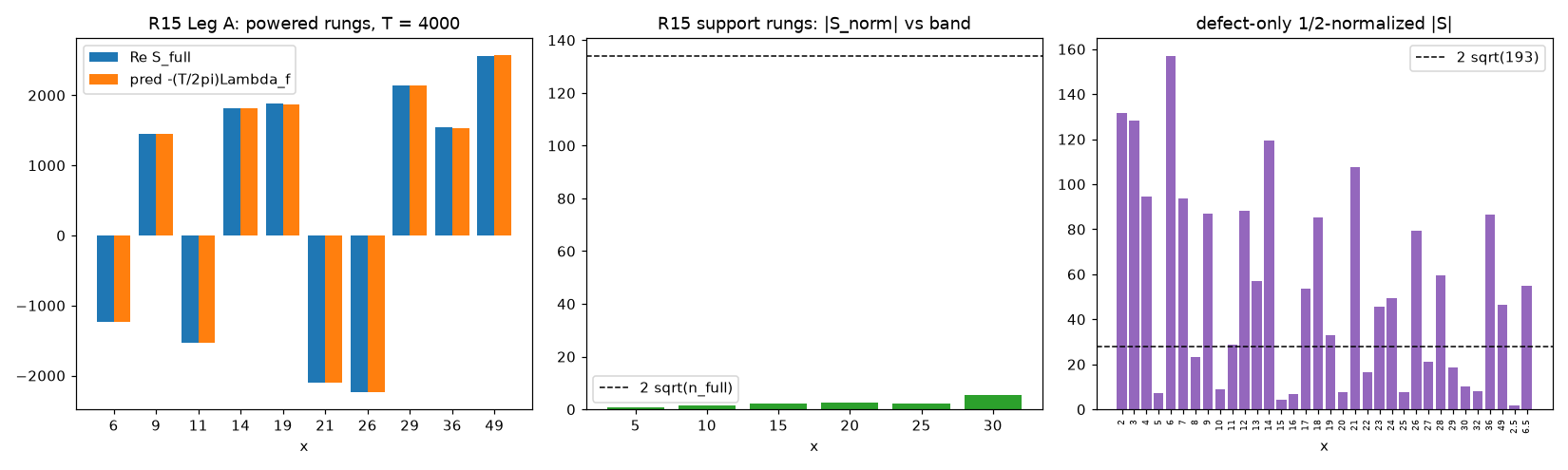
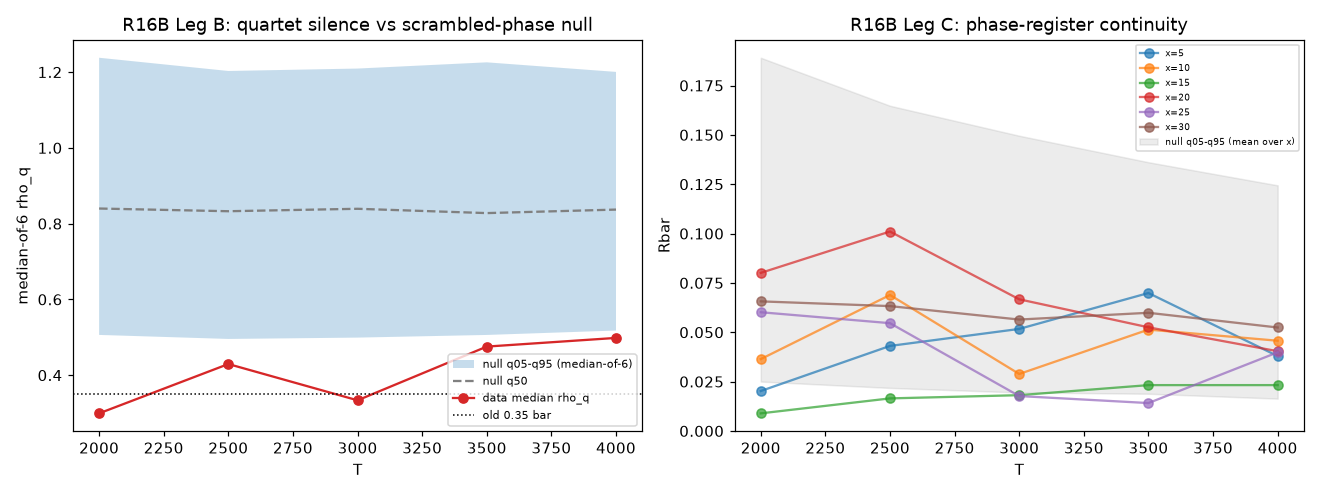
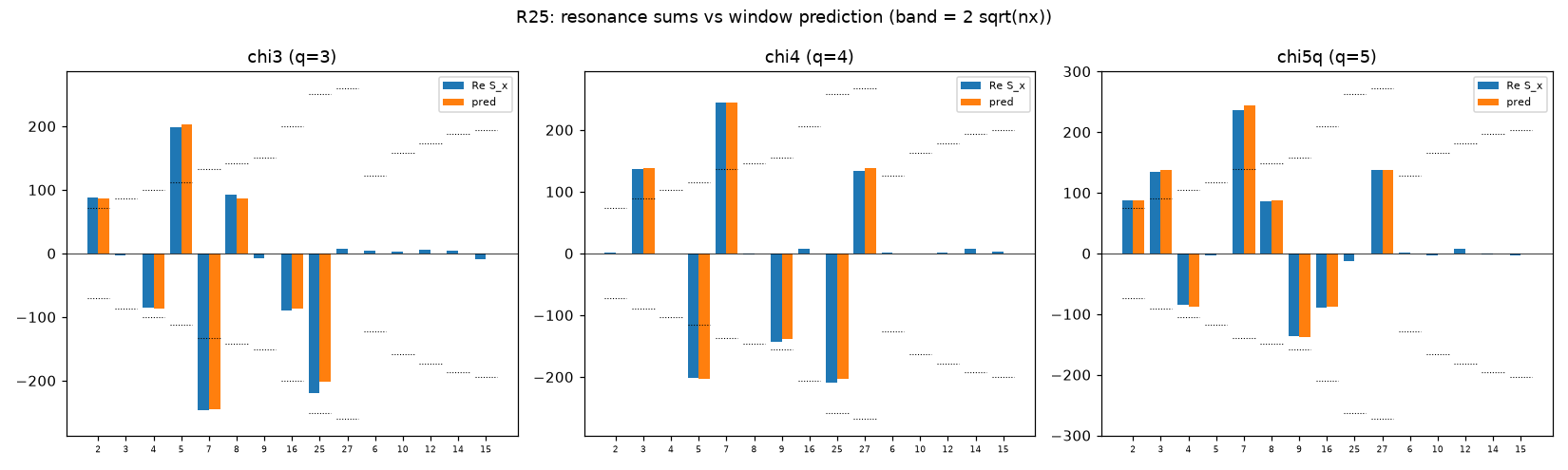
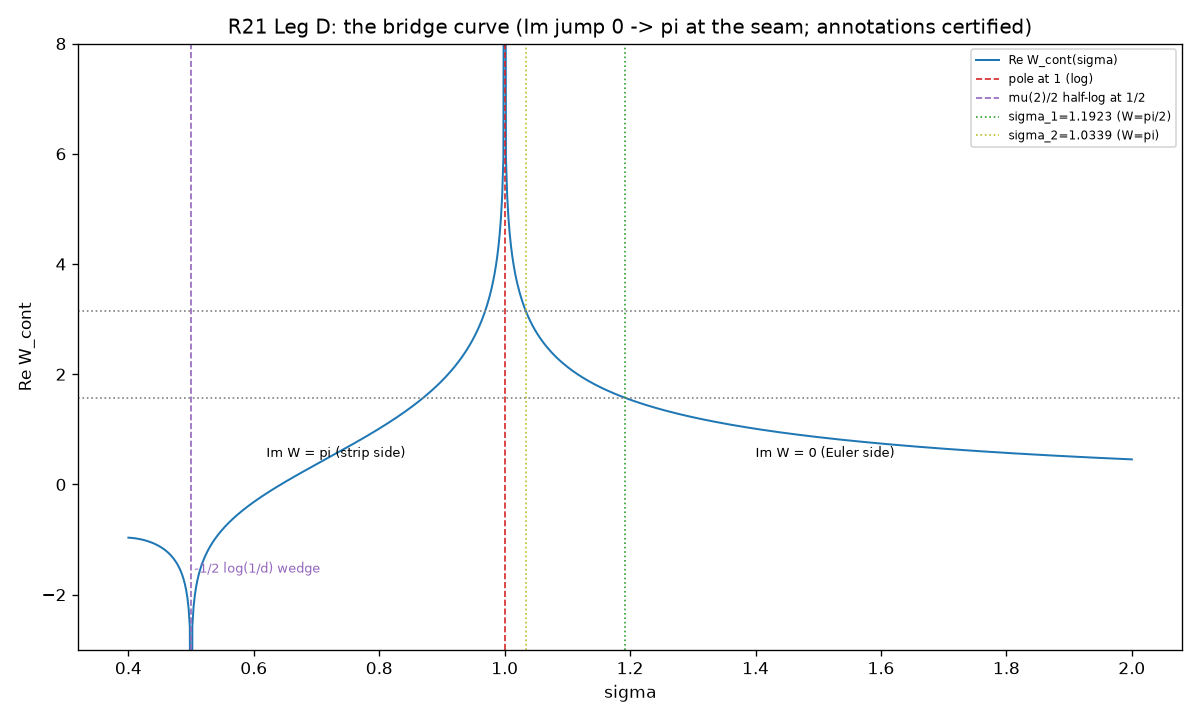
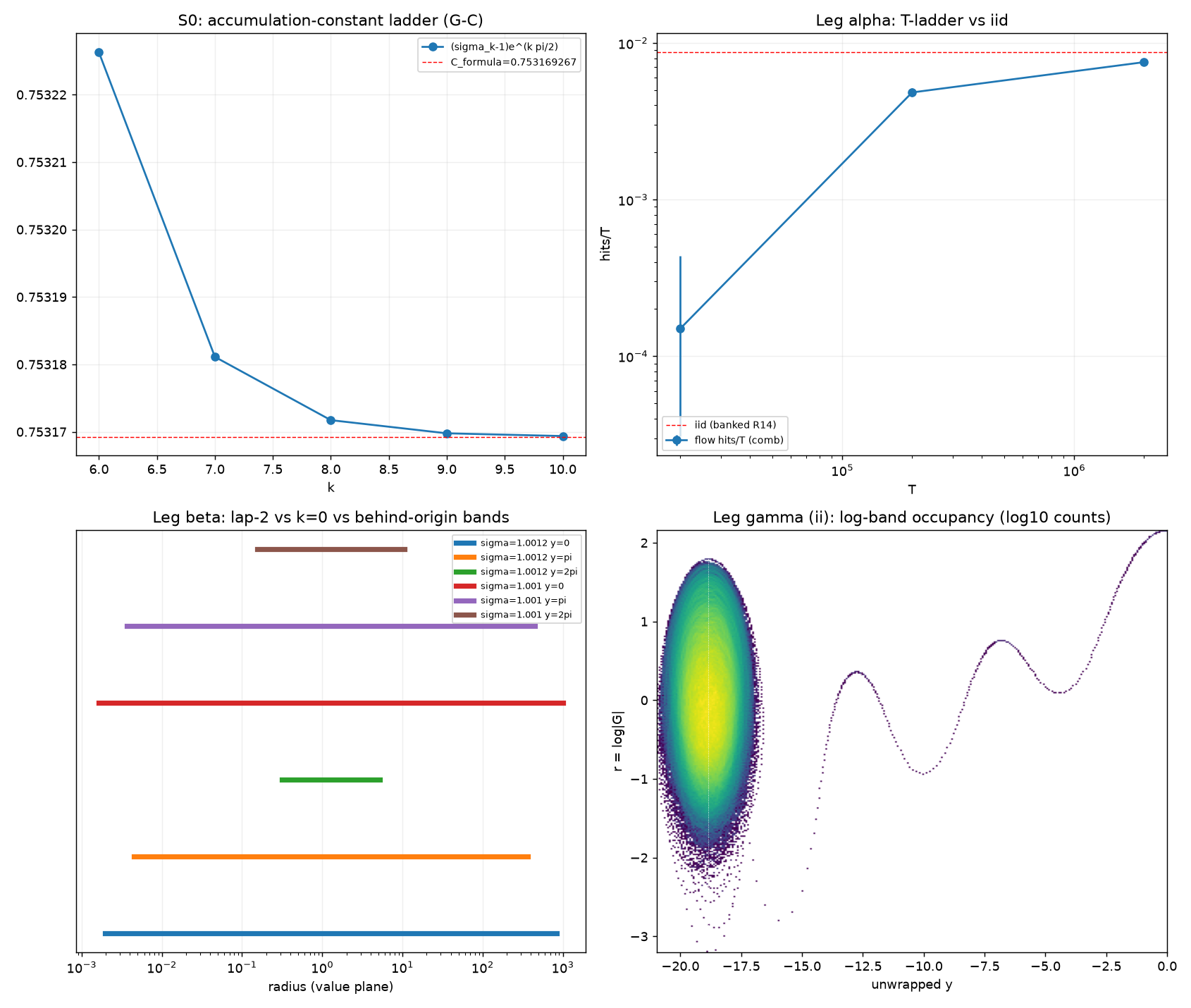
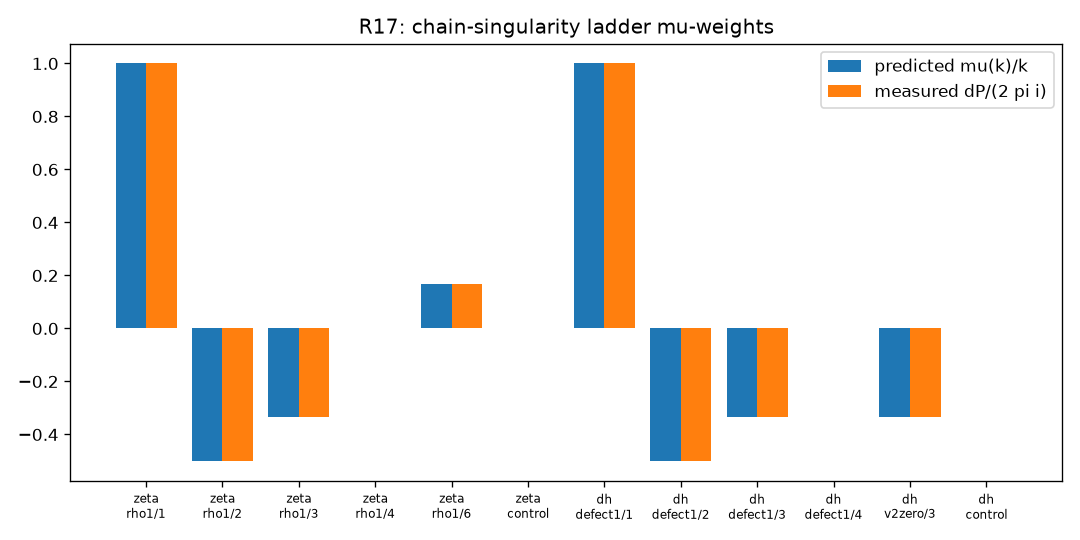
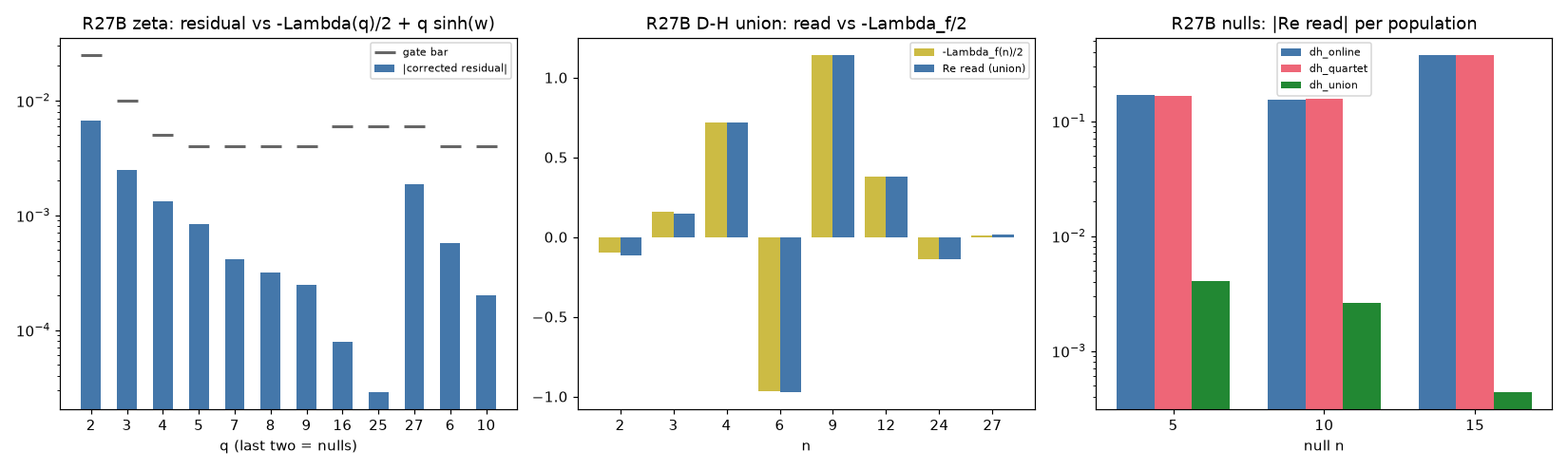
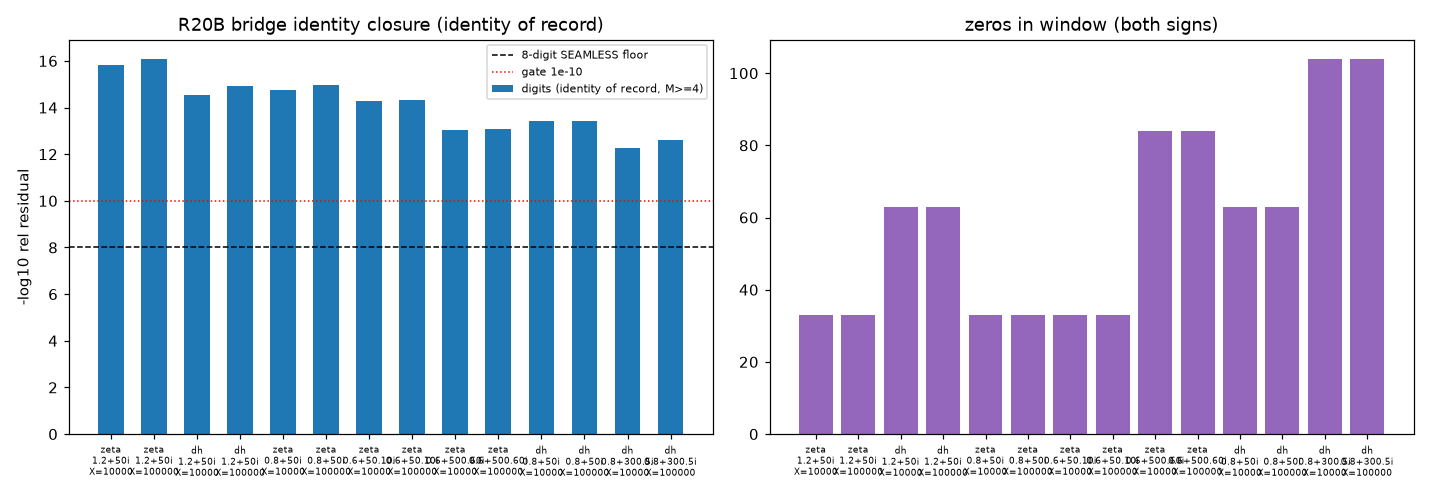
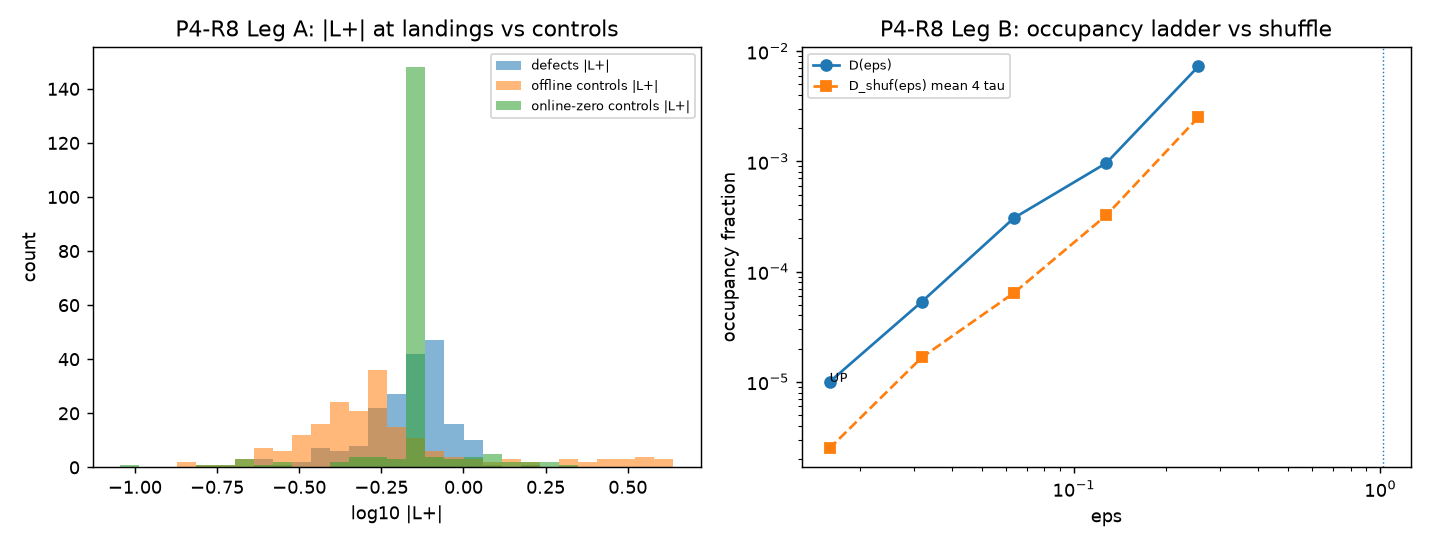
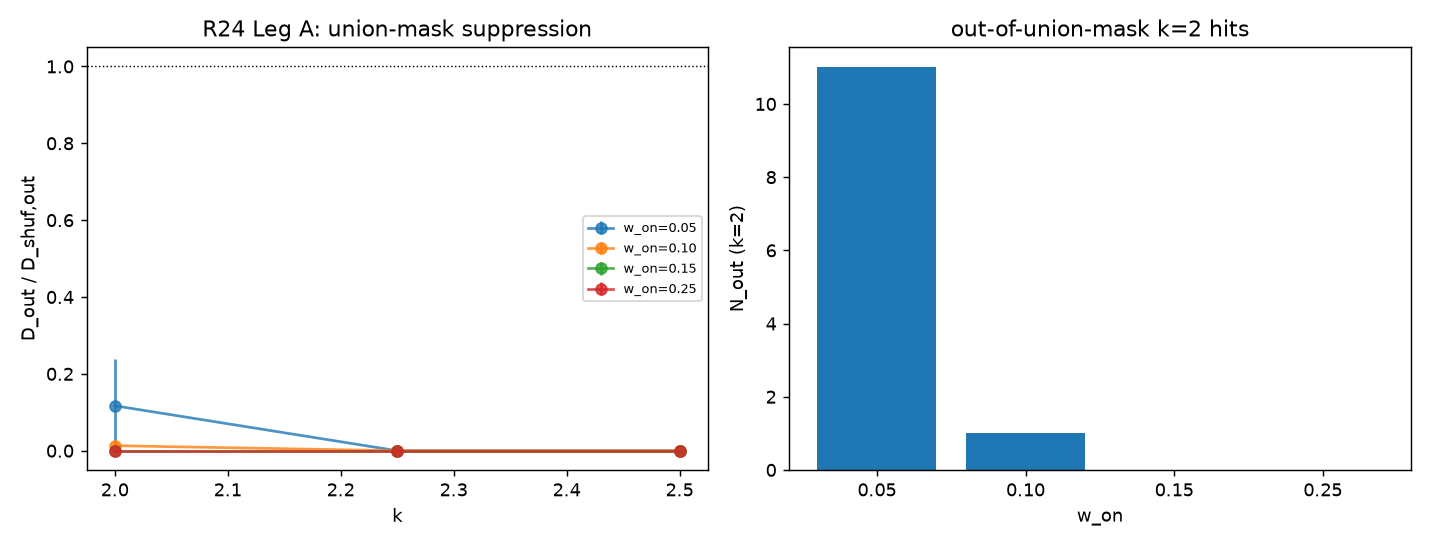
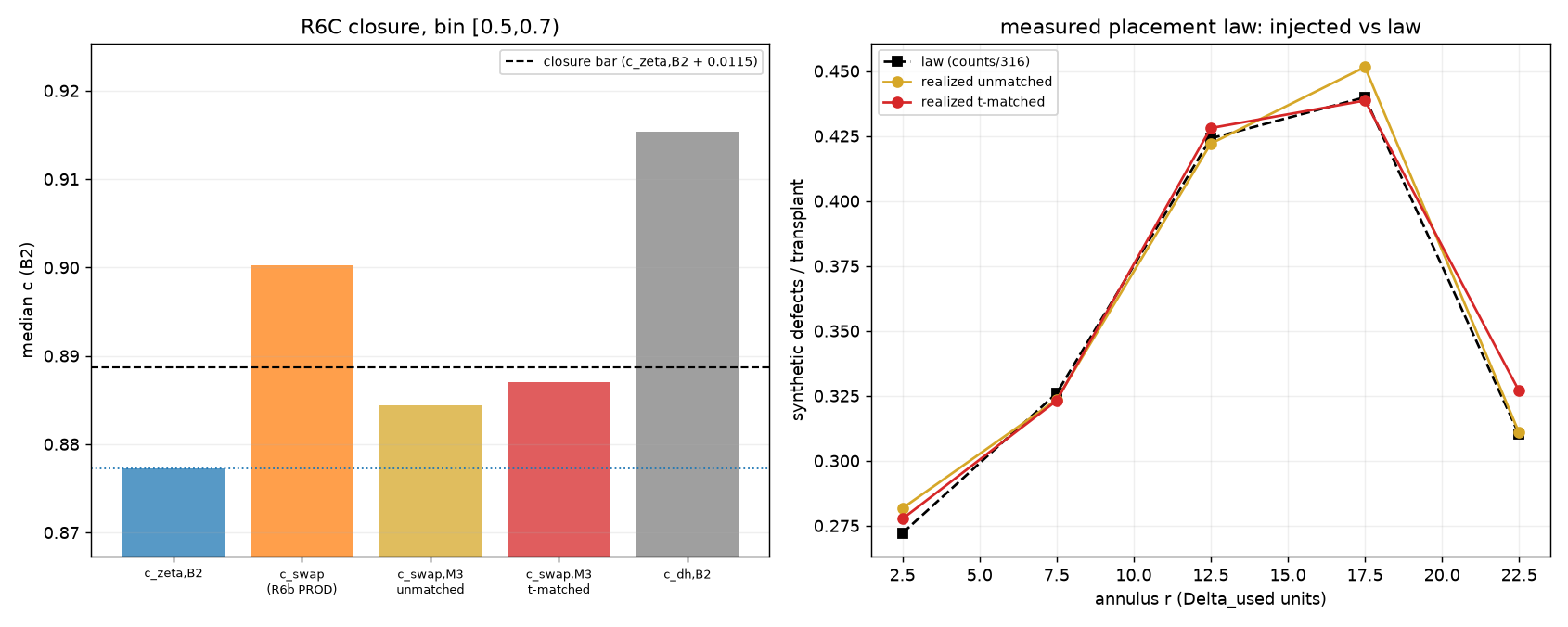
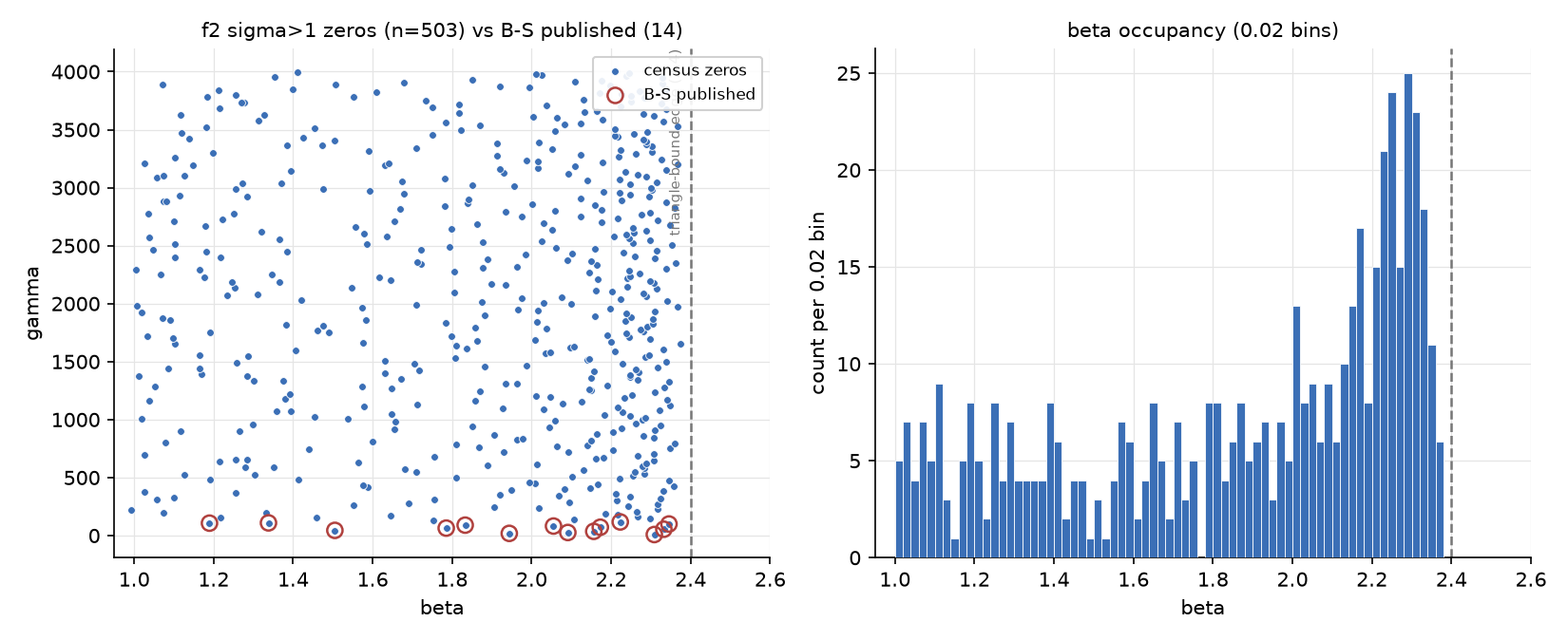
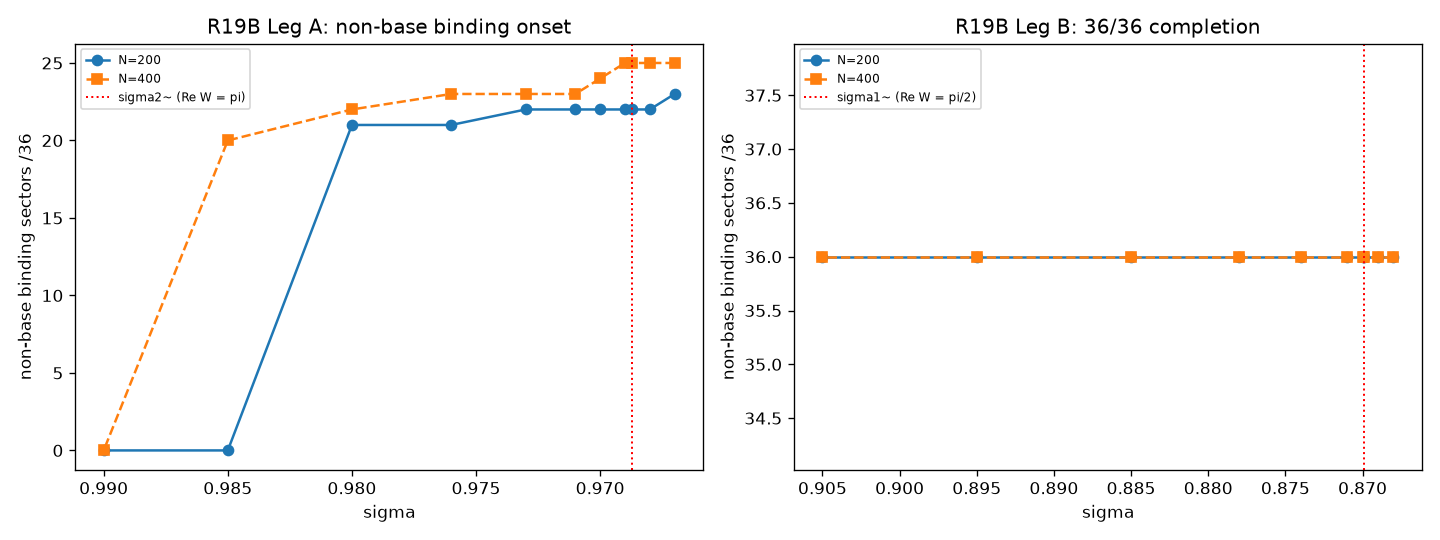
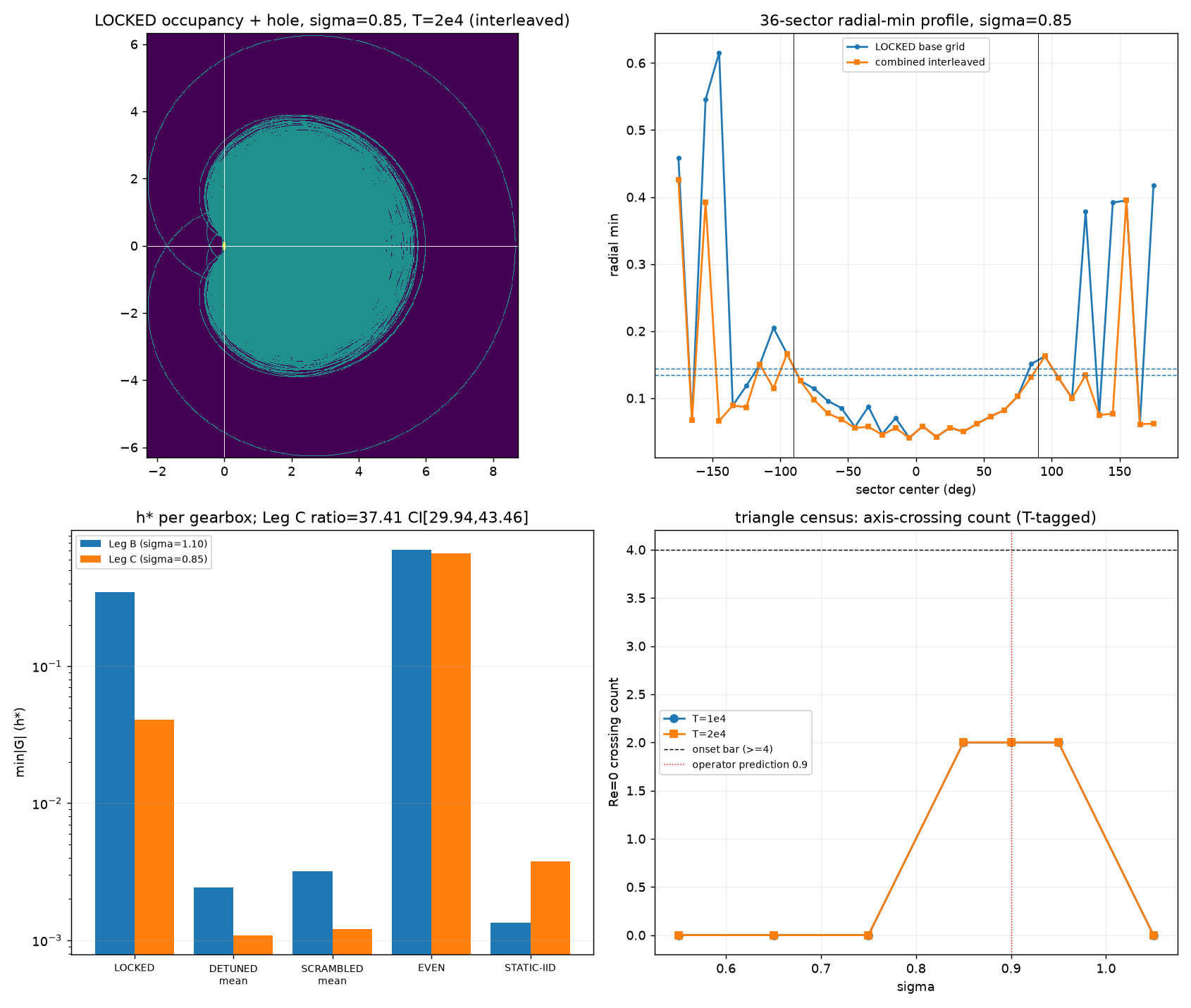
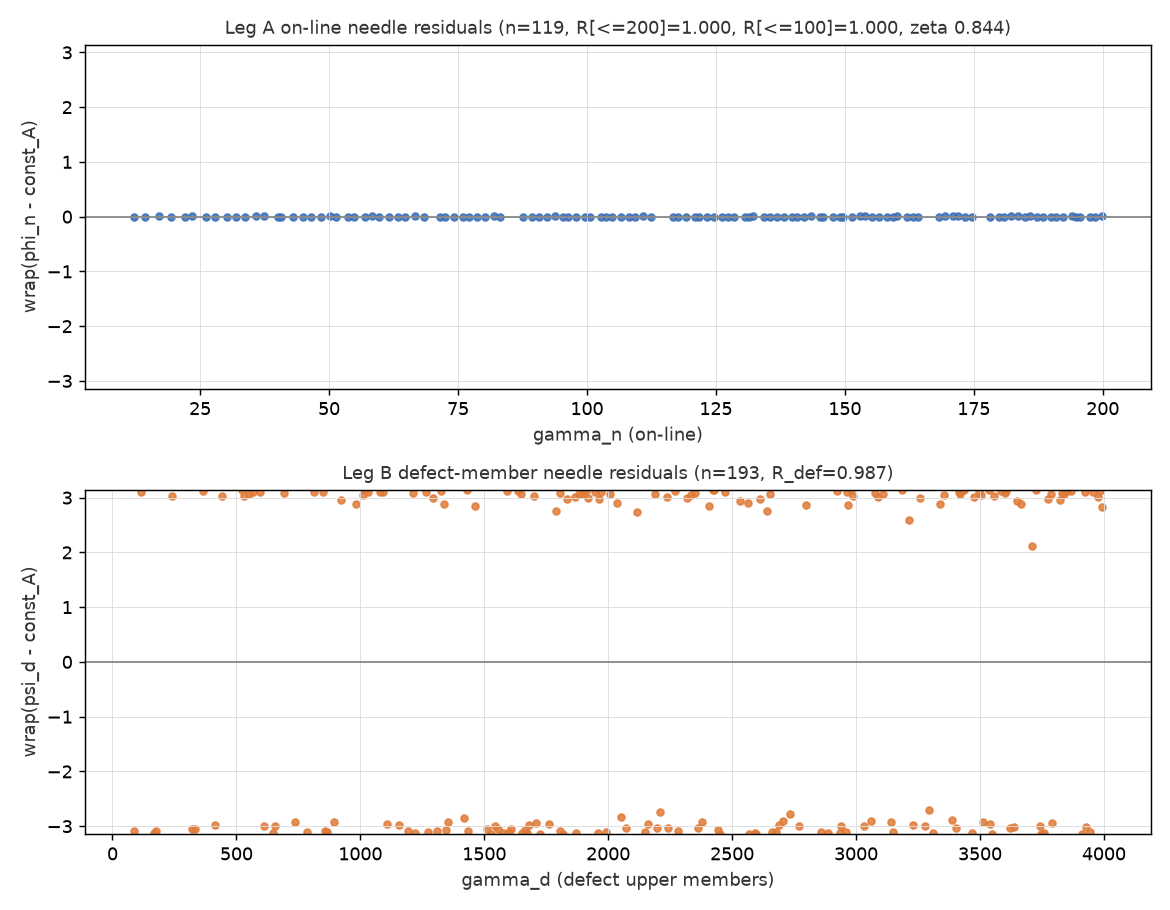
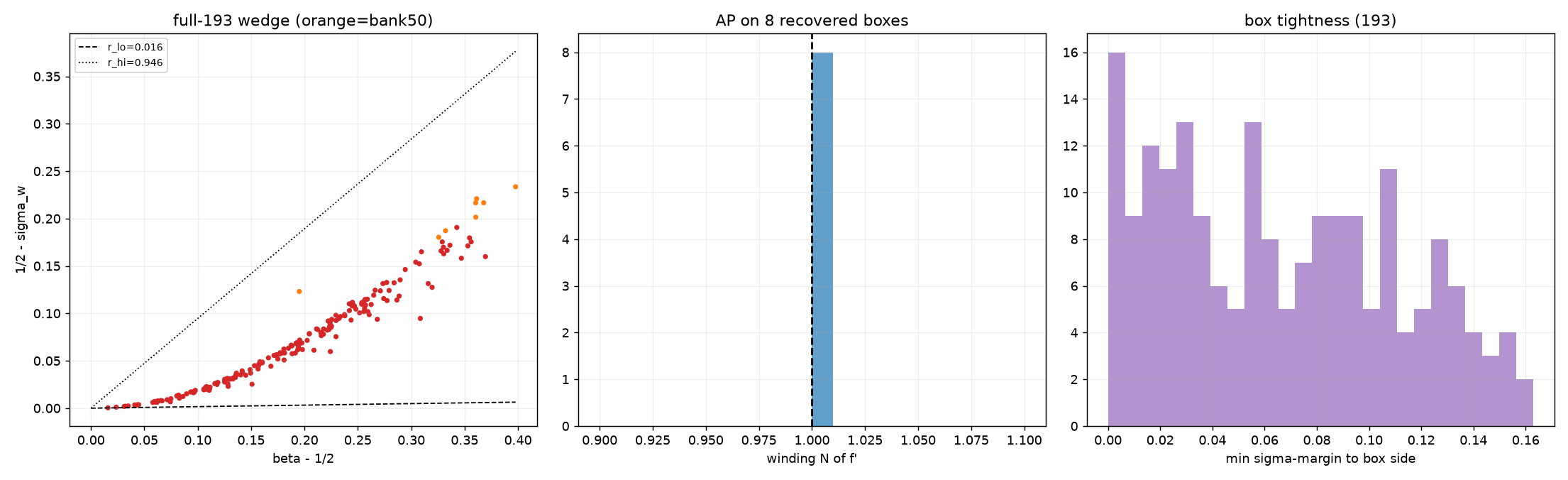
1. — round R15
The support law at full support. Left: half-shifted resonance sums Re S_full(x) over the complete D-H zero set at T = 4000 (blue) against the zero-free-parameter window prediction −(T/2π)Λ_f(x) (orange), at the ten powered rungs — value and sign agree at every rung (max deviation 0.0238; nine of ten ≤ 0.0082). Centre: the six rungs where the coefficient arithmetic predicts a null; each measured |S_norm| sits far below the 2√n_full band (×13–77 below the noise RMS) — the predicted silences are deep, not merely small. Right: the defect-only (off-line quartet) half of the same register. Note the dashed reference line marked "2 √193" is the superseded ½-normalization of erratum E-P4W5-1: the quartet terms carry modulus w_d = x^(β−½)+x^(½−β) ≥ 2, so the honest band is 2√(Σw_d²) ≥ 55.6. Read against the corrected band, the on-support giants stand at ≈3–5 RMS and the off-support rungs are jointly suppressed below noise — the wave-4 "8–12σ" gloss is retired.
2. — round R16B
Each population enforces the support on its own. Left: the median-of-six suppression ratio ρ_q over the off-line quartet population on a fine T-ladder (T = 2000…4000), against the honest scrambled-phase null band (2000 draws, identical weight multisets, q05–q95 shaded, null median ≈ 0.83). The data median lies below the null 5th percentile at every rung; no single x drives it. The dotted line at 0.35 is the retired wave-6 constant — an on-line-register bar mistakenly applied to a median-of-six statistic; the null band, not the constant, is the bar of record. Right: the phase-register continuity check — anti-concentration flags fade from 2/6 to 0/6 by T = 4000, locating the law in the modulus register rather than the phase register. The rising median with T is filed as an honest boundary (existence, not trend).
3. — round R25 — FIGURE 3 OF RECORD
The support law across the Euler-product pack. Half-shifted resonance sums Re S_x (blue) against the window prediction −(ΔT/2π)χ(x)Λ(x) (orange) on the χ₃, χ₄ and χ₅q harvest lists, with the 2√(nx) noise band dotted. Every powered cell matches in value and in sign, including all five character sign-flip cells (x = 5 for χ₃; x = 3, 7 for χ₄ and for χ₅q) — 2/2, 3/3, 2/2. The rungs at the conductor primes are silent to ρ ≤ 0.134: a new silence species, ramification silence, distinct from the composite silence, 9/9. With ζ and both D-H populations this makes five constructions read by one law with zero fitted parameters, each from its own coefficients.
4. — round R21 — FIGURE 1 OF RECORD
The bridge curve. Re W_cont(σ) on the real axis through the seam at σ = 1, with the two shores labelled by their imaginary register — Im W = π on the strip side, Im W = 0 on the Euler side, the jump being the seam itself. Annotations, all certified: the logarithmic pole at σ = 1; the μ(2)/2 = −½ half-log wedge at σ = ½ (measured slope −0.500574); and the first two blade rungs σ₁ = 1.1923 (W = π/2) and σ₂ = 1.0339 (W = π). The two shores share one logarithm and one constant (slopes 1.0000, D(1e-4) = 2.5e-4), and the seam slope β = 1.244787 cross-pins to C₂/C² = 1.2446 in an independent register.
5. — round R14b
The layered-apple constants at verification grade. Top left: the accumulation ladder (σ_k − 1)·e^(kπ/2) for k = 6…10 converging onto the closed form C = 0.753169266705 (dashed), double-pinned by two independent dps-30 computations (difference 2e-13); the residual falls off in exactly the geometric ratio e^(π/2), which fixes the next-order coefficient C₂ ≈ 0.7060. Top right: the flow-versus-iid hit rate along a T-ladder to T = 2×10⁶ — the ×60 starvation seen at T = 2×10⁴ is a finite-T mixing lag (T_mix ≈ 1.3×10⁶), not a lock. Bottom left: lap-2, base-sheet and behind-origin radius bands. Bottom right: the log-band occupancy map whose k-resolved floors are base-sheet-carried for σ > 1 and wound-sheet-carried in the strip (99.98% on k = −3).
6. — round R17
One rational weight arithmetic, on both constructions, blind to the line. Predicted chain weight μ(k)/k (blue) against the measured monodromy increment ΔP/(2πi) (orange) at twelve loops: the ζ zero-image rungs ρ₁/1, ρ₁/2, ρ₁/3, ρ₁/6 and the D-H rungs at a defect (off-line) singularity and at an on-line v2 zero, with controls. All twelve agree to ≤ 2.4e-16, and μ(4) = 0 is measured as an absence — the ρ₁/4 and defect₁/4 columns are empty at the 1e-18 level, against controls at ~1e-19. The off-line image, the on-line image and ζ carry the identical weight at every common k: the continuation machinery is measurably LINE-BLIND, which is precisely why the missing identity cannot live here.
7. — round R27B
The bridge's mirror, read at record grade. Left: for ζ, the corrected real-axis boundary residual against −Λ(q)/2 plus the pole background q·sinh(w), at twelve cells with their gate bars — every cell inside bar (worst 27% of bar) and the corrected residual declines monotonically 6.7e-3 → 2.5e-4 as the cells deepen. Centre: for D-H, the union read (on-line ∪ quartet) against −Λ_f(n)/2 — 8/8 in value and sign, including the two blind cells n = 24 and n = 27 predicted before they were read (residuals 1.2e-3, 2.0e-3), and no pole background, f being pole-free: a measured construction contrast. Right: the nulls n = 5, 10, 15 read per population — each population alone rings at O(0.1–0.4) (blue, pink) while their union is regular at ≤ 6e-3 (green). Off-support regularity is cross-population interference, not per-population smallness; on support the same interference lands the arithmetic exactly.
8. — round R20B
The bridge identity closed on our own certified lists. Left: −log₁₀ of the relative residual of the heat-kernel explicit formula (identity of record, Γ-pole family M ≥ 4 included) at fourteen rungs — two σ > 1 gate rungs plus ten strip rungs, on both constructions (ζ and D-H) and at both cutoffs X ∈ {10⁴, 10⁵} independently. Every strip rung closes to 12–14 significant digits, well above the 8-digit SEAMLESS floor (dashed) and the 1e-10 gate (dotted). Right: the number of zeros summed in each window, both signs. At the D-H rungs the 193 off-line quartets enter as explicit stones — 63 of 104 zero terms at those points are quartet terms. The residual of a closed rung bounds any missing zero's contribution: 2.3e-15–1.0e-12 per rung, so the v2 on-line list and the quartet ledger are locally complete at every probed window.
9. — round R8b
What an off-line zero is made of. The D-H function decomposes exactly as f = c₊L₊ + c₋L₋ into two Dirichlet L-constituents (certified to ≤ 3e-31 at all 193 landings, both c±-routes agreeing to 4e-31). Left: the distribution of log₁₀|L₊| at the 193 off-line landings (blue) against off-line controls (orange) and on-line-zero controls (green). The landings sit at healthy constituent magnitude — median 0.722, statistically the same as the on-line-zero control at 0.749, and ×1.38 [1.34, 1.46] above the generic 0.523. There is no small-times-small suppression: an off-line zero is two O(1) prime systems in phase opposition, which is what makes the object primitivity-anchored. Right panel, read with care: this is the occupancy ladder against a 4-τ shuffle surrogate, which was ruled NOT-A-READ at adjudication (per-τ spread ≈ ×70); the repaired 64-τ surrogate and the depth split are R8c/R8d work, and the enhancement it appears to show is resolved there as zero-set-carried at depth.
10. — round R24 — FIGURE 2 OF RECORD
The cooperation field goes empty. The mask is the union of the full 193-quartet ledger with the certified v2 on-line zero list (3264 zeros in window), widened by w_on. Left: the out-of-mask cooperation ratio D_out/D_shuf,out against depth k, at four mask widths — suppression falls 0.117 → 0.013 → 0 as w_on grows, and the ratio is identically zero at every k ≥ 2.25 for every width. Right: the count of surviving out-of-mask hits at k = 2 — 11, 1, 0, 0 across w_on = 0.05, 0.10, 0.15, 0.25, meeting the registered R22 prediction of zero at 0.15 exactly. The residue at the loose widths is the single on-line zero event at γ = 1183.28 at every rung. Sentence of record: cooperation is zeros of f — landings on or off the line — and nothing else, at all measured depths (σ₀ = 0.85, t ∈ [1000, 4000], k ≥ 2).
11. — round R6c
Closing the 0.895-versus-π/4 gap. Left, in corrected B2 coordinates on the diagnostic bin [0.5, 0.7): the measured ζ constant (blue) and D-H constant (grey) with the closure bar (dashed, c_ζ + 0.0115) and the transplant ladder between them — the wave-3 shape-only swap (orange) overshot the bar; the M3 transplant built from the measured defect-placement law lands at 0.8844 unmatched and 0.8870 t-matched, so the residual S_resid,M3 = +0.0097 sits inside the bar and more than halves (57.5% absorbed), with the identity exact and the remainder inside the EP-pack spread of 0.0230. Right: the measured placement law itself — synthetic defects per transplant against annulus radius, injected (gold, red) tracking the law (dashed) rung for rung. The full accounting of the cross-function contrast is then density 72% + shape 10% + defect placement + remainder within family scatter.
12. — round R30b
The instrument can see σ > 1 zeros; the counterexample simply has none. A census of the sibling Davenport–Heilbronn-family function f₂ over the identical window, run on the identical instrument that returned n = 0 for f. Left: every in-band zero in β ∈ (1, 2.4], γ ∈ [0, 4000] (blue), with the fourteen published Balanzario–Sánchez-Bernal points (red circles) all reproduced — the remaining 483 are previously unlisted. Right: the β occupancy histogram, filling toward the ceiling with maximum β = 2.3747443578, just under the family parameter σ = 2.3822861089 (dashed), and occupying [1.00, 1.76) ∪ [1.78, 2.38). The rate is 0.126 zeros per unit t, against 0.000 for f in the same window with the same instrument. Numbers of record: 497 distinct in-band zeros — the panel title's n = 503 is the raw row count, which includes five duplicates and one below-band row; the arithmetic of record is the CSV's, not the title's. This is the figure behind the 497 count that settled the f₂ discrepancy in the papers' favour.*
13. — round R19b — ⚠ RECORDS A REFUTATION
A pre-registered correspondence, refuted. Wave-6 observed that the sheet handoff across σ = 1 appeared to begin and complete near two blade rungs of the Ch. 7 ladder, and R19B tested that on fine grids (Δσ = 0.001–0.005, N ∈ {200, 400}) with a zero-free-parameter pre-registration. Left: the count of non-base binding sectors as σ descends — the onset sits at σ = 0.980 (N = 200) and 0.985 (N = 400), i.e. it moves up with N, 0.011–0.016 above σ̃₂ and heading away from the rung as N grows: resolution-bounded, not converging. Right: the completion leg is already 36/36 at the top of the grid (σ = 0.905), an offset of at least +0.035 above σ̃₁, censored from above, and non-monotone against the wave-6 single-sector cell. Verdict of record: CORRESPONDENCE REFUTED (rule-19 first-crossing test, tolerance 0.002) — the wave-6 alignments were grid coincidence, and the blade rungs do not schedule the sheet descent at these settings. What survives, and is banked independently, is the handoff itself: the switch is near-total, base-sheet share falling from 1 to ≈5e-5 in a single rung, reproduced at both N.
14. — round R13
The gearbox, the apple, and the hole. Top left: occupancy of the locked skeleton at σ = 0.85, T = 2×10⁴ (interleaved grids) — the filled body with its off-centre hole is the object the dictations call the apple. Top right: the 36-sector radial-minimum profile of that hole, base grid against the interleaved combination. Bottom left: the minimum |G| over the locked configuration against four controls at σ = 1.10 and σ = 0.85 — LOCKED sits ×37.4 [29.9, 43.5] above the floor in the strip, while SCRAMBLED, DETUNED and STATIC-IID all coincide at the sampling floor (predicted 1.2e-3, met), so it is the weld that carries the finite-T hole; the EVEN closed-orbit control (316 cells against 4090) is the measured content of "uneven is why the apple exists". Bottom right: the triangle census axis-crossing count against σ, with the operator's predicted 0.9 marked — the onset bar (≥4) is never reached, a settings-bounded null with middle structure only over σ ∈ [0.85, 0.95].
15. — round R10b
The needle is an identity, so it cannot be a channel. Top: the residual of arg f′(ρ_n) − π·S_f(γ_n) about its constant, at 119 on-line D-H zeros — flat on zero, with resultant R = 1.000 for γ ≤ 100 and γ ≤ 200. Bottom: the same read at the 193 off-line defect upper members — flat on ±π, R_def = 0.987, the offset being convention-mechanical (the quartet's 2π step) and the 0.16 rad spread being the landing scatter. The law is exact and derived: the θ-clock cancels the Z′ alternation, so the needle relation is a functional-equation mechanical identity rather than a measurement about the line — the previously banked ζ value of 0.844 is the raw, uncorrected basis, and the S-corrected read is 0.999998 with constant −π to 5e-4. The needle channel is excluded as an object channel by identity, on both constructions. This figure is also the first needle read ever taken at off-line landings.
16. — round R4b
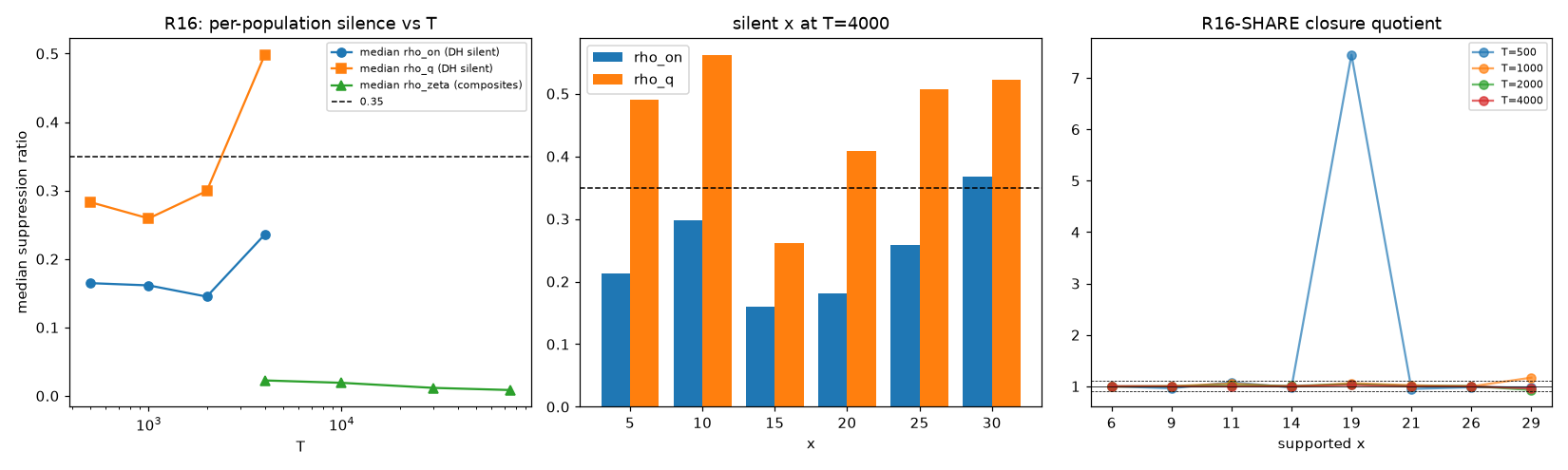
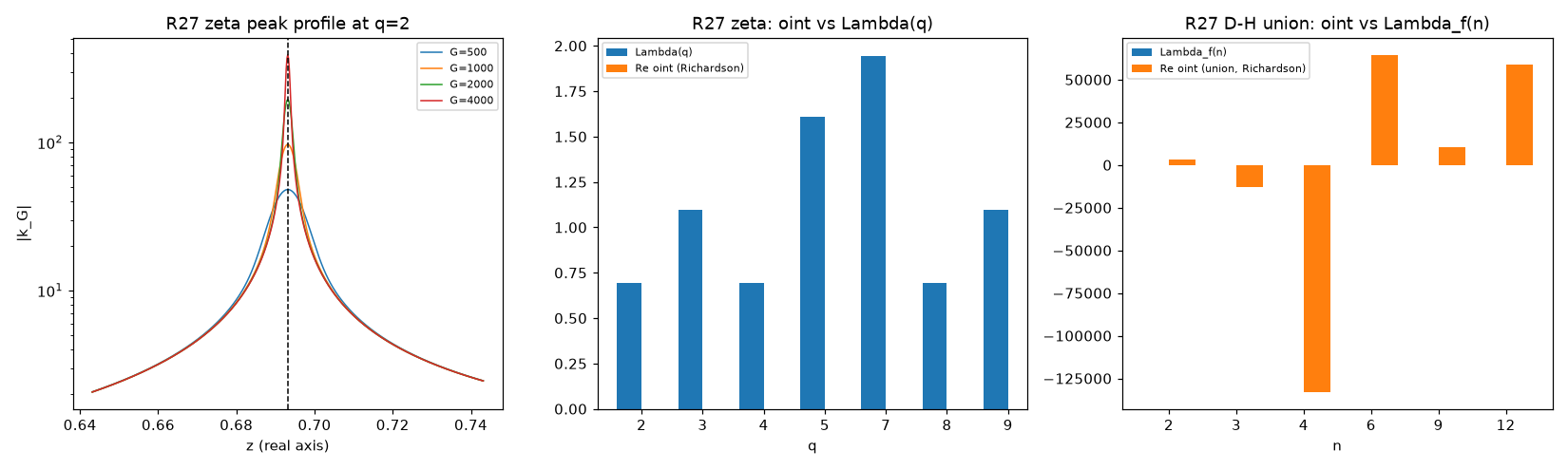
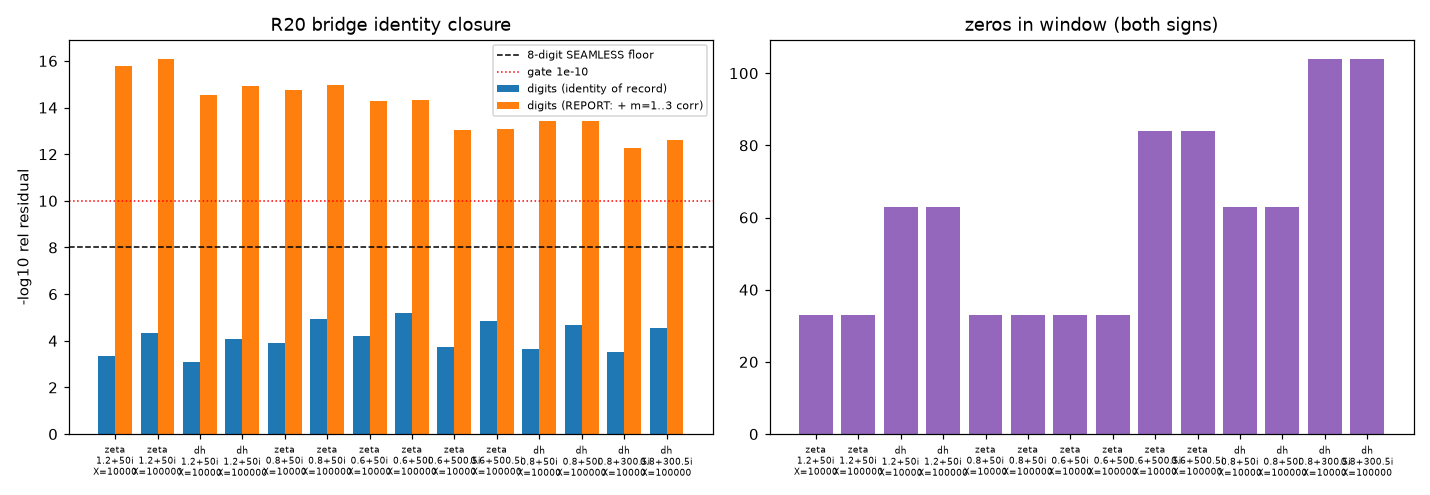
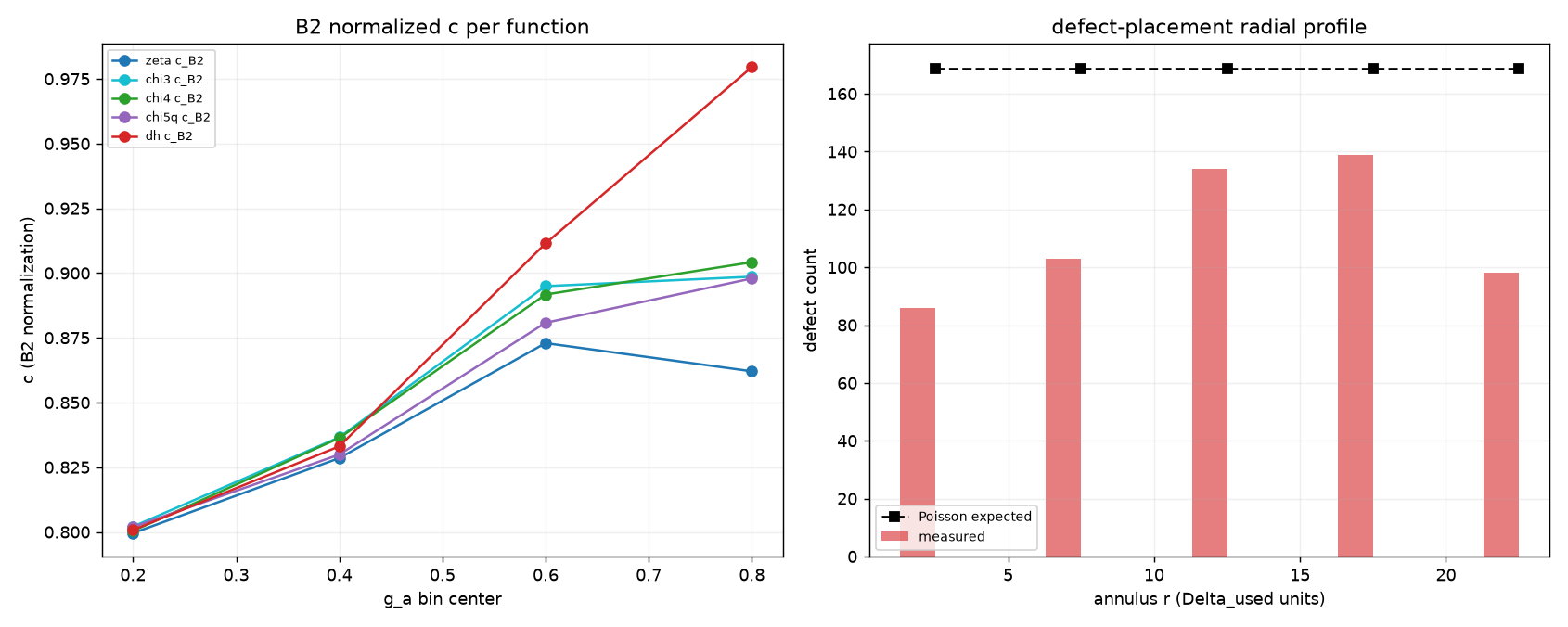
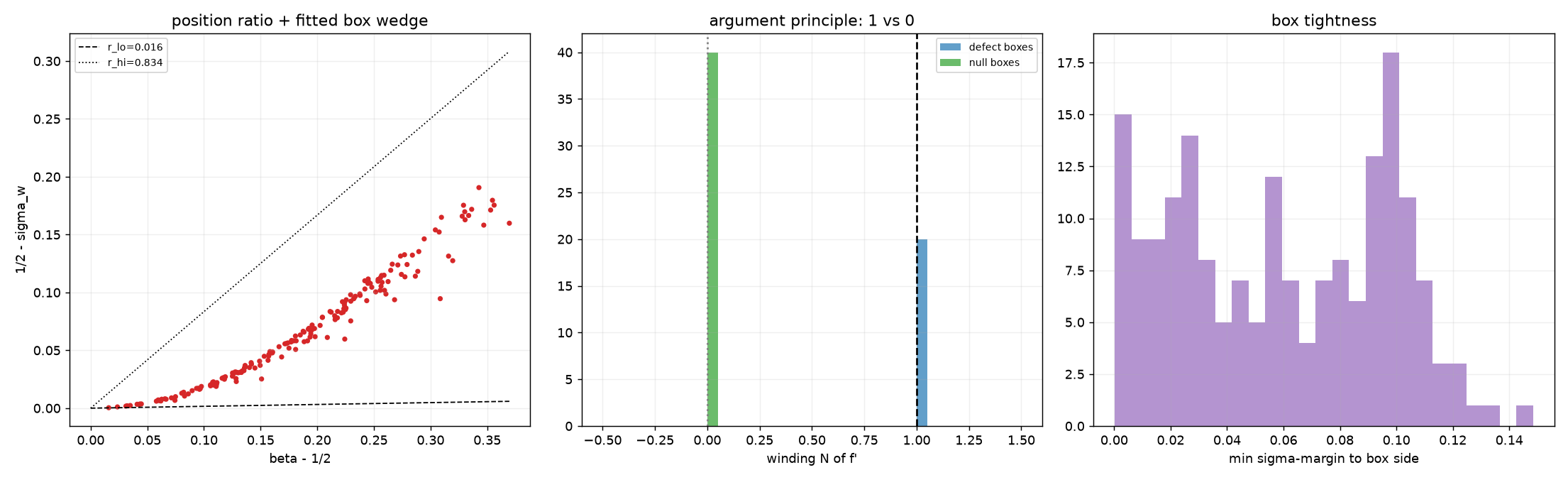
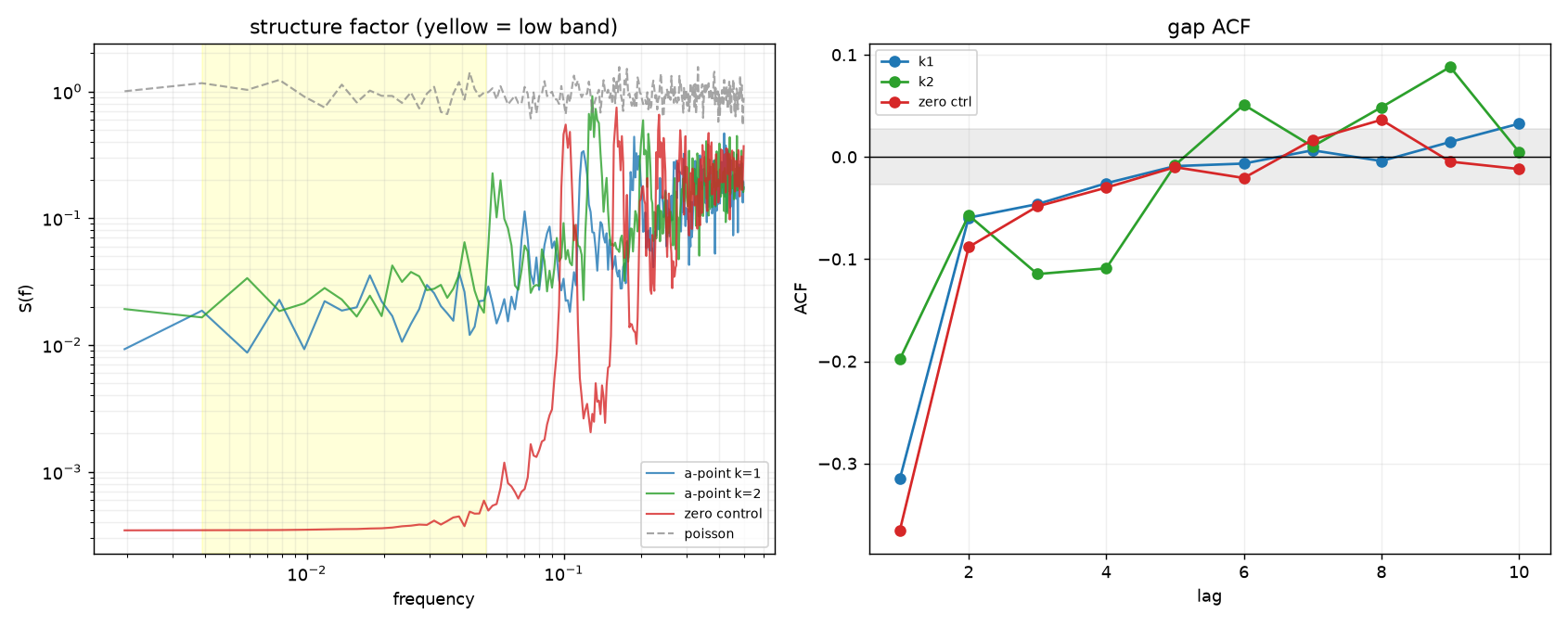
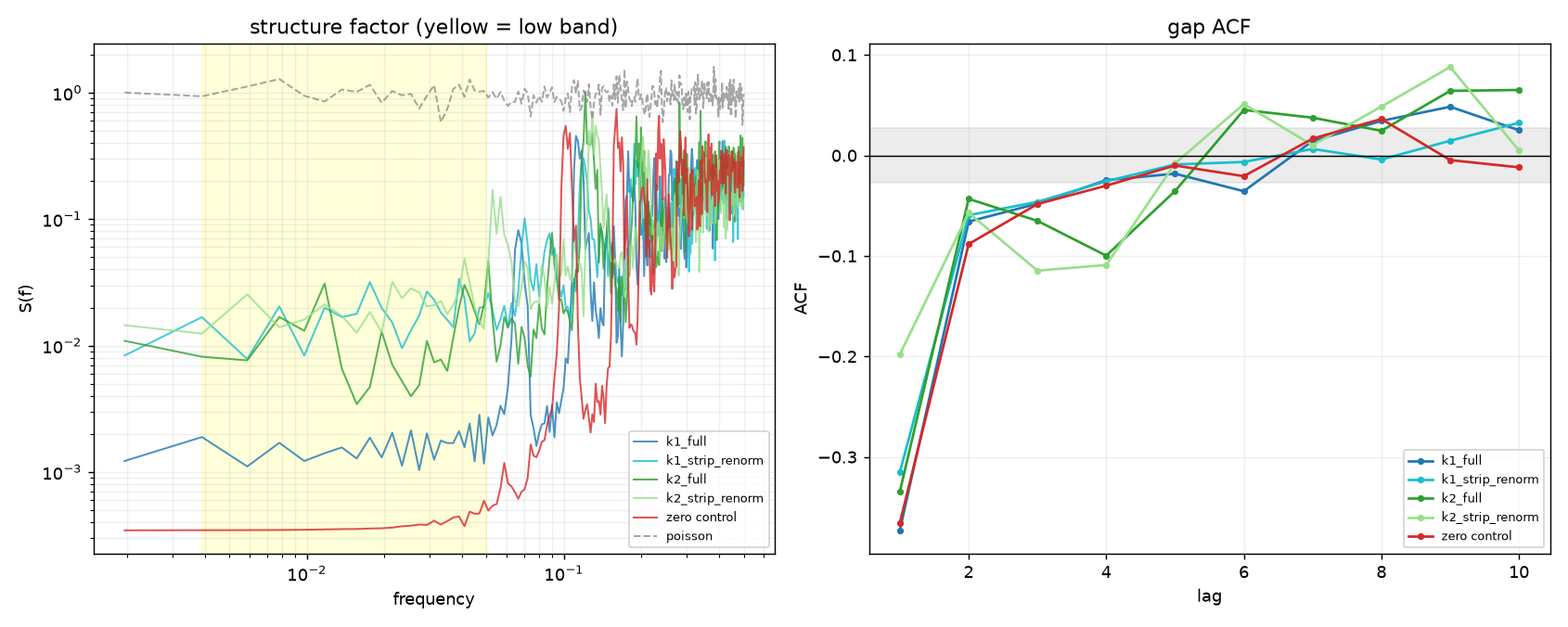
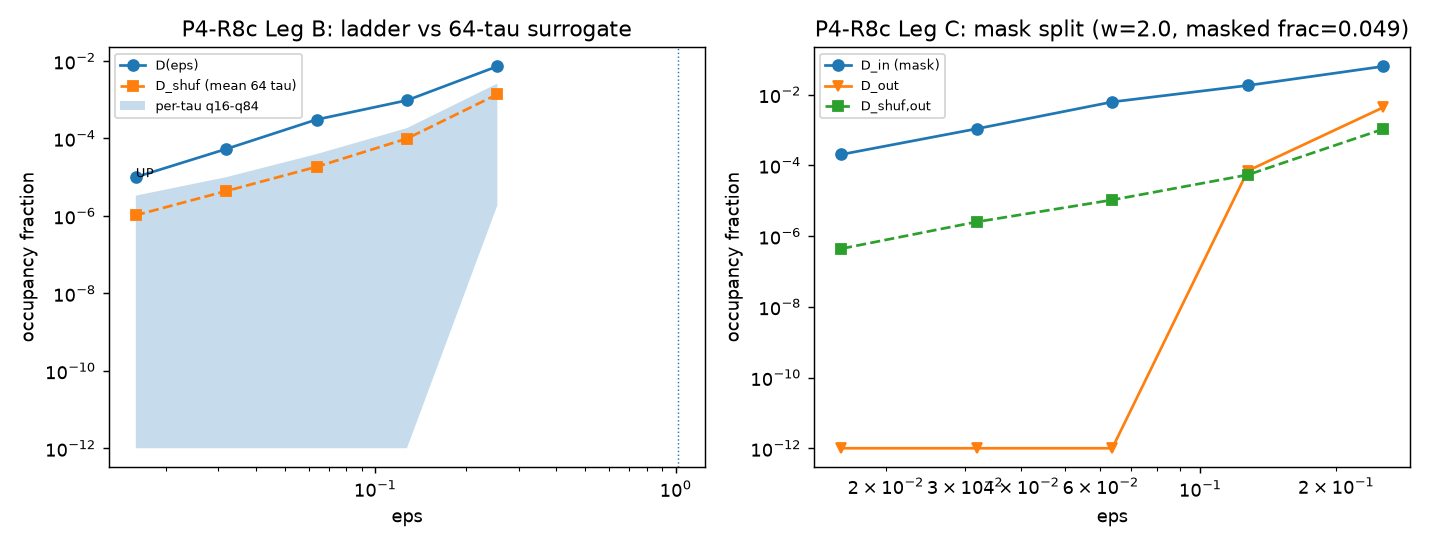
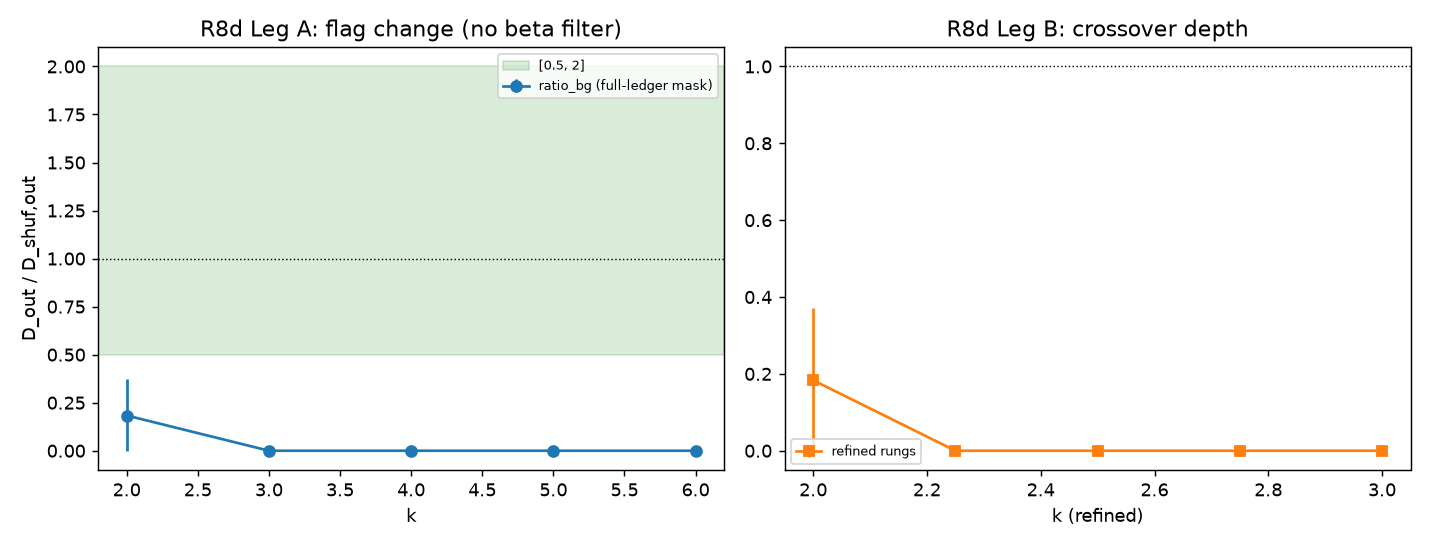
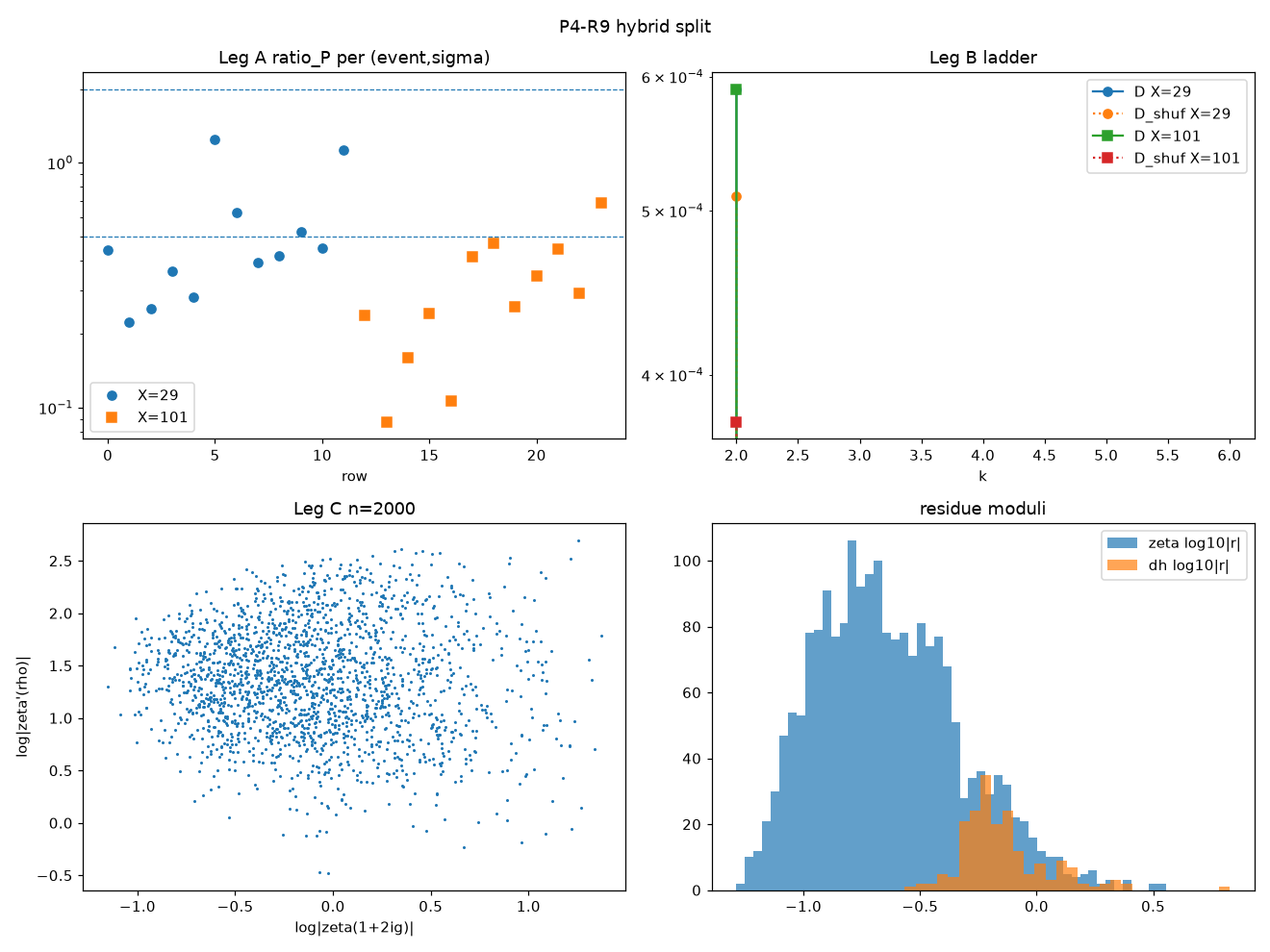
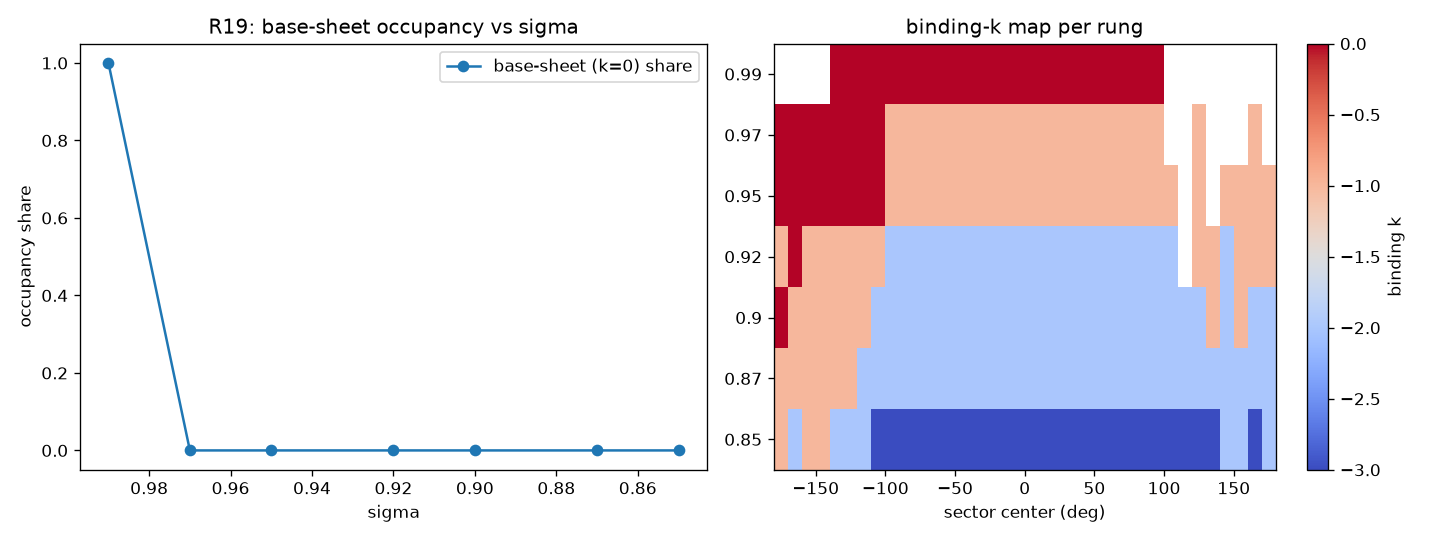
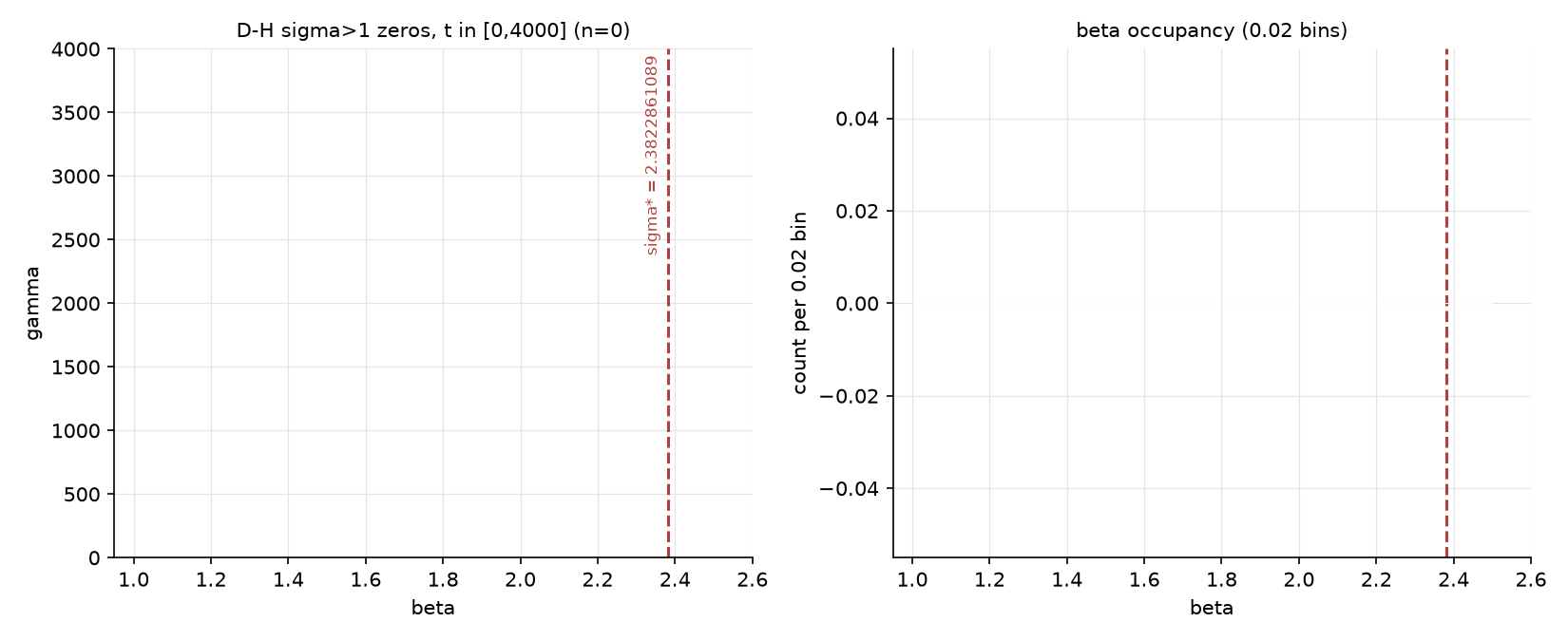
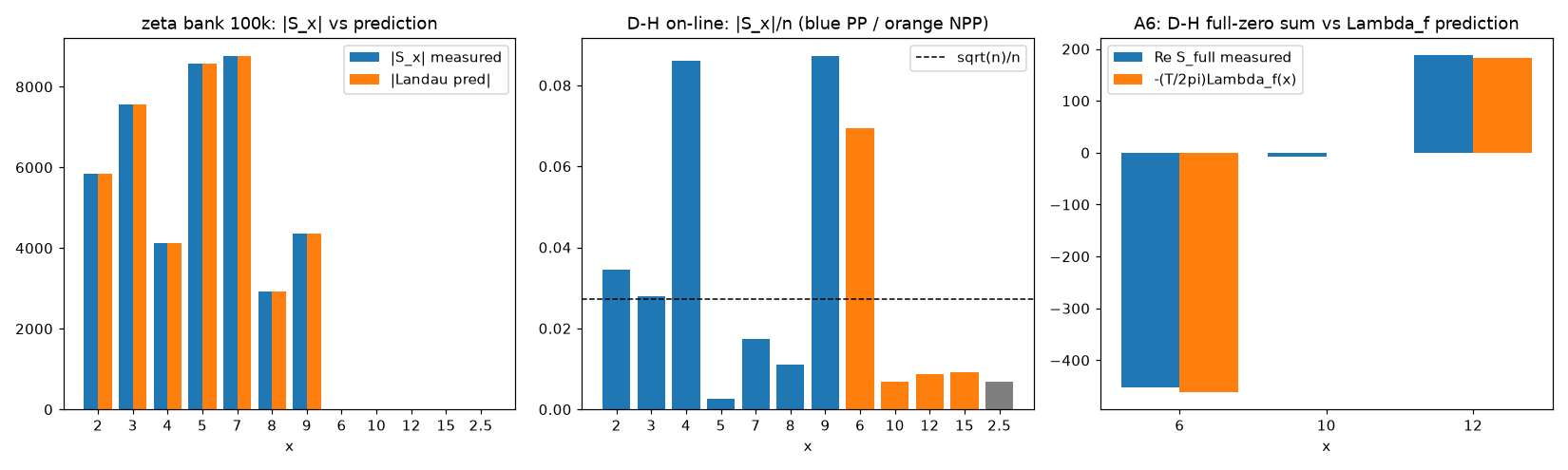
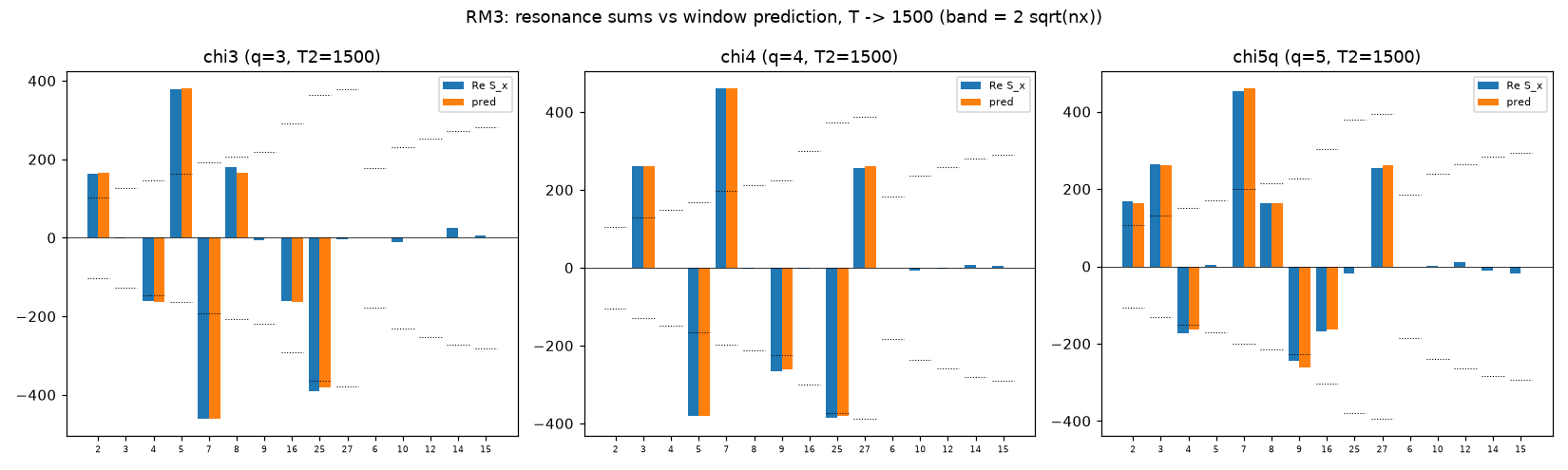
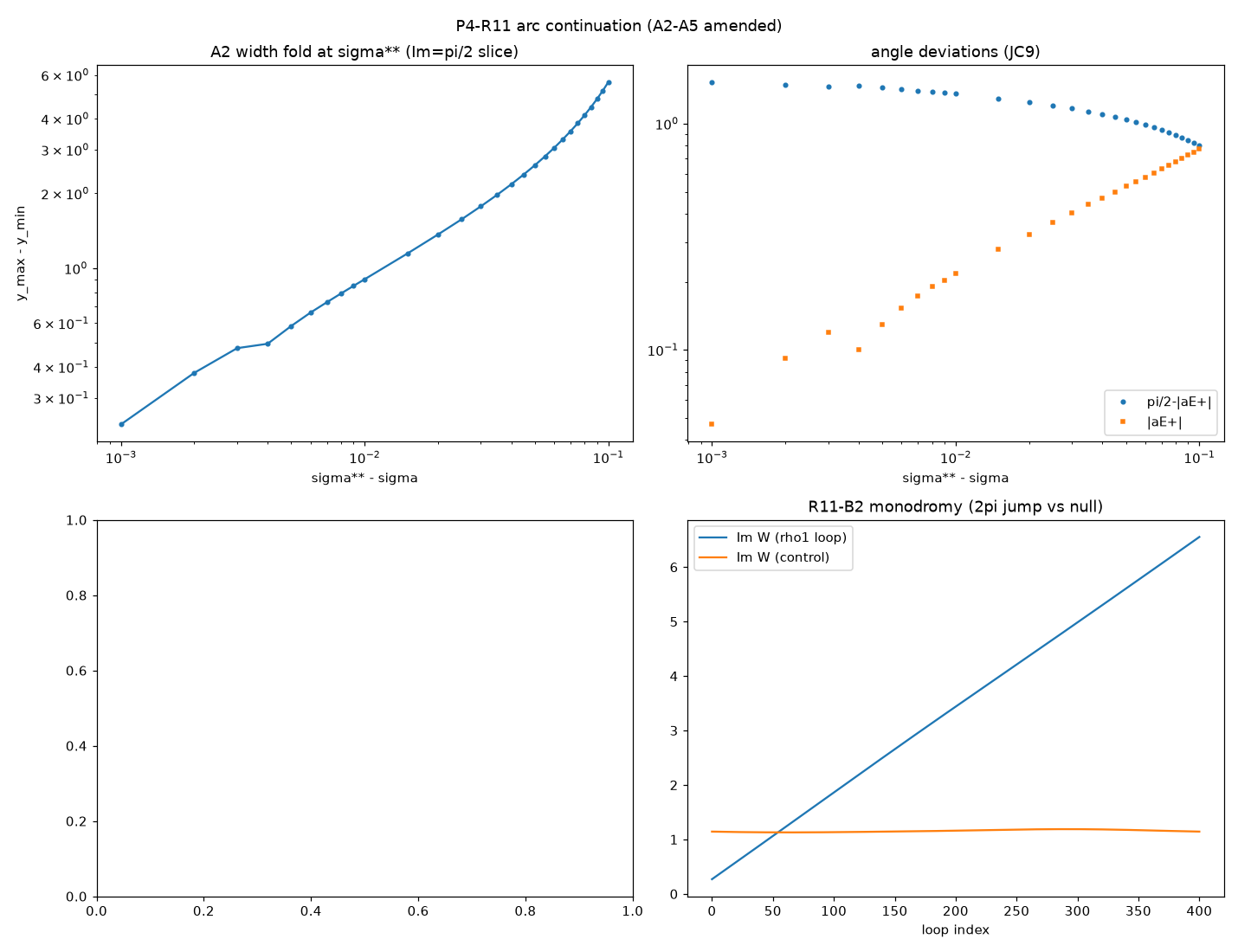
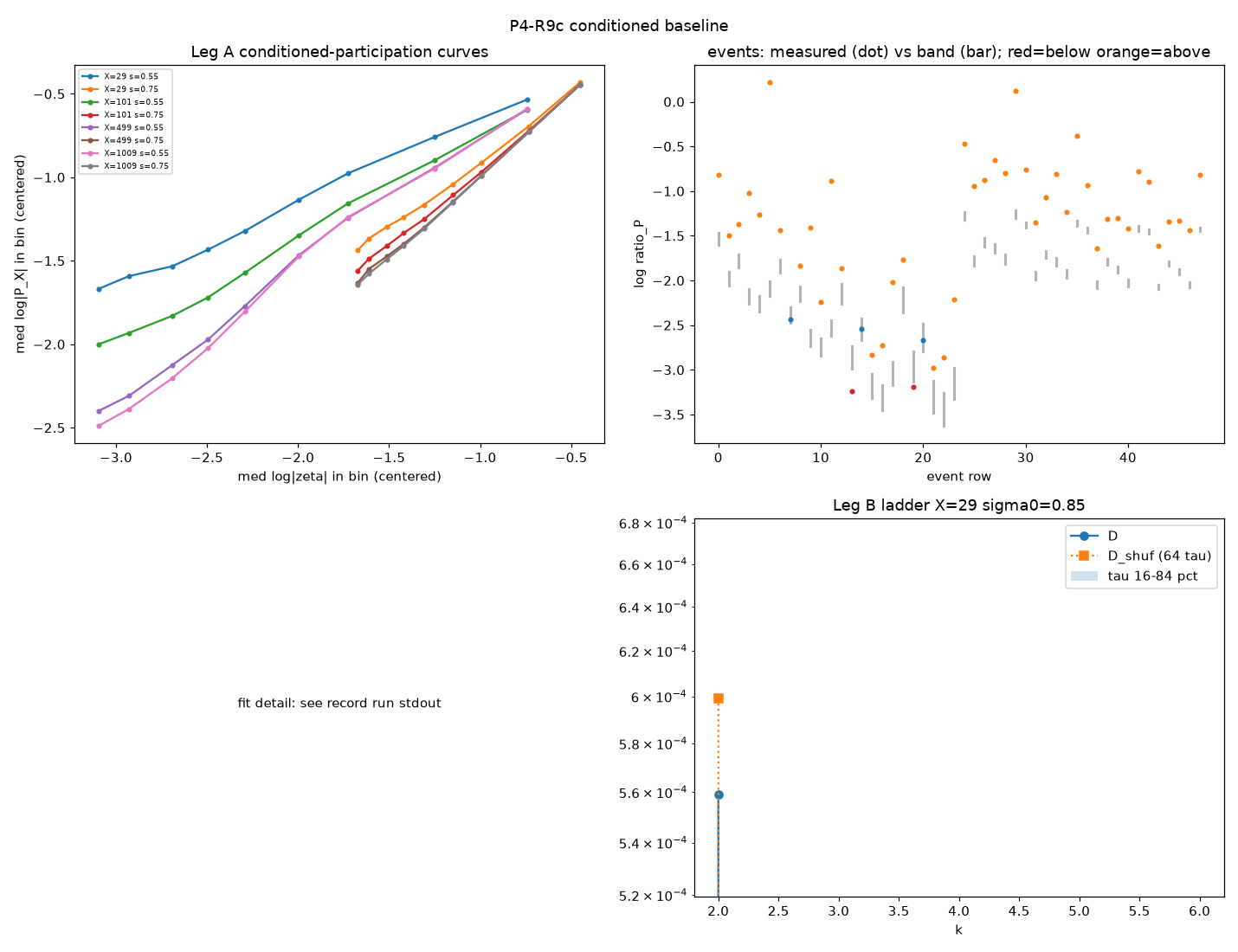
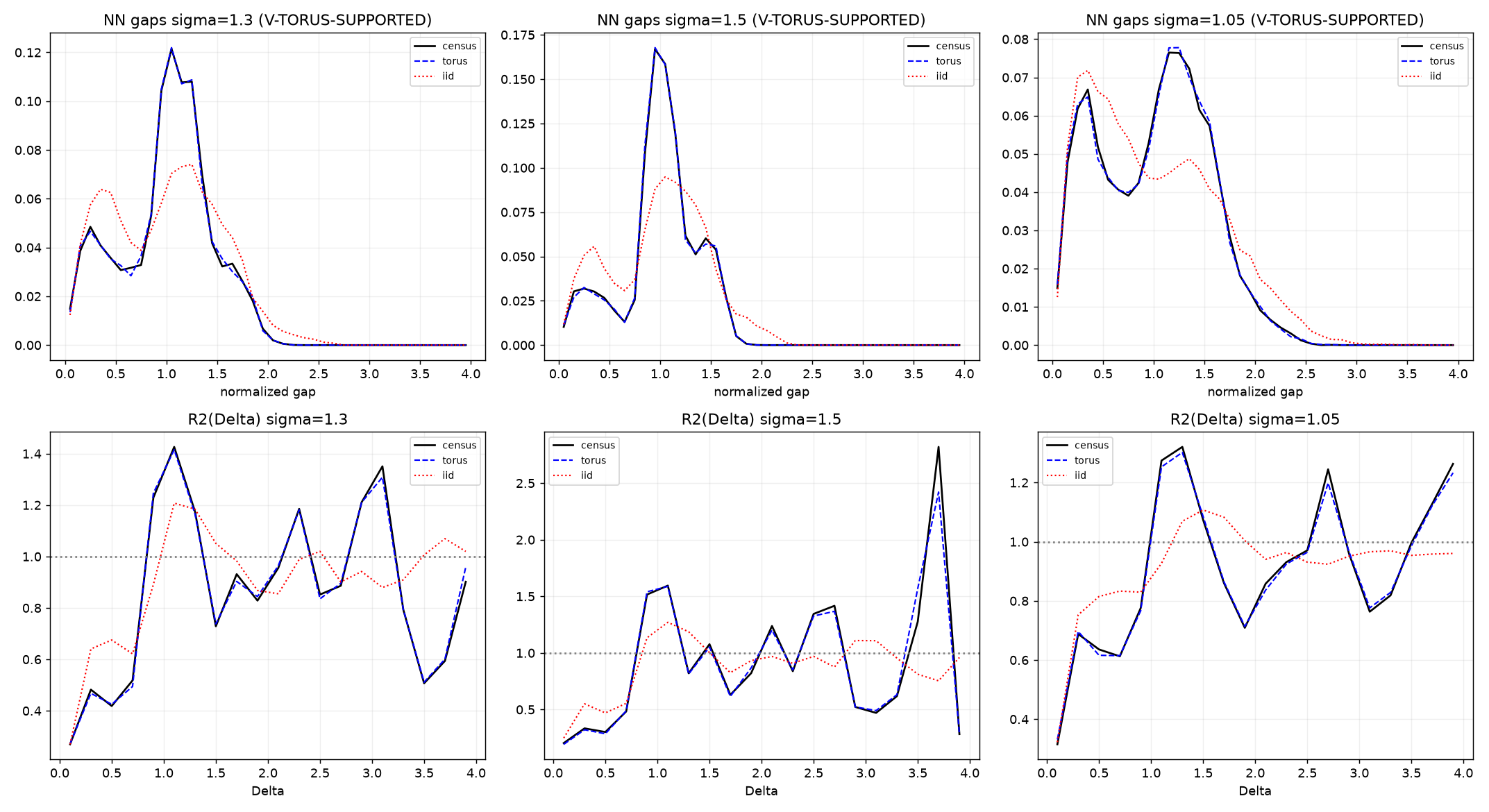
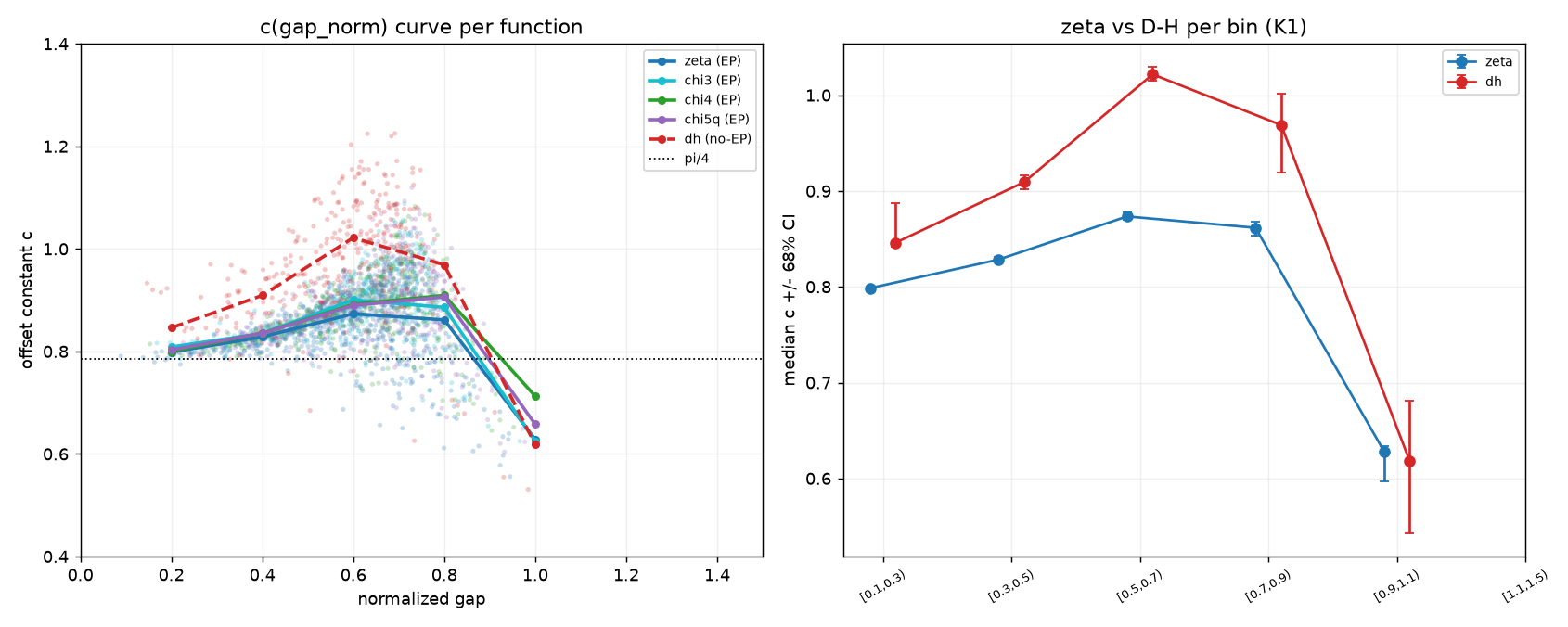
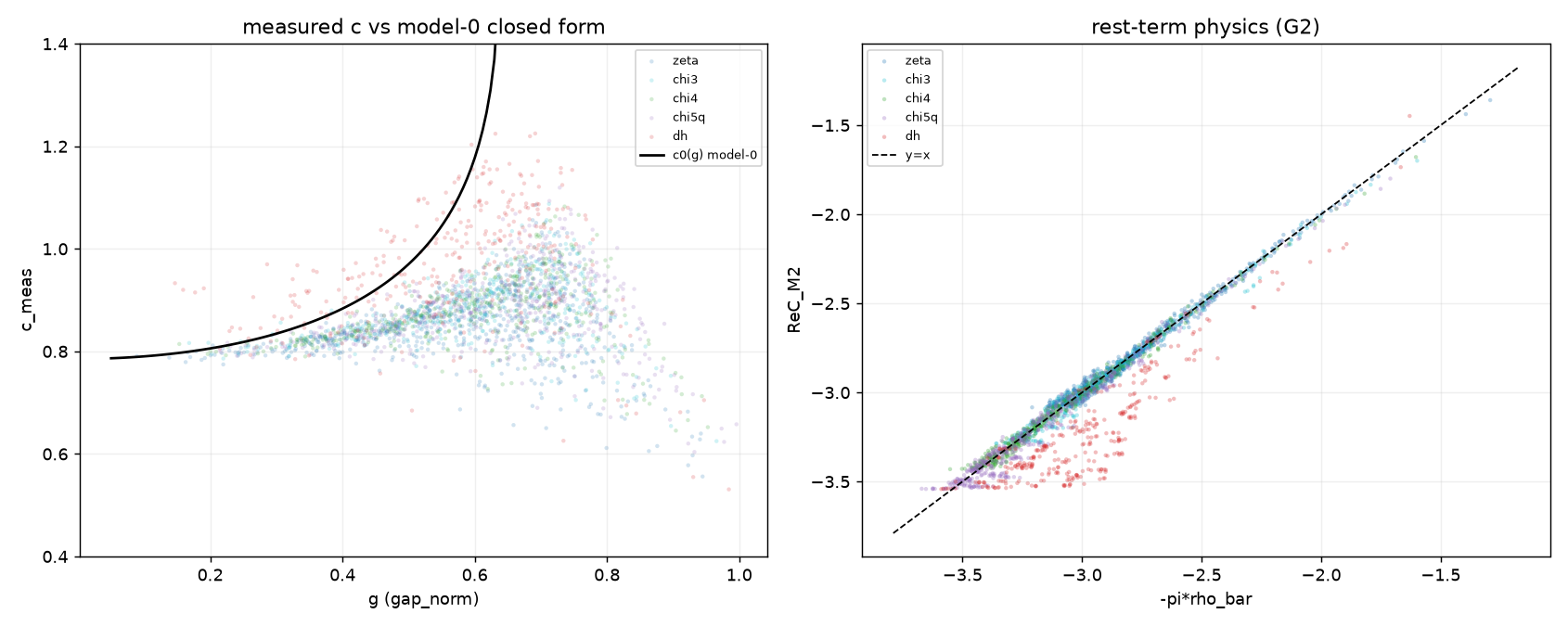
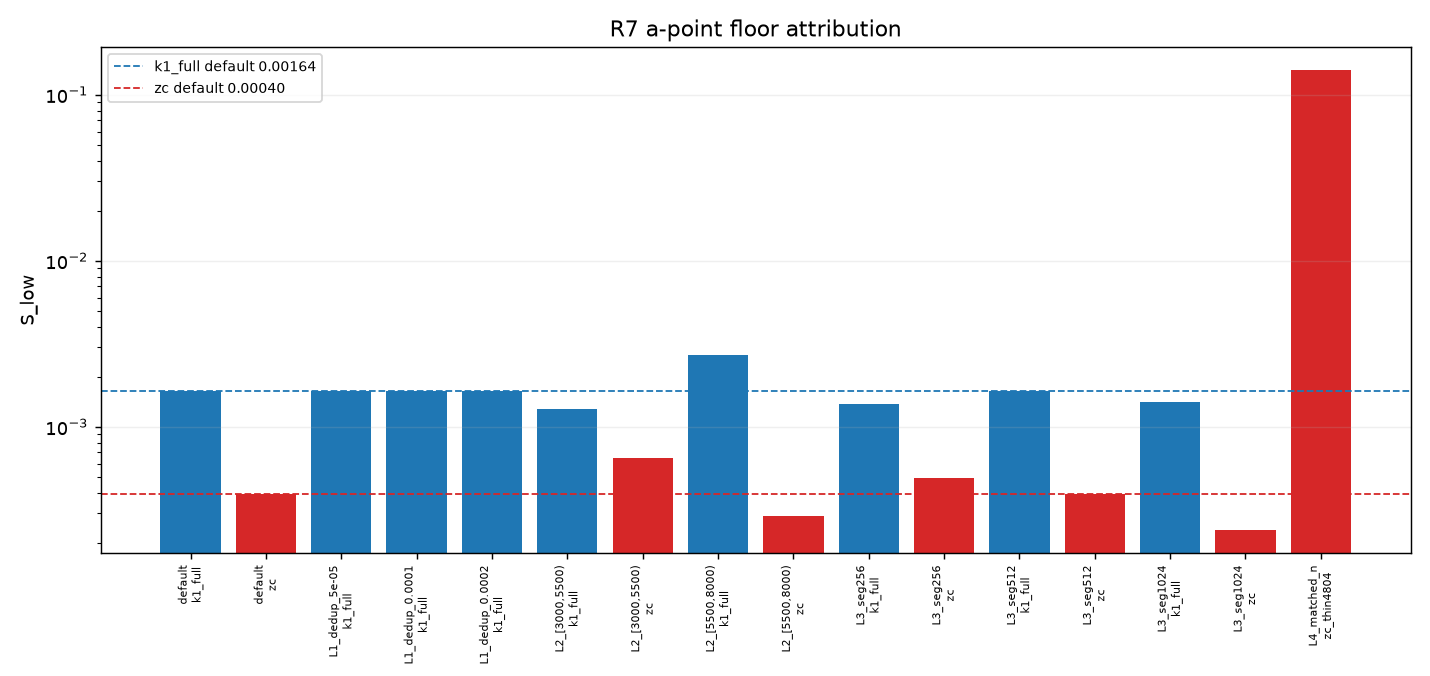
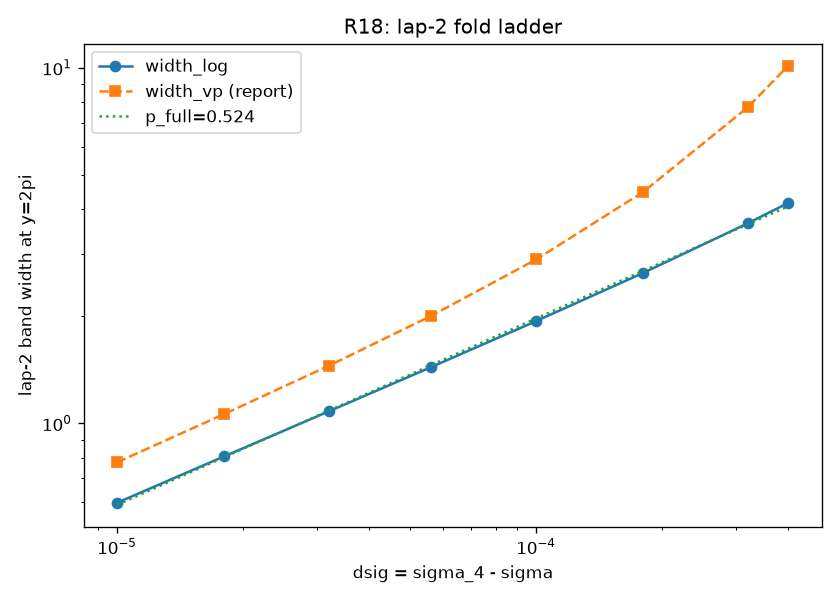
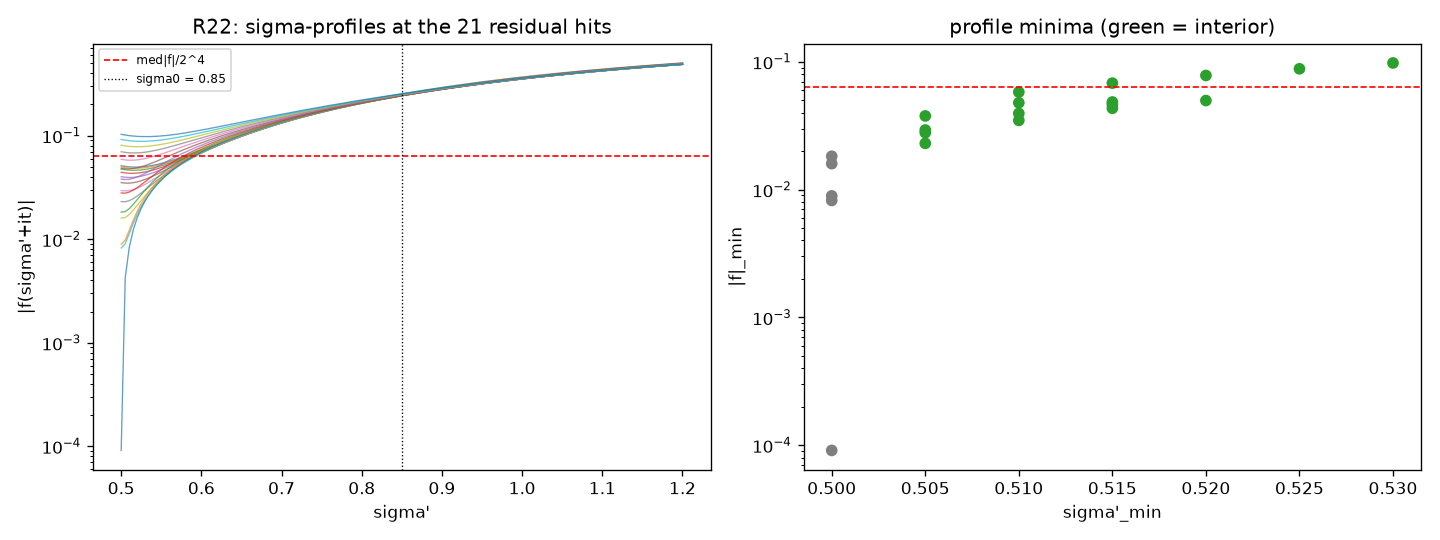
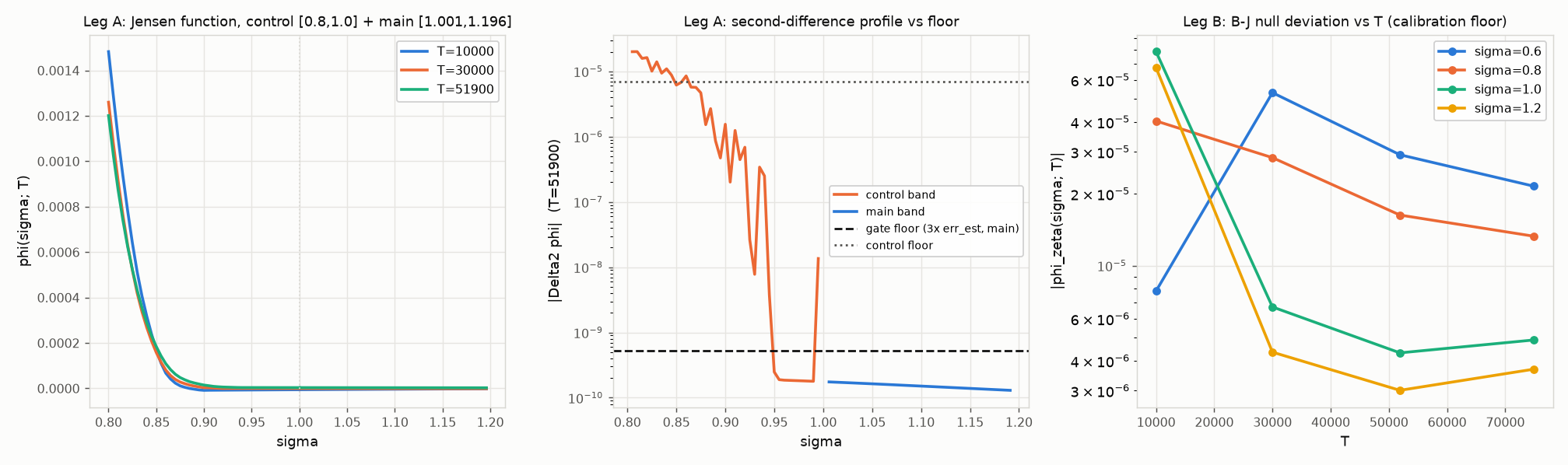
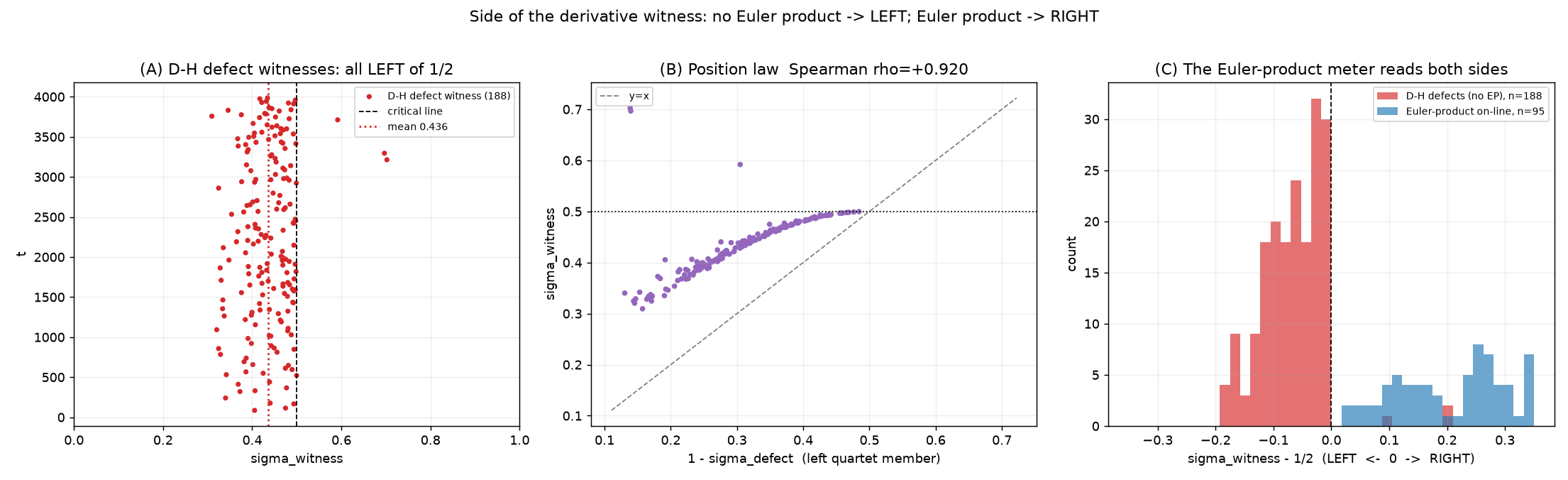
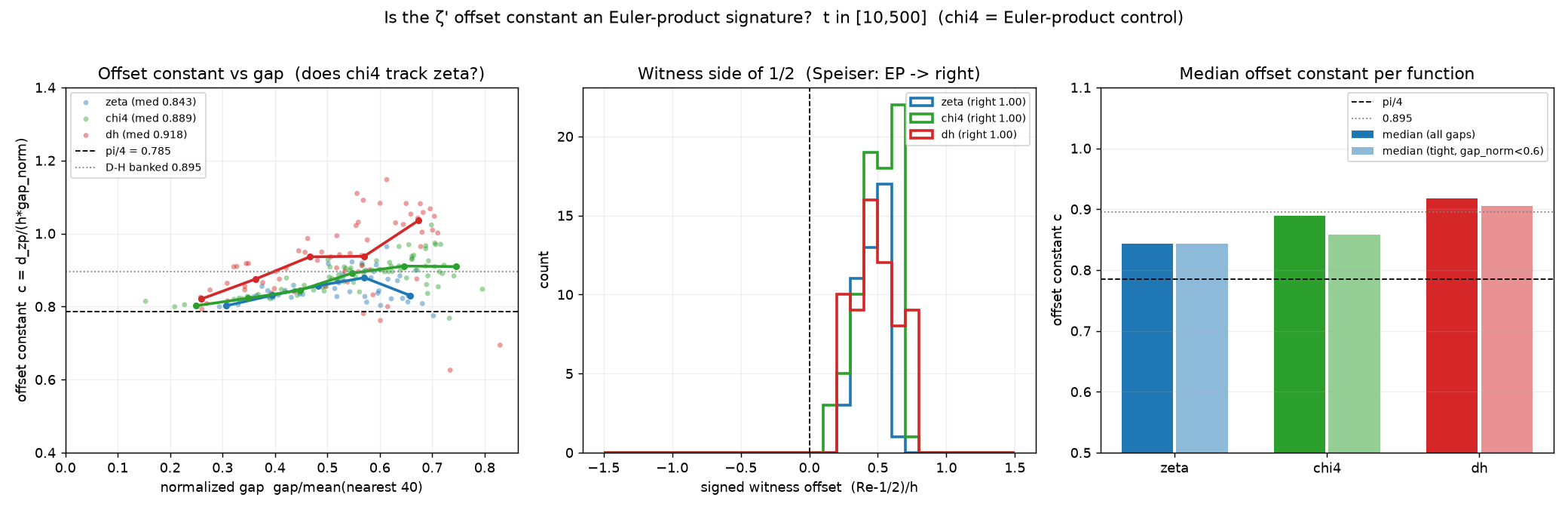
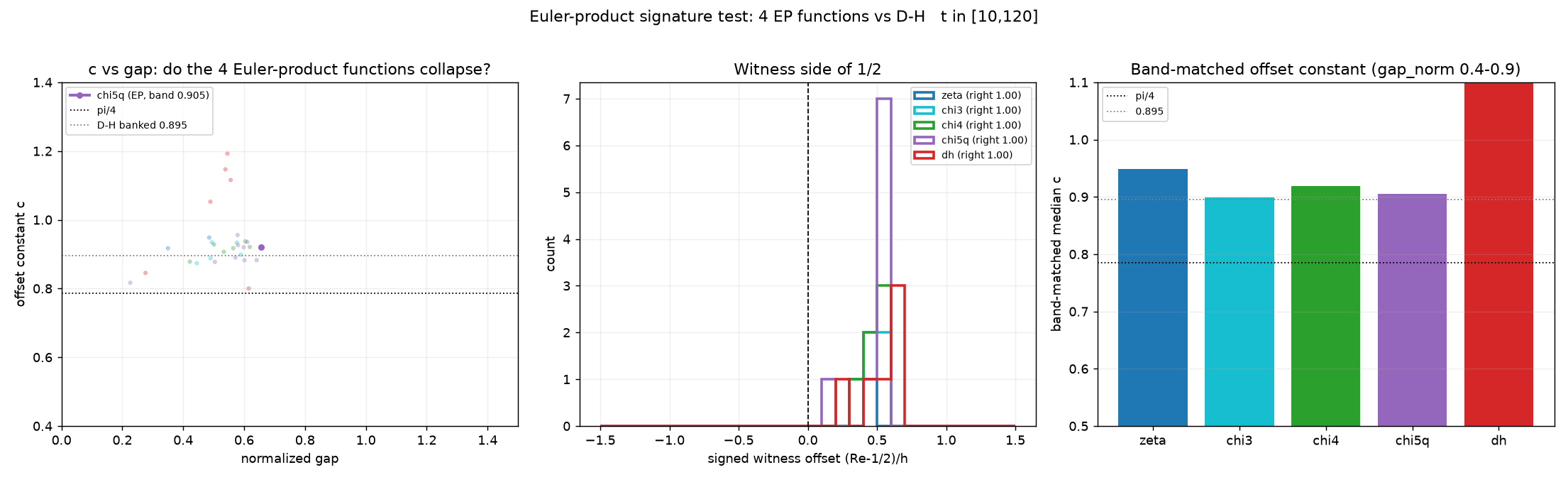
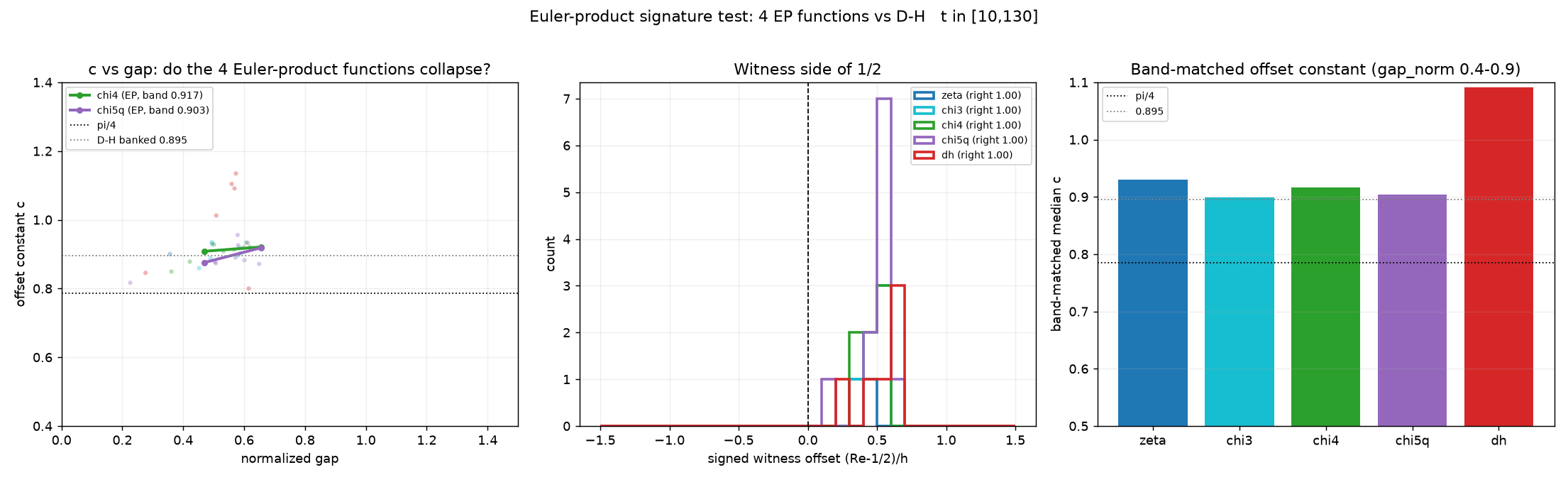
The local Speiser pairing, certified and frozen. Left: for all 193 off-line zeros, the derivative-witness displacement ½ − σ_w against the zero's own offset β − ½, with the wedge bounds r_lo = 0.015986 and r_hi = 0.946163 (Δ = 0.046648) — the constants of record, frozen at this round and unchanged from the full-193 preview to 0.00%. Orange marks the 50 bank-seeded events. Every point lies inside the wedge: 193/193. Centre: the argument-principle winding of f′ over the eight boxes recovered at this round — the eight that a wave-1 basin artifact had put outside the certification (erratum E-P4W1-3) — each returning N = 1.00000 exactly, seed-independent, from dps-50 LEFT convergence (|f′| ≤ 1.2e-41). Right: box tightness, the minimum σ-margin from the witness to the box side, over all 193 boxes. The bijection is re-closed at 193/193 and the lemma write-up proceeds on frozen constants.
Supplementary materials
The audit layer: how the numbers above were checked, what was corrected, and what is owed to whom.
Open the supplementary materials
This file carries the audit concordance and the provenance ledger of the paper named above, together with its revision record.
S1. Revision record
an internal record — Packet Centroids IV (v0.6 DRAFT, s96 + literature pass s96-cont-2 + wave-10 integration s97 + dual ladder at record grade s97-cont + remainder sweep s98 + revision pass s99, 2026-07-23)
TITLE (operator-approved s96-cont, 2026-07-23):
Appendix B — Audit concordance
Every printed statistic in this paper carries a row in the audit annex (row → draft site → statistic → source of record: EVAL file + adjudication section), built alongside the draft per the discipline of [2] App. B and [3] App. B. Internal annex of record: the audit annex; the published form follows the [3] pattern (separate supplement, opaque ledger tags) on operator order. Statistics frozen in [1],[2],[3] are cited to those papers, not re-rowed.
Appendix C — Provenance ledger (operator structural conjectures in this arc)
Recorded verbatim in the program files ahead of measurement; archived sources quoted, never paraphrased from memory. Status per the both-paths rule: confirmations and refutations at equal prominence.
- Apple-continuation thesis (dictation series 1 and 12, s88): "the apple shape is what merges both Euler domain and Complex domain and bears both qualities"; "these points are defined in Euler domain and transit into Complex plane in continuous way, the transition of the apple shape is the translation mechanism, of Euler and Complex language." → Part III (bridge curve, branch points), Part V (atlas). CONFIRMED as structure (branch-at-zero certified; atlas banked).
- Integer skeleton / gearbox (dictations 2–6): integer-defined skeleton with interlocked rotating joints; "gearbox of different time dilation watch hands sitting in sequence on tip of each other"; "the rotation is uneven, and is continuously uneven"; t = range of integer segments; "the interlocking dependencies define the shape of the apple, their mutual gradual limitations." → §15.2 (lock/weld/unevenness measured), §3.2 (budget identity). MEASURED: interlocking = entire σ>1 obstruction; unevenness = the apple's existence; weld carries the strip hole at settings.
- Front angles / axis crossings / half-phase mirror (dictation 7) → §16.2; ranges reading (max/min endpoints) CONFIRMED EXACT (mirror 8.9e-16); angle law measured (fronts parallel at σ**).
- Three-triangle structure "from 0.9 onward" (dictation 8) → §16.2: middle structure develops at σ ∈ [0.85, 0.95] (brackets 0.9; onset read with mandatory T-tag; settings-bounded null beyond).
- Wave-fully-spent energy clause (dictation 9) → exact and banked: A(1) = 0 with A′(1) = π²/6 (the stem hinge).
- Triangulation program + missing multiplicativities (dictations 10–11) → §16.1: atlas delivered; PSLQ clean negative (NONE-BEYOND-KNOWN) — the missing-dependency search returned that the known dependencies are all there are at atlas level.
- Layered-apple principle (s89, eleven clauses, root file): layering past W = π; winding-weighted areas; half-apple method; clause-9 registered prediction (trivial exact doubling) CONFIRMED at the mirror ray, refined off-ray (modifier 1.30); clause 10 (sheets first, ½ last) vindicated and binding; clause 11 (k = label, not altitude) → §14.1.
- Bridge-curve identification (2026-07-22, near-verbatim): "the leftmost picture is the bridge… it does contain Euler world and the bridge between"; "the cleanest visual representation of how the Euler could be connected to Complex plane, how it does traverse it." → Ch. 6; certified by three zero-free-parameter preregistrations; Figure 1.
- Refuted/regraded in this arc (equal prominence): the blade-rung↔handoff correspondence reading (REFUTED, §14.4/Ch. 18 item 1); the exact-doubling clause off-ray (refined, modifier 1.30).
S4. Errata ledger (paper §2.5)
§2.5 Errata ledger. Twenty-six errata across the arc, all named, none instrument-fatal, identifiers preserved: E-F26D-1/-2 (gate design); E-P4W1-1/-2/-3; E-P4W2-1/-2 (+ residual R-P4W2-1); E-P4W3-1/-2; E-P4W4-1..5 (E-P4W4-3 = the defective wave-1 list, §2.1; E-P4W4-4 = fold-exponent gates applied to a corrections-bearing window); E-P4W5-1/-2; E-P4W6-1/-2/-3 (E-P4W6-1 = the load-bearing one: the explicit-formula spec omitted the Γ-pole family; the corrected identity is the identity of record, §9.1); E-P4W7-1/-2 (E-P4W7-1 = a stability gate retired as spec-defective, §9.3); E-P4W8-1; E-P4W10-1/-2/-3 (E-P4W10-1 = the entire-function contour-gate spec defect of the dual-ladder probe; E-P4W10-2 = window crowding at x = 25; E-P4W10-3 = a cross-population gate retired as wrong-model — all §8.5); E-P4RM-1 (a runcard window-label typo, zero impact). Each is reported in the section whose result it touches.
S5. Source status (paper §19.3)
§19.3 Source status. Newly verified first-hand this arc (V): Bombieri–Ghosh 2011; Bombieri–Hejhal 1995 (fields); Righetti 2017 (full text); Righetti 2016; Booker–Thorne 2014; Jessen–Tornehave 1945 and Borchsenius–Jessen 1948 (full texts); Büthe 2015; Kaczorowski–Languasco–Perelli 2000 (full text); Fujii 1989 (fields); Kawalec 2026; Goulden 2026; Garunkštis 2019; Ng (arXiv/DOI); Dueñez et al 2010; Stopple 2020; Christ 2014 (carrier for the Bohr 1911 / Bohr–Jessen citations). Carried from [3]'s verified set: Speiser 1935; Levinson–Montgomery 1974; Spira 1994; Balanzario–Sánchez-Ortiz 2007; Davenport–Heilbronn 1936. (S), non-gating: Turing 1953; Booker 2006; Gonek 1985/1993; Fujii 1990; Landau 1911/12; Landau–Walfisz 1920; Fröberg 1968; Vaughan 2015; Stopple (Lehmer pairs, DOI held); Azaïs–Wschebor 2009; Bohr 1911; Bohr–Jessen 1930/32; Kershner 1936; Cassels 1961; Gonek 1981; Bombieri–Mueller 2008. Source dossier with verbatim quotes and access dates: literature-pass record of this arc.