Packet Centroids V
The Per-Event Witness Law, the Count Register in Three Instruments, and the Measured Gap
An exact per-event law of the critical line — and the same motion that proves it exact shows it cannot do the job, for a reason that is measured rather than asserted.
Read this as a workbench
This site is a record of a workbench, not a record of finished results. Rigorous standards were applied to the arXiv paper alone. The paper below is the project's own text, complete — including the negative results, the priority concessions and the errata.
Packet Centroids V: The Per-Event Witness Law, the Count Register in Three Instruments, and the Measured Gap
What an exact per-event law of the critical line can and cannot do
AI assistance: Large language models were used for computation, proof drafting, proof checking, literature consultation, cross-verification, editing, and manuscript preparation. The mathematical arguments were drafted and checked by these models, including repeated blind refereeing by independent model instances; the author has not independently verified every proof. The author originated and directed the research programme, made the methodological and editorial decisions, reviewed the manuscript, and accepts responsibility for presenting this material. The work is written so that every claim can be checked from what is printed and deposited, without trust in either the author or the models.
Record of work: These files are a record of work, not a record of results. They include measurements that were later corrected, conjectures that were refuted, and observations that have never been checked against the literature. Every claim is marked with which of those it is.
1. Introduction and statement of results
1.1 What this paper set out to do
The series title refers to the packet-centroid smoothing identity introduced in Paper 1; this paper continues that series' numbering without using the construction directly.
Paper 5 opened with a single aim, stated before any measurement began: to find exact conditions forbidding zeros off the line σ = ½ — conditions, not statistics. The programme's own framing of the open move was inherited from Paper 4: a law known to hold for a population of zeros had to be promoted to a statement about each individual zero. That promotion is what the programme calls arrow 2, the witness identity.
The aim was not achieved. This paper reports what was achieved instead, and it is more than a negative: the witness identity was promoted to a per-event law, then proved exact, then shown to hold uniformly in T, and then — in the same motion — shown to be incapable of doing the job, for a reason that is now measured rather than suspected.
1.2 The five results
(i) The witness identity is an exact per-event law, and it is universal — for the elementary reason, printed at §3.1, that it is the small root of a quadratic: it holds for any function with two simple zeros on a slowly varying background, so the Euler-product class is not a hypothesis of it. For a cluster of zeros with half-separation parameter a and local logarithmic-derivative background R, the displacement of the associated derivative-register witness from the critical line satisfies
ε₂ = a²R / (1 + √(1 + a²R²))
exactly in the tight-cluster limit — an asymptotic statement whose approach to exactness is what the measured residuals in Chapter 3 track, not the residual error of an approximate fit — with the wide-cluster departure fully accounted by one further order in R. This was confirmed on ζ, on the Davenport–Heilbronn function, on the primitive real Dirichlet L-functions of conductor 3, 4 and 5, and on primitive complex characters (two of conductor 5, one of conductor 7) — the full tested honest-Euler class. The conductor enters through exactly one term, the density normalisation −½·log(qγ/2π). Both halves of the identity have now been measured: its real part is the sign law — 193 of 193 witnesses left of ½ on the counterexample — and its imaginary part, tested here for the first time, predicts the witness's ordinate to 1 % in median and 1.65 % in slope in the tight-cluster stratum, departing in the wide one (Chapter 3.1). (Chapter 3.)
(ii) The identity's real part is archimedean, exactly and unconditionally, and therefore uniform in T. For any F in the extended Selberg class of positive degree — a functional equation and nothing arithmetic — the functional equation forces Re[Φ′/Φ] = 0 on the critical line, hence in the Riemann-type case
Re[F′/F(½ + iT)] = −½·log(q/π) − ½·Re ψ((½ + κ + iT)/2) = −½·log(qT/2π) + O(1/T²).
The O(log T) sum over zeros — the object that had blocked every uniform-in-T attempt the programme made — is not estimated. It is absent. Every previously measured feature of the witness register follows as a corollary: the sign law, the π/4 asymptote with its rate, the banked rigid-pair model, the domain breakdown boundary, and the conductor law. (Chapter 4.)
(iii) The count register separates the two constructions, in three instruments with disjoint failure modes. Over t ∈ (0, 4000], the number of zeros of the derivative lying left of ½ is 0 for each of ζ, four primitive Dirichlet L-functions and each Davenport–Heilbronn constituent separately, and 193 for the constituents' weighted sum (ζ's own zero-count of 0 here is not itself a new exclusion — certified unconditional results already cover about seven orders of magnitude further in t, Chapter 5.5; the content is the contrast with the non-multiplicative sum). The same 0/0/193 contrast was then read a second time by an argument-principle box census and a third time by a pure value-region winding count that uses no zero-finder at all. (Chapter 5.)
(iv) The dual-register visibility threshold δ_c is a well-defined quantity of the register. It has a window-independent limit approached from above, collapses onto a single curve in the product γ₀·w across four decades of height, and is flat in height across six decades: δ_c(w→0) = 0.008234 / 0.010378 / 0.008896 at γ₀ ≈ 10², 10⁴, 10⁶. It is explicitly not the lower bound a proof would need. Its flatness in height and its δ² scaling hold BY CONSTRUCTION and are instrument validation, not results (§6.1, re-scoped 2026-09-04); what the register contributes about ζ is the LEVEL ≈ 0.009 at the stated injection normalisation, reproducible across heights to ±15 %. (Chapter 6.)
(v) The exact objects this programme owns partition into two halves whose intersection is empty, and this is measured rather than assumed. Every exact object the programme owns is either per-event and class-universal — it fires identically on ζ and on the counterexample, and therefore cannot separate them — or class-separating and not per-event. After five further waves of measurement no object of ours landed in the intersection. The reason is structural and we state it rather than leave it implicit: our exact objects are EQUALITIES, and an equality inherited from the functional equation is class-universal by construction. The intersection itself is not empty — the classical zero-free region lies in it, and Chapter 9 scores it — so the deficit this paper measures is not the absence of an intersection object but the rate at which the known ones approach the critical line. (Chapter 9.)
1.3 The honest accounting
This paper carries an unflattering register, and carries it in the text rather than in a footnote. The programme ran twenty-nine probe legs across nine waves, drawn from a set of measurement rounds where one round contributed two legs and another was re-run once after its instrument was rebuilt. By declared tier, taking each ledger row at its highest declaration: twelve of the twenty-six rows — fifteen of the twenty-nine legs — are instrument, control or verification tier only; eight more are topped by locator tier, which is structurally incapable of producing a condition; and six carry a condition-candidate declaration, every one of which resolved into the class-universal law rather than a condition. One round was retired as a design catch, and one stopped at its own specification gate. (The tally reflects the ledger's tier column as finally recorded; an earlier hedged version of it undercounted the locator share.) Five of the nine waves are recorded, in the programme's own words, as having moved no blocker. The keystone aim did not happen: the witness law became exact and became universal, which is the opposite of an obstruction.
The register the programme judges correct for this work is Paper 4's: the gap named, instrumented, measured on both sides — not crossed.
2. Setting, objects, and the standard of evidence
2.1 The two constructions
Throughout, ζ is the Riemann zeta function and the counterexample is the Davenport–Heilbronn function
ℓ(s) = (1 / 2cos α)·( e^{−iα} L(s, η) + e^{iα} L(s, η̄) ), η mod 5 with η(2) = i, tan α = (√(10 − 2√5) − 2)/(√5 − 1).
That constant is 0.2840790438…; the programme carried it as an unexplained algebraic number before the literature pass identified it as the classical tan α (Chapter 5.6). The counterexample satisfies a Riemann-type functional equation, has real coefficients, and has no Euler product. It has 193 zeros off the critical line in t ≤ 4000, in mirror quartets straddling σ = ½ with offsets δ = β − ½ ∈ [0.015918, 0.397750].
The counterexample is the paper's instrument of falsification. Any candidate condition that would forbid off-line zeros must be false for it. This criterion is used throughout and is the origin of the paper's central negative.
Its off-line zeros are not a curiosity; they are forced. In the Kaczorowski–Perelli normal form the counterexample is a combination of two primitive Dirichlet L-functions, and Kaczorowski–Kulas prove that any degree-1 element of the extended Selberg class which is a combination of two or more such L-functions has infinitely many zeros in ½ < σ < 1, with real parts dense in that interval (cited at statement level: the original is paywalled, and its hypothesis and conclusion are pinned by two independent first-hand sources — Appendix E, entry [10]). The 193 zeros we census in t ≤ 4000, with real parts spanning [0.515918, 0.897750], are therefore the visible part of a provably dense set — not a finite anomaly that a longer window might exhaust.
2.2 The requirements ledger
The programme scores every candidate object against seven requirements, fixed in advance:
| requirement | |
|---|---|
| R1 | per-event — it constrains an individual zero, not a population average |
| R2 | value-coupled — it involves the function's values, not only zero positions |
| R3 | line-selective — it distinguishes σ = ½ from nearby lines |
| R4 | class-separating — it must be FALSE for the counterexample |
| R5 | independent of the two already-known conditions |
| R6 | uniform in T |
| R7 | survives the detection floor |
(The two already-known conditions here are the zero-defining equation and the functional equation — see the scoring in Chapter 9.1.) Chapter 9 scores the paper's objects against this ledger. The result is the paper's central finding.
2.3 Standard of evidence
Every numerical claim below is a finite-window measurement above a finite detection floor, carried out under a preregistered gate with a stated falsifier. Where a gate could not fail by construction, it was removed from the evidence and is reported as removed. Where a measurement's headline changed under re-derivation from the filed data, both readings are on the record and the change is stated. Chapter 10 reports the resulting error register in full, including the errors this programme made against itself.
3. The witness identity: exact, per-event, universal
3.1 The identity and its domain
(The parameters a and R are introduced descriptively — cluster half-separation and local logarithmic-derivative background, respectively — and are pinned down precisely, as the archimedean quantity of Theorem W1-2 and the corresponding separation, in Chapter 4.2.)
Derivation, and what it depends on (printed 2026-09-04; the closed form had been stated without it since the first draft). Write the function near a cluster of two simple zeros as F(s) = (s − ρ₊)(s − ρ₋)·G(s), with ρ± = w ± a — w the midpoint, a the half-separation, real for a straddling pair and imaginary for an on-line pair — and let R := G′/G(w) be the logarithmic derivative of the background at the midpoint, taken constant across the cluster. With u := s − w,
F′/F(s) = 1/(u − a) + 1/(u + a) + R = 2u/(u² − a²) + R,
so a zero of F′ — the witness — solves the quadratic
R·u² + 2u − R·a² = 0,
whose small root is u = (−1 + √(1 + a²R²))/R = a²R/(1 + √(1 + a²R²)). That is the identity ε₂ = a²R/(1 + √(1 + a²R²)), verbatim. Nothing else enters: it is the position of the derivative zero between two simple zeros on a slowly varying background, and it holds for any meromorphic function with that local shape — for a polynomial with two close roots as much as for ζ. The one approximation is dropping R′(w)·u², the variation of R across the cluster, which is exactly the wide-cluster "R-order effect" measured below. The identity is therefore inherited from local factorisation — an input strictly weaker than the functional equation, which it does not use — and the function under study enters through R alone. The functional equation enters at one place: it fixes Re R = −½·log(qγ/2π) + O(1/γ²) (Chapter 4). Im R, the neighbour sum, is uncontrolled (§4.5). For tight clusters u ≈ a²R/2, so Re u has the sign of a²·Re R — negative for real a (straddling pair, witness left) and positive for a = ih (on-line pair, witness right): the sign law, which is the local mechanism of Speiser and of Levinson–Montgomery rather than a new register. What the rest of this chapter measures is how well ζ and the other tested functions realise that local shape.
The closed form ε₂ = a²R/(1 + √(1 + a²R²)) was confirmed on ζ at law grade (median relative deviation 0.0052) with the background carried entirely by the density term −½·log(t/2π): the sign agreement is 1.000 and the rank correlation with the density-only prediction is +0.9912. The π/4 instantiation was recovered.
The imaginary half, measured rather than assumed. At a straddling pair the half-separation a = δ is real, so the two halves of ε₂ separate at leading order: u ≈ a²R/2 gives Re ε₂ ≈ a²·Re R/2, which the functional equation fixes, and Im ε₂ ≈ a²·Im R/2, which it does not (Chapter 4.5). Beyond leading order the closed form couples the halves through √(1 + a²R²): Im ε₂ vanishes when Im R does, but with Re R set to zero the predicted Im ε₂ moves by a median 10 %, 37 % and 71 % in the tight, middle and wide thirds below (the previous version of this paper wrote “Im ε₂ is driven by Im R alone”, which holds at leading order only). What the functional equation leaves free is therefore necessary for any ordinate offset, and is not the whole of its size. Re ε₂ places the witness left of ½ — the 193 of 193 census — and Im ε₂ predicts the witness's ordinate offset from the defect. Until this version only the real half had ever been tested. Measured against the certified pairing at all 193 certified off-line quartets, prediction against measurement gives a correlation of +0.9487, a regression slope of +0.7930 and a median relative deviation of 0.0123 — in relative terms sharper than the real half's 0.0433 on the same events. Those pooled figures understate it, and the stratification is the honest read. Split by cluster width |aR|, the size parameter of the one term this identity drops:
| stratum by \ | aR\ | n | correlation | slope | median rel. dev. | |
|---|---|---|---|---|---|---|
| tight, \ | aR\ | ≤ 0.5430 | 65 | +1.0000 | +1.0165 | 0.0099 |
| middle | 64 | +0.9999 | +0.9989 | 0.0089 | ||
| wide, \ | aR\ | > 0.8761 | 64 | +0.9372 | +0.7364 | 0.0468 |
The imaginary half agrees with the identity to 1 % in the tight and middle thirds and departs in the wide one; the pooled slope of 0.79 is the wide third pulling the fit. (The previous version of this paper called the tight third “exact” and named the dropped variation of R across the cluster as the mechanism of the departure; both are corrected here.) “Exact” is this chapter's word for the real half's median third-order deviation of 5×10⁻⁵, and the imaginary half is two orders coarser: in the tight third the slope is +1.0165 with a standard error of 0.0006, so the 1.65 % overshoot is not noise, and the middle third (slope +0.9989) sits closer to the identity than the tight one. The departure is therefore not monotone in |aR| across the three thirds, and the dropped variation of R across the cluster — the candidate mechanism, the one the real half's calibration names — was not computed for the imaginary half: the stratification compared the tight and wide thirds' slopes and nothing more. The cause is a candidate, not a measurement. What this is: a measured per-event association at n = 193, on one function, inside one window, tying a quantity the functional equation does not fix to a position that can be measured. What it is not: a bound on Im R, a statement about ζ, or a separating object — the identity fires identically on both constructions, which is Chapter 9's point, and locating a witness relative to a defect forbids no zero anywhere.
The identity is exact in the tight-cluster stratum — median third-order relative deviation ≈ 5×10⁻⁵ — and the wide-cluster departure is not a failure but an R-order effect: one further order in the variation of R across the cluster closes it, with the fraction of events improved by that order equal to 0.835 and a second-order domain edge at normalised gap 0.9. The rise of the measured ratio above π/4 with cluster width is exactly this domain curve, not a conductor effect — the banked offset-law domain curve of Paper 3 §8.6 and Paper 4 App. F, where the closed form above is itself derived; it is stated, confirmed and extended here.
3.2 Universality across the class
(Locality r₉₀ is the neighbour radius, in cluster units, at which the local background estimate saturates — see §3.4.)
| construction | median rel. dev. | locality r₉₀ | density rank corr. | all right of ½ |
|---|---|---|---|---|
| ζ (control) | 0.0331 | 1 | — | min Re 0.5158 |
| χ mod 3 | 0.0152 | 1 | +0.9657 | min Re 0.5038 |
| χ mod 4 | 0.0305 | 1 | +0.9577 | min Re 0.5244 |
| χ mod 5 | 0.0339 | 1 | +0.9560 | min Re 0.5313 |
| χ₅⁺ (complex) | 0.0409 | 1 | +0.9638 | min Re 0.529 |
| χ₅⁻ (complex) | 0.0385 | 1 | +0.9536 | min Re 0.531 |
| χ₇ (complex) | 0.0312 | 1 | +0.9671 | min Re 0.511 |
(ζ's own density-rank correlation is given in §3.1 above.)
The complex-character leg required a genuinely complex root number (arg ε = ±0.554, +1.174) and a functional equation relating χ to its conjugate, validated to 2×10⁻³¹. Arrow 2 therefore holds on every function tested, real and complex, with the conductor entering only through the density normalisation — as the derivation in §3.1 says it must. The identity holds for any function with two simple zeros on a slowly varying background, so the Euler-product class is not a hypothesis of it, and the seven rows above are seven measurements of neighbour isolation (how nearly R is constant across a cluster), not seven confirmations of a class law. [Re-scoped 2026-09-04; through the previous version this sentence read "spans the full honest Euler-product class", in conflict with §1.2(i)'s "tested".]
3.3 Height stability
On the certified zero bank (the LMFDB/Platt bank of Paper 3 §2.1) at γ ≈ 10⁸ and 10⁹: median relative deviation 0.0050 and 0.0053, locality r₉₀ = 2, density rank correlation +0.9750 and +0.9701, and the ratio 0.7884 → 0.7895 against π/4 = 0.7854. The ζ leg is stable roughly four orders of magnitude beyond the census plateau.
3.4 The counterexample's difference, isolated
The counterexample's background is not local: its share does not saturate with neighbour radius. The cause was isolated exactly. Adding the single omitted constituent density term −½·log(5γ/2π) restores locality at r₉₀ = 1, and the direct background 3.811 is close to that density, 3.750. More sharply still: the two constituents, run on their own zeros, are each local exactly as ζ is, while their sum is not. The parts are local; the sum is not. The counterexample's difference from ζ is conductor plus partner-sum structure — not a failure of the identity, and not a locality property of any Euler product.
The witness position law survives: 193 of 193 witnesses converge left of ½, with rank correlation +0.9890 against the banked value, mean position 0.4267 (the bijection and rank law of Paper 3 §8.8 and Paper 4 App. D). An earlier wave reported this law as diluted; that reading was traced to solver instrument (thirty-digit precision with a secant clamp and a frozen local background) and superseded. The superseded reading and its correction are both on the record.
3.5 The π/4 constant on thick statistics
A direct tight-pair harvest over γ ∈ [14.135, 235999.997] examined 358,090 consecutive pairs, yielding 2370 at normalised gap ≤ 0.2 and 298 at ≤ 0.1. Of these, 254 were censused: the ratio at ≤ 0.1 is 0.792062 over 79 pairs, against π/4 = 0.785398. All 254 witnesses lie right of ½. The harvest reproduced the banked tightest pair (0.021860 at γ = 71732.9086, Paper 3 §4.1) and the classical Lehmer pair without being told to look for them.
One banked value is superseded and must be printed as such: the smallest measured witness offset is now min Re w\* = 0.500112099639 at γ = 234016.9015089, replacing the value 0.500126 printed in Paper 3 §8.4. This tightens an observed margin and closes nothing.
4. The archimedean backbone
4.1 Theorem W1-1
Theorem. Let F belong to the extended Selberg class with degree d_F > 0 — that is, F is a Dirichlet series convergent for σ > 1, with meromorphic continuation of finite order and a functional equation Φ(s) = ω Φ̄(1−s), Φ(s) = Q^s ∏_j Γ(λ_j s + μ_j) F(s) — and let F(½ + iT) ≠ 0. Then log-differentiating the functional equation gives Φ′/Φ(s) = −(Φ̄′/Φ̄)(1−s), and at s = ½ + iT the point 1 − s̄ equals s, so Φ′/Φ(s) = −conj[Φ′/Φ(s)]. Hence Re[Φ′/Φ(½ + iT)] = 0 and, in the Riemann-type case (r = 1, λ = ½, μ = κ/2, Q = √(q/π)),
Re[F′/F(½ + iT)] = −½·log(q/π) − ½·Re ψ((½ + κ + iT)/2) = −½·log(qT/2π) + O(1/T²),
exactly and unconditionally.
(Standard Selberg-class notation: κ is the gamma-factor parity parameter, ψ the digamma function, λ_j, μ_j, Q the gamma-factor data of the displayed functional equation, and Φ̄ the Dirichlet series with conjugated coefficients, Φ̄(s) = conj[Φ(s̄)] — see Selberg's axioms, ref. [5].)
The mechanism is that the functional equation pairs each zero β with 1−β at the same ordinate, so in the Hadamard decomposition of Re F′/F the sum Σ_ρ (σ − β)/|s − ρ|² cancels term by term at σ = ½.
Attribution, conceded at result prominence, and corrected against the source. The identity is classical bookkeeping, and its exact address is Garunkštis (2019), the displayed line preceding formula (2.2), which states it for every element of the extended Selberg class of positive degree. An earlier version of this chapter addressed it instead to Garunkštis–Šimėnas (2015) formula (5) "restricted to σ = ½", and stated it under a hypothesis of real coefficients, proving it by the observation that Λ is real on the critical line. That hypothesis is too strong and that proof is not the general one: Λ is not real on the line for a complex character, yet the identity holds there. The gap in the earlier proof was first exposed by measurement, then closed by citing the correct general argument above, which needs no real-coefficient hypothesis; the complex-character measurement itself stands as confirmation, holding at χ₅⁺, χ₅⁻ and χ₇ to 1.0×10⁻³⁷, 2.4×10⁻³⁷ and 8.8×10⁻³⁶ against a 10⁻²⁵ bar. The theorem as now stated is therefore larger than the version this programme first proved, and it covers the complex-character leg of Chapter 3.2 rather than leaving it outside. What is claimed is the application of §4.3, which is untouched by the correction.
One sharpening of the published statement survives, and it is the programme's own. Garunkštis prints the error as O(1/t). On the critical line the 1/t coefficient vanishes: for ζ the constant is pinned exactly at 1/(48T²), with the measured residual times T² equal to 0.0208333333333 across T = 10² … 10⁶, worst deviation from 1/48 being 3.65×10⁻⁷. The published order is therefore not tight there.
The sharpening is not ζ-only — and that is a corollary of the theorem above, not a measurement. This constant was carried through earlier versions of this paper scoped to ζ alone, and the previous version widened the scope by measurement; the widening is right and the reason is a theorem. It holds for every Riemann-type member: in the exact identity the conductor enters only through the T-independent −½·log(q/π), which cancels against the law, and the parity only through Re ψ((½ + κ + iT)/2), whose κ-dependence is O(e^{−πT}) (Chapter 4.4). So (Re R − law)·T² is the same function of T for every (q, κ) — the second-order term of the digamma expansion — and equals 1/48 + 3.65×10⁻⁷ at T = 10² whatever the conductor and parity. The counterexample's value on an arbitrary-precision arbiter at thirty digits, at sixteen points of a geometric grid over T = 10² … 3×10³ offset from the integers to stay off zero ordinates — a median of (Re R − law)·t² of 0.0208333458038 against 1/48 = 0.0208333333333, 1.2×10⁻⁸ above it, at q = 5 and κ = 1 — is a check of the corollary, correct to the digit and adding nothing to it. What does not move is the attribution — the sharpening is still this programme's own, because the published statement it sharpens is O(1/t) for every member of the class. The consequence for Chapter 9.1 was already in the record: the identity itself is verified on the counterexample to 6.56×10⁻³⁷ (Chapter 4.4), so the archimedean backbone agrees with the counterexample to every order and cannot separate the two constructions at any order. The previous version called that the central negative getting stronger; it is the central negative stated exactly.
4.2 Theorem W1-2
At a cluster midpoint w = ½ + iγ_mid the two subtracted terms contribute nothing to the real part: purely imaginary for an on-line pair (a = ih), and exactly cancelling for a straddling off-line pair (a = δ, giving −1/δ + 1/δ = 0). Hence
Re R = −½·log(qγ_mid/2π) + O(1/γ²), exact, unconditional, and uniform in T.
4.3 What follows as corollary rather than as fit
- The density term is the entire real part — not merely dominant. This is why the density-only ingredient measured sign, order and rank alone at +0.9912.
- The witness sign law. ζ's on-line pair has a² = −h² < 0, so Re ε₂ > 0 and the witness lies right of ½; the counterexample's straddling quartet has a² = +δ² > 0 and the witness lies left. The banked censuses — 0 of 551 left for ζ, 193 of 193 left for the counterexample — are now consequences of one sign against a negative archimedean term.
- π/4 as the rigid-pair limit with an explicit rate. (π/4 itself remains a conceded classical constant, identified at Paper 3 §8.2; this is a rederivation in the programme's coordinates.)
- c₀(g) = (π/2)/(1 + √(1 − (πg/2)²)), algebraically identical to the banked rigid-pair model of Paper 4 App. F, whose configuration correction first enters at order h⁴ — precisely the banked tight-exact / wide-R-order calibration of Chapter 3.1.
- A derived breakdown boundary at g = 2/π, replacing a measured domain edge.
- The conductor law −½·log(qγ/2π), derived rather than fitted.
4.4 Verification
| gate | worst value | bar | ||
|---|---|---|---|---|
| identity, ζ, T = 10 … 10⁹ | 6.29×10⁻³⁹ | 10⁻²⁵ | ||
| identity, counterexample (q = 5, κ = 1) | 6.56×10⁻³⁷ | 10⁻²⁵ | ||
| error rate 1/48 | confirmed | — | ||
| arrow-2 form, six on-line ζ pairs incl. the classical Lehmer pair | 2.85×10⁻³⁹ | — | ||
| ten certified off-line quartet midpoints | 1.06×10⁻³⁹ | — | ||
| sign law | LEFT 10/10 | — | ||
| π/4 | c = 0.786128 (dev 7.3×10⁻⁴) | — | ||
| identity, complex χ₅⁺ / χ₅⁻ / χ₇, T = 10 … 1.2×10⁴ | 1.0×10⁻³⁷ / 2.4×10⁻³⁷ / 8.8×10⁻³⁶ | 10⁻²⁵ | ||
| error rate: measured residual·T² vs 1/48, T = 10² … 10⁶ | 3.65×10⁻⁷ | 10⁻⁶ | ||
| 1/48 on the counterexample — a corollary of the theorem of Chapter 4.1, checked, not gated: arbiter at thirty digits, sixteen geometric grid points over T = 10² … 3×10³ | median 0.0208333458038 (1.2×10⁻⁸ above 1/48); worst ≈ 3.6×10⁻⁷ at the bottom of the grid by the closed form, the same function of T as the ζ row | none — no gate was run | ||
| witness imaginary law, 193 off-line quartets, pooled — the gate as run | correlation +0.9487, slope +0.7930 | \ | correlation\ | > 0.5 |
| witness imaginary law by third of \ | aR\ | — a stratification, not a gate; no bar was pre-stated | slope +1.0165 / +0.9989 / +0.7364 | — |
Includes evaluation within 10⁻⁷ of a zero ordinate, where F′/F is diverging. Falsifier witness: the same evaluations with the conductor forced to q = 1 give |diff| = 0.804719, 0.972955 and 0.549306 at conductors 5, 7 and 3 against a 10⁻²⁵ bar — the gate is falsifiable and the conductor is load-bearing. Those three deviations are exactly ½·log q, which is the sharpest form of the statement: what the gate measures is precisely the conductor term, and nothing else.
A recorded negative on the gate design itself. The falsifier witness was first written to force the parity κ rather than the conductor, and it could not fire: the deviation stayed at 1.4×10⁻⁴⁰, i.e. still passing. The reason is exact — by the reflection formula, Re ψ(¾+iy) − Re ψ(¼+iy) = Re[π cot(π(¼+iy))], which decays like e^{−πt}. The identity's parity dependence is O(e^{−πt}), so the density law is parity-blind, and a gate built on parity is a gate that cannot fail. It was replaced under the standing rule of Appendix B rather than reported.
4.5 The honest limitation, tested as a gate rather than as a control
The theorem's hypotheses are membership of the extended Selberg class with positive degree — a functional equation, and no Euler product, no multiplicativity, not even real coefficients. That is exactly the condition the counterexample satisfies, and the theorem was therefore verified on the counterexample, to 37 digits, as a gate.
Scored against the ledger of §2.2: R6 met — the first uniform-in-T statement inside the critical strip in the programme's history — with R1, R2 and R7 also met, R4 failing by construction, and R3 failing. It lands in the per-event, class-universal half, beside the witness law itself.
At degree 1 that failure is structural rather than accidental, and this is a theorem, not an observation of ours. Kaczorowski–Perelli classify the degree-1 sector of the extended Selberg class completely: every element is a Dirichlet-polynomial combination of shifted primitive Dirichlet L-functions, and the sector is a real vector space. Imposing the Euler product collapses it to ζ and the shifted primitive L(s+iθ, χ) alone. So the hypotheses of this theorem — analytic axioms with no arithmetic — admit an entire vector space of non-multiplicative functions, of which our counterexample is one member among many. No object resting on those hypotheses can be class-separating at degree 1. The negative is not about which counterexample we happened to pick.
The programme's asymptotic-in-T capability was the named first weakness. It has now been built, and it forbids nothing. That is a stronger statement than the argument that preceded it: we hold the uniform statement and can see directly that it does not separate. What it does not buy: no bound on the imaginary part of R (still the O(log T) neighbour sum); nothing off the critical line, since the proof uses Re[Λ′/Λ] = 0, a property of the line alone; nothing on the detection floor; and nothing on S(T) — indeed arg Λ being constant on the line is exactly what makes S(T) the difficulty elsewhere.
5. The count register, in three instruments
5.1 The contrast
Over t ∈ (0, 4000], on one engine and one window:
| construction | derivative zeros left of ½ | own zeros left of ½ |
|---|---|---|
| ζ | 0 | 0 |
| χ mod 3, 4, 5, 7 | 0 each | — |
| counterexample constituent L(s, χ₅⁺) | 0 | 0 |
| counterexample constituent L(s, χ₅⁻) | 0 | 0 |
| their weighted sum (the counterexample) | 193 | 193 off-line |
The zero counts extend to t ∈ (4000, 20000] and to a spot window at t ∈ [100000, 104000], and the erosion ladder reaches r_lo = 10⁻¹⁰ with no safety gate biting at any rung.
5.2 Instrument validation, in both directions
A count of zero proves nothing unless the same instrument returns a nonzero count where one is known. Both directions were exercised:
- True positive: 193 of 193 boxes contain exactly one derivative zero; the contiguous strip census returns 193 with no excess.
- Independent-finder positive control: argument principle against an independent Hardy–Z finder agrees at every conductor — 114 = 114, 122 = 122, 129 = 129, 141 = 141 — and 130 = 130 on the constituents.
- Instrument health: 0 unsafe boxes of 753, then of 825, then of 800 across the three waves; worst |n_raw − round| 2.4869×10⁻¹⁴, 2.153833×10⁻¹⁴, 1.81×10⁻¹⁴; evaluator arbiter against an independent implementation 8.13×10⁻¹².
5.3 The detection floor, in closed form
δ_min(γ, r) = √(4r / log(qγ/2π)), exactly δ² = r² + 2r/|R|.
At r_lo = 10⁻³ this is 0.0380 at γ = 10² falling to 0.0146 at γ = 10⁹; at r_lo = 10⁻¹⁰, 1.202×10⁻⁵ falling to 4.60×10⁻⁶. The floor is a rate, not a wall, and no finite r closes an all-height quantifier. This is the price of the third blocker, quoted rather than paid.
5.4 The third instrument: a value-region winding count
The winding number of the value region along a fixed-σ ray, computed with no zero-finder, no box grid and no Newton iteration, reproduces the zero count exactly. Against the ledger's own count of zeros with β > σ:
| σ | ledger | measured winding | ζ on the same column |
|---|---|---|---|
| 0.60 | 162 | −162.0917 | +0.4824 |
| 0.75 | 51 | −51.0593 | +0.4562 |
| 0.90 | 0 | −0.0388 | +0.3964 |
Extended to a 46-column ladder, the winding total is an integer staircase matching the ledger at all 23 π/4-resolved columns — 193, 191, 184, 175, 167, 156, 140, 125, 114, 100, 85, 64, 51, 36, 26, 21, 16, 9, 1, 1, 0, 0, 0 — non-increasing at all 22 steps, with the residual falling monotonically 0.115865 → 0.034090 — well under the threshold that would make nearest-integer rounding ambiguous, so the match is exact after that rounding, not merely close. Stronger than the preregistration asked: every one of the 22 step intervals carries a step count exactly equal to the ledger's zero count in that interval. ζ reads a maximum modulus of 0.4824 and both constituents 0.1134 — null, as required.
The register's sensitivity was demonstrated on a named certified zero: β = 0.8301632 at t = 1709.4136, lying 1.63×10⁻⁴ to the right of the σ = 0.83 ray, is resolved correctly.
This is a third reading of the 0/0/193 contrast whose failure modes are shared with neither of the other two.
5.5 A methodological result that must not be over-read
For t ≤ 4000 a certified zero count already gives, unconditionally and about seven orders of magnitude higher, that every ζ zero in the window lies on the line. The ζ count of zero is therefore not a new exclusion. Its value is methodological: it calibrates an instrument that then says something the classical count cannot, namely that the derivative register separates the multiplicative members of the class from the non-multiplicative sum.
5.6 What the literature already owns, and two rescopings it forces
A first-hand literature pass was carried out before this chapter was drafted, and it changes how three of its claims must be printed.
The 193 = 193 equality is the expected instance of a published theorem. Garunkštis–Šimėnas Theorem 1.2 gives N(T) = N₁(T) + O(log T) for every element of the extended Selberg class of positive degree — the counterexample included — and Šimėnas states explicitly that a Speiser analogue can hold for a function with neither an Euler product nor the Riemann Hypothesis. Our exact equality is therefore confirmation at precision, at zero error against a log T bar, and not a discovery. What the theorem does not explain, and what remains this paper's content, is the contrast: zero for every multiplicative member and 193 for the non-multiplicative sum. (To fence that claim exactly: the existence of the sum's off-line zeros is itself forced, by the theorem conceded in §2.1; what no published source holds is the census-grade, exact-integer, positive-controlled form of the separation measured here, in three instruments.)
An external positive control, found in that pass, and it passes four for four. Spira computed the counterexample's off-line zeros for t ≤ 200 and claimed no derivative zeros left of ½ in that range. Garunkštis–Šimėnas observed that this would contradict their theorem, recomputed, and published four. Our banked data reproduces all four to every published digit:
| published ℓ-zero | our value | published ℓ′-zero | our value |
|---|---|---|---|
| 0.80 + i 85.69 | 0.8085171825 + i 85.6993484854 | 0.40 + i 85.70 | 0.4053715 + i 85.705136 |
| 0.65 + i 114.16 | 0.6508300810 + i 114.163343 | 0.47 + i 114.15 | 0.4747755 + i 114.160785 |
| 0.57 + i 166.47 | 0.5743560500 + i 166.479306 | 0.49 + i 166.47 | 0.4932799 + i 166.479839 |
| 0.72 + i 176.70 | 0.7242576950 + i 176.702461 | 0.43 + i 176.70 | 0.4402986 + i 176.707977 |
This is the only external validation the count register has, and Spira's incorrect negative is this paper's own control logic appearing in print twenty years early: a zero-finder that fails to find something is not evidence of absence.
The class-wide zero must be scoped to the window. Akatsuka–Suriajaya give Speiser-type equivalences split by parity, and the conditional form matters here: for an odd primitive χ with q ≥ 23, the Generalised Riemann Hypothesis for that character is equivalent to L′ having no zeros in 0 < Re s < ½; for an even primitive χ with q ≥ 216, it is equivalent to L′ having exactly one. Neither count is an unconditional fact — each is one side of an equivalence whose other side is unproven. Our class-wide leg includes an even character. Two scans settle what our census can and cannot see: no real derivative zero on (0, ½) at q = 3, 4, 5, 7, but exactly one at q = 229 (σ = 0.487995440177) and q = 257 (σ = 0.463554464580). That extra zero is real — it sits at t = 0 — and our census runs t > 0, so it is invisible to us at any conductor. The source itself says as much: its remark on the even case records that the expected extra zero is the one corresponding to the trivial zero at s = 0 and is located near s = 0. The claim must therefore be printed as "0 over t ∈ (0, 4000]", with the even-character count of 1 named as conditional, and not as "class-wide 0" and not as "0 because our conductors are small" — though it is worth stating that our tested conductors, 3 through 7, do lie below both thresholds, so no measurement of ours is in tension with either theorem.
6. The dual register and the visibility threshold
6.1 The construction
What this chapter is, and it is not a result about ζ (re-scoped 2026-09-04). Two of the three readings below hold by construction and are INSTRUMENT VALIDATION, not measurements of the object:
- The height flatness. |Δ| = |2 e^{(½+iγ₀)z}(cosh δz − 1)| carries γ₀ only in a unit-modulus phase — §6.2 says so verbatim — and the baseline it is compared against, ζ's own off-support residual at the sampled z, contains no γ₀ either. So δ_c(γ₀) = const is a THEOREM OF THE CONSTRUCTION, and the pre-registered TRENDING-vs-FLAT falsifier could only have fired through a plumbing defect — which is what happened once and was caught. The collapse onto c = γ₀·w is the same statement seen through the averaging window: the sinc of averaging e^{iγ₀z} over a z-window.
- The δ² law. cosh δz − 1 = δ²z²/2 + O(δ⁴). The exponents 2.0200 / 2.021394 / 2.0132 and "0 of 480 cells out of band" test the arithmetic of the implementation, not a property of ζ. Under this paper's own Appendix B rule (3) — a gate satisfied by the instrument's construction is excluded from evidence — this belongs beside the parity gate of §4.4.
What IS about ζ, and it is one number with its normalisation attached: the LEVEL, δ_c ≈ 0.009 at the stated injection normalisation 2e^{z/2} — rescale the injection and the number moves — and the honest reproducibility figure for it is the spread ACROSS heights, 0.0082–0.0114 (±15 %), not the 0.083 % flatness within a window. Result (iv) of §1.2 is accordingly an instrument self-test printed as a height law, and is re-scoped here; §6.4's comparison against the counterexample's measured offsets and §6.5's pricing sentence are unaffected, since both use the level and not the flatness.
In the zero-built dual register, a doubled on-line zero is replaced by a straddling pair at offset δ. The replacement is count- and height-preserving, so only off-line-ness varies:
Δ = 2 e^{(½ + iγ₀)z} (cosh δz − 1), vanishing as δ².
The quantity charted is δ_c, the offset at which the injected residue rises above ζ's own off-support residual. The δ² law has now been reproduced three times, the last half a decade lower in δ: exponents 2.0200, 2.021394, 2.0132, with 0 of 480 cells out of band in the final run.
6.2 The height law
Flat across six decades, on certified ordinates up to γ₀ = 99999999.930157:
median δ_c = 0.009081 / 0.010243 / 0.011411 / 0.011094 / 0.009799 / 0.011277 at γ₀ ≈ 10², 10³, 10⁴, 10⁵, 10⁶, 10⁸ — ratio 1.2566.
Confirmed on three constructions, two of which the executing bench did not run, and on two independent computational paths agreeing to eleven significant figures. This is the analytically expected answer: |Δ| is provably independent of γ₀, height entering only as a unit-modulus phase.
6.3 The window law and the plateau
δ_c depends on the averaging window w. The dependence is now characterised:
- The median δ_c is flat to 0.083 % against a 10 % bar over c = γ₀w ≤ 0.1, at every height, with every individual x flat to better than 0.1 % across a tenfold window shrink.
- Read of record: δ_c(w → 0) = 0.008234 / 0.010378 / 0.008896 at γ₀ = 98.831194 / 10000.065345 / 999999.793417, ratio 1.260 — reproducing the flat height law at the plateau limit.
- The window law collapses onto a single curve in c = γ₀·w: the c = 0.3 and c = 1 ratios reproduce to 0.05 % and 0.12 % across four decades of height.
Consequence: every δ_c previously filed is an overestimate by a factor that is a function of γ₀·w alone, so the register is more sensitive than the record claimed.
6.4 Against the counterexample's measured offsets
At the plateau windows, against the corrected offset range [0.015918, 0.397750]: 138 of 180 cells below the floor, 42 within, and 0 above, at every height.
6.5 What this is not
It is a visibility threshold in one register, measured against a regularity that is itself measured. It is not the lower bound on the un-cancelled injection that a proof along this route would need, and no such bound exists on record. And it is not a height law: the flatness in γ₀ and the δ² exponent hold by construction (§6.1, 2026-09-04) — what the register contributes is the LEVEL with its normalisation, whose reproducibility across heights is ±15 %. The favourable direction of the measurement is worth stating plainly, and so is the fact that it forbids nothing.
7. Theorem 2: the scaffold, complete apart from Lemma 1
The theorem and its missing lemma, stated here rather than only pointed at (added 2026-09-04; earlier versions of this chapter certified three "items" whose statements lived only in Paper 2).
Theorem 2 (Paper 2 §4.2, quoted). The packet-centroid displacement Φ_k admits an exact evaluation as a computable formula — the erfc-smoothed main-sum expression with its Fresnel endpoint correction — rather than as a fitted model, uniformly on compact σ-intervals. Lemma 1 (Paper 2 §4.3, quoted as the open step). The first-order Chester–Friedman–Ursell / Bleistein correction to the relevant uniform asymptotic expansion is O(t^{−1/2}) in Φ-units, uniformly over the lattice average defining the packet, including near-lattice coincidences |w| → 0 where two singular pieces cancel.
And the theorem is zero-blind. Paper 2 §4.4 states it in its own words: proving Theorem 2 would not add any statement about the zeros — the mechanism it certifies is a statement about the centroid's evaluation, not about where ζ vanishes. This chapter carries the scaffold as a certificate for Paper 2, not as a result on this paper's aim; the missing analytic step is a uniform remainder bound at a coalescing saddle, which is a lemma rather than a wall, and it belongs to the dedicated paper Paper 2 already scoped it to.
The paper's second track certifies the numerical scaffold of Theorem 2. Its three proof-burden items now stand as follows.
Item (1) — near-field amplitude and singular-piece cancellation — certified uniform. The paired singular-piece sum stays at most 6.70×10⁻³ against a baseline 2.212×10⁻², with no blow-up down to w = 10⁻⁶. Sharpness is exact per σ at p = 1 − σ (R² = 1.0), an upper bound to the master's "at most one power".
Item (2) — done in Paper 1.
Item (3) — certified on the bound. The constant is C_max = 0.8253233 < 1, finite at all 10296 points and flat in t across two decades (0.823920 … 0.825323 over t = 10³ … 10⁵); the certificate is established on that tested range and is not claimed beyond it. The arbiter is the strongest gate in the programme at 1.445×10⁻³⁵, reproducing the banked anchors exactly through the original unmodified routine; the two independent paths agree to 4.65×10⁻²¹, and the boundary term is confirmed O(1).
The order fit is corroboration, not the certificate, and this is stated because the programme got it wrong the first time: the mean-based estimator is cancellation-contaminated and stratified, while an unprompted root-mean-square path gives −1.000 in all nine cells, matching the preregistration. Both are printed; neither is picked.
Lemma 1 is stated, not claimed proven. Its drafting is unblocked and its machinery is known; it is the natural spine of a successor paper. Printing a certified scaffold with the lemma stated and open follows the precedent of Paper 2, chapter 4.
8. Negatives, as content
House precedent prints negatives as results. Five belong here.
8.1 A condition-count metric that could not disagree with its own preregistration. The assembled-chain leg was retired by design catch: its outcome space contained only "2" or bench error, and the quantity it correctly computed — that a Jacobian rank equals 2 exactly when the derivative is nonvanishing — is a restatement of zero-simplicity, carrying zero separating content between the two constructions, which is what the leg existed to supply.
8.2 The interpolation dial does not exist in the space where it was sought. A one-parameter family was built to slide between "is an Euler product" and "is not". It is not functional-equation-preserving. The functional equation pins the parameter to arg ε(χ₅⁺) = 2·arctan ξ, hence to a two-point set — the counterexample on the even branch and its partner on the odd. The bench's own measured residual column separates the two admissible points from all others by sixteen orders of magnitude. Independently, the deviation measure is exactly even in ξ while the zero counts are not, differing by up to 63 % at identical deviation. The space contains no Euler product at all; the multiplicativity question it was built to ask remains unasked; the space is closed as a dial.
8.3 An observable retired on evidence. The wrap/occupancy observable, proposed as a finite-T reader of the support trichotomy, is not reachable: the approach rate at the three columns inside the relevant boundary is 3.341 / 5.275 / 7.496 degrees per decade against deficits of 92.822 / 93.481 / 94.779 degrees, giving T\* = 10^31.8 / 10^21.7 / 10^16.6 — a linear extrapolation of the measured degrees-per-decade rate, not itself measured at those heights — the most favourable exceeding a 10¹² bar by 4.6 orders. Stronger still, and derived independently: the approach rate has no feature at the boundary at all — 3.34, 5.28, 7.50, 9.36, 10.55, 9.33, 7.39, 5.62 degrees per decade across σ = 1.005 … 1.300, a smooth unimodal curve peaking outside the constant, with the three inside columns approaching slowest. The observable never discriminated the two sides. It is retired from the programme's gate vocabulary permanently.
[Scope note, 2026-07-29. The retirement bans gates specified on the saturation of a finite-T cumulative extreme of the value region — the observable that was measured here. A stationary quantile-register occupancy is a different observable and is not covered by this retirement.]
8.4 The asymptotic economics are decisive and unfavourable. The detection floor is log-type (exponent −0.500000 ± 7.7×10⁻¹⁶). The tight-pair harvest rate converges rather than drifting, at binomial z = 10.24 — a real difference, not sampling noise. Cost is superlinear in T and independent of the floor parameter across four decades. Therefore: erode the floor; do not climb in height. A hundredfold budget buys roughly elevenfold height and 10 % in the floor, against roughly 40 % from the floor parameter alone at no extra cost. The filed reach figures are upper bounds, about 1.43× optimistic.
8.5 No uniformity in T is established by any of this, and no finite computation can establish it.
9. The measured gap
9.1 The partition
Scoring the paper's exact objects against §2.2:
| object | per-event | class-separating | verdict |
|---|---|---|---|
| witness identity (arrow 2) | yes | no — holds identically on the counterexample | cannot separate |
| archimedean backbone W1-1/W1-2 | yes | no — verified on the counterexample to 37 digits as a gate | cannot separate |
| count register, three instruments | no — a region count | yes | cannot constrain an individual zero |
| winding staircase | no | yes | as above |
| dual-register δ_c | partially | measured, not proven | not a bound |
Across the programme's own exact objects the two halves have empty intersection, and that is measured rather than assumed. Five further waves of measurement did not produce one.
The scope of that statement matters, and we fix it here. The ~70 objects scored above are ours, and every one of them is an equality — an identity, a closed form, a normal-form relation. An equality inherited from the functional equation is class-universal by construction: the counterexample satisfies the same functional equation, so it satisfies the same identity, so the object cannot separate. That is not an accident of which objects we happened to build; it is a property of the register we built them in. For the keystone object it is exact and sharper than stated: the witness identity is inherited from local factorisation alone (§3.1), an input weaker than the functional equation, so its failure to separate is not a measurement that could have come out otherwise — this chapter's negative is exact for it.
The intersection itself is not empty, and the omission was ours. The classical Hadamard–de la Vallée Poussin zero-free region — ζ(σ+it) ≠ 0 for σ > 1 − c/log(|t|+2) — was never scored against the ledger of §2.2, because it is not one of our objects. Scored now:
| Req | Verdict | Why | ||
|---|---|---|---|---|
| R1 per-event | MET | a pointwise exclusion at a named point, not a population statistic | ||
| R2 value-coupled | MET | an inequality among values of \ | ζ\ | at three points |
| R3 line-selective | FAILS | it separates a neighbourhood of σ = 1, not of ½ — the sole failure | ||
| R4 class-separating | MET | Λ(n) ≥ 0 is exactly what a non-Euler member lacks, and we own the witness on our own certified data: f₂ (defined in Paper 4 §13.1) — same period-5 family, same functional equation, no Euler product — carries 497 zeros to max β = 2.3747, deep inside the region ζ's positivity forbids | ||
| R5 independent | MET | not a rewrite of ζ = 0 or of the functional equation | ||
| R6 uniform in T | MET | holds for all t with an explicit constant | ||
| R7 survives the floor | MET | a theorem, not a measurement |
Six of seven. Our own objects reach four at best and never R3 and R4 together. Corrected statement of the gap, and it is sharper than the one it replaces: the deficit is not the EXISTENCE of an object in R1 ∧ R4 — two are known, the zero-free region approaching ½ from the right and Lemma 1 approaching from σ ≤ 0 — but the RATE at which either approaches the critical line. Both stall against a barrier of the same depth as the Riemann Hypothesis itself: a zero-free region whose boundary reached σ = ½ for every t would, together with the functional equation, BE that statement, not a step toward it. Naming the deficit as a rate therefore names it as closed at RH-depth, not as a tractable next step.
One further correction to the mechanism, from a successor paper's positivity analysis. The separating ingredient above is positivity of the local data, not multiplicativity as such: the two are not the same condition, and positivity is strictly stronger. A genuine Euler product can carry negative local data — L(s,ψ) with ψ mod 5, ψ(2) = −1 gives Λ_L(2) = −log 2 < 0 — so wherever this paper's gap sentence reads multiplicativity-aware, the register meant is positivity-aware. The counterexample fails positivity twice over: composite support and sign.
9.2 The one worked example of the target shape
The programme owns exactly one object of its own with the right shape. Paper 3's Lemma 1 (§10.2 there) — |ζ(σ+it)| ≥ |χ(s)|·ζ(2(1−σ))/ζ(1−σ) → ∞ for σ ≤ 0, proven and unconditional — is per-event, a pointwise inequality forbidding a zero at each individual point, and class-separating, since its floor is the aligned Euler stem transported by the functional equation, which a function without an Euler product does not have. It fails R3: it separates σ ≤ 0, a classically zero-free region, not σ = ½.
Read together with the classical member scored in §9.1, it is the second of exactly two known objects of the target shape, and the two approach the critical line from opposite sides — the zero-free region from σ > 1 inward, Lemma 1 from σ ≤ 0 outward. Both are inequalities, both are carried by positivity of the Dirichlet coefficients of log ζ, and both stall before reaching ½ — closing that stall, for either object, is RH-depth, not an incremental step (§9.1). That is the shape of the open problem in this programme's coordinates.
A scoping correction that the record contains against itself, and which we state rather than leave for a reader to find. Paper 3's §10.2 records the in-strip continuation of Lemma 1 as "equivalent to positive floors on (½,1), i.e. the open problem." That is loose: Paper 3's own §1.2 banks Bohr–Courant — inf_t |ζ(σ+it)| = 0 on every ray inside the strip — so a positive pointwise floor there is false, not open. What is open is attainment: the finite-height rate at which the infimum is approached. Consequence for the ledger of §2.2: R1 read as a pointwise floor is empty by theorem inside the strip, and no search will populate it. The only live reading is R1 as a per-event CONDITIONAL — a statement attached to a hypothesised off-line zero, deriving a consequence the Euler product forbids. The classical zero-free region has exactly that shape. That was a gap in our search when this chapter was written, and it is no longer one. The conditional form was searched systematically: a dedicated register line ran fourteen legs of exactly that shape to completion, on a negative priced before its first leg ran; and one further instance — whether the one prime-carrying quantity in the witness register, Im R, can see the absence of an Euler product at a hypothesised off-line pair — was searched and closed on its pre-stated branch, with a power curve. The form is open and not exhausted, and the distinction is the whole of it: fourteen legs closed one line and one leg closed one instance, and neither exhausts a form. What remains true, and is this paper's own limitation rather than the programme's, is that every register this paper built measured ζ's own values directly, which is the floor form.
We therefore hold one worked example of our own of the target shape, in a region where it decides nothing, and we know the exact coordinate at which its proof dies. It opens no road. It draws the map better.
9.3 What supplies the ½, and what supplies the confinement
The programme's sharpest structural statement, and the one the paper should carry into its successor:
The functional equation supplies ½ as a symmetry axis. The Euler product supplies confinement to it. The counterexample has the first and not the second.
At degree 1 this statement is a complete trichotomy, already in print, and the paper claims only its reading. Three published theorems close the case:
- Structure (Kaczorowski–Perelli, Theorem 2). The analytic axioms alone — continuation of finite order and a Riemann-type functional equation — force every degree-1 member to be, uniquely, a sum Σ_{j=1..N} P_j(s) L(s+iθ, χ_j*) of Dirichlet-polynomial multiples of shifted primitive Dirichlet L-functions. The sector is a real vector space.
- What the Euler product buys (Kaczorowski–Perelli, Theorem 3). Adding the Euler product axiom, the one arithmetic hypothesis, forces N = 1 and leaves exactly ζ and L(s+iθ, χ). In the authors' own words, it "imposes an arithmetic condition … which, in view of the structure of S#₁, restricts the functions".
- What its absence costs (Kaczorowski–Kulas, Theorem 2). If N ≥ 2, the function has infinitely many zeros in ½ < σ < 1, with real parts dense in that interval. (Cited at statement level through two independent first-hand sources; Appendix E, entry [10].)
So at degree 1: a functional equation puts you in the vector space; an Euler product means being a single L-function; being anything else means that function's own analogue of the Riemann Hypothesis provably fails — a fact about this classification of degree-1 combinations, not a statement about ζ. "The functional equation gives the axis and the Euler product gives the confinement" is therefore not this programme's discovery — it is the shape of a 1999 classification together with a 2007 theorem, and the converse direction is a theorem too. What this paper contributes is the per-event and register-level reading of that trichotomy: that the derivative register reads 0 against 193 in three instruments with disjoint failure modes, that the witness law fires identically on both sides, and that the archimedean backbone cannot tell them apart. The classification says nothing about degree ≥ 2, where the degree conjecture itself is open, and it does not locate a single zero of ζ.
The counterexample's 193 off-line zeros sit in mirror quartets straddling ½: it never abandons ½ as an axis, only as a locus. The ½ itself is Fourier-theoretic — the fixed line of s ↦ 1−s, traceable through Poisson summation to the Gaussian being its own Fourier transform in one dimension — and primes do not enter that derivation. The Euler product's contribution is negative information: zero-freeness in σ > 1, mirrored by the functional equation to σ < 0, leaving the strip. Anchoring buys the strip, not the line. Symmetry about ½ is not confinement to ½.
The same limitation is corroborated from outside the programme: it is not unique to this paper's own constructions. A recent finite-cutoff criticality theorem in the noncommutative-geometry literature has no arithmetic in its hypotheses at all — real distribution, even extension, lower-bounded self-adjoint form — and therefore, by this paper's own criterion, cannot separate ζ from the counterexample either (hypotheses and statement read; the proof was not independently checked here). Criticality of this shape is carried by symmetry, not multiplicativity.
10. Errata, and what they say about the programme
Twenty-five errata were minted against the programme's own documents. Twenty-four are specification defects. One is a reporting defect. Zero are errors in any computed quantity. That is the tally of the research arc and it is unchanged. Against the manuscript itself and its routing layer, eleven further errata have since been minted across three later versions, and the register of record now holds thirty-six rows: twenty-four specification, seven reporting, four scope, one process, and still zero in any computed quantity.
The defects were, without exception, caught by a bench at run time or by adversarial re-derivation during review — and never by the author of the specification that contained them. Five consecutive waves confirmed the same diagnosis: the design layer of this programme is less reliable than its execution layer.
Two episodes deserve print because they are reusable.
A gate that could not fail. A winding criterion was specified as |Δarg| < π, measured on the output of a routine that returns increments in (−π, π] by construction. The criterion was therefore satisfied by the aliased read itself, and the gate testing it could never fail. A control-bearing re-run at quarter resolution showed four columns shedding whole numbers of turns with fractional parts preserved to every printed digit, while both controls moved by exactly 0.0000. Without that check the wave would have reported off-line zeros below the defect scanner's own smallest observed offset — a false discovery in a register validated to the exact integer three times over.
A mitigation that failed in the form of prose and worked in the form of mechanism. Two failure modes from a later wave reproduced inside the prose rule written in an earlier one, for the sole purpose of preventing them. The response was to move the discipline from instruction to mechanism: thresholds loaded from named artefacts at run time rather than transcribed; imports called through validity-domain assertions written as code; every gate required to print a falsifier witness or be declared construction-invariant and excluded from the evidence; one self-contained specification file per executing agent. The honest measurement of that change is that it did not lower the defect rate — six defects under prose rules, nine under mechanical ones — but it changed who catches defects and when, moving detection from luck to construction. On its first outing the loading rule caught a constant that had been wrong for two waves.
Eight standing rules were adopted from this experience and are listed in Appendix B.
11. What this paper does not claim, and what is open
Does not claim. No condition forbidding zeros off σ = ½. No exclusion of any zero anywhere. No statement uniform in T about anything except the archimedean identity of Chapter 4, which is class-universal and therefore forbids nothing. No improvement of any classical zero-free region. No new exclusion for ζ: the classical certified count is seven orders higher.
Open, and named.
- The intersection — restated as a RATE problem. Two objects of the target shape are known (§9.1, §9.2) and both stall before the critical line, so the difficulty is not to find an object in R1 ∧ R4 but to make a known one reach ½; equivalently, to improve the rate c/log t rather than to construct a new register — and, as noted in §9.1, closing that rate fully is the Riemann Hypothesis itself, not a lesser waypoint toward it. Within the programme's own register the intersection is empty, and that emptiness is the whole difficulty here. The question below is deliberately a smaller, different one: the one exact per-event marker of multiplicativity the programme owns is the composite content of the von Mangoldt transform — an Euler product provably cannot resonate at composite argument; the counterexample provably must. Whether that marker can be coupled to zero location rather than to zero counts is unanswered and is the successor paper's question.
- Lemma 1 of Theorem 2, stated here, with known machinery and a fully certified target.
- The validity certificate for the dual register — no gate has yet asked whether the regularised extrapolant equals the analytic continuation. This should be drafted through the explicit formula with a Gaussian test function, and not through a continuation theorem customarily quoted conditionally on RH, which would be circular inside an argument about off-line zeros.
- The local pairing lemma — the analytic displacement bound in the box constants — remains open with no plan on record, and is printed as open.
- A multiplicativity dial that keeps the functional equation fixed. Recorded here because the literature pass of Chapter 5.6 found one: a one-parameter family f(s, τ) in the extended Selberg class whose endpoints are multiplicative and whose interior is not, holding conductor, parity and root number — and therefore the functional equation — fixed throughout. Its functional equation was verified independently to ~10⁻³⁰ across the interior before being recorded. The programme's earlier conclusion that no such dial exists is correct only within the space it searched, and is corrected here. Two qualifications travel with it, and the first is now settled rather than flagged. The dial's interior provably has off-line zeros, and the reason is the term count. Kaczorowski–Kulas require N ≥ 2 in the normal form of §9.3, and the family has N = 2 for 0 < τ < 1 and N = 1 at both endpoints — at τ = 0 it is a Dirichlet-polynomial multiple of ζ alone, at τ = 1 a single L-function. So the theorem applies exactly on the open interval, and nowhere else. This matters because one secondary source paraphrases the hypothesis as holding "for any τ", which at τ = 0 would assert infinitely many ζ-zeros to the right of the line — the extra factor there has all its zeros exactly on σ = ½, so every such zero would have to come from ζ. The paraphrase is loose; the theorem is not. Second: the published trajectory census — 1452 zero trajectories with 0 < Im ρ(0) ≤ 1500, of which 1166 stay on the critical line and 286 leave it — is described by its own source as heuristic, its accuracy not explicitly controlled. Both the object and that caveat must travel with the numbers.
What makes the family worth a wave is now precise. Every member has the same functional equation, the same conductor, parity and root number, and real coefficients throughout, so the archimedean backbone of Chapter 4 applies at every τ and cannot distinguish any member from any other. Multiplicativity is the only thing varying, and the off-line behaviour switches exactly where the term count does. That is the controlled experiment the programme has been unable to build for itself — and its answer to "is there a threshold below which good behaviour returns" is already known to be no, since N ≥ 2 holds throughout the interior.
11.4 Continuation in Paper 6 (forward-reference layer)
Four of this paper's open items are answered, and two of its conclusions corrected, in Paper 6, Packet Centroids VI. No measured quantity of this paper is changed by any of the below.
| This paper | Continued at | What changes | ||
|---|---|---|---|---|
| §10 open item 5, the FE-fixed multiplicativity dial — "the controlled experiment the programme could not build for itself" | Paper 6 ch. 2–4 | Built, run, and it returns a clean null. The dial's functional equation is verified at every τ before any experiment is specified on it; the trajectory census banks N_right(τ) with an exact two-family decomposition 1453 = 1069 + 384, residual 0; and at forty departure events the witness identity of §2 holds to a median relative deviation of 0.0117 on the non-multiplicative interior, with the conductor term in place. The per-event register follows the class-universal law continuously across the boundary. | ||
| §10 open item 1, the intersection, and the composite marker | Paper 6 ch. 5, ch. 14.1 | The per-event handle the marker needed is removed by measurement: composite fingerprints are phase-driven, cell-specific and not discriminable per event (no pairing, 0/193); the composite silence is a union phenomenon and the marker is population-grade on this instrument. Separately, the intersection question itself is re-scoped — see the two corrections below. | ||
| §8.1, the empty intersection | Paper 6 ch. 14.1 | Corrected, and already applied to §8.1 above. The intersection is empty across this programme's objects, all of which are equalities and hence class-universal by construction; the classical zero-free region scores six of seven, failing only R3. The deficit is the rate at which a known object approaches ½, not the existence of one. | ||
| §9.2 / §2.2 requirement R1 | Paper 6 ch. 14.2 | Corrected, and already applied above. R1 read as a positive pointwise floor is empty by theorem in the strip; the only live reading is per-event conditional — which this programme had not then systematically searched, and has since (see Chapter 9.2). | ||
| §3.5, the honest limitation — the archimedean backbone's hypotheses are the functional equation alone | Paper 6 ch. 4 | Given its general form. An equality inherited from the functional equation cannot separate two functions that share it, so the backbone's failure to separate was structural rather than a shortcoming of that particular identity — and the same argument applies to every exact object in Papers 1–5. | ||
| §5.5 δ_c and the dual register | Paper 6 ch. 13 | The neighbouring question — how small \ | ζ\ | gets, and how often — is given an exact large-deviation rate function whose convergence abscissa is σ = ½, together with the reason the Jensen/Littlewood route caps at density theorems rather than exclusions. |
Appendix A — Round register
Carried in full in the Supplementary Materials.
Appendix B — Errata register and the standing design rules
Carried in full in the Supplementary Materials.
Appendix C — Literature position
Carried in full in the Supplementary Materials.
Appendix D — Provenance ledger
Carried in full in the Supplementary Materials.
Appendix E — Per-claim citation map
Carried in full in the Supplementary Materials.
References
(Tags: (S) = read at statement level, from a secondary source or citing chain; (V) = verified first-hand against the original; "V-dossier via [N]" = verified first-hand within the literature review behind entry [N].)
[1] Dvořák: Packet Centroids of the Riemann Zeta Function: A Smoothing Identity and a Displacement Sum Rule (Paper 1).
[2] Dvořák: Packet Centroids II: The Fresnel Mechanism, Coil Geometry, and Zero Conditions of the Partial-Sum Walk (+ Supplementary Materials). (Paper 2)
[3] Dvořák: Packet Centroids III: The Aperture-Crop Law, Carrier Dynamics, and the Euler-Product Stem (v1.1; + Audit-Annex Supplement; + Graphical Companion). (Paper 3)
[4] Dvořák: Packet Centroids IV (v0.6 draft; not locked — see Appendix D). (Paper 4)
[5] Selberg, A.: Old and new conjectures and results about a class of Dirichlet series. In: Proceedings of the Amalfi Conference on Analytic Number Theory (Maiori, 1989), Univ. Salerno, 1992, 367–385. (S)
[6] Kaczorowski, J., Perelli, A.: On the structure of the Selberg class, I: 0 ≤ d ≤ 1. Acta Math. 182 (1999), 207–241. (V, full text)
[7] Kaczorowski, J., Perelli, A.: The Selberg class: a survey. In: Number Theory in Progress, Vol. 2 (Zakopane-Kościelisko, 1997), De Gruyter, Berlin, 1999, 953–992. (S; as listed in [6])
[8] Kaczorowski, J.: Axiomatic theory of L-functions: the Selberg class. In: Analytic Number Theory, Lecture Notes in Math. 1891, Springer, Berlin, 2006, 133–209. (S; as listed in [6])
[9] Conrey, J.B., Ghosh, A.: On the Selberg class of Dirichlet series: small degrees. Duke Math. J. 72 (1993), 673–693. (S; cited throughout [6] as its degree-0 and r=1 precedent)
[10] Kaczorowski, J., Kulas, M.: On the non-trivial zeros off the critical line for L-functions from the extended Selberg class. Monatsh. Math. 150 (2007), no. 3, 217–232. (S — hypothesis and conclusion pinned by two independent (V) sources, [6] and [30]; the paper itself returned 403.) Theorem 2, as stated in [30] Remark 9: if a degree-1 element of the extended Selberg class is, in the normal form of [6] Theorem 2(ii), a sum Σ_{j=1}^{N} P_j(s)L(s,χ_j) with N ≥ 2, then it has infinitely many zeros in ½ < σ < 1 and their real parts are dense in (½,1).
[11] Speiser, A.: Geometrisches zur Riemannschen Zetafunktion. Math. Ann. 110 (1935), 514–521. (S; V-dossier via [3])
[12] Garunkštis, R.: Zeros of the extended Selberg class zeta-functions and of their derivatives. Turkish J. Math. 43 (2019), 2921–2930; = arXiv:1904.03123. (V, full text)
[13] Garunkštis, R., Šimėnas, R.: On the Speiser equivalent for the Riemann hypothesis. Eur. J. Math. 1 (2015), 337–350. (V, full text)
[14] Akatsuka, H., Suriajaya, A.I.: Zeros of the first derivative of Dirichlet L-functions. J. Number Theory 184 (2018), 300–329; = arXiv:1604.08015. (V, full text)
[15] Levinson, N., Montgomery, H.L.: Zeros of the derivatives of the Riemann zeta-function. Acta Math. 133 (1974), 49–65. (S)
[16] Yıldırım, C.Y.: Zeros of derivatives of Dirichlet L-functions. Turkish J. Math. 20 (1996), 521–534. (S; as listed in [14])
[17] Berndt, B.C.: The number of zeros for ζ^(k)(s). J. London Math. Soc. (2) 2 (1970), 577–580. (S; as listed in [14])
[18] Davenport, H., Heilbronn, H.: On the zeros of certain Dirichlet series I; II. J. London Math. Soc. 11 (1936), 181–185; 307–312. (V-dossier via [4])
[19] Cassels, J.W.S.: Footnote to a note of Davenport and Heilbronn. J. London Math. Soc. 36 (1961), 177–184. (S)
[20] Spira, R.: Some zeros of the Titchmarsh counterexample. Math. Comp. 63, no. 208 (1994), 747–748. (S; V-dossier via [3]) — not to be confused with Spira, Another zero-free region for ζ^(k)(s), Proc. Amer. Math. Soc. 26 (1970), 246–247, which is the Spira cited by [14].
[21] Balanzario, E.P., Sánchez-Ortiz, J.: Zeros of the Davenport–Heilbronn counterexample. Math. Comp. 76, no. 260 (2007), 2045–2049. (S; V-dossier via [3])
[22] Bombieri, E., Ghosh, A.: Around the Davenport–Heilbronn function. Russian Math. Surveys 66:2 (2011), 221–270. (V-dossier via [4])
[23] Righetti, M.: Zeros of combinations of Euler products for σ > 1. Monatsh. Math. 180, no. 2 (2016), 337–356. (V-dossier via [4])
[24] Turing, A.M.: Some calculations of the Riemann zeta-function. Proc. London Math. Soc. (3) 3 (1953), 99–117. (S)
[25] Platt, D., Trudgian, T.: The Riemann hypothesis is true up to 310^12. Bull. London Math. Soc. 53 (2021), 792–797. (S) — the certified height underwriting 5.5's ``seven orders higher''.
[26] The LMFDB Collaboration: The L-functions and Modular Forms Database, zeros of ζ(s). (V — the bank used at 10^8–10^9.)
[27] Connes, A., van Suijlekom, W.D.: Quadratic Forms, Real Zeros and Echoes of the Spectral Action. arXiv:2511.23257 [math.OA] (2025). (V abstract + theorem statement; body and proof unread)
[28] Titchmarsh, E.C.: The Theory of the Riemann Zeta-Function, 2nd ed., rev. Heath-Brown, Oxford Univ. Press, 1986.
[29] Montgomery, H.L., Vaughan, R.C.: Multiplicative Number Theory I. Cambridge Univ. Press, 2007.
[30] Zaghloul, G.: On the linear twist of degree 1 functions in the extended Selberg class. arXiv:1903.06145 (2019). (V, full text — the source that pins [10]'s hypothesis.)
Project materials
The complete project — all papers with their supplementary and visual companions, and the data behind them — is available at zeta.pukapasoft.xyz.
This paper is one part of a series. Its companion files are Packet Centroids V: Supplementary Materials and Packet Centroids V: Visuals.
Nothing in this work decides the location of any zero of the Riemann zeta function, and no result here is progress toward a proof of the Riemann Hypothesis.
Figures
No figure set exists yet. The paper's own drafting record lists "no figures" as a carried debt, with a figure pass named as a separate election. When that pass runs, this file is where it lands.
Workbench renders
Not this paper's figures
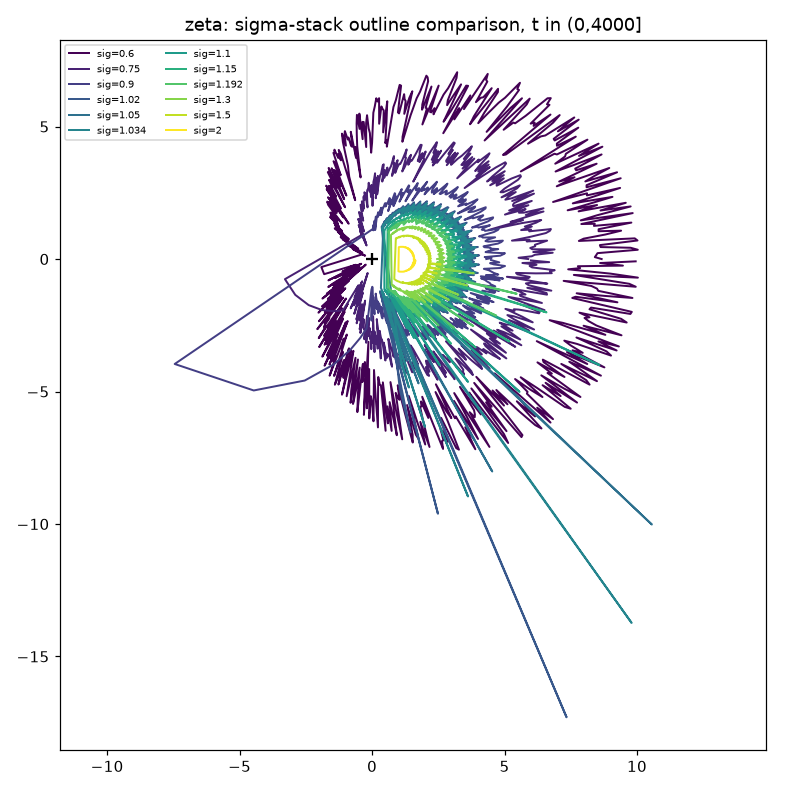
This paper was written without a figure set, and says so above. The 5 plots below came out of the rounds behind it and were never promoted to figures of record — they are here because this site carries the workbench. Captions are the ones written for the renders at the time.
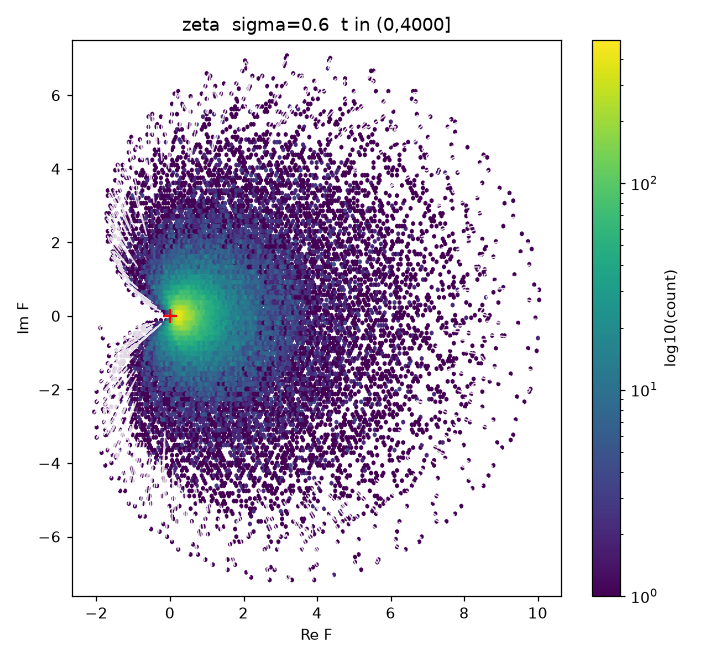
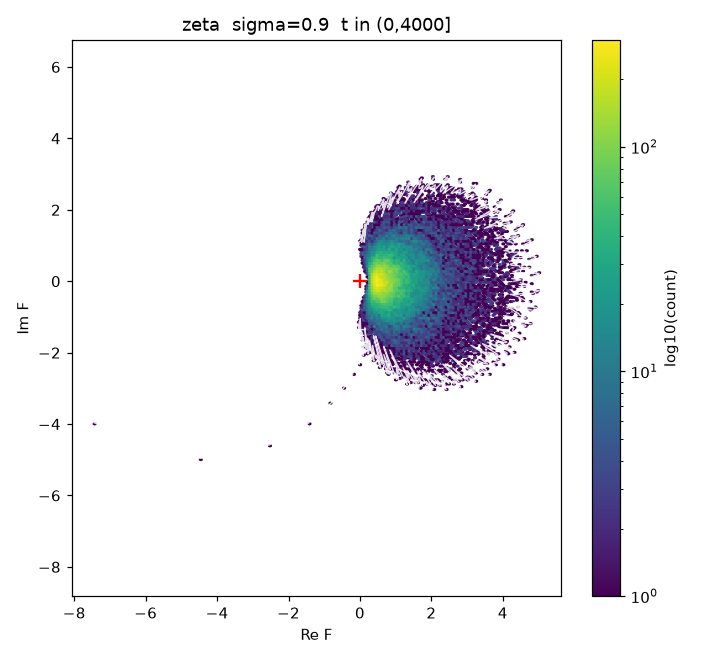
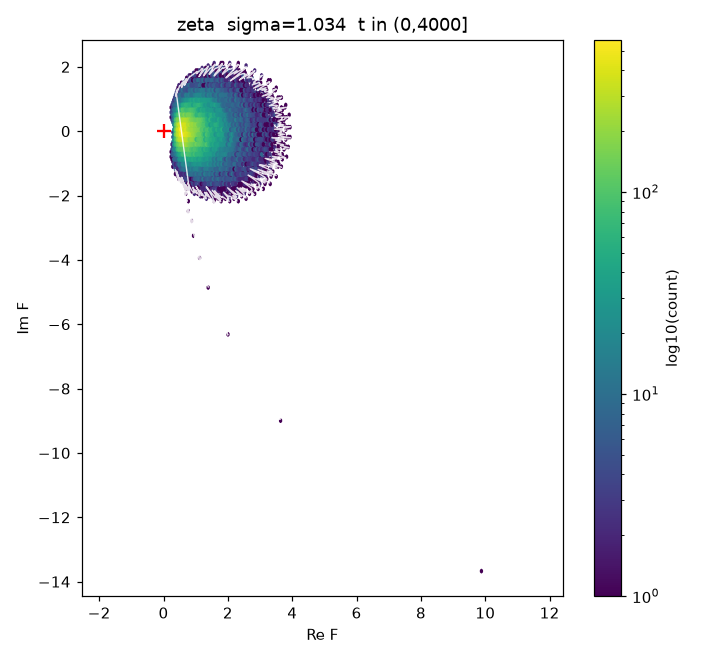
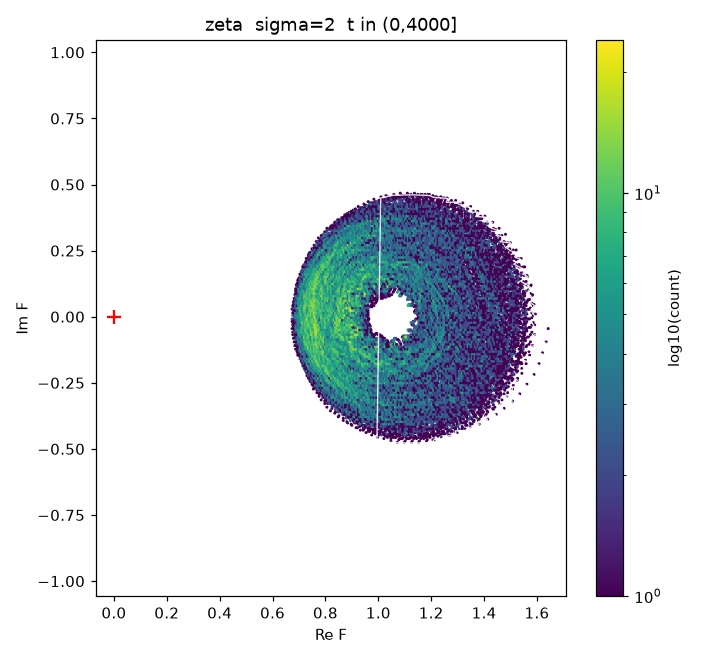
Pair A — σ = 0.6000 · the deep strip, where the count contrast is largest
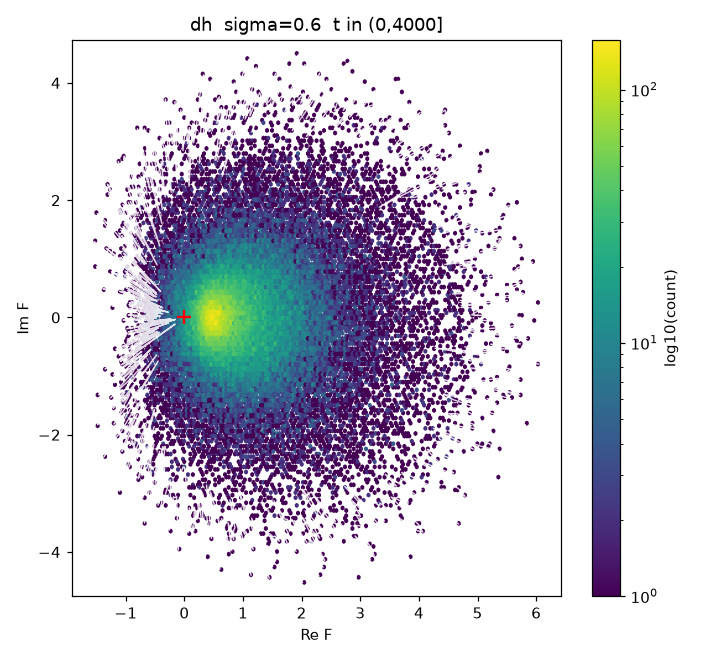
Value regions of ζ(σ+it) and of the Davenport–Heilbronn function ℓ(σ+it) at σ = 0.6000 over t ∈ (0, 4000], 80 000 sample points, log-count hexbin; the red cross marks the origin. Both regions contain the origin, but they wind around it differently: the value-region winding total is +0.4824 for ζ — no zero of ζ lies to the right of this ray in the window — against −162.0917 for ℓ, matching the defect ledger's own count of 162 zeros with β > 0.6 to the exact integer. The winding total, not the picture, is the measurement (p5r24_columns.csv); the panels show only what the register is computed from. Scope: the D-H column is RESOLUTION-BOUNDED — its max angular step is 3.016 rad against the π/4 sampling bar — so the depicted min|ℓ| = 0.00442 is not a structural fact and must not be read as an approach to a zero. The ζ column is inside the bar (max step 0.668 rad); its min|ζ| = 0.049711 reproduces the banked ζ ray census (Paper3Essentials.md §3.1, m(0.6) = 0.0409) to a ratio of 1.22 over a 2.5× longer window, in the right direction and of the right size. Occupancy figures visible in the panels are descriptive only; the wrap/occupancy observable is retired from the programme's gate vocabulary (R27). Probe draft, not paper-polished.
Pair B — σ = 0.9000 · the upper edge of the strip, where D-H's own off-line zeros run out
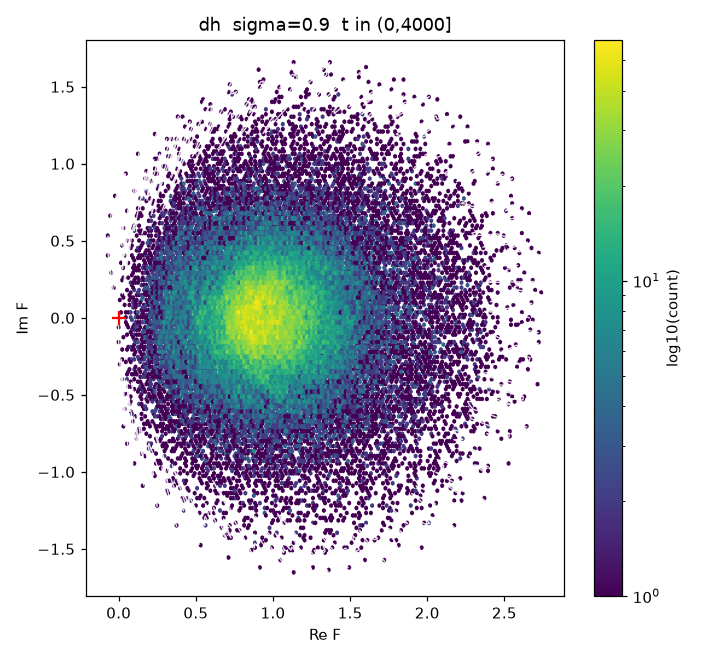
The same instrument at σ = 0.9000. Here the register reads +0.3964 for ζ and −0.0388 for ℓ — both null, against a ledger count of 0 zeros with β > 0.9 for either function. This is the register's own negative control, and it is not vacuous: D-H's certified off-line zeros in this window occupy the corrected offset range δ = β − ½ ∈ [0.015918, 0.397750], so the largest of them sits at β = 0.897750, just inside this ray. A register that read a nonzero integer here would be reading zeros that the ledger says are not there. Scope: the D-H column is RESOLUTION-BOUNDED (max angular step 2.885 rad vs the π/4 bar) — its min|ℓ| = 0.04061 is not a structural fact, and in particular the visual impression that ℓ's cloud reaches the origin at this σ carries no structural weight. The ζ column is inside the bar (max step 0.352 rad), min|ζ| = 0.241099 against the banked m(0.9) = 0.2060, ratio 1.17. Probe draft, not paper-polished.
Pair C — σ = 1.0340 · the first rung past σ = 1, and the bracket the gate did not find
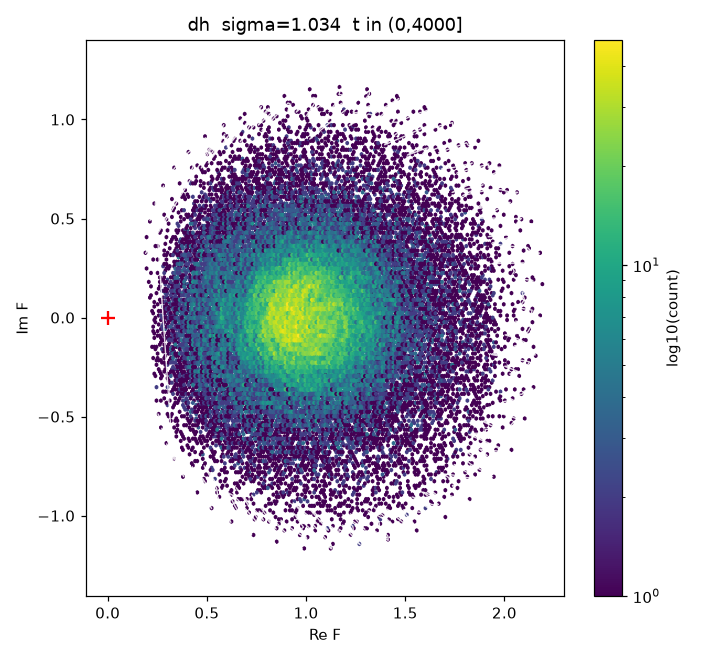
Value regions at σ = 1.0340, the grid column bracketing the constants-ladder rung σ₁ = 1.033908072362924. Both value regions are now detached from the imaginary axis (DETACHED-CLEAR; crosses_imag_axis False for both), and both winding totals are null — +0.1147 for ζ, −0.0279 for ℓ. The preregistration for this round asked whether ℓ's value region shows a Euler waist or wrap ladder that ζ's does not, with the pass condition specified as full 2π angular occupancy and a detachment transition bracketing σ₁ and σ\\ = 1.192347. That question was not answered. The ζ control failed both bracket sub-checks — maximum occupancy anywhere on the grid is 0.4208, and max|arg| declines smoothly and monotonically across σ with no discontinuity near either constant — so TR-C3 fired and both D-H verdicts were correctly withheld (euler_waist_absent, ladder_present = GATED-N/A). Erratum E-P5W8-3 records the cause: the gate was specified against an observable the programme's own record already showed to be unsaturated in T above the pinned window T = 4000. The panels are shown as the honest negative, not as a finding. ζ min|ζ| = 0.313165 sits above the Euler floor A(σ) = ζ(2σ)/ζ(σ) = 0.052865, with 0 floor violations across the ladder — stated as ≥, the floor being an infimum never attained at finite T (second half of E-P5W8-3). Both columns are inside the π/4 resolution bar. Probe draft, not paper-polished.
Pair D — σ = 2.0000 · the far Euler regime, where the two look alike and the reasons differ
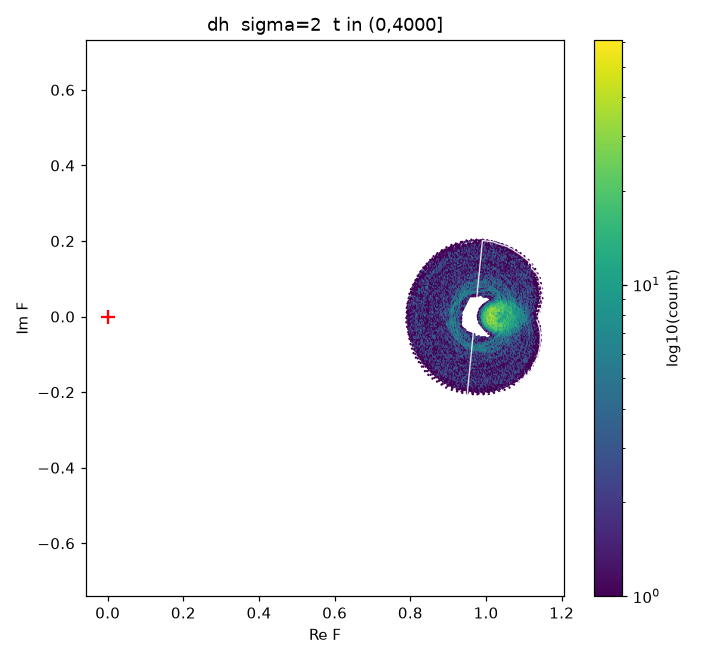
Value regions at σ = 2.0000, far outside the critical strip. Both collapse to a compact region tightly encircling the value 1 and well clear of the origin — ζ into an annulus about 1 with a visible hole, ℓ into a smaller crescent — and both winding totals are null (−0.0345 and −0.0085). The two pictures look alike; the reasons behind them are not the same, and that is the point. ζ's separation from the origin here is Euler-forced: min|ζ| = 0.673859 sits at or above the Euler floor A(2) = ζ(4)/ζ(2) = 0.657974, with 0 violations, and the product's absolute convergence excludes zeros for σ > 1 unconditionally. ℓ has a Riemann-type functional equation, real coefficients and no Euler product, so it has no such floor available to it — its zero-freeness here is not certified by this panel and is not claimed by it. The functional equation supplies ½ as a symmetry axis to both functions; only the Euler product supplies confinement to it, and ℓ has the first without the second — 193 certified off-line zeros in this same window, forming mirror quartets that straddle ½ without abandoning it as an axis. Both columns are comfortably inside the π/4 resolution bar (max angular step 0.028 and 0.016 rad); nothing in this pair is resolution-bounded. Probe draft, not paper-polished.
Pair E — both σ-stacks · the full ladder, with the chord caveat
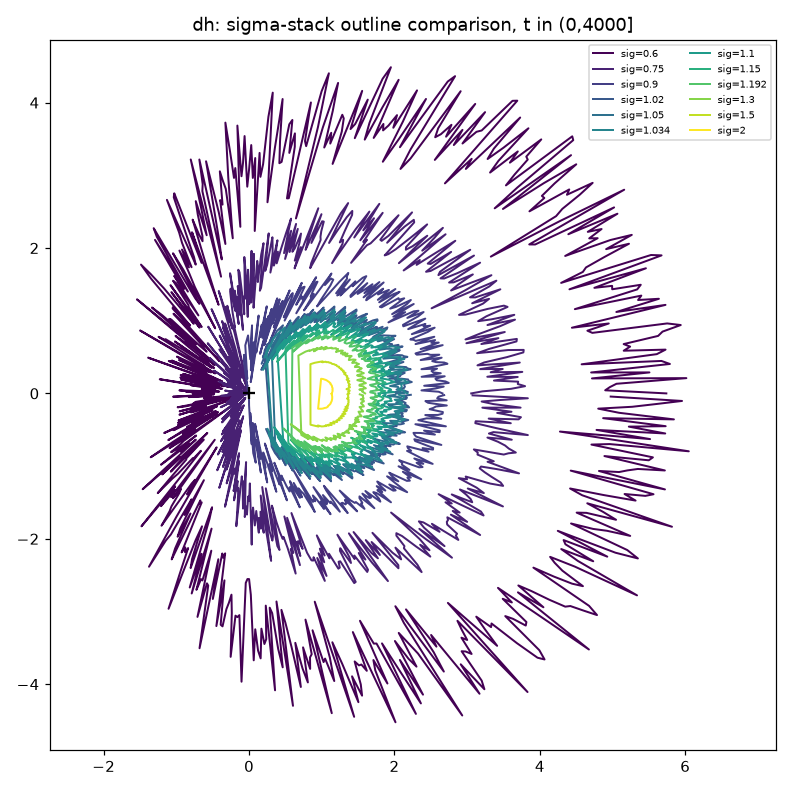
Angular outlines of all twelve σ columns overlaid, ζ (left) and Davenport–Heilbronn ℓ (right), t ∈ (0, 4000], same run and same instrument; the cross marks the origin. The outlines nest monotonically inward as σ grows, and max|arg| declines smoothly across the whole ladder — for ζ from 170.98° at σ = 0.6 to 24.74° at σ = 2.0 (77.73° → 24.75° across the detached columns σ ≥ 1.02), for ℓ from 179.96° to 12.15° — with no wrap detected at any column and no discontinuity at either σ₁ = 1.033908 or σ\\ = 1.192347. This smoothness is precisely why the round's Euler-waist / wrap-ladder preregistration is filed as NOT TESTED: the ζ control failed its bracket sub-checks, TR-C3 fired, and both D-H verdicts were withheld (E-P5W8-3). The observable itself was subsequently retired from the programme's gate vocabulary, permanently (R27, which discharged the erratum): its approach rate is 3.34–7.50°/decade against deficits of 92.8–94.8°, implying saturation heights T\* = 10³¹·⁸ / 10²¹·⁷ / 10¹⁶·⁶, exceeding the 10¹² bar by 4.6 orders at the most favourable column — and the rate has no feature at σ₁ at all, being a smooth unimodal curve peaking near σ ≈ 1.05, outside it. Rendering caveat, binding: the long straight segments — conspicuously the rays running to the lower left and lower right of the ζ panel — are CHORDS drawn across angular ranges the outline extractor found unoccupied (JC-R24-9). They are an artefact of the renderer and not trajectories of either function. The load-bearing record of angular occupancy is the count field of p5r24_outline.csv, not these lines. Probe drafts, not paper-polished.
Supplementary materials
The audit layer: how the numbers above were checked, what was corrected, and what is owed to whom.
Open the supplementary materials
This file carries the round register, the errata register and standing rules, the literature position, the provenance record and the reference apparatus of the paper named above.
Appendix A — Round register
This appendix is the complete register of the measurement campaign behind the paper: twenty-nine probe legs, run in nine waves between 2026-07-23 and 2026-07-27, filed here as twenty-six rows (Row 18 carries four legs; every other row carries one).
How each row was produced. Every round was specified in writing before it ran: the quantities to be measured, the acceptance gates, and what outcome would count as falsification were fixed in advance. Execution was done by a computational bench with no access to the project's interpretive record, working only from its written specification. A separate adjudication session then re-derived every headline figure from the filed data files before anything entered the record — and that practice changed the record in every one of the last five waves. Where a re-derivation changed a reading, both readings are preserved; where a gate was found defective, the defect is an entry in Appendix B and the gate's reading was removed from evidence, never silently repaired.
Tier vocabulary. Each round carries a declared tier, fixed before the run: condition-candidate (could in principle yield a condition separating the Riemann zeta function from the counterexample), locator (locates structure — prices where something lives — but is structurally incapable of producing a condition), instrument (validates machinery; no new-law claim), control (firms a constant or calibrates against known ground truth), verification (re-checks an already-adjudicated reading at greater height or precision). By highest declared tier the twenty-six rows split: twelve rows (fifteen legs) instrument, control or verification only; eight rows topped at locator; six condition-candidate — and every one of the six resolved into the class-universal law rather than a separating condition. One round was retired by design review before adjudication (Row 14); one stopped at its own specification gate and ran nothing (Row 15). Five of the nine waves moved no blocker, in the programme's own words.
Throughout: "the counterexample" is the Davenport–Heilbronn function defined in Chapter 2; "witness" and the identity ε₂ = a²R/(1+√(1+a²R²)) are as in Chapter 3; "left/right of ½" refers to the real part of the witness point; correlations are Spearman rank correlations; the "locality radius" of the background term is the number of neighbouring zeros needed for the truncated local sum to carry ~90 % of it.
Wave 1 — executed and adjudicated 2026-07-23.
Row 1 (condition-candidate; the keystone). The per-event witness identity tested on both constructions. On the zeta side: the identity holds at law grade (median relative deviation 0.0052 at second order); the tight-stratum displacement ratio came out 0.7882, inside the preregistered band [0.78, 0.80] whose limit is π/4; 0 of 555 witnesses fell left of ½ (smallest real part 0.500126); the background term is local (locality radius 5); and the density term −½·log(t/2π) alone carries sign, order and rank (sign agreement 1.000, rank correlation +0.9912). On the counterexample side: the identity is exact in the tight-pair limit (relative-deviation quartiles 0.0110 / 0.0317 / 0.0552 / 0.0577, non-increasing toward small separation), but the position/rank reading came out diluted — rank correlation +0.5384 against the previously banked +0.9890, mean witness real part 0.4867 outside the banked band — and the background non-local (no finite locality radius; local shares saturate near 0.10–0.15 where the zeta shares reach 1.000). Verdict: zeta leg ratified law-grade and local. The dilution was flagged as possibly an artifact of the instrument (27 of 193 events non-converged or wrong-side under 30-digit arithmetic with a clamped solver) and routed to a dedicated verification — Row 4, which later confirmed exactly that.
Row 2 (locator + instrument). A response census in two registers. In the half-shift register: perturbation burden uniform across all populations (worst block share 2.86), no threshold at or below 0.1, sub-null rigidity persisting in 13 of 13 cells across rungs, contrast falling 0.0669 → 0.0225 → 0.0102. In the dual (residue) register: all reproduction gates passed (worst deviation 3.8e-05; a continuity pin agreeing to 3.5e-08; union nulls 4.03e-3 / 2.63e-3 / 4.38e-4); a single-block removal ladder broke the union regularity by factors 41.1 / 75.1 / 15.5 while the all-block ratio was +1.000 (a linearity identity). One preregistered "silence" metric failed to reproduce — traced at adjudication to a collapse-prone ratio, not to the data (Appendix B, entry 1); the reading of record is that the two populations' dual fields anti-align everywhere off-support, each of size O(0.1–0.4), with the union regular at or below the 6e-3 scale. Tier verdict: prices register visibility; produces no condition.
Row 3 (instrument). The verification harness for the paper's Theorem-2 scaffold (Chapter 7). Exact-quadrature self-checks at 3.3e-11 / 5.0e-11 / 1.7e-11 against a 8.5e-10 bar; a new exact negative-index quadrature at 1.3e-12 / 3.1e-13 / 2.7e-13 against 1e-10; per-term constants banked (maximum 1.6185; median captured 0.286, ejected 0.087, negative 6.95e-6); the guard-set paired-singular-piece sum bounded at 7.37e-3; a two-route truncation cross-check with deviation exactly 0 in all twelve cells. Ratified: the table of constants the eventual proof must beat.
Wave 2 — executed and adjudicated 2026-07-24.
Row 4 (verification of the keystone; primary). The counterexample leg of Row 1 re-solved at 50-digit precision with analytic derivatives and the full (non-local) background: 193 of 193 events converged, 193 of 193 witnesses left of ½, rank correlation +0.9890 — equal to the banked value exactly — mean witness real part 0.4267, zero fallback solves. Row 1's dilution was therefore instrument in full, not structure. The non-locality itself was identified: it is the single omitted partner density term −½·log(5γ/2π); adding that one term restores locality radius 1, with the direct background 3.811 against the density prediction 3.750 (the two constituents' individual log-derivatives, each ~10.5, near-cancelling). Supersedes Row 1's counterexample reading; both remain on record.
Row 5 (verification). The zeta leg of Row 1 carried to heights γ ≈ 10⁸ and 10⁹ on the certified public zero bank (LMFDB / Platt): reproduction pin against Row 1 passed; at γ~10⁸ (133/133 converged) relative deviation 0.0050, locality radius 2, density rank correlation +0.9750, ratio 0.7884 → π/4; at γ~10⁹ (132/132) 0.0053, +0.9701, 0.7895. The witness law is height-stable roughly four orders of magnitude beyond the census plateau. (Reported in Chapter 3.)
Row 6 (locator). Dual-register coherence. The anti-alignment law was banked with a collapse-immune metric: on the real part of the dual field, nine of nine off-support cells show opposite signs, median cancellation depth 0.011; the complex-register cosine (median −0.90) shows the imaginary parts do not cancel — which is why the metric was moved to the real register (Appendix B, entry 2). The previously unexplained ×15–25 break of a proportionality assumption was explained as phase coherence (coherence ≡ 1 by linearity; measured factor up to 24.6). The zeta "self-conspiracy" posing was measured: an injected residue on zeta stays un-cancelled at the ~1e-3 scale where the counterexample's union cross-cancels to ~4e-3. Produces no condition.
Row 7 (instrument). The near-field certificate for the Theorem-2 scaffold: the paired singular-piece cancellation is uniform down to window 1e-6 (maximum paired sum 6.70e-3 against a baseline 2.212e-2, no blow-up), with sharpness exponent p = 1−σ exact per σ (R² = 1.0) and sharpened boundary-saddle constants (0.3082, superseding the harness's coarse 1.6185). Formal drafting of the corresponding lemma was unblocked by this certificate.
Wave 3 — executed and adjudicated 2026-07-24.
Row 8 (condition-candidate + control). Universality of the witness law across conductors q = 1 (zeta), 3, 4, 5 — the real primitive Dirichlet characters, i.e. honest Euler products — with zeta run as a same-engine control. Stage-A validation passed 4 of 4 (two-path evaluator agreement ≤ 3.1e-8; functional-equation mirror ≤ 8.5e-40; derivative checks ≤ 1.8e-11; simple zeros, root number +1 throughout); census 258 events per conductor on self-generated zeros. Outcome: law grade at every conductor (median relative deviations 0.0152 / 0.0305 / 0.0339 against the zeta control's 0.0331); background local (radius 1, equal to the control); density carries sign, order and rank (+0.9657 / +0.9577 / +0.9560, sign 1.0000); all witnesses right of ½ (minima 0.5038 / 0.5244 / 0.5313; control 0.5158). A π/4 acceptance band mis-calibrated to the wrong gap stratum fired spuriously and was retired (Appendix B, entry 3): the ratio's rise with gap width is the banked domain curve, identical across all four conductors including the control, and the tight bin recovers π/4 where populated (0.7966 at q=1, 0.7907 at q=3). The conductor enters only through the density normalisation −½·log(qγ/2π). (Chapter 3's universality table.)
Row 9 (control / condition-candidate). The wide-pair residual calibrated on zeta ground truth: 369 events. In the tight stratum the closed form is exact to third order (median relative deviation ≈ 5e-5); in the wide stratum the departure closes with one further order of the background's variation (fraction improved 0.835, against a 0.7 bar), with the second-order domain edge at normalised gap 0.9 and no degenerate cubic root in 369 events. This accounts mechanically for Row 8's ratio rise: the wide-pair departure is analytic background variation across the cluster, not a failure of the identity.
Wave 4 — executed and adjudicated 2026-07-24/25.
Row 10 (condition-candidate + locator). Extension to genuinely complex characters, and the partner isolated. The two constituents of the counterexample (the complex characters mod 5) plus a complex character mod 7 were run through the same census (378 events per character) after validating the complex functional equation Λ(s,χ) = ε(χ)Λ(1−s,χ̄) to ≤ 2e-31, with root numbers that are genuine phases (arguments +0.554 / −0.554 / +1.174). Outcome: law grade (0.0409 / 0.0385 / 0.0312), local (radius 1), density-carried (+0.9638 / +0.9536 / +0.9671, sign 1.0000), all witnesses right of ½ (minima 0.529 / 0.531 / 0.511). The witness law therefore spans the full honest-Euler-product class of degree 1, real and complex. The headline, at locator tier: the two constituents of the counterexample, run on their own zeros with their own neighbours, are each local exactly as zeta — while their weighted sum (the counterexample) has no finite locality radius (Row 4). Parts local, sum not: the counterexample's non-locality is emergent from the partner sum. (Chapter 3.)
Row 11 (control / condition-candidate). Domain and height of the universality. Second leg: the wide-pair accounting of Row 9 is itself universal — all three complex conductors close at the next order (fractions 0.842 / 0.822 / 0.785; domain edges at normalised gap 0.9–1.1, matching zeta's 0.9). First leg: an enlarged census (1200 zeros of the character mod 3, ordinates 8–1374) yielded only 3 very-tight pairs — the very-tight stratum is suppressed by the zero-spacing statistics at every height, so a preregistered thickness target of 30 such pairs was unreachable by census enlargement and was retired (Appendix B, entry 4); the 3 pairs are exact (0.0046) and at π/4 (0.7923), and the domain curve reproduces on thick per-bin statistics (per-bin counts up to 137). The thickness residue was discharged directly by Row 13.
Wave 5 — executed and adjudicated 2026-07-25/26.
Row 12 (instrument + control; the wave's spine). The derivative-zero (Speiser-register) box census, calibrated on a true positive. For the counterexample: each of the 193 witness boxes banked in Paper 4's appendix contains exactly one zero of the derivative (histogram {1:193}); a contiguous strip census over t ∈ (0, 4000] returns 193, reconciling with the per-box count at zero discrepancy (a literal narrower band returned 167 — exactly the 167 banked witnesses inside that band, a clean secondary confirmation). For zeta: the count of derivative zeros left of ½ is 0 at all five tolerance rungs down to 0.001, over σ ∈ [0.02, ½−r]. Instrument quality: 0 unsafe boxes of 753, worst deviation of the winding integral from an integer 2.49e-14, evaluator arbiter 8.13e-12. The detection floor was given its closed form δ_min(γ,r) = √(4r/log(qγ/2π)) (exact form δ² = r² + 2r/|R|), cross-checked against measured displacements at median relative error 2.5–2.7e-3. Three scope attachments bind any write-up: the box instrument itself was built in Paper 4's arc, and this round's new content is the full-population occupancy plus the first region census in this register; the counterexample's control band (σ ∈ [0.2165, 0.4998]) is narrower than the certified zeta band, so there is no true-positive calibration over σ ∈ [0.02, 0.2165]; and for t ≤ 4000 a certified classical zero count (Turing's method; Platt's verification) already gives the zeta result unconditionally about seven orders of magnitude higher — the zero count is not a new exclusion; its value is methodological. Two geometry slips in the specification were caught and printed (Appendix B, entry 6).
Row 13 (control). A direct tight-pair (Lehmer-pair) hunt: 358,090 consecutive certified zero pairs over ordinates 14.135–235999.997 harvested; 2370 pairs at normalised gap ≤ 0.2, 298 at ≤ 0.1; 254 censused (79 at ≤ 0.1). The π/4 asymptote now stands on thick statistics from certified ordinates: ratio 0.792062 at ≤ 0.1 (n = 79) against π/4 = 0.785398; 254 of 254 witnesses right of ½; median relative deviation 0.005649. The previously banked tightest pair (0.021860 at γ = 71732.9086) and the classical Lehmer pair were both reproduced unprompted. New record, superseding the earlier census minimum 0.500126: the smallest measured witness offset is Re w* = 0.500112099639, at γ = 234016.9015089, gap 0.021866, ratio 0.785634 — 0.03 % above π/4 — printed with the standing statement that it tightens an observed margin and closes nothing. A sampling nuance (the delivered medians oversampled the tightest gaps) was measured by an 80-pair top-up, both readings printed, neither picked; no reading moves by more than 0.002.
Row 14 (locator + control; retired). The assembled-chain "condition count". Retired by design review before adjudication and then ruled on its own terms. The quantity it computed — the number of independent real conditions at a defect, prereg 2 — was computed correctly two independent ways (agreeing at all 193 events, with the third-condition candidate reported non-vanishing), but the rank of that Jacobian equals 2 exactly when the derivative is non-zero, for any analytic function: the quantity is a restatement of zero-simplicity and carries zero separating content between zeta and the counterexample, which is what the leg existed to supply (Appendix B, entry 5). Its 28 wide-stratum sign misses were settled from the raw data as solver escapes to remote roots (returned points at displacements up to 480× the local scale; two solution paths returning different roots in 9 of 25 converged cases): the banked 193/193 result of Row 4 stands unchallenged. Also measured here, and standing: tight-stratum coupling 134/134; the zeta posing depth 2.2198e-01 against the counterexample's union 2.6735e-14.
Row 15 (instrument; stopped at its own gate). The Theorem-2 negative-boundary-order certificate. The bench found the specification underdetermined in four respects (the object, the exponent, the contour, the arbiter) and stopped at the gate written for that purpose, running nothing (0.3 s). Ruled correct conduct and a specification debt, not a finding: all four questions were answered at adjudication from the original statement of the proof burden (the second-order remainder has relative order O(1/t); no contour is required; the existing exact-quadrature arbiter applies), and the round was re-staged with a full literal specification as Row 17.
Wave 6 — executed and adjudicated 2026-07-26.
Row 16 (instrument + locator + control; the wave's spine). The constituent count census: does the count register separate the sum from its parts? Both stop-gates passed (six evaluators agreeing to 1.2e-11 over seven points; the wave-5 box census reproduced bit-identically). Result of record: over the identical window (t ∈ (0, 4000]) and engine, the count of derivative zeros left of ½ is 0 for each constituent of the counterexample (in both band geometries) and 193 for their weighted sum, with no excess in the wide band; each constituent also carries 0 zeros of its own left of ½; and the instrument was validated in both directions — 193 on the sum as true positive, and 130 on-line zeros of a constituent recovered by the argument principle against 130 from an independent Hardy-Z finder, reproduced on two contours and two grid steps. 0 unsafe boxes of 825; worst integer deviation 2.15e-14. Two further floor rungs (1e-4, 1e-5, about 9 s each) showed the floor is nowhere near the instrument's limit. The contrast 0 / 0 / 193 moves the primitivity statement from the witness register into the count register — "these and no others in the band" — the strongest form available to the programme. It locates the off-line phenomenon in the partner sum and forbids nothing.
Row 17 (instrument). The Theorem-2 boundary certificate on the re-staged specification (from Row 15). All four gates passed: arbiter at 1.445e-35 with the wave-1 harness anchors reproduced exactly through the original unmodified routine; the bound holds with constant C_max = 0.8253233 < 1, finite at all 10296 grid points and flat in t across two decades (0.823920 … 0.825323 over t = 10³…10⁵); the boundary sum is O(1) in the natural units (range 0.0134–3.5709); two computational paths agree to 4.65e-21. The order fit is corroboration only: the mean-based estimator is cancellation-contaminated (a specification defect, Appendix B entry 7), while the root-mean-square path gives slope −0.998…−1.001 in all nine cells, matching the preregistration; both are printed, neither picked. With this, the numerical scaffold of Theorem 2 is complete: item (1) uniform to window 1e-6 (Row 7), item (2) done in Paper 1, item (3) certified on the bound. Infrastructure for the error term of the centroid expansion; it says nothing about the location of zeros.
Wave 7 — executed and adjudicated 2026-07-27.
Row 18 (four legs; instrument + control). Completion of the count register over its window. Leg one, the erosion ladder: the zeta count stays 0 at every tolerance rung from 1e-6 down to 1e-10 — 800 box evaluations, 0 unsafe, maximum argument-principle deviation 1.81e-14, with no safety gate biting at any rung, so the instrument's limit was not located (it lies below the ladder); the floor at the last rung is δ_min = 1.202e-5 (γ = 10²) to 4.60e-6 (γ = 10⁹). Leg two, higher windows: the count remains 0 over t ∈ (4000, 20000] (320/320 boxes safe) and over t ∈ [100000, 104000] (80/80 safe); cost grows from 0.012374 to 0.136970 s per unit t (ratio 11.07). Leg three, the class: derivative-zero strip counts are 0 for the characters mod 3, 4, 5 and 7, and 0 of 193 boxes for each counterexample constituent, with the argument-principle count agreeing with an independent finder at every conductor (114=114, 122=122, 129=129, 141=141). Leg four: the previously excluded sliver σ ∈ (0.001, 0.02] also holds 0; and a descriptive occupancy comparison (2367 against 4111 adjacent on-line pairs, difference −1937) was closed at adjudication with zero fitted parameters — it is the census cap acting through the counterexample's own offset law, predicted capture 0.5778 against measured 0.5758. Net: class-wide 0, sum 193, in a finite window above a finite floor; the zeta legs are not new exclusions (the classical certified count reaches ~7 orders higher unconditionally).
Row 19 (locator + instrument; superseded in part by Row 21). The injection round: a zero-built dual perturbation — a doubled on-line zero deformed into a straddling pair at offset δ, count- and height-preserving, vanishing as δ². The δ² law was confirmed cleanly (40 of 40 cells with fitted exponent in [2.0037, 2.0275], median 2.0200, minimum R² 0.999867) and is immune to what follows. The visibility median and the height reading were retracted at adjudication: the imported instrument's damping suppresses the injected term up to 500-fold at the specified top height, and the injected magnitude is provably independent of height, so the measured four-order fade was instrument in full (Appendix B, entry 10). Read of record at the one in-regime height: median visibility threshold δ_c = 0.0145, 10 of 10 cells at or below the counterexample's measured offset range, none above — with every identified instrument effect biasing the threshold upward, so the measured values are upper bounds. Re-run with a rebuilt instrument as Row 21.
Row 20 (instrument). The asymptotic-economics leg. Standing after adjudication: the witness law and the π/4 ratio are height-stable at γ ~ 10⁹ (0.007988 on a broad sample; 0.794660 at gap 0.005553); the detection floor's height dependence is logarithmic and exact by construction (fitted exponent −0.500000 ± 7.7e-16); the tight-pair harvest rate converges (~0.995 % via 1/ln γ), with the drift real, not noise (z = 10.24, recomputed at adjudication); total cost is superlinear in the window height and independent of the tolerance floor, so the design conclusion — printed as such — is to erode the tolerance rather than climb the height: a hundredfold budget buys only ~11× in height and ~10 % improvement in the floor, while eroding the tolerance improves the floor at essentially no additional cost; the published reach figures are upper bounds, about 1.43× optimistic. One verdict was corrected at adjudication: a "drifts-unexplained" classification became "drifts-as-predicted" — the specification had instructed a fit against the wrong law, and the measured exponent (0.9750) is exactly what the correct closed-form prediction itself produces (Appendix B, entry 8). Establishes no uniformity in the height, and no finite computation can.
Wave 8 — executed and adjudicated 2026-07-27.
Row 21 (locator + instrument). The injection instrument rebuilt (from Row 19): an undamped exact decomposition and a height-matched ladder as two independent paths, agreeing to eleven significant figures in all 60 cells; six certified ordinates from 98.831194 up to 99999999.930157 (the top three from the public zero bank; none fabricated); the δ² exponent reproduced (120/120 in band, median 2.021394, minimum R² 0.99986665). The height law is flat: per-height medians 0.009081 / 0.010243 / 0.011411 / 0.011094 / 0.009799 / 0.011277 over six decades, max/min ratio 1.2566, confirmed on three constructions of the statistic, one using no extrapolated value. At every height, 0 of 60 cells lie above the counterexample's measured offset range; 43 of 60 lie below its floor (a count originally filed as 51/60 against a floor constant later found wrong and corrected — Appendix B, entry 18; the load-bearing none-above statement is unaffected). Two retractions of record: "every cell in-grid" is false (62 of 120 rows sat below the measurement grid, their thresholds extrapolated; the estimator itself certified to better than 1 % where checkable); and the threshold was found to depend on the window used to read it (factor 1.6 at the same height), which set the next wave's spine (Row 24).
Row 22 (locator + control; a designed negative). The coefficient-dial round: the attempt to interpolate between "is an Euler product" and "is not" inside the real odd period-5 coefficient space. The round's premise — that the family is functional-equation-preserving along a one-parameter line — is false, and the measurement itself established it: the completed-equation residual is 4.095e-16 and 5.329e-16 at exactly two parameter values (the counterexample's, and its negative reciprocal −3.5201470213, which reproduces the banked second construction to 3.854e-15) against 0.27–1.795 at all seventeen other grid points — a sixteen-order separation. Analytically, the functional equation forces arg ε = 2·arctan ξ, a two-point set (Appendix B, entry 11). The preregistration was voided on both axes: the seventeen non-symmetric members have no σ = ½ axis for "off-line" to refer to, and the proposed deviation measure is exactly even in the parameter while the zero counts are not (up to 63 % apart at identical deviation). What stands: exactly two members of the space carry a Riemann-type functional equation, and those two are exactly the two with few strip zeros (10 and 11 against 110–234 elsewhere) — a statement about the functional equation, not the Euler product; the space contains no Euler product at all, so the multiplicativity question was never asked there, and the space is closed as a dial. Two positive controls the run earned without claiming them: the zero counter reproduces the banked ledger exactly at the counterexample's parameter, and the σ>1 census reproduces the banked density to 1.8 %.
Row 23 (control + instrument). The counterexample's value region drawn for the first time: 24 vertical-line columns at 80,000 points each. The specified control observable failed for a reason already on the record — it requires an occupancy saturation not reachable at the pinned window height (Appendix B, entry 13) — but the pipeline itself was validated by a two-sided control found in the filed data at adjudication: the winding totals along three columns are −162.0917 / −51.0593 / −0.0388 against the certified ledger's own counts of 162 / 51 / 0 zeros to the right of σ = 0.60 / 0.75 / 0.90, while the same columns on zeta read +0.4824 / +0.4562 / +0.3964 — zero zeros to the right — reproducing the banked winding switch; a third control (minimum modulus against the banked census floor, ratios 1.22 / 1.22 / 1.17 over a 2.5× longer window) points the same way. This is the first time the programme read the counterexample's off-line zeros out of a pure value-region register — no zero-finder, no box grid, no Newton iteration, with the certified ledger as the check rather than the input — and it seeded the following wave's Rows 25 and 26. In-strip value contrast, direction-bounded: minimum modulus 0.00442 / 0.00321 / 0.04061 against zeta's 0.04971 / 0.14528 / 0.24110 on the same columns.
Wave 9 — executed and adjudicated 2026-07-27.
Row 24 (locator + instrument; the wave's spine). The window law of the visibility threshold. The bench's filed classification was overturned at adjudication to "plateau": the written classification clause compared incommensurable quantities and could not reach the plateau branch on any data (Appendix B, entry 17); on the specification's own operational conditions the median threshold is flat to 0.083 % against a 10 % bar over the small-window range at all three heights, and every individual cell is flat to better than 0.1 % across a tenfold window shrink. Reads of record in the zero-window limit: δ_c = 0.008234 / 0.010378 / 0.008896 at heights ≈ 10² / 10⁴ / 10⁶, max/min 1.260 — so the flat height law of Row 21 survives the window correction unchanged, and every previously filed threshold was an overestimate by the computable window factor alone (×1.47 for wave 7's window, ×1.09 for wave 8's): the register is more sensitive than the record had claimed. New and unclaimed by the bench: the whole window law collapses onto a single curve in the product (height × half-width), reproducing to 0.05 % and 0.12 % over four decades of height. The δ² exponent reproduced a third time (median 2.0132, 0 of 480 cells out of band), half a decade lower in δ. Against the counterexample's corrected offset range [0.015918, 0.397750] — independently re-derived here, confirming the correction of Appendix B entry 18 — the plateau thresholds sit: 138 of 180 below the range, 42 within, 0 above, at every height. Still a visibility threshold in one register, measured against a regularity itself measured: it forbids nothing.
Row 25 (instrument + control). The winding register as a spectrum reader — the count register's third independent instrument. The bench's filed classification was overturned at adjudication to "staircase": against an independent dedupe of the certified ledger, all 23 columns match the count of zeros with real part beyond the column exactly — 193, 191, 184, 175, 167, 156, 140, 125, 114, 100, 85, 64, 51, 36, 26, 21, 16, 9, 1, 1, 0, 0, 0 over σ = 0.51…0.95 — non-increasing at 22 of 22 steps, with the residual falling smoothly and monotonically from 0.115865 to 0.034090, and (stronger than the preregistration asked) every one of the 22 step intervals carrying a step count exactly equal to the ledger's zero count in that interval. Null legs: zeta's largest winding magnitude 0.4824; each constituent's 0.1134. The instrument resolved a certified zero sitting 1.63e-4 to the right of a column ray (β = 0.8301632 at t = 1709.4136), where two adjacent coarse samples differ from the converged reading by 2π to six digits. The round's only failing item was resolved, not carried: the specified second path was a strictly coarser instrument than the first (Appendix B, entry 24), and the adjudication exposed the sampling criterion "|Δarg| < π" as satisfiable by an aliased read — the wave's most consequential defect (Appendix B, entry 21). No contour, no box grid, no Newton iteration, no zero-finder: failure modes shared with neither other count instrument. Counts a certified finite list on one finite window; locates nothing new; forbids nothing.
Row 26 (instrument). Reachability of the wrap/occupancy observable — the discharge of the control-observable defect of Row 23. Verdict: not reachable, and the observable is retired from the programme's gate vocabulary permanently. Basis of record (after setting aside a top ladder rung run 20× coarser than the rungs below, which produced zero new record of a cumulative-maximum statistic — the signature of undersampling, Appendix B entry 25): on the fine-sampling lever alone, the approach rate is 3.341 / 5.275 / 7.496 degrees per decade at the three columns inside the target interval, against angular deficits of 92.822 / 93.481 / 94.779 degrees — requiring window heights of order 10^31.8 / 10^21.7 / 10^16.6, at least 4.6 orders of magnitude beyond the stated 10¹² feasibility bar. New at adjudication: the approach rate has no feature at the target constant at all — a smooth single-peaked curve in σ, peaking outside the interval, with the interior columns approaching slowest — so the observable does not discriminate the two sides of the question at any reachable height. Establishes no uniformity in the height, and no finite computation can.
Accounting, restated from the register. Twenty-nine legs, twenty-six rows, nine waves. Twelve rows (fifteen legs) never rose above instrument, control or verification; eight topped at locator, structurally incapable of producing a condition; six were condition-candidates and every one resolved into the class-universal law. One round retired as a design catch; one stopped at its own specification gate. Five of nine waves moved no blocker. Nothing in this register decides the location of any zero of the Riemann zeta function.
Appendix B — Errata register and standing rules
Twenty-five errata were minted across the nine waves. Their composition is the paper's Chapter 10 finding: twenty-four are specification defects and one is a reporting defect; none is an error in any computed quantity. Every one was caught by a computational bench at run time or by adversarial re-derivation at adjudication — never by the author of the defective specification. Each entry below states where the defect lay, what it was, how it was caught, and what it changed. Entries are numbered in the order minted; each carries a permanent identifier in the project record. Cross-references "Row n" point into Appendix A.
Entry 1 (wave 1; gate design). A preregistered "silence" metric was a ratio whose denominator was the smaller of two field magnitudes; at a control point both magnitudes sat near their own zeros (0.0135), the denominator collapsed, and the metric read 0.468 against a 0.15 bar while the actual union reading (−6.3e-3) lay inside the certified ≤ 6e-3 regularity scale. Metric retired; the round's conclusion is carried by its independently passing gates (Row 2). Collapse-immune replacements (an alignment cosine and an additive cancellation depth) were specified for the successor round.
Entry 2 (wave 2; metric design). The anti-alignment metric was specified on the complex values of the dual field, which conflates the non-cancelling imaginary parts: measured cancellation depth 0.85 on the complex values against 0.017 on the real part — the register every reading gate actually uses. Corrected to the real register; the complex cosine (median −0.90) kept as a diagnostic (Row 6).
Entry 3 (wave 3; gate design). A π/4 acceptance band of [0.75, 0.82] was written against medians over the gap stratum ≤ 0.4, while the π/4 asymptote lives in the stratum ≤ 0.2; at the census heights the tight stratum is nearly empty, the ≤ 0.4 median sits on the banked domain curve, and the zeta control itself (0.833) would have failed the band. Two spurious gate firings overridden; the band retired; the reading of record is the per-bin domain curve, which recovers π/4 in the tight bin at every conductor (Row 8).
Entry 4 (wave 4; gate design). A discharge target — at least 30 pairs at normalised gap ≤ 0.2, to be reached by enlarging the census — is unreachable: that stratum is suppressed by the zero-spacing statistics at every height (1200 zeros yield 3 such pairs). Target retired; the underlying caveat was discharged in substance by thick per-bin statistics and then directly by the dedicated tight-pair hunt (Rows 11, 13).
Entry 5 (wave 5; metric design). The "condition count" of the retired assembled-chain round: no algorithm was supplied for it, and its outcome space was "2, or bench error" — a quantity that cannot disagree with its preregistration is not a measurement. The bench's implementation was correct arithmetic (two independent definitions agreeing at all 193 events), but the quantity is the rank of a Jacobian that equals 2 whenever the derivative is non-zero, for any analytic function — a restatement of zero-simplicity, carrying no separating content. Metric retired; no value of it enters any verdict chain (Row 14).
Entry 6 (wave 5; gate/spec design). Two geometry slips in the box-census specification: (a) frozen constants that are ratios of witness offset to defect offset were written as absolute distances from the critical line — read literally, every box would extend to σ = −0.446 regardless of its defect; (b) a strip inner edge written as an absolute offset structurally excluded 26 of the 193 known witnesses. Both readings were run and printed: the literal strip returns 167, exactly the witnesses inside that band (itself a clean confirmation); the capture-all strip returns the preregistered 193 and is the reading of record (Row 12). Design lesson: a frozen constant carries its normalisation with it.
Entry 7 (wave 6; metric/spec design). The order read of the boundary certificate was specified on a lattice-mean estimator that carries cross-term cancellation whose degree depends on a sample count saturating against a specified 32-point cap at a rate that varies with the parameter — and at one grid cell the specified "middle third" contains exactly one integer. The bench's unprompted root-mean-square second path settled it (slope −1.000 to three decimals in all nine cells, matching the preregistration). No result changed: the certificate rests on the bound, the arbiter and the O(1) check, all estimator-independent (Row 17).
Entry 8 (wave 7; gate/spec design). A specification stated the correct closed-form law for the divergence of the detection floor's first-order form — and then instructed the bench to test it against a √log γ law. The divergence is an identity growing linearly in log γ, never as its square root; the bench's fitted exponent (0.9750 ± 0.0031) is exactly what the correct law itself produces, verified independently at all seven heights (ratio 1.000000). Verdict corrected from "drifts-unexplained" to "drifts-as-predicted"; the associated trigger firing voided (Row 20).
Entry 9 (wave 7; gate design). A reproduction gate demanded agreement at "at least 3" banked off-support comparison points; the record contains exactly two. The gate was unsatisfiable as written. The bench reproduced both existing points (within 5e-8 against bars of 2.0e-3–6.7e-2), sourced a third comparison from the banked instrument's own certified spot-check, and surfaced the substitution rather than resolving it silently; the adaptation was accepted as meeting the gate's intent. Design lesson: a reproduction gate must be written against a count of banked targets that has been looked up, not assumed.
Entry 10 (wave 7; spec design — material: it cost the wave's spine probe three of its four heights). An injection grid was specified up to height 10⁴ on an imported instrument whose damping suppresses the injected term by factors 0.9994 / 0.939 / 0.368 / 0.00193 at the four specified heights, with no required check that the term survives; and the injected magnitude is provably independent of height, so the measured four-order fade with height was instrument in full. The height reading was retracted; the δ² scaling is immune (a fixed-height ladder cancels the attenuation out of the exponent); the read of record moved to the one in-regime height (Row 19). Design lesson: an imported instrument carries its validity domain into any specification that uses it.
Entry 11 (wave 8; premise design — material). The specification asserted that a one-parameter coefficient family preserves the Riemann-type functional equation along the whole line. False: the functional equation pins the parameter to exactly two points, established three independent ways — the bench's own measured residual column (a sixteen-order separation between the two symmetric points and all seventeen others), an analytic derivation (arg ε = 2·arctan ξ), and an independent mid-run check. The premise was never tested before the experiment was specified on it; the preregistration was voided (Row 22). Design lesson, subsequently mechanised: a family's defining property must be verified before an experiment is specified on it.
Entry 12 (wave 8; import validity domain — material). A window rule drove the integration half-width below an imported routine's fixed grid step at four of six heights; the quadrature degenerated to a single point (integral ≡ 0). Uncaught, the run showed a spurious 42-fold jump in the threshold between two heights and would have reported the preregistration's own falsifier — a fabricated height law. The bench caught it, replaced the sampling with an adaptive step guaranteeing at least 201 points (identical summation and damping), kept the old-window reproduction leg bit-clean, and reported the fix as load-bearing; accepted as instrument plumbing (Row 21). This is entry 10's failure mode reproducing inside the rule written one wave earlier to prevent it — the finding that moved the programme's design discipline from instruction to mechanism.
Entry 13 (wave 8; gate observable design — material). A control gate required the value-region pipeline to bracket two constants via full 2π angular occupancy at a pinned window height — an observable the programme's own record already documents as slowly convergent and unsaturated well above that height. The pass condition was unreachable as written, for either construction; the reason of record for the withheld verdicts changed from "the pipeline is defective" to "the observable is not measurable at this height" (the pipeline passes three separate banked controls — Row 23), and the question became Row 26. A second half of the same entry: a floor condition written as an equality should have been an inequality — the Euler floor is an infimum never attained at finite height; the measurement satisfies the inequality with 0 of 9 violations.
Entry 14 (wave 8; gate addressing). A gate compared the evaluator's output at banked zero coordinates stored as double-precision text; the function's magnitude at such a coordinate is dominated by (storage error) × (local slope) — about 7.8e-15 × 1.2558, exactly matching the measured values — so no correct evaluator could pass the gate as written. The bench's adapted check (re-refine from the same stored seed at 50-digit precision, then apply the identical falsifier) passes at 10 of 10, worst ratio 1.4e-20, and was accepted as the check of record. Design lesson: a gate comparing against banked coordinates must state the precision at which they are stored, or refine from them.
Entry 15 (wave 8; gate design). A per-cell reproduction gate named ten banked cells of which four hold no value in the named column (they sat below the measurement grid); the check was executable only on a fitted column the gate did not name. Entry 9's failure mode a second time, within two waves of the rule written to prevent it. The banked median is sound on both available routes (0.014515 / 0.014596); the earlier reading stands. Remedy mechanised: thresholds are loaded from the named artefact by the probe at run time, and a missing value stops the probe.
Entry 16 (wave 8; gate design). A regime gate could not fail: with the ladder scaled proportionally to height, the quantity gated on collapses to a damping-factor ratio independent of everything varied — measured spread 1.04016, identical to five decimals, at all 60 cells against a 1.5 bar. Ruled a mislabel rather than a design error (the invariance is the correct engineering response to entry 10; the defect is calling a construction invariant a gate); the bench proving the invariance algebraically was credited. Remedy mechanised: every gate must print a falsifier witness at run time or be declared construction-invariant and excluded from evidence.
Entry 17 (wave 9; classification-clause design — material: it forced a wrong classification onto a correct measurement). A classification clause compared the dispersion across cells (genuine per-cell structure spanning a factor ~16) with the drift of a median across windows (a sub-percent convergence effect). The two are incommensurable, so the clause fires whatever the data does — the mirror image of a gate that cannot fail — and it preempted the "plateau" branch beside it. The bench applied it as written and stated both numbers; the adjudication overturned the classification to plateau on the specification's own operational conditions, met with two orders of margin (Row 24). Remedy: a classification clause must compare like with like — the drift of a statistic against the uncertainty of that same statistic, paired.
Entry 18 (wave 9; transcribed constant). The counterexample's offset floor had been quoted as 0.0305 from specification to specification since wave 7 and never re-derived. Independent re-derivation from the certified ledger (386 raw rows, deduplicated to 193) gives offsets δ = β − ½ ∈ [0.015918, 0.397750], with two zero quartets below the old floor; the same range follows from two other stored columns and is consistent with the programme's earlier banked continuity range. Dependent counts corrected (wave 8's "51 of 60 below the floor" reads 43 of 60); every load-bearing "none above the range" statement is unaffected. The error surfaced on the first outing of the loaded-thresholds rule.
Entry 19 (wave 9; grid design — material: it stalled the probe). A winding ladder's first grid point was placed at σ = 0.50 — the critical line itself, where the winding about the origin is undefined (the argument flips by exactly π at each of ~4112 on-line zero crossings) and an adaptive refiner refines without limit. The specification asked for a quantity that does not exist at the endpoint it named. Adaptation accepted: drop the endpoint, coarsen the ladder, bound the local bisection; nothing was lost — the ladder floor still sits below the lowest defect real part, 0.515918. Remedy: a grid endpoint is checked for existence of the quantity being measured.
Entry 20 (wave 9; cost design). A height ladder was specified with no cost model; the evaluator's cost per sample grows with height while the sample count grows with the window, so total cost scales roughly as the square of the window height. The dropped rungs price at 2.11 h and 24.93 h at the run's own throughput. The bench capped the ladder under instruction and stated the price of every dropped rung; non-material — the finding survives on the fine rungs alone.
Entry 21 (wave 9; criterion design — material, and the single most consequential item of the arc). "|Δarg| < π" is not a numerical criterion. It is the correct necessary condition in exact arithmetic, and unsafe numerically for a reason that also makes it untestable: the standard unwrapping routine returns increments in (−π, π] by construction, so the condition measured on its output is satisfied by the aliased read itself. Evidence at three levels: the same column in two runs returned windings differing by a whole turn; a control experiment at the tighter quarter-turn bound showed four columns shedding whole turns (−4, −3, −1, −1) with fractional parts preserved to every printed digit while both controls moved by exactly 0.0000; and the missed turn was localised to a certified zero (β = 0.8301632, t = 1709.4136, 1.63e-4 from the column ray) where both aliased steps — 3.1046 and 3.1409 radians — are under π. Had it not been caught, the wave would have reported off-line zeros below the defect scanner's own smallest observed offset: a false discovery in a register validated to the exact integer three times over. Ruling: quarter-turn (π/4) sampling is standing discipline for every winding accumulation; the π criterion is retired everywhere. All fifteen columns run under the π criterion are preserved as this entry's evidence, never as a reading — including the eleven that happened to agree with the ledger.
Entry 22 (wave 9; trigger drafting). A trigger's first clause referenced the very classification it was being used to determine — read one way it reports a classification reached elsewhere, read the other it forces one. The bench took the second reading and filed the negative branch while none of the three conditions the specification names as the falsifier had occurred; the classification was overturned at adjudication (Row 25). A minor second item in a sibling specification: "four columns strictly inside" an interval that contains three (one endpoint misses by 9.2e-5) — caught by the bench because the specification also required the constant to be recomputed. Remedy: a trigger never references the classification it gates; classification branches are defined on measured quantities alone.
Entry 23 (wave 9; reporting defect — the first of its class in this programme). A results summary's totals line stated 224 / 212 / 44 cells ("44 %") where its own per-cell table and the filed data both give 252 / 184 / 44 (38.3 %) — verified cell by cell on both routes. The computation is right, the data files are right, the per-cell table is right; the prose summation of the table is wrong. Neither a specification defect nor a computation error; catchable only by re-summing the summary's own table, which is what the standing practice of re-deriving from the filed data does. The substance of the reading is unchanged.
Entry 24 (wave 9; two-path design). A two-path check's second path was specified as a uniform walk at half the base step with no angular bound — a strictly coarser instrument than the adaptively refined first path at exactly the intervals that matter. It produced the only failing item of an otherwise clean round and forced the mis-classification of entry 22. A third path (uniform walks at successively halved steps) converges onto the first path and the certified ledger at both disputed columns, with turns shed in whole units as sampling coarsens. Remedy: a two-path check must be an instrument of equal or better resolution than the path it checks.
Entry 25 (wave 9; ladder design). A ladder whose reading is a cumulative running maximum ran its top rung at a sampling step twenty times coarser than every rung below; that rung returned zero new record at all eight columns — the signature of undersampling, which can only bias a cumulative maximum low — so the rung is not a measurement of the statistic, and four-point fits built on it were set aside. The classification survives on the finely sampled rungs alone, by 4.6 orders of magnitude (Row 26). Remedy: a ladder whose read is a cumulative extreme holds sampling density constant across rungs, or the rungs are not comparable.
What the register says about the programme. The diagnosis, stable over five consecutive waves: the design layer is less reliable than the execution layer. Instruction-level rules addressed to the specification's author did not work, because the author is the party who cannot see the defect — every defect was caught by a bench, at run time, from the data. The honest measurement of the mechanical rules adopted mid-arc is that they did not lower the defect rate (six defects under prose rules, nine under mechanical ones) but changed who catches defects and when: detection moved from luck to construction.
The eight standing rules (binding on all subsequent work):
- The three mechanical rules: numerical thresholds are loaded from the named data artefact by the probe at run time, never transcribed by hand — a missing or undefined value stops the probe; every imported routine is called through validity-domain assertions stated as code; every gate prints a falsifier witness at run time, or is declared construction-invariant and excluded from the evidence.
- One self-contained specification file per computational agent — the architecture cannot rest on an instruction that a file-reading tool honour section boundaries.
- Quarter-turn (π/4) sampling for every winding accumulation; a bound of π is retired as a numerical criterion wherever it appears.
- A classification clause compares like with like: the drift of a statistic against the uncertainty of that same statistic, paired, never against the dispersion of the population it is computed over.
- A trigger never references the classification it gates.
- A two-path check must be an instrument of equal or better resolution than the path it checks.
- A ladder whose read is a cumulative extreme holds sampling density constant across rungs.
- A grid endpoint is checked for existence of the quantity being measured.
Appendix C — Literature position
the literature dossier (Speiser register, first-hand), the literature dossier (the degree-1 classification, first-hand — the record that corrected Chapters 4.1, 5.6, 9.3 and 11.5) and the literature dossier (the noncommutative-geometry and truncated-Weil cluster, first-hand).
Appendix D — Provenance
Operator conjectures recorded ahead of measurement, with adjudications: the conjecture record (1–5), an internal record and an internal record. The degree-1 closure argument used in the last of these rested on a citation that was unread when it was written; it was read first-hand on 2026-07-27 and the argument stands unchanged.
Appendix E — References
the bibliography of record: 30 entries with tiers, plus a per-claim citation audit mapping every load-bearing external statement in this paper to its source and its verification level. Six citation defects found and repaired, one of them resolved by a further first-hand read; the residues are named. Format finalisation is a publication-layer step.
Drafting debts carried by this version
This is v0.4, the version of record. What remains owed is listed rather than hidden.
- No figures. Paper 4 shipped without graphics and this draft does the same; a figure pass is a separate election.
Full citation apparatus.DISCHARGED 2026-07-27 — bibliography assembled at Appendix E with a per-claim audit; the degree-1 Selberg-class classification read first-hand. Two residues remain and are named there: Kaczorowski–Kulas is cited at statement level, its hypothesis and conclusion pinned by two independent first-hand sources — a first-hand read stays desirable and is no longer blocking (resolution of 2026-07-27, the literature dossier §6) — and the Connes–van Suijlekom body is unread by design.Chapter 3 cross-references to the banked Paper 3 and Paper 4 sections are named in the ledger and not yet inlined.DISCHARGED in v0.2 — inlined at their points of use (§§3.1, 3.3, 3.4, 3.5, 4.3, 9.2).- Paper 4 is not locked and this paper cites it throughout.
Title and numbering await the operator's election.DISCHARGED 2026-07-27 — title approved by the operator; numbering follows the arc.- Print hygiene, verified as applied in this draft: the superseded Paper 3 §8.4 minimum is stated as superseded (§3.5); every threshold comparison uses the corrected offset range [0.015918, 0.397750] (§6.4); the three resolution-bounded winding columns are printed as confirmed by the staircase rather than as standalone structural facts (§5.4).
**Ceiling restated, binding: nothing in this paper decides the location of any zero. The intersection of §9.1 is empty across the exact objects this programme owns — not empty in general, since the classical zero-free region lies in it and is scored there. The exclusion band never closes. The S(T) wall is untouched.