Packet Centroids VII
The Positivity Register — What an Inequality Can and Cannot See
Weil and Li positivity, calibrated against certified counterexamples for the first time. It detects the class from the sign of one eigenvalue, then prices itself out of the only use that would have mattered.
Read this as a workbench
This site is a record of a workbench, not a record of finished results. Rigorous standards were applied to the arXiv paper alone. The paper below is the project's own text, complete — including the negative results, the priority concessions and the errata.
Packet Centroids VII: The Positivity Register — What an Inequality Can and Cannot See
A calibrated experiment on Weil and Li positivity, run against certified counterexamples, and the price of the classical method
Draft v0.4 · 2026-07-31 · v0.3 plus one erratum and nothing else — a REPORTING-class correction at 14.3, recorded in full in the Supplementary Materials errata register; NO computed quantity changes. Appendix E's routing entry also gains the corresponding row for the prior erratum, which the previous draft applied to the text but omitted from the register. Prior draft: v0.3 · 2026-07-31 · v0.2 plus one erratum and nothing else — a REPORTING-class correction splitting the dial concession at 6.1 / 9.1 / Appendix B; NO computed quantity changes. Prior draft: v0.2 · 2026-07-30 · written from banked and audited results only; no number in this draft is new to the project record and none was recomputed for it. Six figures, all rendered from banked CSVs; a per-claim citation audit at the bibliography of record; thirty-five errata rows — thirty-four standing — recorded in full in the Supplementary Materials (Appendix E).
AI assistance: Large language models were used for computation, proof drafting, proof checking, literature consultation, cross-verification, editing, and manuscript preparation. The mathematical arguments were drafted and checked by these models, including repeated blind refereeing by independent model instances; the author has not independently verified every proof. The author originated and directed the research programme, made the methodological and editorial decisions, reviewed the manuscript, and accepts responsibility for presenting this material. The work is written so that every claim can be checked from what is printed and deposited, without trust in either the author or the models.
Record of work: These files are a record of work, not a record of results. They include measurements that were later corrected, conjectures that were refuted, and observations that have never been checked against the literature. Every claim is marked with which of those it is.
Chapter 1 — What this paper is, and what the previous six left it
1.1 The inherited sentence
Papers 1–6 closed on a structural diagnosis rather than on a theorem. Every exact object the programme built — some seventy of them, catalogued and scored — is an equality inherited from the functional equation. Riemann's ζ shares the same type of functional equation with a certified counterexample: the Davenport–Heilbronn function, and, inside the programme's own period-5 family, the non-Euler element f₂ that carries 497 zeros out to β = 2.3747 (the smaller certified subset used in the experiments below, 23 zeros at t ≤ 400, is a restriction of this same census; see Chapter 4). An identity that both objects satisfy cannot separate them. The diagnosis therefore named an absence rather than supplying an answer: whatever would separate them — and nothing in the programme's record does — would have to be an inequality carried by the local (prime) data.
Paper 6 also corrected the programme's own map twice. The requirement-intersection that Paper 5 measured as empty is not empty in general — it was empty across the programme's own objects, all of which were equalities and so failed the discrimination requirement before they were scored; the classical Hadamard–de la Vallée Poussin zero-free region, which is not ours, scores six of seven. And the strongest form of the first requirement — a pointwise floor on |ζ| in the strip — is empty by theorem (Bohr–Courant), leaving one live reading: per-event conditional, a consequence derived from a hypothesised off-line zero.
1.2 What Paper 7 set out to do
Exactly one classical construction has that shape — an inequality built from local (prime) data: the explicit-formula quadratic form (Weil positivity) and its Li-coefficient avatar. Both are equivalences of the Riemann Hypothesis, not reductions of it, so assembling them establishes nothing about it; this paper tests the construction as a diagnostic instrument on that understanding. The programme had built every ingredient over four papers — the explicit formula including the full archimedean and Γ-pole family, verified on both constructions to 12–14 digits; the archimedean term −½·log(qT/2π) as an exact per-event object, instantiated four independent ways; the composite content of Λ_F as the exact multiplicativity marker; certified counterexample zero lists; and a differentiable path across the Euler-product boundary — and had never assembled them.
Three properties make this register unlike every register in Papers 1–6. It is an inequality, so the failure-by-construction that killed the seventy equalities does not apply. It is indexed by test-function support, not by height t — every earlier instrument certified a window in t, and the "exclusion band never closes" blocker stood over all of them; this register has no t in it, so height-uniformity is met for free. And it comes with a calibrated true positive: nobody had evaluated the Weil functional on a literal Riemann-Hypothesis-violating Selberg-class element, so a null result on ζ can be given meaning for the first time by measuring the same instrument on an object that must fail.
1.3 What this paper claims
Eleven conjectures were stated with pre-registered falsifiers and all eleven are scored. In one line each:
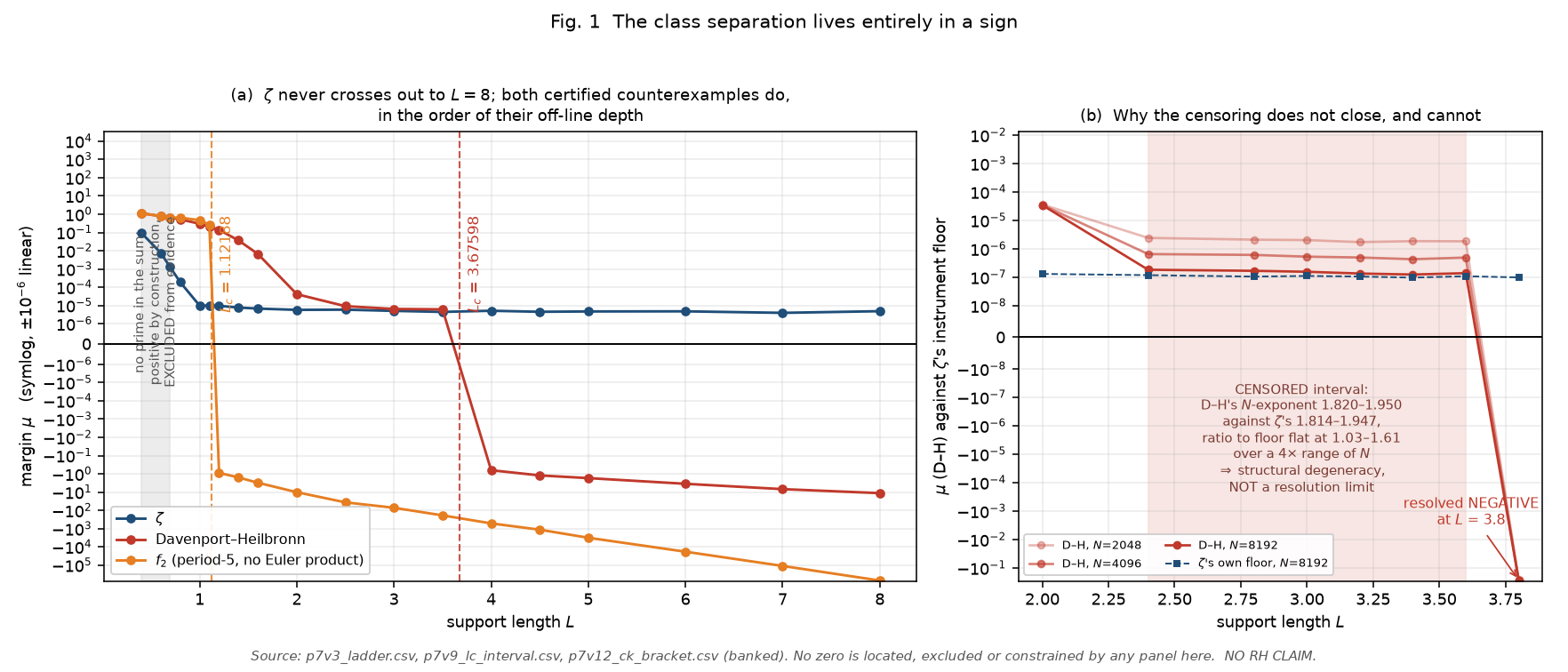
- The register works as a class detector on its sign, and only on its sign. ζ's form is non-negative at every rung out to support length L = 8; f₂'s crosses zero at L_c = 1.12205; Davenport–Heilbronn's at L_c ∈ [3.67539, 3.67656]; the dial's interior is negative at every interior parameter and its endpoints never are. The ordering is by off-line depth, every time.
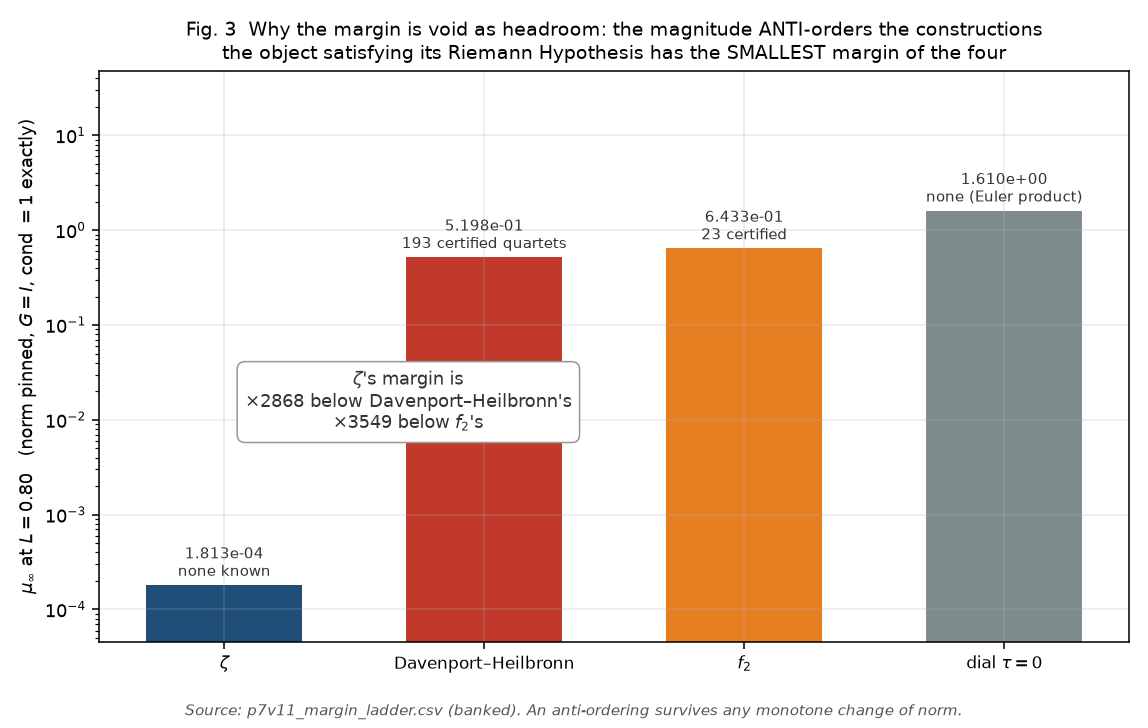
- The register is void as a quantitative instrument, for a reason stronger than noise: where the margin is measurable at all, ζ's margin is the smallest of the four objects — 2868× below Davenport–Heilbronn's and 3549× below f₂'s at L = 0.80. The magnitude anti-orders the constructions, and no monotone change of norm repairs an anti-ordering.
- The rate at which restricted-support positivity becomes unprovable was fitted through two points: L_c ≈ c·δ^{−α} with α = 0.6800 between the two banked crossings (f₂ at δ = 1.76, Davenport–Heilbronn at δ = 0.31), δ the depth of the off-line zero. A two-point fit has no residual degree of freedom, so the power-law FORM is assumed rather than measured, and the explicit formula's own off-line term e^{δL} says the exponent tends to 1 as δ → 0 (8.1). The arithmetic side of the form has e^{L_c} terms, so pricing the register at the depths a direct search already reaches (δ ≈ 4.4×10⁻⁶) costs at least 10³¹⁴⁵ terms under the fitted law — a LOWER BOUND, far larger (≥ 10^{10⁵}) under the explicit formula's asymptotics, and printed without a band (re-scoped 2026-09-04, E-P7RV-1) (L_c ≈ 7241; band 10³¹⁴¹–10³¹⁴⁸ over α ± 0.0001, 10³¹²⁹–10³¹⁶⁰ over the wider ± 0.0004 bar — δ here is five orders below the measured crossing depths, so this is an extrapolation of the rate law and not a measurement). The support register is structural, not computational.
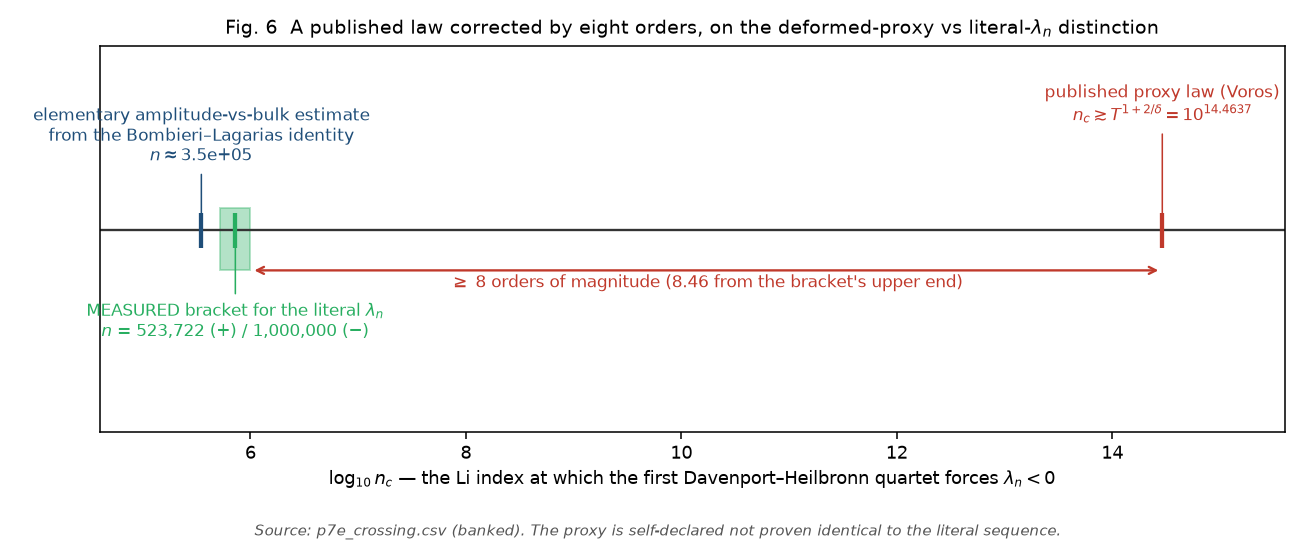
- The Li register carries the same verdict with a published law corrected on the way: a proxy crossing law in print (Voros; see 11.2) is off by at least eight orders of magnitude for the literal Li coefficients, with the true crossing bracketed at n = 523,722 (positive side) and 1,000,000 (negative side).
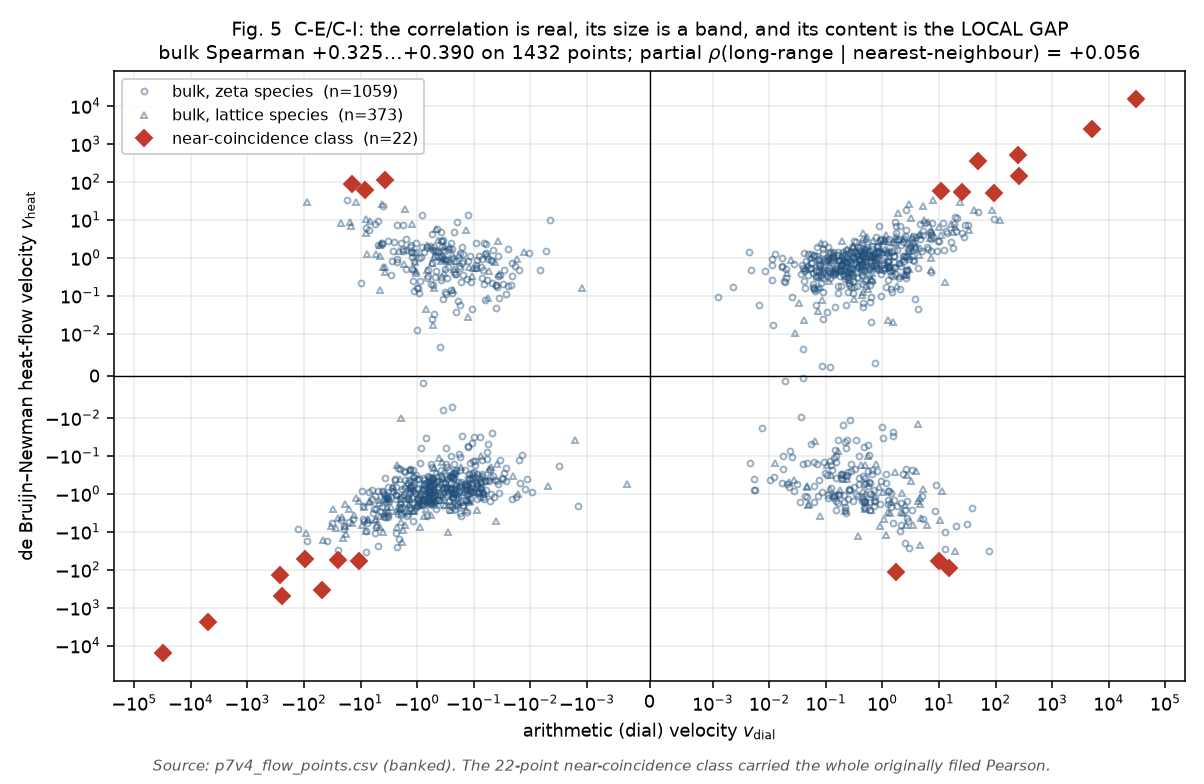
- Two flows share a boundary, and what they share is local: the correlation between the arithmetic (dial) zero flow and the analytic de Bruijn–Newman heat flow is real (bulk Spearman +0.325…+0.390) and is carried by the nearest-neighbour gap alone — the long-range part contributes partial ρ = +0.056. That is a property of any 1/(xᵢ−x_j) interaction and carries no arithmetic.
- Two identifications in the programme's earlier papers are resolved as classical objects with owners: the programme's stem is the Liouville point of the Mertens 3-4-1 inequality (nearest antecedent Arias de Reyna–van de Lune 2012), and its long-standing carry-over wall is the Liouville summatory function — a named Riemann-Hypothesis equivalent. Both are then priced and closed: the Diophantine route to zero-free-region tightness is short by 1.7–2.9 billion orders of magnitude.
- And a methodological claim the arc paid for: the single most consequential finding was a defect, not a conjecture. The main instrument was built with its arithmetic block twice too large. Correcting it turned a reported failure into the class separation the round was built to find, and voided every eigenvalue in two filed tables.
1.4 What this paper does not claim
No zero is located, excluded or constrained. Positivity is not established for ζ at any support length in a sense that survives the limit; every positive reading is a finite realisation at a stated grid, with its own convergence exponent printed, and each is a statement about the form at that support, not about a support-infinite limit. The margin's existence, re-established here after being falsely reported as zero, is not headroom and is explicitly not offered as such. The counterexample calibration certifies that the instrument can detect a violation of the shape the counterexamples have; it certifies nothing about violations of other shapes. And the claim printed at the close of the arc's second wave — zero errors in any filed computed quantity — is withdrawn for this arc, in bold, because it was false when printed: two eigenvalue tables were wrong in every row.
PART I — THE INSTRUMENT
Chapter 2 — The Weil form as a computable object
2.1 The form
Let F have degree 1 with a Riemann-type functional equation of conductor q, parity κ and root number ω, in the form assembled across the programme's earlier papers (1.2). Take φ real, even, supported in [−L/2, L/2]; set g = φ ⋆ φ̃, supported in [−L, L], and h = |φ̂|² ≥ 0 on ℝ. The explicit formula, read as a functional, is
W_F(φ) = P_F(φ) + A_F(φ) − 2 Σ_{2 ≤ n ≤ e^L} (Λ_F(n)/√n) · g(log n),
with P_F the pole term (present iff F has a pole at s = 1) and A_F the archimedean term,
A_F(φ) = (1/2π) ∫ h(r) · [ log(q/π) + Re ψ((½+κ+ir)/2) ] dr.
Two properties make this the register of choice. Every term is quadratic in φ, so discretising φ on N grid points over [−L/2, L/2] gives W_F(φ) = φᵀM_Fφ with M_F real symmetric, and positivity of the form is exactly λ_min(M_F) ≥ 0, with the minimising test function read off as the corresponding eigenvector. And restricted support makes the arithmetic side a finite sum (n ≤ e^L): the object computed is exact, not truncated. That is the whole computational reason for parametrising by support.
2.2 The locality decomposition
Write M_F = M_pole + M_arch − M_pp − M_comp, where M_pp collects n a prime power and M_comp collects n composite but not a prime power. Then M_comp ≡ 0 if and only if F has an Euler product. All four blocks are computed and filed separately at every rung; the decomposition is the instrument for the locality conjecture of Chapter 5.
2.3 Four pins, each of which changed the measurement
(1) The margin is not λ_min of the raw matrix. A published finite-cutoff computation reports a smallest eigenvalue of order 10⁻³³⁴ — Groskin (2026), arXiv:2605.20224, at cutoff c = 100 and N = 250, in the Connes–van Suijlekom truncated form, cross-checked against the independent implementation of Kim et al. (2026), arXiv:2607.24830. Both postdate this programme's own literature horizon, neither has any citation or review history, and the second sits in a general-mathematics preprint category; both are cited here with those hedges attached and neither is treated as authorising anything. A number that small is not a mathematical margin; it is the conditioning of the basis. The sign of λ_min is basis-independent; its magnitude is not. Pin of record: the margin is the generalised eigenvalue μ(L) := min_φ W_F(φ)/⟨φ,φ⟩_G with G the Gram matrix of a named basis, solved as a generalised symmetric eigenproblem, cond(G) printed at every rung, and any rung whose conditioning exceeds working precision reported UNRESOLVED — never as a small positive margin. μ depends on the norm, so the norm is part of the register, and any comparison of two μ values names the norm both were taken in. In this paper's record runs the norm is pinned to G = I with cond(G) = 1 exactly. The objective, written out (added 2026-09-04): μ(L) = inf over real even φ ≠ 0 with supp φ ⊆ [−L/2, L/2] of [ 2·𝟙_pole·(∫φ(x)cosh(x/2)dx)² + (1/2π)∫|φ̂(r)|²·(log(q/π) + Re ψ((½+κ+ir)/2))dr − 2 Σ_{2≤n≤e^L} Λ_F(n)·n^{−1/2}·∫φ(x)φ(x − log n)dx ] / ∫φ(x)²dx — the Rayleigh quotient of the discretised form M_F in the Euclidean grid norm, whose minimum is λ_min(M_F) and whose minimiser is the eigenvector. It mentions the von Mangoldt coefficients Λ_F(n) explicitly and linearly, for n ≤ e^L only, each weighted by n^{−1/2} times the autocorrelation of φ at lag log n; on the band where μ is measurable at all (L < log 3) exactly one coefficient enters, Λ_F(2). Units, stated because the text had not (E-P7RV-6): whether M_F carries the grid factor Δ = L/N so that φᵀM_Fφ equals W_F of the interpolant, and whether the G = I denominator is Σφ_j² or Δ·Σφ_j², is not printed anywhere in this paper; every cross-object ratio (7.3) and the N-convergence claim are stated in that grid norm and are interpretable only once it is.
(2) Below L = log 2 the gate cannot fail. No prime enters the arithmetic sum until the support reaches log 2 = 0.6931, because the first term is n = 2. Below that the form is archimedean-plus-pole and positive there — not by construction (corrected 2026-09-04, E-P7RV-3). For ζ the value is a near-cancellation of two O(1) terms, the pole term 2(∫φ cosh(x/2)dx)² against the archimedean integral: for φ = cos²(πx/L) at L = 0.7 the pole term is +0.245982, the archimedean term −0.241423, the coefficient side +0.0045596 — equal to the zero side over the first 80 zeros to 2.3×10⁻⁹ (the explicit formula closes) and 1.74 % of ‖φ‖² = 0.2625 (checked 2026-09-04). The archimedean kernel is itself indefinite (7.3). For the pole-free conductor-5 counterexamples the same quantity is positive by a wide margin. Positivity on the sub-log-2 band is therefore a numerical fact for these four objects; a theorem for the band, if one exists, is not cited here — an earlier review recalled Connes–Consani (Weil positivity and trace formula, the archimedean place) as proving exactly this for support up to log 2. That paper has since been read first-hand — arXiv:2006.13771 (2020; earlier versions of this paper printed 2021), Remark 3.9(ii) — and it does not say that. What it states is that the functional D ∘ Q is not negative on [2⁻¹, 2], with an explicit witness: a positive-definite f supported in [−log 2, log 2] for which D₊(Q₊f) tends to ≈ 2.98699. That is the failure of negativity exhibited at the log-2 scale, not a proof of positivity below it, so the sentence above stands: a theorem for the band, if one exists, is still not cited here. The two readings jointly locate the same boundary from two directions, and neither is progress on the Riemann Hypothesis. The EXCLUSION from evidence stands on the reason that matters: no prime enters, so no reading there discriminates. Every reading at L < log 2 is printed as a disclosure and excluded from evidence. The evidence band begins at log 2, and each rung declares its own prime content against the entry thresholds log 2, log 3, log 4, log 5, ….
(3) A free positive control, better than anything designable. The archimedean contribution to the lowest eigenvalue grows like log(1/a) as support → 0. The asymptotic is Suzuki (2026), arXiv:2606.09096, in the form
λ_a = log(1/a) + μ₁ − log(2π) + ψ(2) − 1 + O(a), a → 0⁺,
with μ₁ > 0 constant and ψ the digamma — published, parameter-free, and in a regime where the answer is known; reproducing it is an independent check on the entire assembly, with the same computation minus the pole term as its falsifier-witness. Two further reproduction anchors are used the same way: Connes–van Suijlekom (2025), in an established venue and the most rigorously vetted source in the recent cluster, and Groskin (2026), self-caveated ("we make no claim of proof", and its author's own finite-N extrapolation self-reported as falsified under refinement). The third recent numerics source, Kim et al. (2026), sits in arXiv's general-mathematics category and is tiered accordingly — it may cross-check and may never authorise; where it is used at all, it is used only for a shape two better-tiered sources state independently. The control was made a gate on the round: no ladder, no record run until it passed.
(4) Two shapes for the load-bearing term, reconciled by derivation. The pole-plus-archimedean content appears in visibly different shapes across sources — point evaluations against an integral with an exponential weight — and the literature extract could not verify they are the same formula. This blocked implementation, because that term is the entire positive side of the inequality. It was derived rather than adopted on trust: the two shapes are one formula in the u = log-variable representation, verified at twelve cells (recorded in the Supplementary Materials), which additionally retired an earlier defect class (a Nyquist limit attributed to the archimedean quadrature; the u-space block has none) and lifted the working ceiling from L = π to L = 8.
2.4 Rule compliance, stated at design time
λ_min at finite (L, N) is a finite realisation of two different kinds. The grid rate is a convergence: λ_min(N) → λ_min(∞) as the quadrature converges, and an N-ladder at fixed L prints the exponent. The support dependence is not a convergence: λ_min is a genuinely L-dependent object and is not an approximation to an L = ∞ limit. Reading it as one would be the register conflation that Paper 6 documented as a recurring failure class, and — as Chapter 7 records — a variant of exactly that conflation still produced two of this arc's errata.
Chapter 3 — Assembly, controls, and the defect that mattered most
3.1 The closure gate
For each of ζ, Davenport–Heilbronn and f₂, and for at least three test functions, the zero side Σ_ρ h(γ_ρ) was compared against the coefficient side P + A − 2Σ, with a bar of ten significant digits — Paper 4 achieved 12–14 on the same objects, so anything worse indicts the assembly and not the mathematics. The falsifier-witness is the same comparison with the Γ-pole family deliberately omitted: it must fail visibly, because that omission is the load-bearing one (it cost Paper 4 a round), and if it does not show, the test function is blind to it and the gate certifies nothing.
3.2 The archimedean controls
Three live falsifiers were run on the τ = 0 endpoint of the dial against zero-side ground truth: the archimedean term omitted (fails by 1618–18163×), conductor q = 1 in place of q = 5 (4451–11026×), parity κ = 1 in place of κ = 0 (164–884×). The pole gate as originally specified was not a control — it compared an object with itself — and is replaced here by a test against zero-side ground truth, whose falsifier fires at 295–1672×.
3.3 The defect
The first wave's filed eigenvalues are void. The instrument was built with its arithmetic block twice too large: a factor 2 applied where the coefficient-side convention already carried it. Every eigenvalue in the two filed ladder tables is wrong. The defect was found by an adversarial re-read in the following session, not by the session that wrote the probe — the third consecutive round with that provenance.
Two things follow, and both are recorded at result prominence. First, correcting the defect turned a reported failure into the separation the round was built to find: on the corrected instrument the register separates ζ from both counterexamples. Second, the order that ran the defective probe contained an assembly check — and the check validated a separate analytic code path and never touched the matrix whose eigenvalues were filed. That is not a violation of any standing design rule; it is a gap between them, recorded as such, and its concrete mitigation is an instrument rather than a rule: an assembly arbiter that compares the matrix actually diagonalised against an independently assembled form, reusable by every downstream round. It reproduces the corrected filed values to 1.1×10⁻¹⁴.
PART II — WHAT THE REGISTER SEES
Chapter 4 — The class separation, and it lives entirely in a sign
Run on the corrected instrument, with the norm pinned, the evidence band beginning at L = log 2, and the N-ladder carried to N = 4096 (8192 where the reading was contested):
| Object | Off-line zeros | Reading |
|---|---|---|
| ζ | none known | μ ≥ 0 at every rung L ∈ [0.8, 8.0] |
| f₂ (period-5, same FE, no Euler product) | 23 certified, max β = 2.3455 at t ≤ 400 | crossing at L_c = 1.12205, converged |
| Davenport–Heilbronn | 193 certified quartets, δ ∈ [0.0159, 0.3978] | crossing at L_c ∈ [3.67539, 3.67656] |
| the dial, interior τ (Garunkštis–Šimėnas 2015; see 6.1) | 0 → 107 → 0 across τ | negative at every interior τ; never at either endpoint |
The ordering is by off-line depth in every case, and the endpoint behaviour is a theorem-backed prediction rather than a fitted one — the theorem is Kaczorowski–Kulas, on the density of off-line zeros of a degree-1 Selberg-class element without an Euler product — a family with two Euler-product endpoints and dense off-line zeros in the interior must read this way, so a failure here would have indicted the instrument and was pre-stated as doing so.
Figure 1 is this table drawn: panel (a) carries the whole ladder out to L = 8, with ζ flat and positive against f₂'s crossing at 1.12205 and Davenport–Heilbronn's at 3.67598, and panel (b) shows why the censored interval [2.4, 3.6] does not close and cannot — the subject of 8.1.
This is the paper's positive result, and it is exactly this large — no larger, and one-sided (2026-09-04, E-P7RV-5). The register certifies violations from the sign of one eigenvalue; on ζ it reads NON-DETECTION at every rung, and that is what "detects the class" means here. A resolved negative is, moreover, a converged reading and not yet a certificate: Weil's criterion is an iff over all admissible φ, so one admissible φ with W_F(φ) < 0 evaluated exactly would certify an off-line zero of F — the arithmetic and pole terms of the grid minimiser's interpolant are exact, the archimedean integral is quadrature (the u-space block), and no quadrature error bound at the negative rungs is printed. Converting one negative (Davenport–Heilbronn at L = 3.8) into an interval-arithmetic certificate is the assembly gate E-P7W1-15 named, pointed at the filed object; it has not been run.** On these four objects, the sign of one eigenvalue reproduces the known split between ζ and the certified off-line-zero objects; it decides nothing about ζ itself, which is not evaluated here at unrestricted support. Chapters 7 and 8 measure what the sign costs and what the magnitude is worth, and both answers are negative.
Chapter 5 — Locality: the register's separating property, measured
The conjecture was that the property separating ζ from a non-Euler element is support-locality of Λ_F — supported on prime powers ⟺ Euler product — rather than multiplicativity or coefficient positivity, both of which the programme had already falsified as candidates (ψ(2) = −1 gives a genuine Euler product with negative local data; the programme's own F_k family kills raw positivity). Sharp form: the minimising direction of the Weil form should align with the composite-support block.
Verdict: SPLIT. On Davenport–Heilbronn the claim is supported decisively — 0 of 400 random directions reach the minimiser's composite share, at L = 4, 5 and 6. On f₂ it is not: the apparent signal there is the construction's own scale, which the magnitude control removes. The falsifier-witness for ζ (composite share identically zero by construction) is printed and excluded from evidence — it cannot serve as a control, because it cannot fail.
The split is informative rather than inconclusive. The two counterexamples differ in conductor and in low-zero density, and Chapter 7 finds the same two variables ordering the margin magnitudes. Locality is the register's separating property where the register is a detector; it is not a property one can read off a single non-Euler example.
Chapter 6 — The dial response, and what the depth actually tracks
6.1 The family
With ψ the even quadratic character mod 5 (ψ(2) = −1), set
f(s,τ) = (1−τ)·(1 + √5·5^{−s})·ζ(s) + τ·L(s,ψ), τ ∈ [0,1].
Both endpoints carry the same conductor, parity and root number, so the family satisfies one functional equation at every τ — verified first-hand, to between 6.2×10⁻³¹ and 4.4×10⁻³⁰, before any experiment was specified on it. (The τ = 0 and τ = 1 endpoints are themselves distinct Euler-product Dirichlet series, related to but not identical with the ζ and Davenport–Heilbronn objects tested in Chapters 3–5.) The interior provably violates its own Riemann Hypothesis — the analogous on-the-critical-line statement for this family's zeros, not the Riemann Hypothesis for ζ — a theorem of Kaczorowski–Kulas, which is why the family is here.
This family is not ours, and the credit belongs here where it is introduced rather than only where it is discussed (an earlier draft gave this credit only where the family was discussed later; that is corrected here, with no computed quantity changed). The construction — a convex one-parameter family of Dirichlet series preserving one functional equation at every τ, used to transport zeros between its endpoints — is Balanzario–Sánchez-Ortiz (2007), Zeros of the Davenport–Heilbronn counterexample, Math. Comp. 76, 2045–2049, eq. (5): "For each τ ∈ [0,1], let f_τ = f₀·(1 − τ) + f₁·τ", with the functional equation stated to hold "for all τ ∈ [0,1]" and the zero-persistence statement as their Theorem 1. Garunkštis–Šimėnas (2015) add the explicit perturbation formula for the zero motion, and cite Balanzario–Sánchez-Ortiz as their own antecedent. The concession is stated in full at Appendix B; the concession is stated in full at 9.1, and every use of the dial in Chapters 4 through 8 inherits it. What Papers 6 and 7 add is measurement, not construction.
6.2 The declared confound, and why the leg was built around it
The pole term has residue proportional to (1−τ) and vanishes at τ = 1: the positive contribution shrinks linearly along the dial while the composite block grows, so a dial response could be driven entirely by the pole term and say nothing about locality. Three variants were run and all three filed — pole term as-is; pole term frozen at its τ = 0 value; pole term removed — and the conjecture is scored on the second and third. The declared confound proved impossible, not merely absent: variants (a) and (b) agree at 0.000e+00 on the interior.
6.3 The shape, and then the magnitudes
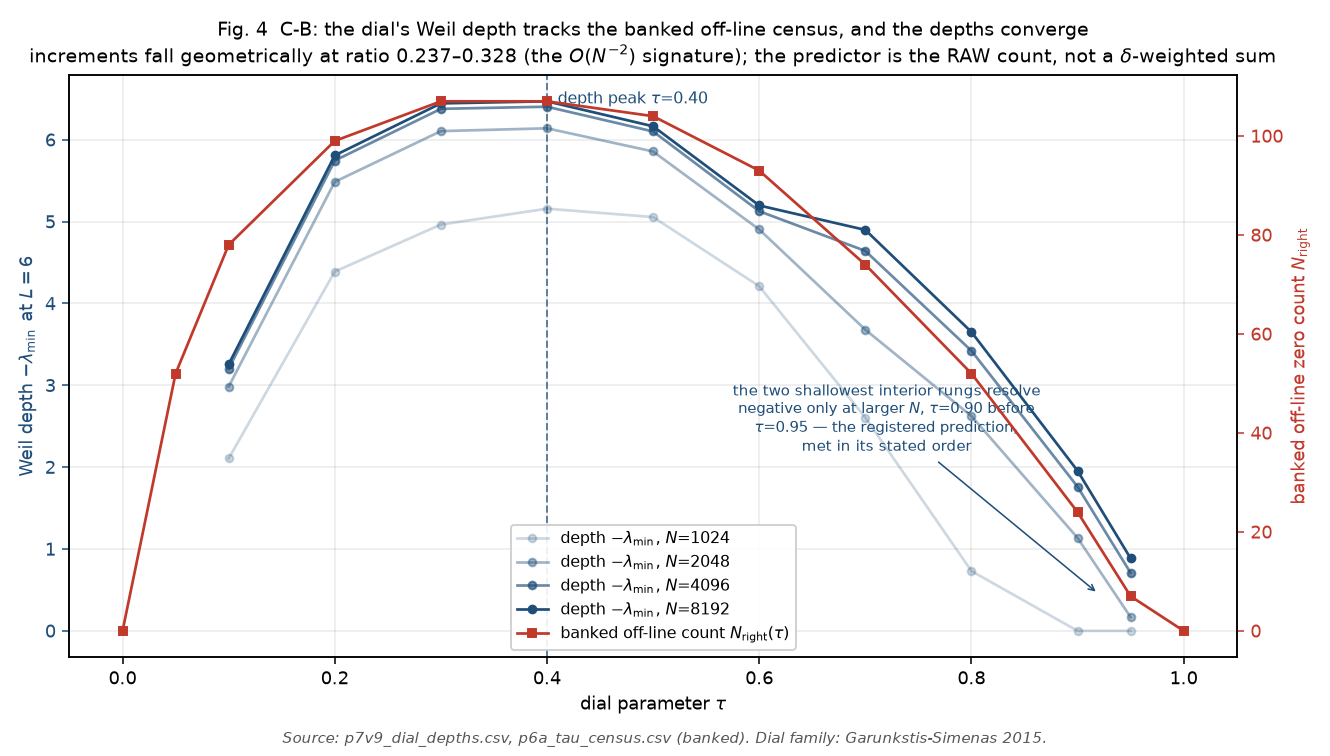
The banked off-line count across the thirteen-rung τ grid is N_right(τ) = 0, 52, 78, 99, 107, 107, 104, 93, 74, 52, 24, 7, 0. Against it:
- the depth peak sits at τ = 0.40 at every N, matching the banked N_right peak;
- Spearman(depth, N_right) = +0.9636…+0.9879;
- partial ρ = +0.94…+0.96 with the arithmetic magnitude partialled out.
The registered convergence prediction was met in its stated order: τ = 0.90 resolves negative first (L = 5, N = 2048), τ = 0.95 second; at L = 6, N = 2048 all eleven interior rungs are negative and both endpoints sit at the floor. The control that makes this meaningful passes — ζ and both dial endpoints remain ≥ 0 at N = 2048 and N = 4096.
The depths were filed as lower bounds. They are not. From N = 2048 to 8192 the increments fall geometrically at ratio 0.237–0.328 — the O(N⁻²) signature — and Richardson limits are filed for all ten interior τ, every one two orders inside the pre-stated analytic bound. The conjecture is therefore supported on a stronger register than it was stated in: the depth magnitudes are converged and filed, not merely ranked. Figure 4 draws the two curves against each other, with the N-ladder overlaid so the convergence and the registered order of resolution are both visible.
6.4 And what the depth is not
A natural refinement — that the converged depth is a δ-weighted off-line sum Σᵢe^{δᵢL} rather than a raw count, since the explicit formula puts a quartet's zero-side term at r = γ ∓ iδ — is refuted, and the falsifier says the weighting actively hurts. Raw count: ratio coefficient of variation 0.360 overall, 0.0269 on τ ∈ [0.2, 0.6]. Weighted sum: 0.704 and 0.095. And shuffling the depths across τ predicts better than the true depths (median CV 0.381). The structural reason is one line: λ_min is an extremal eigenvalue, and additivity was assumed.
The predictor is the raw off-line count.
Chapter 7 — The margin: a headline reversed, a decay law measured, and a number priced out of reach
7.1 The reversal
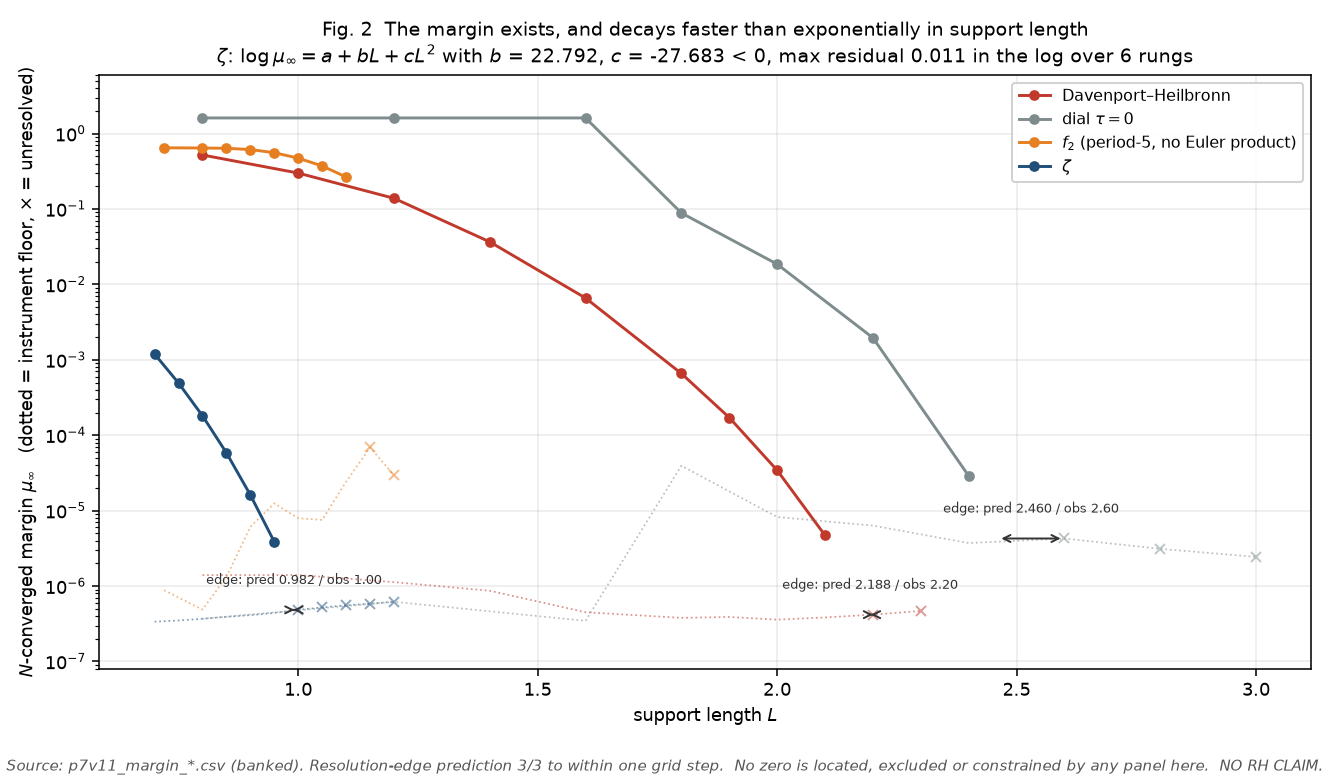
The previous round reported the L² infimum is zero for ζ at every L. That is false as a statement about the form, and it is corrected here. Its ladder began at L = 1.0, which is within 0.018 of the instrument's own resolution edge; what was read as "zero" was a value at the floor. On 0.70 ≤ L ≤ 0.95 the margin is N-converged positive at all six rungs, falling 1.1935e-3 → 3.8636e-6 — a factor 308.9 over ΔL = 0.25 — with an N-exponent of 0.007 at L = 0.80. The margin exists.
The mechanical lesson is worth more than the correction and is stated as a general rule, because it caused two of this arc's four errata: a ladder that reports a value against a floor cannot distinguish converged and small from decaying to zero. Only the N-exponent can, and the exponent costs one extra rung. This is a new instance of the register-conflation class — two quantities sharing the word "small": near the floor, versus going to zero.
7.2 The decay law
With the margin resolved rather than floored, its actual target is measurable:
log μ_∞(L) = a + bL + cL², c < 0,
i.e. decay faster than exponential in support length, with maximum residual 0.011 in the log across six rungs and no fitted structure left over. Figure 2 shows the resolved rungs of all four constructions above their own instrument floors, with the predicted and observed resolution edges marked.
The degenerate band above the resolved rungs is the instrument's resolution edge, and that reading was tested against a falsifier the fit could not see: the edge's location was predicted for three constructions and hit 3 of 3 to within one grid step. The competing explanation — that the band is grid-limited because the minimiser sits at the grid's Nyquist mode — is refuted decisively: the minimiser is smooth (alternation index 0.0000) and sits at the bottom of the spectrum (r₅₀ = 0.3–2.7 against r_Nyq = 536–12868; mass above half-Nyquist 0.0000), i.e. inside the zero-free band below γ₁ = 14.13 — the opposite end from where the mechanism put it.
7.3 Why the margin is nevertheless void as headroom, and the reason is not the one expected
The margin was commissioned as the honest headroom of the classical positivity method. It cannot serve, for a reason that survives any monotone change of norm:
the magnitude anti-orders the constructions. At L = 0.80, ζ's margin is the smallest of the four objects — 2868× below Davenport–Heilbronn's and 3549× below f₂'s.
The sign separates the class; the magnitude separates by conductor and low-zero density. A quantity that ranks the object satisfying the hypothesis below the objects violating it is not a measure of how much room the method has. Figure 3 is that ranking on one axis.
Where the anti-ordering comes from (added 2026-09-04, E-P7RV-4). On the band where the margin is measurable at all (L < log 3) the form contains one prime. The review pass of 2026-09-03 probed the pole-plus-archimedean Rayleigh minimum alone — no Λ_F(n) at all — on a coarse grid (N = 8 and 16, unconverged, indicative only) and found ζ already far below the pole-free conductor-5 objects at L = 0.69 (of order 0.01–0.03 against 0.33–0.67). If that ordering holds on the filed block split (the four blocks are filed per rung, 3.2), the anti-ordering is a conductor / pole / digamma effect present BELOW the first prime, the instrument never measured the zeros on that band, and "void as headroom" is a one-line consequence of the explicit formula rather than a measured surprise. The block split can settle it from filed data; it has not been run, and Figure 3 stands as a measurement pending that reading.
A second obstruction stands independently: the register's natural alternative norm is not a norm. The archimedean form is indefinite — its kernel changes sign at r = 6.29 for ζ and r = 1.21 for both counterexamples, and λ_min(M_arch) = −4.44 at L = 8. So the margin is norm-dependent, the register supplies one norm in which it is measurable, and the alternative the register itself suggests cannot be used.
7.4 The price
The margin is unmeasurable above L ≈ 1 by any feasible grid: about 10¹⁸ cells to reach L = 2 and 10⁴⁵ to reach L = 3. And it is resolvable only on the band where the form's arithmetic content is a single prime — n_arith = 1 at every resolved rung, with the second prime entering at log 3 = 1.0986.
That is the sharpest statement of the register's limit in this paper. The margin exists, its decay law is measured, its ordering disqualifies it as headroom, and the band on which it can be seen at all contains one prime.
Chapter 8 — The rate dictionary: an exponent pinned, and an arithmetic threshold found where it was not predicted
8.1 The support half
The dictionary sought converts an off-line depth δ = β − ½ into the support length at which positivity dies:
L_c ≈ c·δ^{−α}.
The exponent through the two banked crossings is α = 0.6800 ± 0.0001 — an interval 2000× narrower than the range of width 0.37 filed one round earlier — but it is a two-point fit inside an assumed power law (re-scoped 2026-09-04, E-P7RV-1): two (δ, L_c) pairs determine two parameters exactly, leave no residual degree of freedom, and cannot distinguish δ^{−0.68} from e^{b/δ} or from (1/δ)·log(C/δ); the bar is bracket propagation inside the chosen form. The explicit formula supplies the small-δ form itself: an off-line quartet at ½ ± δ + iγ contributes 2 Re φ̂(γ − iδ)², of size up to e^{δL}‖φ‖², against an on-line sum bounded independently of L, so the crossing satisfies δ·L_c ≈ log C + o(1) and α → 1 as δ → 0. The fitted 0.68 is a local slope over δ ∈ [0.31, 1.76] — and f₂'s driving zero, at β = 2.26, lies outside the critical strip (E-P7W2-2). Two steps got there, and the first was a correction. (Scope pin on the bar, added 2026-08-04. Two bars are in circulation and both are correct, propagating different inputs: ± 0.0001 — half-width 9.12×10⁻⁵ — propagates the Davenport–Heilbronn crossing bracket [3.67539, 3.67656] alone, holding f₂'s crossing at its point value 1.12205; ± 0.0004 — half-width 4.10×10⁻⁴ — propagates both crossing brackets, f₂'s [1.12125, 1.12250] together with D-H's. Each bar is now printed with its specification. The wider one is the honest default wherever both crossings are treated as measured with uncertainty.)
The censoring does not close, and cannot. Davenport–Heilbronn's crossing had been reported as censored on L ∈ [2.4, 3.6] against the instrument's floor, with the expectation that a larger N would resolve it. Carried to N = 8192: on that interval D-H's N-exponent is 1.820–1.950 against ζ's 1.814–1.947, and the ratio to the floor is flat at 1.03–1.61 over a 4× range of N. D-H's infimum goes to zero there exactly as ζ's does — so positivity does not fail on that interval and the censoring is a structural degeneracy, not a resolution limit. L = 2.0, read the same way, is a converged positive gap (N-exponent 0.037, ratio to floor 20.7 → 262.4), not an approach to a crossing. That alone moves the crossing to L_c(D-H) ∈ (3.6, 3.8].
Then bisection brackets both crossings to 0.0012: f₂ ∈ [1.12125, 1.12250] (containing the banked 1.12205), D-H ∈ [3.67539, 3.67656], with a driving-depth ratio of 5.7264. The bracket pins α, and it excludes α = 1 by 75% within the power-law family at these two depths (E-P7RV-1: not an exclusion of the explicit formula's α → 1 asymptotics, which bite at smaller δ) — α = 1 would require L_c(D-H) = 6.4253, a factor 1.748 above the bracket. The exclusion is now two-sided; it had been argued one-sidedly before.
8.2 Where the arithmetic is felt, and where the sign changes — two different places
A natural reading of the crossings is that a margin dies when a new prime power joins the finite arithmetic sum, i.e. at an entry threshold log n. Refuted as posed, and resolved on both halves. Neither bracket contains an entry threshold; they lag the nearest by 0.0226 and 0.0118 — 18× and 10× the bracket width.
But the entry is visible, exactly where it should be. Across L = log 3 the derivative dμ/dL jumps −2.044 → −5.285 and keeps steepening, with a maximum step of 3.242, against a non-entry falsifier scan at L = 1.05 reading 0.0071 — a ratio of 459×. So the arithmetic content is felt precisely where it enters; the sign change happens elsewhere, set by a continuous competition against the archimedean part.
8.3 The price of the support register, and it is the arc's headline negative
The register is height-uniform: there is no t in it, so the blocker that stood over every instrument in Papers 1–6 does not apply. That was the register's whole attraction. Its cost replaces it:
the arithmetic side has e^{L_c} terms, and L_c ≥ c·δ^{−0.68} on the fitted law — a two-point fit; the explicit formula's own asymptotics give L_c ≈ (log C)/δ, larger still (E-P7RV-1).
(The per-object values of c and their derivation are recorded in the Supplementary Materials.) At δ = 4.4×10⁻⁶ — the depth a direct search already reaches at γ = 10⁹ with r = 10⁻¹⁰ — that is at least 10³¹⁴⁵ terms — a lower bound; under α = 1 the price is ≥ 10^{10⁵} (E-P7RV-1). (Corrected 2026-08-04. This paper printed 10³⁴ to 10³⁸⁹⁵, a range computed at the retracted interval α ∈ [0.331, 0.699] and never recomputed after the exponent was pinned at α = 0.6800 by E-P7W3-3; its width was the width of a withdrawn interval, not of a measurement. Recomputed at dps 30 from the two banked (δ_drive, L_c) pairs — f₂ at (1.76215, 1.12205) and Davenport–Heilbronn at (0.30773, 3.67598), which return the prefactor c = 1.6493914 and reproduce the pinned exponent at α = 0.6800096 — the cost is L_c ≈ 7241, i.e. 10³¹⁴¹–10³¹⁴⁸ over α ± 0.0001 and 10³¹²⁹–10³¹⁶⁰ over the both-brackets bar α ± 0.0004. The extrapolation caveat is part of the claim: δ = 4.4×10⁻⁶ lies five orders below the measured crossing depths, so this is the rate law extended, not a measured cost. The verdict is unchanged and slightly sharper: 10³¹⁴⁵ is as unaffordable as 10³⁸⁹⁵, and the corrected figure is a lower bound rather than a 3861-order interval — and the bands printed here are bracket propagation inside the assumed power law, not a model uncertainty (re-scoped 2026-09-04, E-P7RV-1).) Weil positivity at restricted support is a structural register, not a computational one. The cost is stretched-exponential in 1/δ, and the trade the register offered (uniformity in height, paid for in support) is not affordable at any depth the programme can reach.
PART III — TWO FLOWS
Chapter 9 — The dial as a zero flow: a formula conceded, kinematics confirmed, a prediction failed informatively
9.1 The concession, printed at result prominence
The dial's zeros move with τ, and the perturbation formula for that motion is
∂ρ/∂τ = −(∂f/∂τ)/(∂f/∂ρ).
This family and this formula are in print, and they are in print from two sources, not one. The convex FE-preserving family and its zero-persistence theorem are Balanzario–Sánchez-Ortiz (2007), Zeros of the Davenport–Heilbronn counterexample, Math. Comp. 76, 2045–2049 (eq. (5), Theorem 1); and the collision-before-departure mechanism this chapter measures is stated in their §3 in prose — "there must exist 0 ≤ τ\ < 1 such that f_τ\ has a zero in the critical line with an even multiplicity … zeros of multiplicity greater than one must exist before the Riemann hypothesis fails." Garunkštis and Šimėnas (2015) then write down exactly this velocity formula, integrate it numerically, and describe trajectories that meet and split symmetrically off the line. Read first-hand and conceded in full. Their computation is self-declared heuristic ("accuracy was not controlled explicitly") and their 1452 is a trajectory count, 286 of which leave the line — confirmed verbatim at the primary source. (This paper's own 1454-zero, 1453-anchor count in 9.2 is a distinct, independently run census, not a reproduction of the source's count.)
What survives as the programme's own is narrower than the previous round claimed, and the correction is recorded here rather than argued with. The argument that Re ≡ 0 is forced by the functional equation together with real coefficients — so that a departure is necessarily a collision — is already stated in prose in their own text, and is conceded too. What is ours is the verification of it at 2.75×10⁻²⁸, where they observed the phenomenon heuristically and declared their own accuracy uncontrolled; the splitting exponent, found stated nowhere and measured at 0.481 [0.436, 0.503]; and the zero-parameter prediction of the departure parameter τ\*.
9.2 Kinematics, then the prediction
The kinematics are confirmed to 9.1×10⁻¹⁴ over 1454 zeros, with the exact count anchor 384 + 1069 = 1453 and residual zero. The two species — ζ-zeros and the 5-lattice zeros at spacing 2π/log 5 = 3.903963 — take different formulas, and conflating them would be a like-with-like failure; both are run separately. (The banked lattice spacing 3.9035 is corrected here to its closed form.)
The zero-parameter prediction τ\*ₙ ≈ (γ_{n+1} − γₙ)/(vₙ − v_{n+1}) fails: 4 of 39 departure events (a subset of the 1454-zero census, where trajectories actually meet) land inside a bar derived from the first-order truncation. The residual is the content, and it is robust: a 30 positive / 9 negative late bias, i.e. real trajectories accelerate into collision relative to the first-order estimate. That names the missing order rather than merely recording a miss.
Chapter 10 — The arithmetic flow and the heat flow: a real correlation whose content is local
10.1 The comparison, and two traps in the literature
The de Bruijn–Newman heat flow moves zeros by a Calogero–Moser repulsion, and (Rodgers–Tao) Λ ≥ 0 places ζ at that flow's boundary. Comparing its velocity field with the dial's is open ground: the heat-flow literature analyses the real-zero regime and explicitly never the post-collision complex regime.
Two implementation traps were caught before the leg ran, and either would have corrupted it silently. The published ODE ∂ₜx_k = 2Σ_{j≠k}1/(x_k − x_j) is written in the doubled coordinate z = 2γ, while the dial's velocities are in plain γ — so either the ordinates are doubled or the γ-native form dγ_k/dt = (½)Σ_{j≠k}1/(γ_k − γ_j) is used, and the code says which. The two published renderings of that ODE appear to disagree on the sign, and the round treated that as a live discrepancy. That reading is withdrawn here: the difference is a relabelling of the summation index, and the two are algebraically identical — checked against the primary text at byte level in this manuscript's own citation audit. The sign was in any case re-derived from the repulsion property (for x₁ < x₂ the gap must grow), with the two-body check printed as the falsifier-witness, and that control stands on its own merits.
10.2 The size, which is a band, and the direction the correction ran
With near-coincidences separated as their own class rather than trimmed (that class of 22 points carried the whole originally filed Pearson correlation), the bulk reading is Spearman +0.390 [+0.332, +0.446] on 1432 points, flat over four decades of class boundary and identical in both species, with MAD(residual)/MAD(v_dial) = 0.908.
Completing the heat-flow sum to its untruncated form and adding the functional equation's mirror zeros moves the bulk correlation to +0.325…+0.390 and the unexplained scale to 0.961–0.966. The correction therefore runs away from what the conjecture prefers — stated plainly, because the previous round's correction ran toward it. An interior-window control shows most, but not all, of the fall is a window edge. The size is a band, ~0.90–0.97 unexplained, and it is truncation-dependent; a robust scale ratio is not a variance decomposition, and no variance decomposition is available from a rank statistic.
10.3 What the two flows actually share
The local gap alone. The nearest-neighbour term by itself gives ρ = +0.3525, against +0.3246 for the full field. Partial correlations settle it: ρ(dial, local | long) = +0.3173 [+0.2606, +0.3754] against ρ(dial, long | local) = +0.0557 [+0.0001, +0.1075], with the difference CI [+0.1888, +0.3413] excluding zero. The control passes: the reciprocal of cross-species separation reads −0.019 on the bulk.
Figure 5 makes the shape of the finding visible in one panel: the twenty-two near-coincidence points sit at the extremes of both axes, which is how they carried the whole originally filed Pearson, while the bulk carries a modest rank association and nothing more.
The consequence is a downgrade, and it is the honest one. What the arithmetic flow and the analytic flow share is a property of any 1/(xᵢ − x_j) interaction. It carries no arithmetic. The conjecture that ζ sits at the arithmetic flow's boundary where composite content first becomes nonzero is measured, banded and downgraded: the correlation is real, its size is a band, and its content is the local gap.
PART IV — TWO PRICED NEGATIVES
Chapter 11 — Li coefficients: a published law corrected by eight orders, and a route priced out
11.1 The register
λₙ = Σ_ρ [1 − (1−1/ρ)ⁿ], with the identity |1−1/ρ|² = 1 − (2β−1)/|ρ|² — verbatim in Bombieri–Lagarias (1999), conceded here at result prominence and twenty-seven years in print. Concession widened 2026-09-04 (E-P7RV-2), read byte-level from Lagarias's own hosted reprint: Bombieri–Lagarias do more than own the identity — they relate the positivity of λₙ to Weil's criterion through the Guinand–Weil explicit formula: "We also give an arithmetic formula for the numbers λ_n in Li's paper, via the Guinand–Weil explicit formula and relate the conjectural positivity of λ_n to Weil's criterion for the Riemann Hypothesis" (abstract) and "the positivity in Li's criterion has the same meaning as in Weil's criterion. The interesting point is that Li's criterion requires an explicit and rather simple set of test functions for its verification" (§4, Concluding remarks). So the Li register of this chapter and the Weil register of Parts I–II are two truncations of ONE quadratic form — Li's test functions have full support and are indexed by n, the restricted-support form has compact support and is indexed by L — and not two independent registers. Through v0.4 this paper conceded the identity only and called the two registers independent. Its consequence is the register's whole mechanism: the mirror member with β < ½ grows, driving λₙ → −∞ at rate ≈ (½−β)/|ρ|² per index. An off-line zero must therefore show up as a crossing at a finite index n_c, and the question is where.
11.2 A nine-order discrepancy, and which side was wrong
Two laws were on the table. Voros, in print, gives n_c ≳ T^{1+2/δ} on a deformed proxy sequence — introduced there as the simpler object to analyse and compute, and nowhere claimed in that source to be term-wise identical to the literal λₙ (the source's own hedge; the stronger phrasing "proven not identical" would be ours, and is not used) — reproducing n ≈ 100 for one Davenport–Heilbronn zero and n ≈ 3×10¹⁴ for another, the latter being this programme's own first certified quartet. An elementary amplitude-versus-bulk estimate from the Bombieri–Lagarias identity gives ≈ 3.5×10⁵ for the same zero. Nine orders apart, on a decidable question, with a certified zero list in hand to decide it.
The exact off-line contribution was computed from the certified quartets and atlas with no model, the on-line contribution from the certified list, and a Riemann–von Mangoldt tail model whose error is bounded and printed, contributing as a band and not a point.
Verdict: the published proxy law is off by at least eight orders for the literal coefficients, with the crossing bracketed at n = 523,722 (positive side) and 1,000,000 (negative side) — i.e. near the elementary estimate, not near the proxy's. The proxy does not track the literal sequence in the small-offset regime, and that gap is the finding. Figure 6 puts the three numbers on one logarithmic axis; the printed gap is 8.46 orders from the bracket's upper end, and the statement of record is at least eight.
11.3 The negative, pre-registered as the expected outcome
The crossing index was then compared against the direct-search cost of the same exclusion. The Li route costs more than the direct search. Li positivity is a structural register, not a computational one — the same verdict Chapter 8 reaches for Weil, now with numbers on both sides. Filed as a negative with its numbers, which is the only kind of negative this programme files.
One lead is recorded rather than closed: results proving genuine finite-range zero exclusion for the generalised τ-Li family are the one place where finitely many coefficients demonstrably buy something, and they bear directly on this register's height-uniformity claim.
Chapter 12 — The stem is the Liouville point: an identification, an owner, and a price
12.1 The identification
The Mertens 3-4-1 inequality's polynomial factors as 3 + 4cos θ + cos 2θ = 2(1 + cos θ)², tight only at θ = π. Requiring θ_p = π for every prime says n^{−iγ} = (−1)^{Ω(n)} = λ(n), whence Σλ(n)n^{−σ} = ζ(2σ)/ζ(σ) = A(σ) — the programme's stem, carried through Paper 3 as a geometric object. Three consequences follow at once: Paper 3's stem study is a geometric study of the extremal set of the classical zero-free-region inequality; the abscissa σ\(T) = 0.90007 is a tightness abscissa; and the dead Davenport–Heilbronn stem says the counterexample has no Liouville point*.
And the programme's long-standing carry-over wall is named. Continuing A(σ) = ζ(2σ)/ζ(σ) into the strip is the Liouville summatory function, Σ_{n≤x}λ(n) = O(x^{½+ε}) — a classical Riemann-Hypothesis equivalent with its own literature (Pólya's conjecture, false; Haselgrove; Borwein–Ferguson–Mossinghoff). That is why the wall stalled: it is the hypothesis, relocated. The wall stands; the question of what the wall is is closed.
12.2 The owner
Half of this is in print. Arias de Reyna and van de Lune (2012) prove by explicit Kronecker construction that ζ(s + it_k) → ζ(2s)/ζ(s) along a sequence with p^{−it_k} → −1 for every prime — and that condition is the Liouville point. They never write "Liouville" and never touch zero-free regions; the 3-4-1 identity is standard but is never placed beside them. Roughly twenty search angles found nothing unifying the two. They are cited as nearest antecedent and only the synthesis is claimed.
12.3 The price, and it closes the route
If the extremal set is the target, how close can one get to it? For p ≤ P and γ ≤ T (the values and the search's stated completeness are recorded in the Supplementary Materials), the achieved simultaneous deviation of (γ log p mod 2π) from π was measured, and the Mertens slack evaluated at the best-approximating γ against its Haar average.
Effective linear-forms-in-logarithms bounds give deviations ≳ γ^{−κ}, and the chain's gain goes as the fourth power of the deviation (1 + cos θ ≈ ε²/2, so 2(1+cos θ)² ≈ ε⁴/2). The Diophantine route to zero-free-region tightness is short by the Baker gap: 1.7 to 2.9 billion orders of magnitude at the level of the underlying deviation, 6.7×10⁹ to 1.14×10¹⁰ orders once carried through the fourth power that the Mertens chain actually uses. The conjecture is true, half of it was in print, and it is closed by pricing.
PART V — METHOD, AND THE SHAPE OF THE LIMIT
Chapter 13 — What this arc got wrong, and how it was caught
This chapter is carried in full in the Supplementary Materials.
Chapter 14 — What the register can do, what it cannot, and why the arc closes here
14.1 The capability, bounded on both sides
It works on its sign — one-sidedly: it certifies violations, and on ζ it reads non-detection (E-P7RV-5). ζ non-negative to L = 8; f₂ crossing at 1.12205; Davenport–Heilbronn at 3.67598; the dial's interior negative at every τ and its endpoints never — ordered by off-line depth every time. That is a working class detector built from an inequality, which is what the programme's own diagnosis asked for and had never assembled.
It is void as a quantitative instrument, because its magnitude anti-orders the constructions, and an anti-ordering survives any monotone change of norm. It is computationally closed: resolvable only where the arithmetic content is a single prime, at roughly 10¹⁸ cells to reach L = 2.
14.2 What is left is a rate
The requirement-intersection that this register was built to occupy is not empty; the deficit is the rate at which a known object approaches ½. The classical zero-free region scores six of seven. This register answers the rate question in the only way it can: with a priced negative. The support register is height-uniform — no t in it, the first instrument in the arc for which that is true — and its cost is stretched-exponential in 1/δ. The Li register reaches the same verdict from the other side — the same quadratic form under a different truncation (Bombieri–Lagarias; E-P7RV-2). Both are structural registers, not computational ones.
A rate is not answered by another round of the same register. Anything further here would be a new register, which is extension rather than closure, and the arc's mandate is closure. The compute arc is therefore closed with no leg specified and unrun, eleven conjectures scored, none unaddressed.
14.3 What stays open, named so that nothing is quietly dropped
- The rate question itself, unchanged and unanswered: what object approaches ½ faster than the classical region does?
- The per-event conditional reading — a consequence derived from a hypothesised off-line zero. This register is per-event conditional by construction and both halves of it responded, so that search is open, not exhausted.
- Constructibility of an inequality of the right shape remains open, in the same negative sense as everything else in this paper: one candidate shape is now ruled out. A positive Weil-form margin cannot be it, because that margin anti-orders the constructions in the one norm the register supplies, and the register's natural alternative is not a norm at all.
- A successor topic, scoped out of this paper deliberately. A proposal to retarget this paper onto the bridge between the programme's F_k family and the finite Dirichlet sums S_N was re-derived rather than adopted, and its first three steps have no object: F_k(w) = ζ(w, k+1) is exact — tail = whole − head, verified to ≤ 7.1×10⁻⁴¹ — so there are no remainder terms to analyse and Euler–Maclaurin is not involved. What is open is the relation between two zero sets, and this programme has now measured both right boundaries on one instrument: F_k's rightmost abscissa grows without bound (2.424, 3.118, 3.811, 4.505, 7.278, 10.050, with the offset slope tending to ln 2 − 1) while S_N's rightmost zero converges to 1 — at index 12, 10.05 against 0.884, a factor of 11. (An earlier draft of this paper stated instead that S_N's rightmost zero is bounded by 1, citing 0.829 → 0.971 for N = 8…80; that is false. Platt–Trudgian, Zeroes of partial sums of the zeta-function (LMS J. Comput. Math., 2015), Theorem 1.1, show ζ_N has infinitely many zeros with σ > 1 for every N outside the finite set {1…18, 20, 21, 28}, and Montgomery (1983) gives ψ_N = 1 + (4/π − 1 + o(1))·log log N / log N with the constant best possible, and 4/π − 1 ≈ +0.273 > 0, so the supremum exceeds 1 for large N and approaches 1 from above. The figures 0.829 → 0.971 for N = 8…80 are windowed maxima at census heights, not suprema, and only illustrate the published asymptotic. The contrast this sentence draws is unaffected: u\*(k) → ∞ against ψ_N → 1, so the two zero sets still separate without bound and the factor-of-11 illustration stands. This was caught in a later literature-review pass; the record is in the Supplementary Materials.) No priority is claimed for that pairing and no search for prior work on it has been run: this paper's four literature extracts were scoped to the positivity, Li, heat-flow and Liouville registers, and none of them covers it. That is a Paper 1–2 register question, it belongs to a successor paper rather than to this one, and its literature leg is that paper's first act.
14.4 The last word this paper is entitled to
The register was chosen because it is an inequality, because it is indexed by support rather than height, and because a counterexample could calibrate it. All three held: its sign reproduced the known split among these four test objects. It then priced itself out of the only use that would have mattered, in two registers that are two truncations of one form — Li's criterion is Weil positivity on an explicit family of test functions (Bombieri–Lagarias 1999; E-P7RV-2) — with numbers on both sides — and the largest single correction this paper produced was to its own instrument, not to anyone's mathematics.
No zero is located, excluded or constrained by anything in this paper.
Appendix A — The conjecture scoreboard
| # | The claim, in one line | Verdict | ||
|---|---|---|---|---|
| C-A | the separating property is support-locality of Λ_F, and the Weil minimiser aligns with the composite block | SPLIT. Supported on D-H (0 of 400 random directions reach the minimiser at L = 4, 5, 6); not on f₂, where the apparent signal is the construction's scale | ||
| C-B | the dial's Weil depth tracks the banked off-line census in shape | SUPPORTED, on a stronger register than stated: depth magnitudes are N-converged and filed (Richardson at L = 6, increment ratios 0.237–0.328). Partial ρ = +0.94…+0.96; peak at τ = 0.40 at every N; Spearman +0.9636…+0.9879 | ||
| C-C | the programme's stem is the Liouville point of the classical zero-free-region chain | TRUE, and half of it was in print (Arias de Reyna–van de Lune 2012). Then priced and closed — short by 1.7–2.9 billion orders of magnitude | ||
| C-D | the dial is a zero flow with a zero-parameter departure prediction | Formula conceded (Garunkštis–Šimėnas 2015). Kinematics confirmed to 9.1e-14 over 1454 zeros, count anchor 384 + 1069 = 1453. Prediction failed (4 of 39); the residual is a robust 30+/9− late bias | ||
| C-E | the arithmetic zero flow and the heat flow share a boundary | Correlation real, size a band, content local. Bulk ρ +0.325…+0.390; unexplained scale 0.90–0.97; downgraded twice — the size is truncation-dependent, and what the flows share is the local gap alone | ||
| C-F | a rate dictionary converting off-line depth into support length / Li index | SPLIT. Li half won — the published proxy law is off by ≥ 8 orders, crossing bracketed at n = 523,722 / 1,000,000. Support half fitted through two points inside an assumed power law: α = 0.6800 ± 0.0001 (E-P7RV-1), with L_c(D-H) ∈ [3.67539, 3.67656] against L_c(f₂) = 1.12205; α = 1 excluded by 75% within that family only; the price is a lower bound | ||
| C-G | the margin μ(L) and its decay rate as the classical method's honest headroom | Re-decided: the margin EXISTS (N-converged positive on 0.70 ≤ L ≤ 0.95, ×308.9 over ΔL = 0.25). Decay faster than exponential (log μ quadratic in L, max resid 0.011). Void as headroom because the magnitude ANTI-orders the constructions (ζ smallest of four, by 2868× and 3549×). Priced: ~10¹⁸ cells for L = 2 | ||
| C-H | the degenerate band is grid-limited — μ → 0 when the minimiser sits at the Nyquist mode | SPLIT. Mechanism refuted (alternation index 0.0000; minimiser at the bottom of the spectrum, below γ₁ = 14.13). Replacement — the resolution-edge reading — supported 3/3 against a blind falsifier | ||
| C-I | the dial/heat-flow correlation is carried by the local gap alone | SUPPORTED. partial ρ(local \ | long) = +0.3173 vs ρ(long \ | local) = +0.0557; difference CI [+0.1888, +0.3413] excludes zero |
| C-J | the converged depth is a δ-weighted off-line sum, not a raw count | REFUTED, and the weighting actively hurts. Raw count CV 0.0269 on τ ∈ [0.2, 0.6] vs 0.095 weighted; shuffled depths predict better than true depths. λ_min is extremal; additivity was assumed | ||
| C-K | a margin dies at an arithmetic entry threshold log n, not at an analytic scale | REFUTED AS POSED, RESOLVED on both halves. Neither bracket contains a threshold (lags of 0.0226 and 0.0118, 18× and 10× the bracket width). But the entry is visible: dμ/dL jumps −2.044 → −5.285 across log 3, max step 3.242, against a non-entry falsifier reading 0.0071 — a ratio of 459× |
Tally: two supported (C-B, C-I) · one split (C-A) · one split whose replacement is supported (C-H) · one refuted and pinned to a number (C-F; C-F's own verdict above reads SPLIT, and that word is kept as printed rather than reconciled with this tally's phrasing) · two refuted (C-J, C-K, the second resolved on both halves) · one conceded, priced and closed (C-C) · one measured, banded and downgraded (C-E) · one whose prediction failed informatively (C-D) · one whose refutation was itself corrected and re-priced (C-G). Plus one further leg — bounding Λ from above — closed by an existing theorem before any computation ran (recorded in Chapter 13, in the Supplementary Materials).
Appendix B — Standing concessions, binding on every chapter
- Balanzario–Sánchez-Ortiz (2007), Zeros of the Davenport–Heilbronn counterexample, Math. Comp. 76, 2045–2049, own the dial FAMILY — the convex FE-preserving construction f_τ = (1−τ)f₀ + τf₁ (their eq. (5)), its zero-persistence theorem (their Thm 1), and the collision-before-departure mechanism (their §3). Garunkštis–Šimėnas (2015) own its VELOCITY FORMULA, and cite Balanzario–Sánchez-Ortiz themselves (this credit was split between the two sources in a later draft; earlier credited to Garunkštis–Šimėnas alone). What remains the programme's own is the particular dial with ζ at an endpoint, and every measured quantity on it.
- Arias de Reyna–van de Lune (2012) own the Kronecker route to ζ(2s)/ζ(s).
- Bombieri–Lagarias (1999) own the |1−1/ρ|² identity.
- Voros owns the precedent of a Li-type test on Davenport–Heilbronn.
- Rodgers–Tao (2020) own Λ ≥ 0, which closes the Lehmer-pair route outright.
- The Mertens-polynomial optimisation line is Rosser–Schoenfeld → Ford → Mossinghoff–Trudgian.
- Two novelty questions returned clean, each filed as a failed search with its queries named, never as an absence claim: no published numeric support length at which restricted-support positivity ceases to be provable; and no prior evaluation of the Weil functional on Davenport–Heilbronn or on any literal Riemann-Hypothesis-violating Selberg-class element.
Appendix C — What was run
Carried in full in the Supplementary Materials.
Appendix D — Figures, captions and data of record
Carried in full in the Visuals companion, with the data behind each figure.
Appendix E — The errata register
Carried in full in the Supplementary Materials.
Appendix F — References
The numbering below is that of the project's bibliography of record; a per-claim citation audit — mapping each literature-dependent statement of Chapters 1–14 to the entry that supports it, with source tiers, live discrepancies, and the searches of record behind the paper's absence claims — is carried in the Supplementary Materials companion.
Programme papers.
- Dvořák: Packet Centroids of the Riemann Zeta Function: A Smoothing Identity and a Displacement Sum Rule (Paper 1; rev4c).
- Dvořák: Packet Centroids II: The Fresnel Mechanism, Coil Geometry, and Zero Conditions of the Partial-Sum Walk (Paper 2; REV3).
- Dvořák: Packet Centroids III: The Aperture-Crop Law, Carrier Dynamics, and the Euler-Product Stem (Paper 3; v1.3).
- Dvořák: Packet Centroids IV (Paper 4; v0.7 draft).
- Dvořák: Packet Centroids V (Paper 5; v0.4 draft).
- Dvořák: Packet Centroids VI (Paper 6; v0.2 draft).
Weil positivity and the restricted-support programme (Chapters 2, 3, 7, 8).
- Weil, A.: Sur les « formules explicites » de la théorie des nombres premiers. Comm. Sém. Math. Univ. Lund (1952), 252–265; reprinted in Œuvres Scientifiques II.
- Yoshida, H.: On Hermitian forms attached to zeta functions. In: Zeta Functions in Geometry (Tokyo, 1990), Adv. Stud. Pure Math. 21, Kinokuniya, Tokyo, 1992.
- Bombieri, E.: Remarks on Weil's quadratic functional in the theory of prime numbers, I. Atti Accad. Naz. Lincei Cl. Sci. Fis. Mat. Natur. Rend. Lincei (9) Mat. Appl. 11 (2000), no. 3, 183–233 (print year reported both as 2000 and 2001).
- Suzuki, M.: Weil's quadratic form via the screw function. arXiv:2606.09096 [math.NT, math.FA], 8 June 2026.
- AIM: Weil's positivity criterion. Riemann Hypothesis Wiki entry.
Noncommutative geometry, the trace formula, and the 2025–2026 finite-cutoff numerics (Chapters 2, 3).
- Connes, A.: Trace formula in noncommutative geometry and the zeros of the Riemann zeta function. Selecta Math. (N.S.) 5 (1999), no. 1, 29–106. Precursor: Journées équations aux dérivées partielles (1997), art. no. 4, 1–28, DOI 10.5802/jedp.516.
- Connes, A., Consani, C.: Weil positivity and trace formula, the archimedean place. Selecta Math., DOI 10.1007/s00029-021-00689-4; arXiv:2006.13771.
- Connes, A., Consani, C.: Spectral triples and zeta-cycles. Enseign. Math. 69 (2023), no. 1–2, 93–148; arXiv:2106.01715.
- Connes, A., van Suijlekom, W.: Quadratic forms, real zeros and echoes of the spectral action. Comm. Math. Phys. 406 (2025), issue 12; arXiv:2511.23257.
- Connes, A., Consani, C., Moscovici, H.: Zeta spectral triples. arXiv:2511.22755.
- Groskin, A.: High-precision approximation of Riemann zeros via the truncated Weil form. arXiv:2605.20224 [math.NT], v1 13 May 2026, v2 26 June 2026.
- Kim, T., Hong, Y., Kim, M., Choi, S., Jang, J., Shin, J., Kim, M.: A numerical realization of Suzuki's Weil-quadratic-form operator: the archimedean spectral law, its universality, and an operator form of Weil's positivity criterion. arXiv:2607.24830 [math.GM], 23 July 2026.
- Burnol, J.-F.: The explicit formula and a propagator. arXiv:math/9809119; companion papers arXiv:math/9810169, math/9902080, math/9901051, math/9812012.
- Haran, M.J.S.: The Mysteries of the Real Prime. LMS Monographs (New Series) 25, Oxford University Press, 2001.
- Morán Ledezma, Á.A.: A probabilistic interpretation of Weil's explicit sums and arithmetic spectral measures. arXiv:2311.08519.
- Miller, S.D.: The highest lowest zero and other applications of positivity. arXiv:math/0112196.
The Selberg class, its degree-1 structure, and the certified counterexamples (Chapters 1, 4, 5, 6).
- Selberg, A.: Old and new conjectures and results about a class of Dirichlet series. In: Proc. Amalfi Conf. Analytic Number Theory (Maiori, 1989), Univ. Salerno, 1992, 367–385.
- Kaczorowski, J., Perelli, A.: On the structure of the Selberg class, I: 0 ≤ d ≤ 1. Acta Math. 182 (1999), 207–241.
- Kaczorowski, J., Kulas, M.: On the non-trivial zeros off the critical line for L-functions from the extended Selberg class. Monatsh. Math. 150 (2007), no. 3, 217–232.
- Davenport, H., Heilbronn, H.: On the zeros of certain Dirichlet series. J. London Math. Soc. 11 (1936).
- Bohr, H., Courant, R.: Neue Anwendungen der Theorie der Diophantischen Approximationen auf die Riemannsche Zetafunktion. J. reine angew. Math. 144 (1914).
- Hadamard, J. (1896); de la Vallée Poussin, C.-J. (1896).
The dial family and its zero flow (Chapters 4, 6, 9).
- Garunkštis, R., Šimėnas, R.: On the Speiser equivalent for the Riemann hypothesis. Eur. J. Math. 1 (2015), 337–350; DOI 10.1007/s40879-014-0033-1.
- Speiser, A.: Geometrisches zur Riemannschen Zetafunktion. Math. Ann. 110 (1935), 514–521.
- Levinson, N., Montgomery, H.L.: Zeros of the derivatives of the Riemann zeta-function. Acta Math. 133 (1974), 49–65.
- Balanzario, E.P., Sánchez-Ortiz, J.: Zeros of the Davenport–Heilbronn counterexample. Math. Comp. 76 (2007), no. 260, 2045–2049.
- Spira, R.: Some zeros of the Titchmarsh counterexample. Math. Comp. 63 (1994), no. 208, 747–748.
- Jerby, Y.: A dynamic approach for the zeros of the Riemann zeta function — collision and repulsion. arXiv:2108.03716.
The de Bruijn–Newman flow (Chapters 10, 13).
- de Bruijn, N.G. (1950); Newman, C.M. (1976).
- Rodgers, B., Tao, T.: The de Bruijn–Newman constant is non-negative. Forum Math. Pi 8 (2020), e6; arXiv:1801.05914.
- Tao, T.: The de Bruijn–Newman constant is non-negative. Blog post, 19 January 2018.
- Csordas, G., Smith, W., Varga, R.S.: Lehmer pairs of zeros, the de Bruijn–Newman constant Λ, and the Riemann hypothesis. Constr. Approx. 10 (1994), no. 1, 107–129.
- Csordas, G., Odlyzko, A., Smith, W., Varga, R.S.: A new Lehmer pair of zeros and a new lower bound for the de Bruijn–Newman constant. Electron. Trans. Numer. Anal. 1 (1993), 104–111.
- Odlyzko, A.: An improved bound for the de Bruijn–Newman constant. Numer. Algorithms 25 (2000), 293–303.
- Polymath, D.H.J.: Effective approximation of heat flow evolution of the Riemann ξ function, and a new upper bound for the de Bruijn–Newman constant. Res. Math. Sci. 6 (2019), 22; arXiv:1904.12438.
- Ki, H., Kim, Y.-O., Lee, J.: On the de Bruijn–Newman constant. Adv. Math. 222 (2009), 281–306.
- Simonič, A.: arXiv:1612.08627.
- Stopple, J.: arXiv:1508.05870.
- Newman, C.M., Wu, W.: arXiv:1901.06596; Bull. Amer. Math. Soc. 57 (2020), no. 4.
- Soundararajan, K.: Duke Math. J. 91 (1998), 33–59.
- Radziwiłł, M.: arXiv:1301.3232.
Li coefficients (Chapter 11).
- Bombieri, E., Lagarias, J.C.: Complements to Li's criterion for the Riemann Hypothesis. J. Number Theory 77 (1999), 274–287.
- Li, X.-J.: The positivity of a sequence of numbers and the Riemann hypothesis. J. Number Theory 65 (1997), 325–333.
- Keiper, J.B.: Math. Comp. 58 (1992).
- Voros, A.: From asymptotic to closed forms for the Keiper/Li approach to the RH. arXiv:2204.01036.
- Voros, A.: Discretized Keiper/Li approach to the RH. arXiv:1703.02844.
- Voros, A.: Sharpenings of Li's criterion for the RH. Math. Phys. Anal. Geom. 9 (2006), 53–63.
- Coffey, M.W.: Math. Phys. Anal. Geom. 8 (2005), no. 3, 211–255.
- Lagarias, J.C.: Ann. Inst. Fourier 57 (2007), no. 5, 1689–1740.
- Freitas, P.: A Li-type criterion for zero-free half-planes of Riemann's zeta function. J. London Math. Soc. 73 (2006), no. 2, 399–414.
- Palojärvi, N.: arXiv:1807.01506 (v3, 2020).
- Mazhouda, K.: arXiv:1506.01755.
- Omar, S., Mazhouda, K.: J. Number Theory 125 (2007), no. 1, 50–58; erratum: J. Number Theory 130 (2010), no. 4 (page range reported inconsistently across secondary sources).
The Liouville point, the Mertens chain and the zero-free-region route (Chapter 12).
- Arias de Reyna, J., van de Lune, J.: Some bounds and limits in the theory of Riemann's zeta function. J. Math. Anal. Appl. 396 (2012), 199–214; arXiv:1107.5134.
- Mossinghoff, M.J., Trudgian, T.S.: Nonnegative trigonometric polynomials and a zero-free region for the Riemann zeta-function. J. Number Theory 157 (2015), 329–349.
- Mossinghoff, M.J., Trudgian, T.S., Yang, A.: Res. Number Theory (2024); arXiv:2212.06867.
- Bellotti, C., Trudgian, T., Yang, A.: arXiv:2603.21490 (2026).
- Rosser, J.B., Schoenfeld, L. (1975); Ford, K. (2002).
- Haselgrove, C.B. (1958); Lehman, R.S. (1960); Tanaka, M. (1980); Borwein, P., Ferguson, R., Mossinghoff, M.J. (2008).
- Baker, A. (1966); Baker, A., Wüstholz, G.: Logarithmic forms and group varieties. J. Reine Angew. Math. 442 (1993), 19–62.
- Matveev, E.M.: Izv. Math. 64 (2000), 1217–1269.
Project materials
The complete project — all papers with their supplementary and visual companions, and the data behind them — is available at zeta.pukapasoft.xyz.
This paper is one part of a series. Its companion files are Packet Centroids VII: Supplementary Materials and Packet Centroids VII: Visuals.
Nothing in this work decides the location of any zero of the Riemann zeta function, and no result here is progress toward a proof of the Riemann Hypothesis.
Figures
6 figures. Each opens with the commentary the paper wrote for it; click a thumbnail for the full-size render.
This file carries the paper's six figures, each with its caption and the data of record behind it. No figure computes a mathematical quantity — each is drawn from a table banked before it was rendered.
Appendix D — The figures, with their data of record
Every figure is drawn from a CSV banked before this manuscript was written. No figure computes a mathematical quantity, and the two ratios printed on Figure 3 are asserted against the manuscript's own text in the plotting code rather than re-fitted. Renderer: the probe instrument.
| — | — | — |
Figure 1
The class separation, in two panels. (a) the margin ladder over L ∈ [0.4, 8]: ζ positive at every rung, f₂ crossing at L_c = 1.12205, Davenport–Heilbronn at 3.67598, both brackets marked, and the sub-log-2 band shaded as excluded from evidence. (b) the censored interval: D-H's margin at N = 2048/4096/8192 against ζ's own instrument floor, showing the ratio flat at 1.03–1.61 over a 4× range of N — a structural degeneracy, not a resolution limit — and the resolved negative at L = 3.8
Source data: the banked data table, the banked data table, the banked data table
Figure 2
The margin exists and its decay law. N-converged μ_∞ for all four constructions on their resolved rungs, each above its own printed floor, unresolved rungs marked as such rather than plotted as small positives, and the resolution edge predicted-vs-observed for three constructions — the blind falsifier the quadratic fit could not see
Source data: the banked data table, the banked data table, the banked data table
Figure 3
The anti-ordering. μ_∞ at L = 0.80 for ζ, D-H, f₂ and the dial's τ = 0 endpoint, on one logarithmic axis with each object's off-line inventory printed beside it. ζ's margin is the smallest of the four — ×2868 below D-H's, ×3549 below f₂'s
Source data: the banked data table
Figure 4
C-B: depth against census. Weil depth −λ_min at L = 6 across the dial's interior at N = 1024 → 8192, overlaid on the banked off-line count N_right(τ). The peak coincides, the increments converge, and the two shallowest interior rungs resolve negative in the order registered in advance
Source data: the banked data table, the banked data table
Figure 5
C-E/C-I: the two flows. v_dial against v_heat for all 1454 census points, both zero species, with the 22-point near-coincidence class separated rather than trimmed. That class sits at the extremes of both axes, which is how it carried the whole originally filed Pearson
Source data: the banked data table
Figure 6
The eight orders. The three candidate Li crossing indices on one log₁₀ axis: the elementary amplitude-versus-bulk estimate, the measured bracket for the literal λₙ, and the published proxy law — with the gap from the bracket's upper end printed
Source data: the banked data table
What no figure does. There is no figure of the Weil form itself, of the minimising test function, or of the archimedean kernel's sign change, because each would require either a new computation or a rendering choice that carries an argument the text does not make. The three most consequential statements in the paper — the anti-ordering, the price, and the withdrawal of the zero-errors claim — are a bar chart, an arithmetic estimate and a sentence, in that order.
Supplementary materials
The audit layer: how the numbers above were checked, what was corrected, and what is owed to whom.
Open the supplementary materials
This file carries what the arc got wrong and how it was caught, the record of what was run, and the errata register.
Chapter 13 — What this arc got wrong, how it was caught, and one round that never ran
13.1 The literature wave paid for itself before a single compute agent ran
Five literature agents ran in parallel with the first compute wave. Their return cancelled one round by theorem, rewrote another's target, downgraded a conjecture, and caught four specification defects — all before any compute result existed.
The cancelled round is worth stating in full, because the cancellation is the finding. A leg was specified to bound the de Bruijn–Newman constant Λ from above using a banked census of 2370 tight zero pairs. Lehmer pairs bound Λ from below, never from above — the direction was wrong in the specification. Worse, with the bound's own algebra the numerator is negative for every admissible pair, so the best the register can ever produce is Λ ≥ 0⁻, and Rodgers–Tao proved Λ ≥ 0 unconditionally in 2020. The route is closed by a theorem plus one line of the bound's own algebra, and no round is to be spent on it. What was nearly bought: an agent-round producing numbers superseded six years earlier.
13.2 Errata
Four waves produced twenty-eight standing errata in this arc. The classification of record: two at wave 0 (a lattice spacing corrected to its closed form 2π/log 5; a mis-specified witness bar); sixteen standing from the first wave and its audit — six specification, six reporting, four code-or-filing — of which the arithmetic-block factor of 2 is the arc's most consequential defect and an aliasing limit attributed to the archimedean quadrature was later retired as a defect class once the u-space representation was derived; six from the second wave's verification pass, three reporting, one specification, two code; and four from the third, all reporting and all against the previous round's register: the false zero-infimum headline, the withdrawn lower-bound status of the dial depths, the over-wide exponent interval, and the single-truncation correlation fraction now filed as a band.
Both figures in the sentence above were wrong in v0.1 of this manuscript, and correcting them is itself an erratum of this wave — the total was printed as twenty-three against its own enumeration, which sums to twenty-eight, and the second wave's class split was printed as four-one-one against a round record that reads three-one-two (E-P7W4-3 and E-P7W4-4, both REPORTING, neither touching a computed quantity). They are the same failure mode as E-P7W1-17: a bookkeeping quantity is a computed quantity, and carrying one forward without re-measuring it is how this arc loses counts. Every statement is reprinted at Appendix E, which exists so that the next such slip is caught by addition rather than by trust.
Two further errata were minted by this manuscript's own citation audit, both REPORTING class and both against the arc's banked record rather than against a computed quantity. The claim that two published renderings of the heat-flow ODE disagree on the sign is withdrawn — the difference is an index relabelling and the renderings are identical (10.1). And the argument that Re ≡ 0 is forced along the dial, previously retained as the programme's own, is conceded: it is in the source's prose, and what remains ours is its verification at 2.75×10⁻²⁸ (9.1). Neither changes a number; both shrink a claim, which is the direction such corrections usually run in this arc. With the two counting errata above, this wave stands at four and the arc, when this wave closed, at thirty-two standing across thirty-three IDs — the extra ID being the wave-1 erratum that was reclassified rather than deleted, because the ledger grows and never shrinks. Two further rows were added after that close, at v0.3 and v0.4, so the arc's figure of record is thirty-four standing across thirty-five IDs; the register in Appendix E is where that count lives.
Two defects caught at run time were deliberately not minted, because nothing was filed from them: an out-of-domain fit extrapolation for f₂, and negative Richardson limits below the ladder floor for ζ, both flagged in place rather than tabulated silently.
And the claim that must travel with the tally: zero errors in any filed computed quantity is withdrawn for this arc. It was printed in bold at a wave close and it is false — every eigenvalue in two filed tables is a filed computed quantity and every one was wrong. This arc inherits Paper 6's record, not Paper 5's.
13.3 The provenance of the catches, stated because it is the reusable finding
Three rounds in a row, the load-bearing defect was caught by the next adversarial reading, not by the session that wrote the specification — which reproduces Paper 6's measurement that defects are essentially never caught by a specification's own author. The mechanical design rules did not lower the defect rate; they changed who catches defects and when, moving detection from luck to construction. Copying the rules into a specification's preamble does not apply them: they bind the body, and the order that lost a census quoted two of them in its preamble while violating both below.
One rule was minted in this arc, from a measured failure of exactly this kind: a coordinator-level disagreement with the plan of record is routed into a gate with both branches pre-stated, or into the open-questions register for adjudication, or dropped — never written into a per-agent order as a "correction", because the agent consuming that order cannot see the plan and therefore cannot catch a bad premise. Of three corrections written into one order, one was half-right and scoped to a round that was never dispatched, one was not a correction at all, and one would have destroyed evidence. The corollary binds equally: withdrawing a disagreement wholesale on authority is also wrong; each item is settled on its mathematics and the scoreboard is recorded.
13.4 One conjecture from outside the register, run and refuted
A standing conjecture that a prime power is followed sooner than average by a prime was run against its own primary control and refuted: the prime comes later, at every n (Δ = +0.044…+0.149 of a mean gap, p ≤ 1.9×10⁻¹⁴), and the effect weakens with n instead of strengthening, splitting bimodally by the parity of n. The mechanism is elementary: pⁿ mod q is confined to the n-th-power subgroup of index gcd(n, q−1) — 20 of 20 tested cells match that rule exactly — and residue-matching removes 78–94% of the effect. A pre-stated secondary hypothesis for the residual took its refuting branch. Two defects were found in the conjecture's own design document.
Appendix C — What was run, and on what
Instruments: the corrected Weil-form assembly with its independent arbiter; the u-space archimedean block; the generalised-eigenvalue margin ladder with printed conditioning; the bisection bracketer; the velocity-field and heat-flow comparison probes; the Li accumulator with a bounded tail model; the Diophantine slack search. Data, all banked before this arc and none newly acquired: the certified Davenport–Heilbronn on-line zero list and defect ledger (4112 on-line, 193 quartets); f₂'s 23 certified zeros; the dial's τ census, off-line zero atlas and event table; the 1454-point flow census; the 797-row off-line depth atlas.
Appendix E — The errata register of record: forty-one IDs, forty standing — four waves plus this one, six review-pass corrections (2026-09-04) and two later source-record corrections
Why this appendix exists. Until v0.2 the arc's errata lived only at their round-record pointers, and the manuscript carried a summary tally of them — which is exactly how the tally came to be wrong (13.2, E-P7W4-3/-4). The ledger grows and never shrinks: a reclassified or retired erratum keeps its ID and its row. Class marks: SPEC = a defect in a specification or order; REPORTING = a filed statement that overstates or mis-states what was measured; CODE/filing = a defect in an instrument or in a filed data product.
Wave 0 — the inline desk round.
| ID | Class | Statement |
|---|---|---|
| E-P7W0-1 | REPORTING | The dial's lattice spacing was banked as 3.9035. The exact value is 2π/log 5 = 3.903963, the zeros of 1 + √5·5^{−s} being s = ½ − iπ(2k+1)/log 5. No count or decomposition changes — 1453 = 1069 + 384 is a count, not a spacing. |
| E-P7W0-2 | SPEC | The P7-D0 witness bar was written as ">1e-3 at every zero"; it must be stated on the median, with near-coincidences between the two zero species exempted and reported. Corrected for any re-run; the as-run gate and its raw numbers stand unedited. |
Wave 1 and the s123 instrument audit — seventeen IDs, sixteen standing, one reclassified.
| ID | Class | Statement | ||
|---|---|---|---|---|
| E-P7W1-1 | SPEC | The P7-G order named the leg-2 closed form as −Re[3 log ζ(σ) + 4 log ζ(σ+iγ) + log ζ(σ+2iγ)]. Wrong object: since −ζ′/ζ = ΣΛ(n)n^{−s}, the identity reproducing the Λ-weighted Mertens sum is the log-derivative; the literal log ζ form carries weight Λ(n)/log n and the wrong sign. The bench caught it numerically (σ = 1.5, γ = 5: −2.339 against the Λ-sum's 4.246), implemented the correct identity and kept the wrong one as a printed diagnostic — a wrong path is not a two-path check. | ||
| E-P7W1-2 | REPORTING | The P7-G EVAL nominated the un-propagated per-point SD as the primary bar and mislabelled the correctly propagated slope bar as a naive residual SE, inverting the two; the consistency claim built on it was unfalsifiable as stated. No filed number changes. | ||
| E-P7W1-3 | CODE, self-disclosed | ratio_closed divided an exact closed-form S by a truncated Haar average, returning 76.03 at σ = 1.001. Fixed by adding an exact Haar average via ζ′/ζ and pairing every ratio with its own self-consistent truncation register. Full re-run: leg 1 reproduced, leg 3 byte-identical, only leg 2 changed from wrong to correct. Disclosed when nothing compelled it. | ||
| E-P7W1-4 | SPEC | Two orders asserted absf2 ≤ 1e-30 as a STOP-capable input gate. The tolerance was invented, the artefact's worst residual is 8.503e-26, and the gate constrained a quantity neither round consumes — a rule-11 violation in the body of an order whose preamble quoted rule 11. Cost: f₂ absent from P7-E's validated figures. | ||
| E-P7W1-5 | REPORTING | The P7-E EVAL stated the gap to the proxy law as "11 orders of magnitude". It is 8.93 from the nominal crossing and 8.46 from the resolved bracket. Statement of record: at least 8 orders. No filed number changes. | ||
| E-P7W1-6 | REPORTING | n_c = 338,030 was quoted as "the literal crossing". It is the first sign change of the exact banked part inside a censored window, and λₙ is resolvedly positive at a larger n (523,722). The resolved bracket replaces it. | ||
| E-P7W1-7 | RECLASSIFIED (was SPEC) | "An orthonormal basis of cell indicator functions violates the criterion's decay hypothesis, so ζ's negative is a domain artefact." Withdrawn as the diagnosis — the explicit formula was tested on a literal step function and closed to four digits, so the basis is admissible for this computation. Demoted to a live but non-load-bearing note: h ~ r^{−2} is borderline against the O(r^{−2−δ}) hypothesis as the literature states it, and a smooth basis remains preferable on general grounds; it is not why the sign flipped. | ||
| E-P7W1-8 | SPEC | Leg 0.3's gate specified a global OLS slope on a finite-a realisation of an asymptotic carrying an O(a) correction, with no approach rate stated — a rule-10 violation. The bench substituted the correct instrument and printed both readings. | ||
| E-P7W1-9 | SPEC | The archimedean tail bound (1e-12 × diagonal) is analytically unreachable — the unreachable-bar failure mode. The bench substituted an R-doubling certificate at 0.15–0.17% and printed both; ruled out by magnitude as a cause of the round's effect. | ||
| E-P7W1-10 | SPEC | The P7-C order specified a linear-projection variance ratio as "the round's number" with no carrier- or outlier-robustness requirement, in a programme whose own ledger names carrier artefact as a recurring, already-measured failure. The foreseeable happened: leg 3's headline number is void. | ||
| E-P7W1-11 | REPORTING | The P7-C EVAL flagged the Pearson/Spearman divergence and its cause, then derived the round's number from the fragile measure anyway, and stated the branch call's robustness in a way that reads as covering the projection. Partial catch: the diagnosis is present, the consequence is not drawn. | ||
| E-P7W1-12 | CODE/filing | the banked data table was filed with every numeric field written as a numpy repr on all 1454 rows, unparseable by standard readers without repair. The other three CSVs are clean. No value is wrong; a filed data product that cannot be read as numbers is a filing defect. | ||
| E-P7W1-13 | CODE — the arc's most consequential defect | The arithmetic block was indexed on \ | j−k\ | while the convolution kernel is a function of the signed offset, so the formula's factor 2 was applied twice: M_pp and M_comp are exactly 2× correct. Consequence: every λ_min in the banked data table and the banked data table is wrong, ζ's reported branch was spurious, legs 2/3/4/5 were void as filed, and the locality statistic was evaluated on eigenvectors of the wrong matrix. Corrected values → the banked data table. Correcting it turned a reported failure into the class separation the round was built to find. |
| E-P7W1-14 | CODE — retired as a live defect class | The archimedean kernel cache used a uniform step of 2.0 over [300, 10⁶], past Nyquist for the cos(r·mΔ) factor once L > π. No filed rung was affected; any extension would have been. Retired once the u-space representation was derived — that block has no Nyquist limit — and with it the L = π working ceiling, which is why the ladder now runs to L = 8. | ||
| E-P7W1-15 | SPEC | The P7-A order made the closure gate the assembly's only verification, and that gate validates a separate analytic code path. No gate anywhere in the order tested the matrix assembly the eigenvalues came from. Rule 3 in its sharpest form: the falsifier was live, fired correctly, and was pointed at the wrong object. The missing gate is one line — cᵀM_F c for random c against the analytic formula — and is now a reusable instrument that reproduces the corrected values to 1.1×10⁻¹⁴. | ||
| E-P7W1-16 | REPORTING | The even quadratic character mod 5 was printed as odd; it is even (functional-equation residual 4.6e-31 against 1.73 for the odd reading). Applied in place to the Paper 6 essentials and master; no computed quantity of Paper 6 changes, since the parity enters only the archimedean kernel and no Paper 6 chapter evaluates one. | ||
| E-P7W1-17 | REPORTING | A root-file count was carried forward across two editions without being re-measured, and did not reproduce under a direct listing. A bookkeeping quantity is a computed quantity. Re-instantiated twice since: at s126 (a derived count printed as measured) and at this manuscript's §13.2 (E-P7W4-3/-4). |
Wave 2 — the verification pass on the dial round.
| ID | Class | Statement | ||
|---|---|---|---|---|
| E-P7W2-1 | REPORTING | The pole gate was a comparison of an object with itself: for τ < 1 the constructor already sets the pole order to 1, so the two assembly calls were identical and max\ | diff\ | = 0.000e+00 was a tautology. The mathematical claim is correct and was adjudicated separately; the probe implemented it and did not test it. Verdict unchanged; evidence replaced by a zero-side test whose falsifier fires at 295–1672×. |
| E-P7W2-2 | SPEC (rule 6) | The driving depth was compared across two off-line populations complementary in β — f₂'s σ > 1 census against D-H's strip quartets — which is not like with like. Effect bounded at −0.58% under a 10,000-zero synthetic injection; conclusion unaffected. | ||
| E-P7W2-3 | CODE, diagnostic only | A composite-content column counted floating-point noise: the test was an exact comparison to zero, so ~1e-16 recursion residues at composites were counted as composite content. At the Euler-product endpoint the true count is 0, not the filed 5. Weights ~1e-16/√n; no eigenvalue moves. | ||
| E-P7W2-4 | CODE | The archimedean grid truncated at R = 3×10⁴ with no analytic tail and used 4000 trapezoid points on [0, 300] — off by 8.7e-4…2.4e-3 relative at twelve cells. The re-audit's positivity argument is confirmed but its 3e-6 drift figure is not general: the measured shift is up to 1.3e-2 absolute and 3.5% relative, one-signed (always reading low). No sign change anywhere. Superseded by the u-space block. | ||
| E-P7W2-5 | REPORTING | A permutation bar was printed as the headline's support. The permutation destroys the τ-ordering, so the bar tests only "better than random pairing" — and the round's own magnitude control clears that bar at all nine rungs, so it cannot discriminate the claim. Partial correlation is the right statistic (+0.94…+0.96); the paired-bootstrap difference is inconclusive at n = 11. Partial catch: the caveat is stated and the bar is printed anyway. | ||
| E-P7W2-6 | REPORTING | L_c(D-H) = 3.78370 was quoted as a point and the exponent read one-sidedly on the ground that L_c falls with N. On the exact block the crossing is stable in N at L = 3.8 and the bracket is (2.0, 3.8] with [2.4, 3.6] unresolved. Corrected then to α ∈ [0.33, 0.70]; superseded at wave 3 by α = 0.6800 ± 0.0001 (E-P7W3-3). |
Wave 3 — all four REPORTING, all against the previous round's register.
| ID | Class | Statement |
|---|---|---|
| E-P7W3-1 | REPORTING | "The L² Rayleigh infimum of the Weil form is ZERO for ζ at every L tested" is false as a statement about the form. The ladder's printed table began at L = 1.0, within 0.018 of the instrument's own resolution edge (predicted 0.982, observed 1.00). On 0.70 ≤ L ≤ 0.95 the margin is N-converged positive at all six rungs, 1.1935e-3 → 3.8636e-6, N-exponent 0.007 at L = 0.80. The norm-dependence clause survives, and a second, stronger obstruction is added: the magnitude anti-orders the constructions. |
| E-P7W3-2 | REPORTING | "Every depth remains a LOWER BOUND" is withdrawn. From N = 2048 to 8192 the dial's interior depths converge with increment ratios 0.237–0.328; Richardson limits are filed for all ten interior τ. The non-convergence was a ladder-length artefact, and the ranking claim it was used to protect stands independently. |
| E-P7W3-3 | REPORTING | C-F's α ∈ [0.33, 0.70] used L = 2.0 as "last rung resolved POSITIVE", treating a converged positive gap (N-exponent 0.037) as an approach to a crossing. Corrected in two steps — L_c(D-H) ∈ (3.6, 3.8], then bracketed to [3.67539, 3.67656] — giving the value of record α = 0.6800 ± 0.0001, a 2000× narrowing. The refutation of α = 1 strengthens and no longer rests on a one-sided argument. |
| E-P7W3-4 | REPORTING | The bulk arithmetic fraction "~0.85–0.91" was filed from a single inherited truncation. Completing the neighbour sum and adding the functional equation's mirror zeros moves the unexplained scale to 0.961–0.966 and the bulk Spearman from +0.390 to +0.325 / +0.347; an interior-window control shows most but not all of the fall is a window edge. Corrected: the fraction is a band, ~0.90–0.97. |
Wave 4 — this manuscript's own citation audit and its own arithmetic.
| ID | Class | Statement |
|---|---|---|
| E-P7W4-1 | REPORTING | "Two published renderings of the heat-flow ODE disagree on the sign" is withdrawn. A byte-level fetch of the primary text shows the difference is a relabelling of the summation index and the two renderings are algebraically identical. The surviving control is the re-derivation from the repulsion property with its two-body falsifier-witness, so no result depended on the quoted renderings. The defect was in the extract's reading of the literature, not in the leg that used it. |
| E-P7W4-2 | REPORTING | "The derivation that Re ≡ 0 is forced is the programme's" is conceded — the argument is stated in prose in the source's own text. What remains the programme's: the verification at 2.75×10⁻²⁸ against the source's self-declared uncontrolled accuracy, the splitting exponent 0.481 [0.436, 0.503], and the zero-parameter τ\* prediction. Second time this arc has shrunk this conjecture's claim toward its measurement half, in the same direction both times. |
| E-P7W4-3 | REPORTING | §13.2 of v0.1 printed twenty-three standing errata for the arc against its own enumeration in the same sentence, which sums to twenty-eight (thirty including this wave). Corrected. Same failure mode as E-P7W1-17. |
| E-P7W4-4 | REPORTING | §13.2 of v0.1 printed the second wave's class split as four reporting, one specification, one code; the round record reads three reporting, one specification, two code (the archimedean-grid erratum is CODE, not REPORTING). Corrected here and in the operative register. No statement of any individual erratum changes. |
| E-P7W5-1 | REPORTING | The dial's attribution is SPLIT. The convex FE-preserving family f_τ = (1−τ)f₀ + τf₁ (eq. 5), its zero-persistence theorem (Thm 1) and the collision-before-departure mechanism (§3) are Balanzario–Sánchez-Ortiz, Math. Comp. 76 (2007) 2045–2049; Garunkštis–Šimėnas (2015) add the explicit velocity ODE and cite them as antecedent. Applied at 6.1, 9.1 and Appendix B in v0.3. The sharpest part of the record: that paper was already a first-hand source in this programme, cited in Paper 3 for the thirty published Davenport–Heilbronn zeros — it was read for another purpose and the construction inside it was missed. No computed quantity changes. [Row added at v0.4: v0.3 applied this erratum to the text but did not enter it here, which is the omission this appendix exists to prevent.] |
| E-P7W5-2 | REPORTING | 14.3 read “S_N's rightmost zero is bounded by 1 (0.829 → 0.971 for N = 8…80)”. False. Platt–Trudgian (2015) Thm 1.1: ζ_N has infinitely many zeros with σ > 1 for every N outside {1…18, 20, 21, 28}; Montgomery (1983) gives ψ_N = 1 + (4/π − 1 + o(1))·log log N/log N, constant best possible, 4/π − 1 > 0, so the supremum exceeds 1 and approaches from above. The banked column is a set of windowed maxima, not suprema. The contrast the sentence draws — u∗(k) → ∞ against ψ_N → 1 — is unaffected, and no computed quantity changes. |
Review pass — 2026-09-04, six REPORTING rows, none moving a computed quantity.
| ID | Class | Statement | Disposition |
|---|---|---|---|
| E-P7RV-1 | REPORTING | The headline price ~10³¹⁴⁵ terms with a ±3-order band (1.3, 8.1, 8.3, App. A C-F) rests on L_c ≈ c·δ^{−α} fitted through exactly TWO (δ, L_c) pairs; a two-point fit has no residual degree of freedom, so the power-law form is assumed, the band is bracket propagation inside it, and the explicit formula's own off-line term e^{δL} gives α → 1 as δ → 0 (under which the price is ≥ 10^{10⁵}); "α = 1 excluded by 75 %" holds within the power-law family only. Found by an independent review pass of 2026-09-03 (§C1, §B2 — the two-point arithmetic reproduced: α = 0.6800096, c = 1.6493914, L_c = 7241.5) | Reprinted as a LOWER BOUND without band at every site; the verdict "structural, not computational" survives and strengthens; two further (δ, L_c) points from the dial would restore a real fit uncertainty (not run) |
| E-P7RV-2 | REPORTING (concession) | "Two independent registers" (14.2, 14.4): Bombieri–Lagarias 1999 was conceded for the modulus identity only; their paper relates the positivity of λₙ to Weil's criterion via the Guinand–Weil explicit formula and says Li's criterion "requires an explicit and rather simple set of test functions" — Li = Weil on a family; the two priced negatives are two truncations of one form. Read byte-level from Lagarias's hosted reprint (dvips text strings) on 2026-09-04; %s (§C2) | Concession widened at 11.1; 14.2 and 14.4 re-worded; no number moves |
| E-P7RV-3 | REPORTING | 2.3(2) "below L = log 2 the form is archimedean-plus-pole and positive BY CONSTRUCTION": for ζ it is a near-cancellation (pole +0.245982 against archimedean −0.241423 at L = 0.7 for a cos² test function; coefficient side +0.0045596 = zero side over 80 zeros to 2.3e-9; 1.74 % of ‖φ‖²), the archimedean kernel is indefinite, and for the pole-free counterexamples a numerical margin — a fact, not a construction; the recalled Connes–Consani 2021 theorem is a search lead, its banked abstract carrying no support statement. %s (§B1, §C3); the closure recomputed 2026-09-04 | Sentence corrected; the exclusion from evidence stands on "no prime enters" |
| E-P7RV-4 | REPORTING | The anti-ordering (7.3, Fig. 3) presented as a finding of the corrected instrument; an unconverged probe of the pole-plus-archimedean minimum alone orders ζ far below the conductor-5 objects before any Λ_F enters, so it is indicated to be a conductor / pole / digamma effect below the first prime. %s (§B4, §C4) | Mechanism paragraph added at 7.3 as INDICATED, not settled; the filed block split can settle it (unrun); Fig. 3 stands as a measurement pending that |
| E-P7RV-5 | REPORTING | The positive result stated two-sidedly ("detects the class from the sign") where the register certifies violations and reads non-detection on ζ; and "resolved negative" is a converged reading, not a certificate — the archimedean block is quadrature with no error bound printed at the negative rungs. %s (§C5) | One-sided wording at ch. 4 and 14.1; the interval-arithmetic certificate of one negative named as the gate E-P7W1-15 pointed at the filed object, unrun |
| E-P7RV-6 | REPORTING | Three count conflicts and one units gap: the errata count printed 33 IDs / 32 standing (13.2, App. E header) against 35 / 34 in the register that already carried the two wave-5 rows; the f₂ inventory 497 vs 503 (497 distinct zeros with β > 1, closed s134; 503 is the row count of the census file); C-F's verdict word SPLIT against a tally reading "refuted and pinned"; the version line "v0.2" beside "master line v0.4"; and the norm/units of μ never stated. %s (§B3, §B5, §C6, §C7) | All four counts reconciled (now 41 IDs / 40 standing with this pass); units sentence added at 2.3(1) |
Source-record corrections, 2026-08-04 — two IDs, arising from a central re-derivation of already-filed figures rather than from a round. They are numbered in their own series because they are not part of the arc's wave tally above, which stands at thirty-five IDs and thirty-four standing.
| ID | Class | Statement |
|---|---|---|
| E-SR-3 | COMPUTATION | 8.3 printed the support cost at δ = 4.4×10⁻⁶ as 10³⁴–10³⁸⁹⁵. That range was computed at the retracted interval α ∈ [0.331, 0.699] — superseded by E-P7W3-3 — and was never recomputed once the exponent was pinned, so its width was the width of a withdrawn interval and not of a measurement. Recomputed centrally at thirty digits from the two banked (δ_drive, L_c) pairs, f₂ (1.76215, 1.12205) and Davenport–Heilbronn (0.30773, 3.67598): prefactor c = 1.6493914, the pin reproducing at α = 0.6800096, giving L_c ≈ 7241 and ~10³¹⁴⁵ terms (10³¹⁴¹–10³¹⁴⁸ at ±0.0001; 10³¹²⁹–10³¹⁶⁰ at ±0.0004). Binding caveat, carried wherever the figure is printed: δ = 4.4×10⁻⁶ lies five orders below the measured crossings, so this is the rate law extended, not a measured cost. The verdict is unchanged and slightly sharper — 10³¹⁴⁵ is as unaffordable as 10³⁸⁹⁵, and the register is structural, not computational. |
| E-SR-4 | SCOPE | Two bars on α = 0.6800 were in circulation and both are correct, propagating different inputs: ± 0.0001 (half-width 9.12×10⁻⁵) propagates the Davenport–Heilbronn crossing bracket alone, holding f₂'s crossing at its point value 1.12205; ± 0.0004 (half-width 4.10×10⁻⁴) propagates both crossing brackets. No number is wrong and none moves; each bar now carries its specification at every site, and the wider one is the honest default wherever both crossings are treated as measured with uncertainty. |
Two defects were caught at run time and deliberately NOT minted, because nothing was filed from them: an out-of-domain fit extrapolation for f₂, and negative Richardson limits below the ladder floor for ζ — both flagged in place rather than tabulated silently. One order-layer defect is likewise recorded and not minted: six inventory rows across the three s126 audit orders described claims this manuscript does not make, having been written from memory of the draft rather than from the draft. All six were caught by the agents that received them, and nothing was filed from any of them. Its mitigation is one line and is recorded rather than made a rule: an inventory row cites the draft's own line, or it is not written.